
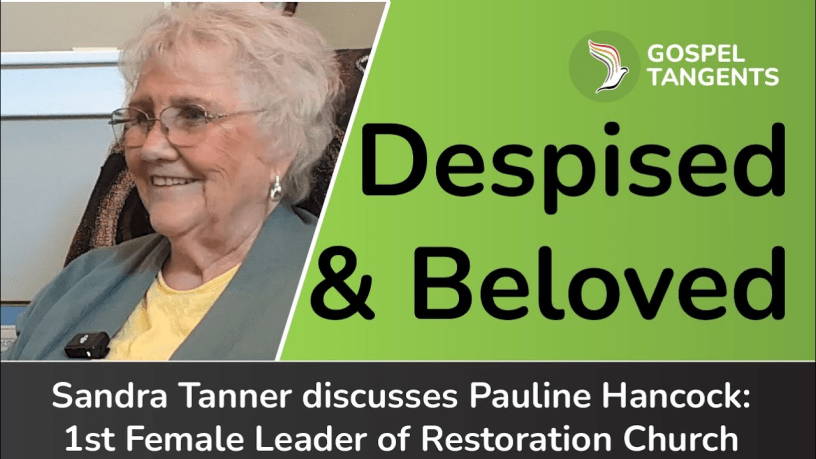
Sandra Tanner is well-known today as a staunch critic and historian of Mormonism, chronicled recently in the biography Lighthouse: Jerald and Sandra Tanner, Despised and Beloved Mormon Critics of Mormonism. While Sandra is now enjoying life in a condominium in Sandy, Utah, having retired from the stresses of her old neighborhood in Salt Lake City, her journey as a critic began in the late 1950s alongside her husband, Jerald Tanner.
This period of questioning led the newlywed Tanners to explore various splinter groups, resulting in Sandra becoming a temporary convert to a unique movement led by one of the earliest known female leaders in the Restoration: Pauline Hancock’s Church of Christ.
Critic, Not Anti-Mormon
Before diving into her early faith experience, Sandra is careful to distinguish her identity. She notes that she is comfortable being labeled a “Mormon critic,” but strongly rejects the term “anti-Mormon.” This is because the “anti-Mormon” label often implies an animosity toward the people, which she does not feel. She condemns any violence against Mormon people. She sees herself as a critic of Mormonism—its doctrines and history—not its followers.
Jerald Tanner’s Search for the “Start”
The Tanners’ joint investigation into Mormonism began around 1959. Jerald’s personal crisis was spurred around age 18 when his bishop suggested he go on a mission. Jerald began reading critical works, notably Fawn Brodie’s book (written in 1945), which was the standard critical source at the time.
His investigation led him to seek out local splinter groups, first visiting the Reorganized Church in Salt Lake City. There, he met a barber named James Wardle, who operated a shop that housed one of the largest collections of historic books on early Mormonism. Wardle provided Jerald with a key text that shaped his direction: David Whitmer’s pamphlet, An Address to All Believers in Christ (1887).
Whitmer’s position was that the Book of Mormon was the main thing and that Joseph Smith “got a big head, invented all this other stuff.” This idea became Jerald’s litmus test: if there was any truth to Mormonism, it had to be at the start, centered on the Book of Mormon. Jerald even took a trip to Independence, Missouri, to verify Whitmer’s claims that the revelations had been changed, specifically noting discrepancies between the current version of the Doctrine and Covenants and the early Book of Commandments.
Pauline Hancock and the “Luke-ite” Church of Christ
James Wardle also informed Jerald about Pauline Hancock’s small Church of Christ group, noting that they aligned more closely with David Whitmer’s views than other splinter groups.
Pauline Hancock was raised in the Reorganized (RLDS) Church, where her father had served as a pastor in Salt Lake City. She became disillusioned with both the RLDS and the Temple Lot Church. She, her husband, and others who went through similar struggles were deeply impacted by Whitmer’s pamphlet.
This group, sometimes referred to as “the Luke-ites” because they first met in the home of a Mr. Luke, established their own theological foundation:
- Book of Mormon Fundamentalism: They adopted the Book of Mormon and the Bible as their core scriptures.
- Rejection of Later Revelation: Crucially, they did not accept revelations past 1830. They threw out the Doctrine and Covenants, the Book of Commandments, and the associated priesthood ideas, believing Joseph Smith was only called to bring forth the Book of Mormon, not to set up a church.
- Worship Space: They built a small “basement church” at the corner of Crysler and Lyndon in Independence, Missouri. The interior reportedly featured used movie theater chairs.
Jerald visited Pauline’s small group in Independence multiple times in the mid-1950s, staying for weeks at a time. He was deeply influenced by Pauline’s message that “all you really need is Jesus” and that they should scrap the institutional “stuff.” Jerald found a new personal relationship with Christ through reading the Bible and the Book of Mormon, moving away from institutional religion.
While Pauline’s church eventually folded, she was highly influential. The sources note that while she never claimed the title of prophet for her movement, she did claim to have had a vision of Christ before the group formally started meeting as a church.
From Brigham Young Defender to Critic: Influences That Sparked Tanners’ Journey
Sandra Tanner, raised defending the faith, her path to becoming a leading critic of Mormonism was catalyzed by several unexpected influences, including the work of a pioneering female Restoration leader and the startling discovery of historical documents.
The Vision of Pauline Hancock
Sandra Tanner’s husband, Jerald Tanner, was deeply influenced by an obscure Restoration group led by Pauline Hancock. Pauline was a head of her group, called the Church of Christ (Bible Book of Mormon), serving as its minister and preacher. Though she never claimed to be a prophet, she was considered a “deliverer of the message”.
Crucially, Pauline did claim to have a vision of Christ before the group started meeting as a church. This vision occurred during a transition when she was trying to sort out what she believed, focusing on the “original kernel of Mormonism”. She told Christ she couldn’t fulfill the calling to tell the world what she had learned because she was a woman, but Christ responded, “I was a man, and they didn’t listen to me. So, it doesn’t matter that you’re a woman. You are called to go out and tell what you’ve learned”.
Pauline’s group focused on studying the Book of Mormon outside of various splinter groups. Their theology centered on the “oneness idea of God,” a modalistic model (though they would not have used the term “modalism”). They aimed for a rejuvenation of the David Whitmer flavor of Mormonism, seeking to go “back to original Mormonism” using just the Bible and Book of Mormon.
Jerald Tanner’s Cottage Meetings
Jerald Tanner became converted to Pauline’s message after two visits to Missouri. At age 20 (around 1957 or 1958), Jerald returned to Salt Lake and began holding little cottage meetings at his parents’ house. He would play reel-to-reel tapes of Pauline’s different sermons or teachings. The purpose of these meetings was to discuss early Mormonism and explain where the Church “went off the track”.
Sandra’s grandmother, a relative by marriage to the Brigham Young family, received an invitation to one of these meetings via a postcard. Sandra, visiting from Southern California during spring break, drove her grandmother to the meeting. Grandmother claimed it was “sort of like a Mormon fireside”. Jerald, whom she found “nice looking” and “cute,” impressed her with his studies on Mormonism’s problems and the group’s focus on returning to the Book of Mormon.
From Defense to Doubt
Sandra’s journey of doubt had already been seeded by others.
First, her mother and aunt began studying Mormon history in the 1950s after reading Fawn Brodie’s book, No Man Knows My History. They were pouring over “apostate literature” and photocopies. Sandra, then in high school, was busy defending the faith, while her mother and aunt were “going into apostasy”. Sandra noted that her mother became known as being “too inquisitive” in Sunday school classes, often disrupting the class with questions.
Sandra’s mother and aunt found James Wardle’s barbershop, possibly through Sam Weller’s bookstore (which stocked anti-Mormon and polygamy literature). James Wardle was the link that put Sandra’s mother in contact with Pauline Hancock’s group.
Second, Sandra recounts her first challenge in Mormonism occurring in 8th grade when a Christian girl questioned her about what Mormons believed about God. Sandra proudly quoted the popular saying from the 1950s: ” as man is, God once was. As God is, man may become.” The girl called this “blasphemy” and walked away, leaving Sandra stunned.
Will there be Murderers in Celestial Kingdom?
Third, while attending the Institute of Religion in Southern California in the late 1950s, Sandra was troubled by a conversation with her Institute teacher about an acquaintence convicted of murder. The teacher said that the person could never be baptized, receive the temple ordinances (endowments/sealings,) or reach the celestial kingdom. This answer shocked Sandra, who questioned how this system fit the “gospel of Jesus” if the “good news” meant, “Unfortunately, you don’t qualify”. (It is noted that current 2025 church policy allows a person convicted of murder to be baptized and go to the temple after completing their sentence, with First Presidency approval, but the practical difficulties for a prisoner remained. If he was on death row, he would never qualify.) It is unknown what official Church policy was in 1958.
The Deal Breaker: Brigham Young’s Sermons
After meeting Jerald, their courtship centered on studying Mormon history. Sandra, who was raised to practically worship Brigham Young, told Jerald she was a “great-great-granddaughter of Brigham Young”. Jerald challenged her to read his sermons.
Jerald brought copies of sermons addressing Adam-God theology, polygamy, and the Civil War. But the ultimate “real deal breaker” for Sandra was reading the blood atonement sermons. Specifically, she was horrified by the passage where Brigham Young discusses finding his brother in bed with his wife:
“I would immediately put a javelin through them both and this would save them… I would be justified and… this is loving your neighbor as yourself.”
This teaching, which claimed there were “certain sins you could commit [that] the blood of Christ won’t cover,” was entirely opposite to the benign image she had of Brigham Young. Sandra immediately rejected Brigham Young out of hand: “God did not tell Brigham Young to teach this sermon. This cannot be from God… That guy’s toast.”
After that moment, Sandra was ready to read anything Jerald had. She purchased a copy of the 1833 Book of Commandments and compared it against the current Doctrine and Covenants, confirming David Whitmer’s claim that Joseph Smith had changed revelations.
Despite her own mother’s severe worries that Sandra was being “sucked in” to a “fanatic cult group” in Missouri (even though her mother acknowledged church problems, she would not leave the role of a Mormon), Sandra and Jerald had a whirlwind romance and were married by a Protestant minister. Their partnership in critiquing Mormon history had begun.
What are your thoughts? Is Sandra despised or beloved?
 Wheat & Tares
I’ve no doubt my born and bred SLC parents would have despised the Tanners, but I’m grateful for them. They worked hard to share hidden truths and lies and I’m grateful for that. It blows my mind that I was part of an organization that for decades deceived me regarding its history and beliefs. I used to tell people, “don’t tell me what my church believes” – I go every week and I know what we believe. Nope, I was wrong and it took me a long time to be ready to hear the truth.
Ah the Tanners, branded as the most evil people since my youth. They’re just telling the unflattering parts of Mormon history.
familywomen, I can’t stand the argument that going to church makes you knowledgeable about the church. It makes you knowledgeable only about what going to church is like and that’s it. It doesn’t make you knowledgeable about history, the scriptures, or the finer details of church organization. Most people who attend church weekly are in full drone mode and are not interested in any sort of critical thought or any news or controversial history that makes them uncomfortable. They are interested in repeating tired story after tired story.
Not here in the UK Brad. People really struggling to resolve modern thinking and church history, particularly unavoidable in our studies of church history this year. Lots of muttering in corridors.
However, our migrant members who are in the majority are most likely to conform with gratitude, and they are the future of the church. Time for me to let go of my privilege. Interesting times.