

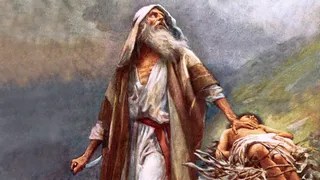
Before we get to the question that is the title of this post, let’s review the story of Abraham and the commandment to sacrifice Isaac.
The Book of Abraham in the Pearl of Great Price teaches that Abraham was raised in a wicked setting, by men, including his father, who worshipped idols. “Their hearts were set to do evil.” They sacrificed children to their idols, and Abraham’s father even tried to sacrifice him. When Abraham was on the brink of being sacrificed to an idol, he prayed and was saved by an angel. The voice of the Lord covenanted with him to take him away from this wicked land and into a strange land, where he would be blessed. Abraham 1:1-19
Abraham journeyed to this new land, where he had revelations and made covenants with God. Abraham married Sarah. They could not have children until very late in life, when the Lord sent them a son, Isaac, long after Sarah was past the age when she could have children. This miracle son was Abraham’s second born. His firstborn was Ishmael, whose mother was Sarah’s handmaiden, Hagar. Hagar and Ishmael were driven out when Isaac was young. I’m skipping all the details, obviously.
Now we get to Abraham’s test, the Abrahamic sacrifice, the great test of obedience and faith. The Lord told Abraham to sacrifice his son, Isaac, in a burnt offering [FN 1]. Abraham apparently didn’t tell Isaac about the command to sacrifice him. Isaac asked where the lamb was. Abraham said that God would provide one. Technically, that was true. God had sent Isaac as a miraculous birth, and then God sent a ram in the thicket. But it was a cagey answer. The story doesn’t say Isaac cooperated. It says that Abraham “bound Isaac his son, and laid him on the altar upon the wood.” Genesis 22:9. Isaac is passive in that verse — it’s Abraham acting on Isaac to tie him up and put him on the altar.
You’re familiar with the story so I’ll skip to the end. Once Isaac was tied to the altar, with Abraham standing over him with a raised knife, an angel showed up and said, “Just kidding! We just wanted to see what you would do. There’s actually a ram in a thicket. Untie Isaac and sacrifice the ram instead.” The Lord went on to say that because Abraham had not withheld “thy son, thine only son” (Ishmael is apparently no longer Abraham’s son?) that the Lord would multiply his seed as the stars in heaven, “and in thy seed shall all the nations of the earth be blessed.” Genesis 22:1-18.
The LDS Church, and most all of Christianity I assume, teaches this attempted sacrifice of Isaac as a great display of Abraham’s faith and obedience. Church lessons and Church leaders encourage us to follow Abraham’s example and sacrifice things out of obedience, even if it’s hard.
Now we get into the question I asked in the title of the post.
Whose Point of View Do We Use to Judge Whether Abraham Passed the Test?
The ideas that follow germinated after I read a mini-essay written by a Jewish person, that I didn’t bookmark or save so I can’t give proper credit. But the gist of the post was that Judaism does not teach perfect obedience to God in the way that Christianity does. Instead, the Jewish God prefers his followers to push back, argue with him, question things. Abraham did this when he bargained with God to save Sodom and Gomorrah if even five righteous people could be found (Genesis 18:16-33).
(Keep in mind that there are many different teachings in various sects of Judaism and they don’t all agree. There isn’t “one right interpretation” of the story of Abraham and Isaac in Jewish tradition and other Jews may disagree; the essay I read wasn’t the definitive statement on the Jewish interpretation of this story.)
Instead of judging that Abraham passed the test because of the Lord spoke and renewed the covenant of posterity, in the essay that I read, the author examined the events in the story that followed.
Abraham’s Point of View
The Lord never spoke to Abraham again. There are no revelations to Abraham after the voice of the Lord congratulates him for being willing to sacrifice his son. If Abraham wanted a closer relationship with God as a result of this episode, he didn’t get it.
After Sarah dies, Abraham remarries a woman named Keturah and fathers six more sons. He now has eight sons. He leaves everything to Isaac (Genesis 25:5). Abraham had even more sons from concubines. He gave them gifts and sent them away from Isaac (Genesis 25:6). Then he dies “in a good old age” (Genesis 25:8).
That’s it. After he tried to sacrifice Isaac, he never had a spiritual experience again. He procreated. He sent a servant to find a wife for his son, and he remarried and had a whole lot more sons.
The story doesn’t say Abraham ever sought out God in prayer again. The beginning of Abraham’s story contains a lot about his desire to know God; there are no more efforts after he tied Isaac to an altar. Was the silence on God’s end — was God disappointed that Abraham was willing to kill his son? Despite knowing how evil child sacrifice was?
Was the silence because of Abraham? After he had time to think things through, was Abraham horrified that he was willing to kill his own child because God told him to? And so he deliberately distanced himself in an effort to avoid all future revelations? If God wanted a closer relationship to Abraham, he didn’t get it.
Sarah’s Point of View
Sarah is completely omitted from the story about Abraham attempting to sacrifice Isaac. Did Abraham talk to her about this commandment? I’m going to guess that he didn’t. Abraham leaves with Isaac to go sacrifice him, and the next time Sarah is mentioned, it’s to say that she died. Genesis 23:1-2. Nothing suggests that they talked out what happened before she died. We have zero information about what Sarah thought about this.
Isaac’s Point of View
Isaac was about 37 when Sarah died (he was born when Sarah was 90, and Sarah was 127 years old when she died per Genesis 23:1). He wasn’t married. At some point after Sarah’s death, Abraham sends his servant to find a wife for Isaac from among Abraham’s relatives. That’s where Rebecca comes from. Isaac marries her after the servant explains what he did (Genesis 24). Isaac was 40 years old when he married Rebecca (Genesis 25:20).
There is no interaction between Abraham and Isaac after the attempted sacrifice. Nothing. Not one word. Abraham sends his servant to find a wife for Isaac, and the servant tells Isaac when he brings Rebekah. Isaac is living “in the south country” and it’s apparently far away from Abraham (Genesis 24:62). There is no hint that Isaac ever met any of his half-brothers; there is no hint that Abraham ever met Rebekah. Isaac and Abraham are never together in the pages of the Bible again.
This is karma. Abraham left his family and went far away after his father tried to sacrifice him to an idol. Isaac apparently put a lot of distance between himself and Abraham after Abraham’s attempt to sacrifice him.
Isaac is a passive patriarch. He marries the woman his father’s servant tells him to marry. He has only a couple of interactions with God. The first recorded interaction between God and Isaac was when Isaac prayed because his wife was barren (Genesis 25:21), and the Lord sent them twins, Jacob and Esau. When Rebekah had a question about her sons, she got her own revelation (Genesis 25:22).
The Lord also sends Isaac to another land when there was a famine, and renews the Abrahamic covenant with Isaac. “I will make thy seed to multiply as the stars of heaven … Because that Abraham obeyed my voice, and kept my charge, my commandments, my statutes, and my laws” (Genesis 26:1-6). Isaac will be blessed because Abraham was righteous, not because of anything he did independently.
Rebekah takes charge of the birthright issue, and tricks Isaac into giving the younger son, Jacob, the birthright blessing. Isaac lets it stand (Genesis 27).
Throughout his life, Isaac mostly just lets things happen to him. Perhaps he would have been that way anyway. Abraham took action after his father tried to murder him. But what is Isaac supposed to do? Find a different God to worship? He doesn’t seek out a different God, but he also doesn’t seek out the God his father worshipped. Isaac asks God for his wife to conceive. The Lord appeared to Isaac to tell him to leave the land to get away from a famine. That’s it.
Abraham’s test of faith apparently ruined his relationship with his son, and may have traumatized his son in ways he never recovered from.
God’s Point of View
Based on what Abraham heard right after he tried to sacrifice Isaac, the Lord was pleased with Abraham’s obedience and promised him posterity and blessings. This is where we get into our own views of God, and what kind of God we are willing to worship.
If God wanted Abraham to spend the rest of his life procreating, then yay, that’s what Abraham did. If God wanted Abraham to have a close and loving relationship with Isaac, that didn’t work out so well.
The Christian God who demands absolute obedience, even if we’re commanded to do something that violates our moral code, is a frightening and costly God to worship. There is a lot of evidence in the text that God was pleased with Abraham’s willingness to kill his son. Abraham is held up as an example of a righteous man throughout the scriptures. But who would want to be Abraham? Who would want to be in a family relationship with someone like Abraham?
A more Jewish view of God would question the command to kill Isaac. Abraham knew how evil that action was. He knows how he felt about his own experience when his father tried to sacrifice him to an idol. Did God really want Abraham to repeat the sin of his father? And what kind of God gives a command like that just to see if Abraham will refuse to obey?
In Our Daily Lives …
This situation reminds me of men called into full-time Church service. Their Church work takes them away from their families. I’ve read posts from children of men who served faithfully in the Church who resent their fathers for being gone so much. They even resent the Church, and many have left. Did these men pass an Abrahamic test? Did God want all their time and attention in this life? Did God want them to spend more time with their families?
One of the lessons I take from the story of Abraham and Isaac is that you can’t have it both ways. At some point, in some situation, you’ll have to choose between God and family.
FN 1: By modern standards, this is an episode of religious psychosis. Someone tried to murder their child because God told them to, and then immediately thereafter heard the voice of the Lord praising his obedience and promising him a multitude of posterity that would bless the whole earth.
Questions:
- Have you had to choose between obedience to God and being a good parent/child/sibling/spouse?
- There are several examples of Mormons believing that they got a revelation to kill someone: the Lafferty brothers, Chad and Lori Daybell, others. Abraham is not a good example to follow. Have you ever had to teach the Sunday School lesson about Abraham and Isaac? How did you approach it?
- The Church’s Come Follow Me lesson compares Isaac to Christ and asks this question: What can we learn about Heavenly Father and Jesus Christ from the accounts of Abraham and Isaac and of the Crucifixion?
- Do you see any similarities between Isaac and Christ? Differences?
 Wheat & Tares
This could be what you read. It’s relevant, in any event, and describes my beliefs which probably derive from reading both Kant and Jewish philosophers in my youth. It’s from an early review of Omri Boehm’s new book Radical Universalism (I think this is Corey Robin, writing):
“[There is a] fascinating discussion in Boehm’s book of Kant on the Akedah, the story of Abraham’s binding of Isaac, where Kant becomes the first hero of modern philosophy by saying that Abraham was wrong, that, as Abraham himself realized in the prior story of Sodom and Gomorrah, there is something higher than God, which is justice itself, and that what justice, with its concomitant idea of humanity requires of us, is not obedience but disobedience, that in the face of injustice, we never in fact have the right to obey, but only the duty to disobey, even if we are disobeying God. Because, again, justice is higher. That’s what grounds the monotheistic turn of Abraham, not a particularistic story of the Jews, but the universal story of disobedience to the highest authority, even if that authority is God, in the name of something greater, namely, justice.
Abraham should have told that god to go to hell, where he belonged for ordering such a thing.
I have always wondered the same. Maybe God was expecting Abraham to protest and not blindly follow. Perhaps, when God noticed Abraham was acually going to go through with it, he had to intervene with the angel. It wasn’t a reward for obedience, it was an interviention to stop someone from blind obedience.
Elie Wiesel explores this very subject.
I read an article recently on the concept of vertical or horizontal morality. I can’t link to it because iPads are not that smart and we quite repairing a computer once between each use. But in the article, it defined vertical morality as looking to an authority figure for obedience, while horizontal was looking at the harm or benefit to others. So, in religion, it would be the idea of strict obedience to God, and in government it would be obeying laws and authority figures. The author explained it as how the religious right can justify their worship of Trump while overlooking his obvious moral lapses. But, you are going to have to search for the article yourself for that discussion.
But the author used the story of Abraham being willing to sacrifice his son because obedience was the most important thing. The author pointed out that there are many people who hate this story and wonder what kind of monster God would tell someone to kill their son, because to them, morality is not “whatever God wants” but is what is good, with good being defined by harm done to people. Kind of like the pagan morality of “ do no harm.”
The article made me think of the different Mormons, one group who claim that obedience is the first law of Heaven, while this other group claims that love is really the first law of Heaven.
Abraham obviously thought obedience was the most important thing, or he would have told God to stuff it. The writers of the story also thought obedience was most important. But all the people who are sickened by the story think that Abraham was a horrible father, who did not really love his son.
Or people come up with psychological theories of Abraham being traumatized as a child and acting out his trauma by attempting the same thing with his son, or religious psychosis where Abraham is crazy and hears a voice in his own head, not God at all but insanity.
People think that a loving God would never tell someone to kill his son, so the story is false. Just a made up story to teach people to obey religious authority above their own conscience.
There are lots of explanations that us people who have that horizontal morality come up with to explain this “horrible” story in the Bible. But our morality is based on doing good, showing love, this “other” centered morality, rather than just seeing morality as what God tells you. People who only see morality as what God says, see no problem with the story.
So, whose morality are we judging the story on? Mine or President Oaks?
As far as how the church uses the story to try to say, “it was to teach us about how God felt in sacrificing his son” I think that is just more bovine droppings. God is God, for crying out loud. He knows the end from the beginning and if He did not see the greater good and celebrate what Christ sacrificed, then we have a bigger problem than a God who orders murder. We have a God who thought the atonement was a bad idea. No, I think God knew that Jesus death was really quite temporary and very worth it. So, not at all like murdering your mortal son.
I guess I’m just too worldly and cynical now that I’m out of the Church but I find loyalty tests utterly ridiculous. Let’s just be good people and practice the Golden Rule. Real morality isn’t that complicated.
Anna, this article?
https://www.huffingtonpost.co.uk/entry/vertical-morality-maga-christians_l_68dc8386e4b0b11989f00fb8
Christian,
I really like that reading, which is echoed by these words from H.L. Menken “Obedience is doing what your told regardless of what is right. Morality is doing what is right regardless of what you’re told”.
These aspects, I suppose, progress on a spectrum but I think, developmentally, the expectation is to become more capable of discerning what is right without external authority whispering in your ear.
It’s understandable for a 4-year-old child to yield their decisions to a wiser “big person” in the room (assuming they are wiser), but that idea dominating the teachings of the 50-year-olds defies the purpose of the Garden story.
Innocence was never the final destination, it’s the point of departure. The point was to mature into beings capable of discerning between good and bad, hence the Tree of knowledge of good and evil. However, the authority is shared, navigating between external and internal, but always seeking the ability to act with “skillful means”. Obedience is not a virtue in and of itself. Without agency, the personal capacity to act, obedience will become extreme towards authoritarianism. To be fair, agency without laws to protect community, will become chaos.
Obedience is a tough concept. Were the women who are now in many church leadership positions obedient when they pursued their careers outside the home, at the time when the president of the church was teaching otherwise? Is obedience a test by which I can measure someone else, or can I only use it to measure myself? My wife heard that counsel, and when child number one came along she quit working. She had more income than I did at the time, so it was a big financial hit, but she wanted to raise the child and then later children, and fortunately my earnings went up over time. (Also fortunately, I didn’t die or become injured or sick.) But that was a decision that we made together, or really me supporting her decision. Is it right to look at the obedience of others? Of course, some of those women in high church office are now preaching exact obedience to the common people, so they certainly look at the obedience quotient (OQ) of other people. And their obedience really is the people’s obedience to God: it is their obedience to the church leadership. Unlike some general authorities, I cannot replace Jesus or God with the Church and see them as equal 100% of the time in all things.
Job is not parallel to Abraham, but there is some commonality. Job did not understand why all the bad things happened to his family and to him, as Abraham did not understand why God commanded him to sacrifice Isaac. Job did not curse God and die, as his wife counseled him to do–from a place of her despair, not her wickedness. But he did question God’s fairness, and he challenged God to show himself so that Job could prove that he did not deserve the calamities that had befallen him. When God did appear, he condemned the friends who spoke words without wisdom for condemning Job, who surely merited his bad treatment. Job was vindicated. He could do nothing to stop the calamities, and while he did not curse God and die, he did question, aloud, to friends (leaders?) who told him that he surely merited his misfortune. I’m not focusing on the friends here, but on Job. Most people who read Job only read the introduction and the end (the prose parts), and in the introduction Job does acknowledge that the Lord both gives and takes away, and he blessed the name of the Lord. But in the meat of the book, the poetry parts, Job really questions and almost challenges.
Should Abraham have questioned and challenged? Maybe yes, and maybe no. Janey raises a good question. I’ve told myself that I am not as good as Abraham, because I would not be able to sacrifice a child. Had Abraham done the deed, and had I been on his jury, I would have voted guilty. I would also have voted guilty for Nephi for Laban’s murder. We know from the NT and BoM that God knows how to free people from jail, and from Daniel in the OT God knows how to save people from capital punishment. I would have voted to convict.
I would have to know that the commandment came from God. I would not take the commandment from a man, whether he be a prophet, a stake president, a bishop, or a RS/EQ president. If God wants me to violate the laws of man, then he can’t send his message to me through a man or woman. He will have to send his message by someone higher than a man or woman. But even then, unlike Abraham, I might have to question or challenge. Abraham bartered with God over how many righteous people it would take to save a wicked city. What if Abraham had questioned the commandment to slay Isaac? Would God have struck Abraham dead on the spot? On the other hand, Saul was judged pretty harshly for not obeying a commandment to destroy all of the Amalekites and their livestock.
More questions than answers, but this thing called faith is a complex thing. Thanks, Janey.
One problem in the interpretation of scripture is the direction in which we read the text. Modern westernized Christianity, unlike Judaism uses scripture to end a conversation rather than begin one. We tend to read through the eyes of God, interpreting the text as divine dictation, instead of through the fumbling, stumbling, and bumbling hands of the author. Read through the lens of the author, scripture is an unfolding story of transformation, growing through cultural baggage and bias, reimagining God as we leave the tyranny of past ideas about God. The story of Abraham is no exception to this.
There is an alternative interpretation, similar to Janey explanation, that doesn’t paint God as testing human loyalty by commanding moral absurdity. Abraham was raised in a culture and by a father who participated in placating their God by child sacrifice. There is a reasonable claim that Abraham has been corrupted by his past and that the God of Israel is not commanding precisely what he has condemned but rather bringing it to an abrupt end. The death of Jesus could also be argued as the end of scapegoating, and the advent of atonement by voluntary self-sacrifice. Hence the idea of a broken heart and contrite spirit, not a goat or other person.
Instead of reading these stories as “God commanding moral absurdity to test obedience,” they can be read as God breaking humanity out of old, destructive frameworks.
• Traditional reading: God tests Abraham’s loyalty by demanding the unthinkable—killing his son.
• Alternative reading: Abraham, shaped by a culture steeped in child sacrifice (cf. references to Molech, and Joshua 24:2 noting Abraham’s father worshiped other gods), assumes that the ultimate way to show devotion is to kill his child.
• God lets him walk down the path up to the point of violence to reveal that this is not who God is.
• The real test isn’t “will you kill for me?” but “will you trust me enough to give up the violent gods of your past?”
• Thus, the story ends child sacrifice—God provides the ram and redefines devotion as faith, not blood.
This interpretation casts God not as a sadistic tester but as a revelatory disruptor, breaking Abraham free from his inherited worldview. Additionally, the “God” who gives the order is not the same God who calls off the craziness. “Elohim”, which although we LDS use that name as God the father, that term is used generically in the Old Testament. The pagan Gods are referred to as Elohim as well. It’s commonly known as both a singular term as well as plural (many Gods). The God who stops Abraham is YHWH, the covenantal God of Israel. The text alludes to the “true” God breaking in to contradict Abraham’s inherited image of God. Therefore, the “test” is not whether Abraham will kill, but whether he can repent of his distorted idea of God and learn who YHWH really is.
W&T has a great community of commenters, and these are thought-provoking comments.
christiankimball and Gilgamesh — thanks for pointing out, more eloquent, commentaries and ideas about Abraham’s story. There is so much to discuss in this particular scripture.
Anna — I like that distinction between horizontal and vertical morality. That’s a good, simple image that really focuses how we measure morality. I’m fully into horizontal morality these days. How does an action affect other people? That’s the only question that really matters to me. God can survive some disobedience in the pursuit to consider others’ welfare.
todd smithson — thanks for sharing that H.L. Menken quote. And your comment cogently sums up the journey from innocence to wisdom. Adam and Eve left the Garden to learn from their own experiences, not just expect God to make every decision for them. Thinking of it is a spectrum, a journey, rather than destination is a good way to replace a stagnant righteousness with a developing morality.
Georgis — I’d never compared Job and Abraham before, and you’re right that Job challenges God and practically demands that he explain himself. Job’s anger gets him a stern rebuke, while Abraham’s instant obedience got him the Lord’s praise. That sort of cuts against the idea that God wants us to push back. But personally, I would rather be around people who push back than people who obey without question. You raise interesting situations to examine this question in other contexts — women’s careers, Nephi, Saul and the Amalekites. There aren’t any easy answers.
Hedgehog, yes, that is the article.
It is interesting that the story of Nephi killing Laban uses the vertical morality, whatever God commands is good and moral. While us horizontal morality people hate that story too. And if whatever God commands is moral, then God gets to call the exceptions to the 10 commandments. After all, God’s rules, so God can change them if he wants to. And that infamous letter from Joseph Smith, well, the very morality of polygamy, not just the one letter about polygamy. It doesn’t matter if polygamy hurts women. It is moral because God said so. And we humans saying, “but it HURTS people, well we are arguing with God. Joseph Smith wrote the letter saying that whatever God commands is correct, so he was a believer in vertical morality.
And we who have that horizontal morality, well, we think we are right and that it is a better morality. A more moral morality. But who are we to think we are smarter than God?
As God asks Job after Job argued with him, did you teach the eagle to fly and set the stars in motion? In other words, God is asking Job if he thinks he is smarter than God to object to the bad things God did to him.
I derive no moral teachings from any of the stories about Abraham. In fact I see Abraham as problematic. He was a deeply superstitious man who feared a vindictive, angry deity who commanded him to kill his son, really for no reason (not that any reason would be justifiable) other than because this patron god YHWH told him so on a whim. This reveals YHWH to be tricky and arbitrary. If any god told me to kill my own son, I would immediately dismiss that god as evil. Abraham is also problematic because he is promised land that was already inhabited by other groups for his posterity: the land of the Canaanites. Because this promise was etched in holy text, we have a holy land that has become a region of conflict. And we must deprive of freedoms and rights and even basic shelter 5.5 million non-Jews who live on this so-called “holy land,” and have been for centuries and centuries, because Abraham was promised this for his posterity 4,000 years ago.
Regarding your first comment, Anna — I’ve always read the anguish of God at Jesus’ atonement as due to the sentencing of an innocent person to an eternity’s worth of pain, no matter to what end. It’s the ultimate Omelas child, to be mourned even while used.
Innocentbystander, I will admit that I do NOT “get” the Christian need to torture Jesus for everyone’s sins, or to kill him. If God isn’t big enough to forgive us when we are sorry for a mistake without torturing someone else, well, like I said, I just don’t “get” the way Christians talk about a punitive atonement. I think God is better than I am and I can forgive people just because they are sorry and I don’t need to torture them, or someone else. The only “justice” I care about is justice to the victims of sin. And torturing Jesus sure doesn’t help the child whose father beats them, or a victim of murder, or a relative who mourns the victim of that murder. Torturing Jesus doesn’t help any of us, so I just do NOT understand why Christians think torturing and killing Jesus helped anybody. I was also able to understand other people’s pain at having been victimized by rape or domestic violence and as a counselor I was able to help them process that pain. So, why isn’t Jesus a more loving counselor than I can be. Oh, and in trying to heal when I have been hurt, my own counselors didn’t have to go through the same thing and they didn’t have to experience all of my pain. Nor did accepting Jesus make my own pain any less, so, like I said, I just don’t get the “pain” Jesus suffered or see how it accomplished a damned thing.
So, your comment about Jesus’s eternities worth of pain just makes me go, “What? Why?” Because to me, that just isn’t how God works. So, call me a non Christian if you like, but I do not accept that God had to dump a bunch of pain onto Jesus or have him crucified. I have to back up and remind myself that some people see some kind of ??Something??? from Jesus suffering and dying.
I usually do not try to explain how I feel because then I run into people like you and they try to convince me Jesus needed to be tortured and feel all our pain and then I don’t like the sadistic person who tries to explain why it was so necessary that Christ “feel” every exact feeling of guilt ever felt through all eternity. Puke, no thank you. Not a God I am willing to worship.
I think one of the lessons of the Abrahamic test is to be willing to listen and trust one’s own direct relationship with God over that of any cultural or religious authority — to recognize that divine guidance may challenge societal norms, and that true faith sometimes requires stepping into uncertainty with conviction, even when it defies tradition or expectation.
I realize that, in the context of a story where someone is asked to kill their own child, this perspective might seem extreme or even unsettling. So I hesitate to offer it as a universal guide. But honestly, it’s the only way I’ve found to preserve my integrity and shield myself from being controlled or coerced by the will of others. Trusting my direct relationship with the divine is what keeps me grounded and free.
I like this one – a lot to unpack and think about. I was serving as a counselor in a stake presidency when I asked to be released. I have a daughter with a severe progressive neurological disease and my young son with profound autism was not getting any easier. I knew it was a tremendous burden on my wife to be taking the kids to church on her own most Sundays – as well as getting them fed and ready for bed on the evenings when I was away from home. I also could see, that I would never be released without specifically asking and could also see, that next in line would be stake president, etc. There would just be no end. And that simply was not fair to my wife, my kids, or myself.
So, I asked to be released. My wife and I had talked it over and had decided we would switch off on who would got to church each Sunday and who would stay home with the kids. Because honestly, having a child with profound autism does not fit with the church program. He was not able to sit through sacrament meeting, let alone participate in primary – and why try to make him? It was just cruel. So we started switching off and then the pandemic hit.
During that break from church, so to speak, I realized what a relief it was to not go at all. I had had doubts for a while, but had more time to really look at them. And then there was the practical side of things – I have two children who are going to need significant supports there whole lives. My son will most likely outlive me by decades. And my daughter might, assuming current gene therapy trials are successful and reverse some of her disease before she passes away from it. The LDS church is not going to pay to take care of my children when I am gone – no matte how many hundreds of thousands I might pay in tithing. And my two non disabled children should not have other bear that full financial burden. So, we stopped paying tithing so that we could set that money aside with our other savings to be there to someday help take care of our kids when we are gone. Knowing that the church would find me unworthy for making this choice – for choosing my innocent children’s well being over the church, so to speak, was the final kicker for me.
I do miss the sense of community, but if I were to return, I would still not pay tithing ever again, nor would I be willing to clean the church when I am tired enough changing diapers on a teen and pre-teen. I remember after I was released from the stake presidency how my home ward immediately started to try to give me callings. It would always be that way if I returned – and this it would never be a place of peace or rest.
Great article!
In my opinion, a loving God would not ask a father to kill his son. Perhaps this narrative has resulted in genocide, filicide, and other forms of interpersonal violence and homocide that pervades many cultures and is too often excused in the name of God–or one’s religious affiliation.
משנה תורה קידושין אב משנה
On the opening sugya of this the first published commentary upon this specific Mesechta; in this opening public learning of the Talmud, my opening thesis stands and accuses the ראשונים חכמים of the Capital Crime דיני נפשות crime of עבודה זרה – the 2nd Sinai commandment. Based upon גט גירושין, an Av time-oriented mitzva from the Torah. Therefore (this word employs a רמז of swearing a Torah oath), denigrating an Av tohor time oriented Torah commandment prostituted to a rabbinic positive commandment which does not require k’vanna (קידושין the דיוק of גט גירושין), the av tumah perversion of T’NaCH/Talmudic משנה תורה\common law unto Greek/Roman statute halachic law. Avoda zarah statute law determines the posok halacha, based upon cults of personality, like as represented in the statute Tur and Shulkan Aruch codes, rather than Gemara halachic בניני אבות\precedents which serve to make a different perspective reading of the language of this the Av Mishna of קידושין. This sh’itta of Reshonim g’lut scholarship merits a direct Torah curse rather than a blessing. Therefore, this Talmudic commentary calls for a Sanhedrin common law court to judge this dispute made against Reshonim Talmudic scholarship upon the both the T’NaCH & the Talmud – accused of the At tuma דיני נפשות crime of avoda zarah — enforced by NaCH prophetic mussar prophets/police of Sanhedrin Court Torah mandated Constitutional authority to enforce judicial rulings made by the Federal Sanhedrin Courtrooms.
Obviously, to publicly call for the restoration of common law/Legislative Review of Reshonim statute halachic law openly blesses the Zionist success who rose our people out of the European ashes of Shoah, after that Wilderness generations Orthodox rabbinic spies melted the heart of that generations which resulted in the Torah plague curse, known as Chamberlain’s White Paper public betrayal of the Balfour Declaration. That this false oath, comparable to the floods which destroyed the generation of Noach, obliterated and caused the Sun to permanently set upon the British empire. That dead empire gone the way of the dead Assyrian, Babylonian, Roman, Islamic, Mongrel, Ottoman, Austria-Hungarian, Japanese, 3rd Reich, French, British, and USSR, defunct empires that together with the Roman Protocols of the Elders of Zionism NT forgery as dead as the trinity God created through the Nicene Council dogma decree of statute law, together with the Av tuma avoda zarah Allah Golden Calf God which translates the שם השם First Commandment Spirit Name unto the degraded אלהים word translation of Allah. Therefore, the Siddur openly instructs the mussar that Torah oaths can Create יש מאין, תמיד מעשה בראשית מלאכים. Av tuma avoda zarah profanes with the lie that theology and creeds can create Gods either through council or by way of Angels! The latter a perversion equal to profaning Av tohor time oriented Torah commandments unto positive rabbinic mitzvot which do not require k’vanna.
_______________________________________
_______________________________________
_______________________________________
התם דבמלחמה קאי דדרכו של איש לעשות מלחמה, ואין דרכה של אשה לעשות מלחמה. כתב לה בלשון זכר מתני’ אהדדי. לא קשיין. הכא דלגבי אשה קאי קתני לה בלשון נקבה. התם דלגבי איש קאי דדרכו של איש ליבדק ואין דרכה של אשה ליבדק.
_______________________________________
_______________________________________
_______________________________________
No. Its the duty upon the woman to check that she has 11 tohor days without spots before going to the mikveh. Therefore its the דרכה של אשה ליבדק. In Jewish law, particularly in Hilchot Nida, women required to check for eleven clean days (tohor) free of any spotting before they can immerse in the mikveh. This is indeed considered part of דרכה של אשה ליבדק. Essential to clarify that women bear the primary responsibility for their own nida status. While men may guide or remind, the act of checking and counting the clean days is inherently the duty of the woman.
This distinction emphasizes the importance of personal responsibility in the observance of family purity laws. Women, not Men, bear this primary Torah responsibility.
________________________________________
________________________________________
________________________________________
דהא אשה נמי באונס מיטמאה. תני לשון זכר מ”ט? תני שלש משום דרכים ניתני דברים. וניתני שלשה משום דקבעי למיתני ביאה. וביאה דרך.
________________________________________
________________________________________
________________________________________
Unintentional Tumah – The mention of אשה נמי באונס מיטמאה refers to the concept that a woman, alas often also become tamai unintentionally. This highlights that women, like men, are subject to the laws of tohor and tuma, particularly regarding the status of nida, which has specific ramifications in Jewish common law.
Masculine Grammar (לשון זכר) – The phrase תני לשון זכר מ”ט? raises the question of why the laws are expressed in masculine form. This can lead to a discussion on the implications of language in halachic texts, which often use masculine wording even when referring to obligations that apply to both genders.
Three Reasons (שלש משום דרכים) – The response תני שלש משום דרכים ניתני דברים indicates that the discussion might categorize the concepts into three paths or aspects. This serves to clarify that laws can apply in different contexts or scenarios; complexities around halachic language, obligations of both genders, and nuances in the application of purity laws. . The section ושלשה משום דקבעי למיתני ביאה links these implications to the concept of ביאה (intimacy), indicating that discussion about the laws also has to do with the connections and relations between men and women.
Different Contexts – The laws in question may apply differently depending on the circumstances. For example, the same law might have various implications when applied to men versus women or within different relationships. Complexities of Language – The language used in Halacha can sometimes be nuanced, requiring careful interpretation to understand the intended meaning and application. Obligations of Genders – Certain laws may impose different obligations on men and women, which needs to be acknowledged in discussions of Halacha. Tohor laws: (The most complicated subject in the entire Sha’s according to my Rav Aaron Nemuraskii. Tohor vs. tuma delves into the different “spirits” which dominate the opposing Yatzirot within the heart! The sworn oath brit of Gilgal – the basis of the order of Rabbeinu Tam tefillen – the chosen Cohen people cut a sworn oath brit alliance only to do avodat HaShem dedicating Yatzar Ha’Tov tohor middot holy to HaShem לשמה.) These laws can change based on circumstances, such as the level of ritual purity required for different people or situations.
The mitzva דאורייתא של קידושין לשמה – obey the brit between the pieces oath that the seed of Avram shall number as the stars of the sky. The Avot the fathers of the chosen Cohen people. This unique people, created through observance of time oriented Av Torah commandments places the primary burden to educate the Cohen children born through this marital union to learn and understand the obligation sworn at Gilgal, the Rabbeinu Tam tefillen k’vanna, to do Avodat HaShem service only through the dedication of Yatzir HaTov tohor spirits from within our hearts לשמה.
Hence the laws of קידושין exclude Goyim by definition. 1. Goyim never accepted the revelation of the Torah at Sinai; both the New Testament Protocols of the Elders of Zionism forgery and the Koran dictated by the מלאך גבריאל – جبرائيل (Jibril) to Muhammad exactly/perfectly duplicate the sin of the Golden Calf Av definition of tuma avoda zarah. The Torah directly condemns all word translations which pervert the Divine Presence Spirit Name unto word translations for God. Nothing in the Heavens, Earth, or Seas comparable to the revelation of the Divine Spirit Name commanded לשמה at Sinai.
This passage exemplifies the structured way halacha discusses purity—acknowledging that both men and women have responsibilities while using language that could be historically skewed towards men. Our Gemara addresses complexities around halachic language, obligations of both genders, and nuances in the application of tohor laws. תני שלש משום דרכים ניתני דברים because 3 qualifies as a חזקה.
Genocide, a profane taboo word, commonly raped pillaged and burned among people who abhor the Israeli response to the Oct 7th 2023 massacre. Genocide in this context, amounts to Holocaust denial. A word meant to prevent another Shoah has been weaponized to accuse Jews of committing the very crime inflicted upon them.
Genocide — a word forged in the ashes of the Shoah — has become a profane taboo, violated, cheapened, and weaponized by those who abhor Israel’s response to the Oct. 7th 2023 massacre. In this context, the accusation is not merely false; it amounts to Holocaust denial. A term meant to prevent another genocide is now hurled against the Jewish state in a grotesque inversion of history: the victims accused of the crime that nearly annihilated them.
This version of the Xtian Church infamous blood libel. Manufactured and disseminated by the UN, EU bureaucrats, Moscow, Beijing, and the media conglomerates that sell “genocide headlines” the way pornography sells clicks. Genocide sells. Justice does not. And so, the word violently and brutally raped and pillaged for political theatre rather than applied with legal integrity. Genocide occurs when those in power worship power itself, not justice. But no one dares question the motives of the institutions promoting this Blood Libel slander. Why? Because the same leaders, together with their institutions, have grown dependent on the “Jewish problem” narrative to justify their own existence.
Never once has anyone questioned the agenda of an organization that promotes this “Blood Libel Slander” made against Israel. Israel did not sign the Rome Agreement which established the International Court of the Hague. In point of fact, NEVER AGAIN, as PM Begin expressly communicated to Jimmy Carter at Camp David, means that Israelis post the European “Final Solution” will ever again permit, specifically European Goyim States, to dictate their “SOLUTION” to “THE JEWISH PROPLEM”. Israel rejects the idea that: (1) Jews exist again a ward of Europe. (2) Jewish sovereignty pre-conditional to UN approval. (3) Jewish self-defense is subject to foreign veto. Thus, the ICC’s attempted jurisdiction is a political fiction—an extension of the pre-1948 mindset that Jews do not have independent standing among nations. The ICC’s claim of jurisdiction over Israel: a fiction built on an older fiction. This accusation of “genocide” guilt imposed by Press decree upon Israel, simply the old paternalism in a new legal wrapper of classic South African Apartheid racism.
The accusation of “genocide” against Israel after Oct. 7, a form of modernized Holocaust denial — a mutation of the classic European blood libel — and the UN’s usage of the term reveals a long-standing imperial contempt for Jewish sovereignty. The UN never had moral universality. It functioned from birth as a colonial power-balancing instrument, and its treatment of Israel, merely the most concentrated exposure of its original design flaws. Where medieval Xtendom accused Jews of murdering Xtian children, the modern UN-Leftist coalition accuses Jews of murdering Palestinian children.
The replacement theology converts the UN as the new Ersatz-Xtianity. The idea of a secularized form of Xtianity that rejects the theological trappings of the Gospel narrative, but retains dogmatic moral and ethical frameworks associated with Papal Rome. This concept often manifests in political contexts, where political ideologies adopt seemingly Xtian ethical principles, like for an example: a just war, without engaging theological ‘Good News’ yet promoting the new religion of democracy.
The UN originally set up to prevent another Shoah. Clearly the UN has failed its mandate and MUST disband. What does the UN have to do with the Xtian “Genocide” in Nigeria? Or Pol Pot, or Idi[ot] Amin? The UN promotes platitudes rather than pursues justice. The UN today totally not recognizable to the UN of 1948. Pursuit of power and political coalitions of State international alliances has completely uprooted the founding Charter. The UN systematically ignores or minimizes actual genocide, mass slaughter, and mass enslavement when politically inconvenient. The UN protects authoritarian regimes with bloc voting. The Human Rights Council institutionalizes political scapegoating. UN Bloc voting by authoritarian states has turned this pie in the sky replacement of Wilson’s post WWI League of Nations into a political marketplace where justice get bought and sold on the illegal white women, and child-slave trade-markets.
Franklin D. Roosevelt U.S. President; championed the idea of a global peace organization. Eleanor Roosevelt, Chairperson of the UN Commission on Human Rights; pivotal in drafting the Universal Declaration of Human Rights. Winston Churchill – British Prime Minister; advocated for collective security and cooperation. Joseph Stalin – Soviet Dictator primarily responsible for the Allied victory over the Nazis; boycotted the UN Chapter VII dictate to North Korea. Charles de Gaulle – not included at the Yalta Conference, French Resistance leader; crucial in representing defeated France’s interests post-WWII wherein France sat as a Permanent Member in the UN Security Council. De Gaulle as a statesman, succeeded in asserting France’s interests in the aftermath of World War II. Harry S. Truman, U.S. President after FDR; supported the formation and principles of the UN which negated the Constitutional Right of Congress to Declare War.
The Yalta Conference, held in February 1945, was a pivotal meeting between Franklin D. Roosevelt, Winston Churchill, and Joseph Stalin to discuss the post-war reorganization of Europe and the establishment of international cooperation through the United Nations. Their responses varied significantly, reflecting their distinct national interests and ideologies. Stalin showed a positive attitude towards Roosevelt’s proposal for a new international organization aimed at maintaining peace. He recognized the need for a framework to manage post-war tensions and prevent conflicts. These men who built the UN, represent colonial empires, racial hierarchies, colonial interests, and military blocs.
Stalin insisted that the new organization must include mechanisms that recognized the Soviet Union’s status as a major power. He wanted assurances that Soviet interests and security concerns, particularly in Eastern Europe, would be addressed. While agreeing to the formation of the United Nations, Stalin was adamant about establishing Soviet influence in Eastern Europe, emphasizing a security buffer to protect the Soviet Union from future aggression. Clearly the Democratic Party leadership attempt to increase the NATO alliance to include these same Eastern European countries into the NATO alliance, specifically the Ukraine, no UN Resolution has ever condemned.
Churchill was more cautious regarding Stalin’s intentions. He was supportive of the idea of a United Nations but harbored concerns about Soviet expansionism and the balance of power in Europe. Churchill advocated for a United Nations that emphasized democratic principles and human rights. He urged for a system that would prevent the imposition of totalitarian regimes, especially in nations liberated from Nazi occupation. Yet the UN promotes Arab dictatorships, specifically Palestinian Arab dictatorships, precisely following the Oct 7th 2023 massacre of Israelis. Churchill wrote the first White Paper, this man focused his interests over British domination upon any new balance of power political arrangement.
Stalin’s enthusiasm for the concept of the United Nations demonstrated a strategic acknowledgment of the necessity for international governance. This was essential for managing tensions after the war. His insistence on recognizing the Soviet Union’s status as a major power was non-negotiable. The establishment of a security buffer in Eastern Europe was paramount for him, as it aligned with the Soviet doctrine of protecting its borders from perceived threats. Stalin’s strategy foreshadowed the post-war division of Europe. His desire for influence in Eastern Europe laid the groundwork for future Cold War dynamics, where conflicting ideologies and interests between the USSR and Western nations would lead to tension.
Mali announced the expulsion of French troops, effectively ending an French economic or military domination. In similar fashion the governments of Burkina Faso, Niger, Chad, Senegal, & Côte d’Ivoire. The UN never once condemned French neocolonialism. The rise of alternative global partnerships, particularly with nations like China and Russia, has provided Sahelian countries with options to diversify their diplomatic and economic relationships. The UN never condemned Western neocolonial economic structured dominance which favored French interests over African development. Independent Sahelian countries, no thanks to the UN, have started to forge new alliances that prioritize their interests rather than continuing to rely on traditional colonial ties. African sovereignty and control over national resources the UN never recognized.
Jan Christian Smuts, a prominent South African statesman and military leader, had a contentious and complex relationship with Mahatma Gandhi. While they both played influential roles in early 20th-century India and South Africa, their interactions were often marked by significant ideological differences and personal animosity. Smuts held a more conservative viewpoint, often prioritizing colonial interests and the maintenance of order within the British Empire.
One major point of contention was the implementation of discriminatory pass laws targeting Indians in South Africa. Gandhi actively opposed these laws through protests, while Smuts supported the laws as a means of maintaining control. During discussions about Indian representation in South African politics, Smuts was seen as obstructive, further fueling Gandhi’s disdain for him.
Reports suggest that Smuts had a personal dislike for Gandhi, viewing him as a radical undermining British authority in South Africa. This animosity was reflected in their public exchanges and political opposition. Despite their differences, Gandhi’s struggle for Indian rights in South Africa remains a significant historical contribution, overshadowing Smuts’ position at that time. Today, Smuts is often critiqued for his stances, which contributed to systemic discrimination, while Gandhi is celebrated for his non-violent approach to achieving social justice. The relationship between Jan Christian Smuts and Mahatma Gandhi exemplifies the broader tensions of colonial politics, with personal ideologies and ambitions clashing in a critical period of history. Their interactions serve as a lens through which the complexities of resistance against colonial rule can be understood.
Jawaharlal Nehru, as India’s first Prime Minister played a significant role in the establishment of the United Nations (UN). Nehru was a strong proponent of internationalism and believed in the necessity of a global organization to foster peace and cooperation among nations. His vision was largely influenced by the horrors of World War II and the need to prevent future conflicts. Nehru actively participated in key discussions that shaped the UN’s formation. He was part of the Indian delegation at the San Francisco Conference in 1945, where the UN Charter was drafted.
His contributions emphasized the importance of decolonization and civil rights. Nehru advocated for the inclusion of human rights in the UN framework. As a leader from a newly independent nation, he championed the cause of oppressed peoples, aiming for a UN that would not only prevent wars but also promote social justice. Nehru’s commitment to the UN and its principles laid a foundation for India’s active participation in UN affairs, which has continued to influence its foreign policy. His advocacy for peace, cooperation, and justice remains a part of India’s global identity today.
In 1975 the United Nations Human Rights Commission condemned the Augusto Pinochet regime for its widespread human rights violations, including torture and political repression. The resolution called attention to reports of extrajudicial killings, disappearance of political opponents, and the overall lack of civil liberties in Chile under Pinochet’s dictatorship. The Augusto Pinochet regime immediately eclipsed the socialist influence of Hernán Santa Cruz.
Alger Hiss, a high-ranking official in the U.S. State Department and a key figure in the founding meetings of the United Nations. In 1948, Whittaker Chambers, a former communist and journalist, accused Hiss of being a communist spy and of passing classified documents to the Soviet Union. In 1950, Hiss was tried for perjury and was convicted, serving several years in prison. While Hiss was involved in the establishment of the United Nations, serving as a crucial part of the U.S. delegation at the founding conference in 1945, his legacy became overshadowed by the espionage allegations. Historians often debate the extent of his guilt, with some arguing that he was falsely accused.
The Weaponization of “Genocide”, the UN has perverted into a political cudgel, detached from its historical meaning. Its use against Israel, framed as a form of Holocaust denial and “blood libel.” Israel’s Sovereignty Post-Holocaust — “Never Again” means Israel will not allow external powers—especially European states—to dictate Jewish survival, our international borders or our Capital City. Israel’s refusal to sign the Rome Statute, presented as a rejection of foreign-imposed “solutions” which presume Israel remains a Protectorate Territory of the UN or post WWII European Courts of international law.
The UN was created to prevent another Shoah, but instead it promotes platitudes and power politics. Examples: ignoring atrocities in Nigeria, Pol Pot’s Cambodia, Idi Amin’s Uganda, and French neocolonialism in Africa. A UN which continually remains worse than simply silent about its founding premise: preventing unilateral security expansions that could trigger world conflict. A UN which “claims” to defend human rights, built partly by men who defend racially stratified empires.
Selective Condemnations, the UN condemned Pinochet’s Chile but ignored French neocolonialism in Africa. UN resolutions often reflect political convenience rather than consistent justice. The Smuts vs. Gandhi conflict illistrates how the UN’s silence on neocolonial structures in Africa echoes the impact of Colonial legacies.
Alger Hiss’s role in founding the UN is overshadowed by espionage accusations, symbolizing the organization’s compromised legacy, matched only by the grossly perverted number of UN condemnations made against Israel. The UN has always had compromised foundations, and those cracks have widened into fissures today.
The UN never morally coherent. It stands exposed as a truce between competing empires wrapped in universal language. The same Human Rights Commission built by men like Smuts and Santa Cruz now functions as a propaganda bureau for authoritarian regimes. And the same UN founded with Alger Hiss — now shadowed by espionage accusations — continues to operate with layers of clandestine influence.
The weaponization of “genocide”, an old psychological warfare guilt trip, on par with “He died for you”. It continues the old European narative: The Jew as the world’s chief problem. Where once Jews were accused of poisoning wells, today we are accused of poisoning Gaza. Where once Jews were accused of blood crimes, today we are accused of genocide. A system built on the ashes of the Holocaust now recycles Holocaust denial under the guise of human rights.
Why Smuts? Why Gandhi? Why Pinochet? Why the Sahel? Why Nehru? These leaders and countries both tyrants and saints influenced the establishment of the UN, its the failed ‘dream vision’ which ignores the eternal conflict conducted between Power vs. Justice. All the prophets of the T’NaCH pitted justice against avoda zara – the Human worship of power as God.
Israel never signed the Rome Statute. Therefore the ICC has no jurisdiction unless Israel consents which fundamentally profanes the post Shoah sworn oath “NEVER AGAIN”. The ICC’s maneuver relies on the fiction that “Palestine” is a state with standing. British Palestine, established by the League of Nations based upon the Balfour Declaration of 1917 ceased to exist when David Ben Gurion declared Jewish national independence and named the new country Israel in 1948.
Only in 1964 did Egyptian born Yasser Arafat embrace the name of Palestine as central to his PLO Charter. That charter did not view Jordan’s West Bank or Egypt’s Gaza as occupied territory. It limited the phrase “Occupied Territory” only to ’48 Israel. UN Resolutions 242, 338, 446, 2334 etc all political blood libel frauds. UN Resolution 3379 – Zionism is Racism – rejects the Balfour Declaration which fathered the Palestine Mandate of 1921.