
Where have all the crazies gone? By crazies, I mean devout traditionalists, and by gone I mean that according to Pew Research, they have dropped from 2/3 of Mormons to 1/4 in the last 20 years. What’s caused this shift in how people Mormon?
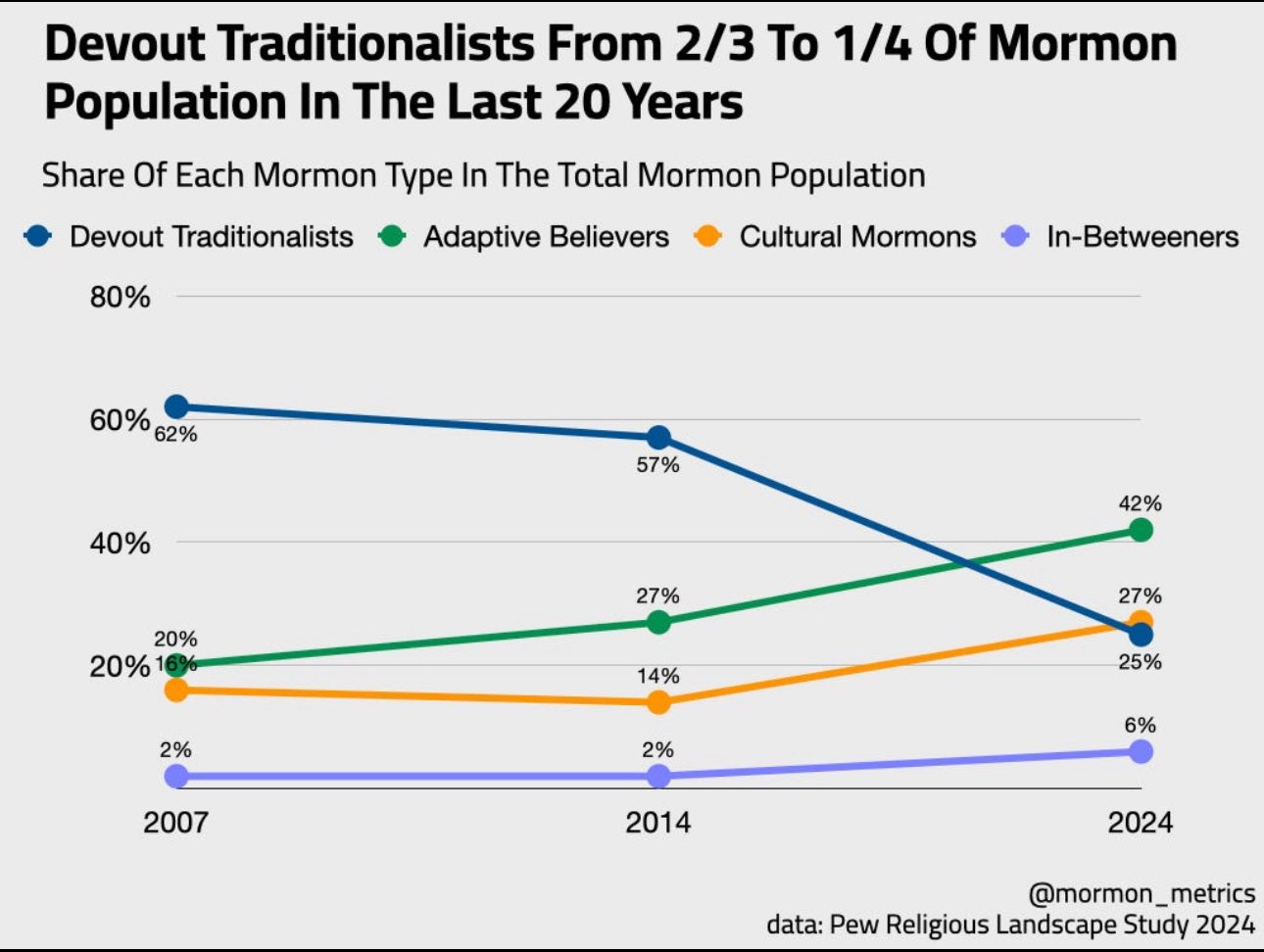
First, it wasn’t actually 2/3–it was 57% that self-reported in the “devout traditionalists” bucket. The shift is still dramatic (from 57% to 25%), and corresponds with a rise in all other groups but primarily in Adaptive Believers (from 20% to 42%) and Cultural Mormon (from 16% to 27%).
First, let’s try to understand what is meant by these terms.
Devout traditionalists. This group consists of orthodox members who are highly active and mostly politically conservative. They follow traditional social and political viewpoints and are more likely to favor the patriarchal, single bread-winner family model promoted in the Proclamation on the Family. For the most part, they are observant, attend church regularly, hold callings, pay tithing, and hold an active temple recommend. They align with the viewpoints espoused by Church leaders. They tend to be skeptical of secular social change. Most of us would probably use the term TBM for this group.
Adaptive Believers. They are more progressive and more flexible in how they interpret doctrine and practice in light of evolving social norms. They are more likely to accept and support LGBTQ people. They often hold more liberal or progressive political views than the Devout Traditionalists. They may hold non-literalist views on scripture, and they may selectively attend to counsel from leaders. They value personal conscience over deference to church leaders’ perspectives. We might call these Nuanced Believers.
Cultural Mormons. These folks self-identify as Mormons, but they participate on a social basis, not due to belief in the religious tenets or teachings. Many of them rarely attend Church, but still call themselves Mormons. We might call these PIMO if they attend or inactives if they don’t. This group actually looks like a symptom of a more mature religion, IMO. Consider how many people self-identify as Catholic but haven’t been to mass in over a decade.
In-Betweeners. These are church members who are either on their way out of the faith or are at least in a conflicted position of questioning their beliefs or their place in the Church. They are likely transitioning away from participating in the Church. They could be Elisa’s “quiet quitters” or they could be actively turning down callings, letting their temple recommend lapse indefinitely, and skipping meetings. These are probably also under the PIMO umbrella, but a specific subset. Realistically, they are probably truly ex-Mormons.
The data showed that the percent of Americans referring to themselves as LDS remained roughly the same (~2% of the US population), but within that group, their commitment level was shifting away from the rigidity of the Devout Traditionalists to a much more progressive and nuanced belief system.
There are a few factors one could consider that occurred during this timeframe:
- Self-reporting. This could represent a shift in how people characterize their membership or devotion. Words change meaning over time. Do more members see it as desirable to be “less devout” according to these questions? In other words, are these results basically unchanged, but how people define the terms or see themselves is different?
- Continued proliferation of internet. According to ex-Mo spaces, the more “accurate” information is readily available to the membership online, and the more online the membership is, the fewer true believers there will be. This is probably a trend across all sectors of life and one reason that institutional trust is at an all-time low and probably not improving any time soon. The secret things are being published from the rooftops, if the internet is a rooftop, and there is no way to spin gold out of some of this straw.
- Social media. Doubters are not generally welcome in church (or at least their doubts are not) since church is supposed to build faith, not erode it, but there are many places online where doubters can connect and discuss their doubts. If church is primarily a community (of believers) it can very easily be replaced by a community (albeit online) of doubters or former believers.
- Trump and political polarization. Whether you love him or hate him, Trump is a polarizing figure. For those who don’t like him or what he’s doing, there’s a moral component to their opposition. When you have a ward filled with people who are morally outraged, people who shrug off the outrage, and people who embrace what others see as immorality, you’re going to crack the ties that bind that community together. What LDS congregations look like post-Trump remains to be seen. Among other faiths, congregants have self-selected politically into like-minded groups.
- Pandemic fallout. It’s hard to overstate just how devastating it was to religions when it was suddenly unsafe to attend in person and everyone breathed a collective sigh of relief at not having to go. Why did they feel relieved? Inertia is its own reward, and all community interactions come with social obligations that can be fraught or draining at times. Some may have felt that their efforts were futile or that attendance was pointless. Within Mormonism, there was also an issue with the sacrament only being available to married women combined with being told that it didn’t really matter. We were suddenly being told by leadership that church ordinances were irrelevant and unnecessary, confirming what many may have suspected, and also undermining the entire concept of church attendance.
- LGBTQ Acceptance. There’s a pretty huge shift among members in terms of acceptance of homosexuality, rising from 24% in 2007 to 46% in 2023. That change corresponds with these figures. Given church leaders’ stance on LGBTQ issues, it also creates both exit ramps (particularly for families with LGBTQ children coming of age and coming out, forcing many parents to choose their child or their faith) and trust erosion among members whose personal views misalign with the retrograde views of much older generations who are setting church policies.
To me it seems like there are a few possible ways to view this shift:
- The church is going to become much more flexible and progressive and less dogmatic and controlling. This could involve losing the right flank who could splinter off.
- The church is going to shrink because it is really just designed for and by Devout Traditionalists.
For the first thing to happen, church leaders will have to figure out how to do this. The more progressive families and nuanced believers leave, the less likely the church will seek to be more open. There will be no need, “no demand for it” (as Carrie Jenkins falsely claimed about Coca-Cola at BYU.)
A new Oaks presidency, with fellow lawyer Christofferson by his side, doesn’t feel like we are heading into an era of tolerance and progress. For example, the church is so vehemently opposed to trans identities that the policy treats them as criminals in the congregation requiring an escort to use the wrong restroom, and the church has also submitted an amicus brief to bar trans people from protected status as a class which would help prevent discrimination. They sided with Justice Alito who thinks the real risk is religious conservatives being cast as bigots.
While that may be the church’s stance, will the members follow? Will they leave? Will they stay and push for change? Do they share these anti-trans views? Certainly a President Oaks, even in a diminished capacity, will maintain his track record of anti-LGBTQ advocacy, particularly in areas of policy and jurisprudence. Does the drop in people who see themselves as “devout traditionalists” indicate that they aren’t buying into these culture wars arguments as the trends seem to show?
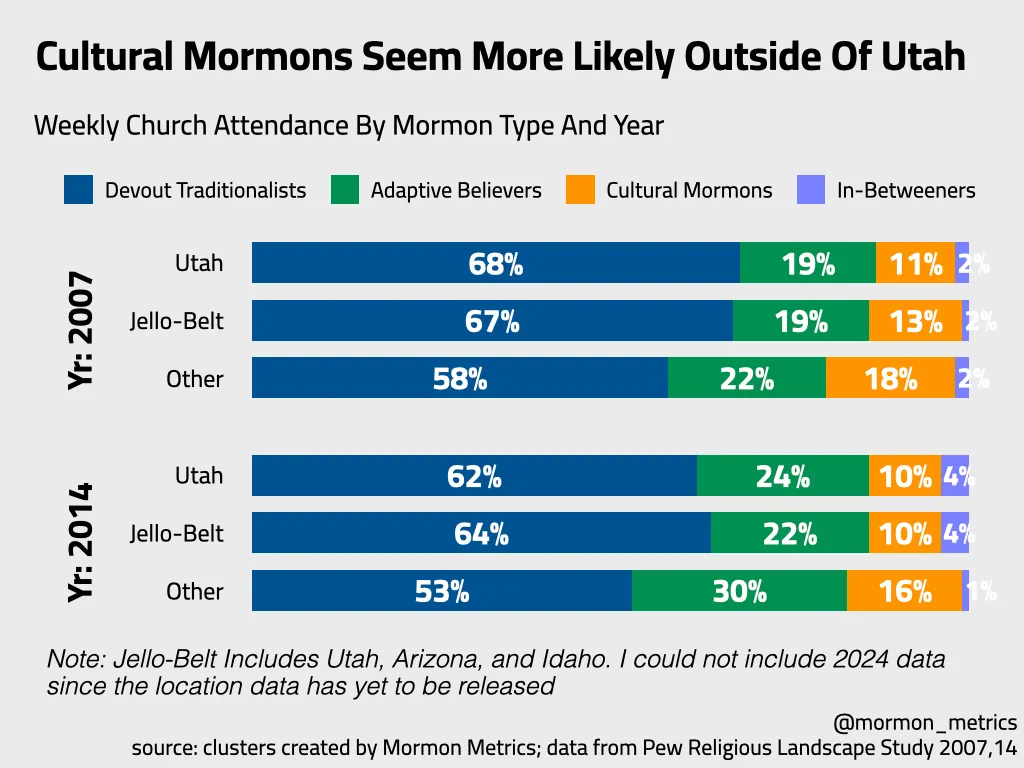
There was an interesting follow up to this data (from the Mormon_Metrics substack) showing that the Devout Traditionalists are more common for church members living in Utah, and Cultural Mormon were more common outside of Utah. This is the opposite of the “expected” result based on the chatter I’ve always heard that would cast “converts” as the ones who are most devout, and those born into the religion as mostly socialized into it (Cultural Mormons). I even had a relative who, on her first experience living in Utah (Utah County even!) was so appalled at how people behaved she said “How do you deal with the complacency?” Apparently I dealt with it by being complacent because I honestly had no idea what she was talking about. Since the trend is showing the opposite of that assumption, maybe that socialization in church-centric Utah communities is actually creating more commitment. You don’t have to question your beliefs when they are commonly held. As Madge would say in the 1970s Palmolive commercial “You’re soaking in it!”
What do you make of this demographic shift? Are there other things you observe in this data (or in the Momon_Metrics substack data in general) that surprise you? Do you find any of these conclusions suspect?
- Do you see the church becoming more progressive or smaller?
- What do you think has driven these changes?
- How have people you know changed over this time period in terms of their belief?
Discuss.
 Wheat & Tares
Interesting data. In the average ward, I doubt there is any overt sense that the percentage of “devout traditionalists” (the TBMs) have fallen dramatically. What masks the decline in “devout traditionalists” among the membership is probably the fact that 98% of senior leadership and probably 80% of local leadership are themselves “devout traditionalists” or even “zealously devout traditionalists.” The 20% of local leaders who think differently generally have to act like “devout traditionalists” most of the time anyway. That’s just the Mormon system and they’re stuck with it if they say yes to a leadership calling. All of the “adaptive believers” discourse happens outside the institutional church.
Yes, the Trumpification of the Church is eroding the sense of community that characterized most wards pre-Trump. MAGA Mormons still think they are “following the Brethren” even as they take most of their (un)religious and cultural cues from Trump and his posse. Senior leadership is, I think, largely unaware they aren’t really leading the parade anymore. Non-MAGA Mormons are dismayed by the whole mess and increasingly ask (if they are still around) “What am I doing here?”
If this was broken further down in age ranges, the percentage changes would be even more radical I assume. We’re in for a wild ride one way or another in the next 15 years for the church and world. Good luck to us all.
I bet the change is mostly a generational change. in my very Mormon family, the older generation (Gen X and older) are very much devout traditionalists. There are some devout traditionalists in the younger age groups, but for my millennial and older Gen Z cousins there are a lot of adaptive believers (I am less confident on the younger Gen Z cousins, mostly since it seems people in my family need to get to their mid 20s to not just parrot what their parents believe)
If this is the case for the wider Church, Mormonism is going to look very different in 20 years
I think there are two primary factors driving this. Probably the strongest one is the generational change alluded to by Zwingli. The generational differences in attitudes were quite apparent in the research published by Jana Reiss in The Next Mormons in 2019. I would say a possible secondary factor is the pandemic, where some of the most right wing members discovered for the first time that they had differences with official guidance coming from the church in the form of recommendations for masks and vaccines. I’ve heard anecdotally a number of stories of that leading people to question their faith and their allegiance to the leadership of the church for the first time. So now there are both progressive and conservative leaning groups who might now consider themselves some form of “culturally Mormon”.
Not to worry, we still have many, many crazies out among us; most of whom are Uber Leftists who are hell-bent on violence, destruction of property, undermining society and bring down the Republic. In fact, they seem to adore rot, decay, filth and destroying everything that has served as the underpinnings of society for centuries. Perhaps Hawkgrrl could turn her energies and focus on these folks; oh wait, she may very well identify with them! (Oh well, it was a false hope indeed).
And Dave B……Most definitely identifies with the “loonies out among us” so, there’s still much to study, contemplate and observe among our populace!
Lefthandloafer: either a master of satire or an angry, platformless troll here to highjack threads to post their tripe because no one else will listen. Talk about a bubble detached from reality. No need to be so insecure, friend. Yikes.
Lefthandloafer hasn’t read much of this blog I guess. That is a lot of vitriol without a lot of Christlike compassion unless it is meant as a parody of MAGA which I am afraid it is not.
The most interesting thing not discussed nor polled would be what any member would think about the rest of the congregation, they’d probably tell you that the “Devout” was closer to the 80%.
We were all masquerading as Devout when only 25% actually were.
I know this has been posted on before, regarding presenting as TBM. But I’ve never see the true stats.
In my experience God is showing church members and leaders that we’ve moved beyond acting as devout traditionalist.
Politically speaking, starting back with Newt Gingrich. The Republican Party began losing its integrity and invited hate, racism and inequality to their core. Here in Ca. where I live church members began to change to Democrats.
Now most members are Democrats.
I believe as members we are to recognize who has the most light within them.
It’s obvious that Republicans hold the most darkness. Therefore they cannot distinguish truth facts or reality itself
And yet, Brian: it’s interesting to note that even here on Wheat and Tares (within this bastion of liberal/progressive/socialist thought) my comments still get some upvotes – which may signal that (while often quiet) not everyone agrees with the radical declarations from such as you; nor all we all “going over the madness waterfall” which so many of you seem to advocate for.
As for any insecurity – I have to laugh. For, while I have many, many issues with the LDS Church – and don’t believe in many things that they still teach – I have decided to stand by them when it comes to loving and honoring the United States and trying to get rid of so much of the rot, corruption and filth that the “the Left” has been gardening for so many years. Ironic I know, that I would deliberately choose to stand by those whom I once despised – in light of a group that I hold in even greater contempt. (Oh….the Horror and Meanness! LOL!)
Footnote: And, again with a conscious view of the paradox contained therein, I have several recent commentors (here on Wheat and Tares) to thank for my “Radicalization” back to supporting the love of country, freedom, rule of lawa, and Freedom of Speech: as displayed by the LDS Church. Please imagine that you see my bow and salute to you.
Lefthandloafer: “most of whom are Uber Leftists who are hell-bent on violence, destruction of property, undermining society and bring down the Republic. In fact, they seem to adore rot, decay, filth and destroying everything that has served as the underpinnings of society for centuries.” What a bizarre comment. I’m not sure where you get the idea that I’m 1) Uber leftist, 2) hell-bent on violence, 3) have ever destroyed property or advocated it, 4) undermined society, 5) want to bring down the “Republic” (noted that you prefer that term to “democracy”), 6) adore rot, decay or filth, or 7) adore the destruction of everything that have served as the underpinnings of society for century. If by #7 you mean that I would love to see the patriarchy destroyed, that’s your one gotcha that you’ve got right. The rest of your assertions bear absolutely no resemblance to me or to anyone–literally any human being–that I know personally on the left. On the contrary, it’s my right-wing high school friends calling for actual “civil war” and violence, but I assume they are all bluster and that when push comes to shove, they are more likely to drink a beer with you than shoot you, even if you are a leftist. So whoever these “most of whom”s are that you are talking about, I don’t know them. If you think you’re convincing people by declaring yourself the only sane person in a cesspool of whatever you’re claiming, well, maybe consider a different approach.
Andy: “We were all masquerading as Devout when only 25% actually were.” I actually think you are quite right in your assessment here. I did a post on this concept a while back. It’s extremely common in strong cultures (and when it comes to religions, outsiders often see those cultures as “cults”) for people to hide their true feelings, as in the story of the emperor’s new clothes. Here’s a definition of this phenomenon: “Pluralistic ignorance is a psychological phenomenon where individuals in a group privately disagree with a perceived norm but assume most others accept it, leading them to conform to that norm publicly. This often happens because people are hesitant to voice their true beliefs out of fear of appearing ignorant or being a social outcast, resulting in a false group norm that doesn’t reflect the private attitudes of its members. Examples include students at a college party not enjoying the drinking but believing everyone else does, or employees in a meeting who don’t understand a topic but stay silent because they assume everyone else does.” And I blogged about it here back in 2020: https://wheatandtares.org/2020/12/16/pluralistic-ignorance-unpopular-norms/
I remember a friend coming up to me at an LDS wedding reception. She said “I just really hate going to the temple.” I said, “Well, a lot of people feel that way.” She still had internalized the Mormon you’re-the-problem scripts and said, “I’m sure if I just went more often I’d like it more.” I said, “Don’t bet on it.” I mean, in other areas of life, when you don’t like something, how often does doing it more make you like it more? The only area I can think of is exercise, but is going to the temple like a physical exertion? I don’t think so. Anyway, my friend is still as Mormon as she ever was, but maybe she’s quit beating herself up over the fact that she doesn’t enjoy the temple because she now realizes that she’s not the only one.
Thank you, dutifullyfaneea839d7ab, for recognizing that the aptly named Newt Gingrich is the progenitor of the amoral relentless grab for power at all costs that has already eroded the fabric of American society and left it in shreds.
The right can pretend that they have a vision of a “better” or “more real” America. Maybe they’re deluded enough to genuinely see it that way but it’s a naked power grab by oligarchs and their paid politicians that sells us all out by degrees. Middle class white Americans may be low on the list but they’ll come for us too and that’s why the only strategy we have is to stand together as racial and religious and gender and age and economic groups and push back for the America we remember that includes ALL citizens and puts corporations and huge organizations like churches back in their place as limited resources and not tyrants governing our every move and leaving us crumbs.
Leftandloafer: Willful ignorance becomes you.
An honest look at virtually all the events of the past 15 years, I’ve learned a few things.
1. Rightists blame leftists only to be proved wrong, after the fact, but by then everything has moved on, so no one bothers to correct their perceptions and just go with the initial lies. I must admit, Republicans are much better and faster at getting those lies out there and never backing down despite the evidence.
2. Attacks on the left happen just because someone wants them to. Maybe it’s something they said, or it could be the initial blaming and lies that follow an event, later proved wrong, and never retracted.
3. Attacks from the right often involve violence or the suggestion of it. Whether it’s Charlottesville, George Floyd, the governors in PA or MI, or Charlie Kirk (remember he was labeled a leftist by his MAGA family, all because he was questioning his sexuality; that doesn’t make him a leftist, just confused).
4. Those on the right can’t talk about anyone not like them with civil dialogue. They either copy the names the president gives people or make up their own names, but never respect anyone not like them, as a human being.
5. When attacked, particularly physically, like George Floyd, or even our nation on Jan. 6, there have been marches, demonstrations, speeches, etc., but violence seems to enter from someone on the right trying to provoke a situation. There’s a big difference between those on the right who have a strong desire to tear down legal protections and those on the left who actually believe the government should protect them for EVERYONE, including minorities.
6. I doubt anything I say will have an impact on you or anything you believe. While I believe most of us in this forum have issues with the church in one way or another, we still believe in the difference between right and wrong. We believe in the words of Christ, even if others have usurped them for their own desires. There are many on the right (MAGA) who claim to be Christian, but few of them follow the teachings of Christ or apply them to ALL PEOPLE.
Finally, since this is about devoutness, I’m going to admit that I was concerned about Pres. Oaks in becoming the prophet because of his anti LGBTQ statements and his use of the Family Proclamation to justify his words. But, I did read in the Salt Lake Tribune that he also has made known his views on the MAGA part of the church and how they are hurting it. In other words, I got the impression he was going to be more direct in talking about how our religion is reflected in our politics and call out the MAGA extreme. I believe he has an understanding of the Constitution and how it applies to all people, not just white religious men who are good at hiding their hypocrisy. If he is as direct in his MAGA statements as he has been in his LGBTQ statements, more people will leave the church, but it will be better for it because more will also come into it.
Hawkgrrrl: Rest assured that I’m not trying to convince you of ANYTHING! You and I (along with Dave, Brian and Janey) are worlds apart; so far apart that I don’t believe the delta between our differing views can be (and perhaps, never will be) reconciled. The only counsel I’d offer up (which of course you’ll totally ignore) is that the question should be asked “how many others – who at one time – might have been somewhat sympathetic to certain Leftist causes have now (like me) said Oh, to Hell with this insanity; all resulting from how truly bat-sh*t crazy the Left has become; with no boundaries, little to no morality and obviously comfortable with collapse and decay?
Instereo: with just a few (quite minor changes) I could spit this summary right back at you; and make the same claims against the Left. Ironic isn’t it?. You have no more right to speak for Christ than I do. To attempt to do so – is the height of presumptive arrogance.
lefthandloafer: I can’t imagine quite as readily as you can that our actual views (or lifestyles) are actually that different at all. I suspect that we both have and love our families, that we are kind to our neighbors, that we would pitch in if someone needed help, that we care about our pets, that we look for the good in others (maybe more easily when not in faceless interactions like these). I honestly don’t know what you think is “batshit crazy,” what boundaries you think the left is violating or erasing, and what you are characterizing as little to no morality or collapse and decay. Seriously, what are you even talking about? I know it’s hard to convey tone, but I’m honestly curious. I believe in religious freedom but not religious supremacy. I believe in (personally) following the teachings of Jesus as a moral code, but not in requiring that of others. I believe in the freedom for all tax-paying Americans to pursue life, liberty and happiness without constraints that would prevent their ability to do so, which is why I’m against discrimination. I’ve travelled the world (76 countries and counting), and I’m still as American as ever, even though we need to do better in many areas, primarily healthcare (that’s my personal hobby horse). So what about that do you disagree with? Anything?
Lefthandloafer
Is the giant green frog an example of what you fear?
If we look at the religious society in Jesus’ day, and using the four-category schema in the OP, we would have to say that the Pharisees, Sadducees, and scribes were in the first category of “devout traditionalists,” and we would have to put Jesus in the second category of “adaptive believers.”
I think the second category is the right place to be, and where the Lord wants us to be. People in the first category teach exact obedience to the prophet, but Jesus taught that the letter of the law kills while the spirit gives life and He teaches us to learn and apply gospel principles for ourselves and with the guidance of the Holy Spirit within our community of faith. If someone classifies me as being in the second category, I am okay with that because that is (1) where Jesus was in his day; and (2) where Jesus wants me today.
The data is interesting, and seeing which way the new LDS first presidency tries to lead the church will be interesting. You can see the divide the OP mentions just by listening to some of the conference talks – there’s a group of that continues to push blind obedience to the leadership no matter what, while there’s another distinct group who has chosen to focus on the actual life and teachings of Jesus without any mention of things like covenant paths.
The data also makes me wonder how people’s self-imposed labels are impacted by their broader social context. A person considering themselves a devout traditionalist in Utah may look very different than someone giving themself the same label somewhere like southern California or Europe or South America. Even within Utah there’s a surprising difference just between neighboring counties.
(Then there’s people who label themselves by drunkenly wandering into the comments section of the internet while angrily drooling out random political words. Thanks for the laugh lefthandloafer, it made a dreary day a little brighter.)
“How have people you know changed over this time period in terms of their belief?”
The people I know simply don’t want to talk about things anymore. There used to be a period where we discussed the issues du jour. Nowadays, no. The possibility of heated pushback simply seems higher. It is easier and easier to rub someone the wrong way and damage a relationship. In a sense it is kind of nice. I simply don’t hear political commentary as much at church as I used to. On the other hand, it is depressing. It feels like the country’s ability to have a conversation has deteriorated and it only seems to be getting worse.
2007 saw the rise in social media. The shift in attitudes seems highly correlated to this. The church can’t control so much what members consume. The church used to be able to have steer members away from the controversial matters and have them hear only what they wanted them to hear.
I often think about my experience on my mission in Montréal, where a first counselor in our ward was half Black. He had joined the Church and stayed active even during the time when Black members couldn’t hold the priesthood. Eventually, he did receive the priesthood, but by then his wife, who was white, had become inactive. While I was on my mission, I learned that their college-age son was attending BYU and living in the same Orem neighborhood where I grew up. Small world.
I always saw that man as an example of perseverance, someone who waited patiently through difficult times, trusting that change would eventually come. For a long time, I believed LGBTQ issues would follow a similar path. I thought that if I held on, the Church’s stance would soften, and there would someday be full acceptance, a real place for LGBTQ members to belong.
But everything changed when I had my own son. He was growing up with lesbian aunts, and I realized I had to reconcile what he was hearing about people he loved and cared for. I found myself having to “unteach” things said by a careless or dogmatic Primary teacher, youth leader, or Sunday School instructor. It felt different when it was my own child; the harm wasn’t theoretical anymore.
I grew up believing deeply in the idea that “by their fruits ye shall know them.” Over time, watching the increasing alignment of U.S. Church members with MAGA politics made me realize that this was no longer my tribe. I couldn’t keep trying to be an adaptive believer. Instead, I decided I needed to stand in holy places of my own choosing. I will still selectively read to my son passages from scriptures, but we don’t attend or participate.
While my son is young and impressionable, I don’t want him raised in an environment where worthiness interviews, mission pressure, or exclusionary teachings might shape his sense of self or others. That’s really our story: the MAGA-fication of the Church and the rigidity around LGBTQ equality—and women’s equality—eventually put us on the outside.
But even from the outside, we still consider ourselves culturally LDS.
I’m culturally Mormon. I spent most of my life as a Devout Believer, and a few years as an Adaptive Believer. That didn’t last long before I stopped believing any of it, other than ideas and teachings that were relevant to me personally. And I believe them because of my own experiences and study, not just because they came from scripture or a Church leader. Perhaps that is one line between Devout and Adaptive. Devout believers are more prone to accept something just because it is taught. Adaptive Believers give themselves permission to mull it over and decide whether they agree or disagree.
I will be interested to see where Pres Oaks aims his limited time and energy. He does not appear to be in good enough health to be able to do everything. Will he choose to focus on Christ’s love and the rule of law? (thereby offending MAGA). Or will he choose to focus on gender and reproduction? (thereby offending leftists) I hope his focus is more on love and law. While he would never recant his teachings about LGBTQ+ issues, if he stops talking about them in favor of purging the Church from hatred of immigrants, perhaps the attitudes can soften, or at least stop becoming more violent.
Quentin’s comment was thought-provoking. He’s right that there are likely now disaffected Mormons on the right as well as the left. For some people who used to be Devout Believers, they believe Church leaders are too liberal. I doubt Oaks will try to cater to that group at all.
@Janey I honestly think the only healthy way to participate in the Church today is as a “cafeteria Mormon” (e.g., an Adaptive Believer). But even quietly admitting that among Devout Traditionalists would invite the LDS equivalent of being labeled a RINO — a “Mormon-in-name-only.” (Yes, the irony isn’t lost on me, since a Devout Traditionalist would never actually use the term Mormon.) To them, an Adaptive Believer is seen as a sheep in wolf’s clothing.
I agree with you: the Church is at a crossroads. Who does it choose to cater to, and which flank does it try to shore up? Not choosing is, in itself, a choice. A quiet schism is already well underway, and I think it began in earnest with the election of Trump in 2016 — an event that, if we’re being honest, meaningfully thinned the ranks.
In my view, the healthiest path forward would be for the Church to allow greater flexibility for members to self-select into local congregations led by lay leaders who reflect different perspectives or “types” of belief. That would give people a way to vote with their feet without abandoning a ward community altogether.
I’m reminded of Revelation 3:16:
“So, because you are lukewarm—neither hot nor cold—I am about to spit you out of my mouth.”
“Rest assured that I’m not trying to convince you of ANYTHING!”
I know. Your purpose on here is to get angry about people expressing well-thought out ideas that align with center-left in the US, let that rage build up inside, and then explode with random all-caps rants from time to time. I’ve been seeing lefthandloafer comment on here for years and I don’t think much has changed since the first time I saw a comment from you. If it’s any comfort people like you have seized power in the US and seem to be entrenching themselves by spreading lies and propaganda, and violating the Constitution and breaking laws. So there’s that. Do you still identify as libertarian or does that not matter as much anymore since daddy’s back in the high chair? Funny, I don’t hear anyone talk about being libertarian anymore and holding “libertarian” values, since about November 2024. I wonder what happened?