
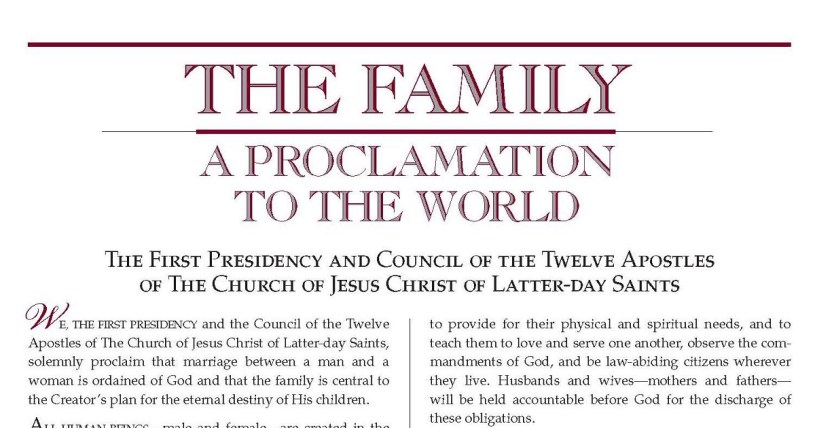
And the mystery is this: What is it? Is it a revelation? Is it doctrine? Is it policy? Is it commentary? And who wrote the darned thing? Who drafted it, who edited it, and who approved it? Those two points are related. If it was drafted by some associate at Kirton McConkie and edited by a partner before being passed along to a committee of apostles, it’s hard to call it a “revelation.” So let’s ponderize.
Let’s start with an Oct. 3, 2025 editorial at the Salt Lake Tribune by Taylor Petrey, titled “The LDS Church’s Family Proclamation is commentary, not revelation.” And what exactly is a proclamation, you ask? Petrey explains:
Unlike scripture, proclamations aren’t canonized. Unlike revelations, they don’t claim to be divine communications. And they don’t always reflect a consistent, timeless consensus that we might expect of doctrine. Apostle Boyd K. Packer once called the 1995 text a “revelation,” but church editors later scrubbed that word from his printed remarks.
There have been a few other LDS “proclamations,” now largely forgotten. But the Family Proclamation is the exception, framed and displayed by many members of the Church and constantly quoted in LDS sermons and General Conference talks. Petrey continues:
The 1995 proclamation is considered doctrine by today’s standards, presenting itself as timeless truth, even while its contents reflect the shifting sands of church history. … If the family proclamation is not revelation, not scripture and not unchanging doctrine, then what is it? I’d argue it’s best understood as commentary.
There is nothing wrong with commentary. Some of the most celebrated works in the Church are best thought of as commentary, including Jesus the Christ by James Talmage, Mormon Doctrine by Bruce R. McConkie, what you read each month in the Liahona (formerly the Ensign), and the many discourses of Joseph Smith and Brigham Young.
However, members and leaders don’t treat the Family Proclamation like commentary. They treat it like an uncanonized revelation, despite senior leaders carefully refraining from calling it a revelation. This was highlighted in the recent General Conference. Elder Rasband said, “Treat it with reverence as the Word of God.” President Oaks focused most of his talk on the Family Proclamation, although he emphasized only the eternal marriage concept in his remark. The new motto for the Church might be, “Get married! Have more kids!” [Hint to our octogenarian senior leaders: If you want young Mormon couples to have more kids, offer free or subsidized day care at LDS chapels! You’ve got a hundred billion dollars to work with, it shouldn’t be hard to do.]
So either LDS leadership and Pres. Oaks in particular are doubling down on the odd position that the Proclamation is a revelation, we just won’t ever call it that. Or else the statements from the just-completed General Conference signal an intention to actually present it to the membership as a revelation and canonize it in an upcoming Conference.
So here is the dilemma. What is the Family Proclamation?
Chime in with your opinion in the comments.
- As shown by Petrey’s article, the Family Proclamation is best understood as commentary. But few members or leaders want to think of it as “just commentary.”
- Is it policy? Actually, I think the claim “the Proclamation represents LDS policy relating to marriage, gender, and sexuality as of 1995” is a fairly accurate statement. It’s generally understood that policies can change. In fact, when LDS leaders want to change an LDS doctrine, that is usually preceded by relabeling the unwelcome doctrine as “just a policy.” But I don’t hear the Proclamation described as a policy by anyone.
- Is it a doctrinal statement? If you allow that LDS doctrine changes over the years, then it’s fine to say the Proclamation is what LDS doctrine was (or what LDS senior leaders wanted it to be) in 1995. If you think LDS doctrine never changes, then you are not very familiar with LDS doctrinal history, and saying “the Proclamation represents eternal and unchanging doctrine” is deeply misleading as it is based on the faulty assumption of unchanging doctrine.
- Is it a revelation? It hasn’t been up until now, but LDS leadership may be adopting that view — even if it doesn’t ever call it a revelation. Or else going even farther by presenting and canonizing it in the near future.
.
 Wheat & Tares
Whether you call it commentary or doctrine one thing is certain: the Family Proclamation represents the COJCOLDS brand. And branding is very important to most corporations, especially this one. We don’t know whether the Brethren will push to canonize this or not. But we can count on the perpetual effort to strengthen this aspect of the brand.
A reminder of MaryAnn’s 2017 post:
And as is hitting the digital media discussion of the proclamation and the family manifesto:
All of which is interesting. I don’t think I’d go so far as to say it was plagiarised, but it does seem to have been an influence perhaps in producing such a document, with an LDS doctrinal twist.
Of all the things to worry about, family composition seems really out of touch to me. In the 1950s, the nuclear family with a single provider and a home was a possibility for everyone. In 2025, that is just not the reality. And frankly, I feel like the church leaders should be much more concerned about the behavior/people its own people are voting and rooting for over LGBTQ+ issues, which overwhelming are in the tiniest minority of the population. Emphasizing it now is cheap costly signaling.
Can the Lord’s one true law firm receive church revelation?
None of us raised dumb kids. While they may feel pressure from church leaders to start a family before they have secured full time employment, they know the church is never going to foot that bill. They also know that paying tithing first and buying groceries second makes a nice sound bite but doesn’t reflect the reality in their bank account. So while the kids hear you, they aren’t listening to you.
The question of whether or not the Family Proclamation is a revelation should be the easiest one. It either is or it isn’t. I can’t become one after the fact. Even its eventual canonization (or not) does not impact whether it was a revelation. Of course, a third option exists: we aren’t sure. It’s one thing for membership as a whole to be unsure, but quite another for church leadership to be unsure of whether or not it is a revelation. How can they not know, and how can they not have clearly communicated this? And we have precious little time left to determine the truth; only 3 of the Q15 are still around: Oaks, Holland and Eyring. I’d wager that within the next 5 years they’ll be gone, and we will be left with an unanswerable question of whether 15 men received this document as revelation or not. (All 15 of them survived for 9 years after the proclamation was published, which is literally the longest the Q15 has ever gone without losing any members, and still they never managed to clearly reveal to the church whether it was a revelation or not!)
For me, the proclamation is a statement of policy/doctrine. There is no real distinction between the two. Policy/doctrine updates whenever church leadership says something new often/clearly enough for us to understand that it is updated.
You could say that Nelson lowered the bar for what qualifies as revelation when he (retroactively) declared the 2015 exclusion policy changes to the handbook to be revelation, and then proceeded to preside over its partial reversal 3 years later. If the handbook (which wasn’t even public at the time) is revelation, then surely proclamations so prominently publicized would also qualify. However, if the bar is that low, and revelations so easily reversed, it dilutes the power of pointing to any particular thing as revelation. Sure, call if revelation, but what does revelation even mean at that point?
The proclamation is not revelation. I am not in favor of canonizing it. But even though the proclamation is not revelation, the church can still canonize it without declaring it to be revelation.
My problem with canonizing the proclamation is three-fold: first, the proclamation isn’t revelation; second, canonization simply isn’t necessary to be considered as doctrinal; and third, some church members will use the proclamation as a metaphorical club against other members.
None of the other church proclamations have been canonized, so there is no need for this one to be canonized.
I think the apostles generally believe the proclamation to be inspired. And I think the number one reason they’ve been hesitant to canonize it is because they don’t want to push people away from the church who might otherwise remain. Even so, it’s my opinion that they may be concerned about getting perilously close or even crossing the line of negative returns–where in more harm is done to the church by not canonizing the proclamation. Time will tell.
If the Proclamation is put up for a sustaining vote, does anyone think this leadership set will give any sort of notice before the vote is taken? A letter over the pulpit to be read the Sunday before conference? An email notice similar to those sent out prior to Church broadcasts? Part of me says that yes they would. Canonization is an important thing that doesn’t happen very often. And then part of me says no, they’ll try to spring it on the membership to try to avoid any sustained discussion of the merits. I just don’t know.
According to Merriam-Webster Dictionary, a proclamation is an official formal public announcement, so I guess technically it is an announcement to the world of the Church’s position without stating it is doctrine vs policy. But ever since it was broadcast/published, it has been treated as assumed doctrine within the Church. Goodness, BYU/Pathways students are required to take a course on the Proclamation on the Family as they are on the Book of Mormon. They are not required to take a course on other Church policies as far as I know. As the Church continues to shift along with the far-right evangelical Christian movement regarding the roles and purposes of women and men, I think many conservative members would be surprised to find or would deny it is not clearly defined as doctrine by the Church itself today.
Jack,
You are the only person to use the word “inspired” so far in this thread — but there are 30 uses of “revelation” — if you want to make a meaningful contribution to the discussion, it would be better for everyone if you would use the same terminology.
We all know that revelation, as used in this thread, is different from inspiration.
I (and some others) shared an opinion that the family proclamation is not revelation, based on information shared by the brethren themselves. I made no statement on whether there was some inspiration attending the brethren as they wrote the proclamation, but I am willing to allow that might have been so. But in this thread we’re talking about revelation (not inspiration) — it is good to speak clearly and to avoid confusion, so let me ask a question to be helpful to you: are you saying that, as far as you can tell,(a) inspiration attended the brethren as the brethren wrote the proclamation, or (b) the family proclamation is revelation?
Jack: “Even so, it’s my opinion that they may be concerned about getting perilously close or even crossing the line of negative returns–where in more harm is done to the church by not canonizing the proclamation.”
Harm to the queer members and allies be damned, right Jack? I think the church tried that approach in November 2015. How did that turn out?
I think there are certain members of the Q15 (Oaks? Rasband?) who would love to frame the Family Proclamation as revelation. Certainly, Packer wanted that. I don’t know whether Packer subversively planned in advance his claim that the FP was “revelation” in his infamous conference talk, or if that was something he just decided (felt inspired?) to do in the heat of the moment. Whatever the case may be, he sure shot himself in the foot because his act forever prevented the FP from being elevated to revelation (I think). Fortunately, there were apparently enough people with integrity in the Q15 to force Packer to scrub the revelation claim from his talk. I think he was in line to be the next president of the Church at the time, too, so forcing him to change the wording must have been a very, very serious power move behind the scenes. Because this happened, I think it would be very hard for the Q15 to claim the FP is revelation again. I mean, Packer’s talk wasn’t altered all that much. The “revelation” wording was removed, and not much else was changed. How can the Q15 promote the FP as revelation when this history is so well documented? They could, and some members would love it, but people who believe LGBTQ people should be received with full fellowship will never forget this bit of history.
Jack brings up “inspiration”. I suspect Jack would have called it “revelation” if it weren’t for the Packer incident. It would be interesting to know what, if any, action might have been taken had Packer used the term “inspiration” instead of “revelation” in his talk. What is inspiration, though? It’s apparently lesser than revelation. I personally think inspiration, in situations like these, means “revelation with a high degree of uncertainty”. The Q15 apparently didn’t receive a strong enough signal from the heavens to call the FP a “revelation”, so it was downgraded it to “inspiration”, but the downgrade almost certainly implies a degree of uncertainty with the matter. Otherwise, why not call it “revelation”? For crying out loud, Nelson claimed the POX was “revelation”, so if the POX “revelation” was so bad that it had to be reversed in 3 years, what are we to think of the accuracy of “inspired” acts of the Q15 like the FP?
It would be interesting to go back and read all of Oaks’ comments about the FP over the years (he certainly has had the most to say about it!). My recollection is that Oaks has referred to it as inspired, but then he also tends to say that it is a statement of “eternal gospel truths”. Now, Oaks is the type of person who would absolutely make a scriptural case to justify the “eternal gospel truths” of the FP if he felt he could, but as far as I know, he really hasn’t taken this approach. Good for him because there really isn’t good scriptural support for denying fully fellowship to LGBTQ individuals in the Bible, and there is literally zero support for it in the BoM and D&C. Oaks seems to rely on tradition, and then the statements of “modern prophets” as the basis for our knowledge of these “eternal gospel truths”. LGBTQ individuals weren’t tolerated over the centuries in Christianity, so I guess this tradition, along with the statements of “modern prophets”, is his basis for denying full fellowship to LGBTQ people. I think Oaks believes this is doctrine, and that this doctrine should never change. Apparently, Rasband agrees with Oaks about this.
There are other apostles who have been curiously silent on the FP. I spent just a few minutes, and I couldn’t find a talk where Uctdorf talked about the FP, and certainly not one where he explicitly talks about denying fellowship to LGBTQ individuals or gender roles. Same goes for Patrick Kearon and Gerritt Gong. All members of the Q15 signed the FP when it was released (Uctdorf, Kearon, and Gong were not in the Q15 when it was released), which is an indication that it was considered by them to be Church doctrine at the time. However, if we are to believe Christofferson’s claim that Mormon doctrine is defined by what all members of the Q15 have taught (something that hasn’t been repeated by the full Q15, so maybe his definition of doctrine is just plain wrong), then the fact that we seem to have multiple Q15 members not teaching its core claim that homosexual marriage is a sin or that women shouldn’t work outside the home would tend to indicate that it may no longer be considered doctrine.
In summary, I think that most of the Q15 never considered the FP to be revelation. Some of the Q15 probably considered it to be inspired when it was released. I think that others in the Q15 knew it wasn’t inspired because they knew how it came about (see Mary Ann’s excellent article describing its origins that has been quoted in a comment above), but they accepted it as doctrine (or were willing to go along with the majority and sign the document). A large percentage of Church membership embraced the FP when it was released. Indeed, I am ashamed to admit that I was one of those who celebrated the release of the FP at the time. Some members probably felt it was revelation, others felt it was inspiration, and perhaps others just felt it was a compilation of “eternal gospel truths”–doctrine that needed to be stated more plainly.
As time has passed, official Church positions and the feelings of many Church members have changed regarding the FP. When the Church released the FP, Church leaders were still teaching that being gay was a choice and that the parents of married gay children shouldn’t allow them to spend the night in their homes or associate with them in public. They were also still teaching that women shouldn’t have careers and that men really did “preside” (with the actual dictionary meaning of preside) over their families. Official Church positions have shifted a lot on LGBTQ issues and gender roles since the FP was released. In that sense, it really isn’t a document that has aged well.
Again, it appears that at least some apostles aren’t really teaching the LGBTQ and gender role portions of the FP any longer. Likewise, more and more rank and file Church members reject the Church’s stance on LGBTQ individuals and gender roles. As a result, it would appear that the FP is no longer considered doctrine by an increasingly large number of Church leaders and rank and file members alike. I remain optimistic that the FP will eventually be disavowed (less likely) or simply not talked about (more likely) as time passes until it is largely forgotten and there is room for accepting LGBTQ individuals and non-traditional gender roles. If this is what actually happens, then it does mean that the FP was not revelation nor was it inspiration or (eternal) doctrine. It was simply an error in judgment by the Q15 in which they claimed it was “eternal truth” when it was really just heavily influenced by tradition and the social norms of the day.
In that sense, I feel bad for Dallin Oaks. Here is a man who was pretty intelligent. He could have used his talents to do some good for the Church. Instead, he wasted decades of his life as a member of the Q15 chasing after windmills by desperately trying to deny full fellowship to monogamous, married gay members of the Church (as well as other LGBTQ individuals). What a waste!
ji,
Yes, I believe the apostles were inspired during the process of creating the proclamation–which took about a year I think. It’s my understanding that they were thoughtful and prayerful through the entire process. And so, with that in mind, I’ve no problem making the assumption that it was guided by the spirit of revelation. That said, I don’t think the inspired process means that we are bound to receive it as a revelation for the church–though I do receive it as an inspired document for myself. But if it were canonized than I would receive it as revelation–absolutely.
Hope that isn’t too convoluted.
“Yes, I believe the apostles were inspired during the process of creating the proclamation–which took about a year I think.”
And in the course of that alleged year, not a single woman, you know that pesky gender that makes up roughly 51% of families, was consulted for input.
Thanks, Jack — I’ll take what you wrote to mean written by men attended by inspiration. That is a reasonable and faithful stand, and I think President Oaks would agree.
But, canonization of a text is a later act by the body of the church showing common consent — canonization does not change an inspiration text to a revelation text.
What do I think it is? In ’95 it appeared to be clever strategy, positioning us on what appeared to be the winning side of the next big culture war issue. For most of us back then (I was 13), it was a feel-good anodyne kind of a document that most people in or out of the church broadly nodded along with with even if they didn’t exactly live that way. And the wording of the document is careful, seldom calling out what exactly it’s against. Don’t use sacred procreative powers outside hetero marriage, though. (That wording was cringe then and time hasn’t treated it kindly.)
President Hinckley was a much shrewder operator and reader of the national mood than we’ve had since. But I don’t think he accounted for how very quickly public perception would shift. More strident members of the Q15 and plenty of members in the pews would use this shift to bolster the document’s bonafides (“See! It IS inspired! Look at how everything has gone to hell!”)–my own sense is that if he could have predicted how fast public opinion shifted on LGBTQ+ issues and how contentious, divisive, and painful this document has since become to the Body of Christ, Hinckley, at least, would’ve left well enough alone. And then he died, and President Monson, already cognitively diminished, did not have the inclination or wherewithal to say “No” to Packer, Oaks, Nelson, and others who seized on the opportunity to finally, publicly, put our money where our mouths had never actually quite been in California in 2008.
And we all know how that went.
I have it on pretty solid authority that Hinckley, on more than one occasion, told the more strident factions of the Q15 off for pursuing similar initiatives while he was alive. But then he was gone.
Back in 1995 The Family looked like a smart play. Whatever else it may or may not be, it didn’t turn out that way.
If you are telling me to avoid honky-tonks, 7-11, crocs, sweatpants, Bon Jovi, hot dogs etc then you are offering me nothing but commentary.
Furthermore, none of the above will bring upon individuals, communities, and nations the calamities foretold by ancient and modern prophets.
It is a sad “commentary” that mountainclimber479 and Margie have introduced the idea of liberal/strident factions among the Q15 and most of us are silently nodding in agreement.
One of Q15 was my mission president and his wife, I’m sure, would call the Proclamation a revelation. I served prior to 1995 so the “policy” of president and wife as “mission leaders” had not yet been revealed.
The Proclamation is as solid of a revelation as any revelation found in the Doctrine & Covenants. It presents policy and commentary built on foundational truth. Is the policy correct? Is the commentary relevant? These questions can be asked of many sections of the Doctrine & Covenants.
Chet, I’m not sure I’d use the word sad. I think it is more feature than bug when groups aren’t homogenous. I’m glad there are very different views and even factions in the Q15, even if I am clearly way out to the left of all of them.
Chadwick
“Harm to the queer members and allies be damned, right Jack?”
I think that’s a valid concern–and I know that the apostles have practically turned themselves inside out in their efforts to empathize and accommodate our LDBTQ members. But we have to remember that the proclamation speaks broadly about problems having to do with the family. Divorce, adultery, fatherlessness, cohabitation, premarital sex, teen pregnancy, etc., are humongous problems that need to be addressed in clear terms, not only to the world, but even to the saints–or so it would seem by the way president Oaks addressed these issues in his conference address.
“And in the course of that alleged year, not a single woman, you know that pesky gender that makes up roughly 51% of families, was consulted for input.”
You may right–though I wouldn’t be surprised to learn that some of the apostles got input from their wives. But even if there was no input from women that does not preclude the apostles getting revelation. As Alma says: “The spirit knoweth all things.” And I think that includes helping men understand the will of God with regard to women and children.
Whoops–L*G*BTQ.
Defining terms is sometimes helpful.
Doctrine, per all English dictionaries, does not mean eternal truth as God knows it. Doctrine is what a church teaches its members at any given point in time. Doctrine ≠ Truth (as God knows it). Doctrine must often change as further light and knowledge is revealed, and as errors are corrected.
Revelation means revealed by God. If I gather a lot of truth from scriptures, talks, and other sources, and compile it into an essay, that is not revelation, even if I am inspired in what I collate and organize. Revelation means God speaks, and God’s mouthpiece then relates what has come from God. Revelation is not what I put together in my own mind. It certainly is not what church lawyers and various committees put together, with back and forth, corrections and changes, from different bodies, including the First Presidency and Twelve. The writing of a scholarly essay may be inspired, but it is not revelation, unless the writer felt that he was writing God’s words or feelings as God communicated them to him. A person writing a revelation from God would not need the assistance of committees of lawyers and church leaders. He might need a scribe, and maybe a proofreader for grammar, spelling, punctuation, etc., but he would not need a committee and multiple back-and-forth drafts over several months.
The Family Proclamation is doctrine, in the classic English definition that it is what the church teaches its members. It is a statement of the church’s position. But it is does not claim to be revelation, and Pres. Hinckley never called it revelation. That came after the fact. A statement of truth may be true, but that does not make it revelation.
One problem that I have with canonization of the proclamation also goes to definition. I am a man, a husband, and a father. The proclamation says that I am to preside in the home. I have no clue what that means. All that I hear is that spouses are perfectly equal, and the man never acts without his wife’s permission, and the man cannot make a decision of any sort without his wife’s consent. Merriam Webster says that to preside means (1) to exercise guidance, direction, or control, or (2) to occupy the place of authority: act as president, chairman, or moderator; or to occupy a position similar to that of a president or chairman.
I am quite confident that no church leader intends to teach what it means to preside, and all those who have mentioned the husband’s role as presiding since the proclamation was issued have said that the two are perfectly equal. I am not opposed to equality, and my wife and I strive in that direction, but I am clueless as to what preside means in the Family Proclamation. Before it gets canonized, we should have a clear understanding of that that verb means. If it really has no meaning, then let’s take it out so as to avoid confusion.
Jack: “I know that the apostles have practically turned themselves inside out in their efforts to empathize and accommodate our LGBTQ members”
They literally banned my son from attending YM classes and activities or using the bathroom at church. That is NOT turning themselves inside out to accommodate him. He is, in their eyes, such a menace that he cannot be invited to play video games on a Wednesday night with the rest of the boys. He cannot join the group to rake leaves at someone’s house, unless they also invite a bunch of girls to come, too. If this is accommodating, I would hate to see what exclusion would look like!
Georgis,
I’m glad you brought up the doctrine definition. I don’t think the dictionary definition is how the church uses the word. I’ve literally heard people on apologetic podcasts say doctrine = truth. And when you position it that way, it is so much easier to dig in and be dogmatic about things because you are conflating two things that should not be. The church’s attempts to redefine words to make intent more palatable are clumsy at best. It would be so much better if the church as a whole would accept the fact that doctrine does change. It is not a debate. What we say and what has happened do NOT align. I think it all traces back to infallibility–that is what people want. They want a safe platform to build on that they never have to inspect. Infallibility brings with it an emotional safety and real truth discovery does not.
I think Taylor’s statement undersells this proclamation cultural purpose. I remember it coming out when I was on my mission. Reinforced by the reaction of local members in New England, I found its release to be very significant. We didn’t mistake it for a new D&C section, but we certainly and immediately regarded it as far more significant than “commentary.” I have never seen devout members, the group to whom the document means the most, ever regard this proclamation as less than an official doctrinal guide.
Would a comparison to the Nicene Creed be useful? Not scripture, but just about as good, especially when recited during Catholic mass.
How quickly this proclamation became a thing to frame and hang in the home next to a picture of a favorite temple. What other religious documents have I routinely seen framed and hanging in the living rooms of LDS families? The Lord’s Prayer; the Ten Commandments, the Footprints in the Sand poem (as a good as a psalm and arguably more beloved).
Jack said that he thinks the GAs believe it is inspired. I totally agree with him here. The GAs are believers and they *believe* it is inspired. They also believe a lot of other stuff that just may well be wrong. Most of the current GAs were not in on it being written and all they know is that the likes of Oaks and Packer have assured them that of course God wants ONLY heterosexuals to be allowed to love.
I think those of us who disagree with the church’s homophobia need to accept the the man who will be our next prophet is a homophobe who has said and truly believes that most or all men will stop loving women and start loving men if it becomes acceptable. He has said as much. He fears that heterosexual marriage will disappear and everyone will become gay. Stupid, I know, but maybe he fears that other men are like him and secretly long to be openly gay. So, his logic goes if all men are secretly longing to be gay, then no babies will be born because everyone wants to be gay. Most of the worst kind of homophobes are secretly fighting their own feelings, and Oaks is a classic homophobe. It is NOT going to get better. Now, having said a truly nasty thing about Oaks, I do not dislike or condemn the man. I feel bad for him because his generation was in a bad spot if they had those feelings. They didn’t dare come out. It would destroy any career ambitions and lead to social ostracism. And Oaks had career ambitions.
And Georgis, in one post you say how the church defines “doctrine” so much different than the dictionary definition, and then in the second you are confused by the way “preside” and “equal” conflict. This again is a case of the church using a word contrary to how it is defined by any dictionary. The church defines “equal” the same way the pigs did in Animal Farm. Some are more equal than others. The church may say women are equal, but it certainly does not act like it. It acts like the pigs. So, please continue to treat your wife as an equal and realize the church thinks differently than you do and only sees women as absolutely necessary and by saying women are equal in marriage only mean “absolutely necessary as your most important accessory”. If the church really believed women were equal, then polygamy would be laughably impossible and as evil as slavery, and having more than one “mother in heaven” would be an impossibility and women would have been given priesthood long ago. The church just has to hide how the doctrine really sees women or us women would leave in droves.
I think one word that describes much of the way this document functions in today’s LDS church membership is “idol.”
What Anna said.
Jake, when it first came out, the GAs made a big deal out of telling us all to frame it and hang it in the living room. We had more than one Relief Society work meeting where we had to work on getting our own copy framed. Copies were passed out fro free to take home and frame. It was A HUGE push where I lived at the time. (Don’t remember where we actually lived at the time because we had some 20 moves while my husband was military) Otherwise, I don’t think much of anyone would have framed it. I know, I got home from RS, promptly took it out of the frame and tossed it because even then I was enough of a rebel to refuse to do stupid just because someone told me too. So, when our home teacher came over next time, he asked why it wasn’t hanging on our wall. I sarcastically asked him if hanging it was going to be asked in my next temple recommend interview, then laughed so he could take it as a joke if he wanted. So, I am sure that some obedient people still have it up. I think my daughter in law might, because she also has the 1st presidency pictures and a temple or two in the living room. Probably Christmas gifts from her mother, because she is too young to remember the push to frame it and hang it on the wall.
And yes, during that big push to idolize a piece of paper, it was talked about as this wonderful new revelation.
I have to remind people of things like this to remind those trying to forget that this church is kind of a C word.
My impression is that the Proc is somewhere on the spectrum between doctrine and policy. I’ve never thought of it as revelation. And by revelation I mean the way Joseph Smith dictated some of the sections of the Doctrine and Covenants with “thus saith the Lord” and all that. Other sections of the D&C were written as explanations or instructions, and I see the Proclamation more in that category. If canonized, it would be scripture, but it was written by a committee who carefully chose each word.
The Church makes a big deal out of it, but it’s basically a ‘water is wet’ sort of statement. It didn’t change anything. It summarized a lot of ideas or doctrine that were already taught in the Church and gave a pithy place to have quotes about family to reference.
I’ve always thought of it more as heavy-handed and wishful manipulation.
I think the Proclamation is a summary of 20th century Church teaching on the family, which was largely outdated already in 1995. Most normie Mormons today would probably call it a “Revelation,” but even they aren’t following it to the letter.
All this sound and fury! Such an “own goal” on the part of the church, in my view.
Couldn’t agree more with @Margie that in hindsight, the act of vaunting the FamProc is the real mistake. And is the gift that keeps on giving, apparently! The biggest conundrum with the FamProc is the extent to which certain GA voices have continued to “double” or triple down on it.
I mean for comparison, think of other things that prophets have said (from the pulpit, no less…) that fade almost immediately. e.g. Monson’s expansion of the “threefold mission of the church” to add a fourth mission of caring for poor/needy. I loved that when it got added, but boy did it never take hold, even in official conversation/culture. The proc on “the living Christ” came out five years after the FamProc but i wouldn’t say it’s been very influential, either. So I guess I’m saying: stuff can come and go… the reason FamProc gets so much sound and fury is because the GAs keep INSISTING it’s doctrine, or revelation, or whatever you wanna call it. We keep talking about it.
The challenge with that, of course, is that there are aspects of it that are difficult/problematic. The husband presiding language. The directive that women should favor childrearing over career. And the phrase on gender essentialism. That stuff just raises more problems/questions than it solves, in my view. (Regardless of what one’s personal view is of these things..) In other words, gender dysmorphia is an actual real thing, be grateful if it doesn’t affect you personally. Hermaphroditism, sexual orientation, etc etc. These things are realities of life that affect people, and they aren’t figments of folks’ imaginations. If it doesn’t affect you personally, it doesn’t mean it’s not real for others. So what then? What does that mean, if you’re a soul with gender dysmorphia or double genitals or any number of other real, documented, actual states of existence? Well the answer is: it ends up being endlessly problematic for you if your church has taken a position on matters of biology (or what have you) that DIRECTLY AFFECT YOU and declare, in no uncertain terms, that you’re basically in “no person’s land” theologically. This is why the church should be silent on biological mysteries like the eternal nature of gender, for instance. Because Jesus cared about gathering the one and left the 99. So you can’t just say: “we triple down on traditional fam structures and the majority of folks who have a clear Kinsey Scale score on sexual orientation or peeps with strongly fem/masc gender identity”. I mean sure there’s a lot of people like that. Most of humanity, turns out. But basing a theological position on that and staking it out is a deliberate act of ignoring the exceptions to the rule and marginalizing them officially? Formally? It just seems bonkers to do that. The church has put itself in a box. And it just seems so unnecessary.
A few years ago, I was interviewed by Elder Rasband, then newly called as an apostle, for a church calling. He asked what I did for a living – at the time I was a stay at home father (and a bishop). He proceeded to tell me that was ok, that family circumstances sometimes dictated that as the best decision. All of which was nice, except for that I did not ask or seek, or need approval of my choice in that matter. But I suspect he had never interviewed a man for a somewhat higher church calling who was a stay at home dad, based on his reaction anyway, so perhaps why he felt the need to comment. Of course, the calling went to a Lawyer 😉 It seems in the US, it’s always a lawyer, doctor, or some kind of similar profession. The man who was called was truly nice though, so at least they got that one right perhaps.
It’s funny though – the FP did influence how I felt about myself and my choices for a long time. I own several apartments in the city where I live that I bought from the earnings of previous work, and used to feel I needed to tell people I was a landlord, rather than a stay at home Dad, since culturally, the stay at home dad thing was clearly not up to par with many of the people I associated with at church at the time. One of the first things I did, when I finally decided to step away from it all, was to throw the FP that had been in our family room in the trash. It felt good, to finally say no, I do not need to abide by this piece of paper that I’ve been told I should hang on the walls of my home – and that I did not have to feel guilty about that any longer.
There is so much sorrow–so much abuse, so much infidelity, so much divorce, so many fatherless children. Cohabitation, premarital sex, teen pregnancy, abortion–and way too many single mothers. The are far too many children who are not getting the stable and loving upbringing they need in order to grow into well-adjusted human beings. And until adults — speaking collectively — can exercise enough restraint to stop placing their wants ahead of the needs of children the proclamation will remain not only relevant but prophetic as well.
How many of the families that were composed of gay man and a straight woman that the church pushed together do you suppose became the environment that you’re advocating, Jack? The Mormon population is filled with them. People hanging onto vain hope and desperation and the church’s promises.
I’ve known some of those men. They’re good men who steeped in lifelong guilt. For who they were. For the women they couldn’t really be husbands to. For the children who had to deal with the confusion of divorce and the added confusion of who their parents were and what it made them.
Ironically and happily, most of them were able to put relationships back together. Testament to what extraordinary people they are but they know and their ex-wives and their kids know that damage was done. Because of the church that promised them they could change and the PoF that outlined what they needed to be regardless of how they had been born.
Some, of course, didn’t make it to that point because the guilt and confusion and pressure and self-loathing was too much for them. You are aware that there’s a spike in the already high rate of male Mormon suicides that coincides with GC, right, Jack? And do you suppose that heals any of the pain of the ex-wives and kids? Or are you enough in tune with reality to understand that that just causes them additional waves of guilt and confusion about why the church’s promises didn’t come true? What they could have and should have done differently?
The church has lied just as much to you, Jack, as it has to those men and the people who love them. They’ve created a rigid, narrow path that isn’t necessary and doesn’t reflect who some people are in the very core of their being.
Fortunately, the church lost that legal battle and they’ve lost the battle for a lot of souls as those people go on to have realistic marriages of true partners. They adopt children who would otherwise not have families and they do a wonderful job of surrounding those children with love and support and caring discipline and give them futures!
It makes me more sad that I can tell you that you can’t see that because you are blinded by the fear that what you’ve always been taught and what you’ve staked your life on is a wish rather than the truth.
@Jack,
Your last comment feels like a strawman argument. You seem to be arguing that most people are opposed to the FP because it states that strong families are a good thing (the strawman), and then you proceed to burn down the strawman by making the case for strong families.
PEOPLE ARE NOT GENERALLY OPPOSED TO THE FAMILY PROCLAMATION BECAUSE IT SAYS FAMILIES ARE GOOD FOR INDIVIDUALS AND SOCIETY AT LARGE.
No one would complain much about the FP if the Church would remove the nasty little bits it contains about:
1. A person’s biological sex always determines their “eternal gender”.
2. Marriage is onliy allowed betwee a man and a woman.
3. Men preside, and women obey.
Indeed, the whole formulation of the FP is quite sneaky because 95% of it is “Rah, rah, rah…familes are wonderful” which almost everyone agrees with, but THE WHOLE REASON for the FP was to give the Church an official position on LGBTQ people and gender roles. If the Church was more honest, the FP would be a whole lot shorter and just clearly state its positions on LGBTQ and gender issues rather than hiding it in all this “families are great” wording that almost no one objects to.
If you want to defend the FP, then you need to address the parts that people object to (LGBTQ and gender roles), not the parts that most people can embrace (strong familes are good for people and society).
Alice,
What you’re addressing comprises a very small portion of the problems that I’m concerned with. And while I recognize that some folks do the very best they can before ending their marriage that is not the case for the vast majority of divorces–IMO.
Re: suicides: while suicide for any reason is heartbreaking I think it’s worth remembering that 30 thousand out of the 40 thousand or so suicides that happen on a yearly basis in this country are committed by adult white males–most of whom are straight–who don’t know who they are anymore. And I’m of the opinion that the devaluing of fatherhood over the last 40-50 years has a lot to do with their sense of disenfranchisement. And so the problems that we’re talking about here cover a lot more ground than sexual identity. I think we sometimes fail to see how comprehensive the proclamation really is in the way it addresses concerns having to do with the devaluing of the traditional family.
mountainclimber479,
I think we have to remember that the proclamation was written right on the heels of the 70s and 80s — when the American family was literally shredded to pieces. Divorce rates rose to 50% within that relatively short period of time–it was frightening. And so the central aspect of the proclamation–the formation of solid families–is no mere afterthought. In fact, the more I think about the proclamation the more it seems to me that the core of its message has to do with doing what’s best for children. And that’s why it ends with a stern warning that things are going to get really bad if parents fail in their responsibilities towards their children–not if we don’t get our act together vis-a-vis issues with gender as important as that may be.
And just to add to that warning I think it’s worth mentioning Mormon’s lament over his people after their last battle. He says (in so many words) you sons and daughters, you fathers and mothers, you husbands and wives! How could you have allowed this to happen! You see, he doesn’t address any civil our ecclesiastical authorities. The remedies to most social ills are found within the sanctity of the home. And if we fail there no external force will be able to keep society from unraveling.
@Jack,
The Family Proclamation wouldn’t have been written if the Church didn’t need a formal stance on gay marriage in order to participate in the legal battles against gay marriage that were happening at the time. This history is well documented (see Mary Ann’s article linked in a previous comment on this post). The document was absolutely written so that the Church could say that marriage was only allowed between a man and a woman. So, yes, in this sense the whole rest of the FP, outside of the part that condemns LGBTQ people, really is an afterthought.
If the Church had not included the 5% of the FP that is controversial (LGBTQ issues and gender roles), no one, likely including yourself, would likely remember much about the FP today. It would be remembered about as much as “The Living Christ” issued by the Q15 in 2000 or the “The Restoration of the Fulness of the Gospel of Jesus Christ: A Bicentennial Proclamation to the World” issued by the Q15 in 2020. No one talks about these documents much at all because they don’t talk about anything very controversial, or at least nothing that isn’t long established Mormon dogma. The reason that people talk about the FP isn’t because of its great, unique, and prophetic insights into the importance of strong families. No, the reason people talk about it is that it is the basis for the Church’s bigoted behavior towards LGBTQ people and its outdated perception of gender roles. There is nothing remarkable or prophetic whatsoever about the non-controversial 95% of the FP. NOTHING. Many people, even people without any religious feelings at all, would largely support the uncontroversial 95% of the FP. There are countless publications from religious and secular sources alike extolling the virtues of strong families in very similar ways to the FP. The FP would be long forgotten without the controversial 5%.
You lamented the problems of “abuse, infidelity, divorce, fatherless children, cohabitation, premarital sex, teen pregnancy, abortion–and way too many single mothers. There are far too many children who are not getting the stable and loving upbringing they need in order to grow into well-adjusted human beings.” Guess what? LGBTQ individuls and their romantic relationships aren’t causing any of the problems you cite. NONE. The Church does not need to discriminate against LGBTQ individuals in order to have a firm stance in favor of strong families. Back in 1995, a number of people really thought that gay marriage would weaken traditional marriages and family. We now know that’s simply not the case. It’s great that the Church wants to promote strong families. Why does it need to discriminate against LGBTQ people to achieve this goal? If, as you claim, the “central aspect” if the FP is strong families, why does the FP even need to mention LGBTQ individuals at all? After all, LGBTQ people aren’t weakening familes in any way, shape, or form.
Again, defending the FP from the point of view that it is wonderful because it encourages strong families, is something that needs to be done. The majority of people, religious or not, agree with this. It’s the hatred towards LGBTQ individuals and outdated gender roles that many people don’t like and would like to see changed.
@Jack
When I was 30, I was still single and decided to adopt a kid from foster care. I still remember how horrified many of my family were at that decision – as well as more than one LDS telling me how wrong it was. I specifically remember one comment that “It’s just wrong. You can’t have him sealed to you!” So narrow minded. This was also around the time that the church was doing the huge pressure campaign for prop 8 in California, where I lived at the time.
My son, that I adopted, is now a thriving, happy, well adjusted young man. Wouldn’t it be great if LDS realized that there are quite a few solutions to the problems that plague our society that leave so many shattered children in their wake – damage often done by a “traditional” family. Singles, gay couples, etc all do just as fantastic a job raising children as many man/woman couples do. If by their fruits ye shall know them, so to speak, then the PF has clearly gotten it really wrong, proving that it was not revelation or even inspired.
mountainclimber479,
“The document was absolutely written so that the Church could say that marriage was only allowed between a man and a woman. So, yes, in this sense the whole rest of the FP, outside of the part that condemns LGBTQ people, really is an afterthought.”
I think we’re talking past each other a bit here. I’m saying that the central feature of the proclamation is the most critical aspect of the document regardless of how controversial it may or may not be. And so regardless of what we believe the motivations were for creating the document in the first place it is imperative that we take its central message seriously.
“There is nothing remarkable or prophetic whatsoever about the non-controversial 95% of the FP.”
Come now, brother, I think we need to recognize that upholding the traditional family as the ideal is becoming quite controversial these days.
“If, as you claim, the “central aspect” if the FP is strong families, why does the FP even need to mention LGBTQ individuals at all? After all, LGBTQ people aren’t weakening familes in any way, shape, or form.”
You may be right that LGBTQ people per se aren’t weakening families. But even so, it is the battle over social ideals that is doing an enormous amount of damage.
LostInTheWoods
That is about the kindest act act of service that can be done for a human being. And I’d rather have a child go to a loving single parent than into the system. Even so, I think we’d be in more trouble than we already are if single-parent parenting became the norm rather than exception. And even as things now stand–it is barely the exception.
Jack
I’ve been staying out of conversations cuz nothing nice to say. But what follows is me being nice.
It looks like to me that you are so intent on defending your position, you are not just talking past each other, but not listening to what is actually said.
To bring history in this, the Inquisition and Witch Finders claimed to torture and burn people alive because they loved them. And when the roasted people say it’s not love, pointing to a document and saying it uses the word love,–Does not make it love. Demonizing people and then using that demonization to persecute is not love. If there’s a battle going on, the damage is happening to those being marginalized. But go ahead, celebrate an inquisition document and it’s central message.
And that is me trying to keep my opinion, on a legal document created to marginalize gay families, to myself.
But since I can’t stop myself regarding Star Trek. My favorite TOS episode is “Devil in the Dark”. The one where Spock mind melds with the Horta (who the miners see as a scary monster) and discovers the miners has been killing her children. And the episode ends with miners and the Horta working together. It was a win win for that mining colony. Sometimes we see Devils in the Dark and sometime our actions create them. We need to stop inflicting damage.
And to quote the Vulcan tenet, IDIC.
@Jack,
“I’m saying that the central feature of the proclamation is the most critical aspect of the document regardless of how controversial it may or may not be.”
You’ve been duped if you think the central message of the FP is to promote strong families. Yes, I can see how it can read that way. That’s how the Q15 (and the lawyers who initially drafted it) want you to read it. However, when you understand the history, it’s clear that the document presents the Mormon ideas about strong families that most people would agree with as a way to make its controversial stances regarding LGBTQ people more palatable. The central message of the FP is gay marriage is wrong and trans people shouldn’t exist. It was written in a way to make it appear that the central message is that traditional familes are great, but that is most definitely not the central message it was meant to convey to the world. Indeed, it was crafted so that the Church could have standing in court cases in opposition to gay marriage.
“Come now, brother, I think we need to recognize that upholding the traditional family as the ideal is becoming quite controversial these days.”
First of all, this is your response to me saying, “There is nothing remarkable or prophetic whatsoever about the non-controversial 95% of the FP.” At the time the FP was released, there were tons of people saying similar things about the importance of traditional familes. Therefore, I stand by my claim that the uncontroversial 95% portion of the FP is not unique, remarkable, or prophetic. Very similar documents were crafted by other organizations at the time. Second of all, I think that to this day that there is still overwhelming support in society for 2 parent families being the ideal. However, at the same time, society is now more accepting and supportive of those families, many of which are quite successful, that don’t meet that ideal. I don’t think that there are very many (yes, some people do, but I don’t think it’s very common) people today who intentionally start out with the intention of breaking from the 2 parent family ideal. Even today, I don’t think that 95% of the FP would be considered controversial. There are a lot of organizations, religious and secular, working hard in many different ways to mitigate the problems you listed.
“You may be right that LGBTQ people per se aren’t weakening families. But even so, it is the battle over social ideals that is doing an enormous amount of damage.”
I’m not sure what the point of this statement is. In one breath, tou seem to be acknowledging that LGBTQ people aren’t weakening families. However, in the next breath, you seem to be saying that the battle over social ideals–which would include acceptance of LGBTQ people–is doing “an enormous amount of damage”. Please explain how LGBTQ people are doing an enormous amount of damage. I don’t think they are doing any damage at all. These people didn’t choose to be LGBTQ. They are simply trying to live their lives the best they can just like everyone else. Why can’t the Church embrace them into full fellowship in our congregations? The part of the FP that condemns LGBTQ people, which again, is the true central message of the FP, is simply wrong. The Church needs to repent of this sin against our LGBTQ brothers and sisters–now!
@Jack
“You may be right that LGBTQ people per se aren’t weakening families. But even so, it is the battle over social ideals that is doing an enormous amount of damage.”
You’re absolutely right, but let’s be clear on where the damage is coming from. Dogmatic Christians that insist on a 1950s definition of marriage ARE doing an incredible amount of societal damage. They are the ones that have always been in power–for the last 1600 years they’ve been in power. Yet, they’ve convinced themselves they are being persecuted when people push back against the religious rules they want universally imposed. Jack, do you even hear yourself? Do you know which group of people has repeated tried to use drugs, therapy, etc to force gay part to go away? I have family that was living in the closet in the church for a long time. When he came out, he tried to make it work in the church, but church leaders eventually forced him out–not because of sin or apostasy. A couple years later he found the love of his life (a gentleman who is wonderful). They married and I’ve never seen this family member so happy. And honestly, they’d still participate in the church if the church would have them, but they don’t. The funny thing is, the damaging part was coming from another individual while they were dating, a TBM that thought that the devil possessed this person my family member was dating so that he could take him away from the family and church. It was truly sad to watch. It was the first time I’d truly gotten angry at religious antics because it horrible.
All y’all and et al,
I think the narrative about the legal purposes behind the proclamation is misplaced. It doesn’t explain the genuine concerns of the apostles regarding the concurrent destruction of the family nor what they could see taking place in the future–as mentioned by Elder Oaks in his most recent conference talk. Plus, based on what has actually been said by the apostles I get the sense that while there may have been some legal advice on the document its creation is by and large the product of a year’s worth of careful thought and prayer on the part of the First Presidency and Quorum of the Twelve. And so, if the proclamation is not inspired — a document presented to the world by all fifteen apostles with one accord — then we are being led by imposters rather than prophets, seers, and revelators. But if the apostles are true prophets then it behooves us to consider their words “in all patience and faith.”
Re: the clash of ideals: The reason it’s so destructive is because it radically shifts the purpose of sex and marriage away from its eternal order–and that shift has already had a catastrophic influence on society (in general) and will continue to do more damage if we keep moving in the same direction. And just to clarify: it’s a problem that presents itself on the level of an entire culture–the West, if you will–and that’s why I believe it’s appropriate to judge the culture without necessarily judging individuals. These sorts of problems tend to be more visible in the aggregate than in the hearts and minds of individuals.
@Jack
Just because 15 men with particular titles all agree on something, doesn’t make them right. I believe Pres Nelson used that same rhetorical device when talking about the world.
“The reason it’s so destructive is because it radically shifts the purpose of sex and marriage away from its eternal order–and that shift has already had a catastrophic influence on society”
I’m curious as to what you’re referring to here. What is the purpose of those things? What eternal order are you referring to? And on both those things, according to whom? And what catastrophic influence has happened on society? What direction are we supposedly moving that you don’t think is good?
You are coming at this from the same 1950s church lens. Widen your view a bit, maybe by at least 10,000 years and see if those “eternal order” and purposes of sex/marriage still hold. The way we view marriage and sex today bear no resemblance to anything in the Biblical times or before. Those were often arrangements to expand male property, alliances, wealth, holdings and power. I mean the whole part in the FP about husband and wife being equal is a very new concept. The Bible doesn’t even have a concept of homosexuality as we talk about it today. Heck, even in Utah in the late 1800s this wouldn’t hold up very well. Utah had the highest divorce rate in the entire nation back then.
There is so much nuance that is based on location and time that the FP completely ignores. I don’t want throw the whole thing out as I think there are some principles that we bundle in with chastity that good for everyone and result in healthier relationships in life. But, to take a snapshot of a single time and place (e.g. white, patriarchal Utah, 1950) and say this is the “eternal order” of all time and space is, at the very least, arrogance of the highest order.
Chrisdrobison,
I’m talking about how things were established in the beginning–in the premortal world–and how those things were ordained to continue into eternity. Sorry for not being more clear on that point.
I agree that a group of people agreeing on something doesn’t necessarily make them right. But when the individuals in that group are sustained as prophets by the church their declarations should carry enough weight–to members of the church at least–to invoke serious reflection on their counsel–especially when they speak unanimously.
@Jack,
“And so, if the proclamation is not inspired — a document presented to the world by all fifteen apostles with one accord — then we are being led by imposters rather than prophets, seers, and revelators.” If you want to go with that kind of black and white thinking, and force people to make that choice, then yeah, I–and many others–are going to tell you that the Church is led by imposters. That kind of black and white thinking, that the Q15 must be either infallible or they’re worthless imposters, that the Church is either all 100% true or it’s all a big fraud, is going to lead so many people right out of the Church because there is SO MUCH evidence showing that Church leaders–even the Q15 as a united body–sometimes make big mistakes. On the other hand, if you want to open your mind to the possibility that there are a lot of gray areas in Church history (some of it’s good, and some of it’s not so pretty), that the Q15 as a body can make big mistakes at times, and it is still possible for some people to find value in the Church, well, that’s a model that works a whole lot better for a many people because it much more accurately aligns with the Church’s true history. Discriminating against LGBTQ individuals is wrong. The Family Proclamation is flawed. It’s just another case in the Church’s 200 year history where the Q15 acting united got it wrong. If that has to make them imposters rather than prophets, seers, and revelators, in your mind, then so be it.
And, your last paragraph…you’re being so very careful in your wording–such vague generalities–I’m not sure I understand what you’re saying. Why be so vague here? It’s really very simple. People here are simply pushing back on you about how the Church is treating LGBTQ individuals so very badly. In fact, the Church is treating them so badly that almost all LGBTQ people choose to leave the Church. What are you actually trying to say? If I understand you correctly, it seems that you’re saying that individual LGBTQ people are OK, but that LGBTQ people/issues, when considered in the aggregate, represent a serious challenge to marriage/families/society. I don’t think that there is any evidence to support this claim. At the time to FP was released, there were many people who believed LGBTQ people represented a threat to society, but as time has passed, it’s become crystal clear that they are not.
Prophets, seers, and revelators simply got it wrong when it comes to the treatment of LGBTQ individuals. Their existence isn’t a danger to the rest of society. If you want to argue that teen pregnancy, having children out of wedlock, high divorce rates, etc. are problems, then sure, those are real problems. LGBTQ people? They’re just trying to live their lives like the rest of us. They don’t pose any danger to society. I have a very hard time imagining the Savior coming to visit His One True Church in the flesh, patting His united 15 prophets, seers, and revelators on the back, and saying, “Good job, guys. You didn’t quite kick 100% of LGBTQ people out of the Church, but 99.9% is pretty darn good.”
Jack
I was going to make a snarky comment about the prophetic teachings about race from past inspired church leaders, but that’s a tangent.
So the boogieman of catastrophe (are you against the 19th amendment?) takes precedence over actual empirical evidence.
Does the theological views of your fearless leaders, also take precedence over others in our pluralistic society? Does your religious beliefs mean we jettison concepts like equal rights, and personal liberty?
But when it comes to judging a culture, I look to human rights and equality under the law. Does the Culture, blah, blah, help its individual members actualize their potentiality? (preferably not in a cage or holding cell)
But my real questions are these,– what do you mean by sex, by marriage, by eternal order?
Consider the Iberian harvester ants. Social insects have genetically complex forms of reproduction, but these critters are even wilder with it’s obligate cross-species cloning. Here’s a new word for you, Xenoparous, a reproductive mode in which a female produces offspring of a different species as part of her life cycle.
Maybe the government should pass a law and outlaw these ants. Unless they get some form of religious therapy and conform to the eternal order.
It’s not the 19th century or the 20th. We need to accept it’s the 21st and not try to go back even further in tine to the Dark Ages
Jack,
“I’m talking about how things were established in the beginning–in the premortal world–and how those things were ordained to continue into eternity.”
Again, according to whom? You’re using scripture and prophets as conversation stoppers, as cognitive bypasses instead of engaging with the content and complexity on its own merit.
Let me put this in a different light. In the OT, the first 5 books are considered by LDS theology (and most orthodox Christians) to have been authored by Moses, a prophet called by God. Those books are essentially the OG family proclamation. It dictates a lot of things about the “family” unit. How do you even begin to reconcile the FP now with the ancient rules (all of which are of the eternal order according to you because both came via prophets)? I mean, the OT literally makes women and children property of men. It OKs sex slavery in parts. There is also a human sacrifice component in there as well. Come now, I would hope that just because you believe Moses was a prophet called directly by God, that you wouldn’t give any of these things credence.
Let’s face it, LDS theology has no room for anyone other than those that are straight, married, with children. Even singles struggle to find their place. And even though all these other kinds of people that are a literal reality exist–right in front of our faces, which is typically how God (as I see it) forces us to see things differently–we close ourselves off because they don’t conform to a snapshot in time of a belief system of a certain segment of the population.
I’ve lurked at W&T and the larger bloggernacle for years but rarely post.
Just a reminder to everyone that Jack has admitted he is not here to have a conversation with other commenters. He sees himself as being an example of faithfulness to those who read but don’t comment.
Not that it isn’t valuable to push back on his comments and provide counterarguments for those same readers. I’m just glad that nuanced members have other spaces where they can hash out ideas without someone constantly bearing their testimony. It gets old after a while.