
The LDS Church conducted its General Conference for the first time in 75 years without a prophet when Russell Nelson died a week ago. The last time this happened, George Albert Smith died 2 days before General Conference.
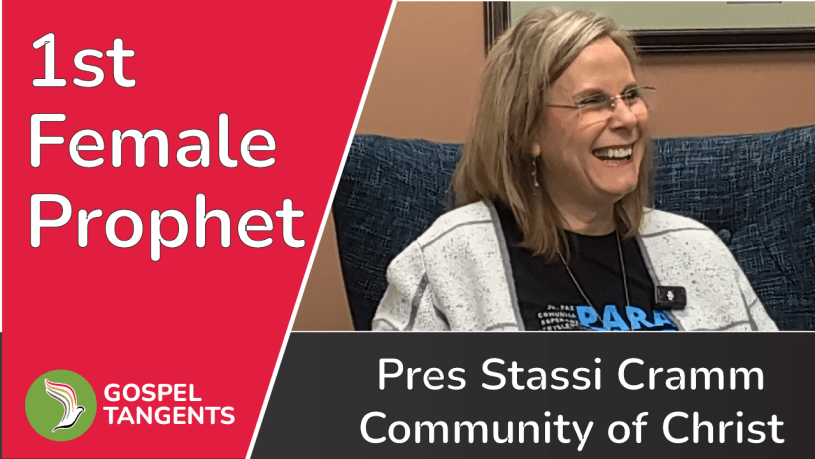
Despite being ordained just 4 months ago, Stassi Cramm has longer tenure as a prophet than (likely) Dallin Oaks, who is expected to be names sometime next week following the funeral of Russell M Nelson. Stassi and I discussed the controversial 1984 revelation that allowed for/ended discrimination for women to receive priesthood.
Look Back at 1984 Revelation on Women’s Ordination
Stassi Cramm was a young adult just starting her career in Southern California when the Community of Christ (then the RLDS Church) experienced a pivotal moment in its history: a revelation was presented that, among other things, opened the door for women to be ordained to the priesthood. For many, it was a moment of profound rightness. For others, it was a deeply divisive decision that would reshape the church for years to come.
She recalls being “oblivious” to the years of study and conversation that led to this moment, as she had been busy with university and her new job. She wasn’t at the 1984 World Conference where this new scripture, now Section 156 of the Community of Christ Doctrine and Covenants, was approved. News traveled slowly back then, through weekly long-distance phone calls and reports from conference attendees returning home.
A Sense of Rightness Amidst Division
When President Cramm finally read the new revelation, her reaction was immediate. “For me, there was this immediate sense of rightness to it and this sense of course! Why hadn’t I thought of this before?” she recalls. She expresses a retrospective sense of shame that, as a woman in the male-dominated field of flight test engineering, she hadn’t previously recognized the “lack of equal opportunity for leadership and service” in her own church.
However, she soon learned of the “divisive nature” of the decision. People had walked out of the conference in protest, and the revelation sparked a schism within the church. Congregations split. Padlocks were put on church doors, and debates raged over property ownership. President Cramm’s own congregation in Lancaster, California, handled the change well. But the wider church felt the strain.
Personal Cost of a Calling
Two years later, in 1986, Stassi Cramm received her first call to the priesthood. She remembers the vulnerability of that moment, standing before her stake conference as some members, including people she considered friends, raised their hands in opposition.
“It’s hard. You feel vulnerable anyways when you’re accepting a call. And so when there’s a group of people who raise their hand against you, intellectually you understand it. Emotionally you feel it”.
She credits the very first women who were ordained as her heroes, calling them “amazing path makers” who endured verbal criticism with humility and faithfulness. For herself, she chose to live in the difficult space of maintaining friendships with those who disagreed, recognizing that differing perspectives on whether the revelation was “of God” shouldn’t sever their ability to be friends. This, she notes, is where Christlike love becomes a conscious choice, not a feeling—a choice to respect others’ opinions even when you don’t share them.
Navigating Faithful Disagreement
This experience highlights a core aspect of the Community of Christ’s culture: navigating faithful disagreement. President Cramm later moved to a congregation in Las Vegas where a group remained opposed to women in the priesthood. The congregation found a way to coexist, making small accommodations for one another. For example, if a woman said the communion prayer, a male priesthood member would serve the sacrament to those who objected.
These were hard conversations, but they were necessary to stay in community together. President Cramm shares a poignant memory of a conversation with a woman who opposed her call as pastor. It ended with a mutual promise: “I will continue to pray for you.”
“And I will continue to pray for you.”
It was a moment of recognition that both were seeking God’s will and had to trust God to lead them forward together.
The 1984 revelation was more than just a policy change; it was a defining event that forced the church to confront deep divisions and learn how to live together amidst profound disagreement. The lessons learned from that difficult period continue to shape the Community of Christ’s approach to decision-making, emphasizing conversation, study, and seeking a higher degree of consensus on important issues.
She has come a long way since 1984, becoming the 1st female Prophet of Community of Christ!
1984 Schism & Its Aftermath
The 1984 revelation that allowed women to hold the priesthood led to an immediate schism within the church, which was then known as the RLDS Church. President Cramm, who was not present at the 1984 conference, describes the period as rancorous with hard feelings. Following the decision, there were significant conflicts, including debates over property ownership and padlocks being put on church doors as whole congregations pulled away from the main body of the church. The opposition was so strong that a resolution to rescind the 1984 revelation was brought forward at the 1986 conference, though it did not pass.
President Cramm contrasts this divisive experience with how the church handled the more recent, and also potentially divisive, issue of same-sex marriage in the early 2010s. Learning from the past, Church leadership approached the topic more slowly, with years of study and conversation. They developed “the principles of faithful disagreement,” which allow members to hold differing opinions on church decisions without being judged as unfaithful. While the church still lost members after implementing new policies on same-gender marriage in 2013, the schism was not as severe as in 1984. Today, there are still members who do not believe women should be ordained, and some voiced their opposition to President Cramm’s call at the most recent conference, which she notes is acceptable within the church’s framework.
Sale of Kirtland Temple
A significant portion of the conversation addresses the recent sale of Kirtland Temple and other historic sites to The Church of Jesus Christ of Latter-day Saints. This decision was very difficult and emotional, comparable in some ways to the 1984 revelation.
Key points regarding the sale:
- Lack of Conference Vote: The decision for the sale of Kirtland Temple was made by church leadership without a vote or formal input from the World Conference delegates. This was a major point of contention for members who felt the process contradicted the principle of common consent. A resolution was brought to the most recent conference demanding that future property sales receive conference approval, but it was ruled out of order.
- Rationale for Bypassing Conference: President Cramm explained that the resolution was ruled out of order because it conflicted with the scriptural and bylaw authority granted to the First Presidency and the Presiding Bishopric to act in the church’s best overall interest. She also stated that giving 2,800 delegates enough information to make an informed recommendation was not feasible, and that leadership needed to be trusted to do their difficult job.
- Negotiation Secrecy: The negotiations on sale of Kirtland Temple were conducted under a non-disclosure agreement (NDA), which President Cramm described as a mutual decision to manage how information was released. A public debate or vote would have weakened the church’s negotiating position, especially since it was determined that the LDS Church was the only entity capable of providing the necessary funds while ensuring the site’s continued maintenance and accessibility.
- Financial Necessity: The sale was driven by a looming financial shortfall that threatened the church’s ability to function globally. Leadership had a legal and moral obligation to keep the church operating and to ensure they could be good stewards of their properties. When it became clear they could no longer afford to properly maintain the temple, selling it was seen as the best option to preserve it.
- Response to “Revelation” Argument: When asked about the argument that the temple was given by revelation and should only be sold by revelation, President Cramm stated that she had not encountered that specific argument before and could not directly respond to it.
Common Consent and Church Governance
The discussion also highlighted the Community of Christ’s legislative-style World Conference, which differs significantly from the LDS Church’s General Conference. Members can speak directly to church leadership from podiums on the conference floor, expressing support or opposition for resolutions. President Cramm finds this process respectful, though it can be emotionally charged and uncomfortable as the presider, who feels the weight of the entire room’s emotions. The process is governed by Robert’s Rules of Order, which includes alternating between speakers for and against a motion.
What are your thoughts on the following?
- Women’s ordination
- Female prophet
- CoC finances
 Wheat & Tares
Excellent interview, Rick. So glad you were able to connect.
Could the Lord make this woman head of the LDS church? Should he?
If 2/3 of Mormons voted for Trump when they had the option of a well qualified woman, would they accept the Lords choice? Even after they obviously messed up with trump?
Can she do profit stuff?
I believe women should be ordained and have full parity within priesthood and other church offices. I also believe in a more legislative style of leadership and less hierarchical. Everything that the Church of Christ has done I support.