
Sorry folks, but this is not a throwback to one of my most popular posts, Mormon Jargon, which included Devil’s Dictionary-style definitions of typical Mormon or Utah phrases. The Church has recently published a new guide for church members to change the lingo typically used among Mormons to phrases that outsiders might find less off-putting, and that also might be more easily understood by those who were not raised in the Church (or in Utah–honestly, a lot of these are things that growing up where nobody knew any Mormons other than me, I had to do this my whole life). Another term for this is code-switching.
Code-switching is the practice of changing your language, accent, or behaviors to fit a different social situation or group. Minorities engage in code switching all the time. It’s a matter of survival. The first time it occurred to me that I was doing it was when I first got to BYU and I was in a grocery store. I overheard strangers using Mormon terms that I had never heard outside of church before, things like Visiting Teacher and Relief Society. These are terms that would have made zero sense to anyone in my community who was not Mormon, so I always used terms like “women’s organization” or “church friends” instead.
This new style guide the church is publishing does not use the term code switching, but that’s what it’s recommending. You don’t have to tell people who are in the minority to do this. They just do it instinctively, and it’s something they have to do constantly. It’s one reason that I always felt that Mormonism was better (certainly more humble and trying to be inclusive) when it was not in the majority. Any majority religion starts acting too clubby and arrogant, or so I observed.
So, here’s the style guide that the Church would like to teach members to use.
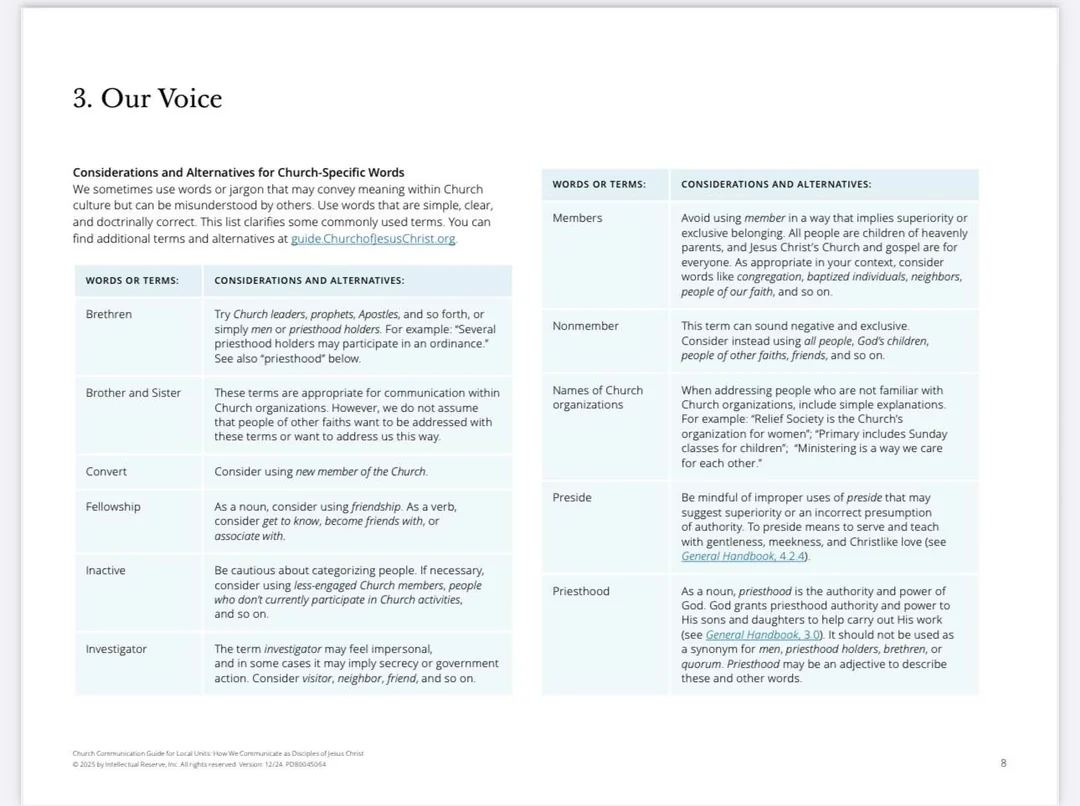
Most of these recommendations are just common sense. People won’t understand the terms because they have an idiosyncratic use in the Church. The names of Church organizations fall into this category. I always called Primary the children’s organization, like a Sunday School, and Relief Society was just the women’s group. It is interesting that they realize that the term “ministering” doesn’t really translate well outside the Church (or frankly, inside the church–amiright?)
Some of these terms have an edge to them. Using “fellowship” as a verb feels like you are revealing a sales tactic, which is exactly what you are doing. Changing it to “friendship” just masks the intent–it’s not an organic relationship based on mutual interests. It’s a way to connect someone to the church. There’s a hidden agenda, a third person (the Church) in that “friendship.” That’s not really what friendship is.
Terms like “brother” and “sister” and “brethren” also have an edge of presumption. While it may feel Christian to think of others as part of the extended human family, it feels a bit culty to call Church leaders “the brethren,” in the same way that other patriarchal churches (also deemed culty) would say “Church Elders.” It points to the unsavory nature of patriarchal conservative churches, that they are run by elderly men who make the rules for everyone else. That’s not something you want to lead with or even admit if you can avoid it. Calling relative strangers or mere acquaintances “brother” or “sister” feels a bit ick, like something you might hear on a polygamist compound (which the Church used to be, so there’s that).
Some terms are a little less problematic, such as “convert” or “inactive,” but they also aren’t as widely used outside the Church. Same with “investigator,” which also points to the sales process a little too openly. If we referred to investigators as “visitors” to the Church, that’s a whole different mindset. That is emphatically not how they are viewed by the missionaries. They are their potential sales, er, converts.
The guidance to avoid terms like members and non-members feels a little ticky-tack to me. Other faiths do sometimes refer to members, but usually that means they belong to that congregation rather than a larger faith organization like the LDS church is. Some will say congregants or parishioners, but many do say members. However, referring to someone outside the church as a non-member, particularly in a location where the Church is in the majority, can feel very exclusionary–especially since it is often used to exclude others or to imply superiority to them.
Other recommendations are a little more subtle in how they reframe the understanding of terms. For example, unlike other churches, the LDS church ordains all men, so referring to men as “the priesthood” is misleading, but not exactly in the way described here. It implies to outsiders that those who hold it are somehow special, either by calling or training, not just by virtue of being male. No mainstream Christian churches ordain all men willy-nilly like Mormons do. The word means something different in basically all other Christian churches. It’s not all men in those churches–just the ones who are in the ministry.
The redefinition of the word “preside” is kind of hilarious. That’s a word with an actual meaning, it’s in common parlance, and no, it does not mean what the Church wants to insist it means. That’s pure gaslighting, mostly so that women won’t realize that they’ve been bamboozled into unequal marriages. However, in this case, the term is probably more likely to refer to the person leading Church meetings, in which case it’s not really that inflammatory. The actual definition of preside is “to be in the position of authority in a meeting or other gathering.” How does saying “preside” lead to an incorrect presumption of authority when it literally means the one in authority is doing it? Perhaps the reason (in the context of a meeting) that it sounds wrong is that it points to the corporate nature of LDS worship. These really feel like stripped down meetings, not a transcendent experience. Even our white bread and tap water is as basic as you can get. But, preside is actually a term that many other mainline churches use to refer to the one conducting the service. Nobody else is getting tied up in knots about it.
It seems that the real blowback on the word “preside” is because the current Church leaders wanted to retain the term in marriages, which is incredibly problematic and truly unacceptable to everyone who hasn’t been indoctrinated. I would be hard-pressed to think of a Mormon married couple who would use that term to describe their actual marriage. It’s just old codgers who think it’s the natural order for those irrational women to be subordinate to their husbands. You can’t just pretend that a word that everyone knows and uses means something it does not mean except in the Church Handbook. Nice try, guys, but if you don’t want people to know that you only see men as in charge and women as dependent appendages, you’re going to have to stop actually using the word preside. It means what it means, and Church leaders do in fact mean what it means. They just don’t want to have to admit it. You might disagree with me on that one, but they are the ones trying to pretend the word means something else so they can get away with using it. Pick a new word! Problem solved!
- Are any of these recommendations surprising to you?
- Have you had to code-switch as a member?
- Are there other terms you think should have been included?
- Do you think this is primarily a problem where the Church is in the majority?
- Why do you think there’s hand-wringing over the word “preside” when used with non-LDS people, given that the term is used in the same way by many other faiths?
Discuss.
 Wheat & Tares
Wow, what an interesting and *revealing* document.
I have indeed noticed that my unit’s LDS missionaries have, over the last few years, invariably used the term “friend” for people who we previously called “investigators.” It’s a gentler term, but honestly they are not “friends,” they are people visiting and investigating the church/Church to see whether they want to join. And that’s exactly what the missionaries are encouraging them to do: please, come check out (investigate) the church/Church to see if you want to join by being baptized and confirmed a member.
And how exactly can you eliminate the word “convert” when it is so foundational for any member’s relationship to the Church? There are literally two kinds of Mormons: those who were born into the Church (“lifers”) and those who joined as teens or adults (“converts”). Those who join as teens or adults go through a “conversion process,” and leaders talk about this quite openly. Yes, converts become “new members of the Church,” but it is misleading and almost incoherent to talk about “the process of becoming a new member of the Church,” which is simply being baptized and confirmed, eliding the whole conversion process that is the real substance of the thing and what everyone is actually referring to. It’s not *becoming* a new member that needs explaining, it’s the *decision* to become a new member (the conversion process).
One could go on and on with this. I see about a half-dozen Sunstone presentations lurking in this material.
It is a very corporate thing to want to manage. There is a lot of corporate lingo that develops within tight knit organizations.
Some other terms they left off of this list:
Gentile – members of the Church of Jesus Christ of LatterDay Saints, formerly known as within and outside the church as Mormons, often refer to people outside the church as gentiles. This is insensitive and obviously problematic
House of Israel, tribes, etc and association internal to the church to the tribe of Ephraim or Manasseh. Commonly part of patriarchal blessings and rambling talks in sacrament or Sunday school. Outside the church makes us seem culty and is really kind of racist since Mormons aren’t Jewish.
Apostate – members or ex members that have been excommunicated – another term redacted to be more politically correct now to loss of membership privileges.
Lamanites – don’t call native Americans lamanites. That makes us look terribly racist and besides we changed the Book of Mormon intro and apologetics so that the lamanites and nephites are only among the ancestors of the original inhabitants of the Americas.
Ward – I am surprised this hasn’t been renamed yet to something vanilla like church community
Elder, Sister – waiting for the day when missionaries get first names back. It translates badly into anciano or old one in other languages. It confuses everyone.
High Priest – this level of the priesthood is on its way to be reinvented like seventies were.
Quorum – internally used for groups of men in the priesthood. Externally kind only used for political entities and the number of people they require to make decisions.
Bishop – calling some guy that was bishop 20 years ago bishop still is confusing.
I totally align with your assessment of Mormonism as a minority religion vs. majority religion. Having grown up in areas where my membership in the church was abnormal, it was refreshing to come to BYU and have friends that shared the same language and background as me rather than the need to code switch most of the time. After 4 years though, I really missed the minority aspects of the church and was happy to go back.
I think the efforts to make the language more accurate are welcome, but don’t need to get hung up about it. Mostly it just helps to realize that we may or may not be communicating what we think we are and to change accordingly.
I don’t really care about friend/visitor/investigator and I will know what you mean each time, but being conscious of it will lead me to use the right term in the right situation. When the missionaries invite someone to church, they could ask the person”would you come with me as my friend to the service”. While there, they might introduce their guest to the Bishop “Hi Bishop, Peter is a visitor to our ward, I’d like to introduce you” and later at the meeting with the Ward Mission Leader they might refer to the “investigator” at church. All are correct, but swapping the terms would make them incorrect.
So put me in the camp of being in favor of the ability to code-switch. I’ll read this effort as an intention to get Utah and Idaho to develop that ability.
Mormon code switching was definitely part of my experience. I grew up where Mormons were sparse enough to be regularly confused/conflated with JWs by the general population, and most of my friends were not LDS, so adjusting my language to be understood in non-LDS contexts came naturally to me. Additionally, my father was an adult convert, so I used different language to connect with my paternal grandparents and that whole non-Mormon side of my extended family than I used to communicate with my mom’s pioneer-descended side. It was just something implicitly understood, never explicitly taught. In the early years of my marriage, I sometimes would quietly remind my wife (born/raised/educated in Utah) to try not to use so much LDS vernacular in conversation with my non-Mormon colleagues and their spouses, because when she did, they had no idea what she was talking about.
The LDS use of “investigator” always sounded weird to me. Normally, that word implies close examination and careful scrutiny of evidence, which is the opposite of what the Church wants prospective members to be doing (and is probably why the Church is backing away from it). Other churches use the term “seeker” instead, but many other religious groups don’t have as much of a missionary emphasis to have any term for such people.
The Church’s attempt to redefine “preside” to fit their narrow agenda is egregious. I’m hoping that doesn’t stick.
I think little words like they have here are not as important to communication as some of the more doctrinal words we use in different ways. I got a bit into comparing religions a few years ago and found a funny reason we disagree with each other. Our definition of some words is quite different. For example, “sin” to Mormons means something bad you *did.* Catholics see sin as something that keeps you from God. So, we get upset with Catholics who say a baby is born into sin, because we think that the newborn is very innocent. That newborn did not *do* something bad. But the definition of sin is different. They think sin is any and everything about our fallen state. It is any imperfection that would keep us from God, so our very humanity is sin, our sickness, our human tendency to make mistakes, our fallen humanity is sin. So of course a baby is born in sin. A newborn is born into our fallen sinful world. Just a misunderstanding of terms if you want to look at it like that. So, “original sin” doesn’t mean what we think it means. It is our fallen state, not what Adam *did*. So, our 2nd article of faith is nonsense. Grace, same thing. Saved by Grace, Born Agains understand it like we understand it, not like we *claim* they understand it. They really do not think they can claim faith in Jesus and then continue sinning because they are saved by faith through grace and it doesn’t matter how they act as long as they have faith. That is our way of misunderstanding them so we can think we are right. And we really do put way way too much emphasis on our works and ordinances saving us, to the point that we pretend we are doing it by being good obedient people and don’t even need the Savior, just our ordinances and our obedience. If anyone gets it wrong, we do by having so much emphasis on ordinances and obedience and not enough reliance on the Savior.
So, for me, code switching is fine and comes naturally and we should not try to change our jargon amongst ourselves.
But if we really want better understanding with others, we might want to look further than “fellowship” and start looking at our meaning of some important words and start to understand how other faiths use those same words. They may not be as “wrong” as we tell ourselves they are. And really how can we convert our friends and neighbors when we misunderstand basic concepts and use the same word to mean different things?
This is mostly common sense to me. Maybe this came more naturally to me growing up outside Utah, but I’ve always been amazed at the lack of self-awareness some Mormons show about their insider jargon. One should be able to describe what you did at church on Sunday to a non-member friend in terms that are familiar to them, yet I hear Mormons all the time seemingly unable to do it. Granted, explaining “gender segregated Sunday School” is an interesting challenge no matter what terms you use.
Here’s the thing about the word “preside”. Yes, it’s problematic for all the reasons you list. But what bugs me more is that amid all of the 2019 changes to temple ordinance texts to make them less sexist (and they really were important changes), they actually _added_ the word “preside” to the sealing ordinance where it didn’t previously exist. Nice try, Oaks, but let me get out my red pen and offer some suggestions for the next revision. (I’m convinced Dallin Oaks is the author due to the addition of a reference to “God’s law”). So, yeah, I agree completely with your assessment about the old codgers, and I’d say we’d be much better off if we tried permanently eliminating “preside” from church discourse everywhere.
I believe that how we talk about things and the terms we use influences how we think about things. Culture and language both influence each other. An effort to use more mainstream terms is in some corners viewed as a cynical attempt to fit in or be more mainstream. And that may well be true to a degree. But also, adoption of softer terms for things may eventually change how members think about things (hence the urgency to excise the word “preside”), which would be a good thing in my mind.
It’s fascinating to listen to Dan McClellan’s stuff on the cognitive sciences. He gets after people who try to control definitions (e.g. what is a “Christian”). Some of these seem like a case of saying one thing publicly, but meaning it completely differently internally. The “preside” definition is absurd. I bet if you surveyed it’s usage in the church by members and leaders, you would find that the words “preside” and “authority” are used in conjunction often. “Presiding authority” anyone? The church’s biggest claims are to authority and it is talked about ad nauseum. It all comes down to authority with the church and who has it. I bet if you looked at the handbook, you’d struggle to make that definition work most of the time. Servant leadership is altogether different.
I don’t think the “God grants priesthood authority to his sons and daughters” has ever landed like they hoped. If someone from the outside came in and examined our usage of “priesthood”, I’m confident they would conclude it to be a male-only thing because saying it is one thing, but behaving like it is another is where the conflict is. Actions will always speak louder. A man always has the final say. We currently get letters from a missionary out in the field and I’m not loving the usage of “friend.” I agree with what’s already been said that it hides the intent of what the missionaries are doing. They aren’t befriending people to make life long connections or to share understanding. They are trying to drive that person into the church. It is very transactional. I mean, we might actually do better at retention if instead of making covenants the priority, we actually build meaningful relationships that naturally lead the person to want to further engage. But wait, we are “hastening the work” and we need to dunk as many people as we can before Christ comes to cut it all off.
Code-switching seems pretty obvious if you want to discuss the church with those who are not in the church. Being politically correct is pretty obvious as well when you want to talk to anyone without offending them, yet it seems to be put down by many as being too “woke.” I won’t go into all the arguments one way or the other, but if words are important enough for code-switching to talk about the church, then words are important in our everyday lives. They are a way we show respect or disrespect. Recognizing that is a common-sense part of being a civil society. I think it’s sad that we have so many in our society actively working or following to change the meanings of words from good to bad; words like woke, liberal, empathy, or change the missions of departments or companies like defense to war, or QWest into Century West or whatever it’s call now.
So instead of ‘convert’ we should call them ‘new members’, but we should also avoid calling people ‘members’?
I’ve lived in Utah and had non-Mormon, non-Utahn coworkers that understood little of the Mormon culture and vernacular around them, and I’ve lived in the Midwest where I was a curiosity at work sometimes. Code switching is useful and needed when people from one group, with their specialized vocabulary, wants to communicate clearly with people not from that group. I don’t think there’s anything inherently wrong, bad, mean or negative about this. To me these words and phrases can be broken down into three categories:
1. Words Mormons use in peculiar ways. Ward, stake, bishop, priest, sacrament, teacher, primary, deacon, elder, etc. Virtually all adults will recognize these words, and they might think they know what they mean, but in a Mormon context they’re probably going to be wrong. They aren’t going to understand what I’m trying to say if I use these words, so I use: congregation, group of 5-10 congregations, leader of a congregation, teenage boy, communion/bread and water, teenage boy, children’s org, teenage boy and teenage boy/missionary/man/men’s organization for those. (Isn’t it fun how ‘elder’ can mean so many things, but none of them are ‘old person’?)
2. Words Mormons don’t use they way other Mormons want them to. The top of this list is, of course, Mormon itself. Priesthood is the other prime example. Everyone has been told that we shouldn’t use priesthood to refer to a group of priesthood holders, but that habit seems hard to kick. (Asking for a friend: is this one also a victory for Satan?)
3. Words that Mormons don’t want other people to hear them using. This is the most uncomfortable category. Member/non-member. Active/inactive. Investigator. Convert. The Brethren. Do you see what all these words have in common? They’re all about how we view other people. They’re about putting people into buckets that we then use to inform how we feel about them and how we treat them. The words that we’ve picked says something about us. You’re part of our group, or you aren’t. You show up on Sundays or you don’t. The Brethren live up on a pedestal that we’ve placed them on. (And that whole middle initial thing just sounds weird to outsiders, right?)
My my classification system, type 1 words are where we code switch to improve communication. I want others to understand, so I use new terms. But in many contexts, I’m happy to teach someone the Mormon term. I think it is useful for anyone in Utah to understand how the Mormons around them function, so I try to explain to them what ward and stake and all those things are. It will help them navigate the world they live in, and I’m not ashamed of our unique terminology. Type 3 words are where we are hiding meaning that we don’t want others to understand. I’m sure different people would disagree about whether certain words are group 1 or group 3 words.
Finally, I find the inconsistencies with missionary titles baffling. In some instances we translate ‘Elder’ and ‘Sister’ (Italian, Finnish), in others we translate only one (Spanish), in others we translate neither (Portuguese). Can we just pick one way?
There is only one reason I can think of as to why there is this attempt to definitionally reformulate the word “preside” inside the Church. Those who preside do not want the traditional definition of that word applied to them. In other words, they don’t want any sense of superiority to be connected with that word. As if a new style guide or the General Handbook could miraculously transform the English language. But then again, it is promoted by those who “preside” so I better heed their directives!
Brian, the words “apostasy” and “apostate” are not found in LDS scripture. They should just go away. Any of the racial terms need to go away as well. “High Priest” should be replaced with “Elder,” and the priesthood offices combined. That will happen just before they decide to ordain women. JK.
The style guide makes sense to me notwithstanding a few odd items noted by the OP and the comments. The fact that they have to publish it shows just how insular the majority experience is for members of our faith. The changes would happen organically if there wasn’t a handful of Mormon meccas. But the BYUs and the amount of church members living in close connection on the Wasatch front allows them to keep these words. In the times I lived in Mormon meccas, the members didn’t code switch; they simply mormonsplained their language to anyone on the outside looking in. So in that regard I support this initiative. Curious to see how well it’s adopted.
Growing up in the middle of SL county, I never realized how odd our lingo was. Then I went on a mission to Hong Kong. Our MTC teachers taught us the Cantonese version of these words but when we used them in practice the local population was so confused. An elder is simply an old person; there is no other explanation. Whoever translated investigator didn’t use the term that we are most familiar, like a detective, and the translation simply meant someone without a path coming to find a path which is just stupid and not something anyone says. Rather than just a generic word like congregation they translated ward and stake and it was meaningless in another language. Some translations were so off the church literally changed their Chinese name while I was on my mission.
I’m thinking about the awkwardness of the use of “Elder” by missionaries that a couple of commenters have pointed out. We think it translates poorly into other langues, but probably that’s because we’ve lost touch with how weird it is to call an 18-year-old Elder in English as well. I would guess that in the 1830s our usage was probably pretty consistent with standard Protestant usage. But we went through a progression: universal ordination of males, progressively younger standardized ages for ordinations, standardizing missionary service for men at 19 and then 18, and an ongoing obsession with the use of titles. And voila, now we’re calling 18-year-olds “old” and acting like it’s normal. I’d argue that the solution to this is fewer titles in the church at all levels, missionaries in cluded. Brother and sister is OK with me; some other churches use it as well. But let’s get rid of the rest. And also the pretentious middle initials for GAs while we’re at it. If you’re named after your apostle grandfather, that might rule you out of GA service, but I’m sure we can find other things for you to do. I would welcome the resulting cultural effects of less title usages on the church.
A thought provoking article and comments. I will only add a favorite quote by a favorite author:
‘When I use a word,’ Humpty Dumpty said in rather a scornful tone, ‘it means just what I choose it to mean – neither more nor less?’
‘The question is,’ said Alice,
‘whether you can make words mean so many different things.’
When a word means whatever you choose it to mean, does it become a cudgel for your cause, while it fails to do what I want words to do, which is to describe the world in ways that make things more clear and coherent.
In every other faith group, and in English dictionaries, the word “doctrine” means that which is taught, which is necessarily often different from that which is true. Elder Bednar seems to be taking the lead position in teaching that doctrine never changes, but in my opinion, he equates doctrine with truth. Truth–that is, as God understands it–cannot be fully comprehended by mortals, and our own doctrine (classic definition) teaches that God reveals more truth as time progresses. Truth does not change, although what we understand it about it may grow, and may oftentimes be revealed only partially. Doctrine, however, is what the church teaches to its adherents. The word means “teaching” or “instruction” and comes from the Latin doctor, meaning teacher. Our doctrine will necessarily change as more light and knowledge (truth) is revealed. Some people want to teach that doctrine never changes, because that (in their minds) would weaken the all-important teaching that the prophet cannot err, ever, in anything, and therefore to allow for doctrine to change weakens what seems to outsiders to be an all-important cult of personality. I have no problem with doctrine changing as more truth is revealed or as existing truth is better understood. Doctrine can and does change, and LDS doctrine has changed over the years; God’s eternal truth does not change, but we know it only partially. That doctrine can change as more truth is revealed should not frighten us, and we should not teach an LDS-only definition of doctrine to our people. We should use the definition that all other English speaking peoples use. As for “policy,” well, that term makes good sense in corporations, but the term is avoided in almost all other churches. That word comes from Latin “politia” meaning the state, or civil administration, from the Greek “polis” or the city. It comes into English from the French “policie,” meaning the study or practice of government. Governments need policies. Churches need policies, also, for their human resources, financial management, and other administrative functions, but using “policy” when we mean “what is taught” seems unnatural.
The French are proud of their language, but when I went on my French-speaking mission I saw that our nametags used Elder. When I asked, the answer was that the word would not translate well. “Ancien” means former, ancient, past, while “aîné” means the elder of two or more. The decision was made to use the English Elder because the French words simply didn’t work and would cause confusion.
I am surprised at how people from Zion are utterly unaware how theirs words sound. Clueless. In addition to the excellent examples above, I can add a few. No one outside of our church knows what a “sacrament meeting” is, and no one know what it means to go to a sacrament meeting to “take the sacrament.” Everyone wears garments; only we use the term to mean sacred underclothes.
I appreciate Anna’s explanation of how Catholics view sin, compared to how we do. We use a lot of words that come with a lot of baggage (sin, grace, confession, sacrament…), and when we use these words before others, it would be heldful if we understood how they understand the word. Communication is more what the hearer hears than what the speaker speaks, so it behooves the speaker to select his or her words with care.
@LoudlySublime
You highlight perfectly the issues the cognitive sciences bring up. Yes, a word can mean whatever a person wants it to mean….in their own head. However, you somehow have to transmit that meaning to someone else’s head, which is the hard part. Words themselves don’t convey meaning–it is whatever context, lived experience, etc in someone else’s head that reconstructs meaning and definition. If the two experiences are not aligned, that is a miscommunication or a meaningless word. I think this is where people misconstrue the purpose of dictionaries. They are an index of meanings as they have changed over time–as in the dictionary tries to capture meanings as they change overtime, not own or create the meanings themselves. In that context, there lots of examples of words in the dictionary that have a ton of definitions attached to them because that is how people have employed those words. As such, trying to be the entity that controls the definition of something is a power play. It means you get to be the thing that says what is in and what is out. You see this all the time online with evangelicals trying to control the definition of a “Christian.” It’s solely a power play in this case.
Brian said: “Bishop – calling some guy that was bishop 20 years ago bishop still is confusing.”
I resent this!