
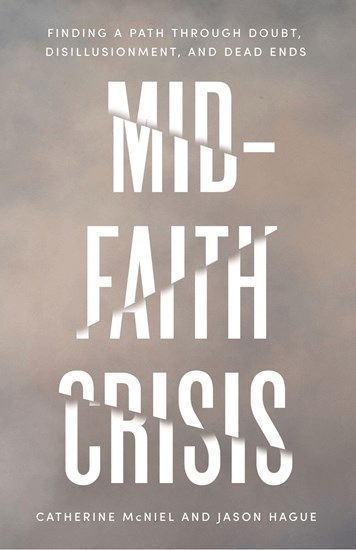
I came across Mid-Faith Crisis: Finding a Path Through Doubt, Disillusionment, and Dead Ends (InterVarsity Press, 2025) at the library. Christians of all stripes struggle with doubt or faith these days, not just LDS. The authors, Jason Hague and Catherine McNiel, are both authors and mid-life Christian pastors of some sort. They each relate their own doubting experience and also offer their advice to struggling Christians for how to work through their doubts. I’m thinking most W&T readers have heard it all before, with chapter headings like “When doubt crept in,” “When church was harmful,” and “When our beliefs collapsed.” The advice they offer amounts to: Don’t get hung up on certainty, doubt is a normal phase for most people, just keep on keepin’ on, and so forth. It works for some people, I guess. It’s a bit different to see the discussion in a hip Christian context instead of the standard LDS one.
One point before I present their own Stages of Faith schema, which I like. When Christians hit a doubting phase, they are doubting God: Does He exist? If I move from unshakeable certainty to a mix of faith and doubt, am I still a good Christian, or have I already slipped over to the dark side? Where do I go from here? When Mormons hit a doubting phase, it seems to center on Mormony things like Book of Mormon historicity; or what the heck is LDS priesthood, really; or wow maybe LDS leaders don’t have a direct line of communication with God, they’re just muddling through while running a billion-dollar kind-of-global church with thousands of staff people and a broad portfolio of assets and properties.
And a second point. When pseudo-fundamentalist Christians hit the doubt wall, they can get a broader perspective and find a mainline or “liberal” Christian church or denomination that fits their new perspective. There are lots of welcoming denominational or megachurch options. Apart from the Community of Christ (formerly RLDS), which appeals to a fairly small slice of disaffected LDS, LDS don’t have that liberal Christian safety net to fall into. When LDS lose their grip on faith, it’s a harder fall, even without the added difficulties of informal shunning and family disruption.
In Chapter Two, “Stages of Faith,” the authors give a nod to previous authors who sketched stages of faith models, including Fowler (the original), Hagberg and Guelich, M. Scott Peck (in The Road Less Travelled), and Brian McLaren. Then they give their own four-stage model with their own labels and descriptions. I’ll summarize it in bullet points, then apply it to the Mormon experience.
- Stage One: Inherited Faith. “This is where we all start: young children embracing everything we are taught by our parents and community. … Normal, healthy, human development requires spending time in this concrete, black-and-white mindset.”
- Stage Two: Confident Faith. “Most of us make this leap into stage two in adolescence or early adulthood, and we stay there for many years, maybe even the rest of our lives. … We put our feet down onto solid religious and ideological constructs that make sense of the world and our place in it while providing a path we can follow ….”
- Stage Three: Mid-Faith. This is where reflective doubt intrudes. “This stage is nearly always kindled by life’s heartaches and upheaval. Some people face new evidence about their faith communities, history, or doctrines that throws them for a loop. Or they encounter compelling points of view that challenge their earlier convictions …. There’s no way to reset the clock, no way to unsee what we’ve seen ….”
- Stage Four: Conscious Faith. I might call it Reflective Faith. Stage Four “is marked with a sense of coming back home and feeling at peace in your own skin. Should we arrive here, we’ll begin to feel comfortable with the limits of logic and the realities of paradox.”
The balance of the book, of course, is directed to Christians who are in Stage Three, encouraging them to move to a more hopeful and humble but somewhat faithful Stage Four. I’m sure readers can offer other alternatives than Stage 4, say Stage 4A (secular enlightenment), 4B (embrace quiet doubt but remain in the faith community for family and friendship), and 4C (permanently unhappy with how things turned out and determined to tell the world about it). There are, in other words, lots of paths out of Stage Three that ought to be discussed. Really tough to go back to Stage Two absent a sci-fi mind wipe.
Here are some quick LDS observations and applications. You all know what Stage One, Inherited Faith, looks like. That’s where fifteen years of Primary and Seminary puts you. That sounds like fairly intensive religious indoctrination, particularly Seminary an hour a day during high school, but there are Christian kids who attend a Christian school and get an entire K-12 curriculum presented through a conservative Christian filter. I’ve read enough commentary on Christian education to know that can get pretty wacky. They are indoctrinated a lot deeper than the average LDS kid.
Most LDS hit Stage Two, Confident Faith, in Seminary or at the latest as a missionary. But past that, the LDS curriculum, weekly talks, and General Conference talks are all aimed at reinforcing the Confident Faith outlook. Doubt is not demonized to quite the same degree that it was in prior years, but even a sympathetic speaker tells you to doubt your doubts, not your faith. F&T meeting is a monthly seminar modelling the rhetoric of Confident Faith. On rare occasions you hear a Mid-Faith story (we call it Faith Crisis) in a Mormon testimony, but that’s fairly rare. No one in the Congregation of the Confident wants to hear about doubts.
The authors opine that almost everyone hits a season or phase of doubt, where Confident Faith gives way to Stage Three, Mid-Faith (or Faith Crisis), a difficult period of self-questioning, questioning your church or denomination, and seeking a resolution or a new path. That may be overstated. Most LDS appear to live out their life with Confident Faith. They may not be 100% zealously committed to the whole LDS program — how many people show up for a service activity or cleaning the church on Saturday morning? — but if you press the average 75 percenter or even 50 percenter, they are still fairly confident, just willing to avoid some of the burdens of LDS membership.
And then there is Stage Four, Conscious Faith (I like Reflective Faith or even Reflective Doubt better), to which I added 4A and 4B and 4C above because there is nothing foreordained about moving into the Stage Four the authors describe. I guess there is also a 4D for LDS who follow doubt right out of the Church but find a different Christian denomination that works for them, or possibly a different faith altogether (Buddhism, a non-theistic religion, appeals to some nuanced types).
So what stage are you in? Does this Stages of Faith model (to which I added 4A, 4B, 4C, and 4D as alternative terminal stages) work better for the LDS experience than other Stages of Faith models you have encountered?
 Wheat & Tares
Dave B, I’d be curious to hear your (or anyone else’s) take on how this book’s faith model compares to Fowler’s Stage of Faith. I read Fowler’s Stages of Faith a long time ago, and it resonated (and still does) with me, so I think about it a lot. It’s been awhile since I’ve actually read the book, so the details are hazy.
It seems to me like Fowler’s stages 3, 4, and 5 are pretty closely aligned with this book’s stages 2, 3, and 4, respectively. Fowler’s stage 1 and 2 and this book’s stage 1 are for young people, so they aren’t terribly interesting to me. Fowler does add a stage 6, which doesn’t seem to have an equivalent in this book’s model, but according to Fowler, not many people reach his stage 6, anyway.
I guess you pointed out one difference–not with the stages themselves, but the number of people who exit Fowler’s stage 3 or this book’s stage 2. If I recall correctly, Fowler says that many people (over 50%?) will remain in his stage 3 their whole lives (that would be “TBMs”), but according to you, this book claims that most people end up leaving stage 2 as adults. Certainly, it seems to me that the majority of people still in the pews in LDS congregations are still at this stage. If we account for the number of people who stop participating actively in LDS congregations, then I suppose a lot more of them have probably moved beyond this book’s stage 2?
At this point, I feel like I’m in this book’s stage 4 (Conscious Faith) or Fowler’s stage 5. I am comfortable with dropping much of the Mormon dogma of my youth in favor of my own formation of morality and embracing the unknown. I’m still an active member of my ward. My wife would have a pretty hard time if I weren’t (although I think we could work it out if I chose to completely step away). Even though much of the talks and lessons given in Church are at the Stage 2/Confident Faith level, so they don’t really apply to me any longer when I’m sitting at Stage 4/Conscious Faith, I am often able to translate the content into something that works or just think or medidate or read my own books when such a translation isn’t possible or worthwhile.
That said, there are times when things are said or taught at church (or General Conference) that are just completely at odds with my faith or that try very hard to shove orthodoxy down my throat. Those are the times when I wonder what on earth I’m doing still participating in this at all. I don’t usually think about that question too long because I’ve generally decided that I’ll “endure to the end” for my wife.
I think this is why I do tend to push back fairly hard against some comments on this blog that just seem to blindly parrot Mormon orthodoxy, regardless of how potentially harmful, irrational, or immoral, and without being willing to even examine other points of view. Of course, that is what (some) people natually do at Stage 2 (“Defend the Faith” = “Defend Orthodoxy” = “Defend the Brethren”). However, I get far too much of that at church without being able to push back much at all (unless I want to be shunned), so I guess I find some amount of relief by pushing back against certain aspects or Mormon orthodoxy that drive me crazy here on this blog, instead–anonymously (again, so I won’t be shunned).
One finding that does seem to be common across Fowler, this book, and other models of the stages of faith, is that people who leave this book’s Stage 2 (“Confident Faith”, the place where adult TBMs are generally at) and really get into Stage 3 (“Mid-Faith”) and certainly for those who make it to Stage 4 (“Conscious Faith”), it is very, very rare for people to simply return back to Stage 2. As a result, churches probably shouldn’t try to get a Stage 4 person to return to Stage 2. because it’s just not going to happen. Attempting to take people in Stage 4 and convert them back to Stage 2 is like emptying a toothpaste tube and then trying to put the toothpaste back in the tube again. It’s just doesn’t happen. Othodox arguments or calls to repentance are not effective for people in Stage 4.
It would be a breath of fresh air, if the Church (and other churches because, as the OP notes, most churches are built to maintain and support people at Stage 2 although I have read about other churches who do a better job of this) would acknowledge this fact and try to make space for people in Stages 3 and 4 from this book. The problem is–and this is especially, especially true for Mormonism–that for people in Stage 2 (which cerrtainly includes a lot of local leaders, and from what I can tell, it includes a number of the Q15 as well), people in Stage 4 are all messed up and confused and simply need to repent to get back to Stage 2. Plus, if space for Stage 4 people were to be openly embraced by Mormon (and other churches’) congregations, wouldn’t their disease quickly spread to those in Stage 2 (who are perceived to be much more desirable in a congregation)? Until the Church (and other churches), can find a way to embrace those who exit Stage 2, they are going to continue to see them either leave–or, like me, find them sitting in the pews, not very engaged, and needing to find outside outlets (like this blog) to release the tension they feel when being forced to live in a Stage 2 world.
Climber,
I don’t know you, so this is not a personal take on your situation, so the following comment is not aimed at you. Much of what you say I agree with.
Most people I know who believe they are in Fowler’s Stage 5 are actually in Fowler’s Stage 4. An LDS person with conjunctive faith—or Stage 5 faith in Fowler’s framework—often remain deeply rooted in their faith while embracing the paradoxes, complexities, and evolving nature of faith and belief. Rather than stepping outside their faith tradition, they stay within it while reimagining their relationship to belief, scripture, and community in more flexible, reflective, and compassionate ways. If there is a strong impetus to leave due to discomfort, pain or a sense of dysphoria, that person is likely a Stage 4. Another marker for Stage 5 is a readiness to examine and find value in other faith traditions. Now one can leave their faith community while in a Stage 4 experience (Stage 4 is hell) and then evolve into Stage 5, but that is relatively rare IMO. The majority of those who leave remain distrustful of organized religion or even religion in general, therefore they are best described as being trapped in the Stage 4 perspective. I guess the statisticians identify them as “Nones.”
Now I’ll really go out on a limb and give advice to those of you who feel trapped in Stage 4 or know someone who is. Most LDS church leaders would gasp at these suggestions:
Make note of, but do not reject paradoxes. Both Stage 3 and Stage 4 folks tend to engage in severe black-and-white thinking. Avoid it. Reflect on your own assumptions, cultural lens, and biases while intentionally listening to people from different faiths, cultures, or worldviews. Stop trying to resolve every mystery or historical issue. Some are unresolvable. Stage 4 tends to demythologize (over-analyze and break symbols apart). Stage 5 people re-embrace symbols as rich carriers of meaning. Look for the meaning while reading scripture, poetry, or myths. Avoid taking everything literally and pursue the symbolic. Nurture friendships with those of different religious perspectives. And last, think about avoid seeing the suffering of life (especially the suffering that comes with passing being in Stage 4) as purely negative. People in Stage 5 see such suffering as a teacher that can reveal deeper compassion and wisdom.
I myself went through a very painful Stage 4 experience. (I hope it is over and I am a legit Stage 5.) But friends in other faiths saved me. Attending religious services of many faiths taught me to see the Divine in places other than the LDS community. Reading scriptures and religious works from other faith traditions helped immensely. (Shout out to Buddhism.) Fly fishing helped a great deal (my way of contemplating nature and touching the sacred). I choose to remain in the LDS community. I know that you’ll never see me on the stand as a Bishopric member or serving as a temple worker. But those LDS folks are my people. I differ from them in many ways. But again, they are my people and I feel at home there.
Happy faith journey to you all.
I agree with mountainclimber479 that this model is basically a simplified Fowler. I know Fowler only indirectly from many discussions about his model and not from reading the book, but I’ve always struggled to understand Fowler stage 6 in particular (thus proving I’m not stage 6, I guess). So this simplified version could possibly be more relatable to more people. It’s also worth noting Richard Rohr’s “second half of life” model which I think is based on a similar developmental notions. I would say that stage 3 in this scheme is the entry into the second half of life, and stage 4 is becoming comfortable with being there. I’d say that pretty well applies to me.
On your alternative stages to stage 4, I’d suggest that if we’re trying to keep things simple, it’s any form of “being at peace”. I’d be inclined to try to define the category broadly enough to include someone becoming comfortable in nonbelief or some kind of alternate faith, Christian or otherwise. And I would say the category of people who are “permanently upset” are really still in stage 3. I suppose some really do spend the rest of their life in that stage, but it sounds like an unhappy place to stay forever, and I think nearly everyone would be better off trying to move on to something better.
It’s interesting that you bring up mainstream Christians questioning God rather than specific beliefs as many Mormons do, because my own questioning looked a lot more like the former. For example, I never particularly related to the way some other Mormons were bothered by Joseph Smith’s seer stone. To me it was just a difference between two different kinds of magic, and I was questioning whether any of the magic was real at all.
I probably spend too much time thinking about how the LDS church could be more friendly to members in stages 3 and 4. I’d really like to see the LDS church drop the belief questions from the temple recommend. I don’t think it’s necessary and I think it really contributes to making members who start questioning feel excluded. And they are a fairly recent addition (in the 1980s). The church really needs to allow more open discussion of the challenging questions without expectation of people reaching a specific conclusion. They fear this because they don’t want the stage 2 folks “contaminated”. It’s not wrong to perceive this as a risk, but I think as long as that fear is allowed to dictate everything, we remain an immature faith that promotes immature faith among the members.
When pseudo-fundamentalist Christians hit the doubt wall, they can get a broader perspective and find a mainline or “liberal” Christian church or denomination that fits their new perspective.
Does this come from the book? If so, it sounds like wishful thinking. Mainline Protestants have lost far more young people to the “nones” than they have taken in as refugees from fundamentalism.
Disillusionment has become a part of our modern life. A reason for this is that modern life has become increasingly complex and volatile and people and institutions have proved unable to meet personal and social expectations.
The greatest disillusionment I ever experienced was with a a tech company at the end of the last century. I joined the company with great expectations. The company was young and growing and I was in a situation to grow with it. The first two years were wonderful and then things began to change. By the time 9/11 happened I was beginning to consider the reality that what I had hoped wasn’t going to happen. I never made it another year with this company. The company cut costs, consolidated offices and by summer 2002 I was out of a job and completely disillusioned about the tech industry and unsure of my future.
What made my disillusionment so profound was the mismatch between my expectations and reality. I had been employed previously by a failing company but I knew it! The failure of the previous company did not catch me by surprise and in fact I and my colleagues made the most of that situation and it was one of the more enjoyable work experiences I had.
I can understand disillusionment with religion and specifically the LDS church. The church invites members to create high expectations for themselves and their family and their church members. When those expectations fail it can be emotionally and spiritually crushing.
How does one recover? With my career, I reset my expectations, humbled myself, and focused on the things I could control. It took several years but in time my confidence came back and I found a work environment in which I could thrive. Key to this progress was applying what I had learned from my failure and not repeating the mistakes that had caused me so much frustration.
My relationship with the LDS church has been stressed. I have been disappointed in the church leadership on a range of issues but I have never been wholly disillusioned. To me the reward of being in the church exceeds the emotional cost but I understand others can feel differently. I recognize that for me to stay in the church I have to manage my expectations and in recent years those expectations have lowered quite a bit, and this does bother me. Yet I continue to have experiences in the church that give me reason to be grateful for the Gospel and Friendships my LDS relationship offers.
Stage 4C, as defined in the OP, is the closest to where I am. I find the theology and organization of the LDS mostly incompatible to my well being. However I’ve not tried to convince anyone, even my wife and kids, to leave with me. This seems like a sort of grudging respect of a hint of church legitimacy.
A couple of potential tweaks for the 4 stages model.
-I wonder if a total deconstruction of theism means there should be a stage 5. Reading the exmormon subreddit I’d say a solid 70% abandon belief in God entirely.
– Where does a passing belief or honoring traditions but a general apathy towards a faith belong? I’m thinking of the Easter and Christmas Christians here.
I think with writing about the stages we go through in life, the authors cannot see the roads they never took. As Dave says in the OP, 4a, 4b, 4c, and he didn’t even get to atheism as the final stage a lot of people end up in. In fact, from the people I have known, more who have a faith crisis end up agnostic or atheistic than ever comeback to some kind of “mature faith” the stage 5&6 for Fowler and 4 for this guy. And what about us odd ducks who go from earliest childhood into stage 3. I never had an unquestioning faith. My earliest memories of childhood were not daring to tell the teacher that Joseph Smith was a jerk and God wouldn’t pick a jerk, or that the stupid teacher is telling us this story of Noah’s ark like it really happened and by 5 I had heard enough Aesop’s fables and other mythology to recognize mythology. I mean, my daddy didn’t read us bedtime stories from fairy tale books, but from Roman mythology, Aesop’s fables, and we went on hikes in Zion National park and had quizzes on the geology so, first time I heard Noah’s ark, I knew enough geology to know that never happened. But as a kid, you can’t really blurt out that kind of disbelief because that stupid teacher up there talked about this as if it was real and obviously it wasn’t. So,no, I arrived in stage 3 doubt before I ever had any faith. Never went through stage 1 and 2 and cannot really comprehend them but OK other people say that was their experience so I believe them. But, no, I do not understand faith without huge doubts.
Another example of stages being different is Kolhberg’s stages of moral development. I noticed back in college that I didn’t fit in his stages, but took a slightly different path and ended up in a bit of a different place. I talked to the guys in my class and none of them got what I was talking about. But the women said that my explanation of the final stage fit better for them. Research since then has shown that the final stage is different for men than women. So, these stages that experts write about are their personal experience. Take what works for you and forget what doesn’t.
And most of all, your final stage of faith or lack of faith development doesn’t have to mean you stay with religion in any form. Atheism is perfectly logical. Probably most logical. Pantheism mixed with Christianity works for me. There really is no one place we “should” arrive at. So, don’t think your path in life is wrong or not as good as the next guy, or the “expert”.
I’m in stage 4B. I attend church weekly with my family. I actually just accepted a stake calling to be an education coordinator. Basically help connect people with different avenues of education and money for that education, be it vocational apprenticeships or 2-year/4-year college degrees. The bishop gave me the calling fully knowing that I don’t believe. I realize that the church community cannot really be replaced in my own personal life. It is there, I like the community aspect of it, but set my boundaries when and where needed. In my years of being under the radar, barely anyone has discussed belief with me. It seems that discussions about belief and religion, at least in Utah, are held really only in the church at sacrament meeting and Sunday School. That’s kind of it. I accept that people will continue to be religious whether I like it or not. Those who approach me with doubts about the church I will validate. I won’t try to keep them in. I will say it like it is. The church ain’t true. But what I’ve realized is that once someone can bring themselves to openly express questions and doubts and sympathy with those who leave, they’re pretty much on the way out even if PIMO is the final destination.
Thanks for the comments, everyone.
mountainclimber, I read Fowler’s book about 20 years ago and don’t remember the details. Thanks for the summary.
Last Lemming, no that sentence was my own observation, based on what the authors were talking about in terms of Christian faith challenger versus what I know of LDS faith challenges. Those are broad strokes, of course.
Trevor H and Anna, my suggested Stage 4A was “secular enlightenment,” which does amount to a non-theistic approach or straight up atheism. Religious people tend to sketch caricatures of atheism, while my sense is that “atheism” has a whole spectrum of perspectives, just like “believer” does.
Brad D, you’re not alone. I think there are a lot of people quietly on Team 4B.
I like the various faith stage schemas, even if this comment is going to come across as particularly critical. I just wanted to comment that most faith stages typologies imply to me a sort of linearity of development — you either stay in one stage or you go to the next. Further, there is an implicit normativity to most faith stage systems.
I’ll actually use part of Dave’s post to demonstrate this. While I appreciate Dave’s breaking of Mid-Faith Crisis’s Stage 4 into 4A, 4B, and 4C, I think that this covers up that faith stage schemas are opinionated about what exactly represents maturity into a later stage. What Dave has especially described in 4B and 4C — “embrace quiet doubt but remain in the faith community for family and friendship” and “permanently unhappy with how things turned out and determined to tell the world about it” — are almost certainly incompatible with what the developers of these faith schemas actually are trying to get at.
To go back to Fowler (which I am more familiar with), these definitely wouldn’t be Fowler stage 5. I think Anon’s comment gets at this, but I’d go further: I think in addition to a lot of people remaining in stage 4 (and incorrectly thinking they are stage 5), that a lot of religious conversions (even ones that a person wouldn’t self describe as a religious conversion) end up being a switch to a Stage 3 paradigm but with different orthodoxy, different authority figures, etc.,. Rather than being a solely linear progression upward (with some plateaus), I think that people can move from (Fowler) 3 to (Fowler) 4, and then back to Fowler 3. I think that the reason a lot of people overlook this is because they are over privileging the content of a particular faith tradition, and then remarking that they never went back to believing the same things they used to believe, so how could they go “back” to Fowler stage 3. But I think that these are more about the “how” and “why” than the “what”, and someone converting to another set of principles, but still in a conventional way (or, to use Mid-Faith Crisis’s description of their Stage 3, “confident”).
I think this is why in Mormon discussions that a lot of times, conservative believing members and exmormons will be on a closer page than some of the liberal/progressive members — the former two still fundamentally agree on what the truth claims that are up for debate are, what the church is claiming to be, etc,. It’s just the exmormon doesn’t accept those. The progressive member destabilizes the discussion by problematizing what the church even is, what the truth claims are, what actually “matters”.
To provoke just a little bit, I’d actually say I don’t think a lot of folks are even fully leaving stage 3 to go into stage 4 (in the Fowler sense). For example, I’d suggest every time an exmormon complains to a progressive Mormon, “But what you believe isn’t what Mormonism *is*” or “But what you believe isn’t what is preached from the pulpit,” this still requires a (Fowler) Stage 3 conventional approach to the religion. Even disbelieving these claims is not fully stage 4 — what is additionally required is the shift from external authorities (“Mormonism is what the prophet says it is”) to internal commitment (“Mormonism is what I’m committed to through my own exploration and revelation”).
As much as I admire people who can engage Mormonism and other religions with that internal sense of purpose and motivation, I recognize I’m not there.
I am some type if 4b, but „quiet doubt“ isn‘t accurate. I am beyond doubt. I have a firm testimony that the church and many of its teachings/policies are not true. At my last temple interview when asked if I had a testimony of the church, I answered yes, I do 😉.
So maybe I need a new category – 4e, which is quiet atheism/apostacy but still active in the church because of friends, family, community and basic Christian values.