

The church, like a lot of organizations, has a lot of data on members. Additionally, now that every person in the congregation has a cell phone in hand pretty much the entire time, there are new ways to gather data on members. Here’s one I just encountered today that surprised me. On LDS Tools, new members are being tracked in a pretty granular way we never had access to back when I was serving. We relied on sketchy, incomplete notes in a 3-ring binder left behind by the prior companionships. A large percentage of our converts were never seen again after baptism. After all, missionaries only got credit for baptism, not retention.
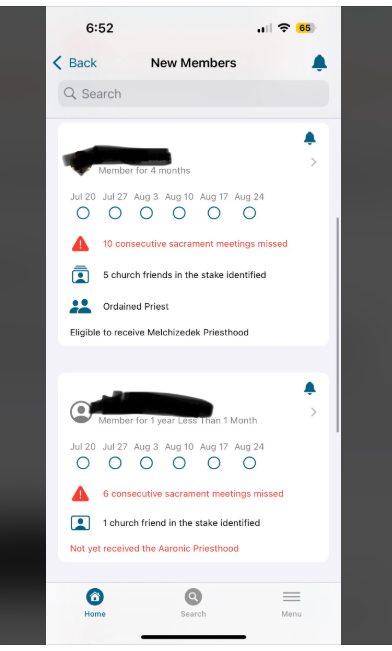
The app allows you to see not only the person’s status in terms of priesthood, but also the number of sacrament meetings they have missed consecutively, and the number of “friends” they have in the stake. This is in the “Covenant Path Progress” section of LDS Tools.
I was surprised by both of these two metrics. While I know that there is an attendance count of the congregation done in sacrament meeting, tracking it at the member level is a surprise that raises a few questions:
- Who is tracking it? the missionaries? ward mission leader?
- How is it tracked? personal observation? phone data (e.g. GPS tracking on their phone number)?
- Is this only for new members or everyone?
Even if it’s only for converts today, that doesn’t mean it won’t extend to everyone later. All I have to do is have a random conversation with someone about anything and suddenly I’m getting ads out the wazoo for this random thing. The first time it happened, years ago, I was slightly skeeved out, but now it’s just another Tuesday.
Of course, that’s here in the US where capitalism is our true Lord & Savior, and therefore, tracking personal stuff is A-OK if it’s done for profit. Not so in many other countries where mega-tech companies have had to alter their data gathering to comply with regulations. And not to be too cynical, but it’s a little hard to see the difference between the church’s efforts (which result in higher tithing paid if successful) and that of other corporations. I don’t really think the Church is that craven, but … optics. The “worth of souls” is great, and there’s a double meaning in that.
I was curious to see how this approach compares across other churches, and here’s a quick & dirty view. Most churches don’t go to these lengths, but two go even farther (which is a difference in both degree and kind as I’ll explain): Jehovah’s Witnesses and Scientology. This feels a little like being King of the Dipshits. Yay, we’re the least bad of the bad ones!
| Feature | LDS (Mormon) | Jehovah’s Witnesses | Scientology | Catholic | Protestant (Mainstream) |
|---|---|---|---|---|---|
| Attendance Tracking | Formal logs, ministering reports | Detailed meeting logs, absences flagged | Course completions & quotas | Sacrament records, not weekly attendance | Light tracking, often for outreach |
| Member Reporting | Ministering members may report to bishop | Monthly field service reports | Knowledge Reports (members report each other) | None | Sometimes small group check-ins |
| Confession/ Discipline | Worthiness interviews | Judicial committees | Auditing & Sec Checks | Confession, no personal file | Informal counseling, small group “accountability” |
| Records Kept | Membership, callings, priesthood level & temple worthiness | Elder notes on sins, discipline | Ethics/confession files | Sacramental registers | Minimal, often just membership rolls |
| Punishment for Noncompliance | Loss of callings, temple access | Disfellowshipping & shunning | Declared Suppressive → disconnection | Rare excommunication | Usually none; people just drift away |
| Frame Used | Pastoral care, accountability | Purity & loyalty | “Technology of salvation,” loyalty | Sacramental life, pastoral care | Fellowship, discipleship |
| Severity of Sanctions | Moderate, social exclusion | High, family rupture (shunning) | Extreme, family & financial destruction | Low–moderate, mostly cultural | Low, voluntary participation |
The LDS tracking system is characterized by a bureaucratic data-driven approach, systematizing the spiritual along a prescribed progression (the so-called “Covenant Path,” *shudder*). The Jehovah’s Witness system is a harsher authoritarian purity state in which individuals are monitored to ensure they do not contaminate the membership with non-compliance; those who leave or are cast out are officially shunned, including by family members. Scientology is like a totalitarian state in which individuals who criticize or leave the organization are deemed enemies to be destroyed using information gained during their time in the organization.
Longer-time institutions like the Catholic Church and mainstream Protestant sects are just not that insecure and controlling about it. One former Mormon in a mixed orientation marriage showed this tracking system to her husband and was asked in confusion “But how do you track spirituality? That’s personal. Isn’t that why people go to church?”
- Do you think this approach is useful or harmful?
- What other types of surveillance does the Church use?
- What data do you wish you knew that the Church has (or probably has)?
- Does this kind of tracking make the church something other than a spiritual institution? Does it reveal insecurity or is it efficient at building up the Kingdom of God?
Discuss.
 Wheat & Tares
Hmm. Does tracking things like number of friends, missed sacrament meetings, and priesthood offices for new converts bother me? Well, if I were a new convert, it honestly might bother be a bit, especially the missed sacrament meetings metric.
As a returned missionary (from long ago), I have some sympathy for attempting to track this type of data on new converts since so many of them leave shortly after baptism. We were simply trying to make sure that we were aware of the fact that some new converts were fading sooner rather than later, when perhaps some action on our part could be more effective. I don’t think the data was generally abused in any way–other than people not coming to Church getting some visits or calls from the missionaries (that, yeah, they may not have wanted). Way back in my missionary days, we would manually (pencil and paper) track church attendance for new members, and even back then the Church’s computer systems already tracked priesthood offices and callings. I think there were times when we did even try to track whether converts had a church friend or not, but that was tricky. Sometimes someone very obviously has made a real friend, and sometimes someone obviously has no friends, but there’s a lot of gray area in between. Since this data was typically lost (because of the paper and pencil nature of it) within 6 months or so after a new convert was baptized, and it was only used to help make missionaries aware of when a convert may be leaving, it doesn’t strike me as terribly ominous, but still, if I were a new convert, and I found out about this tracking, it might seem a little strange–especially if I had decided that I wasn’t going to continue with the Church.
I think the metrics you mentioned on new members are all manually entered into apps by missionaries/members. Based on conversations with my recently returned missionary daughter, I’m pretty sure that there isn’t any phone/GPS tracking going on right now.
One thing that would bother me a lot is if the Church started tracking temple attendance at the member level. In other words, your bishop, stake president, EQ president, RS president could log in to LDS tools and see how frequently you went to the temple, what ordinances you performed, etc. The Church could easily track this because we scan barcodes on the way into the temple (we were for awhile–can’t recall if we still scan, or if the temple worker just examines the recommend nowadays?). Years ago, when the barcode scanning started, I received assurances from local Church leaders that this sort of tracking of individual members’ temple attendance wasn’t occurring. However, I don’t know if that is still the case. I haven’t heard that local leaders have access to such data, but maybe people at Church HQ do? I think that tracking temple attendance bothers me so much because I truly dislike attending the temple, and I just don’t want any local leader to have the ability to call me out on my very infrequent temple attendance. I’m fine with them tracking temple attendance at the aggregate level, but not at the individual ward level. That should remain a personal matter.
Now that the Church has moved to online donations, I think it should remove the ability for local leaders to see donations made online by individual members. In the past, one of the justifications for allowing local leaders to see this is because donations were physically handed to local leaders, so this allowed local leaders to investigate if any member felt that the amount recorded for their donations differed from what they had actually contributed. And, I suppose, for cases where people still do physically hand donations to a local leader, perhaps donations should remain visible to them. However, if a donation (tithing or fast offering) is done through the online process, it doesn’t seem to me that there is really any need for local leaders to be able to see those amounts at all. The tithing declaration process has been modified by the Q15 to the point where local leaders are suposed to limit themselves to simply asking members to declare whether they are a full tithe payer or not, and not to ask any further probing questions *at all*. If that’s the case, then I see no reason for local leaders to continue to be able to see online donations made my individual members. The money goes from a member’s bank account to some Church bank account through an automated online system. Financial clerks and the bishopric have no involvement in this process at all, and they no longer have any need to see the amounts donated by individual members since it never passed through their hands, either.
For those who don’t know, it is possible to avoid local tracking of donations by either mailing a check or wiring funds directly to Church HQ. My understanding is that donations made directly to Church HQ in this manner are not visible to local leaders (but they are visibile in the online system to the members themselves). It’s kind of funny because if I remember correctly, it seems like there’s a Church email address that you have to send an email to ask how to do this. The canned response that is sent to everyone who does this says something along the lines that “the online system (i.e., the one where local leaders can see the amounts donated) is the only approved system for donations approved by Church leaders”. However, the email then just goes on to provide instructions on how to mail a check or wire funds to Church HQ. In other words, the email kind of says not to mail checks or wire funds to Church HQ, but then it just goes on and tells you how to do it anyway. The Church isn’t about to turn down donations–even if you choose to do it in the “unapproved” way. If I remember correctly, you can make fast offering donations directly to Church HQ, but if you do so, it just goes directly into the general Church fast offering account, so if you want your fast offering donations to stay local (at least until the stake is forced to transfer them to HQ if they have too much excess funds), then you should still use the normal online system for that. If you have a missionary, you will definitely need to use the online system to specify that the funds are for your child. However, the amount is the same for everyone, so there isn’t a whole lot of privacy lost in this case (well, I guess there is some privacy lost if you are having financial difficulties and are unable to make the payments, so maybe missionary donations shouldn’t be visible to local leaders, too).
As far as any additional tracking goes, I’m generally OK with the Church tracking a number of things at the aggregate level, but I’d prefer that not much at all is tracked at the individual member level. Individual member tracking could be used for good purposes in some cases, but I think the tempatation to abuse such data is just too great. We’d have leaders using the data to make worthiness judgments, calling members to repentance, choosing who should serve in certain callings, etc. based on such data, and I just don’t think those types of things should be purely data driven. I also don’t want to install any apps or allow the Church to track my GPS coordinates in order to improve the data that the Church can collect. It’s better to require the Church to put forth some manual effort into collecting data–the more work required to collect the data, the less likely the Church will be to track the data (or the less likely the manual process to track it will be accurate enough to provide useful metrics), so this puts a nice natural limitation on the amount of data that the Church is willing or able to collect.
Perhaps it is a sign of how far out of favor I have fallen, but the I can find the “Covenant Path Progress” app nowhere in Tools.
Here’s a weird thing to me. Ever since our ward & stake returned to in-person church there has been ZERO priority by leadership in tracking class attendance. For perspective, church units are supposed to submit a quarterly report of attendance and ministering. A stake clerk acknowledges receipt and the reports percolate up to the LDS Corp. I am in a calling that contributes to the quarterly report and I have not had any feedback about the data being incomplete and I know it is incomplete. My stake president has indicated this quarterly report data is reviewed by the area authorities because in a recent meeting he mentioned feedback he received from them about certain metrics.
Data that is considered “good” is that which is attached to membership records and metered at point of access. This would be temple recommend status, temple attendance (at least in aggregate) and payment of tithes and donations. Baptisms of children on record is easily tracked and sacrament meeting attendance can also be measured. I know the data for ministering is lousy – it is not well reported and I believe the official numbers are bad as more often than not when I visit another ward they are having a meeting about ministering.
So while it is true the LDS church has historically been “data centric” it seems to me the leadership has focused on few datapoints that matter most. Thus, while the tools app allows detailed data collection, I don’t think the leadership believes they need detailed membership activity data. The most important datapoint is temple recommend status – members who have an active temple recommend are typically going to be active members. Members who have a lapsed recommend become a concern.
Now it would be possible for the church to make detailed tracking of members who have the LDS apps on their phone. It is scary how much “spying” mobile apps do. Are the LDS mobile apps doing this? I do not know. I would not be surprised if the church collects some data made available by the phone apps but is any of this data personal and sensitive? I have no idea.
I see what you did there with the title, Mass… oh wait, I’m not Catholic. 😉
I am in the same generational class as mountainclimber479 I think. In the 90’s, Pres Hinckley came out with the list of what every new convert needs – a friend, nourishment with the good word and a responsibility. So there was a checklist that you would use in Correlation Meeting to review/plan to see what the newly baptized members would need. It was simply Plan, Do, Check, Act in local missionary work. How can you help someone get to the temple if you’re not keeping up on how they’re doing?
I get that any large org. tracking anything smells funny. It seems strange to me that it’s digitized as well when keeping it on paper should be sufficient for a local unit to have the impact on an individual that is necessary.
I’m not really surprised that the Church is going all in on data. They have been moving that way for years and its just another step in the corporatization of the Church.
However, due to personal experience with a professor who did research for the Church, I really doubt it will make any difference. From what I gathered, the top leaders are way to eager to equate correlation with causation and are quick to discard stats that disagree with their preconceived notions (a common problem with presenting data to higher-ups in any organization, I know I have that same problem at my work).
At best, maybe it will result in some fun crisscrossed findings that Church leadership would be uncomfortable with (e.g. those that skip Young Men meetings make the most effective missionaries, etc.)
It was interesting, the other day when I was listening to a talk in sacrament meeting on tithing I decided to check one of the speaker’s statements on the widows mite website. I happened to be logged onto the building wifi at the time. The wifi immediately kicked me off of the widows mite website and sent a message to me that this website wasn’t allowed on the church wifi. Very interesting to me that my local church wifi is set up to monitor websites visited to that level
We get almost zero feedback, as members, as to what data the Church collects through monitoring and reports and surveys, and what it does with it. I suspect a lot of it filters up to senior leadership where they look at reports and kick around ideas in senior leadership meetings. I doubt they often draw sound conclusions from all this data. They certainly do not publicize the data, the analysis, and the conclusions they draw — if they did, people like us on the blog would no doubt re-analyze the data and critique their flawed conclusions.
For example, LDS leadership seems utterly convinced that nothing does more good for the membership than building lots and lots of temples. Never mind that for half the people who attend, it’s something like the occasional chore that has to be done to keep the spouse happy: mow the lawn, pay the monthly bills, go to the temple. IMHO, a nearby temple puts a bit more pressure on a few local members to pay more tithing so they can get a recommend and this is largely what is driving the thinking of senior leaders. It’s revenue enhancement, which may not have anything to do with the well-being of the local members.
Interesting contrast with government. There are open meetings laws so your local government can’t (easily) meet behind closed doors and cut deals or otherwise screw the local citizens. There are FOIA requests which permit and empower citizens and organizations to get information the federal government collects. There is none of this for the Church. Data collection is a big black hole as far as the membership is concerned. The only time we hear anything is (1) when a GA reports a selected piece of positive info in a Conference talk, or (2) when an LDS whistleblower spills the beans, usually after leaving LDS employment.
@lws329, I think the IT administration of the WiFi networks is all centralized in Salt Lake. In that context, I’m not very surprised that they are blocking things. But seriously, the Widow’s Mite?
@lastlemming, I think access to this particular feature is probably only for certain leadership callings. I don’t see those features and I’m a currently serving financial clerk. Hawkgrrrl didn’t specify whether the screenshot was one she took herself or got from another source, but I’m guessing the latter.
If the LDS Tools app has permission to track location then it would be pretty easy for the app to know you’d been in the vicinity of a LDS chapel at a given time. Not foolproof but probably 80% accurate. As a side note, I’m a former member but have the app installed on my phone with my wife’s membership and login info because I like to see her ward boundaries and ward callings. I guess I’m doing my own surveillance with my wife’s blessing. They’d look at my wife’s data and see that she’s simultaneously in church and on a trail.
Overall I think the expectation for digital privacy is basically non existent in the USA. This doesn’t surprise me and maybe I’ve been numbed to the idea, but it wouldn’t bother me if I were a member, especially one with a temple recommend. Personal boundaries were crossed long ago with the old 90’s initiatory and the law of consecration covenant where I promised literally everything- apparently now including location – to the building up of the Kingdom of God. I’m pretty sure the USA government could find me pretty quickly if I have a cell phone, and listen to my pillow talk, if they want.
I’m not particularly bothered by this and am definitely not surprised by this.
What exactly will the church do with attendance stats? Nothing. I mean, maybe they will use it to guilt leaders to tell these members to attend more, but in my experience leadership isn’t interested in doing that. This data point is meaningless.
With respect to temple and tithing stats, I believe the church uses that information to direct callings. In that regard, I wouldn’t be surprised to find out if stake leadership has that information. At the very least, the church has the data and I’m sure they do something with it.
I’m quite bothered by the strengthening church members committee, despite no known interactions with them. But if that’s how they want to spend their time, I guess bully for them.
What data would I like to see? Where do I even begin?
For starters, I’m interested in more detailed membership and attendance data than what the church reports anually. How much have resignations increased and are they a consequential number? There are bloggers out there who try and estimate these things, but the church has the numbers and is choosing not to report them. I’m interested in whether activity rates have changed meaningfully over time. In some forums critical to the church it’s popular to make a big deal of attendance rates well below 50%, but I don’t ever remember the numbers being higher. So I want to see the actual numbers that I know exist somewhere in Salt Lake. Same for active temple recommends. I’m interested in trends. Is the incessant “covenant path” rhetoric making anyone want to go to the temple more (if that indeed what the mysterious phrase is meant to imply)?
I’m interested in temple attendance data to help me make sense of what the church’s objectives are with the current temple building spree. On one hand it seems like an extension of the Hinckley-era desire to bring temples closer to people, but on the other hand, some of the new ones in Utah are reducing commute times by mere minutes. Are those new temples actually increasing net temple attendance? By how much? I live near one of the first generation small temples, which is supported by something like 6-7 stakes, and we have persistent staffing issues. I suspect this is the future for the whole church 10 years from now. I’d like to know what fraction of members are serving as temple workers in different areas before and after new temples are built.
It also goes without saying that a bit more financial transparency, even just going back to mid 20th century financial statements, would be welcome.
My general sense is that the church recognizes the perils of making members feel they are surveilled, but also wants to make the sort of data tracking they have always done more automated where possible. The corporate cultures that many of the general authorities came from are ones that track everything they can. They will have to show some restraint at times in this new technological era, or maybe they won’t. It’s possible the future is one where a lot of stuff is getting tracked to satisfy someone’s curiosity in Salt Lake, but it’s not necessarily made available to local leaders.
“Hawkgrrrl didn’t specify whether the screenshot was one she took herself or got from another source, but I’m guessing the latter.” LOL, it was definitely the latter. I haven’t had LDS tools on my phone since my previous phone took a bath in French Polynesia a couple years ago.
Here’s a stat I’d love to see–what % of members are on their phones during services basically non-stop? I bet it’s a majority, and I don’t see anything the church could do to change that. This is just how society is now.
Good information is at least 50% of good inspiration. I don’t blame them for collecting data. All organizations do that. I would be worried if they weren’t trying to collect data. I just don’t know that it will do a whole lot of good. Data has to be allowed to speak on its own terms. If leadership is starting with presuppositions that are non-negotiable, data becomes kind of pointless. That all being said, I think they should be completely transparent in what they collect and how they use it.
The collection of membership data as programmed by our Faith is not something new, and is a common practice amongst many other institutions of democratic societies. The biggest collector of such information would be the governments of the countries in which we reside in the interests of government bureaucracies’ being able to properly enable the functioning of their public responsibilities, taxes, rates, energy consumption, health records etc etc ect. Churches are collect personal data of their membership in order to maintain update records for both general and ecclesiastical purposes. Our Faith collects financial data in terms of donations made by our membership with every member having a unique membership identification. But our Faith does not reciprocate as a matter of fairness, openness, and transparency to the membership an annual report for all to read in terms of assets, acquisitions, expenditures, and investments. They are able to legitimately hidie such data under the cloak of their corporate identity. Recent investigations by the USA Federal Exchange Commission uncovered massive dishonesty relating to certain financial obligations that our Faith had an obligation to be honest and report resulting in being find millions of dollaers with the financial arm of the church also subject to such penalty. Church authorities and those who had responsibilies for such reportings were had been ‘caught-out.’one’s temple attendance information is also captured as are many other aspects of one’s church-life. All internal disciplinary hearings are captured, as also confessions. Whioe I am very much aware of the church acting as BIG BROTHER peering over my shoulder I’m not that fussed about what information is captured about me, but it would be interesting to know wehether ourn Faith would provide all such information held about its members upon request of the individualo member. Thet would be obliged to disclose the same as the information is ‘personal’ and every member ought to be entitled to know what of their personal information has been captured, and to what purpose.
Related to issues with the collection of data, the interface has not adapted to meet the realities of our world. When I was a ward clerk, a sister got divorced and remarried, this time to another woman. I don’t want to discuss whether her choice was right beyond noting that she is much happier now than she seemed to be then, but as clerk, I tried to record that she had remarried, and could not, because it would only allow me to record a husband.
I don’t care if you believe such marriages should exist, the fact is that they do, and that when I was clerk, the system did not allow me to record a legal marriage. The choice to list her as unmarried rather than to acknowledge that she had remarried felt very wrong to me.
I am afraid that if local leaders gained access to greater data on individuals that it would be used for nefarious purposes. I came to that conclusion by having had conversations with my Bishopric and Stake Presidency about what they would do with such data (especially temple attendance and finance). I can only conclude that “unrighteousness dominion” would become even more apparent and a decreased amount of privacy regarding religious activities would not be positive developments. Infantilization of non-leadership members would increase. There needs to be limits placed on the “tracking” and data collecting abilities of church leaders.
Oh, if we’re going to fantasize about interesting stats (like the percentage of people on their phones during church services), a few more just popped into my head:
1. Average percentage of students on any given day taking early morning seminary who are actually conscious and able to pay attention in spite of sleep deprivation.
2. The average increase in a student’s high school GPA when they decide to drop out of early morning seminary to get more sleep.
3. The average amount of content consumed by Church members on official Church websites/publications. What would be really interesting to see is how that amount has changed since before the internet, and people received the Ensign in the mail once a month to now where I think a lot of people find higher quality content (orthodox and non-orthodox) outside of official online Church sources. I suspect engagement with official Church publications has significantly declined as the internet has provided a lot more unofficiasl Church-related content.
4. The percentage of members who went to the temple and really did “learn something new” of substance on any given visit.
5. The percentage of missionaries who masturbated at least once within two months of entering the MTC. Also, the percentage of those missionaries who were asked about it by a local leaders. Also, of those who were asked about it by local leaders, the percentage who told the truth.
6. Same metrics as #4, but this time tracking porn consumption.
7. Same metrics as #4 and #5, except this time ask bishops and stake presidents instead of missionaries.
8. The percentage of declared full tithe payers who aren’t actually full tithe payers (by their own personal definition of full tithe as well as the “net” and “gross” amounts).
9. The percentage of members who believe in the “tight translation model” and actually believe that Joseph read off the letters a-d-i-e-u one by one from the rock or the Urim and Thummin when translating Jacob 7:27.
10. The percentage of members who would be very happy if garments were only required to be worn inside the temple.
11. The percentage of active Mormons who take a “garment break” whenever they go on vacation where no ward members can see them.
12. The percentage of returned missionaries who still have weird dreams/nightmares about their missions decades after returning home.
@mountainclimber479. These made me smile, thank you.
Re: your #1 and 2. Early morning seminary had a huge role in 3 out of my 4 kids leaving the church. The teachers were anti science and really logic and would say things like “you can’t trust science” and “gay people are unhappy”. I wouldn’t be surprised if it’s a net negative for church participation.
Another metric proposal: % of members who are embarrassed every General Conference when the leaders are wheeled out and look more like mummies than humans.
Regarding Hawkgrrrl’s comment about percentage of members on their phones during sacrament meeting, I’d say based on personal experience, it’s pretty high. I am guilty in this regard myself. I can think of one recent talk by a high councilman that got me to put my phone down and really listen. The topic? Loving our neighbor. It was really good. Sadly, he’s not the guy regularly assigned to our ward because I’d like to hear more from him. The answer to how to hold the attention of the membership, I think, is a compelling message about how to actually follow the example of Jesus. It seems so easy and yet so hard.
Quentin, the screenshot comes from a thread on the exmormon subreddit from a couple weeks ago.
Quentin: I think you are right about the fact that many (most?) of the content at church is just not sufficiently captivating to get people off their devices. Even when I watch TV now, I’m on my coloring app. I attended with my very elderly father and my extremely TBM sister, and I realized she & I were both catching Pokemon! (Her grandkids and my kids got us started on it–it’s one of the few things you can do inside a Mormon chapel while mostly listening to the speakers). After my mom’s funeral, my TBM brother asked why I hadn’t attended my dad’s stake conference that day (which struck me as truly bizarre–I have never in my life been so invested to attend someone ELSE’s stake conference, LOL). He said I had missed a really great talk. I said “Oh, what was it about?” He could not remember. I said “Well that sounds convincing.”
So while reading through this most excellent post, I got curious about what data is actually collected by my LDS Tools app. It can:
“-Access precise location only in the foreground
– directly call phone numbers
-read phone status and identity
-run foreground service
-control vibration
-control Near Field Communication
-run at startup
have full network access
-use biometric hardware
-view network connections
-prevent phone from sleeping
-Play Install Referrer API
-Access to Adld API
-access AdServices Attribution APIs
-show notifications
-receive data from Internet
-read Google service configuration”
And then a disclaimer at the end that “updates may add additional capabilities within each group.”
These are fairly benign, mostly functionality-related permissions, especially when compared with some other apps we typically have on our phones. But, they do allow for collection of a lot of data, and Hawkgrrrl is right that of course the church is going to collect everything they can. It improves efficiency in operation, and everyone knows that the hallmark of the kingdom of heaven is its orderly, efficient operation!
The Covenant Path tracking does exist on the app, it was visible for me when I was the RS rep for ward missionary meetings. Now that I no longer have that calling, I can no longer see it.
This kind of information isn’t available to just anybody. You have to be serving in a calling that would negate the need for such information. I can’t even look this up for my ministering families. I guess bird grrrl has the power supreme from all her positive contributions to the church? You’re my idol.