

How much would you pay someone to care for your children? What about to care for you in your final years? Would you pay more if the care was commensurate with the amount your paid? Without the exploitation of free or underpaid labor, our society would collapse. Maybe it should.
Years ago, I was at a Seminary Graduation dinner, and the woman sitting next to me talked about her daughter’s plan to become a teacher. She said, “That’s a good career for a lady.” She clarified that a man would have to earn more than that, so obviously it was fine for her daughter, but not her son. I said “Oh, I didn’t know women were given lower mortgages or discounts on groceries.” She understood my point, but she was a pretty staunch supporter of the patriarchy, including her church talk in which she decried the girl in Steubenville who ruined the lives of those boys who gang raped her and filmed it. Ladies and gentlemen, these are your fellow Mormons.
In a recent post I expounded on Andrea Dworkin’s book Right Wing Women, in which she talked about the devil’s bargain women made with the patriarchy because they had two choices: marry one man to support them financially whom they could manage who might oppress and beat them but hopefully not, or remain single and subject to a workplace in which they might be harassed that would not pay them enough to live on independently. Fortunately, the situation is less dire than it was when she published, but we haven’t arrived at the promised land yet.
The real way to increase the birthrate is to eliminate women’s rights. When women have choices (education, anti-discrimination, equal pay), they choose to have 1-2 children. Men convince themselves that they are “good guys” by believing the lie that women are just better nurturers who prefer to do caregiving and don’t want to work in careers. There are women who enjoy caregiving, and there are also men who enjoy it; but they also can see that it doesn’t pay enough to have financial security. Caregiving is also demanding. Like a newborn, it never sleeps. It’s not a 9-5 operation. Without an unpaid or underpaid workforce of caregivers, teachers, cooks, cleaners, and domestic laborers, those working in corporations would not have the support to earn what they earn. But the system hides this labor. What is unpaid is invisible to us. Like plantation owners, we can tell ourselves that our unpaid labor is well treated. They want to do this work. This is their choice. They aren’t being forced.
Imagine a world, maybe a sci-fi thought experiment, in which a baby was born but was not raised by its biological parents, but instead went into a caregiving facility to be cared for, loved, fed, sheltered, and nurtured into the next generation of productive workers. Would society expect those caregivers to work for free? Would it be indifferent to the type of nourishment, the education, the attention that was being paid to the future workers? Probably not. Our system continues as it is because of false narratives, economic compulsion and inertia.
At a 2012 women’s conference, Ursie Burns, CEO of Xerox, spoke to 200 female executives at Amex, of which I was one. She talked about the issues we all faced if we had families at home. She said that for some reason men were simply not filling those vacancies at home, so we ended up having to do both things, manage our careers, and manage our houses and children. She wasn’t advocating that we let go of our home lives which are a great source of fulfillment, but she did note the problem.
“If women counted in the GDP, the economy would collapse under the weight of its own exploitation.” – If Women Counted: A New Feminist Economics
As we enter a phase in which there is a larger population of aging parents than children to do caregiving, and the costs of caregiving are not baked into our economy (the average monthly cost for assisted living is $5K-$10K–do you have that much extra laying around to help your parents? Do they?), the question remains: who’s going to stop doing paid work and do this unpaid work? In my family, it’s being done mostly by a brother (who works remotely) and a sister (who doesn’t have a job). But it’s a full time job in and of itself that costs money to do and also impacts one’s earning potential.
There are policy changes that would improve these problems with unpaid caregiving:
- Universal Childcare & Elder Care. Every parent knows that once you can send your kids to school, you are suddenly much more free to do paid work. Expanding this to including pre-K and after school programs makes a huge difference. Adding elder care facilities would be another huge boon to workers.
- Paid Family & Parental Leave. Today we have guaranteed unpaid leave of up to 12 weeks, limited to one employee of a company at a time (Sarah McBride has crafted a bill to allow FMLA access to two adults working at the same company, an issue in smaller towns).
- Social Security & Pension Credits. People who are doing caregiver work need to have a safety net when they get old, too.
- UBI (Universal Basic Income). Romney’s plan for child credits would have actually functioned similar to a payday for caregivers, like an actual amount they could live on. But we can’t have nice things.
- Gender Pay Transparency Laws. One thing that consistently happened throughout my career was my boss coming to me and giving me an off-cycle pay increase because she noticed I was so underpaid compared to my peers. This is something I also noticed and corrected with the women who worked for me. I almost never discovered that their male peers were underpaid.
- Investment in the “Care Economy.” This was a priority for Biden’s administration, but it is definitely not for today’s GOP. It was something Romney was often thinking about. Congressional gridlock was the death knell for this.
- Reproductive Rights and Health Access. Women, not men, should be the ones who decide when to have a child.
We’ve been watching the Bob Newhart Show lately (from the 1970s). These are always interesting time capsules of a bygone era. They were considered mostly progressive for their time. Bob and Emily both have careers. He’s a psychologist; she’s a teacher. He handles the bills (once a month); she does the cooking (every day) and cleaning (as needed). They do not have children or plans to have children. In a recent episode, a French couple comes to visit, giving them grounds for an argument about how to host them. Bob wants her to cook duck a l’orange. Emily says she doesn’t have time for that, and they should go out to dinner. Bob says the apartment is too dusty. Emily says they have dust in France. Bob’s nagging becomes quite heavy-handed. If they’ve divided the domestic labor, then he doesn’t get to dictate how she does her part, especially given how much more work she’s taking on. When the French couple arrives, the man bosses the woman around relentlessly, and the woman is upset and crying. Only at the end of the episode do we realize the woman is his mistress, not his wife, and that “explains” his rough treatment of her.
Our current economy depends on other forms of unpaid labor as well: undocumented or migrant workers, offshoring to the global south, prison labor, internships (student labor), post-retirement labor, and gig workers. These are also exploitative labor practices, but they are baked into our economy. Unwinding them would require a substantial change that those who profit (the corporations that are “people” for example) are not willing to make.
So, as usual, let’s pivot to religion and the LDS church specifically. The church also relies on unpaid labor, not just women, but also everyone who isn’t working in the Church Office Building. It’s also interesting to consider the labor used as compared to the amount of decision-making power the person has. Women, as discussed in many posts, provide free labor to the ward but have no decision-making power that can’t be overruled by a man. Men, by contrast, may be asked to provide a LOT of time and effort if they are in a leadership role, and this is also unpaid labor, but they do also get a lot of power in the process, the ability to choose their unpaid workforce, the ability to set the culture of the ward, and to make decisions that affect everyone else. Other unpaid labor that the church uses: temple workers (mostly done by post-retirement people), full-time missionaries (which is not only at their expense, but is how the church adds new members), early morning seminary teachers (daily time commitment at like 6am? Oof!), and of course anyone who has a calling (which vary in terms of time commitment). Additionally, members in good standing must pay the church 10% of their income.
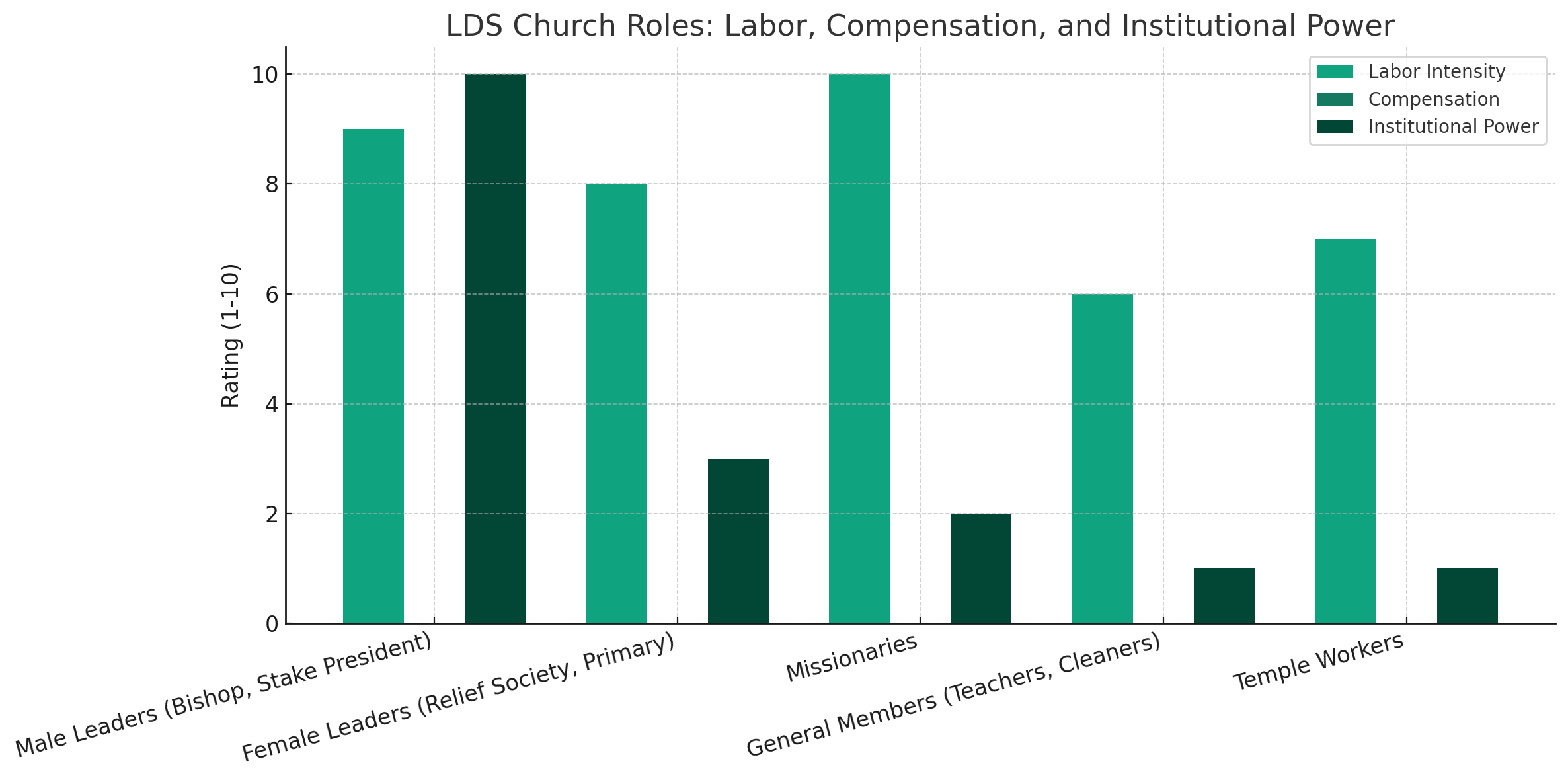
So while I certainly would not wish to downplay the time commitment if you are a male leader, your institutional power is mostly unchecked. All the above positions are unpaid, so that’s equal among them. I suspect everyone here grew up with the cultural norm that you don’t refuse a calling under any circumstance. Once you start setting boundaries, you are probably on the way out the door.
“The unpaid labor of members is treated as a sacred duty… yet it’s difficult to ignore the economic efficiencies it creates for the institution.” — Jan Shipps, religious historian
“It’s not just tithing — the real sacrifice is time, exhaustion, and emotional investment.” — The Mormon Worker
None of this is to say that people don’t find any personal fulfillment in caregiving. Human connections bring meaning to our lives! I also find fulfillment in creating revenue streams, doing data analysis, reading novels, riding my bike, and cooking a fine meal. A system built on the backs of free labor is not only unfair; it’s increasingly unsustainable.
Years ago, an LDS feminist made a comment on social media that had me scratching my head. She said that she always took it at face value that the Church valued motherhood, but she had learned over time that they didn’t value it at all–there was no monetary value associated with it, and it was impoverishing her. In fact, it was like a trick that prevented her from earning a living, from being able to be financially secure as a woman. She pinned that on the church, which does teach a pretend respect for motherhood, but if you work for the church in any paid capacity, you can very quickly see that they would prefer that motherhood be a prison for women, not a blessing that benefits everyone. The church could, even more than the country at large, support families with supplements for caregiving. To some extent, polygamy (which don’t get me wrong, is its own sick sexual exploitation) was designed to do this. Some of the women can do all of the caregiving and others can become doctors or lawyers. On the whole, the church’s employment benefits are designed even worse for women than the US policies on the whole, and they use religious exemptions to allow them to maintain the status quo.
- Have you run into issues because of the need to cover unpaid caretaking work? What did you do to manage it?
- What US policies would you like to see change? What church policies? What church (as employer) policies?
- Do you see the women as “nurturers” argument as a patriarchal ploy to allow men to feel good about exploiting the free labor of women? If not, why not?
Discuss.
 Wheat & Tares
I see the “nurturers” description as another way for men to identify themselves as “not women” (probably subconsciously). I know it is generally used as an “off-the hook” compliment (sometimes tinged with awe) that men give about the executive functioning and emotional labor of women that men do not feel as qualified to engage in and are rewarded less for in terms of individual male identity in our culture.
The thing is, we are all “presiders” and “providers” and “nurturers (or mentors)” of others in our spheres of influence. The majority of us “preside” over the decisions we can control in our lives (including how we emote our emotions), we “provide” for others and they provide for us in hopefully sustainable interdependent ways, and we are all called to “mourn with those that mourn” and attend to others as well as ourselves.
I would like to see mandatory paid parental leave. It’s now the norm for a lot of professional jobs, but it was not the norm when my Gen Z kids were born (which makes me jealous when I see co-workers take the leave now), and it is definitely not the norm for large portions of our economy. All the other “grown-up” countries do this except the US, and it would make a big difference for a lot of people.
I’m not sure church policy changes can have that much of an effect on unpaid caregiving, but just for the sake of the culture it might be interesting to have something like a Relief Society temple night where the women all go and some of the men are asked to volunteer to do childcare.
I would agree that LDS culture doesn’t actually value motherhood for the reasons you give, but on many points like this, Mormon culture is merely American culture wrapped in theological rationalizations.
I am going to zero in on one problem you mentioned, the church’s exploitation of senior missionaries. Just because I am angry about it.
A couple close to my husband and I did two Trek missions and enjoyed them, meanwhile they are getting older. So, retirement for her as she is a bit younger as starting. Two 18 months missions, with about 18 months in between. Then a two year break and another senior mission, so they are getting up there in age, with the husband in his mid 70s. This latest senior mission had him doing semi physical labor 12 to 18 hours a day for 6 days a week and only working 5 or 6 on Sunday because missionaries are expected to go to church. She was doing office work that actually required a lot of walking and up and down stairs for about 10 hours a day. They weren’t complaining in their emails home, but you know they WERE. They were exhausted. This is just too much for free labor…no actually they were paying for the “privilege” to be worked like slaves and not allowed to see their children and grandchildren. This is just too damn much to ask of old people. We invented retirement because old people are just too old to be working 8 hours a day, so the church of antichrist asks them to put in 12 to 18 hours a day. If this was paid employment, this would be illegal. But since they are voluntolds, it is fine for the church to exploit them in the name of God. Isn’t abusing people in the name of God taking his name in vain?
And just the other day a senior missionary was killed when he was put in a dangerous situation by the church. He was on a riding lawn mower on a hillside when it tipped over on him and killed him. A riding mower on a hillside is dangerous, and stupid of whoever asked him to do that. Obviously the slope was enough to put the mower off balance so it rolled over on top of him. I hope to god his family sues the church for a good chunk of money seeing as money is the only thing the church understands.
Professionals should have been moving that lawn, with a specialized lawn mower that cannot tip over. Not senior missionaries. But senior missionaries have become a source of free unpaid labor in jobs normally covered by professionals. It isn’t at all that the church could not afford to hire people for what really ought to be paid employment by people trained to do it with proper equipment.
I am sorry, but the only word to describe this kind of abusive exploitation is probably not fit to print.
I can’t even think of any abusive cult that treats seniors worse.
I am so glad I apostatized before we could get called on a senior abusive session.
I’m not going to take a stand in favor or against the various public policies that would enable families financially to have more children because I am conflicted on these. But I will say this: the very people who preach that we need to have more children, that mothers need to stay at home and raise those children, and that we as a society have become too worldly are the very same people who are typically against the public policies (paid parental leave, etc.) I am referencing. It reminds me of the folks who are “pro-life” but who are against the social programs intended to help poor kids/families once the baby is born.
Where some people see unpaid labor, perhaps others see people volunteering, with no coercion, and I am heading into the city in a few minutes to visit a man in a hospital, at my bishop’s request. I do not have a problem helping to clean the church.
Before most people earned a salary, a man and a woman divided the labor in ways that worked more or less well. It is true that women could not work, and we have remedied that, but women also were not compelled to be cannon fodder for the king’s war. Couples today still have to divide the labor. Unpaid caretaking work? Is that not what families do, or used to do? My wife is away from home taking care of a dying relation right now, and there is no pay, nor is my wife seeking payment. No one is exploiting her. I do not think that I exploited my wife’s unpaid labor when our children were home. She chose to stay home, and financially it hurt because she earned more than I did at that time. We did without many nice things, but that was our choice, and more importantly her choice. My wife does not think that she was exploited, and she is no Molly Mormon. I think that most couples today try to figure it out, and there is no one-size-fits-all solution.
“Ladies and gentlemen, these are your fellow Mormons.” Really? That was one person. She doesn’t speak for my wife or me. Painting with a very broad brush there. Contrary to some assumptions, all Mormons do not think the same.
I am not ready to send all children to orphanages after nursing. Or immediately upon birth: they can provide wet nurses at the orphanages! There is a ST Voyager episode that deals on how the Borg raise infants, and I am not a fan. We have heard a lot of horror stories coming from orphanages over the past few centuries. Do we want to compel parents to unwillingly surrender their children to the state? Would this be progress? It would reduce the resentment some women feel toward women who stay home, but is that grounds to make the state the owners of all children?
I don’t know anything about how the church manages female employees. The same as men, I would hope. I am ok with parental leave, but I wouldn’t put that burden on small businesses.
Bad as it might be, children in families appear to do better than those without. How do we improve the outcome for those without, while not destroying the good that statistically does happen in families? That is a tough question, and thanks for raising a question that merits a lot of thought.
Georgis, I am just like your wife in that I gave up career and stayed home to raise children. It worked out well, because my husband didn’t die or divorce me. If he had, I would have been thrown into poverty in spite of having a good college education. I had no real work experience in the 20 years I followed my husband around the world, moving 20 times in 20 years for his military career. It was a huge risk. Huge.
That is the terribly vulnerable position we ask women to take, with no safety net. OK, the Air Force would have given me enough money to allow me to support my children long enough to get my education updated with all the licensing needed for me to work at more than minimum wage. But betcha your wife didn’t have that. Betcha she was taking bigger risks of ending up in poverty than even I did.
See, even if it a willing choice it is still a huge risk. And right now women are being forced out of the workforce because child care costs are so high. That isn’t really a willing choice. Well, to tell you the truth, it wasn’t for me either. I really wanted more career wise than moving from hell to breakfast for 20 years, not staying in one place long enough to really get everyone settled into school and everything before we knew we had to move again. But during that time, I managed my 4 year undergrad and getting a master’s degree. Yeah, I took more than the allowed for full time (I got special permission cus I am smart) number of credit hours, went to summer school and all. Paying extra because the only university in the area was a private Catholic university, compromised on the degree I really wanted, settling for what was offered.
Why was my husband not expected to make any of those sacrifices or take any of the risk of being one man away from poverty?
Because there is no protection for those of us asked to do all that unpaid labor. And that is what is wrong with your idea that your wife took it all that risk on happily and willingly. How happy would she have been if you had been killed or left her for some arm candy?
There is a reason that the largest group of people living in poverty is women raising children by themselves. And if our society is going to keep demanding that people risk their well being when they take on unpaid labor, then it should come up with some kind of protection. Either give those doing unpaid labor credit for the job experience of the work they did, or have mandatory retirement accounts for housewives, or stop expecting women to be the ones to sacrifice so we have a future labor force (and future cannon fodder). Let’s see, job experience, I did work as a chauffeur, dishwasher, cook, house cleaner, and my volunteer work, I led a women’s organization, did master’s degree level counseling, led an organization for teaching children, ran a day care, taught adults and children. I had pretty vast experience when I finally hit the job market. But zero of it was worth anything because it was unpaid and therefore worthless.
Does anyone else find it ironic that our church general RSP is handing out copies of the proclamation to the world on the family after her great career in law? The church has kept focusing on the anti – Pride sections of the document but then we have a woman with a really successful legal career handing out a document that says women really shouldn’t work. Huh? And don’t get me wrong, I respect our general RSP, she is supporting some really good things.
I just finished a book on the topic of this post, Holding it Together, by Jessica Calarco. You might enjoy it! It highlights about 10 different real stories of women in US society who consistently get in worse and worse binds by trying to do what’s right.
Visiting? Does that include changing his diapers? Bathing him? Turning him so that he doesn’t develop bed sores? Waking in the middle of night to give medicine, toileting, comfort? How long a visit? An hour? A week? Three years?
No women were not conscripted. They could wait at home to be raped and have the roof burned over their heads. And “feeling” that one is not exploited doesn’t mean one isn’t exploited. Some women actively encourage female genital mutilation in countries where that’s a traditional practice, and they would tell you that they do not “feel” exploited nor do they think that it is wrong to do this to their daughters. Tradition, especially when bolstered by religion, is powerful and often deadly/
Anna, thanks for your insightful input. My wife has a real degree and real work experience, and she could have returned to work easily. I also had good life insurance, so while my early death would have hurt, shr would not have been destitute. When my wife was at BYU, the RS president brought in a woman to a lesson to talk about education amd career. Most of the women, all in their 20s, made it quite clear that they were on the marriage path, and they didn’t need to worry about careers. This woman brought sobering statistics about the number of women who will divorce, or husband will die, oe husband will get hurt and lose ability to provide. Very few women in that room had any time for the guest speaker. My wife was in the minority, but she was still Mormon. My wife still recalls the ignorance that dominated in that room, and the RS president was trying to give these women real facts. They didn’t want them. It wasn’t because they were Mormon. My future wife and the RS president were also Mormons. My wife and I were also in our early 30s when we wed, first marriage for both. We also used condoms for the first year or so of marriage. I don’t live in Zion, but there are women in other faith groups in my part of the country who also just think about marriage, and then they’ll be on easy street. Independence is good, and my wife was independent. We came together as two independent people and we decided to work to craft a real partnership, and we both gave up some freedom. Even now I won’t spend over $100 without letting my wife know, and sometimes she says no and sometimes she says wait. We have never donr his and her bank accounts or credit cards. We paid off her and my student loans. Maybe it is good for others to marry the first person who sets the blood aflame, but we both waited until our low 30s, faithfully so far as some commandments go, but we didn’t follow the counsel to marry young. And let’s be serious: is there a commandment to marry young? There may be counsel out there to that effect, but there is no commandment. Saints who cannot tell the difference, and who take all counsel as commandment, probably err. All counsel is not good for everyone in every circumstance. There is a lesson we should teach our youth and adults.
“And she answered: ‘All your words are but to say: you are a woman, and your part is in the house. But when the men have died in battle and honour, you have my leave to be burned in the house, for the men will need it no more. But I am of the House of Eorl and not a serving-woman. I can ride and wield blade, and I do not fear either pain or death.’
‘What do you fear, lady?’ he asked.
‘A cage,’ she said.”
― J.R.R. Tolkien
Georgis: “My wife has a real degree and real work experience, and she could have returned to work easily.” Not true. It’s a great story we would all love to believe, but agism is real, and there is a huge, well documented penalty for gaps in work experience on your resume, including when it is due to child or elder care. The mommy track is viewed as an exit ramp. Whatever your reason to leave the work force for any length of time, you will not find it “easy” to return at anywhere near the level of your experience and skills.
Hawkgrrl: Good essay and things to think about.
I think you’re spot on with your observations about men and women and how they are treated in the church and society. It’s also interesting how many countries are now addressing those issues (mostly in Western Europe and particularly in Scandinavia), but so many are in denial in our country.
I think what really proves your point is the laws passed by the Utah Legislature, where stadiums are funded while children are denied dental care. That’s just an example. I remember when the Salt Lake Real stadium was built and how it was funded. However, we could also highlight that Utah ranks last in Education funding, that it does not accept federal Medicaid funding to support children, or that we are the only state that provides kindergarten but does not require it. We could talk about social programs, sales tax on food, or solving violence in schools with “guardians” who volunteer to take guns to school.
I wonder how the church reports how much it spends on its charities and welfare. Is it actual dollars, or does it include a monetary representation of volunteer labor? We know some money is spent. We know some goods are given that have monetary value. But we also know that many of the goods and some of the distribution is done with volunteer labor, and is that included as a monetary value? When they say they spent 1 billion last year, what does it mean?
Finally, I think what proves your point is the gaslighting we experience at church every week. Things like “Men may be the leaders, but women turn the head,” or “Without my wife, I’d be……… fill in the blank.” As I’ve learned over the years, men and women both struggle with “sin,” and they are both equally capable of goodness, kindness, empathy, or leadership. Men and women who are single parents after a divorce both experience being pariahs in their wards.
My 60 year old brother in law never married and he turned into the de facto caregiver for his mother, now in her 90s. He gets housing, food, a car, and an undisclosed wage but I’m guessing not much. It’s turned him and my MIL into an unhealthy codependent relationship. Once she dies he will be utterly lost emotionally and unemployable.
In a weirdly similar way my wife had a codependent relationship with the church after she was called as release time teacher. She spent 4-6 hours 5 days a week for her calling, the equivalent of a part time job for many years. She loved the calling and the attention from her students. Her own children and I equally despised the calling.
Both the seminary teaching and the caring for my elderly MIL don’t “count” as jobs, and probably actually hurt their job finding prospects because that’s more time since they had a job considered legitimate by IS employers. The church absolutely takes advantage of women.
I’m largely in agreement with what’s written here, but I have some nuances that give me pause when considering remedies. Some random thoughts:
* I think the real problem here is around exploitation. We don’t want to see businesses or churches exploiting unpaid labor that *should* be paid for. This is all too-common.
* I don’t want the whole world to become transactional. Life is only possible via “unpaid labor.” Maybe you and I draw the line between “making things work” and “exploitative unpaid labor” at different places, but there has to be a nuance there or society doesn’t work at all. I think a society of all mercenaries and prostitutes where everybody asks “What’s in it for me?” is a pretty negative place to be.
* I’m not sure I want to mix economics too much with raising children, beyond the inherent requirements of living. In most countries, that would mean capitalism, and is raising a family a capitalistic enterprise? I don’t think so, or it should not be. If someone is getting paid, then someone is paying. And who pays can attach strings.
* I don’t know that encouraging more dual-income families is the right approach for society. It certainly may be for an individual family. But in my utopian dreamings, I wish we were moving towards a world with less work, less exploitation, not more. In other words, I see dual-income families as a necessary evil for the crappy state of our world, not an ideal we should actually desire.
* So little of our society is set up for dual-income families. Just getting both into the work force doesn’t solve that. We have to fix the rest. I think it’s a pretty fundamental re-shaping of how…everything works.
I second Hawkgrrrl’s comment that ageism and gaps in employment matter. Now that my youngest is in upper elementary school, my wife re-joined the work force about two years ago after an almost two decade haitus. It’s not been pretty and we are lucky that she’s not doing this for the money but she’s doing it to build a working network and to model for our kids a non-patriarchal model of marriage.
Before my dad died he complained to me a lot that I lived several states away. It was selfish on his part to shame me for moving where work is more plentiful for my industry but hey that’s par for the course when you’re the child of a boomer. I told him I would quit my job and move back to small town Utah in exchange for him to pay for my lifestyle to take care of him. He finally stopped complaining.
We’ve all discussed the things that would make parenting easier, both financially and otherwise, until the cows came home. But for whatever reason our nation’s obsession and fetish with the billionaire class means we are just unwilling to more justly spread the resources around. Additionally, while I’ve been told by representatives my whole life that there just isn’t money to provide safety nets to all Americans, there is apparently sufficient money to buy loads of black paint and pay to extinguish the debts of the most cruel among us. Our grandkids are going to judge some of y’all’s voting records.
Georgis,
Your marriage is your marriage. It proves nothing about other men & women and their marriages.
It’s like saying that only men having the priesthood is jolly because my bishop is benevolent.
The point is: not all husbands are benevolent and competent to offer their wives free choices. Neither are all bishops capable, competent and benevolent. The structure we have may do well for you and your wife, but you aren’t the only people affected. I am sure any of us can list off people the structure did not protect. Focus on them, just a little please. They are “the least of these” Jesus focused on.
I don’t want to pick on Georgis because he did a lot of things right as a husband to prevent that idea that “the system worked for him but what about others?” He married late, so his wife already had her education. He had good insurance in case anything happened. So many families think life insurance is a cost they just can’t afford and take the risk that the stay at home spouse is left up a creek with no paddle. He made sure that his wife was not taking a huge risk and was lucky enough to be able to afford that. And he isn’t the kind of guy to exchange wife #1 for a younger model. This shows that he knows the risks of being a stay at home mother and protected his wife from them. Good on him.
So, we need to let him off the hook here and talk about the husbands who take their wife’s risking poverty by being a stay at home mother and servant as just his due, and expect her to survive somehow without his providing for the possibility he could die, become disabled, or trade her in on a new model.
As far as solutions, we need to start with getting Trump and his ilk out of office, before they take away women’s right to vote as some of them are talking about. Then after we repair all the damage he has done to social safety nets by gutting health care and adding so much to inflation, then we can asses where we are and what needs to change to make it better for families.
enterprisecaptain: You raise some good points worth discussing further.
– “I think a society of all mercenaries and prostitutes where everybody asks “What’s in it for me?” is a pretty negative place to be.” Me too, but that is certainly one way of looking at the existing patriarchal capitalist structure we all live in. As Mitt Romney once said “Corporations are people, my friend,” and as Ezra Klein (IIRC) added “and if corporations are ‘people’ those people are sociopaths because their only existence is to maximize profits, not to build relationships or create human flourishing.”
– “I’m not sure I want to mix economics too much with raising children, beyond the inherent requirements of living.” The problem is that by *not* providing any financial support to caregivers, we are already mixing economics with raising children. It used to be that children were an asset to the family (thanks to child labor, both in industry and agriculture). Eventually this was limited to things like stuffing envelopes in the home or paper routes (“I want my two dollars!”). But nowadays, children are solely a cost. And when 51% of humans (women) were historically barred from financially supporting themselves, we already were mixing economics with family life.
– “I wish we were moving towards a world with less work, less exploitation, not more. In other words, I see dual-income families as a necessary evil for the crappy state of our world, not an ideal we should actually desire.” I largely agree with this, although my fantasy is more like a change to the work week from 40+ to 25+ with much more built in flexibility (for everyone who wants it). I don’t think WFH remains as big a thing in the future AI economy. The one thing AI can’t do is interact with people in person. It can’t do caregiving (except for therapy). There’s always something like UBI or Romney’s failed “pay for caregiving” policy suggestion.
I met my wife in 2007 when I was 27 and she was 24. She had just finished grad school and begun working as a school psychologist, a low-paying job (especially for a graduate degree), but one that has very good security and steady raises that are negotiated by the school district. I was finishing my Master’s in Middle East Studies, a career that I had embarked on in the wake of 9/11. We married a year later. I interned in DC for the summer and she came with, since she had the summers off. Then the 2008 financial crisis happened. The government stopped hiring. Plus I endured the horrendous process of their dumb security clearances that involve polygraphs, a worthless POS test that tells us nothing, but that the government uses as a shortcut to weed out people (I struggled dearly with the polygraph). I had traveled to over 25 countries in the past while. That makes passing a security clearance all the harder since you have to have American citizens verify everywhere you’ve been (the process to get a government job is seriously so stupid). Two years after commencing my application, I was notified that I didn’t get the government job I was seeking. The economy was horrible, so I stayed in school and pursued a PhD, thinking maybe I could hack it in academia. It turns out that no one can hack it in academia (except an elite few) and the university system is completely corrupt and broken. Administrators suck all the money out while forcing faculty to live on a pittance. What’s worse is that they’ve created an adjunct faculty position where they somehow justify paying faculty starvation wages. Eventually I earned my PhD by 2015, which I’m very proud of. But by the time I defended my dissertation, I already knew that trying to make it in academia was likely a dead end and that my PhD was really actually worthless (I support banning the PhD and turning it into a full-time job instead). I found a CEO of an international company and worked for him for 5 months. He turned out to be a crook and is now in prison. The career paths I had all seemed to hit brick walls. Eventually I took over my brother’s lending business and somewhere along the line discovered daytrading, which is my path, passion, and how I will make my money the rest of my life. No backstabbing colleagues and corrupt administrators. No paranoid polygraph givers and security clearance obsessors. Just me and the market. And that’s the way I prefer it.
Through all this, my wife continued to work as a school psychologist. We had our first child in 2014. It was a blessing for me. It forced me to stop chasing dead-ends, slow down, and focus my energy on him as a father. He’s almost 11 now and is my best friend. Our second came in 2018. Another massive blessing and best friend. But I’ve stayed at home raising them. My deeply Mormon parents treat me as a sort of failure to be pitied. They won’t say it outright, but I can sense it. The Mormons around me have a hard time understanding our situation. We don’t say much to other people. But it was the right decision on so many levels. I regret nothing being a stay-at-home dad.
Hasn’t motherhood and fatherhood always been an unpaid labor, since the very beginning of time and in all societies and all economies?
I think we’ve already come a long way towards egalitarianism – equal pay for equal work, survivor benefits under pensions and Social Security, equal shares in marital property in divorce, and so forth. No doubt, new ideas will be considered in the future. The public policy debates will have to address fairness, who pays, unintended consequences, and so forth.
For universal child care and universal elder care mentioned in the OP, I’m not aware of any serious public policy proposals yet — but if we do something, I hope we can be compassionate in our debates.
Matt,
To me, the irony is after choosing not to follow President Benson’s counsel (they were of age at that time), now they burden other women with calls for “exact obedience” to today’s prophet.
Some (many) men are monsters, but that doesn’t mean that husbands and wives working together and agreeing to a “traditional” division of labor is always a bad thing. If matriarchy were the order of the day, I imagine that some men would be pointing at women as bad examples and bad-mouthing matriarchy. Sometimes what I read here seems like criticism of women who make the choice to stay home with children, as if they’re selling out the sisterhood and they’re traitors to the noble cause, or as if they’re embracing patriarchy and furthering the cause of evil. Why would we criticize a woman to makes a decision to forego career to take care of her children? Why can’t we respect her making a choice for herself? (Assuming the decision is hers, no coercion, etc.)
A husband who won’t let his wife improve herself, or who acts in his own interest (financial and other) and not in the interest of his family, is probably a tyrant. Some men are tyrants, but a decent number are not. Some women can be bad, but many are good. Marriage is hard, and there no one-size-fits-all pattern that all should embrace. Brad D gives an example of something that neither spouse planned, but they are where they are, and they’re trying to make it work. Gold star from me because they’re trying to make their situation work.
I am very sympathetic to Anna on senior missions. I agree that things like lawn work should be contracted out to firms that have insurance, licenses, and trained employees; we shouldn’t ask volunteers to operate serious equipment, but I’ve been on many hurricane recovery projects where I’ve handled my own chainsaw. Actually, we now have to watch a video if we’ll operate a chainsaw, and we have to agree to wear these orange padded jumpsuits, which no one wears after five minutes because it is simply too hot, and we’re volunteers and not employees. If we hurt ourselves, the church has a paper with our signature, so they’re covered, and we won’t expect the church to cover our medical expenses. The senior missionary on the lawn mower might have disregarded direction to take hills head on and not go sideways on the slope; it is the nature of most men to overestimate their ability and to underestimate the threat. I wouldn’t let a neighbor or volunteer cut my grass at my house specifically for liability reasons. When I can no longer do it, I will contract it out. I won’t ask the EQ to handle it for me.
Georgis: Your last comment is both outdated and a straw-woman argument. Nobody is criticizing women (or men) who want to stay at home or engage in caregiving. We are criticizing a system that renders those who make that decision extremely vulnerable. It doesn’t need to be that way, but it is. When society undervalues caregiving and then assigns it to primarily one sex so it can be excused away as what people like that want anyway, there’s no need to fix these problems. Even Mitt Romney, who is quite enamored of the traditional marriage status quo including a gendered division of labor, saw that it’s a rotten system that leaves (mostly) women financially exposed and devalues and discourages parenthood.
And “feeling” that one is not exploited doesn’t mean one isn’t exploited.
Why do I suspect that if someone said the opposite—that feeling exploited means that one is exploited—they would get lots of upvotes? Either feelings are valid or they are not. You can’t have it both ways. (For the record, MAGA is very feelings-driven, so I am not a big fan of automatically validating feelings. I’m just asking for some consistency.)
Georgis, I think you misunderstood my story. I wouldn’t describe it as me and my wife “trying to make things work.” That comes off as us not being satisfied with how things went, and us still holding onto the past and lamenting it not going our way. I would describe it as more of an enlightenment. Us realizing that it doesn’t make sense to chase seeming dreams (emphasis on the seeming), motivated in part by our interpretation of what society around us expects, at great cost, when a much better alternative is actually there. But an alternative that requires defiance of conventional gender norms. My wife loves her career and has found great satisfaction in it. To have chased my career options would have required incredible sacrifice and would have left us with less family time and less money. Keeping her as the main money-maker while I watched the kids made all the sense in the world. Except to the antiquated in their thinking who simply can’t understand how a man possibly couldn’t be the main “breadwinner” and how that must be somehow emasculating. My parents and my brother have called me “Mr. Mom” in the past, not disparagingly, but in gest (with a hint of put-down). To that I’ve responded with a straight face, “I’m Mr. Dad.” Is a man less of a man because he changes diapers and rocks kids to sleep? I actually love caretaking.
Good post and great questions!
I got divorced when my kids were young and never regretted it. XH was such deadweight in the childcare and housekeeping department that my workload decreased once I’d moved him out (yes, I had to pack him up and move him out). There were some terribly hard times, but not once did I think that things would have been easier with him around. What was infuriating was that he couldn’t see how much work he was. All my efforts and sacrifices were invisible. He was happy so naturally I had no reason to complain about anything. I dunno, but when I hear men like Georgis talk about how great their marriage is and how happy and content his wife is with the no-career traditional home life, I wonder if his wife’s version would match up with his.
A second thumbs up for hawkgrrl’s response to enterprisecaptain. Those comments about not making everything transactional, and not mixing economics with childcare, are just far-right conservative talking points dressed up in love and sacrifice. The child support payments that everyone got during the pandemic were a brilliant policy and it should have stayed around. Raising a child costs money; taking care of a family costs money; of course it’s economic. And the only people who can ignore the transactional nature of care giving are the ones who are independently wealthy. There is nothing inherently loving and joyful about having an elderly parent and yourself living in grinding poverty because taking care of a loved one can’t include a transaction.