
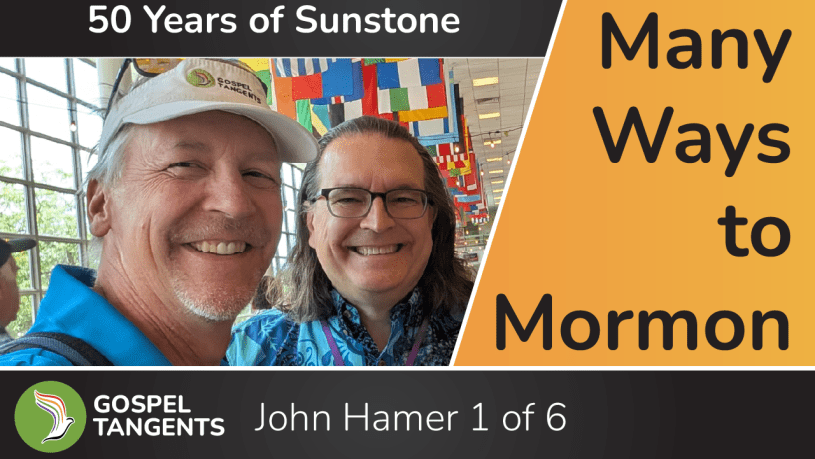
I’m excited to welcome John Hamer back to the show. John is a Seventy in the Community of Christ and a remarkable historian of Restoration Churches. Earlier this month, he was in Utah for the 50th Anniversary of Sunstone, and today we’ll be talking about the many ways to Mormon, including some of the Restoration Churches/schismatic groups that were represented at Sunstone. This episode will be part of a broader conversation about various Latter Day Saint schismatic movements. Join us for the discussion!
Exploring the “Multiple Ways to Mormon” at Sunstone’s 50th Anniversary
The recent 50th anniversary of the Sunstone Symposium in Utah provided a unique opportunity to delve into the rich and diverse landscape of the Mormon culture and restoration heritage. John Hamer is a three-time guest on Gospel Tangents and a Seventy with the Community of Christ. Sunstone serves as an “open diverse forum” that welcomes individuals from all backgrounds, whether they are orthodox LDS, fundamentalists, or members of the Community of Christ. This gathering truly embodies the idea that there is “more than one way to Mormon”.
Influence of “New Mormon History”
The Sunstone Symposium’s 50th anniversary coincided with significant anniversaries for other institutions of “New Mormon history,” such as the John Whitmer Historical Association (JWHA) and the Mormon History Association (MHA), both reaching their 50-year marks. This period, starting in the 1950s and 60s, saw a critical re-evaluation of Mormon history through academic scholarship.
Key figures and works that shaped this field include:
- Robert Flanders: His “early incredible academic book,” Nauvoo Kingdom on the Mississippi, published by this RLDS scholar, revealed that Joseph Smith had initiated polygamy. This revelation caused a “collective faith crisis” that both the LDS and Community of Christ churches, and their members, have grappled with.
- Newell Bringhurst: Co-author of Scattering of the Saints: Schism within Mormonism with John Hamer, Bringhurst is praised as a “treasure for the New Mormon history” due to his prolific work on various topics, including “Blacks in the priesthood”.
- David Howlett: Raised in a “restorationist household” (Josephite fundamentalists), he later joined the Community of Christ and served as MHA president, becoming an “incredible thinker, teacher, professor, speaker”.
- Steve Shields: Author of Divergent Paths of the Restoration, he is recognized as a leading scholar on the many small groups within Mormonism.
Community of Christ: Structure and Modern Challenges
John Hamer also shed light on the Community of Christ’s distinct organizational structure. Unlike the LDS Church, where the First Presidency is an extension of the Quorum of the Twelve, the Community of Christ’s apostles are specifically a “traveling quorum” focused on missionary work in the field, not based at headquarters. The world is divided among these twelve apostles, with assignments rearranging at each world conference.
Recent changes include a “huge turnover” with six new apostles and a significant scrambling of apostolic fields, with some fields, like the USA, now having multiple apostles. For example, Apostle Lach MacKay, who previously covered the northeastern United States and historic sites, is now responsible for Canada, Australia, New Zealand, the Pacific Islands, and Europe.
RLDS Doctrine and Covenants and De-canonization:
◦ The Community of Christ’s Doctrine and Covenants is an active scripture, with new sections added through votes by elected representatives at World Conferences. The conference also has the power to remove sections, which it has done several times.
◦ Baptism for the Dead: This practice was removed from the RLDS Doctrine and Covenants, largely due to the church’s desire to distance itself from associations with LDS temples and practices, particularly those perceived as “secret” or “embarrassing.” John Hamer expresses a nuanced view, considering it meaningless as a necessary saving ordinance for random names but “incredibly valid and amazing” as a spiritual practice for connecting with cherished ancestors (e.g., Jane Manning James).
◦ Blacks in the Priesthood (RLDS): Joseph Smith III’s 1860s revelation allowed black men to hold the priesthood but included a racist caveat to “be not hasty” in ordaining them, reflecting the prevailing societal racism of the 1860s. A recent World Conference resolution to remove this section was voted down, with John Hamer arguing against removal to avoid setting a precedent of “Jefferson Bible” editing scripture.
◦ De-canonization of the Book of Mormon: There’s a “dig” (and potential validity) that the Community of Christ “doesn’t believe in the Book of Mormon” in the same way other groups do. Some leaders and members, traumatized by the “New Mormon History” and historical-literary criticism suggesting the Book of Mormon is a 19th-century construct, have proposed to “jettison all of this stuff.” However, others, especially older members, find it essential to their identity. John Hamer “firmly anticipates” a resolution to remove the Book of Mormon from the canon, though he personally opposes it.
Understanding Scripture:
◦ John Hamer advocates for viewing scripture as “errant, not inerrant.” He believes scripture is a “human response to God’s revelation,” filled with the “biases and limitations of every prophet.”
◦ He argues against treating scripture as a “perfect idol” or a “literalistic rule book,” emphasizing that doing so misses its true meaning and prevents growth. He compares attempts to remove “pseudepigraphic” books (like some Pauline or Petrine letters) to treating the Book of Mormon, or even the Old Testament Book of Daniel (which he calls a “pious fraud”), as disposable.
RLDS Church Operations and Challenges:
◦ The World Conference functions as a “giant legislature” where resolutions are debated and voted upon.
◦ The Community of Christ has three official languages: English, French, and Spanish. A resolution to put all scriptures online in these languages was narrowly voted down, with the official pretext being cost, but John Hamer believes the real reason was a desire by some leaders to minimize exposure to elements like the Book of Mormon they find embarrassing.
◦ The church’s control over intellectual property is criticized, particularly regarding the Kirtland Temple, where photos were forbidden, hindering its use as a missionary tool.
◦ The conversation touches on the resignation of Israel A. Smith (presiding bishop) and Fred Smith’s use of a “prophetic trump card” (revelation.)
The struggle for leadership of the LDS Church between Sidney Rigdon and Brigham Young still echoes today. One lasting outcome is the practice of dissolving the First Presidency at the prophet’s death—a move meant to underscore that Rigdon was never recognized as Joseph Smith’s rightful successor. Historian John Hamer of the Community of Christ joins us to examine Rigdon’s claims, even arguing that Sidney may have had the strongest case for leadership. We’ll also explore the church Rigdon established, now the third-largest “Mormon” denomination. Don’t miss this fascinating discussion
We delve deep into the complexities of LDS (Church of Jesus Christ of Latter-day Saints) and RLDS (Community of Christ) succession after the death of Joseph Smith in 1844, and how this crisis shaped the leadership structures and beliefs of both churches.
LDS Succession after Joseph Smith’s Death (1844)
- Lack of a Defined System: There was no pre-existing system for succession written in the Doctrine and Covenants. The process that unfolded was largely shaped by the personalities and power dynamics of the time.
- Sidney Rigdon’s Claim: Sidney Rigdon, Joseph Smith’s counselor in the First Presidency, claimed the role of “guardian” of the church. This was akin to a regent in a monarchy, intended to lead until Joseph Smith III, who was then a child, could assume leadership.
- Brigham Young’s Maneuver: Brigham Young argued that following the martyrdom, a prophet in the flesh was no longer needed, and the Quorum of the Twelve Apostles should act as the First Presidency. This led to the group initially being called “Twelve-ites” by other branches.
- Timeframe to Leadership: It took three years for Brigham Young to transition from the president of the Quorum of the Twelve to the official prophet of the church. During this period, he acted as “acting president”.
Elimination of Rivals and Decentralization of Power:
◦ William Marks and the Standing High Council: William Marks, president of the Standing High Council, was seen as a rival to Brigham Young. The Standing High Council, which had previously held equal or even superior authority to the traveling Quorum of the Twelve, particularly in organized stakes, was effectively demoted into stake high councils. This move eliminated an institutional rival and concentrated power.
◦ Presiding Bishopric: Similarly, the powerful role of the Presiding Bishop, who controlled temporalities and could act as a leadership rival, was demoted by Brigham Young, who created numerous bishops, reducing the role to a congregational position.
- Retroactive Legitimacy: The LDS Church’s practice of dissolving the First Presidency upon the prophet’s death and the automatic succession of the senior-most apostle were established to retroactively delegitimize Sidney Rigdon’s claim and ensure the legitimacy of subsequent LDS presidents. This automatic succession became rapid over time, especially after Joseph F. Smith, as leaders realized the difficulty of running the church without a quick transition.
- Non-Apostolic First Presidency: In the early church, the First Presidency (including Hyrum Smith and Sidney Rigdon) was distinct from the Quorum of the Twelve Apostles.
Sidney Rigdon’s Church and the Bickertonites
- Rigdon’s Failed Efforts: After excommunicating each other, Sidney Rigdon started his own church in Pittsburgh, which eventually atomized.. John Hamer’s ancestor, William Winchester, briefly served as one of Rigdon’s apostles.
- Emergence of the Bickertonites: The Church of Jesus Christ (Bickertonites) originated from a branch in Pittsburgh led by William Bickerton, who had been Rigdon’s last apostle. This group reorganized after William Bickerton and his followers broke with Brigham Young’s church when polygamy was publicly announced in 1852. The Bickertonites are considered the only viable part of the “Rigdonite branch”.
RLDS (Community of Christ) Succession
- Joseph Smith III’s Legitimacy: The RLDS church’s legitimacy for Joseph Smith III’s presidency rested on two main pillars:
◦ Appointment by Predecessor: Joseph Smith Jr. had indicated his son as a successor, supported by a verse in the Doctrine and Covenants stating the prophet has “power… to appoint another in his stead”. Joseph Smith III himself later emphasized this “appointment” principle for future successions.
◦ Royal Line of Joseph: Many members desired a leader from the “seed of Joseph” (the Smith family line). This idea was heavily promoted by William Smith, Joseph Jr.’s brother, who published pamphlets arguing for the importance of lineage, citing the Book of Mormon and the New Testament example of James (Jesus’s brother) leading the early Christian church. William Smith was a problematic figure, excommunicated for polygamy, but his arguments influenced the early Reorganization.
- World Conference Authority: Technically, the General Conference (World Conference), a legislative body, held the authority to select the church president, and Joseph Smith III was initially voted into the role.
Leadership Conflicts and Modernization:
◦ Frederick Madison Smith: Joseph Smith III’s eldest son, with a Ph.D., became the third prophet-president. He differed significantly from his father, aiming to modernize and bureaucratize the church.
◦ “Supreme Directional Control”: F.M. Smith introduced this controversial policy, vesting supreme control in the First Presidency. This led to a major conflict with his brother, Israel A. Smith, who was in the Presiding Bishopric, resulting in the entire Presiding Bishopric’s resignation. F.M. Smith ultimately used a “prophetic trump card”—a revelation—to assert his authority.
◦ RC Evans: Joseph Smith III’s talented first counselor and orator, who expected to be appointed successor. When F.M. Smith was appointed instead, Evans became very critical. Despite being granted the significant role of Presiding Bishop of Canada, he continued to oppose F.M. Smith and eventually left the church, taking a large portion of the Toronto congregation to form his own church. RC Evans died shortly thereafter in the Spanish flu pandemic, and his church eventually dissolved.
- F.M. Smith’s Legacy: John Hamer views F.M. Smith as the “second reinventor” of the Reorganization, driving significant growth and establishing modern programs like hospitals and orphanages, focusing on the social gospel. He was the last president to generate such substantial growth for the church.
The discussion also briefly touches on the Kirtland Temple, where the RLDS Church (Community of Christ) did not permit weddings or baptisms for the dead due to a desire to avoid association with LDS temple practices. John Hamer personally distinguishes between “temples” (like Kirtland) and “endowment houses” (smaller, standardized LDS temples), based on the level of sacrifice involved in their construction.
What are your experiences with the Community of Christ? Do you have any thoughts on the Succession Crisis?
 Wheat & Tares
The last two prophet-presidents of the Community of Christ, Steve Veazey and Stassi Cramm, were selected following churchwide spiritual discernment processes, which led to recommendations to the World Conference from the Council of Twelve Apostles. That’s a significant change from past practice and most likely sets a precedent for the future. The World Conference itself has seen a reduction in legislative proposals (and time spent going over the minutia of the church’s budget) and an increase in ways and opportunities to celebrate the church’s worldwide, diverse community.
This is an endlessly fascinating topic… I love playing with all the “what if’s” too.
Another great resource, which I found fair and informative, is the Church History Matters podcast. I think there was a half dozen or so episodes tracing the history from a faithful LDS point of view.
Rich, thanks. I think I missed seeing you in June when Stassi was ordained. Next week, John will mention the change in selection. I was surprised by his comments at JWHA spring meeting. Apparently Grant McMurray was there and it made some waves.
Jason, I did listen to the Church History Matters last year when they discussed it. I thought they did a great job. Here’s a link to the first episode: https://doctrineandcovenantscentral.org/podcast-episode/the-eight-possible-succession-paths/