
My post last week about the Book of Mormon stimulated up a lot of good comments. One in particular stood out to me, that the Bible also has faults and anachronisms just like the Book of Mormon. This was especially relevant to me as I had just finished reading Dan McClellan’s book “The Bible Says So”, where he explores three widespread dogmas that are frequently run across with Bible believers: inspiration, inerrancy, and univocality.
Dan explores these by taking about 18 different topics, and exploring them in a separate short chapter. The chapters include topics such as Abortion, Slavery, Homosexuality, Women Covering up in Church, etc.
Dan is an active Mormon (LDS) per his introduction in the book, an pushes back against the argument that his scholarly positions are influenced by his membership in the LDS Church. From the book”
In fact, my positions overwhelmingly and directly conflict with Latter-day Saint ideologies, and if they don’t, the overlap will be only partial and will be entirely incidental.
He then gives an example of Mormon’s belief that Jesus “was the Great Jehovah of the Old Testament”, which is not supported by anything in the Bible.
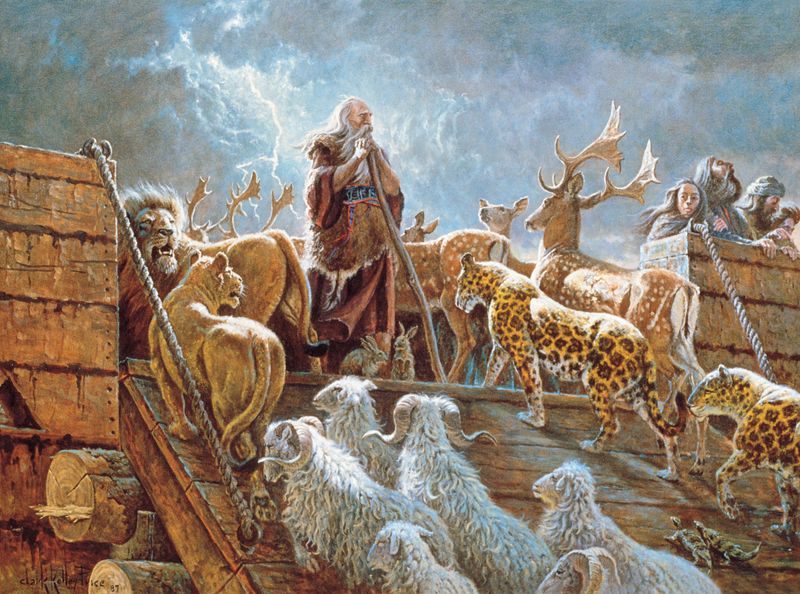
What I find interesting is how do we as Mormons reconcile words of the Prophets that seem to confirm Biblical historicity. There are thousands of references to Noah and Moses over the pulpit in General Conference, yet the general consensuses is that they probably did not exist. There is no record of a global flood and the scientific consensus is it did not happen. There is no archaeological or extra-biblical evidence of Israeli captivity or exodus. The Tower of Babel has no bases in the linguistic history of the world as we know it.
So the question I pose to you is this: If a Prophet (Q15) gives a talk in General Conference, and references Noah as a real person, are we as Mormons then required to believe that the flood was real? For example, this quote from Russel Nelson from 2009: “Some revelations have been given for unique circumstances, such as Noah’s building of the ark….”
Nelson believes Noah was a real person who built an ark. Does a faithful Mormon then have to believe?
 Wheat & Tares
For me, it works better to believe in Noah and Moses as real people.
Similarly, it works better to believe that my grandfather was named Joseph. I never met him, and I have no documentary evidence that he was my grandfather, but people say he was and that works for me. If somehow evidence surfaced that he wasn’t, well, nothing really changes and I will still love my grandmother just the same.
As a biblical example, I know the bible scholars say Herod was already dead before Jesus was born, so he couldn’t have ordered the killing of all the children in Bethlehem. I have no desire to argue with the Bible scholars or to dispute their findings, but I have no new narrative to replace the story, so it works better to believe the story as it is told.
For me, building faith is more noble than destroying faith. And, generally speaking, the stories really are beautiful stories.
You’re asking the wrong question.
The BoM and D&C confirm Noah’s and Moses’ existence, as well as Israel’s captivity, the Tower of Babel in multiple places.
The right question is whether you believe in the veracity of the BoM and D&C.
The Lord gave us the BoM specifically to confirm the veracity of the Bible:
Behold, saith the Lamb of God, after the Gentiles do stumble exceedingly, because of the most plain and precious parts of the gospel of the Lamb which have been kept back by that abominable church, which is the mother of harlots, saith the Lamb—I will be merciful unto the Gentiles in that day, insomuch that I will bring forth unto them, in mine own power, much of my gospel, which shall be plain and precious, saith the Lamb.
For, behold, saith the Lamb: thy seed shall write many things which I shall minister unto them, which shall be plain and precious; and after thy seed shall be destroyed, and dwindle in unbelief, and also the seed of thy brethren, behold, these things shall be hid up, to come forth unto the Gentiles, by the gift and power of the Lamb.
And in them shall be written my gospel, saith the Lamb, and my rock and my salvation.
And it came to pass that I beheld the remnant of the seed of my brethren, and also the book of the Lamb of God, which had proceeded forth from the mouth of the Jew, that it came forth from the Gentiles unto the remnant of the seed of my brethren.
And after it had come forth unto them I beheld other books, which came forth by the power of the Lamb, from the Gentiles unto them, unto the convincing of the Gentiles and the remnant of the seed of my brethren, and also the Jews who were scattered upon all the face of the earth, that the records of the prophets and of the twelve apostles of the Lamb are true.
And the angel spake unto me, saying: These last records, which thou hast seen among the Gentiles, shall establish the truth of the first, which are of the twelve apostles of the Lamb, and shall make known the plain and precious things which have been taken away from them.
And they must come according to the words which shall be established by the mouth of the Lamb; and the words of the Lamb shall be made known in the records of thy seed, as well as in the records of the twelve apostles of the Lamb; wherefore they both shall be established in one.
Honestly I’ve never once heard a believer question the existence of Noah or Moses. At best believers acknowledge that some of the Pentateuch stories are exaggerated or for literary or spiritual effect and may not have happened exactly as described, but for the most part the followers I know seem to trust that it is mostly historically true.
That said, I think there is a lot more flexibility with regard to what you’re supposed to believe as true about the Pentateuch than with the Book of Mormon. Many don’t believe in a global flood but a local flood instead.
I believe that heroic figures of an early Israelite community existed and that these heroes informed the stories of Noah and Moses, which were passed down orally and perhaps in some basic written forms over generations. I believe that the stories originated among the Israelite community before King Solomon and probably before the Judges period of Israelite history. The events described in the Pentateuch are largely impossible to have ever happened. Sorry, there are no talking donkeys. As for the beauty of the stories, sorry but I don’t find Moses commanding his men to slaughter the Midianites but to save their young girls for themselves terribly beautiful or inspirational. The stories are no doubt a fascinating window into Bronze Age cultural knowledge of Near Eastern peoples.
arelius11 actually brings up a good point. Many Mormon believers have a much harder time rejecting the veracity and historicity of much of the Pentateuch because they see the Book of Mormon, D&C, and Pearl of Great Price as corroboration of the events and people described in it. The Tower of Babel has to have really existed and humanity’s languages had to have been broken up there because the Jaredites spoke of it happening. I’ll never forget my experience in the MTC wherein the most boneheaded missionary in our group, whom no one seemed to like, got in an argument in the cafeteria where he insisted quite relentlessly that Portuguese, as well as all other human languages, emerged from the Tower of Babel and that to believe otherwise was to doubt the Bible.
Bill, I’ve found it helpful in evaluating General Authority statements to ask the question of whether the General Authority making a statement regarding a Biblical event is likely to be aware of and studied the evidence against the historicity of the event referenced. If not, then I just assume that the General Authority is simply repeating information he assumed to be accurate rather than making a pronouncement of fact. As it appears the number of General Authorities who make even a cursory study of Biblical historicity appears to be quite small, this allows me a plenty of flexibility in how literally I take the Bible.
One of my favorite movies is Groundhog Day with Bill Murray. I remember hearing a podcast years ago where some philosophers discussed the film.
What really frustrates Phil Connors is that everyone talks about the groundhog as if it’s truly a weatherman. He can’t let that go, and as a result he can’t enjoy the festivities. He’s rude to the woman who runs his bed and breakfast, and his inability to enter into the myth only leaves him more bitter and frustrated.
Of course, there are real differences between this and religious identities, but I think there are also interesting parallels. I imagine someone like Dan McClellan maintains his integrity with his views about the Bible, even in a church setting, but he does so in a way that’s still loving and caring toward others.
For me thats the key. There’s a place to engage in Scholarship and there is a place to immerse yourself in the myth. One thing that frustrates a lot of people is that seems to be able to draw a very sharp line between the two.
It’s interesting that for LDS we are conditioned to sort of directionally believe the Bible, especially the Old Testament. After all we’re taught the BofM is literally true (or at least I was growing up in the 80s and 90s) but our own articles of faith say the Bible has errors. Contrast that with Evangelicals; the Bible often is their equivalent of our BofM it seems.
The history of the Bible as a book is fascinating and is more complex than I think most people know. Even when I was a believer it seemed strange to take most of the Bible at face value. I always gave GAs a pass when talking about biblical events because if we’re all reading an erroneous book we’re each going to conclude differently.
In the old 80s version of the Bible most LDS used, one of the maps at the back showed the Israelite path they followed as they fled Egypt – except the shown path didn’t cross the Red Sea, it went around. One of my BYU profs had us redraw the map with the path crossing the Red Sea. Apparently the GA in charge of the maps in the Bible either missed the important doctrinal implications of a non literal parting or didn’t pay that much attention. There are hundreds of issues if you take the Bible as 100% accurate.
Well, not being a believing LDS, maybe I am the wrong person to answer the question. But, no, I don’t think people can reject the fables in the Bible and still be fully believing LDS. I hate to use Dan McClellan as an example, because I don’t know him. Now, I said fully believing and I suspect some people like Dan McClellan are not fully believing but nuanced to be maybe half believing, but still claim “fully believing” or “in good standing” but maybe they are kidding themselves about just how faithful they are. But remember, this is coming from someone who admits that I don’t believe half of Mormonism.
See, the Book of Mormon is kind of a Mormon requirement as well as the Bible as *translated* correctly. So, you can have minor beefs with the Bible, as translation errors. But the whole story of Noah is not a “translation error”. Then there is the problem that the BoM backs up these stories as literal. So, you cannot say “We believe” article of faith that the BoM is true and you cannot say you believe the Bible is the word of God except for translation errors. Many of the prophets have taken the stories as literal. So now you don’t believe modern prophets are correct either. That is two major premises of our religion you don’t believe and they are among the biggest of the beliefs Mormons proclaim.
I don’t believe the earliest stories in the Bible were literal history. No, they were fables to explain how the world is and who Israel was as a nation and people. Some of those fables were written to unite Israel as a Nation and produce National pride. America has her own stories as in George Washington as a child chopping down a cherry tree and being too honest to lie about it. Made up story. Paul River, nope he wasn’t the one doing the glorious ride and he did not yell “the British are coming.” Made up story for a patriotic poem to unite Americans in feeling American rather than British colonists. So, if Americans did it a few hundred years ago, why not accept that the ancient Egyptians probably did it and the ancient Israelites did it too.
So, since I don’t really believe the whole Bible is the word of God and that the repeat of those stories in the BoM is correct or that the BoM is historical or even really happened, and I don’t believe our prophets are any more correct than myself, I don’t call myself a believing Mormon or refuse to use that word as a win for a Satan I don’t believe in either.
The problem, of course, is that most church members have never read more than a few verses of the Old Testament. If they had, they would realize that most of it consists of material so boring that a whirling dervish could use it to put himself to sleep. Whether it contains anachronisms is not the issue. The issue issue is that the vast majority is just plain boring, and the very few interesting parts contain ribald descriptions of sexual escapades that are so over the top that they would embarrass even the most devious Russian Princess.
Amen especially to Anna’s post. I have stated before that Mormon theology requires a literal reading of the Bible. But sometimes it gets worse! Consider how JS doubled down on lineages and racism in both Moses 7:8 and especially 22, also Abraham 1:24. These scriptural “Corrections” are FAR WORSE than Genesis 4:15.
An INSPIRED Version? Not in my book!
The Dervish are Sufi. The Sema is a prayer ritual. I have been fortunate to observe the practice at least twice. The Sema is intentional and not a result of any disorder therefore sleeping or not sleeping have nothing to do with it.
I feel like we need a rating system that includes a question mark, as in ‘how does this comment relate to the conversation?’
Sometimes comments refer to something a poster has said, and is not a direct or even indirect response to the OP. In other words, sometimes the comment is about the contents of a comment, because it’s a conversation, not a drill.
I think some of the very old writings — the OT and the PoGP — are allegorical and even euphemistic in their telling. I think the story of the flood, for example, could very well be a retelling of an event that is beyond our understanding–wherein a portion of creation was dissolved and recreated. And I think it should go without saying that the garden story is allegorical–a telling of a time, place, events, and people that are other worldly. And so, what we are narratives that are true in spite of the lack of historical or scientific evidence.
We sometimes take things so literally and seriously they the whole point of the story is lost.
If Pres. Nelson tells the story of The Tortoise and the Hare, should we take it to mean there are literal talking animals holding track and field competitions? Of course not. Stories can still be valuable even if we can’t historically place every character.
Thousands of years ago there was a disastrous flood that destroyed the entire world for the people who lived there, and a few people climbed in a boat and survived.
A couple generations later, a village elder used the story to teach something to younger generations (and maybe added some animals to keep the attention of the little kids). The fact that we’re still telling it today is proof that it is a fantastic story.
For most of human history, stories were told to keep history, teach lessons, promote politics, and provide entertainment…all at the same time.
We acknowledge the blend in most ancient religions, but when Christians start reading the Jewish legendarium it suddenly becomes literal…often more literal than the Jewish interpretation of Jewish scripture.
Jack and Pirate, yes, but the Book of Mormon says the tower of Babble story is literal history, and Joseph Smith said that the Garden of Eden story was literal history and even claimed it was in Missouri. So, backing up to an allegorical explanation of some stuff that the BoM or The Prophet said is a problem for your claim as faithful Mormons. Faithful Mormons do not explain away stuff that Joseph Smith said as revelation was true or claim that a big event like people leaving the Tower of Babble for the new world are based on a story that was just allegory to begin with. Even if the barges those people supposedly traveled in were totally unrealistic ridiculous.
If you are rejecting major aspects of Mormonism like Joseph Smith as prophet or the truthfulness of BoM you can call yourself a nuanced Mormon or “believingish”.
Now many of us here reject those things but we don’t claim faithful status, but claim nuanced believer or doubter, or even proud apostate.
Amazon has cut the price of a new hardback copy of Dan’s book to $15.
Anna,
As Pirate says, religion is based on stories, some more literal than others. Jesus told stories, Jesus even affirmed Job being swallowed by a whale. By your standard Jesus was either lacking truth or maybe Jesus himself is just another fictional character. Then what? All durable culture is based on stories. We see this specifically in the Hebrew culture – chapter 6 of Deuteronomy explains the importance of telling stories (see verses 20-25).
Mormonism was a story and now that story is cracking as the literalness of the story is found lacking. As a consequence many are discarding the religion. Is that a good thing? No doubt it is wrong for a religion to coerce people with lies and the Mormon religion is unfortunately guilty of enabling spiritual and emotional manipulation. Yet there is still much to be commended about the religion and its story of faith.
Throw this away and what fills the void?
Rationalism and Humanism claim to fill the void of Myth and Lore and Religion but do they work? Do they provide a better moral compass? I’m unconvinced. I think humans must allow space for the supernational. Reason being is that without the allowance for there being something more about our mortal existence than what we see – something that transcends space and time – then our mortal existence is pathetic and pitiful. Perhaps this is a false hope. But it is a hope I grasp because I am an optimist and the perspective that there is timelessness and timeless truths gives me encouragement.
As for Noah, there actually is strong geological evidence great floods occurred in the ancient world. The legend of a great flood (as well as a great tower) was passed down through the generations of different cultures. Why? Either because it occurred or because the story has great meaning or both. As to Noah specifically, the story of him and his family and the Ark is a powerful metaphor for the salvation provided by God. Thus, to a believer, this makes the story and the characters real.
Jonah, not Job! From Matthew 12
Jesus Tells about Jonah
38 Then some of the teachers of the Law and the proud religious law-keepers said to Jesus, “Teacher, we would like to have you do something special for us to see.” 39 He said to them, “The sinful people of this day look for something special to see. There will be nothing special to see but the powerful works of the early preacher Jonah. 40 Jonah was three days and three nights in the stomach of a big fish. The Son of Man will be three days and three nights in the grave also. 41 The men of the city of Nineveh will stand up with the people of this day on the day men stand before God. Those men will say these people are guilty because the men of Nineveh were sorry for their sins and turned from them when Jonah preached. And see, Someone greater than Jonah is here!
Some Christians deny the title of Christian to those who claim it because they accept Christ, if they also reject the Nicene Creed and Trinitarianism, although it is clear that such people were Christian for a couple of centuries before the council. We see here some people denying the title of Mormons because those people don’t think like they are supposed to think. May a person consider himself perfectly orthodox, even if he holds some views that another person, even a non-believer, thinks aren’t proper Mormon thoughts? I think so. Were Mormons before 1978 who did not accept “official” teachings on race nuanced or believingish? Were they bad Mormons? I don’t think so, and in 1978 they were vindicated in their belief that race was an illegitimate factor in priesthood and temple worthiness. I would not deny the label of Presbyterian to one who claims it, nor would I tell that person what he was required to believe to be a good Presbyterian, for there are many strands of Calvinistic thought. Whether I believe the story of Noah to be literal or allegorical, worldwide or localized, does not define my claim to Mormon or Christian, or does it? I do not believe every word in sacrament meeting or in GC, but I would not call myself nuanced or believingish. I am OK with diversity of thought on various issues.
Bishop Bill: You write in the OP that the Bible also has faults and anachronisms but you don’t provide any receipts. What anachronisms are you referring to? Given the Bible was passed down orally at first, I would expect anachronisms. Not sure why the Book of Mormon would have them since it was written down and not passed along orally.
Regarding comments of a local flood, I was taught in my Mormon circles growing up that it was a global flood because it was the earth being baptized. Maybe my neighbors were high on goofballs, I have no idea. But pivoting to a local flood story has consequences. Was the earth baptized or not?
A Disciple: “Rationalism and Humanism claim to fill the void of Myth and Lore and Religion but do they work? Do they provide a better moral compass? I’m unconvinced. I think humans must allow space for the supernational. Reason being is that without the allowance for there being something more about our mortal existence than what we see – something that transcends space and time – then our mortal existence is pathetic and pitiful.” This says more about you than about any rationalist or humanist and it’s very sad. I have no idea if there is a divine force. And I still find my mortal existence incredible. Relationships with tangible humans and dogs, travel, trying new things, and helping the marginalized have been more rewarding than belief in the supernatural. YMMV.
Anna, I totally hear what you are saying. The Mormon circles I grew up were highly correlated and policed so I understand the thought that once you cross a line you really aren’t Mormon any more. And because I hate boundary policing, I personally try not to pay that line of thinking forward.
Many people like to push this idea that the ancients who constructed the Bible weren’t telling history and they didn’t mean things literally, but told the stories for a deeper literary/spiritual purpose. This narrative dismisses two types of people: 1) believers who think everything in the Bible is literal history and that any history that challenges the Bible is inherently wrong, and 2) skeptics who dismiss the Bible as ridiculous since the stories are extremely far-fetched and couldn’t possibly be true.
I’ve long studied ancient stories. The Vedas, the Quran, ancient Egyptian religious literature, Homer, Hesiod, Norse mythology, etc. I’ve also long studied how ancient peoples interpreted their culture’s holy texts. As far as I can tell, there was widespread acceptance among ancients that these texts were histories that accurately described the past and reality. At the same time, there were counternarratives to these literalist interpretations among other ancients who were more skeptical of the historical accuracy of the accounts and did not like to let the holy texts get too much in the way of their freedom to observe and opine about reality and history. These new narratives that insist that literalists are interpreting scripture incorrectly or who object to the term “fiction” to describe scripture, much like we saw from Sam Brunson on another thread, are ignoring a very inconvenient fact about scriptures: they contain bad history and are chock full of fantasies, delusions, myths, exaggerations, far-fetched tales that were intended to communicate history, not just be literature with moral points. Is there stuff in scripture and holy texts that was intended to be non-historical and simply poetic and literary license? Of course. But to dismiss the idea that authors of ancient scriptures and holy texts ever intended to write historically and describe the past is a sort of denial.
The idea that the religious literalists are getting it wrong and are misunderstanding the true aim of the ancient writers of scripture by interpreting everything historically is similarly a sort of denial. The existence of religious literalists is a testament to a long history of literal interpretation of scriptures and holy texts. Literalists today wouldn’t exist if they didn’t exist in the past. Humans have long had a yearning to correctly understand and interpret the past. If you as an individual feel that today, that means that your ancestors of thousands upon thousands of years felt that same yearning. But unfortunately, what really happened in the past is hard to nail down. Sometimes the human imaginative mind can get in the way of painting historically accurate pictures and create narratives that go too far. Scriptures and holy texts are fair game for textual and historical criticism. Many of the historical claims cannot be ascertained. They’re just plain wrong and inaccurate, and we, including the Sam Brunsons of the world, need to admit that.
Anna,
I think the garden story is a telling of something that really happened–but it comes to us garbed in allegory because of its other worldly-ness. And it’s its straightforward one to one symbolic elements that steer us into asking the right questions about its meaning.
Chadwick:
“But pivoting to a local flood story has consequences. Was the earth baptized or not?”
I don’t know if the earth’s baptism is an absolute theological necessity. Still I think one can argue that the symbolism holds true even if the flood were local–so long as it seemed to cover the entire world from Noah’s limited point of view.
“Does a faithful Mormon have to believe?” This is not a question about whether events in the Old Testament are literally true, but about church culture and church authority. It’s a question about what constitutes “faithful Mormon” and who gets to decide on the definition. My answer to the belief part, for what it’s worth, is that I’m not obliged to believe anything just because the president of the church says something about it over the pulpit. But it seems that many current as well as former members have strong opinions about whether I get to claim the label “faithful Mormon” and think that way. But I get to decide that for myself. I consider myself a faithful Mormon in the sense that I am very loyal to the church, having continued to attend and serve in callings 15 years past the point where others with similar beliefs to mine might have left. Faithful means more than just belief.
Earlier this year I ran across my great grandmother’s family bible that was gifted to her in the 1880s. It is a really interesting artifact of 19th C American protestant thinking, and it is pretty consistent with the literalism that we see inherent in the Book of Mormon. Joseph Smith certainly believed that the Bible had to be taken as literal history, and it’s apparent in the BOM. Likewise, most in that era thought the Masonic order dated back to Solomon’s temple. Joseph Smith also had the great misfortune to think (like most people of his era) that the Egyptian language was inscrutable, and that it was probably pretty similar to the Popol Vuh in that both were “pictorial” languages, making his claims of Reformed Egyptian a logical leap that made sense in his day.
Taking the Bible literally and seeing the BOM as a valid history both require the same kind of anti-scholarly perspective that most people are still comfortable with. People don’t read. People don’t know languages, history or culture. People give religion a pass as something else, something bigger than all that (waves hand). If that’s what gets your juices flowing, I guess go for it. But that doesn’t make it real history.
Back to my great grandmother’s Bible, it contains beautiful illustrations with gold painting, and there’s an entire Encyclopedic section that talks about the Bible as a literal history of the world. We know better than that now, or at least the archaeological record shows that humans evolved much earlier than six thousand years ago and other contradictory evidence. But not everyone accepts that, and that’s why these ideas continue to pervade, even for folks like top Church leaders. After all, a lot of these findings happened well after they were adults. They were raised in a much more magical world.
I am not saying that anybody cannot claim the category of being Mormon. I am just saying that “faithful” Mormon is a category described by certain beliefs, not according to me but according, oh, to your local bishop giving out temple recommends, or the church leadership, or believing in the articles of faith. I am not a faithful Mormon, but kind of a cultural Mormon. I still get to call myself Mormon. I am just saying that some people like to call themselves faithful Mormons who really should be stuck in the category of nuanced Mormons, not that there is anything wrong with nuanced Mormons. I love several of them in fact. A nuanced Mormon is not a bad thing at all. I think they are more educated and intelligent than faithful Mormons. It is just that I think there is a standard of actually, you know, believing the articles of faith and the major tenants of the religion like the Bible is the word of God (not legends and myths) and that Joseph Smith was a prophet therefore things he spoke *as a prophet* should be on the faithful Mormon’s belief list.
And Disciple, I was not saying there is no value in myth or analogy, just that a person who thinks the Bible is myth and not *true* is not really believing what the Mormon church teaches as true. There is plenty of value in myth that is not true, in Asop’s fables, in Greek and Roman mythology, in good literature. It is just that I see a difference in those than there is in historical truth. The Mormon church teaches the Bible as historical, sure there are some people that don’t think it is and they are not really believing what the church teaches. I have never seen a lesson book in all 70 years in the church that taught something like Noah’s Ark was just some old legend. Seriously, the church teaches it as history. If you don’t believe that, then you are not believing everything the church teaches and you are kidding yourself if you think you do. I am not criticizing people who don’t believe everything the church teaches, just wishing they were more honest with themselves and others and dared to call themselves nuanced or something that admits they do not believe the stupid stuff the church teaches. Because, really, Noah’s Ark really happened with a flood over the whole earth? Please, there isn’t that much water. But the church does teach that it really happened. The church is officially categorized by other churches as fundamental because it teaches that the stupid impossible Bible stories really happened.
I regret the insistence by some in this thread who self-identity as not being faithful Latter-day Saints that a faithful Latter-day Saint MUST believe certain matters in a particular strawman or caricatured ways.
I think every faithful Latter-day Saint is free to have his or her own thoughts on a great many matters. That a certain thought seems common or even prevalent among Latter-day Saints of an age or locale does not necessarily make it normative or mandatory for all Latter-day Saints. That an individual Primary or seminary teacher, or even a group of them, taught a lesson a certain way years ago does not mean that all faithful Latter-day Saints must always believe the same way. That an individual bishop, or even several bishops, imposed a certain interpretation on a member in a temple recommend interview does not mean that all faithful Latter-day Saints must always believe the same way.
I am a faithful Latter-day Saint, but I do not believe everything believed or taught by other faithful Latter-day Saints, even ones that I sustain to high offices in the church. For example, I do not accept any doctrine regarding heavenly mothers simply because there has been zero revelation on the topic and I see movement towards establishing that doctrine as us trying to create God in our image — and I cringe anytime a general authority or any other faithful Latter-day Saint expresses heavenly mothers thoughts in our worship assemblies — yet I want to acknowledge that they can still be faithful Latter-day Saints.
I know there are some faithful Latter-day Saints who would question my faithfulness, but I still identify as a faithful Latter-day Saint.
I do see a few maladies in our church culture, and I hope for their resolution, and I have hopes that these are being resolved as time goes by. As an example of a malady, I admit that I do not want to see the family proclamation canonized (although some faithful Latter-day Saints do so hope) for two reasons (and the second is in reference to what I see as a malady): first, the proclamation, not a revelation (and I accept it as a proclamation); and second, I fear some more zealous (yet still faithful?) Latter-day Saints would uncharitably use the canonization as a rhetorical club against other Latter-day Saints like me, particularly on the proclamation’s use of the words “heavenly parents.”
In other posts on W&T, I have seen suggestions that the we should avoid using strawman or caricatured arguments against those who identify as no-longer-faithful Latter-day Saints. I agree. Here, my suggestion is that we should also avoid using strawman or caricatured arguments against those who identify as still-faithful Latter-day Saints. There is no monolith on either side.
Part of the trouble for Mormonism is that some of the key links in its chain of big “P” Prophets (who formally passed down priesthood authority) are non-historic narrative devices… sort of like saying Homer’s Odysseus was your real-life great-grandpa.
It’s not a big deal for other denominations who handle the authority issue in different ways, but it’s proven inconvenient in Mormonism. Not intractable, but certainly inconvenient.
You can get around it, but it takes some concessions. You can admit that Odysseus might not have been your ACTUAL great-grandpappy while still having a deep legitimate connection to Greece…or you can double down that Odysseus was in fact real, and that you know best because of you’re Greek.
You get a bit of both in Mormonism, but I’ll agree that in the tendency in the LDS world is to squint your eyes and go with the latter.
I consider myself a faithful and orthodox member, although I think that priesthood race ban could have been revoked decades earlier had there been unanimity among the top officers, but there was not such unanimity. I do not believe that if a poor person has only enough money to buy groceries to feed her children or to pay her tithing, but not both, that she should pay her tithing. I do not believe in heavenly mothers, not because they aren’t true, but because there has been zero revelation to the church on this subject, and I don’t think that we should go beyond the mark (which is set in scripture). I have no problem accepting the Bible and BoM as scripture, although I am certain that some of it is allegory, some of it is historical, and I don’t really need to know which–does it really matter to our salvation whether the flood was universal or localized? I don’t believe in the idea that the earth was baptized by the flood; I know some people have taught it, but I don’t need to believe it. I can’t see why the earth would need to be baptized if it hasn’t sinned, and I think that Jesus died for people, and not for rocks or mosquitoes (although I don’t know). I don’t think that Heavenly Father “made” the baby Jesus with Mary by physical means, although many LDS men love to think about this as the thought seems to get blood flowing in their nether regions. Am I a nuanced Mormon? I don’t think so. I see myself as a solid believer. Others may disagree, but should we be putting labels on other people? I’d rather not judge others, especially unrighteously. I support a big tent Mormonism, capable of hosting people of divergent views on many topics. Very few points of doctrine are true articles of faith, but even on those few points, how one sees it working can vary. I can believe in Christ without being Trinitarian, and I can believe in prophets without falling into hero worship or cult of personality. I can think for myself how the Atonement might work. None of this makes me nuanced or less faithful than another. Or does it? Why must the faithful all believe exactly the same way? and in all things?
ji & Georgis,
I pretty-much agree with what you say. If we take the temple recommend interview questions as our cue there seems to be more concern about what we do than what we believe. It starts of by asking if we have a testimony of three basic elements–the Godhead, the atonement, and the restoration. And then after that the focus changes to our actions–sustaining leaders, paying tithing, living the word of wisdom and the law of chastity, being honest, doing our best to attend church meetings and fulfill callings, treating family members appropriately, wearing the garment. And so, while a foundation of basic beliefs is indispensable, worthiness is based more in praxis than theory.
Thanks! Interesting post with intriguing ideas.
Ji, all right I like your argument and I withdraw my point. I am defining “faithful” differently than you and when I consider, yours is the better definition. You are kind of like my husband and I do believe he defines himself as “faithful” although there are certainly things he disagrees with. He still remains faithful (your definition) although not fully orthodox. I would change the word I use to “fundamental” except Mormons have a different definition for that. And even orthodox doesn’t quite fit. The non Mormon definition of fundamental is really what I mean, which is to believe in a literal sense. So churches that are defined as fundamental like our is believe the Bible as historical. I would use “TBM”, but I understand TBMs find that offensive, so I am at a loss of a better way to categorize only to differentiate from those who believe even the unscientific and impossible stuff. Should I call you guys nuanced but faithful? Liahona Mormons? Smart Mormons? I just didn’t think “nuanced” was something you would object to. I think of my sweety as “nuanced” and he has never objected. Should I call the totally fundamental guys the stupid Mormons, or just what do we call people who put science into one brain box and religion into another and any religious idea that conflicts with science then the science is wrong? I would like to differentiate what I call nuanced Mormons from stupid Mormons and I would really like a word to distinguish MAGA Mormons from never Trumper Mormons. Because I like to be warned before I get into conversations with certain people about what subjects to dodge. I mean feminist Mormons are willing to identify as feminist Mormons and don’t try to lump themselves in with every other Mormon. So, suggestions for calling TBMs that doesn’t offend them and suggestions for NBMs (nuanced believing Mormons) that doesn’t offend them. Or don’t you want to ever be separated from that kind of Mormon?
Ammendment to above. Yes, I know some people object to any label because they never fit. But I look at it like women’s clothing sizes, sure they never fit, but you just have to go with what is closest.