
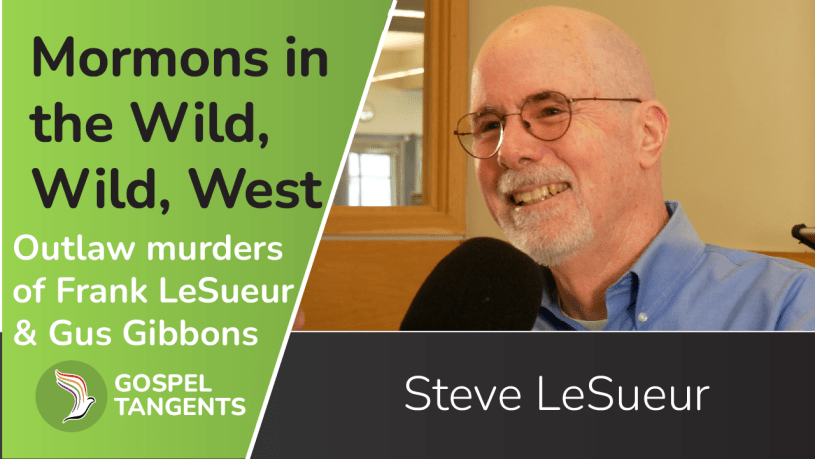
We’re revisiting an interview with Steven LeSueur, an esteemed historian and author of what is considered by many to be the definitive book on “The 1838 Mormon War in Missouri.” LeSueur, who sadly passed away in July 2025, was remembered for his significant contributions to understanding this complex period.
Historian Behind the Book
LeSueur, who lived in Arlington, Virginia, was not a full-time historian. He described his career primarily as a journalist, covering national defense issues, editing a technology magazine, and working as a freelance writer for businesses before his retirement. Despite this, his historical expertise was profound. His seminal book, published in 1987 by the University of Missouri Press, originated from his master’s thesis in American history at George Mason University.
His interest in Missouri history stemmed from early research work he did for Lamar Barrett at BYU in 1976-1977, immediately after graduating with his undergraduate history degree from BYU. This early work involved delving into diaries and letters to find references to “Adam’s altar” (Adam-ondi-Ahman) and exploring various historical sites in Missouri. For his book, LeSueur conducted extensive research at the Library of Congress, Utah archives, and multiple trips to Missouri, even staying with prominent Community of Christ historian Bill Russell, who, along with Valeen Tippets Avery, reviewed his manuscript.
LeSueur also lent his expertise to a documentary called “Trouble in Zion,” where he was one of several “talking heads” discussing the Mormon experience in Missouri, sharing his interpretations of the events.
Seeds of Conflict: Beyond Simple Blame
LeSueur’s approach to the Mormon Missouri War focuses on understanding how events unfolded, emphasizing a snowball effect of reactions rather than a grand conspiracy. While recognizing the immense suffering of the Mormons, he seeks to explain why Missourians reacted as they did.
Key events & LeSueur’s interpretations include:
- Jackson County Expulsion (1832): The Mormons were unjustly driven from Jackson County, having done nothing wrong. While a newspaper article about “Free People of Color” was a point of contention, LeSueur suggests Missourians’ misinterpretation was likely driven by their deep-seated fear of anything perceived as attacking slavery, rather than solely as an excuse to expel Mormons.
- The Caldwell County Compromise (1836): After Mormons were driven from Jackson and found refuge in Clay County, Joseph Smith’s plans for another military expedition prompted fearful Clay County citizens to propose creating a county exclusively for Mormons – Caldwell County. This was shepherded by Alexander Doniphan.
- The “Broken Agreement”: Missourians largely believed that, in exchange for Caldwell County, Mormons had implicitly agreed to settle only there. LeSueur found no such agreement in Mormon sources, but Missourians, including Doniphan, clearly perceived it. For about a year and a half (late 1836 into 1838), relations were relatively peaceful, resting on this perceived agreement.
- Joseph Smith’s Arrival and Mormon Expansion (March 1838): When Joseph Smith and Sidney Rigdon moved from Kirtland to Missouri, Far West (in Caldwell County) became the new gathering place, and plans for expansion beyond Caldwell into Davies (Adam-ondi-Ahman) and Carroll (Dewitt) counties began. This expansion, especially large-scale settlements, was seen by Missourians as breaking the agreement and triggered renewed protests.
- The Danites: This paramilitary organization was formed in June 1838, primarily by Samson Avard and others. Initially, their purpose was internal regulation, enforcing orthodoxy and the law of consecration among Mormons. They notably drove dissenters like Oliver Cowdery and the Whitmers from Far West after Sidney Rigdon’s “salt sermon”. LeSueur argues that Joseph Smith implicitly approved of their actions; Danite generals were honored guests at the July 4th celebration, and Joseph spoke to and endorsed them. While Joseph may not have directed every action, LeSueur asserts that the “buck stops with Joseph,” as the Danites looked to him for leadership and enforced his policies. The demotion of Danite leaders like Avard and Gideon Carter further indicates Joseph’s ultimate authority.
- Sidney Rigdon’s July 4th Oration: Rigdon’s speech, which threatened a “war of extermination” if Missourians came against the Mormons, was a significant turning point. LeSueur clarifies that this speech was a joint effort by the First Presidency (Joseph, Hyrum, and Sidney) and was later printed and promoted by Joseph Smith, indicating his full endorsement. This threat likely stemmed from an anticipation of opposition to Mormon expansion and a confidence in their growing numbers.
Escalation to Mormon Missouri War
◦ The Gallatin Election Battle in August 1838 saw Missourians attempt to prevent Mormons from voting in Davies County, leading to Danite involvement.
◦ The Siege of Dewitt by Carroll County vigilantes led to Mormons surrendering and retreating to Far West after Governor Boggs refused to provide state aid.
◦ In response, Joseph Smith and Sidney Rigdon rallied Mormons on October 14, declaring they would “live off the land of our enemies”. Mormon forces, including many Danites, then engaged in widespread burning and plundering of non-Mormon properties in Davies County, including Gallatin and Millport, actions that occurred while Joseph Smith was present. LeSueur differs from some historians by asserting these actions were not just by “extremists” but were known and condoned by Joseph Smith, leading Missourians to view Mormons as being in rebellion.
◦ The Battle of Crooked River on October 25 occurred when Mormons, led by David W. Patten, attacked Captain Samuel Bogart’s militia to free captured Mormon spies. Patten was killed. LeSueur believes the Missourians were genuinely defending themselves, not “baiting” the Mormons.
◦ This culminated in Governor Lilburn Boggs issuing the infamous “Extermination Order” on October 27, declaring Mormons “enemies of the state”.
◦ The Hawn’s Mill Massacre on October 30, where 17 Mormons were killed, occurred before the extermination order was widely known. LeSueur agrees that had the order reached the attackers, it might have prevented the massacre.
- Joseph Smith’s Arrest and Imprisonment: Joseph Smith and other leaders surrendered at Far West on November 1, recognizing they could not win against the overwhelming state forces. General Lucas sentenced them to death by court-martial, but General Alexander Doniphan famously refused to carry out the illegal order. Joseph was imprisoned in Liberty Jail for treason, following a preliminary hearing that found probable cause. He was later released by a sheriff during a transfer.
LeSueur points out that while the Mormons eventually gained sympathy and were wronged, their actions, particularly the burning and plundering in Davies County, contributed significantly to the Missourians’ perception of them as aggressive and rebellious. He emphasizes that many Missourians were initially sympathetic but lost that sympathy as the conflict escalated.
Steven LeSueur’s “The 1838 Mormon War in Missouri” remains an invaluable resource for understanding the complexities and unfolding events of this tragic period in American and Mormon history.
we’re sharing a powerful story that highlights the often-overlooked human cost of the Wild West era, brought to life by a historian who deeply personal connection to the past. We’re talking about Steve LeSueur, a wonderful historian and author who sadly passed away in July 2025 due to pancreatic cancer. This post is a tribute to his work and his last interview on Gospel Tangents, where he discussed his remarkable book, Life and Death on the Mormon Frontier: The Murders of Frank LeSueur and Gus Gibbons by The Wild Bunch, published by Greg Kofford Books.
Steve LeSueur was driven to explore a piece of his own family history that had been shrouded in mystery for generations. His great-uncle, Frank LeSueur, was murdered by outlaws in 1900. While his family always knew Frank was killed, the details were scarce, and the killers were believed to have gotten away with little effort to capture them. His grandfather, Carl LeSueur, Frank’s younger brother, was only five when Frank was killed and didn’t have many details to share. For over a century, it was largely considered “some minor episode in western history”.
However, in recent years, historians and biographers specializing in outlaws like Butch Cassidy and the Sundance Kid began to point fingers. These historians, some of whom had Mormon ties, suggested that Butch Cassidy’s Wild Bunch gang were the likely culprits behind Frank’s death. This new information ignited Steve’s interest, drawing him into a deeper investigation.
What truly set Steve’s work apart was his unique perspective: focusing on the victims. As he noted, historians often prioritize the outlaws, their daring heists, and exciting getaways, treating victims as mere “bit players” or “extras in a movie”. Steve, however, looked at the events from the victim’s point of view, reading journals, diaries, and reminiscences left behind by Latter-day Saints in the community. He discovered a compelling story that offered numerous insights into both the outlaws and the community itself. It turns out, not many people have an ancestor killed by a famous outlaw.
Despite the year being 1900, which might sound somewhat modern, the setting for this tragedy was truly still the Wild West. Frank LeSueur’s murder occurred just outside St. Johns, Arizona, a “dusty cattle and sheep town”. In 1900, this town had no electricity and no running water. It was an era where cars and airplanes were not yet commonplace.
Steve LeSueur’s research has profoundly enhanced our understanding of this specific Wild West tragedy, shifting the narrative to those who suffered the most. His book stands as a vital contribution to history, reminding us that every “bit player” has a story worth telling. We miss Steve greatly, and our hearts go out to his family.
Don’t miss our other conversations with Steve: https://gospeltangents.com/people/steve-lesueur/
 Wheat & Tares
I’ve had the Mormon War book on my shelf for some time, I’ll have to move it to the top of my stack.
It seems like in the 19th century, the Mormon people as a group could make friends (establish friendly relations), but not keep them. It always fell apart. It happened in Missouri, in Illinois, and again in Utah.
I worked with Steve at Adam-Ondi-Ahman the summer of 1979, Steve was doing archival research for Lamar and I was on the archeology team from BYU with Dr Ray Matheny. We did extensive sureys of the sit finding the original town site and ferry plus we found and excavatined a brick clamp near the temple site. It was an interesting summer and even though we were workin on different aspects of the prject I joyed Steve and found him t be an excelent researcher. His book is the semial work on the Mormon Missouri War.
The Wild West officially ended in 1890.