
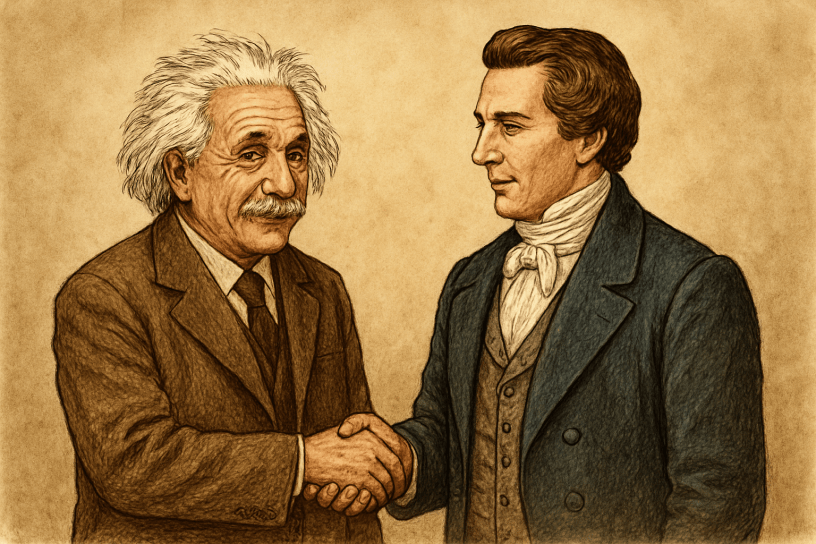
Critics of the Book of Mormon and the Book of Abraham will often point out glaring errors in the text, usually anachronisms, and state that if Joseph Smith got one thing wrong, then it is all wrong. Apologist will counter with a list of all the things he got right, saying one or two mistakes does not invalidate the entire text.
To complete this back and forth between critics and apologists, I ‘ve heard several times the critic counter with the idea that the Book of Mormon is like a piece of counterfeit paper currency. They will point out that if the bill looks right, uses the right paper, and everything looks correct except they spelled the Secretary of the Treasury’s name wrong, then the bill is bad and worthless, even though everything else is correct.
I really liked this counterpoint for awhile, but then started thinking that it probably is not the right analogy for mistakes in the Book of Mormon. A state issued currency is suppose to be 100% right, 100% of the time. History books, even scientific books and papers are not expected to be perfect. Lets look at Albert Einstein.
Einstein made many great contributions to physics that have affected everybody alive today in one way or another. But he also made mistakes, some of which he later admitted he was wrong, and others he never corrected and went to his grave before modern science proved him wrong.
These include his rejection of the probabilistic nature of quantum mechanics (he said “God does not play dice) and his introduction of a cosmological constant showing the universe is not expanding which he later called his biggest blunder of his life.
Because Einstein got some things wrong, we don’t throw out all his works. Could an apologist make the same argument with Joseph Smith and his translations? Putting on my apologist hat, (it does not need to be tin foil to work!), I could argue that both Einstein and Smith were geniuses in their respective fields, they were far ahead of anybody else at the time, and their work has influenced for the better millions of people.
But I don’t think this argument holds up either. Einstein produced things that could be tested. He initially rejected the idea of gravitational waves, but then later experiments proved their exitance. Joseph Smith produced things that could be tested, although not in his time. But modern investigation of both the Book of Mormon and the Book of Abraham have shown them to lack historical fact. Einstein was able to change his mind and admit when he was wrong because he didn’t claim that a supernatural force provided the information. Once you claim an all knowing and all powerful force behind your ideas, you have to be right 100% of the time or your god becomes less than all knowing.
So maybe the counterfeit currency analogy does work.
What do you think? Is there a better analogy?
 Wheat & Tares
“To complete this back and forth between critics and apologists, I ‘ve heard several times the critic counter with the idea that the Book of Mormon is like a piece of counterfeit paper currency. They will point out that if the bill looks right, uses the right paper, and everything looks correct except they spelled the Secretary of the Treasury’s name wrong, then the bill is bad and worthless, even though everything else is correct.”
How about a passport? If it’s a good fake then it will get you there. But the irony is–in religious terms at least–if it gets you there then it’s the real thing.
And that’s the Book of Mormon. In spite of whatever concerns the critics may have–it’s the real thing.
Several decades ago I represented my RLDS congregation in rejoining the local ministerial alliance here in eastern Jackson County, Missouri, after an absence of several years. In the intervening years a number of conservative, Evangelical, and fundamentalist churches had joined. One conservative Lutheran pastor opposed our membership because … Joseph Smith! Something akin to the denominational equivalent to “the sins of the fathers….” No amount of historical and theological evidence would cause him to budge. In the end a Methodist pastor declared that nobody had required such a test of him or anybody else, so no need to start now. Within a few years all the fundamentalists and evangelicals left to form their own ministerial alliance, which I note has since disbanded. In hindsight I could have pointed out what a virulent anti-Semite Martin Luther was, but that probably would not have been the most honorable or Christ like thing to say.
OP states “Einstein produced things that could be tested.” This is the key. A Wolfgang Pauli phrase used to mock very poor scientific conclusions was “it’s not even wrong.”
The BofM is demonstrably fiction. Others of JS’s doctrines were innovative perhaps for the time but they cannot be proven. Just as Bertrand Russel stated about the teapot orbiting the sun, the one with the belief has to prove it to the rest of us, but the route JS and successors take is don’t rely on logic; they rely on feelings. Again, not even wrong.
I enjoy the recent inclusion of quantum physics in some of the recent posts. Btw, Pauli was one of the fathers of quantum physics and Einstein nominated him for the Nobel Prize, which he won. Einstein must not have been completely anti-quantum physics, maybe he just knew it was incomplete given his general relativity work.
I think the way to judge the BoM “true” as in what Joseph claimed it to be, or a work of fiction is pretty much like the counterfeit dollar bill. Get one thing wrong, and you MAY have a very valuable collector’s item because mistakes do happen on our coinage and our dollar bills. Alright, I am teasing with this one because we once had a penny that had a casting error and was in the collectors books as worth more because the error is rare.
Or with the bills, it most likely is counterfeit. If it has one thing wrong, it is at least a wonderful fun collectible even if counterfeit. But before you try to spend it, better have an expert check it for other things wrong. Counterfeits most often have several things wrong.
Most likely an expert can find other things wrong in a counterfeit and there is the key to BoM. There are SO many things so terribly wrong with it that it is obvious to anyone who cares enough to actually check it like the expert would check your dollar bill.
So, conclusion, theBoM is fiction written and not even very realistic fiction at that. Not because of one mistake, but too many to list here. Not because of the kind of mistakes historians get wrong, but the kind of mistake made by someone trying to pass off their own writing as historical. The kind of religious mistake that someone trying to write about a religion they are not very familiar with. Lehi and his family act much more Christian than Jewish. The kind of mistake someone makes trying to write about the ancient American continent from a 1800s point of view. The kind of invisibility of women mistake men write about. The kind of mistake someone trying to make his own religious viewpoint accepted by projecting it into the past. (Even the Bible has this kind of forgery)
This issue is remeniscent of the old Buddhist parable of the empty boat:
A young farmer was covered in sweat as he paddled his boat up the river to deliver his produce to the village. As he looked ahead, he saw another vessel heading rapidly downstream. He rowed furiously to get out of the way, but it didn’t seem to help. He shouted to the other vessel to change direction, to no avail. The vessel hit his boat with a violent thud. He cried out, “You idiot! How could you manage to hit my boat in the middle of this wide river?” As he glared into the vessel, he realized that night one was there. He had been screaming at an empty vessel that had broken free of its moorings and floated downstream with the current.
People especially outside of mornon orthodoxy can find many many things to criticise about the Book of Mormon, such the anachronisms and the lack of historicity, if they wre to take a close look at the Holy Bible, they would find the same faults in abundance. I look at the Book of Mormon and the Bible and considering the texts in their entirety, I can still find much value in the ideas and teaching that they offer up.
If the anachronisms are enough to disprove historicity (and they seem to be to me) we are left with a piece of 19th century fiction. And then what? I understand that people find meaning in the bom. But if Lehi never left Jerusalem and Jesus never visited the Americas, I just can’t will myself into suspending disbelief for the rest of it. If we know it’s not literally true, and the only question left is if it’s good, well – there are lots of good things, this one ain’t for me.
Well said Raymond.
Raymond
I suppose I could just google it but I’ll ask you instead. What anachronisms are there in the Bible?
If one accepts the idea of a loose translation, anachronisms in the Book of Mormon don’t necessarily prove it false. They may reflect Joseph Smith’s cultural and linguistic lens rather than the original record. Of course, this doesn’t resolve the broader question of its historicity, but anachronisms alone aren’t sufficient proof against it
Carey F
Of loose translations, at what point does the looseness lose the translation. If it bears little relationship to the original text, how can it be considered a translation?
If we are going to accept that Joseph translated tapirs as horses or any other “loose” translation explanation to maintain belief in the histories of BoM, then how do we trust other things in it. Maybe it was REALLY Buddha who visited and because it is a loose translation Joseph just translated it as Jesus. Accepting that loose of a translation throws the rest of it into doubt because what if it was written that some bird/snake Mayan god visited, but just like I can’t spell the name of that god, that Joseph just translated the word Jesus in, just like how the word “horse” got in there. The whole idea that Joseph just tossed a word he knew for one he didn’t means we can’t really trust any other detail as fact.
No, the anachronisms prove it is not historical because there has been no logical explanation for how those anachronisms got in there that doesn’t throw the rest of the book into doubt.
I wouldn’t say there’s been no logical explanation for how anachronisms appear in the Book of Mormon. Advocates of loose-translation theories have offered a range of explanations—some more convincing than others. But once you admit the possibility of translation layers, the debate is no longer purely logical or historical. It becomes theological. And that’s exactly how the Book of Mormon frames it. The text itself acknowledges the reality of human weakness in writing and transmitting scripture (Title Page; 2 Nephi 33:4; Mormon 9:33), and then shifts the burden of proof away from flawless logic toward spiritual discernment (Moroni 10:4–5). In other words, the book presents its own argument as theological, not as a matter to be settled by the absence of anachronisms. That said, I agree there’s a point where this kind of reasoning can be stretched too far—where the accumulation of doubts can break the camel’s back. And where that point lies is something each reader has to discern for themselves.
I grew up with Arnold Frieburg’s illustrations in the BofM- they were in our seminary edition. Take just the story of Ammon: he tends the king’s “flocks”. They’re pictured as sheep- but what were they? Llamas, alpacas, tapirs? What were the “horses” that Ammon carefully tended? And the non-existent chariots? What kind of pre-steel sword did he use to smite off their arms?
I have been an OCD studier of these scriptures. When I finally realized the stories are fictional, I felt foolish, betrayed, and heartbroken, like many others!
Einstein did not begin as a con man- he was seeking truth! That is the difference!
I hear in church all the time that science is changing all the time and that church doctrine isn’t, therefore the latter is more trustworthy. One, that’s not true that church doctrine isn’t changing. Two, science isn’t actually changing as much as people who make that argument like to think. Three, it is good that science is experimental and that scientists are not only free but encouraged to challenge each other. At church, by contrast, you’re heavily frowned upon if not seen as a sort of traitor is you challenged the mainstream church narrative and truth claims.
Joseph Smith is no Einstein. Name me one contribution he has made to overall knowledge or the effort towards knowledge on any subject that is recognized outside Mormonism. “He predicted the Civil War.” Yeah, well so did the Painesville Telegraph, published not far from Kirtland, 4 days before the so-called Civil War revelation. As far as I can tell Joseph Smith never made any bold proclamation or observation about truth that he arrived at fully independently without relying on other texts and people in his environ or that he arrived at independently that has been confirmed and ascertained by outside sources.
Tbc, the Book of Mormon isn’t fiction. Fiction is a specific genre of writing that does specific things. The Book of Mormon is scripture. The way scripture demands to be read is different from the way fiction demands to be read, and the things that fiction does are different from what scripture does.
And also tbc, scripture is an amalgam of different genres, including poetry and prose, history and stories.
Does status as scripture mean that the things in the scripture actually happened? I mean, there’s nothing intrinsic in scripture that demands such. My understanding is that it’s very dubious that, e.g., Jonah or Job existed and did the things that the Bible ascribes to them. And like Psalms and the Song of Songs don’t even pretend to represent historical occurrences.
Which is mostly to say, whether or not the things that the Book of Mormon relates happened, calling it “fiction” misunderstands both what it is and what it does.
Sam, scripture has spiritual value, which when you understand that Joseph made the BoM up, kind of cancels out any spiritual value. It is not like portions of the Bible where people write about their experience with God or stories designed to teach us something about God. Scripture should teach about God and uplift and inspire. It does that for some people, but so does good fiction. The way Joseph Smith wrote the BoM it is more fraud than scripture. It is FAKED scripture, so, for me it is nothing but bad fiction or when I am feeling less charitable, it is fraud. It claims to be something it is not, and while there are parts of the Bible where the author is questionable or according to some Bible scholars claims to be someone he is not, it is a whole different level of claiming to be something it is not. If you find spiritual value in it, maybe it is scripture for you, but by that definition, Lord of the Rings is scripture to lots of people too. Maybe even Harry Potter, and for my daughter, the Star Wars book series. Now to be fair, there are parts of the Bible I consider to be less than scripture. Some of it is poetry, some of it is made up cultural mythology, some of it was even written and passed off as being ancient when it wasn’t, so fraud. But some parts of the Bible are more genuine and actually scripture.
Definitions from Oxford Language: 1. literature in the form of prose that describes imaginary events and people. 2. something that is invented or untrue.
EXACTLY!!
Tbc, one can BELIEVE that the bom is not fiction. That belief does not make it a fact. And there is zero evidence for that belief, only a feeling.
I don’t think that the analogy of Joseph Smith’s writing to counterfeit currency works. When someone is counterfeiting currency, they have an obvious motivation and a pattern to follow. I don’t see anything that the Book of Mormon, Doctrine and Covenants, or Book of Abraham closely patterns. Given all of the persecution that Joseph Smith suffered from, I don’t see an obvious motivation for his writings beyond sincere belief.
When you look at the parts of the counterfeit currency which aren’t “wrong” you have an explanation as to where they came from – the bill being copied. When you look at the parts of the Book of Mormon that you don’t consider “wrong”, is there an explanation as to where they came from? I know that I haven’t found any, other than divine providence.
Reading the Book of Mormon multiple times has really impressed me. It’s an amazingly diverse piece of writing. There are epics, sermons, family dynamics, psalms, poetry, currency (for some reason), multiple narrative styles, troop movements, battle plans, mysteries, migrations, and some genres I’m sure forgetting about. And how did it come about? By a barely literate field laborer dictating it over a period of a couple of weeks. Compare that to other great works. The authors had educational training, spent years making drafts, revisions, background notes, and likely had editors and proofreaders. The creation of the Book of Mormon had none of that.
I don’t know exactly which anachronism you may be referring to, but the ones that I know about lead to very interesting discussions about how to properly translate old documents. If Nephi saw an animal he’d never seen before, but used a word which existed for him to catalog it, should that be translated as the name of the animal that twenty-first-century Americans would use? As whatever contemporary natives call it? Or the word that Nephi picked for it? It’s the type of problem that translators wrestle with all of the time.
The longer I study the gospel, the more of these weaknesses go away. There’s an example in Tad Callister’s A Case for the Book of Mormon. He recounts an experience where a student of his said that he was leaving the church because the Book of Mormon mentions barley, and through his studies he knows that barley didn’t exist in the America’s. A few years later Tad Callister reads an archeology paper which mentions the discovery of barley in a sealed container in the America’s which was sealed during the Book of Mormon time frame. There’s so much about history and archeology that we have yet to discover.
So no, I don’t think that the counterfeit currency analogy holds up.
The analogy of counterfeit currency is somewhat ironic, considering that Mark Hofmann got his start in forgery by faking rare minting errors on coins, then selling them to collectors. After a panel of numismatic experts deemed his altered coins as genuine, Hofmann reasoned in his mind that they weren’t really forgeries after all (and thus, not immoral or illegal to sell) as long as leading authorities in the subject could agree that they were real (even when they weren’t). That twisted logic, among other things, sent Hofmann down the path to infamy in Mormon history. So it’s very odd that apologists try to use an argument of currency errors to defend the Church. Hofmann constructed impeccable Church-related historical documents that passed many levels of expert scrutiny; no matter how convincing and accurate they appeared to be, they were still 100% fake, and offered nothing in the way of historical or spiritual value to a sincere reader.
Sam, what are you talking about? The way the Book of Mormon demands to be read (and the way church leaders have long demanded it to be read) is largely historical. Are we not to come away the belief that Jesus really exists, that a group of pre-Columbian Americans believed in and wrote about Jesus (even before he was born), and that he actually appeared to a group of people somewhere in the Americas?
You guys over at BCC want to have it both ways. You acknowledge that the traditional apologetics is far-fetched and ridiculous. Kudos to you on that regard. But you all have reputations within the church as believers so you come up with clever angles to approach the Book of Mormon (a la Grant Hardy) in order to dodge the question of historicity altogether. This allows you to maintain ties to the believing scholarly community and not appear as the loons over at Book of Mormon Central, whom you know are loons (even if you won’t say it). This isn’t to say that you can’t find value in the book’s literary content. But somewhere along the lines you have to admit that the church leaders have long cast the book as history and the members mostly see the book as history and find value in it from a historical angle. I attended Sunday School almost every other week last year where the Book of Mormon was talked about. Every damn class, and I mean every one, it was presented as historical. The Grant Hardy approach has failed. The rank and file never got the memo.
Saying it’s “not fictional” seems like apologistic gaslighting in the way that apologists claim that the Book of Mormon isn’t a translation in the sense of mi nombre es Juan = my name is John. Sure translate can have other meanings, but Joseph Smith’s claim to be translating was mostly in that very direct sense of rendering what was written in reformed Egyptian into English.
If the Book of Mormon isn’t historically true and can’t be shown to be historically true, how is it not fiction? Doesn’t fiction just mean stories that aren’t actually true and didn’t actually happen as oppressed to non-fiction which is stories that did actually happen or allegedly happened and the author is presenting evidence to show them happening? I think what you mean by “scripture” is lies: stories that are claimed to be historical but didn’t actually happen. Writers of fiction are admitting that the stories are made-up. The stories are for our entertainment and not intended to be understood as actually happening. With scripture the authors are telling us they actually happened, but in reality are just making stuff up. That’s lying.
@Brad D, I’m going to push back a little, because I do think Sam has a point. We don’t read it because it is historical, we use historicity as validation for its usefulness and truthfulness–basically, “this is scripture from God and doubly is historical, wow, look at how awesome this book is, no one can deny it now.” Yet, fundamentally, the reason we really read it is because it is scripture. For example, those Sunday school lessons you mentioned were probably mostly focused on lessons we could take and apply to ourselves over arguing where in the world this story took place.
Literalness will be a stumbling block for the value of scripture in Christianity (and especially the LDS tradition) for a long time to come. In fact, the Jews seem to scoff at how worthless we’ve made scripture in our traditions because of our insistence on historicity, inerrancy and single “true” interpretation. The Jews seem to have gotten over that, especially since they’ve been able consistently produce more sacred text in the form of Midrash. They value sacred text from many angles and don’t seem to get hung up on historicity. Job, for example, is a poem. The only people who seem to not know that are Christians, yet they insist he has to be real for his book to be of use, which completely misses the point of the text. I have a feeling we are in for a painful separation from historicity and legalistic approaches in general.
But, I agree with you, trying to separate “fiction” from certain “scripture” is in the same vein as trying to separate Joseph Smith “the man” from Joseph Smith “the prophet”. You can’t. In fact, I feel trying to do that is just a form of idolatry for the subject.
I agree with Sam Brunson and his perspective on Scripture. Believing and saying that characters in scripture are real and that there is a chronological timeline of events does not make the scriptures “Historical”. So while Brad may say the church proposes an historical view of the Book of Mormon, this view is very similar to the one applied to the Old Testament, especially events that preceded the Kings.
How real was Moses? How real was Jacob and his sons? How real was Noah? And of the more modern mythical Old Testament stories, how real was Goliath and Daniel and the Lions Den and Elijah and the priests of Baal? On the one hand believers will relate these people and their stories as real and “historical”. Yet whether the events factually happened is secondary to the myth that they happened. Belief is not actually based on historical evidence but rather on the meaning of the story and what it represents.
And so it is with the Book of Mormon. A believer will hold the view that the events actually happened, if not literally than in a figurative way that might as well be tangible. The characters and stories and themes of the Book of Mormon are relevant to those who believe and this belief holds independent of historical evidence or lack thereof.
As for the main question posed by Bishop Bill, a person’s reputation definitely matters in how the public interprets that person’s arguments. Clearly, a person’s reputation guides us in how much effort we make to consider a person’s argument – for a person with no reputation or a bad reputation we generally are not going to waste our time to prove or understand what is claimed.
However, truth stands independent – on its own merit – and this means that we need to be cautious about rejecting true ideas simply because we do not hold the messenger in high regard. Jesus was rejected by many, especially those who considered his ideas outside the norm and who considered Jesus himself a threat to their hierarchy. In his day, Jesus was a radical and many who were cautious of radicals would have found cause to disregard Jesus and discount his teachings.
chrisdrobison, my understanding from my life in the church is that leaders and followers talk among themselves all day long about how the Book of Mormon is historical and root their entire identities in it being historical. In lessons and talks they treat the stories as if they really mostly happened. Some are willing to cast peripheral events of the stories as metaphorical. I.e., maybe Ammon didn’t really chop off a bunch of arms. But the people really existed. These ancient peoples really believed those beliefs. The events described in the Book of Mormon are mostly historically true. These ancients migrated from the Near East to the Americas. A resurrected (or in some sort of post-mortem state) Jesus really visited them. Again, in Sunday School or giving a talk you can get away with dismissing peripheral aspects of the events described as questionably historical and then claim that literary/poetic license was the reason for such writing. However, if you claim that central events probably didn’t happen or that the book contains no writings, ideas, prose, poetry, etc. of anyone in the Americas predating Joseph Smith, that is heresy.
Now there is one context in which believers will deemphasize the historicity of the Book of Mormon and that is when history and historicity is front and center of the debate, especially when addressing critics or criticism. “Ah, ya know, the book’s not really about history…it’s not meant to be interpreted for its historical value but its spiritual value.” This is nothing more than a gaslighting pivot. I challenge any believer, including quasi believers like Sam Brunson (who have to do their damnedest to pose as believers so as to avoid their whole social world in Mormondom crumbling down), to come out and say that the idea of Jesus visiting pre-Columbian Americans is far-fetched and likely not true. I dare you. Isn’t that the whole point of the Book of Mormon? That it is a second testament of Jesus Christ? And it is such a testament because it was found that pre-Columbian Americans left golden plates talking of Jesus Christ? Is the Jesus Christ of the Book of Mormon simply metaphorical/literary? If so, go ahead and say it. I bet you can’t bring yourself to do so. And that is what separates me from the quasi believers. I spent years as a quasi believer. And then it hit me. Its not just about some things being far-fetched, the central idea upon which the Book of Mormon rests for legitimacy is far-fetched and made-up. It is impossible for Jesus to have visited the pre-Columbian Americas. It is impossible for pre-Columbian Americans to have known about Jesus, either before his birth (well especially before) or after. The idea of Jesus visiting the Americas is a complete fabrication and lie.
I rolled my eyes so bad they got stuck. I don’t like to pick on people, so y’all keep on twisting facts to keep on believing, for me and my house, we will believe in reality and if we can fit God into that reality, fine, but if reality says the BoM is made up fiction written by Joseph Smith and he honestly did hope to make money off selling it, that makes it fraud no better morally than Mark Hoffman. But admittedly the *quality* of Hoffman’s work was much better even if the morality isn’t.
I’m not going to go full-blown Mormon talk here and start quoting Webster’s but here’s the thing. Maybe Job, or Abraham, or an Egyptian exodus, or a global flood did not occur. But the Jewish faith community does. As they say at the beginning of each and every Law & Order episode, these are their stories. These stories hold value because they illustrate how real people interact with their own tribe, other tribes, and the divine. The value holds even if the stories are accurate, inaccurate, or allegorical, because it helps us understand how we tell our own stories.
Compare this to the Book or Mormon. There is zero evidence that pre-Columbian Israelite Christians existed in the Americas. So the Book of Mormon is not only not the story of the indigenous First Tribes peoples of the Americas, the Book or Mormon is no one’s story.
So for me, the Bible is scripture; the Book or Mormon is not. At best, it’s Bible fan fiction and therefore scripture adjacent.
Several commenters have mentioned that the Book or Mormon has added value to their life. I would love to hear more. What in the book added value to your life, why is that value unique to the Book of Mormon and not something you could have received from some other book or personal lived experience?
Chadwick,
The Book of Mormon informs me of the Doctrine of Christ and all that is associated with that. The perspective the Book of Mormon gives on the Gospel of Jesus Christ is clear and profound and expands one’s understanding of the Gospel and its principles. The Book of Mormon also aims to be practical and relevant. It argues that the experiences of the Nephites apply to the current day and it presents characters who respond to trials in ways that the reader can relate. The genius of the Book of Mormon is that the text is both simple and complex. The stories are simple to understand yet at the same the text has layers and nuance that allow deeper thought.
What is especially unique in the Book of Mormon?
(1) From 2 Nephi 25 – 33 we have Nephi’s application of Isaiah’s prophecies to the Nephites and latter-day “Gentiles” with Nephi giving prophetic warnings to the Gentiles and then explaining the Salvation realized by Faith in Jesus Christ.
(2) King Benjamin’s sermon explains both the personal and social responsibilities of discipleship.
(3) The whole Book of Mosiah in the Book of Mormon tells an incredibly layered story that concerns multiple groups of people and individuals involved in real conflict and dilemma. The author of the Book of Mosiah possessed incredible wisdom, spiritual perspective and political insight.
(4) The story of the Sons of Mosiah and their mission to the Lamanites and the conversion of the Lamanites is one of the most profound I know of, and it is singularly unique story (recognize that this story begins in Mosiah 28 and does not end until Alma 58, with the sons of the converted Lamanites joining to fight in the Nephite cause). Appreciate that in the Old Testament the Israelites did not convert their adversary, they destroyed them! Here we have a completely different approach with remarkable plot twists.
(5) In the Book of Helaman chapters 7 – 9 there is the story of a Nephi who challenges the elite of his community. This story could be written in our current day yet it was at best written 200 years ago about a people who lived 2000 years ago. There is great insight and wisdom in human behavior that repeats across the centuries.
(6) The Book of Mormon story ends with the complete failure and destruction of the protagonists. Yet the book argues that the lesson to be learned is to have hope and confidence in Christ. There is a realism in the Book of Mormon that commands attention. What is this message that in great tragedy one should have great hope?
The Book of Mormon has greatly influenced my Faith and taught me lessons that have guided my life. I consider the Book of Mormon one of God’s great gifts and a source of God’s word and wisdom.
At this point I’m not sure what position this quote supports, so take it for what it’s worth.
At the 2016 Seminar for New Mission Presidents, Russell M. Nelson said, ““There are some things the Book of Mormon is not … It is not a textbook of history, although some history is found within its pages. It is not a definitive work on ancient American agriculture or politics. It is not a record of all former inhabitants of the Western Hemisphere, but only of particular groups of people.”
https://www.thechurchnews.com/2016/6/30/23214366/the-book-of-mormon-is-a-miraculous-miracle-says-president-russell-m-nelson-at-2016-seminar-for-new-m/
And Jader3rd, numerous people have refuted your claim that someone with little formal education could produce great literature. How about Jane Austen, Jack London, Mark Twain, Edith Wharton, H.G. Wells and Charles Dickens for starters? As for time, many great works were produced in a few days to a month, including “A Christmas Carol,” “As I Lay Dying,” “The Remains of the Day,” “The Strange Case of Dr. Jekyll and Mr. Hyde,” “On the Road,” “A Study in Scarlet,” etc.
I wonder how long the Book of Mormon would be if all the repetitious phrases (like “And it came to pass”), all the violence and warmongering, all the ridiculously inflated numbers, all the racism, all the convoluted genealogies, and everything directly and indirectly quoted from the Bible was removed?
I love the Book of Mormon! And, with respect to many of the comments here: “Yeah, well, that’s just like, your opinion, man…”
Amen, A Disciple. And with regard to your #3–I find it interesting that Abinadi’s quotation of the suffering servant is placed at the center of the book of Mosiah.
***
As I’ve said before–If we were to take just the sermons of Book of Mormon prophets–from the BoM–and put them together in book form they would comprise the most powerful treatise ever written on the doctrine of Christ. And that’s only one reason–and the most important reason–why the BoM is the most important and powerful document in our possession.
I love The Lord Of the Rings. Better written, more complex, better morals, and more historically accurate than BOM. Well I’l grant that it may not be historically accurate to Terra history, but it’s internally accurate to the history of Middle East.. The BOM is neither internally nor externally accurate, except for the few times, like a broken clock, it tells the accurate time. It’s greatest flaw is that it’s so poorly written that thousands of editorial corrections (to a manuscript which no longer exists in its original form,) have not made it any more interesting, cohesive, or enlightening Grante the correction have somewhat “derubified it. Frodo doesn’t need the appearance of any historical figure for the story to be astoundingly spiritual and humane. Unfortunately the BOM must have a grounding in historical appearances and it does not. No amount of spiritualized BS will make it anything better than biblical fanfic. As for it being of spiritual value some people think tRumplethinskin is a good person without a single bit of evidence that it’s true so belief in the ‘value” of the BOM when compared with, say, the Ramayana, Gilgamesh, or The Urantia Book, demonstrates the human ability to make patterns and connections and nothing more.The Bible contains a lot hogwash but Tyre, Rome, Jerusalem, Corinth, etc. actually existed.
The BoM has some wonderful stuff. It shows, probably better than the Bible, the evil fruits of tribalism and racism. It shows the goodness of egalitarianism. It contains what I consider one of the best explanations of the atonement in Alma 7. There are nuggets here and there about living with faith and following Christ. But it also obviously has some problematic material, like cutting off your enemies’ head, God killing Sherem for heretical teaching, and Christ killing multiple cities for disobedience. I think the BoM is unlikely to be historical, and I do not understand exactly how it was created. But I consider the spiritually valuable parts to be scripture, and the other stuff to be abhorrent. I can’t think of a great analogy for this approach, but I do think it is not helpful to expect anything to be 100% correct for it to be worth anything.
“Unfortunately the BOM must have a grounding in historical appearances and it does not. No amount of spiritualized BS will make it anything better than biblical fanfic.”
Jacob 4: 6: “Wherefore, we search the prophets, and we have many revelations and the spirit of prophecy; and having all these witnesses we obtain a hope, and our faith becometh unshaken. . .”
Jacob’s words are a true witness of the reality of revelation.
Jacob’;s words are gobbledygook. if you read what other mythical humans say you might have an expectation that your beliefs might be verified. Although the verification will occur after your heart has stopped beating and your brain cells have decayed or been eaten by maggots.” He probably didn’t say those words because there’s zero proof he existed. And reliance on the ahistorical jumble that is the BOM is relying on circular logic in so far as there is anything logical in it.
A Disciple seems to be unknowingly proving the point that many are making in the comments. That’s great that A Disciple finds meaning in those stories. The question is, are they as meaningful IF THEY NEVER HAPPENED?
And a apologetic defense of, “but the Bible contains fiction too” is maybe not as strong a defense as they think. For many of us, we recognize that and (speaking for myself) find value in sources that teach good principles. I do not find value in biblical stories *just because they are in the Bible*. And yes, I apply the same analysis to the Bible. If the meaning or value depends on a story actually happening and it likely did not happen, I don’t find it very valuable.
Are some stories or teachings in the Book of Mormon valuable even if they didn’t happen? Sure. But the majority of the Book of Mormon is relating a narrative. And if didn’t happen, it dramatically lessens its utility and impact. Especially because of the false pretense of its composition. Fiction that is written as fiction is not trying to pull one over on you and you understand the types of lessons that you can/should take from it. A work that claims to be historical but is not is just misleading (and again, yes, this goes for the Bible too).
I want to throw it out there that I find great value in the informed viewpoints Sam Brunson contributes.