


Think of Star Trek as modern day parables. An episode tells a story. The story has some ideas that apply it to the world around us. Considering ideas in a story gives us a new way to talk about morals, justice, and fairness in reality.
Today, we are talking about Star Trek: Strange New Worlds episode 1×06, Lift Us Where Suffering Cannot Reach.
To understand Captain Pike’s moral dilemma in this episode, you have to know that Pike is facing an accident nine years in the future that will essentially leave him nonverbal and in the 24th century equivalent of an iron lung. (He saw into the future.) He is, understandably, horrified at his coming fate. In this episode, Pike encounters a society that is far ahead of the Federation medically, and so might be able to heal him. But he can’t just have the medical treatment and leave — he’ll have to leave behind his Federation citizenship and join the society permanently. Instead of a future of medical trauma and severe disability, he’ll have to live a long and healthy life (retired) in a beautiful city with a lovely romantic partner who has made it clear she wants a future with him. What could possibly be wrong with that?
Lift Us Where Suffering Cannot Reach, episode 1×06
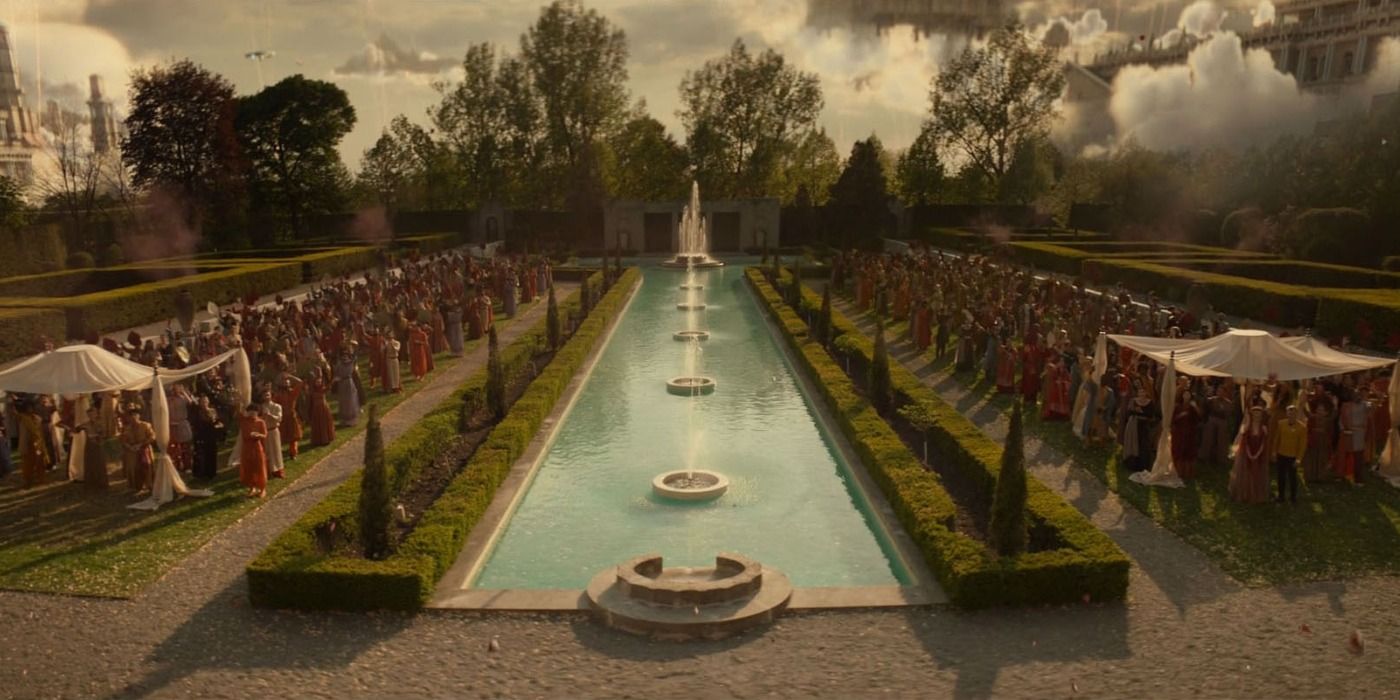
This episode presents the viewer with the idyllic and beautiful city of Majalis, which floats in the clouds above the surface of the planet, an uninhabitable hell of rivers of lava and lakes of acid. Captain Pike and the Enterprise rescue one of its leaders, Alora, a woman Pike met about a decade ago. Her ship was destroyed while she pursued the First Servant and his kidnappers. The First Servant, a boy about ten years old, is vitally important to Majalis. He is to ascend the throne in two days time. If he does not, Majalis will fall and everyone who lives there will be killed. Although she knows exactly why the First Servant’s father kidnapped him and fled from Majalis, Alora lies and tells Pike that the First Servant was likely kidnapped to be held for ransom.
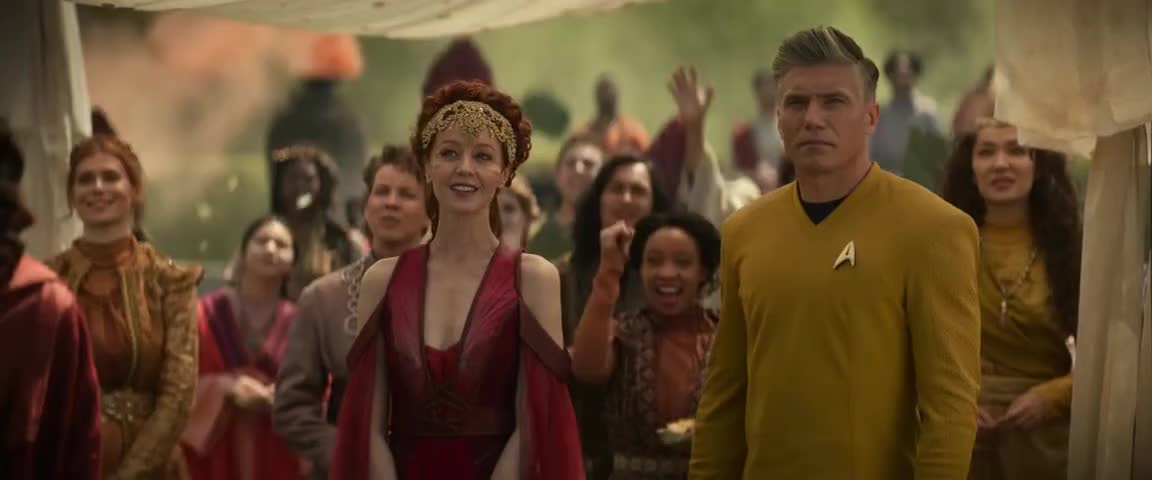
Alora is evasive, and the chaos of the kidnapping attempt and shuttle crash gives her plenty of opportunities to avoid giving Pike any clear answers. Why was the First Servant kidnapped by his own father? How can a ten-year-old boy save their entire civilization? The First Servant is practically a religious figure in a society without religion. The Majalan motto is: “Science, Service, Sacrifice” and the First Servant is dedicated to his role.
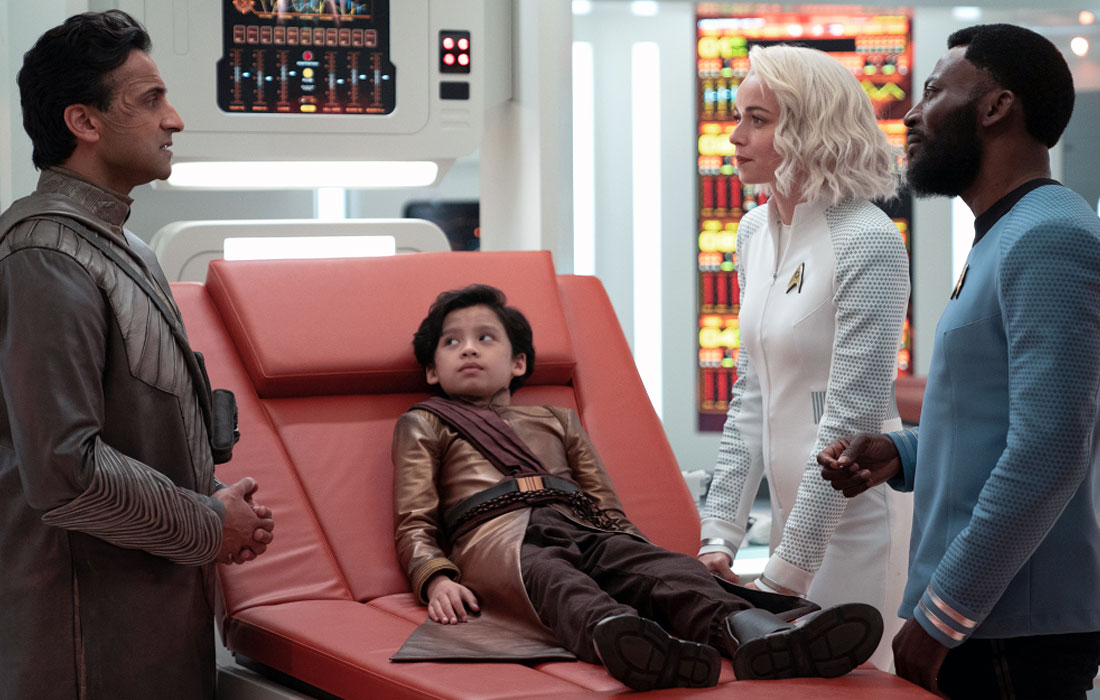
Once the boy is returned to the city, he invites Pike to be part of the ascension ceremony. The society does not allow outsiders to witness this rite, but the Majalan Ruling Council has allowed an exception for Pike because he saved the boy’s life.
Inside the Sacred Chamber, Pike stands in the background as they approach the throne, attached to a number of power generators within. Alora kneels before the First Servant, asking the ritual question: “Do you freely offer this gift of self to the people of Majalis?” “With joy and gratitude, I do,” the boy replies. “Do you freely choose your fate?” she asks next.
Just as he is about to give the ritual answer, the First Servant sees a bundle being carried on a stretcher by some guards, and falters. Two of the guards hold their weapons to bar Pike’s approach, but Alora tells them he could see. To Pike’s horror, it is a child’s corpse: the previous First Servant, now a wasted, lifeless husk. The guards hold him back to prevent him from interfering, as Alora says he has sacrificed himself willingly for the people of Majalis. Pike fights to stop what is about to happen to the First Servant and a guard strikes him and he loses consciousness with Alora looking down on him.
The boy ascends the throne and a look of fear crosses his face as the connections to the machines pierce his face. The First Servant has ascended and become the power source for all Majalis, which will cost him his life.
Later, after Pike recovers, he intends to rescue the First Servant from the machine. Alora stops him by saying even if he could get inside the chamber, severing the connection would kill the boy. Pike is dumbfounded, asking why they would need a child to plug into a machine to keep Majalis running. Alora admits she is not sure why, or what it will do to him; the founders set it up that way centuries ago, and they had tried to find alternatives for just as long; Alora had been trying to find a solution when they met ten years before. Pike asks if the First Servant will suffer, and Alora quietly confirms he will, and that they did not pretend otherwise.
Pike accuses her: “Your whole civilization. All your… this. It’s all founded on the suffering of a child.”
Alora replies: “Can you honestly say that no child suffers for the benefit of your Federation? That no child lives in poverty or squalor while those who enjoy abundance look away? The only difference is that we don’t look away. And because of that, the suffering is borne on the back of only one. That’s what makes it a sacred honor. That’s why I choose our way.”
Pike cannot accept the First Servant’s suffering, cannot allow himself to benefit from the medical miracles that Majalis can perform. He leaves, choosing his doomed future over a life of health and comfort in Majalis. [fn 1]
Discussion
This episode works as a Christian allegory, but with a normal child rather than a God-Savior. The heaven of Majalis is possible only because a child suffers unimaginable torment. He’s honored for his fate, but it’s still going to destroy him. The Christian heaven is possible only because Jesus, the only sinless man to ever live, suffered unimaginable torment. What is it about a civilization that builds its paradise on the exploitation and suffering of an innocent person? [fn 2]
The Morality of Majalis
What did you think of Pike’s rejection of Majalis? His moral stance didn’t change the First Servant’s suffering. Pike harmed only himself by leaving. Clearly, Pike thought the moral injury of staying outweighed the physical injury in his future. If you were in the same situation, what would you do?
Or is Alora on the moral high ground? Like she said, Pike’s society also has suffering children. Majalis only has one suffering child, and no one ignores his suffering. Alora has tried to find an alternative, and she wasn’t the one who set up the system in the first place. Is her stance morally defensible?
Comparing Majalis and Christian Heaven
Now let’s tease out some of the similarities and differences between Majalis and Christian heaven.
- One thing that looks different, but may actually be a similarity is how willing Christ and the First Servant were to make the sacrifice. The First Servant was chosen by lottery from a group of children, and accepted his fate. Christians teach that Christ is the only one who could have carried out the Atonement. This makes me wonder how much choice Christ actually had. No one else could have stepped in for him. Knowing that heaven depended entirely on him didn’t leave Christ a whole lot of options unless he wanted to destroy humanity and his own Father. Bottom line: I believe Christ didn’t really have an option to say no. Neither did the First Servant.
- The First Servant was a ten-year-old child. He’s brilliant and precocious, but still just a child. Jesus was an adult. He taught moral principles, had disciples, and knew how his life would end. Is an innocent person’s suffering somehow … I dunno … more acceptable if it’s an adult rather than a child?
- The burden is different as well. The First Servant is Majalis’s power source. Christ’s burden was all the pain and suffering of humanity. The effect of failure is the same, though. Without the First Servant’s power, Majalis falls into lakes of acid and lava. Without Christ’s Atonement, all of humanity falls into hell. The First Servant didn’t have to feel others’ suffering — his life force was sucked out of him. Does that make a difference in the morality of the suffering?
- The biggest difference that I see between Majalis and heaven is the afterlife. The former First Servant was a shriveled corpse. Christ was resurrected and sits at the right hand of God. Christ has power and authority and glory now. Christ’s suffering ended, and his post-suffering life is magnificent. The First Servant is just dead and gone. This matters to the moral question. Christ isn’t suffering anymore.
- What if he was? What if Christ’s suffering didn’t end? His suffering was called infinite, but yet somehow only lasted for three days. What if that’s just the way we make Christ’s suffering bearable to us? If it’s over, in the past, and Christ isn’t hurting anymore, we can thank him for his suffering and not feel any responsibility to try and rescue him, or lessen his suffering. What if infinite means infinite? Unending? What if, on some level, Christ will continue to suffer for our sins? How much of the acceptability of Christ’s suffering is based on the fact that we’re taught it’s over? If Christ was still bleeding from every pore, would we still praise the Atonement?
Unjust Suffering
The universe is not fair. Suffering and benefits are not distributed fairly. The First Servant did not deserve to be wired into Majalis’s power source when he was ten years old and die, rather than live a long life in the beauty of Majalis. Christ did not deserve to bear all the sins and pain of the world, and die by crucifixion.
How do we respond to unjust suffering? Because there is always unjust suffering. I don’t have an easy answer. That’s a moral question everyone has to examine.
And the thing is — the reason the answer to this question matters — is because we have to determine how we handle the unjust suffering in our society. People are exploited, overworked, sickened, and cast aside so that others can live in comfort, take vacations, and enjoy luxuries. It isn’t fair. It isn’t fair, but humanity can never stop striving for fairness.
So.
Is Christ’s suffering acceptable because it ended and he is now in glory?
Is the First Servant’s suffering more unjust because he has nothing left? He dies and Majalis does not have a religion that teaches the existence of an afterlife.
Is Christ’s suffering acceptable because he voluntarily chose to suffer? Is the First Servant’s suffering more unjust because he lost the lottery and it was bad luck for him?
How do the answers to those questions affect how we approach questions of fairness in our society?
[fn 1] A similar theme was explored in The Cloud Minders, episode 3×19 in The Original Series. The entire theme of that episode is summed up by Spock. He muses to himself: “This troubled planet is a place of the most violent contrasts. Those who receive the rewards are totally separated from those who shoulder the burdens. It is not a wise leadership. Here on Stratos, everything is incomparably beautiful and pleasant. The High Advisor’s charming daughter Droxine, particularly so. The name Droxine seems appropriate for her. I wonder, can she retain such purity and sweetness of mind and be aware of the life of the people on the surface of the planet? There, the harsh life in the mines is instilling the people with a bitter hatred. The young girl who led the attack against us when we beamed down was filled with the violence of desperation. If the lovely Droxine knew of the young miner’s misery, I wonder how the knowledge would affect her.”
[fn 2] Star Trek didn’t invent this philosophical question. The same type of situation is discussed in The Ones Who Walk Away from Omelas by Ursula K. Le Guin. Le Guin was raised without religion, and gravitated towards Taoism; her story is like the Star Trek episode in that the idyllic, joyful society is not linked to religion. Fyodor Dostoyevsky explored this pattern in Christianity in The Grand Inquisitor in The Brothers Karamazov.
 Wheat & Tares
It has always bothered me that Christianity is based in the glorified suffering of Jesus. I hated Packer’s analogy in the story of one boy taking the whipping for another. It isn’t that the boy who committed the sin is the one who should be punished. It is that I don’t think suffering accomplishes anything. It doesn’t *teach* the person suffering that what they did was wrong. Kindness does a much better job at teaching people not to hurt other people.
I don’t believe in Christian “atonement” because I believe in a God who is just as capable of forgiving us as he requires us to be in forgiving others. So, all it takes is for us to honestly *be* sorry for what we did. god knows our heart, so he is big enough to just forgive *if* we have learned to do better. No crucifiction or bleeding from every pore in the garden required. No suffering of Jesus required. No humiliating repentance process required of us, just honestly learning that what we did hurt another person.
Not sure what to do about narcissism, psychopathy, sociopathy and people incapable of learning. Put them on Mars maybe.
Sure, it is true than on our earth under our capitalistic system the poor suffer so the rich can lead cushy lives, which is why at heart, I am a Marxist. I admit that Marxism has never been successfully tried on earth, but that is because the rich have never been willing to give up being rich. It takes a dictator, apparently to force them. But so far, all of the very rich have never been forced to stop being elite. There are always some who support the dictator and get away with staying very rich and always the dictator has been a vicious dictator to stay in power against all the people who they robbed riches from. And always, always the poor have stayed poor. Never yet have humans succeeded in putting Marxism into practice, so who knows how it would actually work. I don’t know if Marxism CAN be put into practice. Or if that kind of idealism is simply beyond humans.
It is like Mormon’s concept of Zion. Ha ha ha, very funny if you think humans will ever attain that. Humans are simply too selfish and there are always some who will cheat or take over power. I have no idea how to make the supper selfish stop cheating and I have no idea how to make the powerful give up their power. The powerful and narcissistic think they deserve special rights and more power and they always figure out how to fight for that.
So, realistically, I am against Marxism and even more against capitalism. But democratic socialism seems to work better. Not perfect but better.
So glad you mention Le Guin and Dostoyevsky. However I would say about the Grand Inquisitor that it less effective than Omegas because it has a more limited didactic purpose which is to conform the Western Catholic Church and, more particularly, the Jesuits.
I love Star Trek: Strange New Worlds and virtually all the other versions of it as well because of the way they approach issues to open up thinking. My favorite episode is the “Musical” in season 2.
As for the episode mentioned, suffering is inevitable for all of us at some point. Who wouldn’t want someone else to take the suffering for everyone else? However, I think the moral is that it’s not possible. We’d just be replacing one form of suffering with a different one, even if it was “pleasant.”
I think the real issue with suffering is how we 1. deal with it ourselves, 2. let others help us, and 3. how we empathize with others as they are suffering. I just had open heart surgery for a congenital heart defect. I’m 70, so I had many good years, and I’ve had this argument within myself of had I had enough “life” or am I selfish for electing to my privilege of insurance coverage and Medicare to get something to benefit me. I’ve also reflected a lot on how thankful I am for the people who have helped me, from Doctors and nurses to my wife, children, and neighbors, to people I’ve known around the state. Yet I’ve also recognized that I have not truly been understanding of the pain others have gone through in my past years. Even though I’ve thought of myself as being caring, this has helped me to understand how far I have to go to develop true empathy for those who are suffering.
I like Star Trek for asking type of moral questions in each episode. I like Star Wars as well, but have found Trekies much deeper and more thoughtful.
I’m a lifelong Trekker, and my opinion is that Strange New Worlds is the best series so far (next in line for me is Deep Space Nine). In fact, with the Roger Korby plotline we just re-watched What Are Little Girls Made of? (original series) last night as a refresher. I always thought that a discussion of the moral issues posed by Star Trek episodes would be the best gospel doctrine class possible, far better than what’s actually on offer.
This episode also made me think of Shirley Jackson’s short story The Lottery, in which citizens of a town enter a lottery and the one selected is stoned to death by the rest in an annual ritual that keeps their society together. It’s also similar to the idea explored by Suzanne Collins in her Hunger Games series, in which each of the districts has a reaping in which two tributes, teens, are chosen to fight to the death in an arena. Their authoritarian government does this to keep everyone in line and prevent revolt, but it leads to revolt and civil war.
The Christian atonement doesn’t make any logical sense to me. Self-sacrifice, especially for the benefit of others does, but punishment of a third party for the errors one makes doesn’t. Two wrongs don’t make a right.
Another way to view the episode is as a Marxist critique of poverty and suffering as the necessary underbelly of a society that allows some to flourish: the haves and the have-nots. The more you contain the suffering to the smallest number possible, the better off you are–or that’s one theory. The flip side of that argument is that it’s more immoral to choose who suffers than it is to allow suffering to happen in a way you didn’t choose. That’s Pike’s ultimate conclusion, and it’s the same conclusion many reach when they contemplate the Trolley problem. For some reason, as humans it feels more right to allow suffering, even if that suffering involves more people (e.g. the 5 strangers who are hit by the trolley) than it does to deliberately choose who suffers. If technology is making the decision, though, it probably will do what logic dictates, what Alora does. It will contain and minimize the extent of the suffering by choice rather than being passive. As usual, most Star Trek episodes are essays on the advancement of technology in tension with human flourishing. Pike chose the illogical human path because pure logic sometimes means you lose your humanity.
And maybe Christianity, at least in terms of the atonement, is inhumane in its logic.
Over a Sunday dinner I posed this same question – if the happiness and security of a village could by ensured by torturing a child, would you choose to participate in that system? Everyone responded “no way” except for one who said it’s the logical choice and maybe truly the only choice. Then he added, we basically have this system in place today where our policies take advantage of minorities and smaller countries.
While I don’t think our economy in the US is as stark as torturing a child, I do believe it’s a sliding scale. My family member’s point was correct in essentially pointing out some aspects of our lives are closer to the Star Trek episode than we should feel comfortable with.
For example in graduate school a question on one of my finals was how can a country justify sending some young men to certain death or terrible lifelong suffering because of war while most people sit comfortably at home. My answer (and I quoted some philosopher whose name I cannot remember) was that the only way to have a semblance of fairness is if the selection process is random. Otherwise we perpetuate and advocate for torturing one for the benefit of others.
Hawk points out several other modern tales. The whole time I was reading this, I couldn’t stop comparing it to Lois Lowry’s The Giver. Perhaps sitting with this concept is a tale as old as time.
“CONFRONT” not “conform” Spellcheck is evil!
I used to consider myself a moderate Trekker, but the only show I’ve seen since Voyager was the first season of Picard.
I think the Atonement ultimately only makes sense if you think of Justice and Mercy as natural laws on par with gravity and Newton’s Laws, rather than conceptualized concepts of law. In fact, I imagine on the other side, in learning how God and the Universe works, a class on the Atonement might more resemble a Physics course, rather than a Law Class. I’m convinced the Father and the Son have exploited any and all “loopholes” in those laws to benefit us in the most greatest way possible.
I do think the Son had a choice. It may not be the Firstborn in every universe under every exalted being. I imagine that choice could be passed down to child number 1698765232 or further.
The best pathway to fairness has already been shown us. I’m guessing the only thing worse than not choosing that path is being forced to take it.
I hated Packer’s analogy in the story of one boy taking the whipping for another.
That is a thoroughly wrong-headed story, but it isn’t Packer’s. I think the last time I heard it in conference, it was from Faust. Packer’s analogy is very different and makes a lot more sense if you put one little twist on the traditional interpretation. In Packer’s story, a Mediator pays off somebody’s debt. In exchange the debtor agrees to obey the Mediator. If we interpret the lender as the victim instead of as God the Father (the traditional interpretation), then what we have is Jesus making a victim whole and nobody getting punished. It’s a much better story than Packer-haters are willing to give him credit for.
This is a topic worthy of thoughtful consideration. It is also a topic that touches on the nature of mortality and of our relationship to God and even the character of God. In other words, the question of suffering is ultimately the question of the meaning of life. Too much to explain, one can only sum up in the most miniscule way.
(1) Is there “divine justice” that demands payment for every human sin?
I don’t know. To believe this is to propose some sort of equilibrium that is beyond our understanding. When in 6th grade I hit my friend Joey in the face with a snowball (and I meant to do it) did God wince in pain? I have difficulty thinking God would care about such a triviality. I did something wrong and Joey either forgave me or got revenge – I don’t recall which. Life moved forward.
I have a hard time thinking God had to suffer to “pay” for all my thoughtlessness, stupidity and immaturity. I can handle the consequences for those acts. So where is the cut line for what sins are great enough to require the Saving Grace of God’s Atonement? Perhaps this question misses the point. The Saving Grace of God is far more than balancing payment for sin, especially when humans have the capacity to reconcile the costs of many of their mistakes. What about human errors that involve costs that cannot be repaid? Does God have to pay those costs? It certainly helps one to Forgive and have Mercy if one believes God has made the balance of payment for wrongs actions.
(2) So why is suffering such a prominent part of Jesus’s Atonement?
Suffering is a very real part of our mortal experience. We experience real pain from both physical and emotional injury. We cause pain to others and other cause pain to us. Sometimes the injury is intentional. Many times it is not.
Perhaps the main point of Jesus’s suffering is to demonstrate that God can relate to us. The condescension of God is that he lowered himself to the mortal, human level and experienced life as a mortal human being. He didn’t have to do this but he did and why? Because God wanted to help humans have Faith in him. God wants to help humans Desire him, and to Love him. So God, in the form of the Son, lived on earth and ultimately experienced the worst that humanity can offer. And then the Son triumphantly overcame his torturous death and rose in Glory. That is a very powerful message of Hope overcoming Evil and that is the message God wants humans to receive.
(3) Why did Jesus suffer in the Garden of Gethsemane?
The suffering of Jesus on crucifixion day recognizes the depravity that humans are capable of, and Jesus was willing to endure this to prove God’s willingness to die for us – to earn our Trust and Loyalty. But why did Jesus suffer in Gethsemane? Scripture clearly states that Jesus experienced great spiritual pain that manifested as physical suffering when he prayed in Gethsemane. I understand this to be in response to the Atonement correcting the conditions of the Fall of Man. Does this mean there is “divine justice”? Maybe. Perhaps to balance the costs of Fall of Man, Justice required a payment that only God himself could make. That payment was made in Gethsemane and then Golgotha.
I scarcely understand it all. I just hope to appreciate what God did for me sufficiently that I will receive His Gift and properly cherish it, treasure it and make use of it each and every day of my life.
I scheduled this post and then went to an exercise class Friday morning. The instructor said, “this next exercise is hard on your back if you don’t use proper form.” Guess who found out she didn’t use proper form? Yeah, I’ve just been moping around the house and watching the clock to my next ibuprofen dose and thinking that lower back pain cannot be transmuted into paradise.
Anyway. Very thought-provoking comments, everyone!
Anna – as always, I love your insights. Growing up in the Church, and absorbing the idea that suffering teaches compassion, it took me a while to realize that suffering sometimes just teaches cruelty. It’s like that saying: “what doesn’t kill you makes you stronger.” That is not true. Sometimes, what doesn’t kill you leaves you weaker, or with fault lines and it’s easier to break along those fault lines.
Instereo – first off, very profound points about suffering. And the Musical episode! The way they turned that into a crisis was deep. People were singing out their deepest emotions, and that was going to cause problems because no one wants to be known on that level by their colleagues. Very intense episode about privacy and what we don’t want to share with others. Strange New Worlds is the best; my favorite Star Trek hands down.
Hawkgrrl – yeah, the utilitarian philosophy was definitely on display in this episode. We can’t do away with suffering, so confining it to the fewest possible people is the best result. And yet it’s horrifying to think that we’re the one choosing who suffers. I’ve read The Lottery too. How do we distribute suffering? And prosperity? We don’t do a very good job at being fair, but God didn’t do a very good job either. Toad made some good points on this same line of thinking.
Chadwick – I didn’t connect this to the Giver, but I see your point. The Star Trek episode was about physical suffering and physical paradise. My take on the Giver was that the Giver maintained the memory and suffered the emotional and moral pain of injustice in order to spare other people the emotional and moral burden. Same question: different type of suffering. The Giver also dealt more with the harm done to those who are spared from suffering. The community was too innocent – they couldn’t make their own choices, even.
It’s all made up. Huītzilōpōchtli didn’t need any sacrifices for the sun to keep going. Unless we’re talking Stargate, Baal didn’t need anyone killed. All across the globe, lives sacrificed for nothing. I wonder what would happen if that kid didn’t, in SNW, get plugged in.(There’s no technobabble on how it works, I’m dubious) Maybe it was all for show and for society cohesion and psychological mumbo jumbo.
What I like about the Christ story. It’s a one and done. No more killing. Too bad Christians didn’t get the message.
I am a SNW fan, and previously thought DS9 the best trek(with episodes like “Duet” and “In the Pale Moonlight”), but my favorite is the childrens animated show Star Trek Prodigy, And season 2 is the best season of Star Trek, full stop. At the end of season one, Hologram Janeway sacrifices herself for her cadet crew. Someone has to steer the ship away. And with full understanding, H. Janeway chooses to do it.
Great post. Thank you for mentioning “The Ones Who Walk Away From Omelas”, because for those of us who read SF&F, it’s obvious this episode is an homage to that.
I’d like to recommend another new addition to this topic: Naomi Novik’s Scholomance trilogy.
At first glance the books just seem like a darker YA version of Harry Potter, but as an inveterate reader of SF&F for the last 45 years I’m surprised at how this series has stayed with me. I’ve actually purchased and re-read it, which I rarely do.
So much of this topic centers on the idea of choice. And one choice we don’t talk enough about at church is the choice to REALLY look at ourselves, to see our own darkness. As Jung says, to confront our shadow selves. Real self-confrontation is incredibly painful and we humans are very skilled at rationalizing.
This discussion and the SNW episode got me thinking. The nature of what Alora says the sacrifice means, tying it back to tradition, that it’s a good thing. The questions being asked of the First Servant. The immeasurable duty and responsibility The First Servant has to accept this fate, especially after being told by so many that it’s what’s best, it’s the only way.
How do we know? How does that society even know? What if it’s a lie? What if it’s just religious ritual passed on claiming that it’s the only way. I say this because of a short story I taught my students last semester, Shirley Jackson’s “The Lottery.”
It parallels a lot of these themes, but instead of someone chosen, it’s a random lottery. Everyone is eager to take part in the lottery, even the woman who is eventually chosen, until she’s chosen. Then it wasn’t fair.
But some in the town know other towns have given up the lottery, which has been a ritual for longer than any of them have been alive. If others gave it up, is it necessary. But an older man lashes out at the young people, claiming its necessity. They had to do it in order to have prosperity, though no one can say exactly what was changed.
When the lucky “winner” of the Lottery is chosen . . . well, maybe I won’t spoil it for you.
But this discussion calls into question, how do we really know a sacrifice is willing? We don’t have Christ’s official account. We don’t have his actual words. We have gospels that were recorded decades afterwards. We have epistolary letters that advocate it. We have theology and dogma going back nearly two thousand years, but it wouldn’t take much for the literature to twist the execution of a criminal into the self-sacrifice we know, today.
So to go back to Pike. He knows Alora, knows that she sincerely believes. The First Servant also sincerely believes his sacrifice will save his people. But is any of it true? Have they actually tried other ways? Even if it was necessary at one time, is it necessary now? Could they find another way? Or does the fact that the current system works enough to not bother trying to find a way that doesn’t require a sacrifice?
I love SNW. This is the episode that lingers most in my head. I trace the beginnings of my faith transition to the realization that I wanted nothing to do with a system that makes my salvation contingent on anybody’s ultimate suffering. The episode shook me, reaffirming so much of what I find grotesque and morally injurious in the Christian paradigm.
I don’t know where I’d rank the -series- in my Star Trek best list, but Pike is rapidly ascending the list of my favorite captains/commanding officers.
I wonder sometimes if we impose on God, as a law, a human-imagined sense of justice. I don’t view the Adam/Eve story as historical anymore and therefore, that pretty much eliminates the fall as we frame it. With the fall gone, the necessity of Jesus’ death and resurrection become unnecessary in the particular context in which it is framed. Yet, as humans, we’ve found great meaning from people who have given their lives out of a seeming act of love. We come at the Jesus story as if there is some cosmic imbalance that must paid for by a god. We live for retributive justice. For us, a god that doesn’t punish someone like Hitler or Stalin, or go after and exact justice on our enemies, is a weak and worthless god. We crave the war god when it comes to our “enemies” and plead for the mercy god when it comes to ourselves. And the sacrifice Jesus makes is to satisfy this human obsession with retributive justice. However, I don’t know that those are scenarios that move people towards goodness. Suzanne mentioned the Prodigy episode. Captain America goes down with the plane to save country. We just watched Deep Impact and the astronauts blew themselves up to save whole world. None of those sacrifices were necessary, however they were done willingly to out of love for others to allow others to live, not to pay down some imbalance. So was Jesus’ sacrifice to stave off some cosmic asteroid headed our way? If so, who put the asteroid there in the first place? Can God, supposedly being all powerful, not change the rules?
In my observation, suffering can lead to learning, but suffering more often leads to breaking. The people in General Conference talking about suffering and learning do so most often from a position of privilege. They’ve never really experienced true suffering–and in my mind true suffering comes with complete destitution, think holocaust camps at the extreme or maybe more moderately having no social safety net at all and things falling apart. That suffering was designed to break people and it was very successful. There were a few that kept their heads up and came out stronger, but I think they were the exception. The Givens’ “God who weeps” gives me a lot of things to think about. For me, I’d rather have a God who is present with me, that I know is there and is an actual help and actually responds. I’m not talking about a vending machine god, but one who shows interest and investment in relationship with me like my wife, or my parents, or my siblings show interest and investment in relationship with me. Right now, the silence and overall absence doesn’t give me much confidence that he/she/they really care that much so I’m not sure why I’d want to spend my time jumping through so many hoops to return to their presence.
What Chris said. Lately, I’ve been thinking along similar lines, so thanks, Chris, for what you wrote.