
Readers of Wheat & Tares will be familiar with the explicit racism in the Book of Mormon. This has been well documented, and the passages well known. Probably the most glaring examples are:
2 Nephi 5:21: “And he had caused the cursing to come upon them, yea, even a sore cursing, because of their iniquity. For behold, they had hardened their hearts against him, that they had become like unto a flint; wherefore as they were white, and exceedingly fair and delightsome, that they might not be enticing unto my people the Lord God did cause a skin of blackness to come upon them.”
Jacob 3:8“O my brethren, I fear that unless ye shall repent of your sins that their skins will be whiter than yours, when ye shall be brought with them before the throne of God.”
This idea that it was actually skin color was reinforced by President Spencer Kimball:
“The [Indian] children in the home placement program in Utah are often lighter than their brothers and sisters in the hogans on the reservation” (Improvement Era, December 1960, pp. 922-3).
But this post is not on this explicit racism, but the implicit racism of the book as a whole as referenced in the mound builders myth.
You can Google Mound Builder Myth for detailed information, but to summarize: The Mound Builder Myth is a 19th century interpretation of the mounds and structures of North America as the works of a long lost civilization, not the work of the American Indians.
The thought was that the American Indians could not have possibly build these amazing structures, so it must have been an early “white” civilization that did it, and the current indigenous people are recent arrivals who conquered the land from the mound builders. Under these circumstances, the Europeans need not have felt any compunction about sweeping aside the supposed savage hordes to re-claim the land on behalf of civilization.
Lest you think this was obscure thinking of the time, in 1830 President Andrew Jackson devoted much of his State of the Union address to promoting the mound builder myth to justify the displacement and sometimes slaughter of the American Indians
“In the monuments and fortresses of an unknown people, spread over the extensive regions of the west, we behold the memorials of a once powerful race, which was exterminated, or has disappeared, to make room for the existing savage tribes.” Andrew Jackson, 1830
There was many other books and writings about the mound builders in the same time that Joseph Smith was growing up. One could argue that the Book of Mormon is just another “mound builder myth” book from that era. In fact the Wikipedia page for the mound builders myth lists the Book of Mormon under the “Pseudoarchaeology” section. It references a quote from the New England Quarterly:
Undoubtedly the most famous and certainly the most influential of all Mound-Builder literature is the Book of Mormon (1830)). Whether one wishes to accept it as divinely inspired or the work of Joseph Smith, it fits exactly into the tradition. Despite its pseudo-Biblical style and its general inchoateness, it is certainly the most imaginative and best sustained of the stories about the Mound-Builders
New England Quarterly, vol 34, no.2 June 1961
The mound builder myth is clearly racist in its aim to minimize the contributions and justify the slaughter of the American Indians and taking their lands away from them. Where the Book of Mormon diverges from this narrative is the talking back of the lands. In fact the Book of Mormon stated purpose is to “save” the Indians from their fallen state, not to drive them out, though Brigham Young might not have got that memo.
What are your thoughts about the mound builder myth and its relationship to the Book of Mormon? Is this just another nail in the coffin of the Devine providence of the book, or is the mound builder myth not really a myth, and Joseph Smith got it right all along?
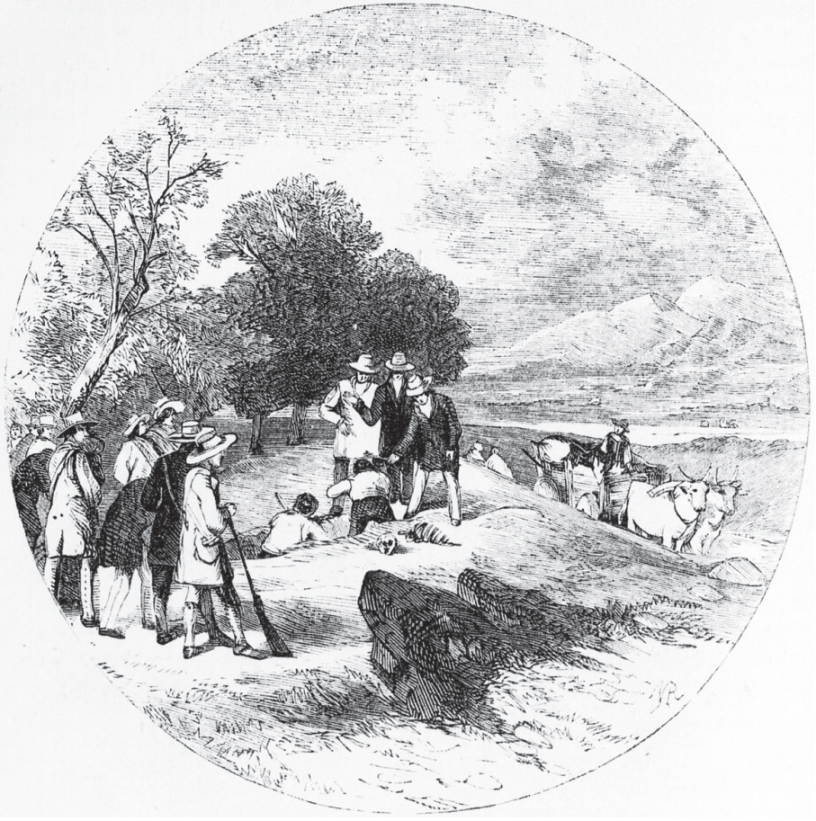
(The caption to the above photo taken from this mound builder article: “A depiction of Joseph Smith, who in his youth had been a treasure hunter, excavating a mound after he had founded a religion on the idea of a lost Mound Builder race.”
 Wheat & Tares
Modern revelation translates 2 Ne. 5:21 in this manner: “He imposed a cursing on them. It was a severe cursing because of their iniquity, because they had hardened their hearts against Him. They were unyielding, like flint. Therefore, although they had been pure and radiant and highly pleasing, the Lord God made their dark countenance show through so they wouldn’t be attractive to my people.”
Other parts of American society have successfully moved on from the Mound Builders Myth. Why are the Mormons still stuck on it? Partly because of the Book of Mormon. Partly because of the idea of prophetic leadership and its claim of close connection to God and His Will — so no updating Mormon doctrine and thinking until the nonagenarian prophet gives a thumbs up.
So what many Mormons view as features of the LDS Church — the Book of Mormon and revelation through modern prophets — is actually the reason the Church as an institution and Mormons as a people get stuck in the past. Word of Wisdom thinking is another example, rooted as it is in 19th-century views of medical science with LDS leadership largely resistant to 21st-century medical science (although at least they didn’t become anti-vaxxers like so much of the membership).
When I was in seminary in the 90s one of the clearly racist verses was neatly explained away by the CES teacher – I apparently didn’t understand English the same way he did. It was one of the first experiences of gaslighting that I recognized as such.
About 8 years ago on the way home from a YM super activity we stopped at a Navajo gas station. On the front page of the local paper was a strongly worded article about how offensive it was for LDS doctrine to claim American Indians were descended from the Middle East. It was vicious and abundantly clear that in their view the LDS church adopted racist and condescending ideas towards Indians. I remember this hitting me hard.
100%. The whole Book of Mormon is based on the idea that humanity itself came from Adam and Eve 6,000 years ago and that the Native Americans had to have some sort of connection to the biblical historical narrative. It is based on the idea that America was a promised land and that Europeans were a superior people since they were Christians. “Civilization” was the product of belief in Jesus. The “savageness” of the Native American population was due to them rejecting Jesus and driving out and killing the earlier “civilized” inhabitants among them. White Nephites are portrayed in the Book of Mormon as the builders of great cities. Lamanites as primitive jungle-dwellers.
It is truly amazing what has been discovered about Native Americans through science and history since the 1830s. None of these findings confirm the Book of Mormon in any way.
arlius11:
What modern revelator did the translation you provide?
Or is it meant as a satire?
arelius11, what you call “modern Revelation” I call gaslighting. Although after LoudlySublimes comment, I’m thinking your comment may be a example of Poe’s law! If so well done!
In the new fancy hymnal (2027), I wonder how many peculiar songs will be removed (Hie to Kolob, The Iron Rod etc).
And of course, Book of Mormon Stories.
Other hymns for kids will be included in the new book – today we sang one as opening hymn for Sac Mtg – the infantilization is real…
Trevor Holladay, I’ve had so many of the same experiences. I’ve spent my whole life in the church and barely gone a week without attending church. I’ve listened to countless conference talks, firesides, and believing scholars over decades. Now when someone finds out I no longer believe, they jump to this absurd idea that I don’t truly understand Mormonism or didn’t understand something. No, I understand and understood it perfectly. What happened is that racism is no longer acceptable the way it was in the 1950s and before, so there is pressure to come up with ridiculous interpretations to save the face of a holy book that is supposed to be the most correct book ever. The explicit and implicit racism of the Book of Mormon is patently obvious.
I have heard about this, but I’ve wondered what is great about mounds? Anyone can make mounds. Especially ones that are removed by farmers in attempts to create flatter fields.
Also, any time I’ve read/heard someone talking about Joseph Smith making up the Book of Mormon because of Mounds, I’ve been interested in reading a first hand account but no source is ever provided. Can someone provide a source? It seems to be an unchallenged assumption.
Beyond the obvious racist messages of the Book of Mormon, are the racial experiences one experiences within the Mormon culture and experience. (This has remained because of the Book of Mormon)
I have many family members who are not of Pioneer/ Northern European decent, including my wife. Experiencing how they are treated by the general membership is all that one needs to know. How many of you have had a Black Family visit your ward, and in the next ward council they are referred to as “The Black Family”. How many of us over 40 years/old, were told not to date or marry outside our race?
Look at the poster children, idolized minority members experiences who married outside their race: Thurl Bailey, Mia Love. Each of their families was opposed to the union.
The current younger crowd does not think this way, however it is still baked into the culture and is 25 years behind the rest of society. Now that Gong is in the red chairs, the teachings and attitudes will change. Remember the gospel and its truths are Eternal, but only for each generation and then next one will come along to gaslight the prior generation.
When I lived in southern Ohio as a kid (I turned 5 there), there were mounds in our vicinity. They were universally called “Indian Mounds.” It was not until I joined the Bloggernacle that I learned of any other theory. Perhaps that is because in all of my reading of the Book of Mormon, I cannot recall any accounts of mound building.
jader3rd – Last year, my son’s class on ancient world art taught a lesson on the mounds in the Americas. It was the first time I had seen them treated as artwork. One of the mounds was a spiral. Others were animal shapes. They were huge – the photos that showed enough of the mound to show it was an animal were taken by drones. No one standing on the ground would see the animal. That was an indication of the planning that went into the mounds.
I checked wikipedia. The articles about the Spiro Mound and the Sugarloaf mound say they were foundations for religious buildings, or used as tombs. Building elaborate tombs was the reason for the Egyptian pyramids. In the Americas, the tomb-mounds were constructed with tunnels and filled with artifacts.
https://en.wikipedia.org/wiki/Spiro_Mounds
https://en.wikipedia.org/wiki/Sugarloaf_Mound
I don’t want to excuse the Book of Mormon peoples from “othering” each other–that’s a regular phenomenon that has existed among human beings since the dawn of time. But as I’ve studied the Book of Mormon pretty consistently from the age of 16 through my early 60s it’s become more and more clear to me that we in the West have misunderstood the relationship between the Lamanites and the Nephites because of our own cultural history.
When the Nephites describe the Lamanites — especially early on in the BoM (in the small plates of Nephi) — it is evident that they are pointing out differences between the two groups that have to do with lifestyle–and that those differences arise from embracing or rejecting the Law of Moses. It is the culture that arises from living the Law of Moses that is the key to understanding the rift between the two groups–and not race, per se.
And so from a Nephite perspective what we have is a group that fails to cover there bodies, that hunts unclean animals, that eats raw meat, that drinks the blood of beasts, etc. These elements of lifestyle seem to be mentioned more frequently than other aspects of “good society” like living in houses and tilling the earth and keeping the sabbath day holy and so forth. They were an affront to the Nephites’ basic sense of clean-living and decorum–because of the Law.
All of that said, regardless of the differences between the two groups we have to remember that the Nephite prophets consistently viewed the Lamanites as their brethren–they were of the same stock so to speak. And so whatever their difference in appearance might’ve have been I’m of the opinion that a darker complexion was likely the product of running around in the hot sun with virtually no cloths on–and my guess is that their little children were buck naked. And so if their complexion was loathsome to the Nephites it would’ve been because it was a sign that they were unclean according to the Law of Moses–and not because of the color per se.
Finally, I think it’s worth noting that as we get deeper into the Book of Mormon the Lamanites become more of a cosmopolitan demographic–and that the label “Lamanite” has more to do with those who are enemies of the Nephites regardless of appearance or lifestyle. This in my estimation is further evidence that the rift between the two groups has less to do with a difference in race and more to do with a difference in ideology.
I do not believe in an ancient origin of the Book of Mormon. I do allow for the possibility of divine inspiration having a role, while believing that a lot of contemporary influences on Joseph Smith show up in the book. However, I think critics of the Book of Mormon who point to specific ideas or texts as sources for it tend to overstate their influence. I think most of those influences are in the background at best. The explicit racism in the Book of Mormon needn’t be based specifically on mound builder myths. Those myths are just one rationale for racist ideas that probably pervaded the culture ever since European settlers arrived in the Americas. I do think the text is motivated in part by a desire to explain differences in skin color between different groups of people, but I think that’s a far more general idea than the mound builder myths.
@Jack, you said, “When the Nephites describe the Lamanites — especially early on in the BoM (in the small plates of Nephi) — it is evident that they are pointing out differences between the two groups that have to do with lifestyle–and that those differences arise from embracing or rejecting the Law of Moses. It is the culture that arises from living the Law of Moses that is the key to understanding the rift between the two groups–and not race, per se.”
Look again at 2 Ne 5:21 from the OP, “wherefore as they were white, and exceedingly fair and delightsome, that they might not be enticing unto my people the Lord God did cause a skin of blackness to come upon them.” (2 Ne 5:21). What you are saying is not “evident” from 2 Ne 5:21. At all.
I see two possibilities:
1. Nephi and Jacob (or Joseph who “translated” the text) meant what they wrote, and you (and certain BoM apologists) are wrong in bending the BoM text too much to make it more palatable to current racial sensibilities. This is by far the more likely possibility.
2. Nephi and Jacob (or Joseph) are wrong, and you (and certain BoM apologists) are right (the darkness wasn’t caused by God, it was a “darkness of countenance” and not even a literal darkening of skin at all, etc.). However, if you’re going to be a Mormon apologist with integrity, if you choose to go down this path, you’d have to be open to much more plausible interpretations of other BoM passages that don’t match the traditional narrative. For example, did God really tell Nephi to kill Laban, or did he just make up this justification after the fact? Was Nephi a fallen prophet after murdering Laban? The Mormon apologists that embrace strange interpretations of straightfoward BoM passages to explain away the politically inconvenient dark skin of the Lamanites are generally not going to be open to the idea that Nephi sinned in killing Laban, much less that he was a fallen prophet, but they really need to be open to such interpretations if they are going to embrace their dark skin theories to erase racism from the BoM. That’s just one example. Others might include:
1. Are we to accept that the Liahonia is a real physical object? Might it have really just been a description of how the Holy Ghost guided them like it can guide us today?
2. Did the Jaredites really cross the ocean in strange boats with magically glowing rocks after Christ (who didn’t even have a physical body yet) touched them? Might this really be interpreted to mean that there were no glowing rocks, but the Brother of Jared’s prayers made the Jaredites feel internal light and hope as they crossed the ocean?
3. Did the resurrected Christ literally descend from the sky and teach the Nephites? Or should we really interpret this as an event that the Nephites saw with their spiritual eyes rather than a real physical appearance of Christ?
Of course, apologists don’t want to reinterpret these sorts of things because they are viewed as faith promoting. However, if we can’t accept some very unambiguous passages of the BoM describing the origin of the dark skin of the Lamanites, exactly which parts are we to interpret in a straightforward way?
Some scripture/texts leave plenty of room to allow for multiple conflicting interpretations. The dark skin of the Lamanites is not one of those cases. How much clearer would the BoM text have to be for apologists to accept that the dark skin was real, and it was caused directly by God?
Right now, I lean towards the BoM not being historical. That creates a problem for the church’s literal interpretive approach it takes with almost everything. Yet, I don’t find the naturalistic explanations to be very satisfactory. It could very well be that the BoM is inspired in a lot of places or could still be used to do inner work, yet the thing standing in the way of that being the culture of literalism. The Jews have a rich midrash tradition that opens the interpretive field very wide, making sacred text for them much more meaningful for contemporary life. Adam and Eve could be both literal and imaginary in that tradition because what really matters when looking at it from all those angles is what you can take from that to work on yourself and community. I can’t remember exactly where I read this, but one contemporary Jewish leader wrote an opinion piece suggesting to LDS members leaving over BoM historicity problems to try the midrash approach. I listened to a recent Soul Boom episode with Rainn Wilson interviewing Britt Hartley (an ex-mormon mystic atheist). It was a fascinating conversation. She describes a college professor she had taking a novel approach to text in that he would direct the students to find each of the characters in a particular story inside themselves (my summary of this probably falls very short). The text becomes a means of doing “soul work”. It sounded like she still engages sacred texts of all religions, but in a way to learn about herself and not out of any desire to know if the religion is true or if the scripture account literally happened, because those questions are increasingly less important. I just wonder if the BoM could become useful again to a lot of people if we abandoned the quest to establish historicity. I realize that creates a LOT of problems for the church’s narrative over the last 200 years. But, as I see it, change or die. The OT is replete with examples of Israel being forced to change its beliefs and views as significant unexpected things happened to them. At the end of the day, Nephi was just as guilty for the division of his family as his brothers were because of his obsession in telling them he was going to rule over them and that he had special access to God. Imagine if orthodox members could recognize this in themselves? I don’t mean to pick on them, but they do tend to take the position of being the ones in the literal right in almost every aspect. Instead of being an inherently racist text, could we turn it on it’s head to instead be a text that helps us recognize those things in ourselves and the potential outcome as a result if we don’t choose something different? I don’t know. This is a very new thought process for me. I have been unable to read the BoM for the longest time because I still feel hurt from all the disappointment in deconstruction. I’m amazed when I read someone like Richard Rohr or Pete Enns who are still able to find meaningful things in sacred text, while also being fully aware of all its issues. I’m also very surprised an atheist can do this as well.
mountainclimber479,
I believe that the Lamanites did have a comparatively dark complexion–the text seems clear to me on that point. Even so, the Book of Mormon clearly uses both literal and metaphorical descriptions when talking about the effects of the curse.
That said, we need to take the whole BoM text into account–not just one verse–in order to see that the descriptions of the Lamanites have mostly to do with violations of the Law of Moses–especially with respect to lifestyle.
That (and that) said, I understand your concern for bias in the way believers might approach the text. But I might say the same thing about those who come it from a purely secular point of view. It’s the most natural thing in the world for non believers to make the assumption that the racial elements in the BoM are merely an echo of our own cultural past. And sadly, that causes many readers (IMO) to gloss over details that might bring greater clarity to the text.
The idea that the Lamanites’ lifestyle violated the Law of Moses in just about every conceivable way is set forth in unmistakable terms by the Nephite writers. And the fact that those violations were abominable in the sight of the Nephites goes without saying to those who understand the cultural demands of the Law–which, of course, the Nephites did.
The only way to take the BOM at face value, as if it’s a historical account of ancient people, is to ignore all the anachronisms in it and to know nothing of the real culture and history and archaeological records of ancient people in the Americas–or at least to know roughly the same amount as what people knew in the 19th century. These were rich cultures with their own understanding of the spiritual that was complex. To believe the BOM is ancient, you have to ignore all of that. It’s easy enough, though, because most people aren’t really readers, and they aren’t that curious about things they think don’t affect their daily lives. Instead, they cherry-pick what they find valuable, the scriptural-sounding rehash of Biblical ideas that are in the BOM. The book is full of racist ideas and assumptions from the 19th century, but of course those are not the aspects that are “inspiring” to people in the church today. And yet, that’s what makes these ideas insidious. It’s the same with all forms of racism, sexism, blaming the poor, blaming those with physical or mental disability, etc. We strain at a gnat (the diamonds in the dunghill as Thomas Jefferson referred to the parts of the Bible that were worthwhile) and swallow a camel.
Hawkgrrrl,
I’ve been studying the Book of Mormon for at least as long as you have–probably ten years longer, truth be told–and. . . what can I say? The Book of Mormon simply is what it says it is.
There has been a lot of great work done on the BoM’s provenance and theology and so forth–and shuffling all of that work off to an “apologist” category won’t make it false. That said, while I’m of the opinion that the BoM will one day be vindicated by scientific means the only surefire way to know of its truthfulness is to do as the book itself recommends–which, of course, you already know.
The Book of Mormon writers give different impressions of “the curse”. Nephi says the Lamanites were cursed with blackness as a mark that would distinguish the Nephites from the more wicked Lamanites. Yet Jacob, Nephi’s younger brother, tells the Nephites that the Lamanites are more righteous than them because their husbands are faithful to their wives and children. This indicates that the “curse” was not about righteousness but more about family lineage.
Many generations later, a story is told in the Book of Alma of a group of Nephites who split off and ended up in war against the Nephites. Alma and Mormon, the editor of these pages, go to great lengths to explain that the splinter Nephite group physically marked itself to distinguish it from the Nephites. The corollary being the Lamanites were marked to differentiate themselves from the Nephites and possibly, the Lamanites at the time of Nephi had marked themselves to make themselves appear different than Nephi and his clan.
By the end of the Book of Alma, Lamanite and Nephite became political and cultural labels. Distinct lands existed but no mention is made of the Lamanites having darker skin and the Book of Mormon explains that large numbers of Nephites had politically joined with the Lamanites and large numbers of Lamanites had joined with the Nephites.
I do not think it is helpful to solely emphasize Nephi’s opinion on the matter. Nephi was jaded and he was not an unbiased historian. The message of the Book of Mormon is demonstrably anti-racist. One of the greatest political and spiritual achievements being the conversion of the “Anti-Nephi-Lehi” Lamanites. This was realized by the sons of the Nephite King choosing to voluntarily labor and serve the Lamanites! Ammon, one of the sons, then concludes with the observation:
“Now my brethren, we see that God is mindful of every people, whatsoever land they may be in;”
So no, the Book of Mormon does not teach Racism but rejects it.
If a curse of dark skin doesn’t actually mean a curse of dark skin and instead means a sunburn, as Jack claims, then what are we to make of President Kimball’s declaration that Native Americans that converted to Mormonism experienced a lightening of their skin? Asking for Randy Bott.
As to the mound builder myth, it really muddles me that we cannot simply acknowledge that our ancestors were wrong in assuming that only white people were capable of innovation. I simply do not understand the harm in calling out past bad behavior and, as Maya Angelou says, do better because we know better. But since most of middle America still wants to believe in a song of the south version of slavery, I guess I shouldn’t be surprised. Snowflakes gotta flake.
@Jack
“There has been a lot of great work done on the BoM’s provenance and theology and so forth”
The Bible has had this to a much greater degree. And yet, we only have archeological evidences for the Bible. And not token evidences, we have uncovered so many significant things that add context to the story and its time period. But even with all those evidences, it turns out that the Bible is mostly fictional in nature. It is a literary work, not an historical one. That doesn’t mean it can’t be valuable or teach us something.
For the BoM, we have exactly nothing when it comes to evidences–zero. We have a time period, but you have no starting place. We have lots of proposed models, but they all fall apart in one aspect or another. And here is the thing about scientific proof, it must remain firmly scientific. That means finding ruins in locations that correlate with the record. That means finding a culture whose literary capabilities and prose match those of the BoM and who also knew of Jesus (by name) before Jesus was born. In addition, their works of literature would have to remarkably resemble the sermons of 19th century preachers. So far, every single civilization proposed as candidates in the time periods required fall very short.
So that brings me to the invitation to pray to know it is true. Subjective experience does not say anything about the objective world. What do you mean by “true”? If you feel it is “true”, it does not mean it is objectively true. This is where apologetics makes things murky, because they are usually engaged in reaching foregone conclusions as opposed to setting down presuppositions and exploring. If you find value and meaning in it, that is wonderful. A lot of people do. A lot of people have experienced what they feel is an answer to that prayer. Yet, the opposite is also true. There are people who don’t get answers or also get the “not true” answer. And it think this is where TBMs and apologists lose people. Their certainty overrides any curiosity. The church has staked so much on the claim of historicity (including the validity of the church itself), which is not a faith claim, therefore making prayer the inappropriate tool to address that claim. It has no remove to maneuver anymore.
The Jews set down literalism a long time ago. It might be best if we do the same.
chrisdrobison,
I’m happy for people to believe the Book of Mormon is inspired for the best reason they can come up with. It’s more important to live by its precepts than it is to prove its historicity.
That said, we have to remember that there’s been far more work done on the BoM’s text than on its geography–and as I’ve said elsewhere: though I favor a Mesoamerican geography we might learn one day that the Nephites actually lived on Mars–and the BoM would still be just as true. And so even though I believe there are good lines of evidence for the BoM’s geography–especially in the old world–the evidence for its authentic textual elements far surpasses what we have for its geography.
Re: revelation: because revelation is a subjective experience–that’s not to say that it isn’t real. How can I convey to you the knowledge that I have of my love for my wife? Or even more challenging–the knowledge that I have of her love for me?! You see, the only thing you can do is take my word for it. Now if you’ve had a similar experience in your own life then you’ll be able to use your own subjective knowledge as a pattern to help you understanding my experience. But even so, that’s not something that we objectively prove in a laboratory–so to speak–in order to comprehend its truth.
Of course, that’s not to say that revelation leaves no trail of evidence–it certainly does. Else how can we build our faith? Even so, though revelation is typically a subjective experience, it can become even more reliable than the knowledge I have of my wife’s love for me–if not absolute then close enough that I can bet my life on it.
@Jack
“we might learn one day that the Nephites actually lived on Mars–and the BoM would still be just as true”
Again, what does “true” mean here? What if we discover the plates JS used and they aren’t what he said they were? Would the BoM still be “true”? We’ve already gone down that path with the book of Abraham. And it appears that the JS Papers have put to bed any other ideas of missing manuscripts. So now all we are left with is the apologetic catalyst theory to satisfy our need to have the conclusion be a certain thing–and that isn’t truth, that’s motivated reasoning. Let’s be real here, truth can’t be a moving target if it is to be reliable. If we discovered the Nephites actually lived on Mars, that would most definitely put the nail in the coffin of BoM truthfulness. The book could essentially be categorized with Lord of the Rings or Chronicles of Narnia after that–both impactful series, but not salvific or historical in any way, shape or form.
“the evidence for its authentic textual elements far surpasses what we have for its geography”
What authentic textual elements evidence? I’m super curious, because everything coming out of BYU and Scripture Central fails to pass muster in one form or another.
“Re: revelation: because revelation is a subjective experience–that’s not to say that it isn’t real. How can I convey to you the knowledge that I have of my love for my wife?”
Sure. But notice the example you gave. You love your wife and your wife loves you. It’s your experience–it’s subjective. It doesn’t say anything objectively about everyone loving your wife, which is how the church members approach the Book of Mormon–if one person believes or “knows” it’s true, then they assume it is objectively true for everyone.
“Of course, that’s not to say that revelation leaves no trail of evidence–it certainly does. Else how can we build our faith? Even so, though revelation is typically a subjective experience, it can become even more reliable than the knowledge I have of my wife’s love for me–if not absolute then close enough that I can bet my life on it.”
Sure, it either leaves behind good things or a path of destruction. The epic certainty in revelation is problematic in my view. Just watching the years of COVID and all the “revelation” occurring among the orthodox that the vaccine was evil is a good example. Many bet their lives and lost. I guess I just don’t trust it or think it is reliable. I trust people to follow their own cognitive biases and spend little time challenging their own assumptions. And those that are most likely to challenge their own thinking and assumptions are most often not the orthodox religious types.
devine=divine