
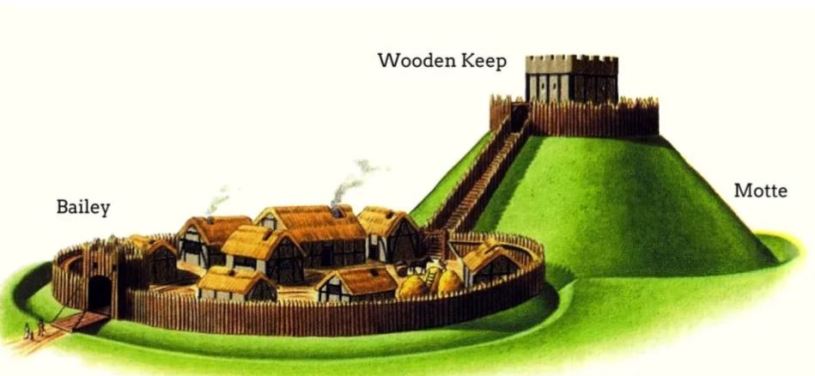
This last week while listening to a podcast on Logical Fallacies, I learned a new one called the Motte and Bailey fallacy. It is sometimes called moving the goal posts. It is a tactic where somebody makes a bold or controversial claim (the bailey), and then when that is defeated, retreats to a related, but simpler and more defensible claim (the motte) without admitting defeat on the original claim.
The name motte and bailey is explained below from a Medium article
The origin of the term is that it is a type of castle developed in medieval Europe. It consists of (for our purposes) two features, the motte and the bailey. I think it’s useful to explain them in reverse order.
The bailey is the desirable place. It is where people want to be. It is large and comfortable and where all the living and working gets done. It is generally flat and open. The problem with the bailey is that it vulnerable. It is hard to defend and susceptible to attack from multiple directions.
The motte is defensible. This is its primary feature. It is designed to do nothing but be defended. The motte is a tall hill so that attackers are exhausted on their way up it, and it has great sight lines, including overlooking the bailey. The building that sits on the motte is the sturdiest, heaviest structure of the castle. It is uncomfortable. No one wants to be on the motte. The motte is used only when the castle is under attack. The people living and working in the bailey retreat to the motte for the duration of the attack.
The Church is experts on using this tactic. Some examples are:
Bailey: The Prophet speaks for God (then the Prophet says something dumb, man will never walk on the moon)
Motte: He was only speaking as a man.
Bailey: The Lamanites are the principle ancestors of the American Indians (then DNA proves it wrong)
Motte: The Lamanites are among the ancestors of the American Indians
Bailey: From a 1981 manual on homosexuality for leaders: homosexual behavior is learned and influenced by an unhealthy childhood, masturbation, and experimentation. (untenable position in the current day)
Motte: from Churches current web site: “The Church does not take a position on the causes of same sex attraction.”
Bailey: The Hill Cumorah in western New York is the same Hill Cumorah as referenced in the Book of Mormon. (lack of any archeological evidence)
Motte: The Church’s only position is that the events in the Book of Mormon took place in the ancient Americas.
So, I’ll open it up you you readers. What are your examples of the Church using the Motte and Bailey tactic?
 Wheat & Tares
This is too easy.
Bailey: Joseph Smith translated Egyptian hieroglyphics from ancient scrolls written by Abraham himself.
Motte: Not so ancient, not by Abraham himself, not actually translated, the scrolls just inspired Joseph to pen the Book of Abraham.
Bailey: Learn things (fact things) about the Church, the Book of Mormon, LDS history, then pray to get a *confirmation* of your belief or hope that these things are true (at least gives a nod towards facts and evidence).
Motte: Go to church or read a few chapters of the Book of Mormon and have a good feeling about it (emotional testimony).
Bailey: The Word of Wisdom is God’s good health and nutrition guide.
Motte: The Word of Wisdom tests your obedience to God’s commands, you get largely spiritual blessings from following it (with anecdotal mentions of possible positive health correlations).
This seems to be a favorite fallacy of apologists. The way I’ve understood the fallacy is that it is four-part:
1) Float bold controversial claims without good evidence.
2) When challenged on the controversial claims retreat to the easier-to-defend motte. “All I was saying is…” some common knowledge position.
3) Try to make the opponent’s reaction look unreasonable and overreactive
4) Once opponent has fallen for the trap and backed off, act as if the opponent has actually conceded and as if the more controversial claim stands.
One time I was engaging an apologist over his strong suggestion (although not overly started) that the larger academic community supported Mormon truth claims. He was claiming that his academic colleagues accepted him and his work. When I challenged him and said that the academic world overwhelmingly rejects the church’s bold historical truth claims about Christians living and writing in the pre-Columbian Americas. He retorted by taking about how some site director over Teotihuacan in Mexico had converted to Mormonism and how his wife was a doctoral candidate in Mesoamerican history and that her dissertation committee all knew she was Mormon and were fine and accepting of it. His aim was to mention some insignificant outliers to make me look unreasonable and uninformed and then proceed to subtly push the idea that the larger academic world was far more open-minded to Mormon truth claims and that the ex-Mormon skeptics were overreactive closed-minded people who actually didn’t understand the issues at hand. But I didn’t take the bait, I dismissed his examples as outliers and told him that if he were to directly ask pretty much all non-Mormon scholars of the pre-Columbian Americas is Christianity and Judaism were practiced in the pre-Columbian Americas that they would flat out dismiss the idea as completely absurd and profoundly lacking in evidence.
It is a most maddening and hard-to-deal-with fallacy, I must admit.
FAIR makes this easy, as Dave B noted
Bailey: In 1835, Joseph Smith declared that the Second Coming of Christ would occur within 56 years, by 1891. (History of the Church, Vol. 2, p. 182).
Motte: Joseph made reference to the incident on at least two other occasions and indicated that his belief was not that the Lord would come by the time of his 85th birthday, but rather that the Lord would not come before that time, which of course was a correct prophecy.
Bailey: I prophecy in the name of the Lord God of Israel, unless the United States redress the wrongs committed upon the Saints in the state of Missouri and punish the crimes committed by her officers that in a few years the government will be utterly overthrown and wasted, and there will not be so much as a potsherd left for their wickedness. (History of the Church, Vol. 5, page 394).
Motte: The US government of Joseph’s Day, the Whigs had won the presidency and controlled the Senate. The Whigs were to be destroyed as a political power, never to recover. The United States government was to be destroyed, since the secession of the South arguably remade the American political order.
Bailey: Finding Treasure in Salem, Massachusetts. Doctrine & Covenants Section 111: 4.
And it shall come to pass in due time that I will give this city into your hands, that you shall have power over it, insomuch that they shall not discover your secret parts; and its wealth pertaining to gold and silver shall be yours.
Motte: Their efforts bore fruit. By March of 1842 they had organized the Salem Branch with 53 members. By the end of that summer, the branch had 90 members.
Bailey: We have no paid ministry.
Motte: The scriptures mention circumstances in which a paid ministry is appropriate and also provide several cautions about the practice. Having a paid clergy is not in and of itself a terrible thing. Problems arise when the issue of money becomes a greater motivator than the things of God (and this can happen to any member). So, the members support those who are engaged full time in the work of the Church if necessary.
Bailey: All are to pay tithing on your annual increase. If I will not open you the windows of heaven, and pour you out a blessing, that there shall not be room enough to receive it. ” “If paying tithing means that you can’t pay for water or electricity, pay tithing. If paying tithing means that you can’t pay your rent, pay tithing. Even if paying tithing means that you don’t have enough money to feed your family, pay tithing. The Lord will not abandon you.”
Motte: Evelyn received a promotion, and Amado found a good job. Evelyn later lost her job, but they continued to pay tithing and to receive spiritual and temporal blessings for their faithfulness. The Bishop asked Amado how the family was doing financially. He responded, “We’re doing all right. Sometimes we don’t have much to eat, but we have enough. And more than anything, we trust in the Lord.” Mission presidents are not to pay tithing on their funds received.
Bailey: 2 Nephi 28:13 They rob the poor because of their fine sanctuaries.
Motte: The temples must be built of the highest quality materials possible. The finest materials are for the Lord.
Bailey: Mosiah 29:16 It is not expedient that ye should have a king or kings to rule over you. Later, Joseph Smith was ordained as the King of the Council, which he ordained to be the governing body of the world.
Motte: Joseph had previously been anointed a King and Priest in the Kingdom of God by religious rites. Joseph was never anointed King over the earth in any political sense
I hate to sound like the old guy who claimed to walk uphill to school and back in the snow, but when I was active LDS back in the day I did things that just aren’t done anymore because the COJCOLDS has redefined what is acceptable or normal. So for example I only talked to my family two times a year during my full-time mission. Now you can talk weekly. We married in the temple and consequently had to leave out some family and friends from the wedding. Now you can do the civil thing first without a stigma or one-year waiting period. We attended LDS meetings for three hours (with four little kids) and now two will do (and apparently they are piloting a one-hour bloc). Finally, my wife suffered through many hot Virginia and Texas summers with those dang G’s…boy a sleeveless option would have been nice.
God needs a temple in McKinney, TX with a steeple height of 174 feet.
Details have now changed after the Church initially refused to budge.
I was just fondly remembering Michael Ballam and a google search lead me to your awesome poll of favorite temple Satan. 👍
I thought I’d take a peek to see your most current post. Surprisingly, I too saw an explanation of the (new-to-me) Motte and Bailey last week. Rather than via RFM, it was a group of atheists conversing with Jordan Peterson to suss out his favorite logical fallacies.
Just an engagement comment on synchronicity and universality. Keep up the good work!
Bailey: “Thy faith hath made the whole”. Faith taught as the transactional magic potion that leads to healing, where the failure to be healed is interpreted as an accusation, “Oh ye of little faith”.
Motte: I think it was Darth Bednar that introduced, “Have the faith to NOT be healed”.
Bailey: Ask and ye shall receive, seek and ye shall find.
Motte: When the heavens go dark and the asking seems to be met with a profound silence,
the tune changes to, trust in Gods timing.
I feel like this is turning into a list of everything the church has ever changed its position on (which is extensive, of course). Rehashing an old subject isn’t that interesting to me, so I think we should be a little more precise. Is it really a logical fallacy if one person said something 150 years ago and someone else contradicts it in the present day? Or if leaders disagree about something and therefore say contradictory things in public about it? So let’s just say it’s most accurate to identify a motte and bailey fallacy if the same individual advances one position and then retreats to another. I think this is probably most prevalent in the Mormon apologetics community.
Bailey: (Nov/22) children of gay couples may not be baptized or ordained because it is so confusing for them to be taught a standard at church that is being broken by a parent at home. It’s for the good of the children! We also already don’t baptize the children of polygamists or people from countries with an Islamic theocracy so there is a precedent, why would anybody be surprised or concerned about this? In case there are still doubts, this was a revelation, thus spaketh the Lord.
Motte: (three years later) we are concerned about the reports of distress among families caused by these children being denied access to baptism. This was just a policy, so nevermind. Carry on.