
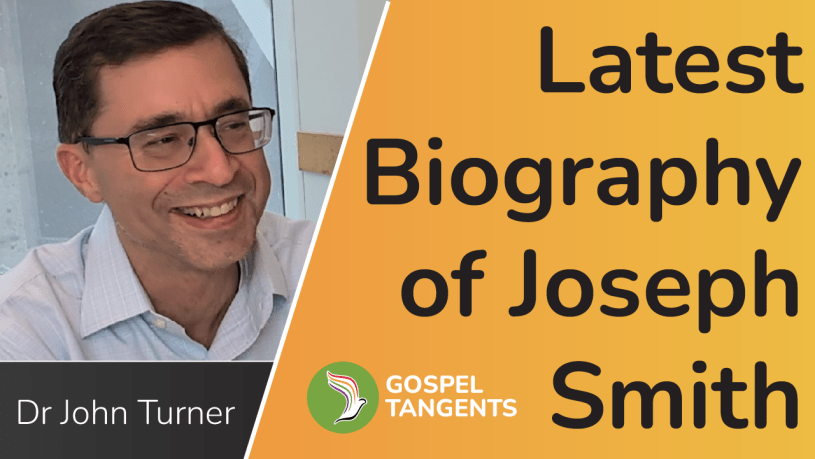
Unpacking Joseph Smith: John Turner’s New Biography
We’re excited to delve into the mind of John Turner, a distinguished scholar and Professor at George Mason University, known for his insightful historical works on figures within Mormon history. Turner, whose academic journey includes degrees from Middlebury College and a PhD in US history from the University of Notre Dame, with a detour for a Master’s of Divinity at Louisville Presbyterian Theological Seminary, has recently released his latest book, “Joseph Smith: The Rise and Fall of an American Prophet.” This new conversation, which coincided with its release on Amazon on June 17th, offers a fresh perspective on the founder of the Latter-day Saint movement.
Turner’s interest in Latter-day Saint history was sparked during his time at Notre Dame, where engaging with Latter-day Saint friends like Patrick Mason and Matt Grow, combined with his focus on the history of religion in the United States and his personal connection to Palmyra, New York (the birthplace of the movement), drew him in. While his dissertation focused on American evangelicalism, he later sought to expand his studies beyond his own tradition, leading him to research and write about Mormonism. This shift resulted in his previous acclaimed works, “Brigham Young: Pioneer Prophet” and “The Mormon Jesus.”
Why Another Joseph Smith Biography?
For many, writing a new biography of a figure as extensively studied as Joseph Smith might seem intimidating, especially with notable works already published by Fawn Brodie, Richard Bushman, and Dan Vogel. However, Turner approached this project differently. Unlike his Brigham Young biography, where he found existing works inadequate or uncritical, he holds “a really warm admirer” for the biographies of Joseph Smith by Brodie, Bushman, and Vogel. He sees his book not as replacing them, but as a “different one,” aiming to do “justice to different parts of Joseph’s personality.”
A significant advantage for Turner was the Joseph Smith Papers project. He lavishes “a lot of praise” on this resource, noting its accurate transcriptions, images, and the impeccable annotation and contextualization provided by its staff. This project offered a “huge head start” and made his task “a lot easier.”
Turner identifies two primary motivations for undertaking the Joseph Smith biography after Brigham Young:
• Engaging Foundational Questions: Unlike Brigham Young, who was a fervent believer, writing about Joseph Smith presented an opportunity and challenge to “return to that foundational time period of the tradition and engage some hard questions that historians writing about Joseph Smith need to engage.” These include questions about golden plates, divine messages, and Joseph’s motivations for plural marriage.
• Joseph Smith as a Biographical Subject: Turner found Joseph Smith to be a “great biographical subject,” describing him as “mirthful,” “colorful,” “energetic,” and “dynamic.” He felt the “fast-paced story” of Joseph’s 15-year public life was too compelling to pass up. Interestingly, Turner notes the volume of available sources for Brigham Young is “exponentially more” than for Joseph Smith, due to Brigham Young’s longer life and more intensive recordkeeping later in the church’s early history.
Navigating the Controversies: Early Life, First Vision, and Golden Plates
Turner’s biography tackles some of the most debated aspects of Joseph Smith’s early life and prophetic claims:
• Joseph’s Early Life: Turner highlights the scarcity of reliable sources for Joseph Smith’s childhood before 1829, noting that much of what is known comes from limited accounts, such as his mother Lucy Mack Smith’s biography, which was dictated decades later and is “a little troublesome” as often the only source. Joseph himself didn’t speak much about his childhood. Turner points out that there was “nothing that prefigured” Joseph’s future greatness in his childhood, as the family’s hopes for leadership were initially “pinned on Alvin” before his death in 1823.
• The First Vision: Turner acknowledges the intense debates surrounding the dating and particulars of Joseph’s First Vision, particularly among Latter-day Saints and critics. While finding some of these debates “a little bit tiresome” and more “faith questions than historical”, he states:
◦ “There’s no reason to doubt the core of the story that a young man troubled about the state of his soul troubled about the churches that surrounded him sought saw and heard the Lord.”
◦ He grounds this in Joseph’s “visionary household” and the cultural scripts of the time, finding it “not hard to believe that he had a powerful religious experience as a young man.”
◦ Turner notes that all accounts share common themes, such as concern about the apostasy of other churches and a vision of Jesus Christ. However, he concludes that the “exact particular[s]” of what the vision contained are “not accessible to us as historians.”
The Golden Plates
This is where Turner offers a clear judgment as a historian:
◦ “Joseph didn’t have golden plates and that he did engage in a certain amount of subterfuge.”
◦ He believes Joseph “made that up,” suggesting it was an economic and religious “vehicle” for a new direction in his life after failing to find other buried treasures.
◦ As a Protestant Christian, while open to “crazy miraculous supernatural things,” Turner finds “the simplest explanation” to be that if someone claims a valuable object but “can’t show it to anybody else,” they likely “don’t have it.”
◦ His conclusion that the Book of Mormon is a “19th century text rather than an ancient record” further supports his view that golden plates were unnecessary.
◦ While Joseph certainly had “some sort of physical object” in the box—something “heavy” and seemingly “thin sheets of metal under a linen cloth”—Turner believes there isn’t enough evidence to support specific alternative theories like Dan Vogel’s suggestion of tin plates or Sonia Hazard’s idea of printing plates. He concludes that the precise nature of the object remains “a bit of a mystery.”
◦ Turner clarifies that his stance on the plates does not mean he sees Joseph Smith as “a fraud, as a deceiver, as an impostor/pious fraud.” Instead, he views the Book of Mormon project as an “act of audacity” rather than “primarily an act of deception.” He finds it “utterly remarkable” that a “random 21-year-old who doesn’t have formal education” managed to publish such a substantial book.
◦ Regarding Joseph’s sincerity, Turner generally tries to avoid weighing in directly, as it’s “pretty hard for us to assess sincerity” of historical figures. However, he believes “Joseph was a sincere Christian in the sense of his family had been seeking a context in which to encounter to know and be saved by Jesus Christ” and that “Joseph believes in the vision that the Book of Mormon and his other texts articulate.”
John Turner’s “Joseph Smith: The Rise and Fall of an American Prophet” promises to be an essential read for anyone interested in the life of Joseph Smith and the origins of the Latter-day Saint movement. His nuanced approach, deeply rooted in historical inquiry and a comprehensive review of sources, particularly the Joseph Smith Papers, offers a compelling and insightful narrative. As Turner himself notes, “historians and biographers will never be finished with Joseph Smith,” ensuring that his complex and dynamic life will continue to inspire new scholarship for decades to come.
Have you read Turner’s book yet? What do you make of his comments?
 Wheat & Tares
Why another JS biography? Because few Mormons are going to read Brodie or Vogel (perceived as “anti”) and Bushman is just too long for most readers. I haven’t read it yet, but I’m guessing Turner’s JS bio isn’t the JS biography mainstream Mormons want, but it’s the biography mainstream Mormons need. It’s going to go right to the top of my stack.
I will definitely read this. I enjoyed his Brigham Young and Mormon Jesus books. I would like to know more about his conclusions about the beginnings of Mormonism bulleted in the post. For example, that the nature of the large heavy object Joseph claimed were golden plates is a bit of a mystery. I wonder what he makes of the is it 3 and 8 witnesses who claimed to have touched and seen the plates.
I didn’t go into the 3 and 8 witnesses with Turner, but Dehlin did. Here’s an AI summary of JD’s interview. I think it is pretty accurate, but I make no guarantees. YMMV.
John Turner believes that Joseph Smith did not possess actual physical gold plates. His conclusion that the plates did not exist as a physical artifact is based on several points:
• Visionary Nature of Witness Experiences: Turner interprets the experiences of both the Three and Eight Witnesses as visionary rather than physical.
◦ Regarding the Three Witnesses (Oliver Cowdery, Martin Harris, and David Whitmer), Turner emphasizes that their experience was “explicitly a visionary experience” where they saw an angel holding the plates and turning the pages. He notes that Joseph Smith’s history describes it as “the same vision was open to our view.”
Turner states that he doesn’t think this experience “gives us anything to go on as historians” for the materiality or physicality of the plates. Even if Martin Harris later indicated he saw them with “spiritual eyes” rather than “physical eyes,” Turner considers the distinction largely beside the point for him, as any description of an angel showing plates falls into a “visionary context” where “the physicality almost seems to be beside the point.” He suggests Joseph had a “remarkable aspect of his religious spiritual leadership” in being able to help others share in his vision.
◦ For the Eight Witnesses, despite their more physical claims of having “handled them with our hands” and “hefted them,” Turner still concludes that their experience was “still a visionary experience despite the physicality of their language.” He believes Joseph could “make the immaterial real for them” and draws an analogy to the Catholic Eucharist, where bread and wine become the body and blood of Christ, suggesting a transformation of something immaterial into something perceived as real. While acknowledging it as a “pretty good piece of evidence” on its face, he ultimately views it as “not empirical proof of actual golden plates.”
• Plates Not Integral to Translation: Turner highlights that the plates “were not material to the translation process.” He points to Oliver Cowdery’s statement that Joseph’s procedure was to put his face into a hat, look at a seer stone, and receive interpretation in his mind. The fact that Joseph did not even bother to bring the “plates or the object that is a stand-in for the plates” when moving from Harmony to Fayette, and that the Whitmers did not seem to need “explicitly physical confirmation,” reinforces Turner’s view that the plates’ physical presence was not necessary. He notes that “the plates become just even less integral to the process” during the second Book of Mormon translation attempt.
• Joseph Smith’s Behavior and the Mysterious Object: Turner considers “the way that Joseph behaves… with this mysterious object” as another reason for his conclusion. The fact that the object was “not integral to the translation” and the secrecy surrounding it contribute to his skepticism. He also notes the “shift” where plates were initially buried in a barrel of beans for transport but later allegedly “carried there by one of the ancient Nephites” or an angel, which he finds inconsistent.
• Examination of the Book of Mormon Itself: Turner also states that “an examination of the Book of Mormon itself” contributes to his conclusion. He reads the Book of Mormon as a “19th-century text,” which leads him to be skeptical about the plates.
• The “Tangible Thing”: For Turner, the truly “remarkable tangible thing” Joseph Smith produced was the long manuscript of the Book of Mormon, not the physical plates. He believes that “the heftiness of what Joseph produces in terms of the book that is probably the single thing that convinces most people about the reality of the plates.”
In summary, despite the claims of witnesses, Turner’s historical analysis leads him to believe that the “gold plates” were not a tangible, physical artifact in the ordinary sense, but rather part of a “visionary experience” that Joseph Smith was uniquely able to facilitate for others.
If you really want the detail, here is a link to the interview: https://www.youtube.com/watch?v=3OPJcdisgJI