
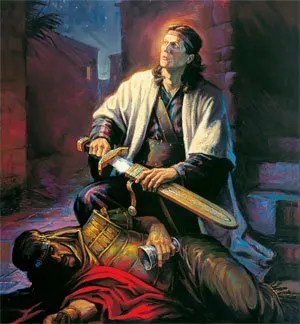
The Church recently published a new essay called Religion vs Violence. In this essay, there is the following about Nephi chopping off Laban’s head. From the Church’s web site:
One potentially unsettling example of violence in the scriptures is the Lord’s command to Nephi to kill Laban in 1 Nephi 4. Elder Dale G. Renlund taught: “No simple explanation of this episode is completely satisfactory, but let me highlight some aspects. The episode did not begin with Nephi asking if he could slay Laban. It was not something he wanted to do. Killing Laban was not for Nephi’s personal benefit but to provide scriptures to a future nation and a covenant people. And Nephi was sure that it was revelation—in fact, in this case, it was a commandment from God.” Even so, it was a rare exception. “Thou shalt not kill” continued to be the standard for Nephi and all of God’s people.
I find it interesting that Renlund did not condemn the murder, but acknowledged implicitly that is was murder, but a “rare exception” to the “do not kill” commandment. So he is justifying murder, even if it’s rare, it’s ok to do.
He says, “Nephi was sure it was a revelation,” but the church provides no ways to be sure if we’re receiving revelation. He claims that “in fact, in this case, it was a commandment from God.” Says who????. The victors get to write the history. All we have is what Nephi claims, but what if he was wrong? Think of the people who have been abusing their kids check all of these boxes, including being “sure” they’re receiving a commandment from God.
How does Renlund’s explanation sound when applied to modern times? I found the below comment from another Mormon forum that was discussing the new Church essay
“There is no simple explanation to Lori Daybell killing her children. The episode did not begin with Lori asking if she could slay her kids. It was not something Lori wanted to do. Killing her children was not for Lori’s personal benefit but to release her children from being dark, into the eternities. And Lori was sure that it was revelation–in fact, in this case, it was a commandment of God”
This does not sound as nice when applied to today. We could add Ruby Franke, Chad Daybell, Ron and Dan Lafferty, and many others who were sure it was “in fact… a commandment from God” During Lori Daybell’s trial, it was presented that she sent a text to her brother Alex just two days before he shot and killed Lori’s husband with the following words: “I would be like Nephi, I am told — and so will you.” This was followed by testimony that Nephi is a revered figure in the Book of Mormon who is commanded by God to slay another man.
Sure, one could argue that ethics can be situational. For example, few people would consider honesty to be an absolute moral principle in this specific setting: you are a Jew trying to evade Nazi persecution and genocide. You would feel that life is a higher order good than lying when you tell the SS that you are a Catholic. But in the hands of the delusional, you get the situational ethics of Nephi, Abraham, and Joseph Smith. These represent a fundamentally flawed hierarchy of values that can horrify the non-believer.
What would have happened if Renlund decided to fix the situation? He could have just said, “Murder is wrong and you should never do it, even if you think God is telling you to.” Is that an unreasonable expectation to have of the leaders of the church? What are the implication to the Church if a leader came out and said this? Is it throwing Nephi under the bus?
Is the Church prioritizing apologetics over people’s safety? What would be the fallout if the First Presidency came out with a statement that said “Murder is always wrong” ?
Your thoughts?
 Wheat & Tares
I have to suppose that if Nephi had been caught in Jerusalem, he would have faced justice there — and if he made a “the Lord told me” argument in his defence, I think he likely (indeed, almost certainly?) would have been properly found guilty and then properly executed as punishment.
Maybe I wish Elder Renlund had said clearly that no one can in today’s world can claim permission or instruction from God for actions of religious violence, and that every person is subject to the laws of his or her society.
And maybe I wish he had said that any person feeling an urge to commit religious violence should seek professional treatment for mental illness.
My BofM professor at BYU had us memorize 6 reasons why Nephi was justified in killing Laban. This was the early 90s and not much has changed.
Absolutes such as “murder is always wrong” don’t serve the church well, except when they do. Polygamy is wrong unless God tells you. Honesty is always right except when lying for the Lord (think SEC). Racism and sexism are acceptable if condoned by God. Even alcohol is ok if you’re Jesus or before 1920 or something.
In the other hand gay marriage, not paying tithing, stealing tithing funds, premarital sex are never ok. Remember kids, some commandments are temporary, including thou shalt not kill.
Had I been called to serve on Nephi’s jury in Jerusalem, his testimony that God commanded him to kill Laban would not have saved him. I would have voted to convict, and God could rescue him from jail if he wanted to. Likewise, Daybell and Vallow’s arguments failed them, and rightfully so. If I speed taking my pregnant in-labor wife to the hospital and the traffic camera captures me running a red light, I can hope that the judge would dismiss the case due to the circumstances, but if not then I properly owe the fine.
We do not need the church to make a statement in 2022 that murder is wrong. We already know it is wrong, and we will punish the Lori Vallows of the world). Is the author suggesting that had the church made a new statement on murder before Daybell-Vallow killed their family members, that the faithful Chad and Lori would not have acted, because of their obedience to the church? I don’t think so. The church also teaches that we believe in honoring and sustaining the law, and that we are subject to kings, rulers, and magistrates.
Yesterday, June 14, with Trump’s military parade, the 1500 No King’s marches, and the political assassination in Minnesota of a state representative and her husband, along with the attempted assassination of a state senator, both Democrats, Utah Sen. Mike Lee briefly posted about the suspected shooter. “My guess: He’s not MAGA,” he wrote on X. Of course, he took it down because investigators quickly found out, even though they haven’t found the suspect, that he was MAGA.
Lee has compared Trump to Captain Moroni and seems to make excuses for anything Trump does that does not reflect appropriate Christian conduct.
It seems to me that while the church is practicing apologitics, many highly ranked individuals do the same. The very principles that attract us to believe in the Church or Religion are ignored if money or power can be had with “exceptions.” It also seems very clear that if someone justifies something in the name of religion, it can appear very different in the light of day, particularly when considering a person’s overall motivations.
I am surprised the church keeps issuing more and more Essays. I was taught that the gospel is true, pure, and simple. These ongoing essays question all 3, but especially the simple part. The LDS church history and taught version of the gospel is complex and fascinating, but far from simple. If it is so simple why so many explanations and essays?
On a tangent, is the name Laban. There was 1 individual and 1 city in the Old Testament that carried that name. Laban was a given name occasionally used during the 1800’s and reached its’ peak in 1820, according to ancestry.com.
Laban Clark, who was the founder of Wesleyan University, was swimming in the waters of the burned over district of New York. Laban had previously been in contact with Nathaniel Woods and a group called the New Israelites. Laban had observed that the Woods group were money diggers, used divining rods, and were waiting for the destroying angel of the latter-day and to gather as saints to build the New Jerusalem. Laban later saw that the New Mormon group used many of these ideas, (along with those borrowed from the many other religious groups in the region). Laban criticized the new Mormon group calling it “the vilest scheme of villainy and corruption that has ever cursed the country”. If JS knew Laban Clark said this or not, is up for debate, but if so…..off with his head.
https://newenglandhistoricalsociety.com/destroying-angel-gold-diggers-book-mormon/
https://www.truthandgrace.com/1879mormonrod.htm
Did Joseph Smith borrow the name Laban for the Book of Mormon from his knowing about Laban Clark, similar to the circumstance of other people’s and places names used in the Book of Mormon? That is for historians and apologists to debate. However, what I find interesting is how many of the histories and many of Joseph Smith’s contemporaries share the very similar stories and verbiage of Joseph Smith. As a single event, what Joseph Smith was not that remarkable. Many others had heavenly visions, used Old Testament/New Testament language, were called of God, had the Priesthood, etc. What makes Joseph Smith remarkable was him being a master of borrowing many ideas from others and being dedicated to this full time in assembling a religion, adding with his charisma to get people to follow him. This religion survived, by moving the first 3 generations to isolation in the Great Basin, where the NE and Midwest crowd were influenced by their neighbors and did not hold onto the these are the only truth ideas.
Laban Clark greatest accomplishment was Wesleyan University. However, since it was not named after him, he does have a sword and book that uses his name 200+ years later in the Mormon doctrine. Would you want your name to be associated with beheading for generations?
I think religious people use “God” as an excuse to do what they want to do and it is no more justified than any similar act with different justification. So, assuming for the sake of argument that Nephi was a real person instead of someone Joseph Smith made up, then Nephi murdered Laban. In cold blood, premeditated and all that. There were other choices and it was not “commanded” by God because God doesn’t take away our free agency. Period. God doesn’t take away our free agency. Ever. And commanding murder is taking away free agency. God gave us commandments and no where is it written “unless I change my mind.” Those commandments are more like suggestions because God does not force us to obey. He leaves our behavior strictly up to us to choose. Nephi found himself in a tough situation, caught between the commandment of God to not kill and the commandment of his father to bring back the brass plates. He decided the easiest way to obey his father was to just kill Laban. He could have taken his clothing and left him tied up and gagged in a back alley, but he decided that killing him was a better choice. God always gives us the choice of what to do. That is one Mormon teaching that I still believe. And Nephi made the choice in a way he convinced himself was what God would want him to do because “daddy the prophet” told him to get the brass plates and don’t come back without them. This is where blind obedience to any “prophet” gets dangerous. God leaves the choice to follow a bad order from a prophet up to us and I just do not believe we are blessed for *any* blind obedience. Even if we believe it is something God wants or something the prophet commands. We have free agency.
So, is killing ever justified? War? Capital punishment? I am glad I don’t have to make those choices in my current life situation, because I couldn’t kill someone. If I was Nephi and *really* believed that daddy was a prophet and he needed me to get those plates, what would I have done? I honestly don’t know. I probably would have told daddy to go get them himself. Or left Laban tied up and gagged in the alley. And sorry, but for me personally, I would have to tell my government that I just would not kill even in self defense in a war. And maybe my religion does not make me a conscientious objector, but personally I am. Just so people know where I am coming from. I don’t judge people who will kill in a war situation because I honestly am grateful that they are willing to do so. But I am not.
Poor poor Brethren. You know they’d love to blame Laban’s murder on porn and violent video games but there simply isn’t any proof.
I’ve always struggled with this story because it is completely nonsensical- blood would be everywhere & all over the clothes- That seemed obvious when I was TBM. Today, I see it exactly like Bishop Bill- Thanks for an insightful post!
PS: Renland’s talk is definitely Cringe!
Not a very fair comparison of Laban and Lori Vallows situation. Laban was a murderer and should have been incarcerated for his crimes. Not even close to be considered an innocent victim. From an eternal perspective and from the narrative, it appears he was an obstacle in the employ of the adversary, attempting to thwart the workings of the Lord. It’s sounding like you’re implying that noone is capable of discerning direct communication from God. That’s concerning to me.
The parallel to Nephi killing Laban was Moses killing an Egyptian (see Exodus 2:11-12). Both Nephi & Moses had cause to be offended. Did that offense justify murder? What we do know is murder changed the course of the lives of both Nephi and Moses.
Note that Exodus offers little defense of Moses and even has Hebrews upset. Contrast that with the exhaustive self-justification Nephi details. There is reason to think that Nephi never convinced himself that he acted correctly.
One thing I find pleasing about some folks’ concern with the moral implications of Nephi’s actions is the implication that the Book of Mormon must be true. Because if it isn’t true–then who cares what Nephi did or didn’t do.
That said, as one who believes that the Book of Mormon is true through and through a whole bunch of wonderful questions jump right off the page when Nephi takes Laban’s life–and Bishop Bill addresses some of them in the OP. And they’re questions that cut right to the marrow: Does God speak to his children? Did God speak to Nephi in that instance? How did Nephi know that it was God who was speaking to him? Is there really such a thing as revelation!
I love how the Book of Mormon confronts the reader with these questions right from the get-go. And one of the reasons (IMO) as to why the BoM begins with such a challenging question is because if we don’t engage the text with–at the very least–an openness to the possibility that God speaks directly to his children–then were are not likely to accept its truthfulness. Because, as we know, the only way to come to terms with BoM is through personal revelation.
Very well said Jack.
LoudlySublime points out that the whole Laban story is full of holes. And the OP reminds us that history is written by the victors. Well, the victor, in this case, was Nephi and he gets to tell the story he wants to tell. My guess is that Nephi did not, in fact, kill Laban, but found it to his political advantage to claim that he had.
So to the extent that a blanket denunciation of murder throws Nephi under the bus, it does not have to be for unrighteously murdering Laban. Instead, the Church could acknowledge the holes in Nephi’s story, express grave reservations that the murder actually happened, and throw Nephi under the bus for exaggerating his accomplishments for political purposes. Fans of Nephi are not going to be fazed by that.
But my guess is that even if the brethren came to believe that the murder of Laban never happened, they would never make such a blanket statement. Russell Nelson would have been 19 when the plot to assassinate Hitler failed. I suspect he remembers reading about it and wishing it had succeeded. If you too wish it had succeeded, then you should not be advocating for a blanket statement.
I remember in my mission in Brazil that many investigators would begin reading the Book of Mormon and then become deeply troubled with this story. Honestly the story never troubled me and I would get annoyed by people rejecting the Book of Mormon over the story. At some point on my mission I developed a response to this by noting how Nephi was acting in a sort of self-defense since Laban had sicced his servants on Nephi and his brothers before and has threatened to kill them.
Now looking back, I still don’t cite this story as particularly problematic. Much more problematic are the stories in the OT particularly in 1 Samuel 15 where Samuel commands Saul to kill all the Amalekites. Saul ends up killing everybody but sparing the animals, thus causing God to feel angry with him. This story has been used several times in the church as a story on obedience and how Saul was disobedient. It is truly horrific.
Generally I don’t find a lot of what’s in the scriptures to be of value in instruction about morality. I generally find advancements in psychology to be of much greater value in instruction us how to live morally.
It took eight years of work by numerous groups in Community of Christ before the following Statement on Nonviolence was approved at the church’s recent World Conference. Even so, there is still considerable room for interpretation and implementation. Obviously, any moral stance on this topic must involve more than lifting passages from the church’s inspired scriptures, particularly the Old Testament and the Book of Mormon.
“We affirm that nonviolence is a means to embody the gospel message modeled by the teachings and life of Jesus Christ. In pursuing God’s justice, those who use nonviolence seek positive change through means guided by the Spirit that do not bring physical, emotional, spiritual, or relational harm to others, oneself, or creation. Worldwide examples teach us that nonviolent actions often lead to transformative and peaceful results. We acknowledge that violent actions often can lead to more violence, making peace impossible. We uphold nonviolence that promotes healing and reconciliation, advocates for the vulnerable, cares for the environment, and creates a just and peaceable society aligned with God’s vision for all of creation. Therefore, Community of Christ, recognizing and celebrating the Worth of All Persons and the Sacredness of Creation, encourages the use of nonviolence, whenever possible, to seek justice. How we decide when nonviolence is possible involves a continuous effort undertaken by each of us—both individually and collectively—as we follow Jesus Christ, the peaceful One, Son of the living God, Word made flesh, Savior of the world.”
Thanks Michael. I like what you say as well–and if you’ll permit me to add just a little to your comment: my guess is that Laban was the worst sort. He felt no compunction at steeling the brothers’ entire inheritance and then sending his guards after them to finish them off. IMO, that action alone bespeaks a regularity to Laban’s actions–the sort of thing we’d expect from a mob boss. Plus there’s the older brother’s reluctance to face Laban–they new he was bad news.
That said, in spite of the fact that Nephi probably had every right to exact revenge–according to the Law, that is–we also have to remember that Lehi was no longer part of that society. And as the reigning patriarch of his own “nation” he had the authority to interpret the Law differently–if need be–than the Jews in Jerusalem. And so whatever the verdict for Nephi’s actions might’ve been in Jerusalem–it wouldn’t have had any sticking power so far as Lehi was concerned.
“stealing” not “steeling”
Jack
“One thing I find pleasing about some folks’ concern with the moral implications of Nephi’s actions is the implication that the Book of Mormon must be true. Because if it isn’t true–then who cares what Nephi did or didn’t do.”
Some stories go back to the Palaeolithic. There are very old stories about Orion, the Pleiades, and the Cosmic Hunt. And some stories just old, Cinderella (over 2000) Jack and the beanstalk(over 5000).
I’m aguessin’ that a wee bit more people have heard of Cinderella and Jack, than Nephi. The stories we tell reveal us. They shape us and our values. Provide the framework for our worldview. Premeditated cold blooded murder of an incapacitated guy is not a good look. A foundational myth that the righteous need to slaughter the others has caused nothing but misery and destruction. As we go into the woods, we need to remember children will listen.
We need to tell stories that inspire us to greater good. (and I will refrain from my Star Trek pitch)
In recent months, this has become a real moral conundrum for me, and it isn’t just about Nephi and Laban. It probably started a couple OT cycles ago when I realized (for whatever reason it took me into my 40s to realize) that the well known “obedience is better than sacrifice” verse in 1 Samuel where, as Brad D noted, the command in question was genocide. While I will concede that Saul is characterized as having disobeyed for the questionable reason of greed, I’ve begun wondering if there would be any good reason to disobey the command (from a prophet claiming to speak for God — not from God Himself) of genocide. As I’ve gone further down this rabbit hole, I’ve explored the question of whether God really wanted Abraham to be willing to sacrifice Isaac.
In some ways, this whole thought train came to a head this last winter when the church released those church history/D&C cartoons, including one that characterized Joseph Smith as a “reluctant polygamist.” It occurred to me then (and I think I commented here something to this effect) that the real problem as I see it is that we can never become too certain that we know what things God might command us, because it seems that He is always able and/or willing to command something that goes against our sense of morality and ethics. From commanding a monogamist to practice polygamy, after 1890 (or thereabouts) polygamists to practice monogamy, Nephi to commit murder, Abraham to commit human sacrifice, Israel to commit genocide, and so on. At some point, is there anything that God cannot command, no matter how immoral or unethical I might believe it is? And, if we believe the narrative being told by Elder Renlund and others, God expects obedience to these commands, no matter how much it turns our moral and ethical stomachs.
Unless of course, you are a person who experiences severe gender dysphoria and, turning to God, you believe that God has told you that He wants you to transition (thinking here of the case of Laurie Lee Hall, specifically, though I know she is far from the only one), in which case, Elder Renlund says in the same talk that God won’t command you to do something that the church believes is immoral or unethical, so such a “revelation” cannot come from God. Or any number of LGB+ LDS who have entered into same sex relationships/marriages believing that God approves of their choice.
This is getting long, but I want to add one more thing. I think it is important to never get too convinced of our own correctness. I can’t help but look at the history of the priesthood and temple ban and think that something would have been a lot better if only mid-20th century LDS members and leaders had been more willing to consider that maybe their sense of right and wrong about racial issues was incorrect and that God might want them to do something different. Somehow, as we learn to know good from evil (one of our main purposes in this life, I believe, based on what I learned from my upbringing as a latter-day saint), we need to be able to balance preserving what is right and good and true in our current understanding of morality while also being willing to question and doubt our sense of what is right and good and true so that we can discard false traditions in favor of new revelations on morality. I don’t know how to do it, but it seems to me that we are often too quick to preserve false traditions and too slow to embrace new revelation.
“ Because if it isn’t true–then who cares what Nephi did or didn’t do.”
By that logic, Jack, who cares about what happened to the Prodigal Son or what the Good Samaritan did or didn’t do. Stories don’t have to be historical to have moral weight.
As someone who no longer accepts BofM historicity, I see Nephi/Laban episode as part of an adventure/escape/revenge narrative, which is naturally appealing to many readers (mostly boys and men), and likely had its genesis in the fanciful tales spun by a certain young man in the 1820s. As a gifted storyteller, Joseph hit on the same formula that Taylor Sheridan often uses today in his projects; that its deeply gratifying to watch the bad guy get his comeuppance (i.e. severely beaten and/or gruesomely killed), particularly when the punishment is being handed down by the story’s “good guy”, who himself is deeply flawed and is thus unconstrained by the severity and moral depravity of his own acts.
Even taking a faithful perspective, I think it’s charitable to view Nephi as deeply flawed and broken, even capable of murder. The whole premise of 1 and 2 Nephi is that they are written from the perspective of a much older Nephi reflecting on his past adventures, often exaggerating his importance but also showing regret for past mistakes. He’s a classic unreliable narrator. Somewhere in the last 200 years, the moral complexity of Nephi got lost in the shuffle, and official Church materials promote him as a white knight hero, including primary songs to that effect. Another casualty of Correlation’s abhorrence for nuance. The only “nuance” they seem to permit are the half-assed explanations that try to justify Nephi’s violence while keeping him up on a prophetic pedestal.
To the broader point of the OP, I don’t believe in any version of God that occasionally requires certain people to be “eliminated” for the furtherance of His divine purposes. These stories make for compelling scriptural passages, but there are many across time and cultures who are only too eager to latch onto theological explanations to justify their violent acts. If God suddenly has need to terminate the mortality of one of His children to restore balance in the universe or whatever, He is more than capable of handling of that task Himself.
@Jack
The notion that Lehi was some sort of soveriegn law unto himself is a convenient way exempting Nephi from legal ramifications, but that line of thinking has been associated with a lot of rationalizing of antisocial behavior. In particular, it sounds a lot like a rationale that has been used by some, including members of the LDS church, to claim they don’t have to pay income taxes, which has been explicitly condemned by leaders of the church (Dallin Oaks, in fact).
On my mission, I once had a lengthy discussion with an investigator over the nature of Nephi’s revelation. The difficulty is that the Russian language (among many others) does not use articles, so there’s no distinction between “the Spirit” and “a Spirit”. The investigator thought Nephi could have received the instruction to kill from any old spirit and had been led astray. I pointed out that the word “Spirit” was capitalized, thus proving it had to have been the Holy Ghost. She didn’t buy it. Decades later, I’m coming around to her side. Capitalization of a word is a very shaky basis for any scriptural interpretation, even when not justifying exceptions to the most basic of moral principles.
I came to consider Nephi an unreliable narrator. As presented, he wasn’t trying to deliberately deceive the reader, but he was writing all these events well after they happened. Years, perhaps decades. Well-intentioned he may be, but it doesn’t mean his recollection is perfect. And there’s the chance that he told himself he was commanded to kill Laban enough that he believed it.
I made this analysis when I was still willing to believe the Book of Mormon was true. That’s no longer the case. My belief, or lack thereof, doesn’t change my view of Nephi as an unreliable narrator.
To the point of murder as the main part of a faith-promoting story? I’m not a fan. Even without God telling us “Thou shall not kill,” the concept of killing someone for their possessions is taboo across most cultures. Certainly all societies that I’ve learned about. I’m more a fan of the faith-promoting stories along the lines of, “I did something really difficult, that I didn’t think I’d be able to do. And I accomplished it without compromising my morals.”
Taking the story at face value. In Nephi’s rationalization of the murder, he quotes an all-knowing utilitarian God, “It is better that one man should perish than that a nation should dwindle and perish in unbelief” as a justification for the act. However, in the end Nephi’s people were lost to history. At best Nephi’s action only delayed rather than prevented the perishing in unbelief of his people that God likely foresaw. This story has some similarities to the morality discussed in Janey’s Star Trek post of 3 weeks ago.
Jack, I am with Quentin. Perhaps you know of Chad Daybell and his wife Lori Vallow? They also claimed their own independent authority.
Interesting and highly amusing!!
My take on both the recital of the event in the BOM and Renlund’s comments is that they are a justification for Nephi’s actions, not a justification for me (or any of the other examples you gave) going out and killing someone. Seems like a real stretch to say that simply because something was done in the BOM I should be justified in doing it now or conversely if I can’t justify doing it now then the individual doing it in the BOM can’t justify it either.
I just read the gospel topics essay referenced in the OP, and frankly, I didn’t have a huge problem with most of it. Then again, it was rather underwhelming. Yes, they kind of glossed over the Mormon Missouri War and Mountain Meadows, but they only had so much space, I suppose. (Besides, at this point, I don’t expect the Church to fully acknowledge Brigham Young’s culpability for the MMM).
The essay did throw in Oak’s recent quote about accepting the results of elections, but didn’t take the opportunity to condemn jan 6 (There is no reason why they couldn’t have, since other specific examples of violence were given). It specifically denounced blood atonement and didn’t condemn or fault service members for doing their jobs – you know – to kill people.
The essay emphasized that true peace will only come if we all follow Jesus, which is great and all, but Ghandi of course wasn’t a follower of Jesus, for example, so no Christianity is needed for peaceful behavior. Besides, I think most Mormons will read this as saying “we just have to wait until Jesus comes back and he’ll fix everything.” Aside from the exceptions mentioned, the overall message of the essay was violence bad, peace good. So not a heavy lift, really, but it was fine. For the life of me, however, I don’t know why they used the Nephi killing Laban story. It wasn’t necessary for the essay, there are plenty of other examples of lovely God- sanctioned acts of violence in the scriptures they could have used, and honestly, most of the people who will read this essay at least have serious doubts of whether a person named Nephi even existed.
Suzanne Neilsen
“Premeditated cold blooded murder of an incapacitated guy is not a good look.”
I wouldn’t say that its cold blooded murder. To me its more like knowing that an assassin is planning on killing my family–and by good fortune I happen to find the guy in an alley way slobbering drunk.
“As we go into the woods, we need to remember children will listen. We need to tell stories that inspire us to greater good.”
I agree. Milk before meat–they’ll be able to sift through the moral ramifications of the story as the get older.
“And I will refrain from my Star Trek pitch.”
Dang. I love your trekkie allegories.
LoudlySublime nails it. This story is evidence that JS isn’t as clever as people claim when he wrote the BOM because if you cut someone’s head off, you need to undress them FIRST or the clothes will be covered in blood. It’s something I found obvious as a teen the first time I read it.
On to other points, though. There was a viral thing about ten years ago in which a sister missionary was blogging about how people should be so fully committed to Christ that, like Nephi of old, they were willing to cut the head off completely, not just slice his throat. She was extremely graphic and frankly sounded like a nutjob or a terrorist, neither of which was a good luck for an active sister missionary currently serving a mission. Someone alerted her leaders, and she did take it down.
And the next thing I’ll point out is that apparently Mike Lee is posting on X, during church, “jokes” about the murder of Minnesotan legislators. He’s honestly a fantastic example of White Christian Nationalism, and so is the BOM. Both of these espouse the worldview that white Christianity is the true religion and needs to take over the other “false” religions. White settlers aren’t doing bad things, essentially killing off millions of natives. They are white saviors to them, rescuing them from the “false traditions of their fathers” just like the plantation owners did for their enslaved people. It’s literally the same mindset.
Jim Bennett:
“By that logic, Jack, who cares about what happened to the Prodigal Son or what the Good Samaritan did or didn’t do. Stories don’t have to be historical to have moral weight.”
I agree. Even so, my guess is–if no one believed the Book of Mormon to be true then Nephi’s killing of Laban would be getting less attention than the goofiest apocryphal writings.
Quentin:
“The notion that Lehi was some sort of soveriegn law unto himself is a convenient way exempting Nephi from legal ramifications, but that line of thinking has been associated with a lot of rationalizing of antisocial behavior.”
I agree that we have to be careful not to use these stories to justify bad behavior on our own part. That said, there are times when people have legitimately declared their own sovereignty–as in the case of the saints who settle in the Rockies. They could never have practiced polygamy had they remained within the boarders of the U.S. And so, while such a practice was illegal in the U.S. the saints felt no obligation at all towards its legal system. They were their own people–a nation defined by their own laws.
ji:
“Jack, I am with Quentin. Perhaps you know of Chad Daybell and his wife Lori Vallow? They also claimed their own independent authority.”
Oh yes–they’re monsters. But there are tens of thousands of murders in the U.S. every year–and most of them are carried out for far less “noble” reasons. Plus, I think it’s worth noting that out of the 18 million so members of record there are maybe one or two Daybells. I don’t think the story of Laban’s killing is adversely affecting the members. My guess is that the Daybells are insane enough that they would’ve found some other means of justifying their crimes had they not been members of the church.
Thanks for the responses everyone.
Senator Mike Lee represents the attitude toward violence that unfortunately appears to be embraced by about 75% of Mormons. It may be time for me to shake the dust off my feet and walk away from any connection with the Saints.
vajra2,
Imagine what the world would be like if the entire population were active members of the church. There would be no violence.
Please stay with us.
Oops, that last comment is from me–Jack.
j, the only thing worse than having an entire population as you describe, is to believe that one would have to spend the eternities with them.
Jesus said By their fruits, you shall know them. Mike Lee is the fruits of the current version of Mormonism. That tells me what I need to know about the current organization and it’s leadership. So glad I walked away.
LOL–And all this time I thought I was safe walking though my neighborhood at night–in Orem, Utah.
Jack, according to CrimeGrade.org, Orem’s violent crime rate is 2.88 incidents per 1,000 residents. Compare that with, say, comparably-sized Carmel, Indiana, which has no significant LDS population to speak of yet somehow manages to have a violent crime rate of 1.427 incidents per 1,000 residents.
The idea that the Church creates uniquely non-violent societies doesn’t bear up under scrutiny. And as much as you want to dismiss the one-bad-apple examples of Daybell et al, when was the last time you heard of self-proclaimed prophets killing their children for secular reasons?
Patrick Mason has an interesting take on the Nephi story. He thinks (as I recall) Nephi was wrong to do what we did and that the BoM lays out the years of consequences of that one action as a means to teaching us that being a peacemaker is the better path.
For those who decry MAGA and the current national government, please note that the murder rate across the country is way down this year. The FBI says it may reach an historic low if the current trend continues.
The country as a whole is safer now than last year. Something must be going right.
el oso, not if you count crime’s commitred by Trump and ICE. LOL. Also, coorletaion is not causation. Yikes. Logic.
Yikes grammar!
El oso, constitutional violations are way up. And when you say the FBI, what you really mean is Patel said that, and based on the Trump regime track record, not sure he’s reliable. I mean, Trump said we hit 1.96 per gallon of gas, which doesn’t exist anywhere in this country. RKF is citing studies that don’t exist to support outlandish health claims.
El oso, one more thing. The general problem with MAGA is that they are not capable of critical thinking. Because Trump highlights something “happening” in the first 150 days doesn’t mean it wasn’t happening before. If they’d just look at all the data, they’d see that this downward trend was happening, and at points significantly, under Biden. Same with beef prices. Cattlemen praise Trump but don’t acknowledge that 85% of the price increases for beef that benefit them occurred under Biden.
I just watched Nemo’s extremely insightful video on this subject. It will be available 6-22-25. It connects highly relevant scriptures that no one brought up in these comments!
C.S. Lewis’s “God in the Dock” does not specifically address the Holocaust (often referred to as the Shoah) or the guilt associated with it in the context of Xtianity. This omission can be seen as a significant gap, especially given the profound moral and theological implications of the Holocaust for both Jewish and Xtian communities. “By their fruits you shall know them” forever condemns Xtianity as a dead religion.
Philosophical and theological arguments for the existence of God, the nature of faith, and moral reasoning which ignore “By their fruits your shall know them” exposes Xtian religious propaganda rhetoric. “Nature of faith” which ignores צדק צדק תרדוף likewise exposes empty Xtian religious rhetoric propaganda. “Moral reasoning” pales in the “Final Solution”/White Paper\Allied refusal to bomb the rail-lines which transported Jews to death camps. Lewis’s contributions to Xtian apologetics, compares to tits on a boar hog.
The historical context of the Shoah, by itself alone, challenges the credibility of Xtian teachings such as Luther’s council to gather Jews into their synagogues and burn the buildings upon them. Or the pre-Reformation decision to impose ghetto gulags upon all Jews living in Western Europe. The biblical phrase “צדק צדק תרדוף” (Justice, justice shall you pursue), underscores the expectation that faith should manifest in actions that promote justice and protect the vulnerable. The failure to uphold these principles in the face of systemic evil raises critical questions about the authenticity of faith.