
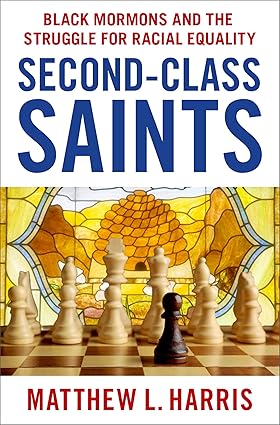
Let’s talk about Second-Class Saints: Black Mormons and the Struggle for Racial Equality (OUP, 2024). The author is historian Matthew L. Harris, who has published several books on LDS history, all worth reading. If you are LDS and read this book, you will be grateful but not happy. Grateful that an unvarnished account of the whole LDS race issue is presented, with special attention to events of the last two generations. Unhappy that so often LDS leaders and members have made bad choices, promoted falsehoods, and made life so challenging for Black Mormons. You think its tough being LDS? Try being Black and LDS.
I don’t have time for a proper review, so I’ll just give a hearty endorsement and note some highlights. Things I really like about the book: (1) Harris did a lot of legwork to get sources (letters, journals, interviews of family members) that give the “behind the scenes” events and discussions within LDS leadership that explain why certain actions or decisions were or were not taken. (2) There is good coverage of more recent events over the last generation or two, events that most readers are probably familiar with because they experienced them in real time. (3) He didn’t pull his punches. I’ve read a lot of LDS history by LDS historians, and it sure seems like they don’t really hold the Church or LDS leaders accountable when the facts call for it. Too often, LDS historians give the Church a historical pass when it doesn’t deserve it. I won’t name names. Harris played it straight, with no thumb on the scales.
Having noted that I really like the coverage of recent events, here is a quick line or two about several of those events related in the last two chapters, which cover 1985 to the present.
The 1978 revelation was not enough. The last two chapters basically trace the long path from the 1978 revelation which permitted Black members of the Church to receive temple ordinances and the LDS priesthood, to the events of 2013 which forced LDS leaders to finally make a public repudiation of prior LDS racist teachings. LDS “folklore” about the ban (which was basically LDS doctrine for over a century) was, it seems, much more persistent than LDS leaders had anticipated.
The first Black General Authority. Helvecio Martins, from Brazil, was called in 1990. “Latter-day Saints eagerly embraced Martins in his new calling and often hugged him when they saw him in public” (p. 275).
A missed opportunity in 1997. There were productive discussions between certain GAs and a group of LDS scholars and activists hoping to produce a statement repudiating the persistent LDS racial “folklore” that senior LDS leaders would approve and publish in June 1998, the 20th anniversary of the 1978 revelation. But a leak to the press and a story reporting the discussions scuttled further progress and the effort failed.
Small steps. In the years leading up to 2013, LDS leaders began making direct statements against racism and directing LDS members to stop being so racist (my blunt summary of their oh-so-gentle rebukes). This included, most notably, some joint statements and projects between the Church and the NAACP.
The Bott Affair and the Washington Post article. The event which finally!!! pushed LDS leaders to make specific public statements repudiating prior LDS racial teachings and justifications for the priesthood and temple ban was a 2013 Washington Post article, based on a journalist’s interview with an LDS religion professor. The prof basically gave (and endorsed) almost every hokey LDS justification you have ever heard for the ban to the reporter, who then reported it in his story (that’s what reporters do, they report). It was a public embarrassment for the Church, which immediately (like the next day!) issued press releases vigorously denying everything the religion prof said. Of course, that was stuff that other religion profs and LDS leaders had been teaching for over a century, so the denials were not particularly candid. But in this business you take what you can get, and the official statements were a big win. Harris went out of his way to emphasize that Randy Bott was sort of thrown under the bus by LDS leadership.
The finish line: the “Race and the Priesthood” essay. A year or so after the embarrassing Washington Post article, the Church published the “Race and the Priesthood” essay as part of its Gospel Topics Essays series. In terms of the progression of the narrative in the entire Harris book, this is the culminating event. In it, the Church finally repudiated in detail the racial doctrines that for over a century were produced and taught by LDS leadership, religion profs, and LDS curriculum material. Don’t call it “folklore,” as if it was the membership’s fault coming up with this stuff and sharing it privately in families and classes. But, again, you take what you can get. The essay was another big win.
So have you read the book? Would you like to? What do you think?
.
 Wheat & Tares
1. I haven’t read the book, but 2. I’d like to.
Just from your summary, the book seems spot on for the lukewarm at best approach the church has taken in facing its past.
It also seems clear that while the “leadership” may finally be understanding and addressing the issues, it’s apparent that the church as a whole doesn’t get it. Having so many members vote for Trump or using some excuse to vote for some third-party candidate who doesn’t have the quirks in personality, but still basically believes the same dogma.
Finally, we have a legislature where anti-DEI legislation is from virtually all LDS lawmakers, particularly in the majority party. The minority party seems to get it, and many may be LDS, but they can’t move much because there are still old folktales about how that party is evil.
Thanks for the warm endorsement, Dave B. And thanks for the succinct summary capturing some of the book’s major points in the later chapters.
I’m happy to answer any questions that may result from this post.
Thanks for signing on, Matt! Let’s make it an AMA.
I probably will read it at some point.
I have a couple of problems with the 2013 essay on race. First, it repudiates the justifications for the policy but not the policy itself, which leaves the door open for many members to continue to believe that God had some still unknown purpose for the racist policy. I reject that premise, and I suspect that some (most?) in senior leadership do as well, but they are not willing to say it in public. Secondly, the essay was relegated to the sort of obscure forum where you put the things you don’t want to talk about, and is therefore not as well known in the church as it needs to be. The irony is that President Nelson has lately taken up the cause of preaching against racism. I believe he’s sincere in his desire to make it a priority, but I think renouncing the actual policies of the past would do more for that cause than anything else he could say.
Quentin: You are correct that the 2013 Race and Priesthood doesn’t repudiate the ban–just the rationales. The statement is ambiguous whether or not the ban can be attributed to God. That was by design.
I’ve read the book. It is extraordinary. If anyone is interested here is the link to the review I did on Goodreads.
https://www.goodreads.com/review/show/6703914440?type=review#rating_866136971
Yes, I read the book, and a lot of the footnote references as well. I agree it’s a fantastic book! I appreciate Matt’s honest & candid writing and speaking- so refreshing!
We were particularly interested also because Randy Bott is a close relative.
I also have an uncle named in the book as a radical opponent of MLK (which he certainly was)!
Matt and Newell Bringhurst have also edited a book on the Gospel Topics Essays.
The essay on the priesthood/temple ban STILL does not make it clear that BYoung’s position was NOT a revelation, and was NOT implemented by God. Many LDS today believe it came from God! McConkie, after repudiating the ban, did NOT change the awful, racist doctrine he spewed in ‘Mormon Doctrine’!! Is it any wonder that Randy Bott, & all the other BYU religion profs were still getting it wrong?
Today, we hear “Root out racism” from the GC pulpit, and everyone thinks it doesn’t apply to them! Because Racism is not necessarily personal- it is SYSTEMIC- it is EVERYWHERE, including in the church!
I am very grateful to Matt Harris, W Paul Reeve, and other honest historians for their contributions and commitment to truth and transparency
Black members will continue to hurt until the Church is willing to Apologize!!
Black members in Africa, however, are not informed of this history, so I am told.
I actually just finished read the book and was enthralled with it. Its really challenged a lot of notions and ideas that I had about church leadership and how “revelation” works. I was equally disheartened, discourage, and disgusted by some leaders but my admiration of others, like Hugh B Brown soared through the roof. It’s hard to square how prophet, seers, and revelators got it so wrong with their godly mission.
In the end, I’m not sure how anyone could read through this book and still believe that God will not allow his prophet to lead the church astray.
Nathan: I’m writing a biography on Hugh B. Brown and I have about half the chapters finished. Like you, my admiration for him has skyrocketed.
I read the book very carefully several months ago and have passed it on to other family members to read as well because I went them to be fully aware of our past track record and all the background leading up to the 1978 revelation with its ramifications that followed.
I knew of quite a few of the back stories previously, but came away with a much greater appreciation for Hugh Brown, Marion Hanks, and Lowell Bennion than ever before. Thanks Matt for your professional and candid approach to your research and writing and thanks Dave B for giving us all a nice nudge to checking out Second Class Saints. I strongly endorse it despite the disappointment and dismay that comes along the reading. I’m a proponent of transparency and if we are to be believers in continuing revelation, we will have to learn how to tolerate the heartache that comes with it at times.
Just two quick questions for Matt: Do you feel that a sincere and careful apology from the First Presidency and Quorum of the Twelve could actually happen in the future under different leadership? and What was the biggest surprise to you during your years of research regarding the priesthood ban?
Richard: I don’t see an apology in the future. I hope I’m wrong, but the brethren have never showed a propensity to apologize. It’s not in their DNA. As for your other question, I was struck at how deep rooted racism was in the church’s magazines and publications. In the 1920s and 1930s they published crude stories using the N-word. That shocked me. I was also struck how the ban affected the apostles personally, even hardliners like JFS. I think they knew deep down that the ban was wrong. Some even knew it was just bad theology.
Nathan, you raised a point that is worthy of discussion, namely the believe that God will not allow his prophet to lead the church astray. Most members of the church seem to think that this means that church leaders will never err on doctrinal issues, but that is baloney. Mistakes have been made. I think that the church erred on waiting so long to remove the priesthood ban, and that doesn’t make me think that the church apostatized.
A true church can teach false doctrine. For example, most of the early apostles believed that male gentile converts had to be circumcised to become Christian, and they had to follow Jewish dietary practices after baptism and for the rest of their Christian lives. This was error.
We would make the church stronger and healthier, I believe, if we could admit that our leaders have erred in the past and if we could acknowledge that they will again err in the future. I am perfectly capable of sustaining a man or men who will err, and error does not jeopardize my testimony. An early Gentile convert would have had to become Jewish before he could become Christian if he converted in an area governed by some apostles, but he would not have had to become Jewish in other areas. There was disagreement, and there was error, but the church was not led astray by disagreement or error. The Lord has given the church to men to administer, and we err. We have utterly distorted and destroyed whatever truth there is in the teaching that the church will not lead the people astray, and I think that this may prove dangerous.
Matt – thank you so much for this book. I thought I knew the story, but I learned so much more. Depressing but enlightening. Having read how passionately certain brethren fought against interracial marriage, it is all the more surreal to see mixed-race couples featured in photography on the church website.
What theological basis was ever concocted for why black women could not attend the temple?
Oh, Roger. Who cares about women? No theological basis needed. If the men can’t do it, the women can’t, either (unless it’s something the men don’t want to do).
Roger, women weren’t permitted to attend the temple back then anyway. Only if they were going to be serving a mission, or if they were about to marry. It was sometime in the 1980s that single women or women married to nonmembers were allowed.
I enjoyed reading the book–it was solid scholarship, the writing was a pleasure to read, and it avoided polemics (insofar one can do so with a topic like this). It let the historical material speak for itself. I appreciate the author respecting his readers’ intellect in that regards.
I also appreciated reading about the efforts of members who were not in leadership to change the policy and the ultimately positive, if deferred, impact that they had on this policy change: Lester Bush, Lowell Bennion, T. Edgar Lyon. I’m glad that there were people who stood up to this.
Thank you for an impressive book.
I enjoyed (if that is the right word) the book as well. Between this book and Paul Reeves’ work, I feel like we have a solid picture of what happened historically on this particular topic. I guess there is always the chance for new documents to come to light that could change our thinking on this, but we seem to have it well documented based on the documents that we are currently aware of.
One of the pushbacks I encounter against works like this is something like, “the author — even if they are active believing LDS — are so blinded by secularism that they cannot perceive the miraculous or the divine.” I wonder if Harris or anyone else would have a response to that.
Another thing that strikes me in apologetic spaces like FAIR is that some insist that we really don’t know and can’t know what really happened. In the recently released Topics and Questions essay on Race and the Church, There is a full paragraph about not speculating about things that have not been revealed about this topic. While I understand that historical scholarship like this will always have some element of uncertainty, it seems like a problem to me as a believer to be told to keep this permanently on my shelf.
With what we currently know, I find it interesting that the B. H. Roberts Foundation’s survey suggests that the church might be evenly split on the question of the ban’s origins: 1/3 not of God, 1/3 of God, and 1/3 don’t know.
As I settle into what feels like a permanent “faith crisis,” I find that this is a key issue, and I appreciate historians like Harris who put forth the effort to document what we can. I don’t see any resolution to the issue in the future.
Re my comment above: After further consideration, I believe this actually IS the theological basis: If the men can’t do it, the women can’t either (unless it’s something the men don’t want to do).
I’m sure they didn’t want black women entering the temple because they would be marrying endowed white men, and having mixed-race children. The horror! When there are enough white men having black sons who can’t have the priesthood or go to the temple, that’s going to cause problems for leadership and eventually force them to change their racist policies, which they didn’t want to do. That’s my $0.02. This is similar to how attitudes have changed so drastically in the church about LGBT members. It’s hard to stomach a prejudiced theology when you know someone who is negatively affected by it. An exception to this rule seems to be women though. I guess misogyny is the most fundamental prejudice. I would love to see a book chronicling leadership discussions about extending the priesthood to women. That’s assuming such conversations even happen.
Dot, I’m stealing that.
Vajra2, I give it to you. 🙂