
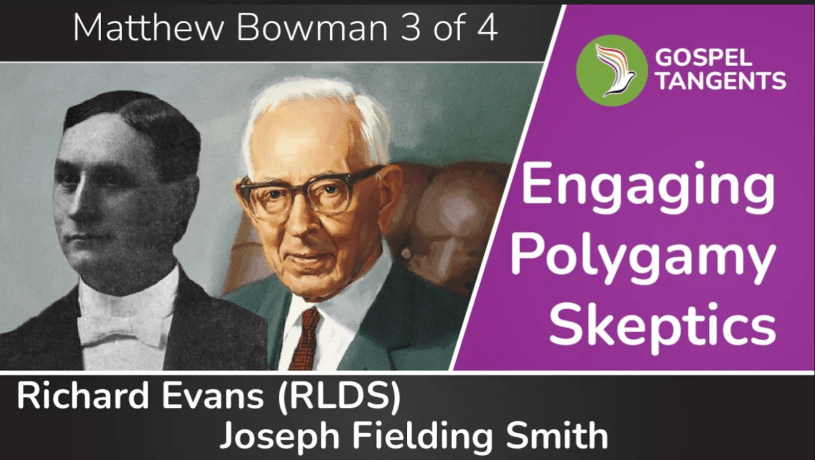
Joseph Fielding Smith‘s writings and views significantly shaped LDS thought for decades. However, his approach to history and sources often differed markedly from academic standards of the time. Dr. Matthew Bowman, author of Joseph Fielding Smith: a Mormon Theologian, highlights Smith’s role and influence. Smith was responsible for beginning the process of professionalizing the Church archives after World War II, organizing materials, creating finding aids, and even starting microfilming efforts. This was a significant step for the institution’s historical record-keeping.
However, when it came to writing history, particularly church history, Smith held a different perspective than professional academics. He is often seen more as an apologist than an academic historian.
An Uncritical Approach to Sacred Sources
A central point of distinction is Joseph Fielding Smith’s approach to sources. Unlike professional historians who are trained to interrogate sources – asking who wrote it, when, and what their biases might be – Smith tended to treat certain sources uncritically. This was particularly true for official LDS sources produced by Church leaders. He believed that sources produced by his family, like Joseph Smith Jr. and Joseph F. Smith, did not need questioning because they were revelators. Similarly, he treated the Bible as reliable history of the ancient world, which most professional academics would not do.
This uncritical acceptance of specific sources, based on a belief in their divine inspiration or authority, is noted as a key difference separating him from professional and even many amateur academics.
No Such Thing as Objective History
The conversation in the source delves into the concept of objectivity in history. It is argued that there is no such thing as objective history of anything in the world; all history and all sources have bias. Academic history is not objective history; rather, it is a form of history that adheres to methods and principles developed over time, and it requires being aware of and accounting for bias in oneself and in sources. The best one can do is be aware of existing biases.
This understanding of bias contrasts with Smith’s approach, where his belief in revelation led him to treat certain sources as inherently reliable, seemingly without engaging in the same level of critical interrogation typical in academic practice. Bias, from an academic perspective, isn’t necessarily about having a predetermined conclusion (though that exists, termed “motivated reasoning”). More often, bias manifests in the questions that occur to a historian to ask (or don’t occur to them), shaped by their background and positionality
.
Influential Works
Joseph Fielding Smith was a prolific writer. Some of his most important and influential works mentioned include:
• Essentials in Church History: His history of the church that treated official LDS sources uncritically but became a landmark work shaping LDS historical discourse for decades.
• “My Question” column: A long-running column in the Improvement Era magazine where he answered readers’ questions on various topics in an authoritative way. This column reached a very large audience during his lifetime.
• Answers to Gospel Questions: A multi-volume series compiled by his son, Joseph Fielding Smith Jr., collating the answers from his “My Question” column.
• Doctrines of Salvation: A collection of his other writings compiled by his son-in-law, Bruce R. McConkie.
• The Way to Perfection: Describes the history of humanity from the pre-existence to the afterlife.
• Man: His Origin and Destiny: A significant work published in 1954, offering a refutation of higher criticism of the Bible and the theory of evolution.
While Smith had a “narrative oriented” mind, wanting to tell stories, his son-in-law Bruce R. McConkie had an “encyclopedic” mind and organized Smith’s writings topically, turning them into reference collections like Doctrines of Salvation.
Smith is considered perhaps the most influential LDS theologian in the 20th century. Bruce R. McConkie, while highly influential himself, is seen largely as a popularizer and systematizer of Smith’s ideas, derivative of his father-in-law.
Views on Race
The Way to Perfection is specifically mentioned as a work where Joseph Fielding Smith explicitly expressed his ideas about race. In this book, he subscribed to the theory that people born of African descent were less righteous in the pre-existence. He used language asserting they “were not entitled to be born white”. He is characterized as very much a defender of the racial restrictions in the church at the time and an influential exponent of this particular idea.
Joseph Fielding Smith and the Question of Race
One of the more controversial aspects of Joseph Fielding Smith’s legacy is his writings concerning people of African descent. Dr. Bowman highlights Smith’s book, The Way to Perfection, where he explicitly states his subscription to the theory that individuals born of African descent were less righteous in the pre-existence. Smith used language that is described as “pretty egregious,” asserting that they were “not entitled to be born white”. He is presented as a “very much… a defender of the racial restrictions in the church” and one of the most influential proponents of this idea, which is traced back to Orson Hyde.
Lowell Bennion Dispute
Smith had prominent public clashes over the priesthood and temple ban. A notable example is his argument with Lowell Bennion, a church educator at the University of Utah Institute. This dispute occurred in front of other educators at a church education symposium in the early 1950s and eventually contributed to Bennion’s dismissal. Many thought Smith was directly responsible for Bennion leaving BYU, Dr. Bowman clarifies that Ernest Wilkinson, who served as both president of BYU and commissioner of church education, was ultimately responsible for Bennion’s firing. Wilkinson, who had a cold relationship with Bennion due to perceived liberalism on race and other issues, viewed Fielding Smith as an ally on these matters, which helped instigate the decision.
Political Differences: Smith vs. Benson
Despite being considered conservatives, Joseph Fielding Smith and Ezra Taft Benson held differing views on politics. A letter from Joseph Fielding Smith regarding Benson, who was called on a mission to England (or Europe) in the 1960s, reportedly stated that Smith hoped Benson’s “blood will be purified” when he returned. This letter is noted to exist in the University of Utah archives.
Dr. Bowman explains that this illustrates deep divides that can exist even within the conservative camp. Smith, a lifelong Republican, was skeptical of the church becoming heavily involved in American politics. He felt that Benson’s fascination with electoral politics was “distasteful” and “inappropriate” for an apostle, considering it “unseemly” and “disreputable”. Furthermore, Smith thought Benson was a conspiracy theorist. It’s noted that conservative politics (like that of Dwight Eisenhower or David McKay) can be separate from conspiracy theory. Benson, however, is identified as a conspiracy theorist, which Smith found vaguely embarrassing. Smith hoped the time in Europe would temper these political interests.
Ezra Taft Benson’s political style and that of Donald Trump
Both shared an anti-elitist suspicion and a belief in “shadowy elites” running the country. Much of Trump’s politics is seen as based on conspiracy theory, for which Benson certainly had sympathy. However, Benson also came from a time where politicians adhered to certain standards of decorum, and it’s suggested he might have found Trump personally distasteful, particularly regarding family values. A key distinction is how they approach politics: traditional politicians think in terms of problems to be solved (e.g., poverty, Cold War), while conspiracy theorists like Benson and Trump think in terms of people – enemies to be destroyed and allies to be rewarded.
Rise of Orthodoxy in the LDS Tradition
Dr. Bowman argues that Joseph Fielding Smith played a crucial role in developing the idea of orthodoxy within the Latter-day Saint tradition, particularly in the LDS Church. Smith insisted in the mid-20th century that correct belief is critically important. He feared that holding incorrect ideas could ultimately prevent salvation. This emphasis, according to Bowman, was imported from the Protestant fundamentalism controversies of the early 20th century.
The concept of orthodoxy – that to be a member in good standing and achieve salvation, one must believe certain things – is presented as an old Protestant idea, originating particularly with John Calvin. This is contrasted with Roman Catholicism, where the emphasis traditionally lay more on ordinances and sacraments (like mass, baptism, and last rites) rather than ensuring every average person understood nuances of doctrine like the Nicene Creed. The push for literacy among reformed Protestants, like the Puritans, was linked to the desire for everyone to read the Bible and catechisms to learn correct doctrine. While the Council of Trent saw Catholicism placing more emphasis on priests understanding doctrine, Vatican II is described as being more ecumenical and re-emphasizing sacraments and the church as the family of God over strict doctrinal adherence for the average member. Smith’s defense and promotion of correct belief led to clashes with other general authorities and lay members.
Smith’s Enduring Influence and Shifting Church Focus
Joseph Fielding Smith’s ideas gained significant traction over time. When he entered the Quorum of the Twelve in 1910, he was somewhat isolated among apostles interested in science and a broader vision of the church. However, by the time he became church president, many quorum members were those he had mentored and who supported his views.
This led to a real push to place Smith and his ideas, such as those in Man: His Origin and Destiny, at the center of what it meant to be a church member. This effort was evident in the religion department at BYU during Ernest Wilkinson’s tenure in the 1950s, where faculty were explicitly told to teach Smith’s works. The correlation movement and curriculum standardization also built upon Smith’s ideas, further solidified by Bruce R. McConkie following him. This period, lasting through the late 20th century, saw a strong emphasis on orthodoxy.
However, Dr. Bowman perceives a shift in emphasis starting in the 1990s. This shift coincided with the realization that rapid globalization led to many new members becoming inactive. The church began to reorient away from a “retrenchment orthodox position” towards devotionalism. This means the focus shifted to living a good, ethical life, attending church, and studying scriptures, rather than primarily emphasizing correct doctrine. This shift is seen as evident in the leadership of Gordon B. Hinckley and Thomas S. Monson and changes in curriculum.
This suggests that the Joseph Fielding Smith emphasis on orthodoxy might be waning. As an example, Mormon Doctrine, a key text promoting this emphasis, went out of print. While the official reason might have been declining sales, it points to the fading influence of the way of being Latter-day Saint that the book promoted – one focused on believing the right things and embracing orthodoxy – in favor of an emphasis on ethical behavior and being a good person. Bishops are seen as being more concerned with members helping others and building ward community than with specific doctrinal stances like the age of the earth.
Cyclical or New Manifestation?
The conversation explores whether the current environment in the church represents a return to a Smith-like emphasis. While some events, like Elder Holland’s “musket” talk or perceived crackdowns at BYU, might suggest a cyclical return to defending the church, Dr. Bowman argues it’s taking on new manifestations rather than a direct return to Smith-style orthodoxy.
He distinguishes between orthodoxy (about doctrine and abstract ideas like evolution or the age of the earth) and defensiveness. While there is a renewed sense of defensiveness, it’s often focused on practice rather than theology, particularly issues related to gender and how people live. Recent excommunications, such as those of Kate Kelly and John Dehlin, are seen as being more about issues of gender, practice, and organizing/mobilizing rather than strictly about theological belief.
The current emphasis is framed as being less about abstract theological ideas (as was central to Smith) and more about how society is organized, especially around gender, which is described as a “real third rail right now.” While certainly premise on a kind of defensiveness, the core focus appears to have shifted from doctrinal purity to issues of lifestyle, social organization, and defending church practices.
Do you agree with Bowman’s take that there is less of an emphasis on correct belief in the Church today? Do you agree that Joseph Fielding Smith & Bruce McConkie’s influence on correct belief is waning? Have you read the book?
 Wheat & Tares
Thanks for that summary. I have not read the book and most likely won’t.
In shaping my non-Mormon understanding of Mormon history, I see a Restorationist church which morphed into a non-Restorationist theocracy over the first 15 years of its existence. With the disappearance of Brigham Young and Utah statehood the theocracy disappeared along with polygamy. But both are embedded in the structure of of the current church. I see Joseph F. Smith as an apologist for a primarily political structure.
Why do Mormons attend wards instead of churches, like Protestants, Catholics and Orthodox? A ward is a 19th century American political unit. It’s a bloc of members administered by a bishop (whose 19th century function might be described as a “ward heeler”). Wards are delineated by neighborhoods, in the same way that New York and Chicago are. I’d extend the political concept to temples being the equivalent of partisan halls, like Tammany Hall, rather than imitations of Free Mason lodges.
By the mid-1840’s Mormonism bore no resemblence to its Restorationist 1800-1810 camp meeting roots. It had become a 19th century American theocracy. Joseph Smith died while running for President of the US in 1844. The ambition that drove him at the end of his life was more political than spiritual, and Brigham Young followed closely behind. Much of the opposition to Mormonism in the 19th century resulted from the machine-like way the Smith/Young theocracy operated. They built Nauvoo and Utah outside of the American political system, and it took Federal force to reconcile their projects to the American system. Utah had to be resurveyed and clear title was not established until the 1870’s, 25 years after Young distributed the land.
Nice summary. Haven’t read the book yet, but I know Bowman does great work.
It’s hard to know where the Church is heading. It seems to be both retrenching and liberalizing at the same time. Orthodoxy is in retreat? Except when it isn’t. Mormon Doctrine may be out of print, but the book still defines Mormon belief for many members of the Church.
Here’s a question. From the viewpoint of 2025, who is more embarrassing to the Church, Ezra Taft Benson or Joseph Fielding Smith?
From the viewpoint of 2025, who is more embarrassing to the Church, Ezra Taft Benson or Joseph Fielding Smith?
I don’t know if “embarrassing” is the right term, but given the choice of a church whose membership embraces conspiracy theories that motivate them to destroy the constitution in the name of defending it, or one in which the membership embraces creationism, racism, and scriptural literalism on Sundays but accepts political losses during the week, I’d take the latter in a heartbeat. (A year ago, I would have rejected the premise of the question, so this was painful to write.)
From my perspective as one not living in Mormon Utah, I to certain degree disagree with Matthew Bowman’s assertian that the church is moving away from doctrinal purity as Joseph Fielding Smith taught. My observations based on what I am hearing in recent General Conference adresses and what I am hearing in Sunday School and Priesthood lesson settings, is that there is a strong emphasis on correct doctrine while losing sight of what the gospel as taught by Jesus might mean.
I suggest that there were other significant reasons for the retreat from JSF/McConkie orthodoxy. Many of the concepts or assertions do not stand up to scrutiny. And some of those assertions, as well as fundamentalist thinking as a whole, simply do not edify people’s spiritual/religious lives over the long term. Devotional practices or worship do edify. I believe that many of the faith crises we’ve seen over the last three decades have been the result of orthodox thinking based upon incomplete or faulty reasoning, and in some cases ill-concieved concepts.