
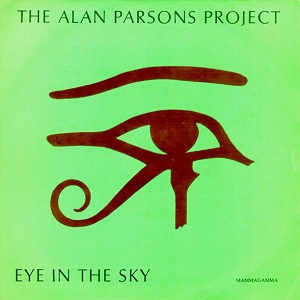
This post is inspired by Eye in the Sky, a song by The Alan Parsons Project, which fortuitously played on my SiriusXM stream while I was pondering what to post today. If you are not familiar with the song, I command you to click on this link and listen. On the album it is preceded by a long intro, separately titled as “Sirius,” but is properly played as part of the song (as done in the link provided). It is a musical sin to play Eye in the Sky without the preceding intro.
What is the Eye in the Sky? Thus saith Google AI:
The “all-seeing eye” or “Eye of Providence” in a Christian context represents God’s omniscience, onmipresence, and watchful care. It’s often depicted as a single eye within a triangle, sometimes surrounded by rays of light or clouds, symbolizing God’s knowledge, the Trinity, or His presence in all things. The symbol is not exclusively a Christian symbol, as it’s also used in Freemasonry, where it represents knowledge, but in a Christian context, it specifically refers to God’s all-seeing nature.
You’ve seen it before, in many places. Take a look at the back of the dollar bill in your wallet. Above the pyramid on the left is, indeed, the All-Seeing Eye. As noted by All-Seeing Google in the above quote, it is also a prominent icon in Freemasonry (here’s another Google AI summary):
The “all-seeing eye,” also known as the “Eye of Providence,” is a common symbol in Freemasonry, representing the watchful gaze of the Great Architect of the Universe, a term Freemasons use for God. It serves as a reminder of the fraternity’s commitment to high moral standards and self-improvement.
That summary explanation is accompanied by another Masonic icon, the compass and the square, a familiar combination to most readers. The all-seeing eye predates both Masonry and Christianity. Again, from Google AI:
The “all-seeing eye” is a symbol representing divine watchfulness, omniscience, and the ability to see all things. It’s also known as the “Eye of Providence” and has roots in ancient Egyptian mythology with the Eye of Horus. In various cultures, it’s been associated with deities like Shiva, Buddha, and God, symbolizing protection, knowledge, and insight.
What about the all-seeing eye in Mormonism? It’s in the Book of Mormon: “I pray the God of my salvation that he view me with his all-searching eye” (2 Nephi 9:44). It’s on and in the Salt Lake Temple: “The All-Seeing Eye of God can be seen on east and west center towers of the Salt Lake City temple and also in the interior in the Garden Room (see Ensign, October 1990, 39; March 1993, 33)” (footnote 1 to FAIR’s interesting article “Why is the Masonic symbol of the All Seeing Eye present on the Salt Lake Temple?“).
So here is my own summary: The all-seeing eye is a potent symbol appropriated by many religions, including Mormonism, to represent various aspects of God, whether named Horus, Shiva, God, the Great Architect, or Elohim.
Now let’s shift gears. Do you think this all-seeing eye of God (interpreted literally), or God’s omniscient knowledge of everything you do or even think (if you interpret the Eye metaphorically), actually watches over your shoulder and sees everything you do?
I am the eye in the sky
Looking at you, I can read your mind
Some people are really creeped out by this idea. There are lots of LDS folk beliefs along these lines, which may or may not be part of Official LDS Doctrine. Here’s from the LDS hymn Do What Is Right:
Do what is right; the day-dawn is breaking,
Hailing a future of freedom and light.
Angels above us are silent notes taking
Of ev’ry action; then do what is right!
So what do you think? Let’s reflect on this LDS doctrine, whether official or folkish.
- Do you think God the Omniscient sees all that you do? Or possibly reads your mind?
- How about Satan? Does he see all that you do, and possibly what you are thinking?
- Does God perhaps delegate to angelic agents who are “silent notes taking” of all that we do? Is your guardian angel actually compiling a dossier?
- What about dead ancestors? Do you think (or do you know some Mormon who thinks) that dead Grandpa or some other relative is watching your every action?
- Do these beliefs, held by you or by someone you know, lead to greater righteousness? Or does it just creep people out and lead to anxiety or debilitating religious scrupulosity? (Here’s a parting shot from Google AI: “Some studies suggest that individuals with strong religious beliefs or those who live in environments with certain religious tenets may be more prone to experiencing religious OCD symptoms.“)
.
 Wheat & Tares
As a 90s kid from Utah, “Sirius” will always bring back unhappy memories.
My personal beliefs on this topic are admittedly inconsistent. I tend to think of God as all-knowing, but not so much all-seeing. Its a distinction that doesn’t make any practical difference, other than I just don’t imagine Him sitting around watching me all day. (Seems very boring.) Yet I suppose He knows what I’ve done.
I don’t believe pretty much any of the traditional LDS concepts around Satan, and certainly not any about him whispering bad thoughts into my brain all day long. Doubly so for any of his followers. If the bad guys can try to talk me into evil all day, it would only be fair that the good guys get to sit on my other shoulder, and there ought to be twice as many good angels anyway. I’d rather take the credit (both good and bad) for my own actions than live in a world where we’ve all got a dozen angels harassing each of us all day long.
On the other hand (I told you I was inconsistent) I like the idea of my mom being aware of me out there somewhere. She’s been gone 40 years now, and I have no memories of her. So I hope, because I like having that hope. It’s not the most logically sound belief system out there, but it gets me through the day.
I think early in life I believed many of those things you describe, and I believe virtually none of them now. I’m still active in the church, but my concept of God has drifted pretty far away from official church teaching. The question about Satan knowing what you’re doing and/or thinking brings to mind an anecdote from my mission. We were walking home from an appointment at which the couple we were teaching had committed to baptism, and I was expressing excitement about it to my companion. My companion admonished me to be silent on the matter because our speaking it out loud would make it known to Satan that they were preparing for baptism, thus giving him an opportunity to try to change their minds. I was quite dumbfounded by this notion, as it was the first time in my life I’d ever encountered it. I’ve come to realize that there’s a pretty broad range of folk doctrines along those lines that get passed down in the church, surrounding what God and/or Satan can know about your thoughts and how they know it. Aside from some a few verses cited here, virtually none of it is scripture, most of it likely speculations of leaders past and present, and possibly ideas absorbed from broader American Christianity.
“under his eye”
A couple months ago in Salt Lake Tribune:
“Are Latter-day Saints more prone to perfectionism? Here’s what the data says.”
[ . . . ]
“Parsing through this data, which also included responses from the teenagers’ parents, religious education professor Justin Dyer and his colleagues came to a surprising conclusion: Latter-day Saints, and religious teens as a whole, were, they determined, half as likely to struggle with high rates of perfectionism than those who had disaffiliated from the religion in which they were raised.
“‘It was clear,’ Dyer, a statistician, writes in the journal’s introduction, ‘the narrative we commonly hear was missing something important.'”
[ . . . ]
“Parsing through answers from more than 1,600 respondents cataloged in the Family Foundations data, researchers found that Latter-day Saints were, at 12%, just about even with their peers of other faiths when it came to the percentage of its population who struggled with high rates of toxic perfectionism.
“Zoom in on former Latter-day Saints, and that number more than doubles. Neither are former members of the Utah-based faith alone in this corresponding jump. According to the study, nearly 1 in 4 of those who had disaffiliated from other faiths struggled with high levels of toxic perfectionism.
“Agnostics and atheists, meanwhile, landed in the middle of the mix with 20%.
[ . . . ]
“Goodman concludes, ‘Contrary to what some may assume, religion overall is associated with lower levels of toxic perfectionism.'”
https://www.sltrib.com/religion/2025/03/15/byu-study-examines-link-between/
What I have heard about “Satan” in the past few years is, he’s victorious when we call it the “Mormon” church (massive yawn). The “Satan” character has become pretty disingenuous to me. Christianity imposed this evil, personal glory seeking, little brother to Jesus on the Bible, as he never shows up in the Garden story or anywhere else. The “Satahn)”, or some member of the heavenly council is represented, but not as the evil little brother, only as an opposing voice. The term in the bible means “Adversary”, not necessarily in one attempting to cause people to bad behavior, but as a countervailing voice to provide perspective and challenge the status quo. The garden story “never” mentions “Satan”, he’s not there, the adversarial voice is a talking serpent, which is weird anyway, but there is absolutely no mention of “Satan”.
As far as the “eye in the sky” or the all-seeing eye, I rather like the image as a compassionate caring idea, an overseer of the earth and such, but it’s been turned into the NSA Kolob branch, executing adversarial surveillance on all his children.
We see it represented in all sorts of Protestant thought, including what we sing as a fun song at Christmas, “Santa Clause is coming to town”. He sees you when you’re sleeping, he knows when you’re awake, he knows when you’ve been bad or good, so be good for goodness’ sake. The message, someone is always watching, and whether or not you get a nice present from God, depends on you behaving well. Another plug for “worthiness”, the most toxic, culturally embraced idea in Mormonism.
In the St. George Tabernacle, an eye was painted high on the wall behind the podium. No triangle, no rays of light emanating from it, just a disembodied, human-looking eye. The few times I attended programs in the Tabernacle, I much preferred sitting in the choir loft, my back to the eye. I just thought it was weird.
As far as the all-seeing eye of God, the concept never bothered me all that much. While I believed he could, and would, look upon me individually, I figured he had much better things to do than watch me.
When I saw this post I thought it was about Sauron. But it’s the Alan Parson’s Project. I have the the album somewhere mixed in there on the shelf next to the unused turntable. The song always creeped me out (along with Every breath you take. But what can you expect from a group called the Police)
God as voyeur was certainly something how my youthful mind interpreted things I heard in church. Every time I set on the toilet I draped a towel across my lap and worried about xray vision. Don’t get me started about showers.
I don’t want dead ancestors watching me. Go away now. That includes God, Satan, the Police State, Santa Claus.
Quentin: I’m curious as to why your companion thought that Satan could hear you talking in the street but not in the couple’s home where they had just committed to baptism? (I don’t really expect you to be able to explain his logic.)
My conclusion from John Mansfield’s snippet is that religion doesn’t produce lower levels of toxic perfectionism, it just chases out a significant percentage of those people who eventually chose to disaffiliate.
In response to John Mansfield (and in line with DaveW, I think).
Toxic perfectionism is OCD-adjacent. It is a mental health issue that is neither caused nor cured by religion. But it can be exacerbated by religion. My interpretation of the data is that maybe half of those with such mental health symptoms find the exacerbation to be intolerable and leave their religion. (The atheist/agnostic data indicate that there may be some with a propensity for toxic perfectionism who actually find relief in their religion. But my guess is that the net flow is outward.)
toddsmithson, thanks for your words on Satan as Jesus’ younger brother. I’m a convert to Mormonism, and I am not at peace with this teaching. It might be true, but the scriptures are silent on it. In fact, I see in the temple ceremony, much clearer in the movies with the many repetitions than in the slides, was that there was a gulf between, on one part Elohim, Jehovah, and Michael, and on the other part Peter, James, and John. The latter three never saw E, and only saw J, and they saw him as God and not as a messenger or servant, and the three of them certainly did not see Jehovah as a peer or as a sibling. I think that our teaching wants to create too much familiarity, where I think the scriptures (and the temple ceremony) counsel distance. I don’t know that teaching that Satan is our brother, or worse, Jehovah’s brother, is helpful in our missionary efforts, and I am not at all certain that we can call it true doctrine. I do not know how we are sons and daughters of God, and it might well be symbolic. After all, we were intelligences before we were spirits, so we weren’t created as spirit children by any heavenly procreative act between male and female divinities. That’s also why I don’t think that teaching heavenly mothers is helpful, nor am I certain that it is true. God allows us to call him father, but I don’t think that we understand what that means.
I do *not* [typo] know how we are sons and daughters of God…
Religious based Obsessive Compulsive Disorder is called Scrupulosity. I think the distinction needs to be made that religious OCD Scrupulosity ONLY occurs in religious individuals. Many nonreligious individuals have OCD, but it will be expressed in a nonreligious way.
For instance a person with Scrupulosity may feel compelled to kneel down in prayer and apologize to God each time a sexual thought crosses their mind. They may even feel compelled to do this when they are in public places. I know a young man with Scrupulosity who can’t go to the temple because he gets freaked when Satan addresses the audience. The same young man also struggled with fast and testimony meeting because he feels compelled to bear his testimony each time even though he lives in a large ward and he knows he needs to give others a turn, and he hates to bear his testimony, and suffers anxiety throughout the meeting.
OCD is about intrusive thoughts that cause a person to feel anxiety if they do not submit to the compulsive or ritual action. The compulsion can be on any topic: safety, contamination, fear for family members, worries about relationships, etc. Sufferers can feel compelled to do many many ritual actions to get momentary relief from anxiety, and often these actions aren’t consistent with their personal values.
I think possibly many members of the church that have Scrupulosity get all kinds of positive feedback for it, at least initially. It can come across to everyone as beneficial conscientiousness in the setting of the church. That leaves me wondering exactly how they determined the parameters of the study they were quoting saying there is less OCD in religion. That may be, but there is definitely more Scrupulosity in people that are religious.
The important thing to counter OCD of all kinds is to promote flexible thinking instead of dichotomous or all or nothing thinking.
@DaveW
Yes, I forgot to mention that part. My companion assumed that in the discussion the presence of the Holy Ghost prevented Satan from being present and able to eavesdrop, but apparently talking on the way home we no longer were benefitting from that cone of silence and thus could be overheard by Satan.
lws329,
I don’t think the toxic perfectionism referenced in the study cited by John Mansfield is the same as scrupulosity, which is full-blown OCD. That’s why I called it OCD-adjacent. The numbers in the study are way too high for scrupulosity or even for all manifestations of OCD combined. Toxic perfectionism is not a formal diagnosis, although if sufferers were to seek a diagnosis, they might get one of obsessive-compulsive personality disorder, which is distinct from OCD and much more common. The study almost certainly relies on self-evaluation and is thus less reliable than one in which the condition is confirmed by a professional. But whatever you call what we are talking about, I agree with your last sentence.
The model DaveW and last lemming propose sounds like it might fit with the data (the little that I read of it): About 20% of religious people start with toxic perfectionism, just like agnostics and atheists. For those with this mental habit, their religion is a focus for the perfectionism, and some choose to deal with that by leaving their religion, and consequently those dealing with toxic perfectionism are over-represented among those leaving religion. Religion didn’t cause their problem and leaving it didn’t cure it, so they still count among those experiencing it.
For this model to balance out with the claimed numbers (12% toxic perfectionism among religious people, 24% among formerly religious people, 20% baseline common among all humanity) that would require the formerly religious to outnumber the still religious 2-to-1. Formerly religious people dealing with toxic perfectionism would outnumber the still religious dealing with it 4-to-1.
However, only 30% of Americans are religiously unaffiliated (the “nones’), so that model of leaving religion is not consistent with these numbers. There must be something besides sorting going on if these numbers are good (12%, 24%, 20%, and 30%).
I was born and raised in middle-Mormondom (literally and figurately, in Midvale, UT, which is short for middle of the valley and is essentially the middle of SL county). I was taught that God could read our thoughts but Satan could not. Also something about writing things down because Satan is illiterate? This was essentially a flex on how God was more powerful than Satan and also something about when we think evil we shouldn’t say it out loud. I have no idea where this came from, how widespread it was shared, and I find no scriptural support for it. But it tracks with President Nelson that I can think myself a Mormon but just cannot proclaim it.
We have a hymn that says angels are very actively watching us. I was taught that spirit prison is on the Earth so therefore my ancestors may be able to watch me and I may feel their presence from time to time. This teaching again was popular in my neck of the woods in 1980’s UT right alongside the Satan worship epidemic and ouija board heyday and so naturally I found this teaching more troubling than comforting. YMMV.
My wife grew up in middle California and has never heard any of this rubbish.
Regarding the SL Trib article, if this data is based on survey, color me skeptically purple.
Isn’t this the same method used to determine that religious folk are happier than non-religious folk? I simply do not see that difference at all based on my interactions with people. Religious people are told they have the plan of happiness and that the covenant path will lead to salvation so of course they will self-report being happy and not prone to toxic perfectionism. My experience is that happiness and toxic perfectionism rains down on all of us.
The Faith Matters podcast for Jan. 11 of this year is an interview with Justin Dyer, one of the coauthors of the SL Trib cited study. He admitted that the study did not look at all into why there is such a large difference between current and former members of the Church. There were some further questions, during which he also acknowledged that the difference might be simply because those for whom the religion works to make them happier stay active, while those for whom the religion exacerbates problems leave. I am not qualified to address either the study methodology or analysis. The discussion left me with a feeling that the study was designed to produce these results. I would be interested in an analysis from a qualified and unbiased source.
At a bare minimum, the study isn’t large enough to confidently address some of the issues. Specifically, there were “more than 1600” respondents, but 41% of them were LDS, while only 8% (~128) were former LDS and 3% (~50) were disaffiliated from some other religion. So when we’re talking about a 24% rate of high perfectionism in that group, we’re really talking about 12 people out of a group of 50 that identified as high perfectionism. There simply aren’t enough people represented here to conclude how all the numbers do or do not add up. The hundreds of LDS data points will potentially provide a reasonable degree of certainty on that group, but the much smaller numbers in the other groups will lead to some large error bars.
I think that God is aware of me and all of my thoughts the same way that I am aware of each cell in my body. I am the “creator” of each of the cells (kind of like their father), and I have a connection to them (they can send signals to me, and they are dependent on me), and I would say that I love each cell and want what’s best for them. Essentially, I experience everything that my cells experience, so you could say that I’m an “All seeing eye” to each of my cells.
But I don’t judge my cells. And in many ways I don’t directly intervene in the lives of my cells, even if they are doing their best to serve me. I just kind of let nature play out in my body. Each cell just by doing it’s thing, makes my body work the way that it does.
And I think that each of us, just by being ourselves, is somehow making the universe work. So I’m not worried about the “All seeing eye” of God judging me. I just seek to live my life in harmony with nature and mankind, and I think that is sufficient.
Chadwick, the business about only God knowing our thoughts is from the Doctrine and Covenants, 6:16. As a SoCal Mormon, I definitely heard that one a lot. “So be careful what you say or write down—maybe pray silently.”
I’m watching one of my kids really struggle with OCD and realizing how much I struggled with it too at her age but didn’t realize it/was even praised for it—lws239 is so right—because it began as scrupulosity.
I’m theoretically agnostic, but the idea of a personal God who loves me and knows me is still comforting. It was such a part of my psyche growing up that I find that on a very deep level, I never feel alone. It’s mostly kind of nice. The “God” I don’t know that I believe in is definitely a benevolent, affirming, lowkey constant presence.
While God is all knowing I don’t think we’re in a fishbowl with regard to folks in the spirit world. I do believe, however, that they can see us–if necessary–when they have a special labor to perform on our behalf. But generally speaking my sense is that they’ve got a lot of work to do right there in their own environment.
That said, I believe the wedjat eye is a symbol of both the Lord’s omniscience and the power of his priesthood–the latter being a mechanism through which flows his revealed will.
Re: Scrupulosity: I experienced a classic case of the destructive power of OCD within a religious context. When I finally hit the wall of depression (20+ years ago) I chopped my tree of faith down to the very roots. Thankfully the roots were good–and I’ve able to regrow my faith into a much more healthy configuration. And now the gospel is sweeter than ever.
aporetic1
I love your analogy. That’s it. Right on the nose. That’s how I feel about God.
It’s a beautiful world we are part of. I am grateful to be one of the cells. I feel very in harmony with it all
I grew up internalizing various non-specific LDS teachings about an all-seeing/all-knowing God, including the idea that He has us under 24/7 surveillance, with collection duties possibly delegated at times to angels/spirits, including our own dead relatives. I don’t remember being taught specific folk doctrines about whether Satan could eavesdrop on spoken but not silent prayers, or specific conditions of deceased loved ones in our midst, or any of that nonsense, but regardless I found any suggestion of God the Eternal Voyeur unsettling. Having natural tendencies toward OCD and scrupulosity did not help. One of the best outcomes of my deconstruction was being able to completely discard this set of beliefs. I don’t wish to live in a spiritual police state, and it’s more plausible that such belief systems evolved from man-made doctrine by religious authorities who have a vested interest in keeping followers compliant. Is anyone really comforted by the possibility that God (or worse, your ancestors) watches you on the toilet, in the shower, or in other vulnerable or intimate moments, and is diligently “silent notes taking” (i.e. scrutinizing your performance of such functions)? It’s weird to think about, but for the 10-year-old me sitting in a primary class, being told that “it’s so wonderful that Heavenly Father is always watching us…” it’s the next logical place for my mind to have gone.
Years ago I read a parenting guidebook that included a section on teaching children about death. It explicitly warned parents not to use seemingly-comforting pseudo-religious rhetoric about how “Grandma is watching over us now” or similar platitudes with kids, because it will cause unnecessary anxiety and paranoia for kids to think they are being constantly spied on, especially by their beloved departed relatives. Notably, the guidebook was co-authored by Fred Rogers. Rogers was a devout Christian and an ordained Presbyterian minister, and no doubt his work in children’s media was informed by his Christian values, but he never made explicit religious references or pronouncements in the context of his work. Yet another example of how Mr. Rogers got it right, while the LDS church was making it worse.
“How about Satan? Does he see all that you do, and possibly what you are thinking?”
For further reference, one could watch “Devil in the Family” about Ruby Franke from Springville, Utah, and her therapist Jodi H. These women would definitely give a “yes” answer to the question above.
Once I started seeing god as synonymous with nature, things changed for me. I started feeling less guilty about trivialities. I began to be motivated out of a hope not to avoid divine punishment, but to feel more connected with my body and nature and the societies and cultures around me. Consequently, I no longer believe in an anthropomorphic god who sees your every action and knows your every thought. I most certainly don’t think that dead ancestors can watch you. If they can, they seem powerless to keep you from doing anything wrong or from harm. There has been and is too much suffering in the world to think that guardian angels are watching over people. If they exist and have power to help, why not help those who are in the most pain? Where are these guardian angels in war zones? Where are they in Gaza, Kashmir, and Ukraine? There probably is no life after death. So enjoy the life you have now. Make what you can of it. Know that in the end there is full release.
We are consistently taught that Satan is a liar, and his Modus Operandi is to lead us astray. With that said, the endowment presentation coupled with the garden story is highly confusing. First of all, the garden story does not clearly suggest which of the characters is lying or telling the truth, and by any measure of factual truth, it appears that the serpent (not Satan) is actually telling the truth, or at least, completing the command with a “Yeah but”.
While the temple ceremony on numerous occasions uses Satan’s voice to command us to do certain things. Such as, put on your aprons. And prior to his exit, he is the chosen motivational speaker to impart the fearful rant about what will happen if these people don’t live up to every covenant made in this temple this day, saying they will be in his power. Well, if Satan is a liar, then why should I then believe that statement at all? Is he lying about him having complete power if I don’t live up to the covenants made or is that just another statement to suck us further into toxic perfectionism? Why would the church choose Satan as the speaker to get members to comply? That would be like the Q15 sitting around their table discussing the important topics to be covered in GC and discussing who ought to impart the most important message, and President Oaks saying, I know who would be perfect, “Satan”, he’ll get people to pay attention.
I definitely grew up with the idea that God was watching me all the time and could indeed read my thoughts, and that my thoughts (along with my works and deeds) would condemn me. I don’t know how anyone else didn’t. I mean, it’s right there in alma 12. Maybe I was just that kind of kid. I suppose I extended this to Satan and his minions as well. I was also told that my ancestors were watching over me as well, but it was heavily implied that they were disappointed in my lack of faithfulness and (or at least I internalized it this way). Do I still hold these beliefs? Not really. I now have a much more expensive view of God and see the scriptures as largely symbolic or simply products of their time and place. Unfortunately, the things you internalized as a child aren’t shaken off so easily
Ironically, the lead story in today’s local newspaper (Northeast US–LDS are a tiny minority) is about new police drones and the police chief is quoted, “We want the EYE IN THE SKY [my emphasis] with the drone to get to an area where there’s a problem before our police officers get there.” Since God is all-wise and all-knowing, why couldn’t He utilize drones or other technology? Maybe heaven is a huge tech room filled with cameras and computers–and some are constantly monitored and frequently updated while others are shoved in a corner and collect dust.
Also, there’s a Primary song called “God is Watching Over All,” apparently from a non-LDS source since the Church doesn’t hold the copyright (“Sing With Me” p.229). The second verse states, “He remembers night and day Ev’ry child at work or play. He will teach you what to do; God is watching over you.” On the one hand it’s comforting to know that God is aware of me. On the other hand, I don’t want anyone–mortal or supernatural–spying on me. On the third hand, God certainly doesn’t seem interested in actually doing anything about my problems or concerns, unless He’s going to present me with a long list of both our failures when I arrive in heaven.
Sorry, that should have been “Children’s Songbook” p.229, although it is in the old
“Sing With Me” p.B-2, under the title “Loving Care.”
toddsmithson,
The adversary’s biggest lie is that he poses as a true sent one. He’s a counterfeit. In disguising himself as a serpent he appears as a false Christ.
Jack
Genesis 3:1 – “Now the serpent was more crafty than any beast of the field that the LORD God had made.” The text says God created the serpent. Presumably God also allowed the serpent into the garden, which means that if we take Satan to be “evil” personified, then that means evil was “IN” the garden and God put it there. You also mentioned him to be a liar, which still begs the question as to why the church employs Satan to give a very heavy handed, coercive speech about what will happen to covenant breakers. Did Satan, on his way off the scene, suddenly grow a conscience, encouraging people to keep their promises, or else. The logic here does not add up at all. Why would Satan, if he is in fact a liar, as you say, tell people the truth about breaking their promises? It would seem more likely for him to try and convince them, as we say he did in the garden, that breaking their covenants will not be a big deal, saying, you shall not surely die, but you shall be as the Gods. Even his statement there, we would classify as a half-truth, God later confirms in Genesis 3:22, when he says, “the lord God said, Behold, the man has become as one of us”. So, the serpent was actually telling the truth. The text reads a lot more like opposing voices, each telling their part of the story, as would the defense attorney and prosecutor, and the truth is formed in the two together. As far as the text is concerned, God and the serpent tell half-truths. My point here is that the story doesn’t really read as we have narrated. Perhaps the story is far more dynamic and nuanced about the nature of reality, that it’s not a simplified binary of good and evil, but it’s, as Lehi stated, opposing forces bound together supporting life. Lest we forget, Eve later says, were it not for our transgression, we never could have had the joy of redemption. That statement formally suggests that redemption is better than innocence and endorses transgression as the path to it.
Jack – you said; “In disguising himself as a serpent he appears as a false Christ.” This is an interpretation imposed on the text, but the story itself never implies or suggests that the serpent is a disguise for Satan (the evil one)
If you were reading the Garden story for the first time, without any prior bias, you would NEVER conclude anything resembling your assertion. The text simply does not support a “disguise” or “counterfeit” idea.
You’ve got the wrong album…it’s Vision Thing from Sisters of Mercy you wanted: https://images.app.goo.gl/hazGxkdsypRnHbF46
toddsmithson,
“If you were reading the Garden story for the first time, without any prior bias, you would NEVER conclude anything resembling your assertion.”
You may be right. But I’m importing elements from the entire canon (including the temple) into the story. We learn elsewhere in the scriptures that the adversary is identified as “that old serpent” and a “liar from the beginning.” In the famous words of Adrian Monk: he’s the guy.
“Did Satan, on his way off the scene, suddenly grow a conscience, encouraging people to keep their promises, or else.”
He might’ve been using the truth to *discourage* people from entering into the gospel covenant. Often its virtue rather than vice that is his weapon of choice.