
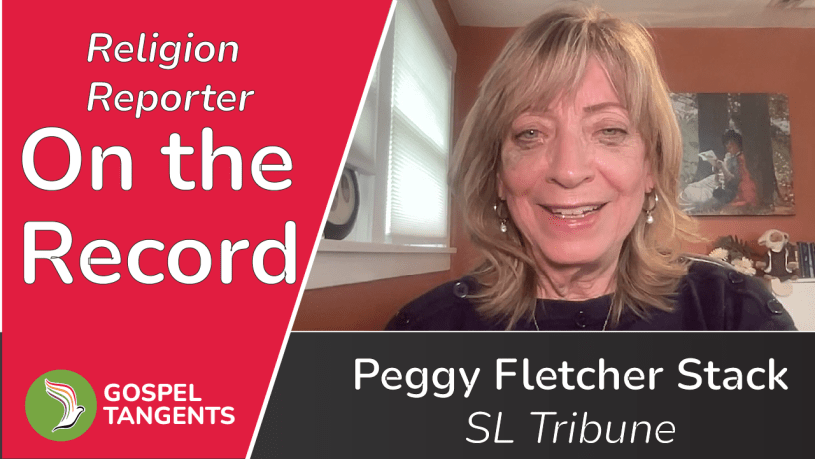
For over three decades, Peggy Fletcher Stack has been a prominent voice covering religion for the Salt Lake Tribune. With a career spanning the tumultuous and transformative years of the late 20th and early 21st centuries, Stack offers unique insights into journalism, faith, and the dynamic landscape of religion in Utah and beyond.
Stack’s journey into journalism wasn’t conventional. Before her 34-year tenure at the Tribune, she was involved with Sunstone magazine and was the originator of the Sunstone Symposium, which began around 1979. Her idea for the symposium was born from a need for content for the younger, student-focused magazine. It proved successful, growing into an annual event that continues to this day..
A significant early experience involved Mark Hofmann, the infamous forger and bomber. Stack knew Hofmann and conducted the only print interview he ever gave. Looking back, she recognizes he was lying throughout their Q&A, something she attributes partly to her youth and lack of formal journalism training at the time. The Hofmann bombings tragically occurred near her wedding day, October 12, 1985. She was close friends with bombing victim Steve Christensen, who was also Sunstone’s biggest donor. The events quickly shifted from appearing business-related to being about the forged documents, leading to warnings that Stack herself might be in danger.
Stack’s path to the Tribune involved freelance writing in Kenya with her husband, followed by years working various jobs in New York City, including at a medical ethics think tank, for the United Methodist Church, and an Episcopal Church magazine. A summer visit to Utah in 1991 led to a friend suggesting she apply for the Tribune’s religion reporter position. Despite having no journalism degree (her degrees are in English and sociology) or daily paper experience, she was hired by the new editor, who wanted consistent religion coverage. Her first story, covering the Southern Baptists bringing their convention to Utah after Salt Lake lost the Olympics bid, landed on the front page. What started as a summer job turned into a career that has lasted over three decades.
Throughout her career, Stack has covered a wide range of topics, including Catholic abuse and interviewing Utah Muslims after 9/11. Highlights include interviews with Archbishop Desmond Tutu about forgiveness and spending four days covering the Dalai Lama. She covered LDS Church leaders, including Howard Hunter and, most notably, Gordon B. Hinckley, who broke tradition by holding news conferences and taking questions.. Stack was among the first reporters to question him and traveled with him on a historic trip to sub-Saharan Africa, where she interviewed him in Zimbabwe.. During that interview, Hinckley famously responded to her question about the burden of public scrutiny by saying, “Adulation is a disease I fight every day.”
Reflecting on her coverage themes, Stack notes that topics like intellectuals, feminists, and LGBTQ+ issues—identified by Apostle Boyd K. Packer as “enemies” of the church—have consistently been pressure points and major areas of her reporting. She explains that journalists cover conflict and problems (“planes that crash” vs planes that land) to bring issues to light. While the focus on women’s ordination might have shifted, she states that gender issues remain “very potent,” covering concerns like young women passing the sacrament or sitting on the stand. Similarly, LGBTQ+ issues continue to be a significant topic, reflected in her nearly 700 articles containing the word “gay.” She recounted a memorable interaction with President Russell M. Nelson where, after he initially focused on her family and then non-Americans, she pointedly asked, “What about women?”
A core tenet of Stack’s career is her journalistic ethic of neutrality. She firmly believes reporters should not express personal opinions in their work or on social media to maintain credibility. She distinguishes her role from opinion writers and receives “blowback” from people on all sides of issues, getting more hate mail than sports reporters. She finds that many readers don’t understand the clear line between objective journalism and opinion writing or public relations.
Technology has dramatically changed journalism, making research easier but turning the job into a constant, 24/7 endeavor compared to the fixed deadlines of the past. Despite the challenges, Stack still finds the job exciting and has no immediate plans to retire, possibly aiming for the 2034 Olympics as a potential “book end.”
I know people have strong opinions about Peggy’s reporting. What are your opinions?
 Wheat & Tares
Legend.
She’s awesome.
She is hands-down one of the best journalists in the business.
She’s hands-down one of the best journalists in the business.
I make it a point to read most of Peggy’s published articles, many of which I save in my personal files. Her though-provoking writing has helped me become a more critical thinker. A thousand thanks to her!
Peggy is a treasure. One of the best minds the church has to offer.
Love her work, and her commitment to good journalism. She is very good at walking the tightrope, by reporting honestly and factually about the LDS church without being critical or antagonistic. I do remember that first press conference after RMN was sustained as church president; as I recall, she asked fair questions, and he was a little patronizing and dismissive in his responses.
I wonder if she has ever been threatened with Church discipline, or if she has had major shifts in her private beliefs over the years.
When RMN said to her at his initial press conference “I knew your mother” and “we love women” I knew it was going to be a rough regime
I have nothing profound to say here, but I want to say that I deeply admire, and depend on Peggy Fletcher’s writing. She is so reliable, so unbiased, so informative. There are few reporters, especially religious reporters, who are her peer.