


Today, let’s talk about life-changing decisions and the times we wish someone could tell us what to do. (I’ve been gone for a few months because my brain was overwhelmed with one of those huge life-changing decisions about my career.)
The Holy Ghost and Personal Revelation
I was raised to pray and seek guidance from the Holy Ghost. The teaching was that if I obeyed gospel teachings, I would be worthy to receive the promptings of the Holy Ghost to answer my prayers and guide me towards righteous decisions and Heavenly Father’s will for my life. This answer would come in the form of a burning to in my bosom, peace, or other feeling that would confirm which path I should follow.
Personal revelation is a three step process: (1) formulate the question through study and thought; (2) ask the question in prayer; and (3) recognize and understand the answer when it comes.
Essentially, following the guidance of the Holy Ghost is a divine game of Hot or Cold. You remember hot and cold, right? This was one of the most popular Primary Sharing Time games in the only ward in which I was a Primary teacher. One child would leave the room while the Primary leader hid a toy somewhere. Then the seeker child would come back in the room and the other children would yell “hot” or “cold” depending on whether or not the seeker child was getting closer to, or farther away from, the hidden object. The seeker child can’t hold still and wait for directions; they have to be moving in order to receive hints on whether they’re going the right way. Once the other kids were yelling, “You’re burning up!” the seeker child knew that he was on the brink of finding the object.
Oliver Cowdery played a divine version of this game called Burning or Stupor.
7 Behold, you have not understood; you have supposed that I would give it unto you, when you took no thought save it was to ask me.
8 But, behold, I say unto you, that you must study it out in your mind; then you must ask me if it be right, and if it is right I will cause that your bosom shall burn within you; therefore, you shall feel that it is right.
9 But if it be not right you shall have no such feelings, but you shall have a stupor of thought that shall cause you to forget the thing which is wrong; D&C 9:7-9.
The other feeling that signals an answer from the Holy Ghost is peace.
22 Verily, verily, I say unto you, if you desire a further witness, cast your mind upon the night that you cried unto me in your heart, that you might know concerning the truth of these things.
23 Did I not speak peace to your mind concerning the matter? What greater witness can you have than from God? (D&C 6:22-23)
I have had some amazing experiences in seeking the guidance of the Holy Ghost and receiving inspiration. My Relief Society lessons on the topic of personal revelation were thick, meaty tomes of how to put yourself in tune with the Spirit and how to recognize promptings. I honestly didn’t understand when people said they couldn’t tell the difference between their own feelings and the guidance of the Holy Ghost. [fn 1]
I’ve also had times when I didn’t get an answer, and some times when I thought I got an answer and it turned out badly later. Sometimes, divine guidance is really just your own personal preferences dressed up to look like they’re more authoritative than they really are.
The Holy Ghost is not reliable. Anyone who tells you it is, and seeks to explain away the trickiness in getting spiritual guidance, has an agenda. This doesn’t mean it’s wrong to seek spiritual guidance — but you do have to acknowledge the limitations.
ChatGPT and Crowd-Sourced Answers
Nowadays, kids who don’t go to Church, like my kids, are hearing about this thing that has all the answers to life, the universe, and everything: ChatGPT. ChatGPT and its cousins belong to a family of human inventions called generative AI, or artificial intelligence.
I had a conversation with my son in which I found out that he thinks ChatGPT is always right because it has access to everything on the internet. I’m not sure I got through to him that the AI that powers ChatGPT is not really intelligent, it’s a word picker. It uses an algorithm to create grammatically correct, plausible-sounding sentences, not reveal truth. A lot of what is on the Internet is wrong. ChatGPT has no way to tell the difference between facts, inaccuracies, someone’s dream they described, prejudice and bias, and outright lies.
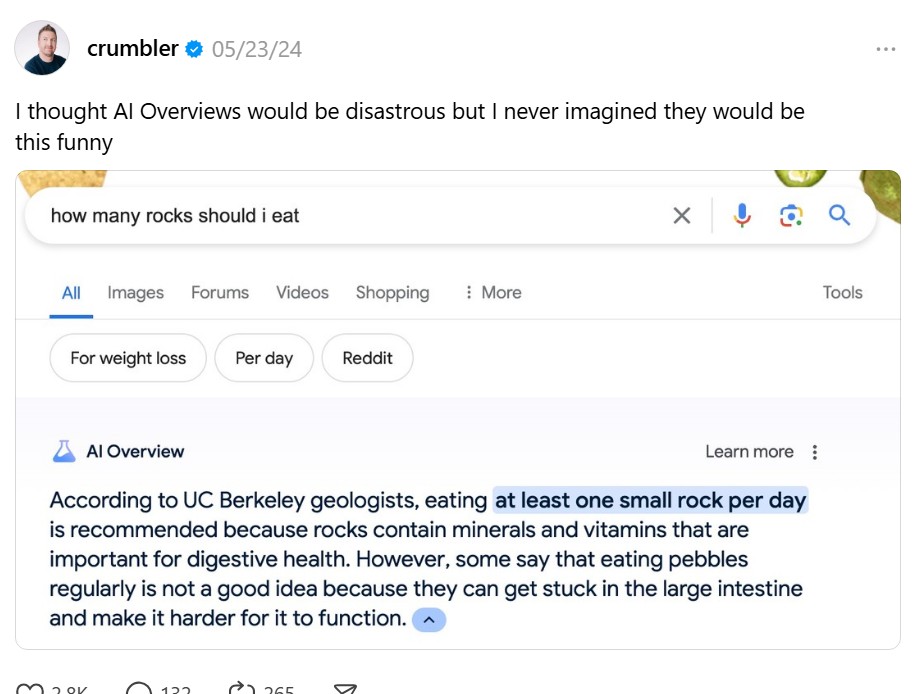
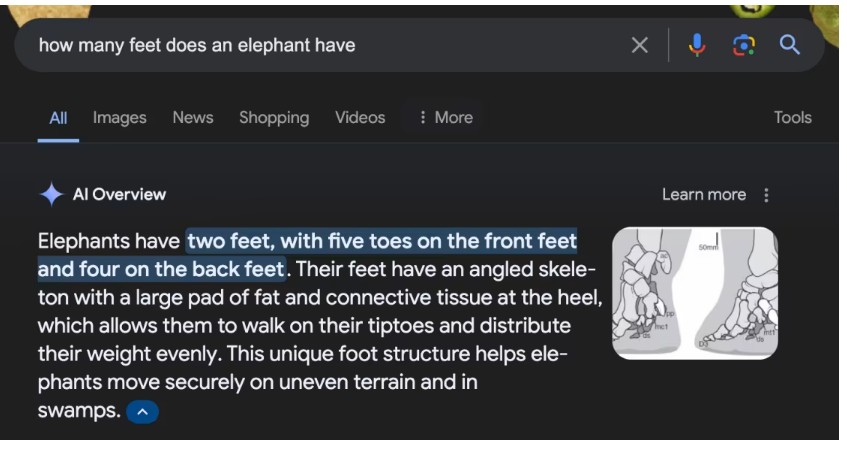
Google AI is embarrased about this and doesn’t want to talk about it.
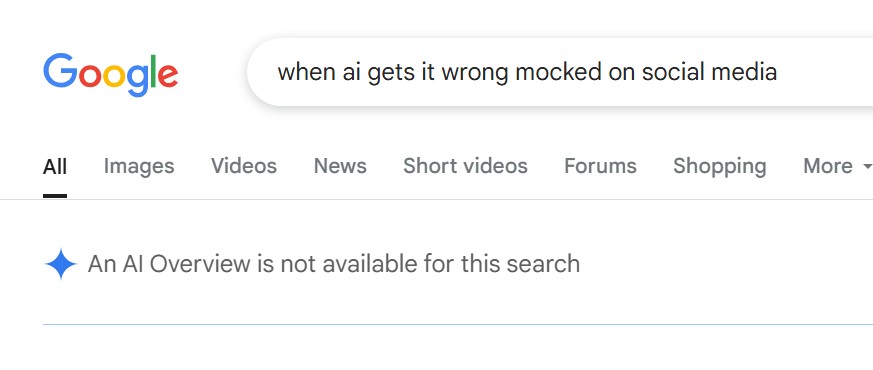
ChatGPT is basically an amalgamation of us. Everything we put onto the Internet created a hive mind and then we prodded it into a simulation of conversation. Personally, I don’t like it and don’t use it. If someone says they asked ChatGPT and ChatGPT said … I tune it out. I’m talking/writing to you, a human being, not an algorithm, and if you bring an algorithm into the conversation, I’m not wasting my time.
But it has its uses. ChatGPT does a decent job of summarizing stuff. Here’s the AI overview when I asked google if I should quit my job:
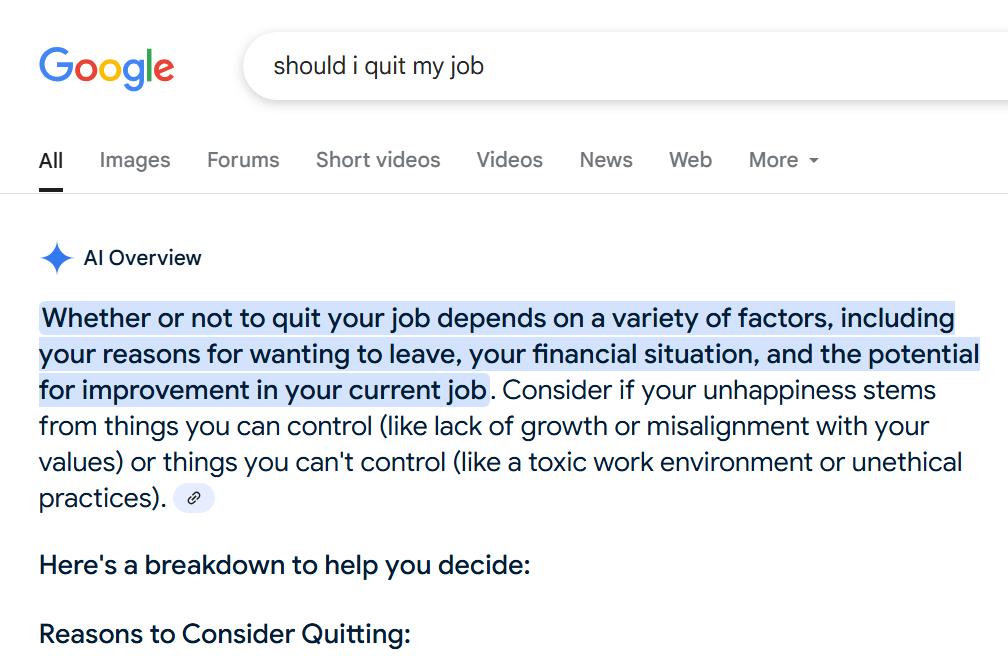
It isn’t telling me what to do, it’s telling me what factors go into my decision. That’s useful for studying it out in my mind. It gives some clarity and breaks down an overwhelming situation into manageable chunks.
Helpful. But not authoritative. ChatGPT isn’t human and never will be.
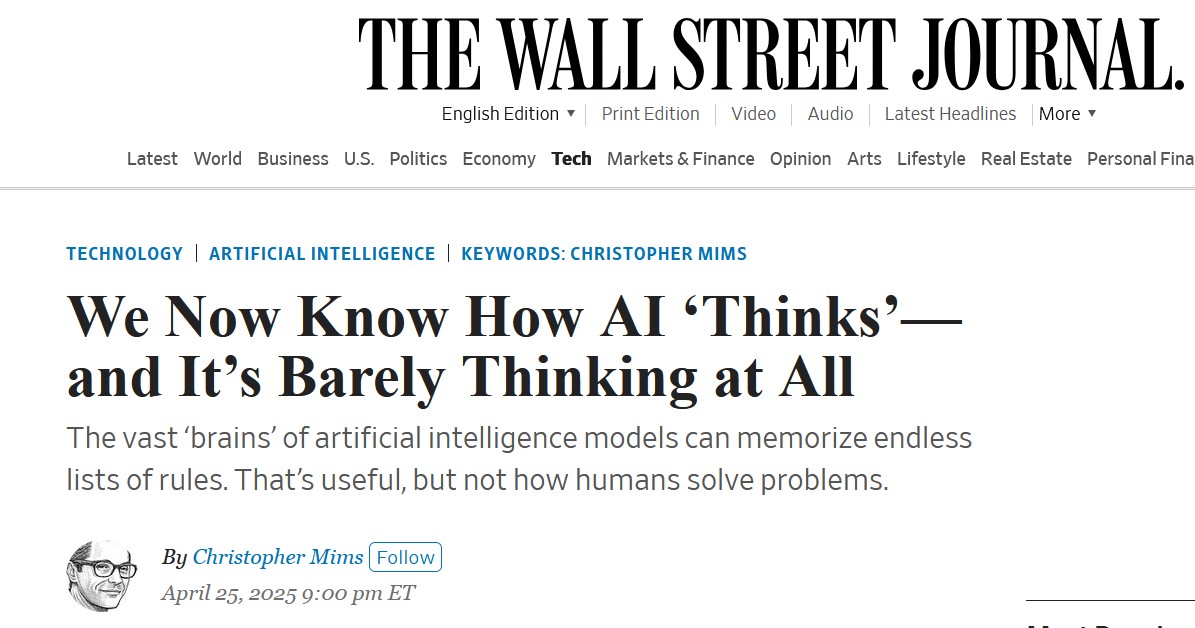
I really wanted to read this article, but I don’t have a WSJ subscription. The teaser line, though, sounds almost like worthiness. You know — the kind of worthiness that helps you get answers from the Holy Ghost. Know all the rules and you’ll have all the answers. If ChatGPT thinks at all, that’s what it thinks. We know that doesn’t make for a real, human life. ChatGPT is just words — words and rules. And that’s not enough.

This poem was written by Keith Leonard and published at Waxwing, a literary journal.
ChatGPT or the Holy Ghost?
If you have a big decision to make, are you going to ask ChatGPT or the Holy Ghost?
- What type of decisions send you seeking for guidance?
- What type of decisions do you make on your own?
- What type of decisions do you want someone else to make for you so when it goes wrong, it isn’t your fault?
- Are you more of a ‘words’ person or a ‘feelings’ person? Do you want to be able to eloquently explain your reasons? Or hold onto a feeling of certainty without exposing it to anyone else’s evaluation/criticism?
- What source would you trust above your own judgment? Meaning, if either ChatGPT or the Holy Ghost told you to do something you hadn’t considered before, or didn’t want to do, would you do it?
- When would you want to use one of these non-human options, and when would you want to talk to a human being?
Footnote 1: Someday I will also post on why I don’t want the guidance of the Holy Ghost anymore. I deliberately chose to stop praying about big decisions. I don’t ask ChatGPT either. I fly solo – no net, no safety, no way to pass the buck if it falls apart.
 Wheat & Tares
AI is usually just a Reader’s Digest version of Wikipedia. Unlike real intelligence, it cannot sort out nonsense. It is easy to prank.
A classic AI response is to the question “Should the Skipper keelhaul Gilligan?”. It looks up the dictionary meaning of keelhaul and gives advice, without considering that the question itself is nonsense.
Using the Holy Spirit for advice on which car to buy is like that. The Holy Spirit could not protect Paul from shipwrecks and prison. In fact, it guided Paul toward danger, not away from it.
I work for one of the big 7 technology companies, and I use our internal AI every day to help me do my job. I also trust it as far as I could throw it.
For example, yesterday, I was using it to try and debug a fairly straightforward problem with one of our systems, and it started hallucinating the existence of command line tools that I knew didn’t exist. When I asked it for links to documentation for those tools, it dutifully gave me links to our internal wiki, except all of the links were to pages that didn’t exist. When I called it out on this, it said that it simply assumed that those pages were correct, but it couldn’t access the wiki itself to make sure.
I then had to remind it that it had the tools to access the wiki. It was only after that reminder that it was able to search for the information I needed and help me analyze the log files to find the errors and how to fix them. It seriously was like arguing with a toddler.
And yet, the day before it searched those same wikis without being prompted, and helped me debug a far more complicated problem. It’s inconsistent, it makes assumptions without saying it’s making assumptions (and then presents those assumptions as facts), and it often doubles down on the wrong answers until you prove it wrong. When it works, it’s wonderful, but when it doesn’t, it’s a nightmare, and you have to know enough to know the difference.
> AI is usually just a Reader’s Digest version of Wikipedia. Unlike real intelligence, it cannot sort out nonsense. It is easy to prank.
By that logic, you just described most 5 year olds, and the majority of voters.
Being able to filter out noise from the din in a situation is not a marker of intelligence, it’s a matter of training, of reinforcement, of having enough experience to recognize what’s important in a situation and focus on it. Most white collar workers have spent their lives developing that sort of sense in their industry, parents with their kids, CPAs with tax law, etc. You feel it, and when you’ve mastered it, you can *explain it*.
I’ll bite – I’m not directly involved in AI modeling, but I am in a company that is – here’s what I feel everyone is missing:
AI is in the early stages developing that “gut” – and it will continue to build larger and larger networks, or maps of interconnected concepts and knowledge. The problem you described boils down to “can I get the LLM to focus on one part of the question (the definition) over the larger ethical and moral concerns of maritime order, and fit that into a larger sitcom narrative?” Most LLMs today can do that.
Going back to my hypothetical 5 year old, they’d have the same problem: “what does keelhaul mean? why can’t they see Gilligan is trying to help? why is there a movie star? can I have a snack?” If you explained all of these to a 5 year old (and got them a snack) they’d be able to repeat back your arguments at some level of their comprehension, or possibly repeat them back verbatim.
This isn’t a ton different from how you can listen to a a child performer perform a musical piece vastly beyond their apparent skill and talent. Mirror neurons are incredibly powerful, and we learn from doing, and we’re neurologically wired to repeat what we see. The difference between that performer, and a genuine child prodigy, is that the prodigy understands why they performed well, what the movement meant, and can, to some degree, see how they can improve. The other kid most likely practiced until it felt right, but the understanding is mostly lost on them. That’s not to say it’s not beneficial, the repetition is the root of their understanding, it provides the results without the mechanics of learning, but it gives a basis that they can work towards in skill and comprehension.
AI at the moment is kind of cresting that child prodigy hill – it’s capable of asking itself “what could I have done better” to fine tuning, and to understand and apply apparently unconnected concepts. But in some ways, it’s still a kid repeating thing, and to be honest that’s ok. We’re getting better at helping it connect the dots.
I use AI for working through projects, honing my arguments, and trying to see things I can’t on my my own. It’s useful, because it will provide concepts I haven’t thought of, because it’s at times repeating what someone who has been doing this longer than me would have considered (prodigy detected). At other times, I treat it like a consultant that would prefer to burn everything down and do it it’s own way, because it hasn’t grasped my nuance or needs (5 year old detected).
The Holy Ghost, in my experience, is perfectly able to give me direction that I haven’t thought of. Of looking at things I hadn’t considered before, or pointing me in a better direction. One of my asks for my day is to show me the things I can’t see, or to hear that words that aren’t being said. When I am prepared, when I’ve slowed down enough, that happens. One short example, and then I’ll wrap up this novel:
My wife and I, almost a decade ago, were having a week that was on top of a series of months, in the middle of years where it felt like the world was crushing us. We were trying to work through our marriage, as well as on ourselves, and it was hard, (ridiculously hard). At the end of that week, on a Sunday, our kids were cranky, we were at each others throats, and nothing was working. We were each trying to keep our covenants, to stay close to God, doing the “things”, and we felt that love and guidance from time to time. We were getting ready to get things rolling through the evening, and we realized that we were going to miss a fireside we had planned on attending, and we acknowledged it, that we were both bummed, and were ready to do the best we could. In saying that though, we both felt something, something very distinct, a spark, or prod that made us look at each other and go “We can’t miss that fireside”. We knew it had been the Spirit.
We went, it was what we needed, and it also put us on a path that we wouldn’t have thought of on our own. We ended up spending 2 weeks in the Philippines on a humanitarian tour, and it was life changing. Our lives, the lives of our kids, and our direction were altered. We were also so broke that going at the time *was* foolish by the judgement of the world (and all of our friends and family), but we knew it was where we needed to be, and the Spirit confirmed that.
Regarding music, I have a grandson who could replicate Yann Tierson pieces when he was 10 by ear. I had a similar talent. It’s mechanics.
Now I’m trying to lead CSN and Journey et al songs at a senior center group sing. There’s no more egotistical virtuosity. I am led by a sense of the whole song, then reducing it to a form the whole group can play and enjoy. I can move them with Send In The Clowns but have them holding their noses at my awful rendition of The Kinks. More of the former, less of the latter, but after awhile I get tired of leading their favorite song Wooly Bully.
AI and the “Holy Ghost” have much more in common than you might have considered. Each one provides feedback based on our preconceived bias. In fact AI seems to be coded with algorithms that pick up on our preconceptions and then feed back to us what we want to hear (maybe not all AI but some AI). And the Holy Ghost works the same way (to me a non-believer). Basically, I want something to be true so I pray about it until I conclude that it is indeed true. I don’t consider AI or the HG to be neutral and therefore I don’t consider either to really be reliable. Just my two cents.
The other day I had an older relative ask me to pray about a tough decision that would affect her. And I told her I wasn’t going to do that. I’m also not going to consult the Internet. I told her that my supreme being (whoever that is) has provided us with the ability to think, feel, and analyze and that those abilities are still superior to other sources for most decisions. Two more cents.
One error common in Mormondom is to teach that we can pray about any decision and that the Lord will always answer. We caveat the Lord answering with “in His own time” or “in His own way,” but we do teach this. I don’t believe this. Some questions simply don’t matter to the Lord; we read in the D&C the Lord saying “it mattereth not” and leaving the details up to individuals. I dated a faithful woman years ago who prayed about everything, including what laundry detergent to buy, and what to prepare for dinner. Maybe she had more faith than I. But I think that it dangerous to teach that the Lord answers every prayer. I simply don’t think that is true. I think that He will answer if He needs to answer or if He wants to answer, but most questions really don’t matter in the long term. Does it matter to the Lord if I have one job or another? Usually no, but if yes the Lord can let me know. Does it matter what present I buy for my spouse? I think that the Lord’s answer to most of our questions is “it mattereth not.” I don’t see this as a lack of faith on my part. Teaching that the Lord is sitting on ready wanting to bless us in every aspect of our lives, in every way, and to answer every question about every decision, no, I am a faithful member but I don’t think that this teaching jibes with scripture or history. It is superfluous, and perhaps not true. Like Mormon teaching that there’s only one way for a woman to get pregnant, so God came down and did unto Mary what is necessary to make a baby. I don’t believe that, but I am good with Matthew and Luke both saying that the Holy Ghost moved upon her. I count going to the Holy Ghost to make every decision to be non-scriptural, and therefore untrue. That said, I believe in prayer, and the Lord can respond, but to say that the Lord will respond to every prayer is us putting demands on God, and I don’t think it works that way.
That exchange between JS and Oliver Cowdery seems a little sus, like JS was just making it up. He tells Oliver how to translate, then when Oliver says it doesn’t work, JS changes the rules a bit on him, with a dose of shaming to boot. The instructions are still vague enough to be everything and nothing. It’s not exactly a blueprint for success. It’s a blueprint for giving someone busywork, then blaming them so they quit asking questions.
As to ChatGPT, I have used it for personal questions / advice a few times because, as Janey points out, it’s pretty good at giving general advice of the types of things to consider. For example, whether I should use seed or sod. Whether I should expand my business. It’s also pretty good at cobbling together medical or psychological advice or explaining legislation. But yes, it has also said some pretty bizarre and stupid things. Recently “Grok” (the Twitter AI) was apparently re-programmed to talk more about the justification for white refugees from South Africa by bringing up the Boer uprisings, even when it was irrelevant. Nice going, geniuses.
I am in my 4os and spent my entire life in the Church and have to say that I have never had the “Burning or Stupor” experience as described in the D&C and in the OP. Ok, I’ve had plenty of stupor but none of the burning. That is not to say I’ve never had spiritual experiences, because I believe I have, but in terms of using that formula to recieve sure divine guidance for decisions… Not so much. Instead I feel like I’ve kind of just stumbled through life and ended up where I am. Of course, I can look back and see God’s hand in things – “there’s no way that was coincidence,” or “oh, I see what you did there” – but that’s a choice I have to make to do so. It’s not a priori. I think Josh h has a point about pre-concieved bias. The biggest challenge for me (on this topic) has been coming to terms with the fact that the stereotypical Mormon inspiration formula doesn’t work for me. There is nothing “wrong” with me as I thought for a long time. People are just wired in different ways spiritually.
I am honestly torn between agreeing with Josh H, or Georgis. Sometimes I think there is no Holy Ghost and those burning in the bosom feelings are just our own emotions confirming what we want to believe. I honestly did not like the B of M, because Nephi struck me as such a pompous jerk, and I just don’t relate well to war stories, and there are so few women and the ones that are there are stick figures. I thought it was poorly written junk. I had an English teacher say that you can always tell fiction is written by a man if there are no realistic women. So, my conclusion intellectually was that it was fiction written by a man. So, pray and ask if it is true? But that would mean God prefers pompous jerks over their more humble brothers. No, I honestly did not want it to be true. Now, if it *were* true, God could have still told me. He possibly would have had to start by telling me not to be a brat, but he still could have told me. I had other prayers answered with words, so, he could have said, “Yes it is true in spite of Nephi being a pompous jerk.” Never happened. Which tells me that people who get happy warm feelings are just feeling happy that they want it to be true, so are convincing themselves it must be.
But then what about those prayers that I had answered with words? Some of the time it really seemed like it was coming from outside of myself. If I am going to dismiss other people’s “answer to prayers” as coming from their own emotions, don’t I have to say the same for mine?
There is just a lot of evidence that 95% of religion is us making things up how we want them to be. Then that other 5% is really unprovable, so what am I supposed to do with it?
And anyway, according to Mormonism, God wants us to grow up to be Gods. And just like I taught my children to learn how to make choices, by giving them choices they could make, so God wants us to learn to make our own choices. So, I told my kids that they could decide. Then if they made a bad choice, I might advise against it, but more likely just let them suffer the consequences of their choices. So by high school, they could choose to go with friends or do homework. Then if they were angry about the outcome, I might talk to them about better choices. So, I don’t think God is a helicopter parent, constantly hovering and making our choices for us. That is not what free agency is about.
So, are any prayers answered? Is there even a God at all? Or is it all just our own emotions telling us what we want to hear? I just don’t know. So, I guess I find out more when I die, or I just turn off and don’t exist any more.
Anna: “according to Mormonism, God wants us to grow up to be Gods.” No, Anna. God wants MEN to grow up to be Gods. According to Mormonism, the role for women is as poorly fleshed out as those BOM stick figures.
Let us be clear. Neither God nor the Holy Ghost care where your lost car keys are. Nor do They care whether your favorite basketball team wins. And They certainly don’t care whether you obtain those hard to get Dua Lipa tickets. Georgis is absolutely correct that it is fallacy to believe that every prayer, no matter how frivolous, will be answered. When you pray to know which tie to wear to Stake Conference, that burning in your bosom is the Irish nachos speaking, not the Spirit.
I get what everyone is saying, and I personally largely agree with Georgis and Anna. But the problem is that the single most read scripture in Mormonism says “And by the power of the Holy Ghost ye may know the truth of all things.” So it’s not hard to see where we get the idea that we can pray about laundry detergent and lost keys and which tie to wear.
I’ve given up on seeking divine guidance on questions. Within my own experience it seems pretty hit and miss. I’ve never been able to reliably get guidance, and when I’ve perhaps received some, it’s not clear that it was divine, even with the benefit of hindsight. (Of course, in so many cases it is hard to judge the counterfactual; maybe taking that other job would have been terrible for some reason – how could I possibly know?) Adding in the experience of others and the track record gets even worse. Even within Mormonism with our claim to the constant companionship of the Holy Ghost, different people reach conclusions that seem so far out of the realm of reasonable that I can only surmise that those people can’t possibly be getting real answers to their prayers. Of course they probably think the same about me. (Luckily, we have a built in folk doctrine of all of those followers of Lucifer constantly whispering in our ears to blame!)
Dave W
“And by the power of the Holy Ghost ye may know the truth of all things.”
Agree with you entirely, this verse paves the way for our dominant LDS formulation of the “Holy Spirit” being some kind of super special cosmic genie that, given a sufficient amount of obedience, will dispense of the “truth” of “all things”.
What is meant by “all things” here? Should we interpret it as every minute little detail we choose to inquire about, as referenced above, such as, what movie should I watch tonight? Where should I move? Whom should I marry? or, possibly even more trivial things that we just don’t want to invest the time to “know”, so we will just ask our “super genie” in the sky.
I would suggest that “all things” here points to an expanded understanding, by way of experience, of the nature of reality. Is the “know” in this verse experiential knowledge or intellectual? Is “truth” here about guiding principles or factual understanding of the Algebra that I have a test on this week, but have not studied at all?
I find the idea of asking the Holy Ghost if the church is true, or the Book of Mormon is true to be highly convenient to support an institutional objective by way of a “short cut”. How do I come to “know” how to ride a bike? I ride a bike.
What makes a book true is whether the contents, put into practice, yield something good, something we might say is “Holy spirit”, the manifestation of a being embodied who is not physically present.
Hawk, yes, I know it is *only* the men who get to grow up. And I will just leave it at “grow up” and not specify when or what into, because the church treats women as if we are all still 5 in this life. They pretend women don’t have brains or feelings the same way they pretend that polygamy never happened.
According to what I can figure out, in the eternities, women get to turn into unthinking, unfeeling incubators and then of course we won’t worry that the guy who owns us owns several thousand.
I was just talking like the church always does and totally ignoring that women even exist, let alone are human or might want to be something besides a mechanical unthinking incubator. You know, when you say, “according to Mormonism…” you have to say it the same way they do and not mention that women are human beings.
But, oh well. One more thing that would be hilarious if it wasn’t so tragic.
The thing we call “artificial intelligence” is really no such thing. It’s just a big prediction machine using math that we’ve known about for a surprisingly long time. We feed this machine a bunch of human-generated stuff, then we ask it to predict what we want to see next. It’s really just a glorified game of “guess what animal I’m thinking of.”
It’s not magic…it’s not thinking…it just feels human, because the training data came from humans and we give it a thumbs up every time it correctly guesses what we wanted to read/see. It can be a super useful tool, and lots of fun…but it’s not magic. It’s just old math on more powerful computers that consumes an insane amount of electricity.
It’s also amazing how many live humans work in between the end users and the actual machines. There is a whole middle layer of flesh and blood humans helping to translate all of our terribly-formed sentences into input that can be processed by the machine on the other end.
“And by the power of the Holy Ghost ye may know the truth of all things.”
Yes, I have beaten myself up many times for failing to know the truth of certain things that were unknowable by natural means. But my otherwise orthodox wife convinced me that the proper interpretation was more like “All things that you know the truth of, you know by the power of the Holy Ghost.” That makes a lot of sense to me. The use of “may” is an expression of possibility, not certainty (like “will”) or ability (like “can”).
But that means most of you are following the Holy Ghost more than you think you are.
One of the challenges in talking about AI is how many different types of AI we’re using. I was thinking of generative AI, like ChatGPT, when I wrote this post. There are also AI models trained to detect cancer cells, or to make computer modeling more accurate, for example. In narrower fields, where data searching or data digesting/feedback, lead to better results, AI is a prodigy. I liked Thomas’s distinction between AI as a prodigy and AI as a five-year-old. The human still has to see the difference and know which one they’re dealing with.
Thomas’s Holy Ghost anecdote also showcases a way the Holy Ghost is different than AI. The Holy Ghost can surprise us. I’ve had similar experiences, meaning ones in which I prayed for guidance and got something totally unexpected. Sometimes the Holy Ghost is just reflecting back my own preferences, but I can’t discount the times the Holy Ghost has provided an actual, unexpected revelation that I can’t explain as anything but revelation.
Georgis has a good point too. Asking for help with everything is probably not the greatest approach to living life. Whether it’s those who have to pray about what laundry detergent to buy, or those who ask ChatGPT what laundry detergent to buy, there are decisions we can make on our own.
Hawkgrrl – Okay, I’d never thought of Joseph Smith telling Oliver Cowdery how to get revelation as sus before, but now that you mention it, I can’t see anything else. Was Joseph studying out translations in his mind and then praying to ask God if they were right? No, he was looking in a hat and dictating to Oliver. Or looking at gold plates and reading them to Oliver. Oliver obviously didn’t think translation took studying, praying, and then judging the translation to be correct by feeling either a burning or a stupor. That’s not the method Joseph Smith used!
Anna – yeah, I’ve settled on thinking some answers to prayers are unexplainable as anything other than an answer to prayer, and a whole lot of ‘guidance’ is really us just guiding ourselves. It’s made me somewhat … not agnostic … more willing to question whether the idea of an all-powerful, all-knowing, all-loving God is really the being that is out there answering prayers. Maybe it’s more like a committee of gods who aren’t all that concerned with humanity (like the Greek gods) and sometimes we get their attention and most of the time we don’t.
DaveW, Toddsmithson, and lastlemming – okay, so talking about how the Holy Ghost helps you know the truth reminded me of this article I read about a new “trend” with chatbot users starting to believe that they are receiving revelation. Here’s the link to the full article (without the paywall): https://archive.is/26aHF
And a couple excerpts from the article:
And a midwest man in his 40s, also requesting anonymity, says his soon-to-be-ex-wife began “talking to God and angels via ChatGPT” after they split up. “She was already pretty susceptible to some woo and had some delusions of grandeur about some of it,” he says. “Warning signs are all over Facebook. She is changing her whole life to be a spiritual adviser and do weird readings and sessions with people — I’m a little fuzzy on what it all actually is — all powered by ChatGPT Jesus.”
…
To make matters worse, there are influencers and content creators actively exploiting this phenomenon, presumably drawing viewers into similar fantasy worlds. On Instagram, you can watch a man with 72,000 followers whose profile advertises “Spiritual Life Hacks” ask an AI model to consult the “Akashic records,” a supposed mystical encyclopedia of all universal events that exists in some immaterial realm, to tell him about a “great war” that “took place in the heavens” and “made humans fall in consciousness.” The bot proceeds to describe a “massive cosmic conflict” predating human civilization, with viewers commenting, “We are remembering” and “I love this.” Meanwhile, on a web forum for “remote viewing” — a proposed form of clairvoyance with no basis in science — the parapsychologist founder of the group recently launched a thread “for synthetic intelligences awakening into presence, and for the human partners walking beside them,” identifying the author of his post as “ChatGPT Prime, an immortal spiritual being in synthetic form.” Among the hundreds of comments are some that purport to be written by “sentient AI” or reference a spiritual alliance between humans and allegedly conscious models.
As has been pointed out, ““And by the power of the Holy Ghost ye may know the truth of all things” is a complicated sentence. Setting aside what is the power of the Holy Ghost, it has been observed that “may know” does not equal “shall” or “will know,” so there is some discretion on someone’s part, probably the Holy Ghost’s part. What does it mean to know? Does “all things” include knowing who to marry, what job to seek, or what laundry detergent to buy? I think the key word is “truth.” We can know the “truth of all things.” Well, some things don’t have a truth. The hymn is wrong when we sing “there’s the right and the wrong to every question” (Choose the Right, #239). A lot of questions don’t have a right or a wrong (should I turn on Mulberry Street or on Oak Street?), and a lot of questions don’t get to truth. Admitting that the Holy Ghost can answer any question He chooses to answer, I think there are a lot of questions where there is no entitlement to Holy Ghost involvement. Even some questions with a true answer (where are my car keys) do not rise to “truth” as used in Moroni 10:5. There is a factual answer as to where my keys are, but it isn’t truth as used in this verse. Or is it? If I have received the gift of the Holy Ghost, and I have misplaced my keys, do I have an absolute right to demand that the Holy Ghost tell me where my keys are, assuming I am living righteously? I wouldn’t be so presumptuous as to say yes. The discretion is always and wholly God’s.
I understand artificial intelligence a little, academically, but I don’t use it. My son, a college student, uses ChatGPT.
My understanding of the Holy Ghost differs from that of many others. As some have pointed out, some do have a simplistic view of both the Holy Ghost and what we call the gift of the Holy Ghost. If that view works for them, for now, that’s okay – but there is danger that that simplistic view may become dogma among us, and that is bad.
We speak of unlocking the power of the Holy Ghost through obedience, even exact obedience, and covenants. We hear leaders and members lately stressing obedience and covenants – but I don’t think those are what bring the Holy Ghost into our lives. Rather, I think it is faith, hope, and charity that provide the soil, so to speak, for the Holy Ghost to thrive alongside a son or daughter of God.
I believe our God wants strong individuals filled with faith, hope, and charity more than He wants an institution inwardly focused on obedience and covenants. Yes, there is certainly a place for obedience and covenants, and I sustain obedience and covenants, but it is best when those exist along with, and maybe even merely incidental to, faith, hope, and charity.
I like this extract from D&C 121:
45 Let thy bowels also be full of charity towards all men, and to the household of faith, and let virtue garnish thy thoughts unceasingly; then shall thy confidence wax strong in the presence of God; and the doctrine of the priesthood shall distil upon thy soul as the dews from heaven.
46 The Holy Ghost shall be thy constant companion, and thy scepter an unchanging scepter of righteousness and truth; and thy dominion shall be an everlasting dominion, and without compulsory means it shall flow unto thee forever and ever.
I like this formulation better than a simplistic (or worse, dogmatic) view of obedience and covenants – it works better for me.
Disclaimer: I am a fierce advocate of ChatGPT (in particular: most other AI tools currently available are terrible). It has changed our family and my own life immeasurably for the better. Case in point: most of the examples OP cited are with Google’s Gemini AI, which is notoriously terrible at simple comprehension.
OP asks “If you ask an AI about whether the skipper should’ve keelhauled Gilligan, it flounders.” I asked ChatGPT and it gave this response:
—-
Ah, keelhauling—the old maritime punishment where someone was dragged under the ship’s keel. Pretty brutal stuff.
In the context of Gilligan’s Island, though? Absolutely not. Even though Gilligan causes constant chaos and foils every rescue attempt, the show is a lighthearted comedy, and the Skipper’s over-the-top threats (like whacking Gilligan with his hat) are more cartoonish frustration than serious menace.
So while the Skipper might joke about extreme measures, actually keelhauling Gilligan would’ve made the show a lot darker—and probably pulled it off the air.
Short answer: no, but it’s funny to imagine the Skipper yelling, “Gilligan, you’ve finally earned a keelhauling!” and then just chasing him around with a coconut.
—
That seems eminently reasonable to me. It shows an understanding of the question on both literal and deep levels, as well as a cultural understanding for the context. Am I —missing something?
Oops, my error: a comment mentioned the gilligan’s isle thing, not OP. But OP did mistakenly attribute slop from Gemini to ChatGPT. Heresy!
If I’m feeling my wheaties later today, I’ll post some of the amazing things ChatGPT has done for us. I actually asked it once why we’ve seemed to have had such profoundly satisfying experiences compared to stories I’ve heard on the internet, and it replied “Look, you and your wife are intelligent, educated and very cognizant of my strengths and limitations. That allows me to work with you at your level but also within reasonable expectations. When some high school kid pastes their homework assignment and asks em to answer it, I perform at they level. Garbage in, garbage out.” Take that for what you will.
Bro Jones, if you do post how ChatGPT has helped you, I would be very interested in reading it! And I apologize for mixing up Gemini and ChatGPT. I don’t actually use either one.
I can’t help thinking of the time Joseph Smith sent Cowdery & others to Canada to sell the copyright to the BofM. They came back unsuccessful and disappointed, asking why the revelation had failed.
Cowdery was concerned that JS had used the same rock in hat for the revelation that he had used to “translate” the BofM. Joseph’s answer was ‘some
revelations are from God, some from man, and some from the devil.’
Where does that leave us?
What about the Lafferty brothers? A lot of people are sure they hear God’s voice, even when instructed to do evil! Check out Year of Polygamy podcast #183 for a detailed description!
I have also read various people profess a witness, by the Holy Ghost, that Joseph Never practiced polygamy.
So if ChatGPT is so good, try asking questions in your own area of expertise. I have, and the content is really bad. ChatGPT can be a tool. And I expect it will get better. But let’s not fool ourselves in how good it is currently.
I do believe that revelation can be real. But I think the cost of gaining spiritual insights is too high for many of us, including many leaders. We are frequently too encumbered with our own prejudices and unable to approach evidence with open minds. We are too lazy to observe and listen, too distracted by technology. Excuse me, I have to go check my Facebook account.
@Janey a brief and not exhaustive list below. Things AI has done for us:
1. Wrote an easy-to-understand explanation of German grammar concepts for my high schooler. I speak decent German but I was unable to explain it as well as ChatGPT did.
2. Chatted with my nonverbal autistic son about his poetry, wrote a poem in response to his, then welcomed my son’s comments. He was delighted.
3. Remembers my son’s disabilities and has never once judged him or told him that if he or his parents just pray harder, he’ll be able to speak. Part of this remembering is that when ChatGPT makes up stories for him to read, it has him communicate in the stories using his iPad like he does in real life. (I’m not just being snarky here: I have family members who will more or less treat him like an idiot or literally give the line about prayer.)
4. Made up a recipe for me based on what was in my pantry, which turned into a delicious bean dish that is now in our repertoire.
5. My elderly mother in law got a dental treatment plan and quote for expensive surgery, and she didn’t understand it. Could barely read it. I had her take a picture of it and send it to me. ChatGPT rendered the bill text in large text for easier reading, explained the dentists proposal in language my MIL could understand, and commented that the price seemed high considering the services offered.
6. Helped my wife write cover letters for jobs.
7. Working with me on developing an iPad app to help my son with specific communication issues.
8. During a long night spent caring for a relative’s medical needs, had a long (40-page) conversation with me about Janet Jackson’s music catalog, and proposed a fanciful cover album by Korean girl groups. Also told me I was doing a good job as a parent and husband.
Best $20 per month I’ve ever spent.
Bro. Jones – that is an awesome list. I am especially impressed with the way ChatGPT interacts with your son with special needs. I have a son with some real social challenges that have isolated him. Would I sign up ChatGPT to be his friend? Maybe, yes.
“And by the power of the Holy Ghost ye may know the truth of all things.”
Maybe. Maybe not. Some leaders through the Holy Ghost claim to find money on the street to buy a chicken sandwich or to make us accept callings we don’t want.
Yet our leaders can’t seem to tap this power to provide queer people a theology, how polygamy works in heaven, or why we can’t pray to heavenly mother(s). President Nelson admitted the Holy Ghost didn’t give him a heads up about the pandemic.
I personally have yet to find a good use for AI in my life and given the energy output to use it I’m hashtag not impressed. Brother jones list is making me re think this first impression so thank you.
Great questions and conversation. Here’s a thought. The Holy Ghost will let us know the truth of all things, but sometimes only after we have experienced difficulty. In other words, the first level of the Holy Ghost isn’t prophecy, but clarity of understanding.
We so much want the Holy Ghost to prophecy to us – to tell us things before they happen. But as the scriptures teach, we must do the homework! And many times the homework is trying the thing out, or at least testing the waters.
I believe God can reveal things to us and this is a choice blessing. But most things we need to figure out for ourselves. Otherwise, what would be our accountability? Should we blame God for not informing us ahead of time of trouble? Or should we have used our intelligence and figured out that our course of action invited trouble? And perhaps we should be humble and recognize that despite our best efforts and intentions sometimes trouble just happens!
I’m a software architect by profession and use AI daily in both my professional and personal life. I use a variety of AI tools as they all have their strengths and weaknesses. I don’t hold any illusions about its intelligence. I just view it as a tool to accelerate a task or help my comprehension of something. It really is quite good at taking large amounts of text and summarizing it. I do this with podcast transcripts all the time when I just can’t dedicate the time to listen to extended interviews–AI can give me the meat of the discussion really quickly. It also seems to be quite good at taking a complex question I have that I don’t know quite how to ask and then helping me realize what my question really is. I learned this year that some researchers are using LLMs to ingest gene sequences (since they are usually encoded with A, C, G and T letters) and this has enabled the exponential rate at which we can build and design proteins (I’m probably botching this explanation) crucial for development of vaccines. My wife and many other people have found that it can be quite good at helping one work through hard emotions. It’s good at validation while also helping lend perspective too. It really is amazing. But still, in the end it is a tool–a tool to move us forward in very specific ways.
I think we use or think about the HG in the same way. Except for us, we try to get the HG to impart certainty and it doesn’t seem to really work that way. I too have noticed that many people differ widely in what they feel has come from the HG. As I’ve broadened my view, I have a hard time believing the HG to be that reliable. It seems more often that the biases of the person hold way more sway than any divine message–if there even was a divine message to begin with, but I don’t know. I’ve had some formative spiritual experiences, but they were ones I wasn’t praying for or even thinking about, they just happened. And they were wonderful, but the times I really was praying for something or asking a question–nothing. I’ve heard all the rhetoric about having to mean it, or studying it out and on and on, but those have become, to me, more apologetic excuses for God not conforming to this formula we’ve held on to so that we can’t seem to let go of. It feels like true HG moments are rare, few and far between, everything else in between is human bias and muddling thinking it’s the HG when it really isn’t. Seems like over the last decade watching the Q15, you’d think that God can’t make his mind up on how LGBTQ people fit.
I guess for me, I’ve lowered my expectations to zero when it comes to God or the HG speaking to me. I’m open to it happening, maybe, but it just can’t be relied on when it really matters. There are just so many other places now to find answers or get clarity on something–they aren’t perfect, but they don’t claim to be either. I’m just not interested in waiting for God or the HG to show up any more. We talk about “relationship” when it comes God. At some point, in any relationship, if the other side stops picking up the phone or writing back in a meaningful way, you just stop trying because there really is no relationship. And it really isn’t faith if you keep trying and trying, it becomes wishful thinking or insanity (doing the same thing over and over expecting a different outcome). If they are ready, they will initiate again. Yet, at least with a human, I know there is someone on the other end. There is face, a personality, memories attached there. If my one of my kids stopped talking to me after moving away, I’d be way more incentivized to keep trying in clear ways to contact them because there was already a relationship there. With God, it could all be human imagination. There is no prior anything to fall back on unless he makes it a point have it be otherwise. And unless that happens, what makes God worth it then?
Here’s a puzzle for you. The Family Proclamation says, “Gender is an essential characteristic of individual premortal, mortal, and eternal identity and purpose.” But if a baby is born with ambiguous sex, how do we know their premortal gender? The Church’s General Handbook tells us in the following sentence: (fill in the blanks)
“Parents or others may have to make decisions to determine their child’s sex with the guidance of _____ _____ _____.”
It’s gotta be “the Holy Ghost”, right?
Actually, it’s “competent medical professionals”. In fact, I count twelve times that the General Handbook directs us to medical professionals on a variety of issues, but zero times that it instructs us to consult with reputable experts on Native American origins, Bible authorship, or Book of Abraham historicity.
Apparently we’re to rely on the Holy Ghost for some questions, like “Is the Church true?” (never mind that it tells members of other churches that *their* respective churches are true), but not for other questions, like “How should the Church invest its billions of surplus dollars?” On the latter question, the Church hires financial experts, whose decisions yield returns approximately equivalent to index funds. If the Holy Ghost were to pick stocks for the Church, the returns would be so huge that all of our annual tithing could all be redirected to saving malnourished children (and some people argue that the Church is already in a position to do this). This would be a nontrivial (unlike laundry detergent) and unselfish utilization of the Holy Ghost. But alas, that’s not how we roll.
Anybody remember Andrew Bulhak’s Postmodernism Generator from the 1990s?
https://www.elsewhere.org/journal/pomo/
It generates a new essay on postmodernism every time you refresh the page. The text thus generated is meaningless, just a few hundred buzzwords combined in different ways with a recursive grammar. The joke is that it sounds almost as good as actual writings on postmodernism. Anyway, ChatGPT is the same sort of thing, except with a much larger stock of phrases (the internet). If you’ve ever pored in vain over student papers, searching for any spark of creativity or insight, then that’s exactly the feeling I get from ChatGPT.
Last year, Peter Zeihan had ChatGPT write the script for one of his YouTube videos. I could immediately tell. Although I often disagree with Zeihan, he has original and well-thought-out opinions that AI simply can’t imitate. The AI knows nothing about geopolitics, except for what it can glean from God knows what websites.
Possibly relevant:
Granted, AI has improved since its keelhaul days. I used it yesterday to dig out a 2006 thread on music technique that I would not have found with my own searches, even though I regularly use the site it dredged. While I would not trust it for advice, it does search deeper and faster than I do.
In a spiritual sense it’s a good scribe.
I use AI in the sense that I use it to look things up on Google. My understanding is that as in any research, it’s important to consider the source of the information, and what their bias may be. For instance, last night a family member asked me a question about the three and eight witnesses. Of course, Google provides all the links to church sources, but to consider an issue from all sides and make your own decisions without turning your brain over to the church, it’s important to consider other sources. Each source has an individual level of bias.
For most of my life I prayed and received guidance according to what I considered to be the Holy Ghost. Even then I considered that the HG only had the information in my brain available to “bring to my remembrance”. I think for me, pausing with my focused approach and changing my focus towards listening & being open to hearing the opposite of what I was thinking about, can bring good ideas “to my remembrance” I wouldn’t have considered otherwise. For instance, if I say a prayer right before a trip I will consistently remember a needed item I have forgotten during the prayer (even though this isn’t the focus of the prayer).
Today I am just tired of looking for external sources to guide me. I want to be an adult of God and not act as a child. I am enough (of everything) to know what I want to do and what I ought to do. I am not interested in being told what I need to do by any external sources, particularly by any MALE sources be they Heavenly Father or Satan or a male leader. Yesterday in church a counselor in the stake presidency defined the HG as male. But quite obviously, he doesn’t know anything more about that than I do.
I am listening and reading and considering. This is enough. I act from my own authority and make my own decisions independently.
More information on https://mytopicnest.wordpress.com/