

Once upon a time, all of us was in chains. Homie still doubled down callin’ us some slaves. Atlanta was the Mecca, buildin’ railroads and trains. Bear with me for a second, let me put y’all on game. The settlers was usin’ townfolk to make ’em richer. Fast-forward, 2024, you got the same agenda.” – Kendrick Lamar
The concept of the American dream dates back to 1931 in “The Epic of America” by historian James Truslow Adams. He described the idea, with roots in the country’s founding principles, particularly the emphasis on individual freedom and opportunity. The American dream included aspirations like:
- Upward mobility. The ability to improve one’s social and economic standing through hard work and effort are at the base of these ideas.
- Financial security. Markers like home ownership, comfortable lifestyle, and being able to support a family are part of the American dream.
- Individual success. Unlike more communitarian cultures where individual needs and wants are subordinate to the needs of others (society, family, religion), individuals are free to pursue their own dreams and interests.
Critics of the American Dream have pointed out several flaws:
- Promoting materialism. The focus is too heavily on wealth and possessions as the goal, not on relationships, ethical conduct, or personal fulfillment.
- Systemic barriers. Structural inequities like racial injustice, gender or sex discrimination, and the disadvantages of inter-generational economic disparity prevent individuals from achieving the “dream” despite hard work. Kendrick Lamar’s lyric refers to this problem.
- Overemphasis on individual responsibility. Social structures can either enhance or inhibit personal ability to achieve the American dream, but are not recognized or emphasized in determining one’s success.
If you think for a moment about what a successful life looks like for yourself or the majority of people you know, it probably bears some resemblance to these ideals. You work at a job, you become good at it, you provide something (a good or service) that others want to buy, and this makes it so you can buy the things you want for yourself and your family. This is how the economy works, more or less, for me and for the people I know.
Is that how it works for politicians, those who represent the needs of people like you and me? I remember when some conservatives were lauding Trump’s decision to forego the presidential salary if elected in 2016, and this triggered a thought for me–as someone with billions in wealth already, why would DJT care about the comparatively paltry salary (which is taxable) when he has far more to gain from other income streams that are not work-based? And clearly the same argument can be made for politicians on the left–Biden’s feckless son gaining financially from influence peddling to Burisma, or Nancy Pelosi trading stocks based on information gained as a Senator, something that has the whiff of insider trading. In the recent volatile market moves, Marjorie Taylor Greene has made a small fortune by trading following Trump’s social media posts that telegraphed what he intended to do; while those were public statements and can’t really be called insider trading, it’s also not how your average American tries to make money. The stock market takes money to make money, and it also takes an understanding of how the system works, something most hard-working Americans don’t have the education or time to deal with. They are more likely to waste money on sports betting or crypto than trying to play the stock market, which is why the former are being advertised non-stop in the last 5 years.
So how do politicians actually make money, if the salary is not it? Here’s a quick snapshot of where the real money is:
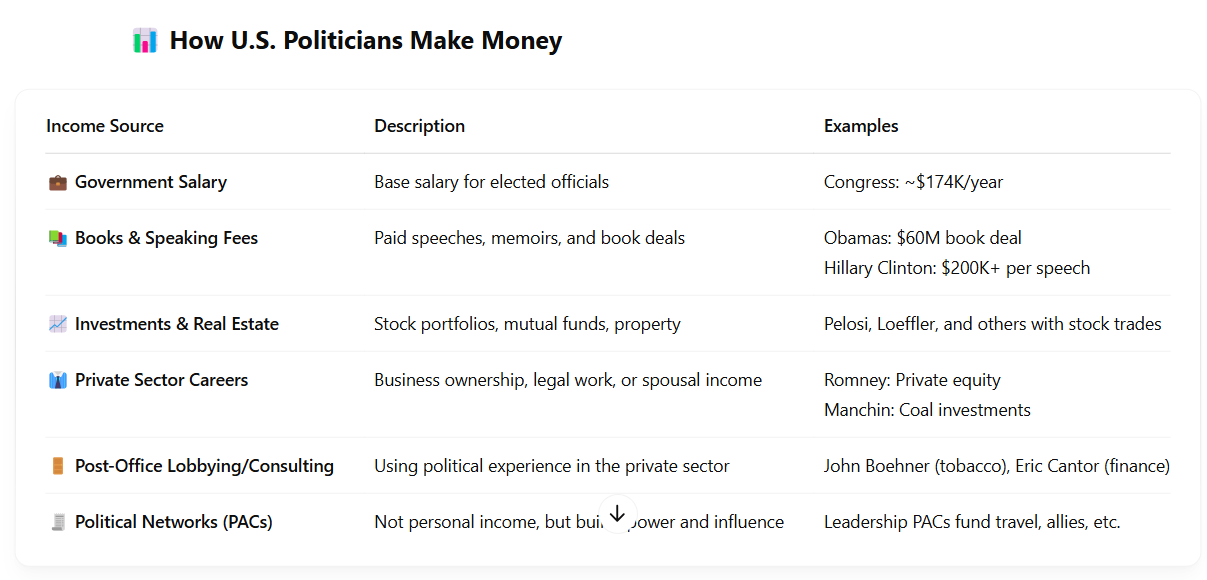
While private sector careers are abandoned when one begins a political career, investments from these careers remain a long-term income stream. These entanglements can influence legislative decisions and priorities. Additionally, while politicians are required to file annual financial disclosures, these are often lists of assets across broad ranges and there are many loopholes that make it extremely difficult to track conflicts of interest or hidden wealth accumulation.
And those are just your garden variety politicians, the normies. Let’s shift focus to politicians on steroids: Trump and Musk. Surprisingly, once again we see that “they not like us.” Here’s an overview of where Trump’s wealth has come from:

This doesn’t look a whole lot different than how politicians make money, even before he became a politician. Even when he is selling a product, it’s really a branding venture using the Trump name. He hasn’t invented a new mop or designed a new type of refrigerator. He inherited the Trump name, and he sells it to his fans to gain power and money. To illustrate my point about how the presidency can be used to make money without taking a salary, here’s a quick overview:

Let’s take a look at Musk’s sources of wealth which are quite different from Trump’s:

This is a little bit different in that he’s not trading on his name, LOL, because that seems like a fast way to lose money. But his wealth is tied up in investments. He gains from the stock market when his associated ventures do well, which is one reason he benefits from government contracts for Starlink, SpaceX or Tesla, exclusive rights to provide services, beneficial rulings in court cases, lower regulations for his industries or hiring practices, etc. Politics is where he can maximize his wealth. X can be used as a propaganda machine to ensure the politics favorable to his interests are in power.
How much money is enough? Are wealthy people more trustworthy?
Growing up in the Church, I once asked why none of the people called as bishops were working class. Jesus was from a working class family and so was Joseph Smith, and that seemed to make them humble and focused on the things of God. Why was that not desirable in Church or ward leaders? I was told that there was a temptation for someone who was poor, and that the Church had to entrust its funds to their care. Someone financial secure wouldn’t need to steal, would have the skills to manage church funds, and it would make the wealthy congregants more comfortable than if someone who made a lot less money could see what they made. The underlying message I heard was that the working class were seen as less trustworthy when it came to money. How little money is too little for someone to be trustworthy?
Now as an adult, I’ve actually become aware of a few instances of embezzlement or financial shenanigans done by Church leaders, and they were never doing it because they were poor. They were often wealthy, greedy, and entitled because of the lifestyle they expected to enjoy. You could be rich and humble or poor and foolish; you could be rich and greedy or poor and humble. These two things didn’t seem to go hand in hand; the assumption was unjust and unfounded. Perhaps the real reason was that those who had more didn’t want others to know what they had. Perhaps it was just prosperity gospel (if you were good, you’d have more money, er, “blessings from God.”)
Some have said we shouldn’t have any billionaires, but just as I have observed in the Church, not all billionaires are equal. Wealth alone is not the deciding factor. For comparison sake, here’s how 3 billionaires’ financial practices compare:
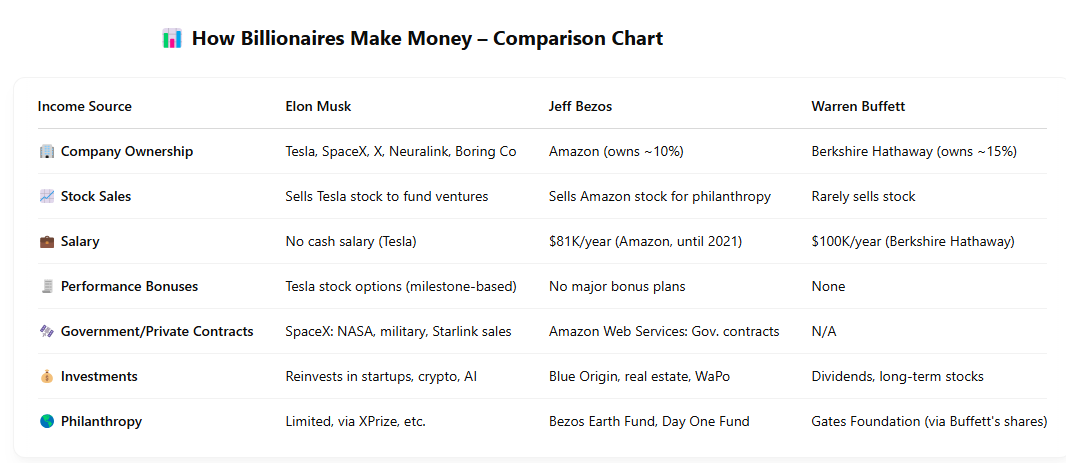
Looking at the philanthropy line is one indication of how individuals feel about their wealth (mine, my legacy, or ours). Also, when you see the sources of wealth, you can trace that right back to the actions people take politically. When is it swampy? Are we “draining the swamp” directly into people’s bank accounts? Isn’t that what “draining the swamp” was supposed to eliminate?
- Have you seen issues in church leadership with those who are wealthy being in charge or with those who are not financially stable being disregarded?
- Were you taught that wealth was a sign of trustworthiness? Do you believe it now?
- How do we govern well for those trying to follow the American Dream when that’s not where the real wealth is, and it’s not how politicians make their money?
- Is the American Dream a myth, an opiate for the masses, or is it something to aspire to achieve?
Discuss.
 Wheat & Tares
Putin, reputed to be the richest man in the world, showed Trump how to run a kleptocracy. Not that Trump needed a lot of tutoring.
“The American Dream” does not include information for disability or old age – if you (and your immediate family) can’t “keep up”, you’re screwed. And if you are a women, you get an impressive amount of micromanaging about the type and level of ambition that you are socially “authorized” to have.
It’s interesting that we have leaders who were avid about encouraging the members to follow the American Dream and also state “no other success can compensate for failure in the home”. I get the empathy and strategy behind why they said those things to calibrate women handling the home front to optimize men going out and chasing the “American Dream” before they got too old and/or feeble for it.
I issue my strongest possible condemnation to the materialism and greed that has taken over the national discourse. This is an unprecedented negative development.
Alas, this is not just a political and cultural phenomenon, it has permeated the Church. Indeed, it has caused the destruction of the Mormon Community.
It used to be that the Church leaders were farmers, plumbers, and mechanics. In essence, they lived lives like the majority of members. They appreciated the Mormon Community that built togetherness by working and playing together.
Now that church leaders are wealthy professionals, they come from lives that are different from the majority of the members. They do not value a historical pageant or a ward dinner. Indeed, they do not value the cultural tradition of Mormon Heritage itself.
If we are going to have a Church led exclusively by the wealthy and out of touch, we might as well just install Dua Lipa and Bon Jovi as our leaders and be done with it.
I have had the opportunity to live in various parts of the US including the west coast, east coast, south west, north east, rocky mountain west, and south east (basically every region except the mid west and far north west). Each place has unique cultural norms. Here’s a couple of observations:
1. the most humble and down to earth folks I have ever experienced are my neighbors and associates in a rather nice suburb of Boston. It wasn’t a lack of wealth that drove this by the way. I knew multi millionaires driving old Volvos and new Toyotas.
2. by far the most materialistic group of people I’ve ever experienced were my associates in a nice suburb of Dallas. Boy do they like to show it there.
3. The eastern bench of the Salt Lake Valley (Draper, Sandy, etc.) resemble #2 much more than #1.
I grew up in Southern California on the edge of Orange County and San Bernardino county. It was interesting because there was a fair amount of jaded allegiance to the values brought into the area by Utah transplants (that we could spot practically a mile a way from their shell-shocked expressions).
At one time I thought we were about building Zion, a communitarian society with no poor. Today we focus almost exclusively on covenants (loyalty to the Church) and personal purity. Years ago, I gave a sacrament talk based on Hugh Nibley 1973 essay “What is Zion? A Distant View” that addressed the conflict between our materialist culture and the achievement of Zion. I do not get asked to speak very often anymore. I recommend reading Nibley’s essay it is as, if not more, relevant today as it was a half-century ago.
“Now that church leaders are wealthy professionals, they come from lives that are different from the majority of the members. They do not value a historical pageant or a ward dinner. Indeed, they do not value the cultural tradition of Mormon Heritage itself.” -John Charity Spring
It’s not that mostly male church leaders don’t enjoy a good meal or a show – be a plumber, a dentist, a college professor, an electrician – everyone enjoys a good meal and a good show.
It’s that the workforce they relied on to produce that isn’t available to do “all the things” at unpaid labor wages AND that the supplies it takes to create those experiences got more expensive across the board. In addition, some of that community stuff worked out because “many hands made light work” – and the “many hands” belong to individuals who are dying off and individuals who are setting engagement boundaries to the point of “quiet quitting” the church and/or finding more personally valuable things to do with their time.
I watched an excellent documentary recently, called “Requiem for the American Dream” by Noam Chomsky. Highly recommended! I’m also waiting to see the “Religion Business” docuseries supposed to come out this summer. Trailer on youtube. I would Love to see the tax-exempt status stripped from All religions- talk about saving taxpayers money!! Of course, I know it will never happen!!
When Brigham Young died, he left an estate of over 4 million dollars. Granted, a lot of it was “church” assets because of the Federal Government’s campaign to rid the country of polygamists. Still, it took over 20 years of litigation before the estate was settled, and some feelings changed the church. Like the revelation about length in the quorum of the 12 and not as an apostle that reranked Brigham Young Jr. to where he was not the Prophet when Joseph F Smith was selected, he being in the quorum longer, even though Brigham Young Jr. had been an apostle longer.
Notice there is no discussion of what a living allowance is for a general authority in public. Are GAs called because they can support themselves the rest of their life based on their wealth, or are they given money to live on, and how much is it? Ask that question up the proper authority channels and see if you get an answer.
Finally, on a national level, it’s easy to put down Democrats for the money they make (60 million for a book or 200K for a speech), but do we really know what Trump makes? We don’t know how much he pays in taxes. We do know that the tax system has evolved into a system where the richest pay a much smaller percentage of their income than their workers do, if they pay taxes at all. When you look at the people at Trump’s latest inauguration, there were people worth over a trillion dollars standing all in a group around the president. One of them even got access to the Oval Office to disrupt the lives of thousands of government workers because his 350 billion income allowed him to “invest” 180 million into Trump’s campaign.
I remember when the “new” Bishop was called, he was the one with the Suburban to take the scouts on their trips, hence one of the more well-heeled members of a ward. Stake Presidents seemed to be successful in business or law, but there were occasional teachers or plumbers, usually only as counselors. Today, it might not be so blatantly obvious for a Bishop because we don’t do scouts anymore, but “successful” is still a must. Also, tithing is imperative. Both to pay and to be able to urge/encourage others to pay. Faith is the first principle of the gospel, but tithing is the first law you have to live by if you want to go to the temple.
Finally, it’s not just leadership and money. Look where they are building temples. Of course, it’s near where LDS members live, which is in the more well-to-do areas of any community. While some LDS members stay in the older parts of town, you can bet that most move to the new developments, and that’s true in Utah but also around the United States. The church closes chapels in core areas of cities and builds new chapels in the suburbs because that’s where the people are. It’s even more interesting that when they close a chapel and sell it, buyers are required to tear it down rather than repurpose it as used to happen years ago. There is an image to protect. It’s not just the leadership. It’s part of our LDS culture. Money is a measuring stick, and there are degrees of glory in it.
Very interesting post. Don’t forget Amazon just signed a deal to pay Melania Trump 40 million dollars for licensing a documentary about her. The upper leadership of the church being mostly lawyers and businessmen has helped the church’s investments become extremely profitable. On the other hand, the lack of transparency about church history, finances, and cover up of child abuse have led to an exodus of members out of the church. The leaders are acting like lawyers and businessmen who are protecting the church assets and reputation rather than providing spiritual guidance and examples of honesty to the members. The image projected by the dress code for missionaries and leadership make the church look very corporate, which presumably is their goal. I’ve heard various stories from family members on missions where they were no longer allowed to wear certain colors of suits, (too light, not conservative enough) or no longer allowed to carry backpacks on their missions and had to switch to messenger bags.
This kind of post provides an opportunity to complain about what ails us, and I have plenty of gripes. But I’ll try for observation, analysis, and opinion, here. My categories of concern are: (a) embezzlement (actually taking money), (b) influence (using power to make things happen for which you get compensated or that work to your benefit), and (c) system failure (making myopic or distorted or short-term decisions).
My opinionated ratings–
About government in the U.S., in my lifetime, good on embezzlement (meaning it happens but there are checks and balances and it seems like most people get caught), terrible on influence (across the board; everybody does it), and fair on systems and decision making until the scorched-earth practices that I think of starting with opposition to Obama and continuing to a point that now feels like disaster.
About the LDS Church, good on embezzlement (good-not-perfect practices, few people benefiting), good on influence in an individual sense (few opportunities for personal gain by trading influence) but run for the benefit of white men which can be understood as a class-oriented rather than individual or family-oriented influence, and subject to significant system failure because decisions are made with limited information and for the benefit of a minority group of the whole.
About not-for-profit organizations I’ve been involved with, subject to embezzlement risk (failure of checks and balances, reliance on one individual with multiple roles), subject to influence distortions (sometimes actual monetary advantage, like hiring or supporting one’s own children; more systematically because the cause for which the organization exists is itself a special interest), and subject to system failure.
About for-profit organizations I’ve been involved with, good checks and balances to prevent embezzlement, good discipline around influence because influence peddling has the effect of diverting revenues and profits, and decent on systems except when too small (solo, family) or too big.
When the scope for discussion is the church, I’m most concerned about myopic decision making. It seems there is a socioeconomic class of men who fill almost all the decision-making roles and even with the best of intentions the results are sub-optimal. As a result, we find ourselves comforting each other that “Jesus is in charge after all” and “all things work together for good.” I’m a skeptic or naysayer with respect to those aphorisms and it makes me unlikable in mixed company.
For what it’s worth, I’ve never heard anyone say that less wealthy individuals were called to positions of trust due to risk of embezzlement. Rather, and perhaps this is my own extrapolation versus any rumors, I’ve always thought it might be more a reflection of asking those that are better off financially as a way to not impose yet another burden on those with less means. Though I’m sure we’ve all heard stories of those that are of “humble means” experiencing miracles for themselves/their families/their “flocks” so that avoiding of burdens is not a very good justification either.
My father worked for the church for the second half of his life. We joined the church when I was 10. He was a builder, building homes and motels. When I was 12 he was called on a mission to build chapels in UK. Just before I went on my mission he became an employee of the church helping to manage the building programme in UK.
After 5 years he was asked to manage the building programme in Australia. This involved negotiating with stake presidents, buying land, getting plans drawn up and through council, but he also had all the tithing for Australia sent to him and banked. He had one secretary, and they operated out of his house. He did this for 10 years until a bod came from SLC and found out he was a carpenter. Within a year he was back on the tools and a church office was set up with 100 employees to do his job. During the time he was the church office he was also a bishop.
I think the tendency to pick wealthy leaders has two motivations. One is they are assumed to have leadership skills. But unfortunately the biggest is the good ol’ prosperity gospel. The church’s roots are after all in New England, home of the Puritans who invented the idea that God blesses the righteous with wealth and prosperity. Joseph Smith was a believer in the prosperity gospel. Look at how the Nephite pride cycle worked. When they were righteous as a people they were blessed with wealth and prosperity, not happy loving families or equality or peace and brotherhood. They prospered in the land until some became richer than others and started lording it over the poor. Then God sent wars and drought and unblessings to humble them.
But back to that better reason for picking bishops who had good business skills and were accumulating wealth and were assumed to have better leadership skills. My husband was career military and we saw a lot of wards that were primarily made up of active duty military. Bishops were picked from the ranks of the officers, never enlisted men. In fact one bishop got in trouble for picking an enlisted bishopric counselor. The ward leadership were supposed to be trained in leadership, not spiritual humble men who had less education, less rank, and less leadership training. Now the base commander could teach Sunday School, and a staff sarg could be Elders Q President, but the bishop had better be at least a captain.
Adam F wrote “Rather, and perhaps this is my own extrapolation versus any rumors, I’ve always thought it might be more a reflection of asking those that are better off financially as a way to not impose yet another burden on those with less means.”
I’d like to believe this. Really. But when the message for those struggling with housing and food insecurity is to pay tithing before paying rent or buying groceries (yes I still say groceries, and I’m half the age of dear president), it feels difficult to manage the two sentiments.
I think if you have the right circumstances, the American dream is still possible, even if it’s harder than ever before. As my oldest will be off to university in the fall, I’m tarting to wonder what type of career and personal choices will be required to simply own property.
Has anyone noticed an affect on the disenfranchised men in the LDS Church? It seem that this tendency to choose leaders from the business and professional elites would have a detrimental affect on morale, especially now that so few common men are ordained high priest. The situation seems to imply almost a caste of leadership.
The American dream is a myth, no doubt, but of course empires, nation states, and enduring 2000 year old religions (as well as 200 year old ones) are built on myths. Only the very clever (or malevolent) among us truly reap the material benefits these myths, while the rest of us serve as mere supporting cast in the mythical ascent narratives of those preordained to rule over us.
Myths not only serve to prop up the powerful, they also tend to harm the the most vulnerable in among us. In Mormonism the conception of the godhead as two beings (no one talks about the third guy) with perfect, glorified, male, white bodies has done severe damage to women, girls, minorities, people with mobility challenges, or anyone struggling with poor body image, to name a few. Further, by taking a broken Jesus off the cross and giving him a glorified perfect shiny body who only visits Mormon temples (and only occasionally), the Church has isolated Jesus from those who were the main concern of his ministry: the poor, the oppressed, the downtrodden, the stranger, the least of these. At least Trinitarianism, while also a myth (and a confusing one at that) provides an image of a truly condescending God who becomes a broken human being and dwells with us. The Mormon Jesus popped in for a few years, made dad happy, got a perfect body, and now seems mostly concerned with putting up arbitrary roadblocks (LDS rituals boundary maintenance) to “accessing” his grace in our individual lives. Doesn’t make sense to me.
“Has anyone noticed an affect on the disenfranchised men in the LDS Church?” – Anon
I think that most men quietly (mostly) walk away from the church when some part of themselves becomes aware of it. I have no research, but I would think that some of these men didn’t stick around after experiencing Senior Primary, YM, and so on.
I am defining “disenfranchised” not only from a “no leadership calling” standpoint, but also from a “weird social vibes” such as when a young man doesn’t serve a mission or comes back early, or stays at home with the kids, or doesn’t want to be a church leader, or doesn’t have the “follow through” that business world high performers do. I would also include “doesn’t feel worthy of a male social network” – so doesn’t build one and stagnates in isolation.
On occasion you hear a general conference talk mentioning some humble farmer who was serving as bishop. That’s great and all, but the only reason it gets mentioned is because it’s exceptional. I wish they would consider why such a story is remarkable, whether it should be remarkable, and how to make it less so.
If I’m a stake president trying to figure out who to call as bishop, one of the big considerations is whether they are able to handle the burden of what is essentially a second part-time unpaid job that involves a lot of management, budgets, and providing assistance to people in the ward dealing with economic distress. That means I need to have high confidence that their marriage and family situation is stable, and that their employment situation is stable and they are unlikely to themselves need assistance. In this era that tends to quickly narrow the pool to white collar professionals and maybe a few in blue-collar professions who own their own business. (I did once have a bishop who was a plumber.) And if you’re not in the pool for bishop, you’re not going to be anything higher up than that. And thus the entirety of the general leadership are white collar professionals. Bonus points if your wife doesn’t work, which in this era selects for the highest paid of the professionals. So I don’t think they are deliberately selecting for wealth and education in leadership; I think it’s all a byproduct of putting such heavy burdens on unpaid volunteers.
“Disenfranchised men? A caste system of leadership?” (Said Anonymous). This may be so, but try being a woman in this system!!
There are ways to achieve the American dream other than buying a mcmansion. First there are ways to buy land to build a house on.
One of my grandsons has a father in law who bought an avacado farm 20 minutes from the centre of his townn, where he and those of his children who want to can build a house. It is perfect country for rammed earth, some of the public buildings near by are rammed earth.
If next time you are moving house you look for a block large enough that you could sub divide it and sell the blocks to your children. Older housing was on larger blocks. My street are all 1/4 acre blocks but the wedge shaped blocks at the end of the cul-de-sac are half acre and if the existing house is in a corner, 2 spare blocks can be divided off. This is how I got my block for nothing.
If you build the house you can save money, and if you are going to build yourself you might look at different forms of construction to save time or money. The first house I built was made of cool room panels which are expanded polystyrene with colour-bonded steel .6mm thick glued to each side to form a sandwich panel that is a structural element. The thickness of the foam determines the insulation value but also the length they can span as roof panels. They come 4ft wide so can quickly build a house. About a month for 3 people from slab to lock up and they are painted inside and out. I do not know if these are available in America, but you must build coolrooms out of something. 2 of my children now live in houses build of cool room panels. When the house were finished they were valued at so much more than they cost that the kids were able to finance a second house.
My present house is built of eco blocks (insulated formwork) which is definitely available in America. Because the eco blocks are then filled with concrete they are incredibly strong. Part of my roof is 75mm precast concrete, with another 100mm of poured concrete. Then 100mm of expanded polystyrene then another 100mm of poured concrete, 100mm is 4 inches. There are 2 cars parked on my roof at present. The rest of the roof is cool room panels 10inch thick which can span 30ft without any extra framing.
If you can’t buy a house look at other ways you can get a house. Then as property values increase your savings grow.
For taking advantage of the system, be sure to check out Trump and son’s crypto ventures of the last few months. NYT’s The Daily has a good podcast on it.
Matt: Yeah, that is some next level evidence of how “they not like us.” I listened to a fascinating podcast of how Trump is deliberately destroying the dollar for his own benefit.
Quentin: Your point about the unpaid clergy being the real driving force behind only putting in bishops with enough wealth to have the financial stability to do a second full time job is spot on.
I’m not so sure about whether that’s the driving source. If it is, it seems paternalistic, but paternalism fits us well so there may be some truth there.
However, I fear there might also be some additional truth, maybe a darker, patronizing truth — many among us may honestly (even if subconsciously) feel that a blue collar man (or a low status professional man) is really unsuitable for inclusion within circles of church leadership — he simply doesn’t fit the mold we have created.
It saddens me to think of this, and I hope that the reason really is solely the paternalistic reason offered by Quentin.
Adam’s term “American Dream” was
“not a dream of motor cars and high wages merely, but a dream of social order in which each man and each woman shall be able to attain to the fullest stature of which they are innately capable, and be recognized by others for what they are, regardless of the fortuitous circumstances of birth or position.”
He coined the term at the bottom of the Depression. It’s the opposite of social climbing. It’s the antithesis of the totalitarian governments which Adams observed. Most of us understand the term in that sense.
Assigning 2025 partisan contexts to Adam’s American Dream is hyperbolic distortion.