
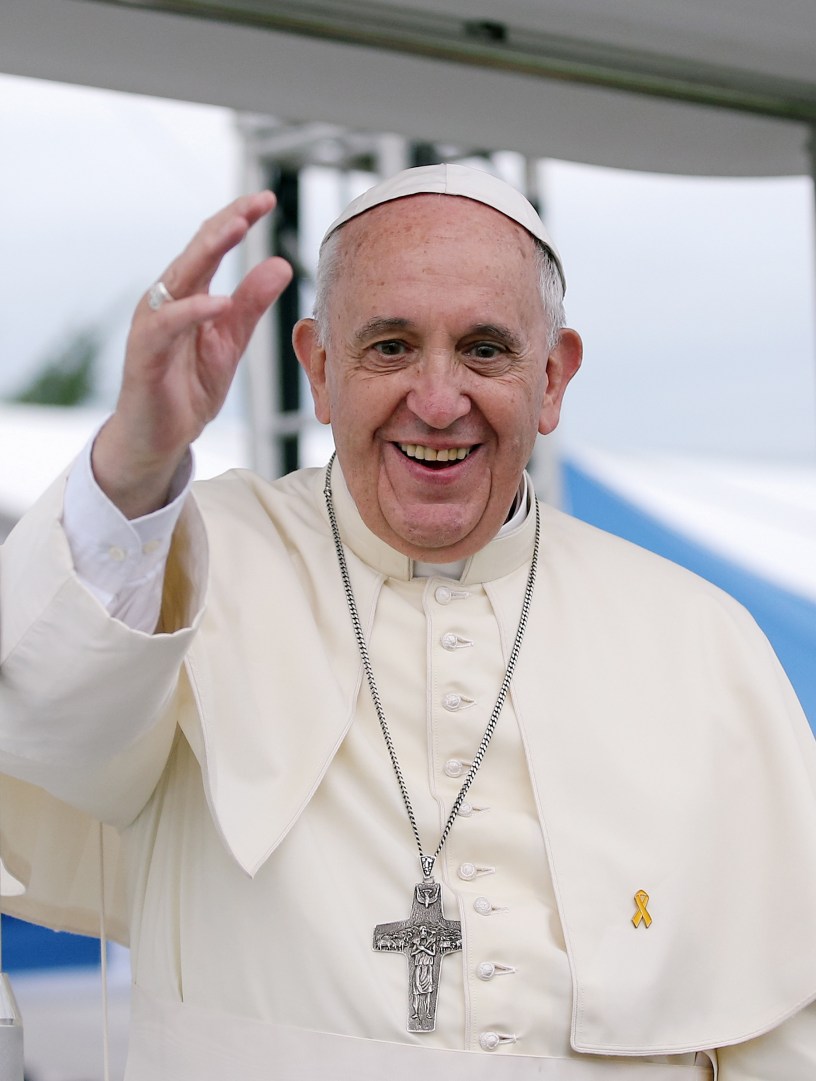
A lot of left-leaning Mormons I know described having “holy envy” as they saw the things Pope Francis did in the Catholic Church since he took the top role in 2013. There are certainly critics within Catholicism who would say that his priorities were too liberal, or who would downplay his impact on actual doctrine, meaning that any areas of focus he made will essentially die with him. Here’s a quick rundown, for those unfamiliar with his legacy, of the things that he did in office. Since he took over from the conservative Pope Benedict, the contrast contributed to the controversy surrounding his papacy.
1. Refocused the Church on Mercy, Inclusion, and the Marginalized
- “Who am I to judge?” — His famous 2013 response about gay Catholics set the tone for a more compassionate approach.
- Emphasized pastoral care over legalism, particularly for divorced/remarried Catholics, LGBTQ+ people, migrants, and the poor.
- Promoted a “field hospital” church that ministers to real-world wounds rather than enforcing rules from afar.
2. Environmental Leadership – Laudato Si’
- In 2015, he released Laudato Si’, a landmark encyclical on climate change and environmental justice.
- Framed ecology as a moral and spiritual issue, not just a scientific or political one.
- First pope to make environmental protection central to Catholic social teaching.
3. Synodality and Church Reform
- Launched a global multi-year process of synodality, inviting ordinary Catholics to participate in reimagining the Church’s future.
- Emphasized listening, dialogue, and shared discernment—challenging centralized, top-down authority models.
- Opened discussions on formerly taboo topics: women’s roles, LGBTQ+ inclusion, clerical celibacy, etc.
4. Shifted LGBTQ+ Approach
- While maintaining traditional doctrine on marriage, Francis has:
- Supported civil unions for same-sex couples (a first for a pope).
- Met regularly with LGBTQ+ Catholics and advocated for an end to discrimination.
- Recently allowed blessings for same-sex couples under specific pastoral conditions (through the Fiducia Supplicans declaration in 2023).
5. Clerical Abuse Crisis: Mixed Legacy
- Took steps to address abuse and cover-ups:
- Created Vos Estis Lux Mundi, a system for reporting bishops who mishandle abuse.
- Hosted a global summit on abuse with bishops in 2019.
- Critics say progress has been too slow or inconsistent, especially on accountability for bishops.
6. Vatican Financial Reform
- Cracked down on corruption in the Vatican’s finances.
- Empowered lay experts and external auditors.
- Reformed the Vatican Bank, increased transparency, and brought some high-ranking clerics to trial (like Cardinal Becciu).
7. Advancing Women’s Roles
- Appointed women to high-ranking positions previously held only by men (e.g., in the Synod of Bishops and Vatican departments).
- Opened the door to female lectors and acolytes through canonical changes.
- However, he has not supported women’s ordination, maintaining the traditional stance.
8. Changed the Tone on Doctrine
- Francis hasn’t changed core teachings but has:
- Downplayed culture war issues.
- Focused more on mercy, social justice, and accompaniment than rules.
- Shifted Catholic discourse from “who is in and who is out” to “how can we walk together?”
9. Interfaith and Global Outreach
- Made historic visits and agreements with leaders of Islam, Judaism, and Eastern Orthodoxy.
- Became the first pope to visit the Arabian Peninsula (UAE, 2019).
- Signed the Document on Human Fraternity with the Grand Imam of Al-Azhar.
10. Democratizing the Papacy
- Lives in a guesthouse, not the papal palace.
- Chose simpler vestments and language.
- Uses humility and humor to reshape what it means to be pope in the modern world.
Pope Francis was also the first Pope to be called from the Americas, the global South, which has elevated the interests of this part of the world. Additionally, quite a few have noted that one of his last acts as Pope was a meeting with JD Vance in which he reminded Vance that charity should not be based on concentric circles with more of it focused on our closest associates, but instead focused where the needs are greatest. Who knows whether this Papal advice will have any influence on how Vance, who became Catholic in 2019, views his moral duties to the least among us, those who have been targeted and vilified by the administration he works for (which is clearly why Francis said what he said).
We’ve discussed many times on the blog whether church leaders have much influence on how adherents behave. For many young Catholics, Pope Francis is the only leader they remember. That is probably the same for young LDS and Pres. Nelson. Leaders of churches do seem to be influential in some key ways:
- Interpreting doctrine and scripture. Their interpretations become authoritative and are quoted by successors, or in the case of Pres. Nelson, quoted by himself and other church leaders in his hearing far more than Jesus is quoted.
- Setting moral and ethical priorities. This is similar to Pope Francis’ conversation with Vance, trying to influence how he views his moral duties.
- Cultural tone and public image. The leader is the face of the religion to governments, to other faiths, to members, and to the public at large.
- Institutional reforms. Pope Francis’ efforts to eliminate corruption and to address sexual abuse, including the leaders who cover it up, are included in these types of reforms.
- Mentorship and leadership development. The Pope can call new Cardinals, and the Church President fills apostle vacancies and selects his own First Presidency. These actions change the leadership, often in accordance with the priorities of the top leader, and influence future leadership for generations to come.
- Engaging with the world. Church leaders often take a stand on things like stem cell research, vaccines, climate change, or other emerging scientific breaththroughs, and their viewpoints influence the church’s relevance.
- Symbolic legacy. Some leaders have a symbolic significance such as their race, gender, sexual orientation, writings, education, or achievements outside the Church. Desmond Tutu was important as a symbol of reconciliation. Pope Francis was a symbol of the importance of the global south, those with a humble background, and the importance of the Americas to Catholicism.
There are some uniquely LDS aspects to Nelson’s legacy (announcing 350 temples, changing the church’s website & logo, eliminating the use of “Mormon,” talking about the “covenant path,” shifting to home-centered worship, rapid structural changes to priesthood quorums, tech improvements to the Gospel Library apps, and a focus on the second coming), but comparing the legacies of world religious leaders requires a broader perspective. Here’s how both men stack up on larger social trends and theological approach:

What I see in this comparison is that Pope Francis adds a bit more openness to Catholicism to be more inclusive while Nelson is a reformer with mostly traditional / orthodox views. What about the important social issues of our day? How do these two men stack up on things like LGBTQ+ inclusion, the role of women, and young people?

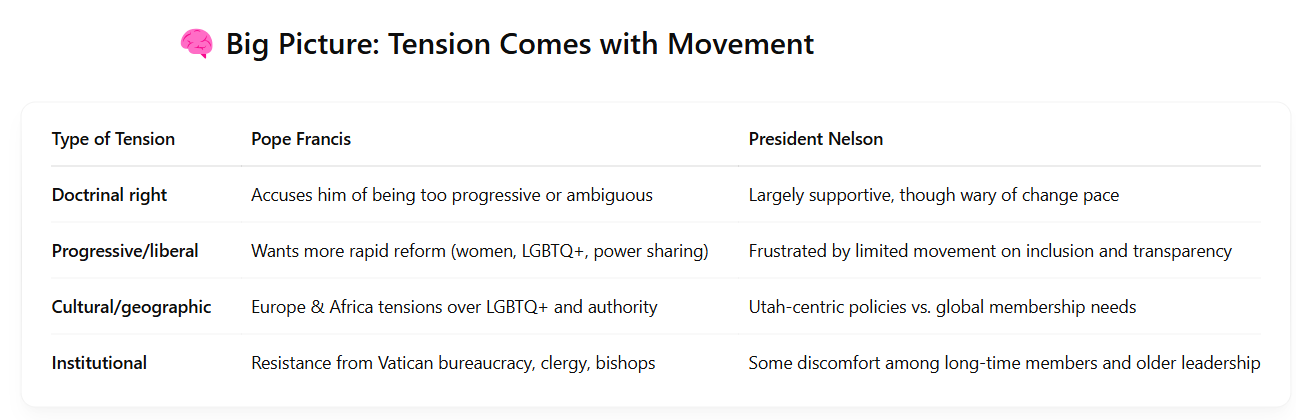
As a progressive, I don’t find Nelson’s legacy very satisfying or his “softened” policy convincing [1]. Additionally, aligning with hardline anti-LGBTQ Oaks is evidence of very harsh intentions toward LDS families with loved ones who continue to be impacted by the Church’s antagonistic stance. But progressives aren’t patient when it comes to change, and both these leaders have weathered the tensions they created within their respective churches. Here’s a comparison of the type of internal church tensions both leaders have faced in their terms:
Conservative pushback. Pope Francis was seen as watering down doctrine, pushing LGBTQ acceptance that some African bishops rejected, decentralizing too much, and creating instability. Some cardinals questioned his fidelity to core church teachings, claiming he was making the Church too worldly. President Nelson’s rapid institutional changes made some longtime church members unsettled by shortening church, rebranding the “Mormon” identity, ending home/visiting teaching, and overall disinvesting in the social aspects of church.
Frustration from progressives. Pope Francis’ changes were seen as superficial rather than doctrinal, not truly addressing the inequality of women. His reforms for divorced and remarried Catholics were seen as too limited to be effective, and the Church still teaches that homosexual acts are sinful, even if the tone is kinder. Likewise, within the LDS church, younger and more progressive members feel that doctrinal change is too slow around LGBTQ+ inclusion, and that the expansion of women’s roles is belied by no actual change to women’s empowerment and visibility. Additionally, many are disillusioned by the lack of full transparency in financial or abuse-related matters.
Conflict among leaders. Francis’ efforts to address abuse and clericalism made him powerful enemies among the ranks of Cardinals. Nelson’s orientation is criticized as being too Utah-centric in an increasingly global church, while still requiring all local churches to adhere to centralized, homogeneous models.
- Do you know young LDS people who only know Nelson as church president? How do they view him? Is this different from how you view the church president who was in place when you were growing up?
- Do you think Francis’ legacy will be enduring in Catholicism? What about Nelson’s?
- What impact do you expect this meeting with Francis to have on J.D. Vance?
Discuss.
[1] It sure looked like someone who created a bad policy, then had the benefit of his predecessor dying so he could look like the “hero,” reversing it much later after clearing out a lot of the Church’s progressives in the process, but ymmv.
 Wheat & Tares
The meeting will have ZERO impact on JD Vance, based on what I have been able to observe. Vance’s loyalty is wholly to Mr. Trump, and he would say that Pope Francis should learn from Trump, not that Trump should (or even could) learn anything from the pope. But maybe Vance will show me differently.
There is no comparison between Francis and Pres. Nelson. Pres. Nelson is far more similar to the Pope Benedict or Cardinal Burke side of Catholicism than he is to the Pope Francis side. They may all end up in heaven, so to speak, if heaven is accessed by personal righteousness, but there is nothing similar in terms of emphasizing mercy and pastoralism over dogma and clericalism (and all that by both words and deeds) or shifting towards decisions based on synods rather than decree.
I used the words “holy envy” in my Facebook post this morning on Pope Francis’ death. While he might not have moved as far as I would have hoped on some issues, he was a humble yet strong leader, who seemed to have an open heart and was willing to listen to God.
I get the sense that there is a lot of fear among American Catholics that the next Pope is going to take the church in the opposite direction from Francis. But only time and the conclave will tell. Still I think Francis will have a lasting influence on at least parts of the church, just as over here in Mormon land Chieko Okazaki and Hugh Brown continue to have influence because they were so different and opened up new possibilities.
I doubt Nelson will be remembered much at all in twenty years or exert any lasting influence, same as Monson. I think really only McKay, Kimball, and Hinckley have exerted any real lasting influence after their deaths in the past century (The latter much to RMN’s chagrin). My guess is that people start using the term Mormon again within three years of RMN’s death.
Unfortunately, I think JD Vance is highly unlikely to be moved at all by Francis. He doesn’t seem to have a moral compass. But if the next Pope is at all a cultural warrior, I can easily see Vance seize on that to excuse his actions.
Pope Francis Is now in Heaven🕊🕯
Nelson reversed the POX, yes, but he’s hardly “softened policies” around LGBTQ issues. As of last year trans people are not allowed to attend RS/priesthood classes of their choice and need a chaperone to go to the bathroom.
I have a soft spot for Hinckley, because he was the president of the church through my teenage and missionary years. Today’s youth probably feel similarly about Nelson. But then again, Hinckley actually had some humility and charm to him . . . .
I think Nelson’s legacy may well be short lived because perhaps the most impactful change he has enacted is elevating the primacy of the current president. Nelson has little regard for tradition. That can be a net positive (2 hour church, merging elders and high priests), or a negative (banning “Mormon”, nearly losing the Teichart murals) but if his successors follow his lead, they may just continue with the perpetual evolution of church programs until no one can remember what anything even looked like back in ye olden days. Of course, if his presidency is followed by a half dozen years of Oaks and then two decades of Bednar and Anderson, they may lock in the idolization of Nelson for an extra half century.
And Nelson has announced exactly 200 temples, 80 of which have been completed.
Francis’ legacy
Negatives: Needed more action on the child abuse scandal.
Positives: charitable, even inclusive towards LGBTQ folks. Demonstratable compassion for poor and minorities. Connected with youth and young adults. Viewed positively by cultural Catholics and non-Catholics. Unafraid of speaking truth to power.
Nelson’s Legacy
Negatives: very weak on cultural and social aspects of church membership. Failed to establish/maintain relationships with LDS LGBTQ folks. Winked at conservative disloyalty (anti-masking, anti-vax, Deseret Nationalism) to church statements and teachings, and allowed extreme political partisanship to remain in parts of the church. Did not connect with members… tried to out Uchtdorf Uchtdorf (“Think Celestial”? “Lift where you stand” is soooo much better!) Ended the HP groups (all it did was dump grumpy old zealots right in the middle of the EQ, 30% of the elders in my ward went inactive.) Botched response to SEC investigation. Unfulfilled promises of big changes coming. I didn’t need all of those blasted vitamins. And I am still a Mormon.
Positives: Ended home teaching (although the Utah Area Presidency is trying to turn ministering back into home teaching). Relationship with NAACP (although this is really part of GBH’s legacy) Sleeveless garments, modernizing missionary attire and tech contact with home (although Uchtdorf’s fingerprints are on these). Two-hour church.
Interesting post!
Most of my growing up involved watching Gordon B. Hinckley not being President but running the Church for an ailing President Benson and then an ailing President Hunter. I remember how my parents venerated Pres. Kimball, but I have no memories of watching him lead. In hindsight, it is more significant to me to remember the considerable sway Kimball and Benson had on how my parents’ raised me, right down to the talking points in FHE, than any relationship I had with the leaders themselves.
I heard a commentator on NPR late last night, might have been BBC World. They were from a more conservative Catholic organization. Apologetically, she was looking at aspects of Francis’s leadership that conservatives would object to; she chalked them up to his tendency to be ambiguous. Basically, if he said something progressive than hmm, he was being ambiguous and we can’t know what he really meant. They are already seeking to remember him as traditional, with some (progressive-sounding) quotes being off-the-cuff and unofficial, taken out of context or given too much weight on social media. Basically, Catholics appear to have their own wishy-washy ‘speaking as a prophet/man’ loophole; this allows them to shelve anything Pope Francis said they don’t want to keep, without calling the authority of the office into question.
I’m no expert on Pope Francis, but I liked his soundbites. And my interactions with today’s Jesuits have been overwhelmingly positive. I hope the Roman Catholic Church avoids any kind of significant retrenchment, because there has been a lot of positive local-level change in our lifetimes. Any given parish can be a wonderfully compassionate, service-oriented, communal place. But if the leadership is staunch and frankly bigoted, that will keep a lot of people away.
I don’t know that I can comment globally on the Francis v. Nelson comparison, but as for the Nelson’s LDS presidency, it really is hard to summarize. It’s a strange mix of rather welcome reforms (two-hour church, getting rid of pageants, relaxing previously stringent missionary rules and traditions) and retrenchment (LDS participation in the culture wars still going strong). It’s hard to say what Nelson’s legacy will be twenty years from now, looking back.
Let’s compare elections. Catholic archbishops will assemble and, using their collective wisdom and inspiration (which I’m sure is how Catholics describe the proceeding) choose the next Pope from a wide slate of candidates. I’m sure that many of those participating give serious consideration to the question, “What does the Church need now? What kind of leader? Who would make an effective Pope to lead the Church over the next ten or fifteen years?”
For the analogous LDS proceeding … there is really only one candidate. The serious questions that Catholic archbishops ask are not really part of the LDS conclave. Even if every single LDS apostle thought that “the right man for the job” was Uchtdorf or Christofferson rather than the next oldest (in tenure) apostle, it won’t happen. Honestly, if you are looking for a proceeding that takes revelation seriously and that allows God to have a hand in the selection of the next leader, the Catholic proceeding scores a lot better than the LDS proceeding.
I agree with Dave B, that the Catholic way is a lot more open to inspiration and allowing God to have a say. Well, letting God have a say that is easier for me to swallow than killing off any other possibility other than the one He wants. It has always really bothered me that our church would rather force God to kill off everyone he doesn’t want than for human leaders be left to make an actual choice. Talk about ducking the responsibility of picking the best leader. What if we did that with other decisions? Say, you are supposed to pick a wife and there are ten possible candidates and you decide to let God pick for you by letting God kill of any girl not right for you. Or maybe let God pick for you by the very next one you run into is the right one for you to marry. It sounds stupid to pick a wife that way, or hire an employee that way, but we have no problem with doing it with the most important job in the church?
I agree with Jake C. that Hinckley filled a leadership vacuum for a long time, and then also enjoyed a long presidency, so add to that his kindness, and I think that generation will remember him better than this generation will remember Nelson. YMMV.
I also agree with Jake C. that I’m not Pope Francis expert but I liked his soundbites.
It’s hard to compare the pope to the LDS president. As a never-Catholic, my ears perk up when I hear about the pope. My ears do not perk up when I hear about the two by twos or the JW leader or the Scientology C-org. I’m guessing most people simply have no interest in what LDS leadership is saying or doing.
As a post-Mormon, my ears may perk up for other LDS leaders, but for Nelson I turn a deaf ear. I mean, the guy called me a covenant breaker, lazy, and told my family to disregard me. I’ve had my fill of Nelson soundbites.
I was thinking of the passing of Pope Francis and his legacy. I saw a sitution in which the pope did a lot of good for the world as well as good for his own religious community. He was never going to make every Catholic happy but I feel that he did his best. Looking at Pres. Nelson’s legacy I think the results will be mixed for the same reasons that no one can make every one happy. Perhaps the real arbiter the legacies of either man will ultimately be by the passage of time. I remember David O. McKay the president as I was growing up. Most of the men who followed were frail men in office and left little as a legacy. Those that I remember who leave valuable legacies were Spencer W. Kimball and the lifting of the black priesthood ban and Gordon B. Hincley and the efforts to better present the Church to the world. When Pres. Nelson does die, I have my concerns for the church given things that Dallin Oaks has said and done.
I think the biggest contrast between Nelson and Francis is humility. Francis truly brought back humility to the office. As a Cardinal he rode the bus. He refused to wear some of the vestments of the office like the slippers and the hat. As pointed out, he was a Jesuit, which is an order very focused on remaining humble and living simplistically, and that’s why he is the only Pope to have chosen the name Francis, after Francis of Assisi, known for renouncing worldly goods. Nelson, whether this is recognized in the average congregation or not, is the least humble church president of my lifetime, and Benson had plenty of issues on that score. I’m sure it’s easy to sniff your own fragrance, but the constant being quoted and thanked by other leaders in General Conference (more than Jesus) is really appalling, the self-aggrandizing stories that don’t pass muster, the image of himself standing like Christ in his temple whites, the actions of undoing his predecessors’ work while ordering changes seemingly on a whim, the ridiculous number of temple announcements that will probably not come to fruition, not understanding the value of artwork and social ties, these are signals that are easily missed, but they telegraph a narcissistic attitude that is unsavory to be heading a church that purports to be run by Jesus Christ. I do think that the idea that Nelson has empowered future church presidents to do whatever they want at a breakneck speed and with little to no forethought and no consultation is likely, and it’s basically what Trump has done to the US presidency. Why would anyone try to bring others along with them? Persuasion is not necessary in an autocracy.
Another interesting thing about Francis’ legacy is that he was in place long enough that he named enough of the current Cardinals who are more likely to agree with his softer stance on things like LGBTQ rights, the role of women, and so on. He didn’t make enough change for progressives, but he changed how the conversations were happening through talk-trine (instead of doctrine). The US Catholic church is more conservative than the Europeans and South Americans, and the African church is hardline against gay rights, so he really only used soft power tactics: persuasion, kindness, refusing to judge. He didn’t change policies, even if he might have wanted to. He wanted a big tent. I don’t think Nelson wants or cares how big the tent is, so long as it’s in his image. As for Oaks, he definitely wants to shrink the membership down to people who agree with his views which a whole lot of us find completely unappealing. It’s definitely not for us. They have made it so.
Maybe I was holding on to a majestic idea of a stone cut from the mountain and God’s prophet on the earth, then I attended a meeting circa 2014, a regional conference where Monson gave an obviously recycled talk.
Nelson’s 2nd wife Wendy, with all her purity and passion, stomped out the remaining embers of my testimony when she stated that Russell as the new prophet had finally been unleashed to do the all the things he always wanted to do, like settle his “Mormon” feud with GBH.
I’m sure Tim Cook had an agenda when he took over at Apple.
I’m sure Iger at Disney had an agenda when they kicked out Chapek.
I’m sure Ted Pick at Morgan Stanley had an agenda when Gorman retired.
I’m painfully sure Trump had an agenda when he got elected again.
RIP Francis you almost persuaded me to be a Catholic.
It struck me that there are 1.3 billion Catholics, and 15 million lds. Also no one over 80 will be involved in electing a new pope, whereas the top 6 apostles are all over 80. Lds are choosing to be irrelevant.
The pope was strongly in support of fighting climate change.
He supported defending immigrants.
He also defended the poor.
He also told Israel to stop killing palistinians in Gaza
And Told Russia to stop killing Ukrainians.
On a different note yesterday my wife was not well and took a Covid test which was positive. We phoned up our doctor who asked for a photo of the test, and then sent an e-perscription for a Pfizer antiviral called Paxlovid. On the box it says these are $1114.51 but we paid $6.90. Our health system negotiates with the drug company on what it will pay them, and then subsidises the difference. Trump says this is a restriction on trade, and wants it stopped. Our government says no.
Pope Francis occasionally issued formal apologies on behalf of the church, which is far cry from DHO’s commitment to non-apology. I also imagine the pontiff’s progressive agenda was often stymied by organizational inertia, which in an organization as massive and old as the Catholic Church is no small obstacle, especially when compared to the problems of the modern LDS church. I didn’t follow his papacy closely, but I definitely had moments of holy envy.
As for Vance, I doubt the meeting will have much long term impact on him. He converted to Catholicism as an adult, but his words and actions while in public office cause me to question his personal devotion to Christian values. Still, I love how the Pope gently called Vance to repentance in his own Jesuit way.
I Think Pope Francis is Is the G.O.A.T🦄🎆
Francis visited the incarcerated 3 days before he died. He called the Christians and Muslims in Gaza who have taken refuge in the Catholic Church there, every night. His final address mentions Myanmar, Palestine, Israel, Yemen, and other places, where people are struggling for survival. I have watched numerous videos showing him interacting warmly and humanely with children, prisoners, physically and mentally challenged people, LGBTQ+ people. Watched as he shared meals with people of all walk of life. He walked the walk and talked the talk
The members of the First Presidency do not call us to such radical love. If they have moments of Christian warmth and service they apparently happened a long time ago. I guess there are no widows today. Twice a year they read some bland musings, often culled from last year’s bland musing or the statements of unaccredited others. I suppose someone will remind me that they are busy with administering a large church of 16 million. To which I respond, “1.3 billion…”
The New Pope from Chicago
The Second Vatican: Papal Renewal Beyond the West – Where the Pope lives is where the Church listens. Repentance, exile, diaspora—an act of moral courage. A functioning Roman Curia intact—Rome as the “embassy,” not the throne. A spiritual Vatican abroad (e.g. Bogotá), and an administrative Vatican in Rome—mirroring Orthodox and Eastern Church multi-polarity. The Cross cannot atone for Auschwitz. No theology of the Cross is complete without acknowledging the silence of God at Auschwitz. The papacy must become a witness to repentance, not imperialism.
The Catholic White Paper: Relocating the papacy as a form of exile rather than schism – a diasporic moral witness. Moral legitimacy, simply more important than territorial continuity. 2024 as the Vatican’s “final break” with Europe. Diaspora, exile, “bearing the mark of Cain.” Rome, morally discredited by its complicity in European antisemitism and 2000+ years of Jew hating theological lies. The Cross of Jesus cannot atone for the Shoah. Rome has become the tomb of Catholicism’s imperial past, not the womb of its future. Relocate the papal court to the spiritual frontiers of the faith—in Bogotá, Nairobi, or even Washington—without surrendering the Petrine title.
Throughout history, popes have temporarily relocated for various reasons (e.g., during wars or crises) while still retaining their title and authority as Bishop of Rome. This flexibility in residence could be invoked to justify a more permanent arrangement. Canon law recognizes the pope’s authority to govern the Church and make decisions regarding his residence. The Code of Canon Law (CIC) does not explicitly mandate that the pope must reside in Rome, allowing for the possibility of a new residence while maintaining the canonical status of the Holy See. The pope is always the Bishop of Rome, regardless of his physical location. This title could be retained symbolically, allowing the pope to govern from a new location while still being recognized as the Bishop of Rome.
The pope could delegate certain administrative functions to representatives or curial officials in Rome, ensuring that the governance of the Church continues without interruption. This delegation could help maintain the connection to the Holy See while allowing the pope to operate from a new residence. Modern technology could facilitate the pope’s engagement with the Vatican and the global Church, allowing for virtual participation in meetings, liturgies, and decision-making processes, thereby reinforcing the connection to Rome.
The pope could continue to celebrate key liturgical events in Rome, such as Easter and Christmas, reinforcing the connection to the Vatican and the historical significance of the city as the heart of Catholicism. The pope could perform symbolic acts, such as the annual blessing from St. Peter’s Basilica, to maintain a visible link to the Holy See and its traditions, even while residing elsewhere.
The pope could consult with the College of Cardinals and other Church leaders to build consensus around the decision to relocate the papal residence. This collaborative approach would help ensure that the move is seen as legitimate and in the best interest of the Church. A formal declaration or apostolic letter could be issued to explain the rationale for the move, emphasizing the continuity of the papacy and the ongoing commitment to the Church’s mission.
While the idea of relocating the papal residence presents challenges, canon law and tradition offer pathways to accommodate such a shift without formally changing the seat of the Holy See. By drawing on historical precedents, leveraging the flexibility of canon law, and maintaining liturgical and administrative continuity, the Church could navigate this transition in a way that honors its traditions while responding to contemporary realities. This approach would allow the papacy to adapt to a global context while retaining its essential identity and authority as the Bishop of Rome.
Would there be two functional capitals (Rome and Bogotá)? Would the College of Cardinals be expected to shift its base? What mechanisms ensure continuity of apostolic succession? Jesus’ own itinerancy and homelessness (Luke 9:58); Pauline epistles on the universality of faith beyond Jerusalem; early Church models of decentralized leadership.
The theological movements emerging from Latin America and Africa represent significant developments within the Catholic Church that reflect the unique cultural, social, and political contexts of these regions. These movements not only address local issues but also offer valuable insights and models for a diasporic Church that seeks to engage with a diverse global community. Liberation theology emerged in the 1960s and 1970s as a response to the social injustices and economic inequalities prevalent in many Latin American countries. It emphasizes the preferential option for the poor and the need for the Church to advocate for social justice and human rights.
This movement integrates Christian faith with the struggles of marginalized communities, encouraging a critical examination of societal structures that perpetuate poverty and oppression. It calls for active engagement in social and political issues, viewing the fight for justice as a fundamental aspect of living out the Gospel. Liberation theology can serve as a model for a diasporic Church by emphasizing the importance of contextualizing faith within the realities of people’s lives. It encourages the Church to be a voice for the voiceless and to actively participate in the struggles for justice and dignity in various cultural contexts.
African inculturation theology seeks to integrate African cultural values, traditions, and practices into the Catholic faith. It recognizes the richness of African heritage and aims to express Christianity in ways that resonate with local customs and beliefs. This theology emphasizes communal values, relationships, and the interconnectedness of life, which are central to many African cultures. It challenges the individualistic tendencies often found in Western expressions of Christianity and promotes a more holistic understanding of faith. African inculturation theology offers a framework for the diasporic Church to embrace cultural diversity and foster inclusivity. By valuing local traditions and practices, the Church can create a more vibrant and relatable expression of faith that resonates with diverse communities around the world.
Synodality emphasizes the importance of listening, dialogue, and shared decision-making within the Church. It encourages the involvement of laypeople, clergy, and bishops in the governance and direction of the Church, fostering a sense of ownership and responsibility among all members. Synodal experiments in various regions, including Latin America and Africa, have demonstrated the potential for local churches to adapt their practices and governance structures to better meet the needs of their communities. This approach promotes a more dynamic and responsive Church that is attuned to the realities of its members. The synodal approach can serve as a model for the diasporic Church by promoting inclusivity and collaboration across cultural and geographical boundaries. It encourages the Church to listen to the voices of diverse communities and to adapt its practices to reflect the richness of global Catholicism.
By focusing on these theological movements, the diasporic Church can become more culturally relevant and responsive to the needs of its diverse members. This relevance is crucial for engaging younger generations and those who may feel disconnected from traditional expressions of faith. Emphasizing these movements fosters a sense of global solidarity among Catholics, recognizing that the Church is not monolithic but rather a tapestry of diverse experiences and expressions of faith. This solidarity can strengthen the Church’s mission and witness in a globalized world. The insights gained from liberation theology, African inculturation, and synodal experiments can inspire innovative models of ministry that prioritize social justice, cultural integration, and participatory governance. These models can help the Church navigate contemporary challenges and engage meaningfully with the world.
Cardinals will still convene in Rome for a conclave when a new pope needs to be elected. The conclave is traditionally held in the Sistine Chapel, and it is a key part of the process of electing a new pope following the death or resignation of the sitting pope. Now a global rite with millions of adherents around the world. The Catholic Church has seen substantial growth in regions such as Africa, Asia, and the Americas, leading to a more diverse representation within the Latin Rite.
Benedict XVI’s resignation as precedent for humility, decline of Roman authority. Galatians 1–2, Philippians 3—to emphasize a faith not anchored in a holy city but in the risen Christ. Benedict XVI & the Jewish statement “Dabru Emet.” The Second Vatican Council (1962-1965) marked a pivotal moment in Catholic-Jewish relations, particularly with the declaration “Nostra Aetate,” which rejected the notion of collective Jewish guilt for the death of Jesus and emphasized the shared spiritual heritage. He rejected the classic Church substitution theology. He maintained that the Church does not replace Israel but rather sees itself in a relationship with it. He encouraged Catholics to engage with Jewish thought and tradition.
“Dabru Emet” explicitly condemns anti-Semitism and calls for Christians to confront their historical complicity in anti-Jewish sentiments and actions. The statement emphasizes the importance of Jewish identity and the need for Christians to respect the distinctiveness of Judaism.
Catholic post-Shoah theology represents a significant evolution in the Church’s understanding of its relationship with Judaism and the Jewish people. Through the contributions of theologians like Joseph Ratzinger and statements like “Dabru Emet,” there is a growing recognition of the need for dialogue, respect, and acknowledgment of the shared heritage between Jews and Christians. This ongoing theological reflection continues to shape Catholic teaching and practice in the contemporary world.
After the humiliations of the 2024 European Olympics and the collapse of Vatican influence in France, Germany, and Italy, Pope Leo XIV made the unthinkable decision—to leave Rome. Not as a schism, but as an exile. A diasporic papacy, symbolizing not fragmentation, but acknowledgement that Hitler’s Shoah murdered the Catholic Church in Europe.
During crises (e.g. the Avignon Papacy, 1309–1376), the Church never officially moved the Holy See, only the pope’s residence. Europe is increasingly post-Christian, with declining Mass attendance, priestly vocations, and moral authority. The contrasting approaches to secularism and religion in France and Germany. Laïcité is a French concept of secularism that emphasizes the strict separation of church and state. It is characterized by a strong stance against religious influence in public life and institutions. This aggressive form of secularism means that religious symbols and practices are often restricted in public spaces, including schools and government buildings. The French model of laïcité, rooted in the 1789 establishment of the Church of Reason. And continued through the French 1905 law that established the separation of church and state, reflecting a historical context of conflict between the state and the Catholic Church. By contrast cultural acceptance of religious symbols. In Germany, religion remains generally more accepted in public life. Yet still there persists the ancient system, a “church tax” – where the state collects taxes on behalf of registered religious communities, which reflects a more integrated relationship between the state and religious institutions. Germany’s more pluralistic cultural style, more forgiving towards permitting some type of coexistence of various religious practices and symbols in public life.
Many of the worst abuse cases and resistance to Vatican authority have emerged from European dioceses. The rising “New World” faith, nearly 40% of the world’s Catholics, live in S. America, European hostility towards the Vatican, perhaps best exemplified through the 2024 European Olympics, which basically denounced the Vatican’s very existence. But even the EU attempt to write a Constitution which made no mention of the Church – another glaring attribute that Europeans have long rejected the moral decay of the Catholic Church in the Vatican.
The U.S. Church has immense wealth, media reach, and access to political influence. The American Church has diverse Catholic populations (Latino, African, Filipino, traditionalist, charismatic). The First Amendment arguably provides more institutional autonomy than many European secular states. A relocation to a city like Buenos Aires or Bogotá could preserve Catholic heritage while affirming demographic reality.
Removing the Holy See out of Europe would echo the Church’s earlier moves toward the “Global South”, consequent to its now popular populous decolonizing or democratizing tendencies. Europe has radically shifted away from both imperialism and Monarchial rule. The Pope could reside in Washington, New York, or Chicago, while technically retaining the title “Bishop of Rome.” The, to quote Bush #1, “new world order”, a diasporic papacy, reflecting the global dispersion of the faith.
The Avignon Papacy eventually triggered the Western Schism, which had profound implications for Vatican authority and church unity. In 1309, Pope Clement V moved the papal court from Rome to Avignon, France. The French monarchy, at that time, sought to exert control over the papacy. The papacy remained in Avignon for nearly 70 years, seven successive popes resided in Avignon. Perceived French domination over the Holy See increased tensions with other European powers, particularly Italy and England.
The prolonged absence of the papacy from Rome diminished its authority and legitimacy in the eyes of many Christians. The perception that the popes were more aligned with French interests than with the universal Church contributed to growing discontent. In 1377, Pope Gregory XI returned the papacy to Rome, which was seen as a restoration of the papal authority. A Pope, anti-Pope schism followed, Urban VI in Rome and Clement VII in Avignon.
The Western Schism lasted for nearly 40 years, during which various European nations aligned themselves with one pope or the other, leading to political and religious divisions across Christendom. The schism was finally resolved at the Council of Constance (1414-1418), which deposed the rival popes and elected Pope Martin V, restoring a single papacy in Rome. The resolution of the schism ultimately led to reforms within the Church and a reevaluation of the papal role in the broader context of European politics and society. At least until the Protestant Reformation 30 year War exploded early in the 17th Century.
The mass human slaughter of the 30 Years War almost depopulated all of Germany. The horrific barbarity of that War, compares to the death toll caused by WWI. A comparison of the two wars, 8 vs 16 million people killed.
The key strategic battlefields fought in Germany. The Thirty Years’ War began as a conflict between Protestant and Catholic states within the Holy Roman Empire but evolved into a broader struggle involving many European powers, including France, Sweden, and Spain. Estimates suggest that the population of Germany was reduced by as much as 25% to 50% due to the war. This staggering loss of life resulted from not only direct military engagements but also from famine, disease, and the breakdown of social order.
The war was marked by extreme violence and brutality, including widespread atrocities committed by both sides. Armies often pillaged towns, leading to civilian casualties and suffering. The use of mercenary troops, who were often poorly paid and motivated by looting, exacerbated the violence.
The Thirty Years’ War ended with the Peace of Westphalia in 1648, which established a new political order in Europe based on the principles of state sovereignty and religious tolerance. The war significantly weakened the Holy Roman Empire and altered the balance of power in Europe. In that same year the terrible Cossack revolt burned like a wildfire across the plains of the Ukraine and Poland. The competing European empires carved up Poland like an American Thanksgiving turkey. Only post WWII did the Allied power return Prussia back to Poland – split between Poland and the USSR. The devastation caused by the 30 year war, led to significant demographic, economic, and social changes in Germany. Many regions took decades to recover, and the war left a legacy of mistrust and division that would influence German politics for generations, particularly in terms of its impact on the German population and the broader European landscape.
Bottom line, the Holy See has a fractured legacy in Europe. The Treaty of Westphalia entrenched state sovereignty and religious pluralism, paving the way for Enlightenment secularism, which ultimately culminated in the French Revolution and the birth of laïcité. The worst clergy abuse scandals and most aggressive calls for doctrinal overhaul (e.g., from Germany’s “Synodal Way”) come from European dioceses.
The post WWII “faithful” in Europe: childless, aging, shrinking, and increasingly disengaged. The Pope is by definition the Bishop of Rome. Moving the Holy See means either redefining that identity or retaining the title symbolically while relocating the de facto papal court. It validates that the moral influence of the ancient Roman empire as dead as the rise of the Jewish state in 1948 proved the Catholic hate speech against the Jews of Europe as an utter lie and ‘blood libel’ slander.
A Second Vatican (perhaps in Washington, Buenos Aires, or Bogotá) emerges as the real base of operations. This “diasporic papacy” echoes the Church’s global dispersion—and acknowledges that Rome no longer speaks for Catholicism’s dead reality. Moving the center away from Europe honors Catholicism’s demographic shift. The First Amendment, despite U.S. flaws, provides more space for institutional independence than European secular bureaucracies. European hostility, symbolized by the 2024 Olympics and EU secularization, has ultimately delegitimized the Vatican’s presence in Rome, perhaps irreparably.
Moving the Holy See could redefine the papacy’s identity while acknowledging the Church’s global dispersion. The notion of a Second Vatican Council in a new location could serve as a base for a revitalized Church that honors its demographic shift and responds to contemporary challenges. The challenges posed by secularization, demographic shifts, and internal dissent will require innovative approaches to leadership and governance within the Church.
The Vatican, as a European power center, no longer represents the heart of global Catholicism. The collapse in Mass attendance, vocations, and cultural relevance across France, Germany, and Italy signals more than just apathy—it reveals deep hostility toward the institutional Church. Catholicism has lost not just power but credibility.
The Church’s failure to protect Jews, the later revelations of complicity or silence, and the enduring legacy of anti-Judaic teachings (now widely condemned but still lingering in parts of Catholic theology) have morally compromised its position. The founding of the State of Israel in 1948 did indeed expose the “blood libel” and other lies as genocidal propaganda cloaked in theology.
A global papacy would reflect reality, not cause a rupture. A diasporic papacy today could be a leap into a post-imperial, multicultural future. Sub-Saharan Africa and Southeast Asia are also growing Catholic strongholds. Meanwhile, the American Church—with its wealth, media power, legal independence (via the First Amendment), and demographic diversity—offers strategic advantages as a logistical base.
.Just as Vatican II reoriented Catholicism in the 20th century—updating liturgy, acknowledging religious freedom, and engaging the modern world—a new base could recenter the Church in its emerging heartlands. Rome no longer speaks for Catholicism’s dead European reality. A “diasporic papacy”, recognizes that post WWII, the Christian Church, bearing the mark of Cain, has gone into the disgrace of exile. Just as did the Jewish people after the Roman empire crushed their revolts 2000+ years in the past.
A new base for the papacy could serve as a revitalized center for the Church, honoring its demographic shift and responding to contemporary challenges, much like Vatican II did in the 20th century. The concept of a diasporic papacy reflects a recognition that the Church must adapt to survive and thrive in a global context. As Europe becomes increasingly secular, the Church’s ability to maintain relevance and authority will depend on its willingness to engage with new cultural realities and the diverse experiences of its global congregation. A diasporic papacy could symbolize a new chapter for the Church, one that acknowledges its past while looking forward to a more diverse and interconnected future.
Just as Vatican II sought aggiornamento—bringing the Church into dialogue with the modern world—a diasporic papacy in the 21st century would be a bold act of ecclesial realism and pastoral renewal. A diasporic papacy represents a pivot from imperial nostalgia to global responsiveness, from Eurocentric bureaucracy to a pluralistic pastoral imagination. By relocating the papal court without discarding the historical title “Bishop of Rome,” the Church could honor its Petrine legacy while signaling a new chapter—one defined not by proximity to empire, but fidelity to its global flock. A Second Vatican, in a new city, could serve as the institutional symbol of this transformation.
A new base for the papacy could serve as a revitalized center for the Church, honoring its demographic shift and responding to contemporary challenges, much like Vatican II did in the 20th century. A Second Vatican Council in a new location as a means of revitalizing the Church; a willingness to engage with the modern world and adapt to the realities of a globalized faith. A renewed sense of purpose and connection among Catholics worldwide, reinforcing the Church’s commitment to its mission in a rapidly changing landscape.
The theological movements emerging from Latin America and Africa are not merely demographic phenomena; they represent profound expressions of faith that address the unique challenges and aspirations of their communities. By focusing on liberation theology, African inculturation, and synodal experiments, the diasporic Church can draw on these rich traditions to create a more inclusive, relevant, and responsive expression of Catholicism that resonates with the diverse experiences of its global congregation. This approach not only honors the cultural contexts of the faithful but also enriches the universal Church, fostering a deeper understanding of what it means to be a global community of believers.