

I just finished the book Invisible Women: Hidden Bias in Everyday Life by Caroline Criado Perez, in which the author details the gaps we have in society due to an assumption of a male default. Policies, employment, data (including AI), medical trials and healthcare, disaster response, government, and domestic life are all based on information that is gathered with “male” as the default. Men are human. Women are sometimes an afterthought, but often just assumed to be covered by the data gathered on the male experience. Some of the poor outcomes for women (over half the population, mind you) include things like more work injuries, fatalities in car crashes, untreated or mistreated symptoms in healthcare that lead to death, etc.:
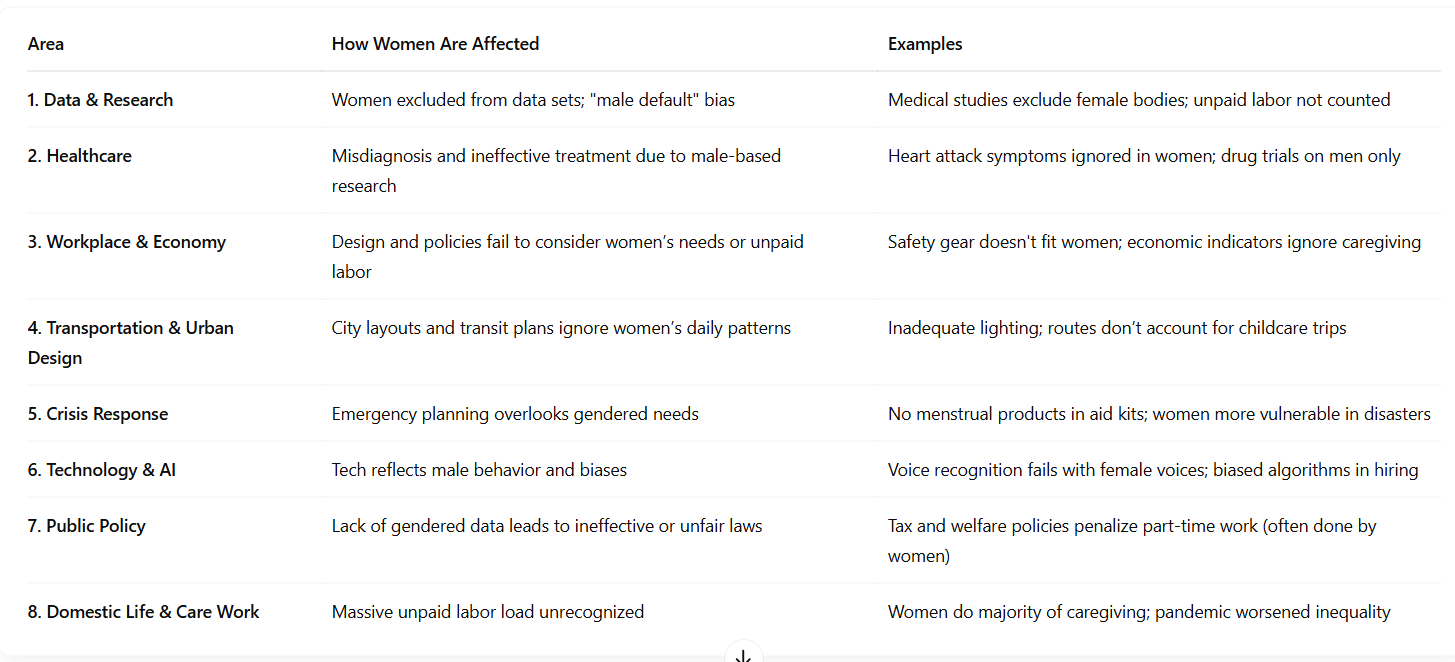
Then, in my podcast queue this morning there was an episode of At Last She Said It in which Cynthia and Susan discuss the fact that the Church seems to be aware that women are leaving the church, but are going about addressing it all wrong. They cite a recent video by E. Uchtdorf, their personal favorite (OK, everyone’s personal favorite, right?) that falls disappointingly short of the mark. The gist of the outreach is telling women that they “belong” and that they “are needed.” It’s interesting because these seem to be things that are more important for men to hear than women. We know we are needed. We are needed too damn much, frankly. What’s in it for us?
This reminded me of Elisa’s excellent 2022 OP: Are Women Quiet Quitting Church? . In that article, she makes an astute observation that is exactly like the arguments made in Criado Perez’s book:
What’s particularly interesting to me as well is that I don’t know if the Church has a clue this is happening. One of the very causes of disengagement—the fact that the Church undervalues and underutilizes women–also makes it more difficult for the Church to notice their disengagement. Women don’t have the same trackable markers of advancement and activity than men have (no priesthood advancement).
Elisa also cites the example of tithing payment not being tracked for women due to the church’s antiquated “head of household” designations. This is a classic example of erasure of women common to patriarchal thinking.
The trend of women leaving organized religion is not unique to the LDS church. The reasons women are becoming disillusioned include:
- Gender inequality and patriarchal structures. Many religions limit leadership roles for women and uphold doctrines that place women in submissive or secondary roles. Additionally, female-centered teachings on modesty, motherhood, and purity feel restrictive, shaming, and burdensome–ignoring the experiences of women and instead defining women from a male perspective, what women are in relation to men, not as autonomous individuals. Complementarian (vs. egalitarian) views of marriage and traditional gender roles are unappealing to an increasing number of women. “Why would I stay in a faith that views me as secondary or auxiliary?”
- Harmful experiences. Many women have experienced spiritual abuse or manipulation by male religious authorities, dismissal or mishandling of abuse allegations (whether these occurred in a church setting or as women seek counsel from leaders for domestic or marital problems) and teachings that blame victims.
- Intellectual or moral disagreements. As women gain education and critical thinking, they often question historical inaccuracies, dogmatic teachings that don’t allow for nuance, LGBTQ exclusionary policies, contradictions between religion and science, and human rights issues that churches ignore or downplay. Additionally, hypocrisy is more easily identified as women engage more in society at large and notice differences between standards the church teaches for its members and how standards are applied to leaders or organizations. “I couldn’t reconcile my faith with my values anymore.”
- Burnout from emotional labor. This one is a particular concern with Uchtdorf’s message about women being needed. Women often carry the emotional weight of communities, and religious communities are no exception: volunteering, caregiving, managing social events, and catering to others. Women often feel used but not empowered, particularly when organizations limit women’s leadership.
- Evolving spirituality. Some women gravitate toward more progressive or interfaith spaces, practices like meditation, mysticism, nature-based rituals, feminist theology, or deconstruction groups. “I didn’t lose faith–I just outgrew the container it was in.”
- Politics and culture wars. As the current political partisan divide also includes a widening gender divide, women whose politics misalign with the majority political views of congregations or leaders may be particularly attuned to “culture war” rhetoric, and may choose to distance themselves from the church community as a result.
Different types of churches are dealing with the loss of women congregants differently. Here are some trends:
- Conservative or fundamentalist churches (Southern Baptist Convention, Roman Catholic Church, Orthodox Judaism, many Evangelical churches) often double down on traditional gender roles (the tradwife trend), emphasizing biblical authority that gender roles are ordained of God. Women are praised for their service, but denied decision-making roles. While some women stay due to community or family ties, these religions are most prone to lose women as women’s concerns are met with dismissal or guilt. “God ordained men to lead women.”
- Mainline Protestant Churches (United Methodist, Episcopal, Evangelical Lutheran, Presbyterian) actively ordain women at all levels, support LGBTQ rights, reproductive justice, and progressive theology. They also specifically work to create space for doubt and dialogue. These faiths are retaining and attracting progressive women, including from conservative religions, but they are still facing overall congregational decline in participation. “Come as you are–even if you’re not sure what you believe.”
- Non-denominational or Megachurches (Hillsong, Elevation Church, charismatics) often show women as worship leaders or prominent “pastor’s wives” while still barring them from decision-making power. They often emphasize emotional experiences and belonging without shifting core gender doctrines. They attract women who seek connection and energy, but alienate those who want equality or accountability. “You’re empowered, as long as you don’t preach to or lead men.”
- Progressive or Inclusive Faith Communities (Unitarian Universalist, Reform Judaism, Unity Church, Quaker, UCC) are often led by women, LGBTQ people, or people of color. Teachings center justice, inclusion, and spiritual autonomy. They welcome doubt, evolution of belief, and hybrid practices. These groups remain small, but are growing due to word-of-mouth, outreach, and refugees from Mormonism or Evangelicalism. “You don’t have to believe everything to belong here.”
- No response. There are also many churches who simply ignore that women are leaving, even as they quietly disappear. “The church didn’t push me out. It just didn’t notice when I left.”
So, how is the LDS church dealing with women leaving, if it is in fact acknowledging it at all? Well, I’m not the expert on this, so I asked ChatGPT. These are the approaches it apparently thinks the Church is taking, which mostly line up with other conservative churches, with a few more details filled in:
- Reinforcing traditional gender roles. Quelle surprise. After all it’s what other conservative churches are doing. You can see the church doing this when it focused on the following topics: motherhood, modesty, nurturing, male priesthood, and the Proclamation on the Family. It’s kind of insane to me that continuing to double down on what’s driving people away is viewed as a great plan, but that’s exactly what Criado Perez’s book showed. When “solutions” are all from a male perspective or based on male experience, women just quit participating and go around the system rather than using a system that wasn’t created for them, doesn’t seek their input, and may be irrelevant to their needs.
- Symbolic inclusion of women. Pres. Nelson has been particularly bad at this one, but some of his predecessors did things like increasing the number of women speakers or those giving prayers at General Conference. He has added a token woman to most higher-level councils, although studies show that women do not speak up at the same rates as men, particularly not when they are the lone woman in a meeting. The mission age was also lowered for women, increasing participation, but not as low as men’s, and women do not hold leadership roles in missions. These “changes” might draw near with their lips, but their hearts are far from equality.
- Emphasis on personal revelation and spirituality. While there is some emphasis on the spiritual gifts and influence of women, it is always restricted to operating within male structures of power, whether in the church or the home. Some women find this rhetoric empowering, while others find it deeply limiting.
- Private concerns, public silence. There are signs (like those delineated by Cynthia and Susan in their podcast) that the Church is very aware of the trend of women leaving, but the church doesn’t really acknowledge this publicly. When it does talk about people leaving, it’s not discussed in gender-specific ways. Going back about 12 years, I had lunch with another Mormon feminist who has since left the Church. She was convinced at the time that the Church just “had to” respond as women were tired of being treated as second-class, as more and more Mormon women had feminist views. I disagreed, stating that church leaders would happily see every feminist leave the church rather than make changes to what works for the leadership. So far, I’ve been right. I was probably thinking of the never-disavowed Boyd Packer talk in which he identified the three enemies of the Church as: feminists, homosexuals, and intellectuals. I haven’t yet seen that the Church doesn’t still treat those groups as enemies.
- Spiritual engagement. Focus on temple worship continues, but occurs under a male priesthood structure that’s hard to miss. There is more content to support mothers, single women, and young adults, including highlights of inspirational women, but in all cases, the women profiled stay within traditional frameworks.
Of course there are women who find the spiritual and community support they need in the church, and they are likely to remain. I often see that mothers of younger children enjoy the benefits of the community in particular. The emphasis on motherhood also might encourage mothers to feel responsible to pass their religion and community on to their kids. I can’t help but wonder how they will feel as their kids grow older, one or two of them identify as queer or trans, or their kids decide that despite their family tradition the church is just not important to them for any of the reasons already identified above.
- Do you think the Church is noticing a gender shift in who is leaving the Church?
- Have you seen the Church make efforts to meet the needs of women? Are any of these efforts successful?
- What do you think the Church could do to retain more women or to attract more?
- Is the Church concerned with women leaving or is it still considered more of an issue if men leave?
Discuss.
 Wheat & Tares
The church cannot afford to fully resolve women’s needs because what women need the most is for men to be held accountable for the cycles of abuse (some violent), control, and neglect that were inflicted on women under the “priesthood authority” banner in the name of “Purity” (starting from the top). The icing on the cake is for the church to evolve into actually really taking women’s needs seriously, they would likely lose and/or disenchant countless numbers of men who don’t want to change to keep up (bye bye financial nest egg and organizational structure). And most of the senior leadership are old enough that they may not be able to adjust to being held accountable for cultural norms they practice without even realizing it.
I don’t know if the smarter move is to continue to push women out of the church to make way for men who are more comfortable without women or to do any of the work to equalize authority to women (not women and children as is the current trend) and provide any restitution to women (and alienate men).
I am curious as to whether social media (and related conversations) will actually inform the church leadership of the many “perks” that are small changes that the church could make to make church activity more of a priority for women. The “sleeveless” garment is one of those such perks (coming after the “Great Yoga Chastisement of 2024”).
I have it on good authority that the general RS president is constantly sending memos to the senior leadership on how women are feeling about things as she travels and meets with women. I don’t think it’s a matter of them not knowing. I think it is a matter of them setting down what they strongly believe they can and cannot do to institute some real change. I think the priesthood ban was a good example of that. And now we know even better that the ban was never anything from God. I just wonder if the Q15 are all operating under premises where they strongly believe some current situation is from God and therefore they can’t do anything about it until God says something, when in reality they really just need to question their fundamental assumptions. I mean, JS gave the okay for women to administer healing blessings. That got taken away by a legalist prophet later. Why not put that back in place as a start? There are just so many easy things they could do that wouldn’t be that hard.
First of all, I loved that book and think about it pretty much every day.
Second, I think you’re right that the church would still rather chase out the feminists (and homosexuals and liberals) rather than make any substantive changes.
A lot more women will have to leave before anything happens—as long as the work gets done and the tithing comes in, who cares if women are unhappy? It’s also a sign of how clueless they really are when they tell women they are needed. “We need all the free labor you do on command for us!” isn’t as persuasive a selling point as they imagine.
I don’t see a good solution short of giving women the priesthood and bringing them into full equality and representation. Every other solution falls short. But since that is very unlikely to happen, I guess women will keep leaving and the ones who stay will have to work even harder. When people ask me now why I left, I tell them, “no taxation without representation.”
A good start would be for us to go back to the way it ways 100 years ago when we had control of our own organization.
Giving women the priesthood authority wouldn’t inherently resolve the issue. Part of the problem is that “authority” comes from priesthood lineage and organizational weight and is defined by men for men, “functional authority” that comes from showing up, tools in hand to do what needs to be done (the “nurturing” authority that women theoretically have – at least on Mother’s Day), and “personal authority” which is the work that happens that drives an individual to show up to do what needs to be done. “Personal Authority” is the bane of organizational religion, and our culture doesn’t provide any conflict-resolution training for when “Priesthood Authority” meets “Functional Authority” in our buildings and in our marriages and households.
Women are still planning and running the children baptisms (event planning & coordination in line with the Primary Presidency), celebration planning (executive functioning under “Nurturing” umbrella) and handing off the meeting EMC role (executed under “Calling in Church” role and handbook requirements), and completion of the ordinance to men (“Priesthood Authority”) with minor updates to who can “sign off” that the baptism happened properly expanded from priesthood-bearer to assigned person over the age of 8 (I guess the “who witnesses” assignment is “presided over” by the church authority because it’s the church code that has to be met by the quality of the baptism ordinance?). with post-baptism routines (and laundry cleaning handled by women and returned to the church). Now, if the female Primary Presidency member was authorized to be the church representative who EMC’d over oops – “presided over” the child’s baptism as the official church representative and consulted with the family beforehand about the event planning (and the witnesses) – that would be revolutionary (and also free up time for the priesthood holder who would normally get drafted).
Almost nothing has changed in the correlation era (60-70 years now) with regard to women’s roles in the church, while almost everything has changed for women in most western cultures during that time. The size of that gap is causing a lot of cognitive dissonance for women. The apparent lack of effort to close that gap is causing a loss of hope for something better for many of those women, so they give up and move on. I think visible efforts for meaningful change, even if not everything is fixed at once, might be enough for many women to be willing to stick around. As it is, most of the changes I see lately look like window dressing.
I would like the church leadership to take the idea of ordination for women seriously, but given that it might be too much for some of the current generation, let’s start with things that could be done without ordination. The list is long. Listen to Cynthia and Susan and their guests on At Last She Said It. Over the course of their podcast they have proposed many excellent ideas for things that could be done right now without making any major doctrinal changes.
I think an important change to make is to find a way to give women more visibility in general conference, given it is regarded as such an important forum. Right now the women leaders speak with about the same frequency as the presiding bishopric and presidency of the Seventy, but less than apostles. The primary problem is that there are so few of them. There are various ways to accomplish the goal of more women speakers, but my preferred solution would be to create additional general leadership callings for women, because I think it would have other beneficial effects on church leadership.
Also, let’s stop doing stupid things. If some random Seventy gets all offended that women are sitting on the stand in meetings in California and thinks it needs to be “fixed”, he should be overruled and corrected by senior leadership. Make it clear to stake presidents and junior general authorities that this kind of nonsense is the fast track to being marginalized and not getting considered for higher callings or influential assignments.
I left the Church in 2021 when women were not leaving (at least it wasn’t being reported) more frequently than men. If that’s what is happening now, I feel sorry for those left behind. Church meetings were often pretty boring and women made them more interesting. The highlight of any PEC meeting was when the RS president spoke. I can’t imagine a ward without many of these women. No thanks. But I’m not sure it matters. Virtually the entire Church can be run with just men and their priesthood if that’s what it comes to. Have fun
“Almost nothing has changed in the correlation era (60-70 years now) with regard to women’s roles in the church, while almost everything has changed for women in most western cultures during that time. The size of that gap is causing a lot of cognitive dissonance for women. The apparent lack of effort to close that gap is causing a loss of hope for something better for many of those women, so they give up and move on. ” – Quentin
I see it too. I think its being amplified because women are still giving birth to and raising female children – who are growing up in a different culture then their mothers and grandmothers “who vowed to make it better for the next generation” and were able to follow through on that vow. These female children are asking different questions and rejecting different theories (some of them church-sanctioned) earlier in their developmental process at home in everyday conversations (and that more women then men are at home and paying attention in these conversations) is hastening the process.
Part of the cognitive dissonance that I personally felt was generated because from before she was baptized, the church system of answers and the available community did not meet the needs of my daughter, and it is a driving factor of why both myself and my child stopped attending (and didn’t provide the executive functioning impetus to get other family members to church). We stayed engaged with the system for several years, “trying to make it work” for our child, our family, and our church community – up until the costs of those choices were greater then the I was willing to pay.
‘As it is, most of the changes I see lately look like window dressing.’
If you put lipstick on a pig, it is still a pig
Legitimate question here.
“Elisa also cites the example of tithing payment not being tracked for women due to the church’s antiquated “head of household” designations. This is a classic example of erasure of women common to patriarchal thinking.”
What practice is this actually referring to? Every ward I have been in keeps track of contributions made by each member (male or female) separately and the data for each is always available.
A lot of the OP and comments are focused on women already in the Church. I have an interesting observation regarding women joining the Church.
My daughter just returned home from her mission to the same country I served a mission in several decades ago. This country is a non-Christian nation far across the ocean from the US. When I served, it was still considered a developing country, but it was progressing quickly, and today it is considered by most to be a full member of the developed world. Because we both served missions there, it has been very interesting to compare notes on what has changed since I was a missionary there. One of the most striking changes is the reduced success that the Church is now having proselytizing women in this country.
When I was a missionary in this country several decades ago, the elders were very strictly forbidden from contacting and teaching women, and the sisters were not allowed to contact and teach men. The elders were universally jealous of the sister missionaries because the sisters’ efforts at cold contacting and teaching females were profoundly more successful than the elders were with males. The sisters typically spent the majority of their time teaching lessons, while the elders spent the majority of their time cold contacting men on the streets. I was in mission leadership for quite awhile, so it was my job to collect weekly reports of lessons taught, baptisms, etc. each week from both elders and sisters, and there was always a big difference between the sisters and elders. Even the most “productive” elders couldn’t approach the numbers of “average” sisters.
When my daughter served her mission, things had changed. For one, elders and sisters could both now teach females and males. However, the shocking thing to me was that my daughter–and everyone else in her mission–is now having better luck cold contacting and teaching men than they are women. In the space of just 30 years or so, the numbers aren’t reversed–missionaries aren’t having as much success with men as they were with women when I was a missionary–but men are definitely somewhat more interested in the Church than women today in this part of the world.
This part of the world is pretty densely populated, so missionaries spend more time contacting people on the streets than they do knocking on doors. My daughter says that pretty much all missionaries in this mission will tend to choose to contact males over females when there are several options available because they know that their odds are better with men than they are with women. When she first shared this with me early in her mission, I didn’t believe her because of my past experiences as a missionary there, but it’s really true. Things have really changed over the last 30 years.
This country used to have congregations where the female to male ratio of active members in the wards and branches was 3:1 or even worse 30 years ago. These congregations really could have benefited from women priesthood holders back then! Women finding men who were members of the Church for an “eternal marriage” was considered a huge problem (with no real solution). The female to male ratio is closer today, but now it’s the men who are having a harder time finding a woman for a temple marriage.
I have travelled to this country for work regularly over the years, including several 6 month stints, so I’ve been able to watch this change and progress both within the Church and just in society in general. A couple of the theories I have about this shift in missionary success with females in this country:
1. Women now work in much high numbers than they did in the past. Women in this country used to have extra time for organized religion which they no longer have.
2. Women in this country now have much, much, much more sexual freedom than they did in the past. When I was a missionary, dating and courting were extremely conservative by American standards. A woman having sex outside of marriage was completely unacceptable and scandalous. (Men weren’t supposed to do this either, but many still did without the consequences that women faced for this kind of thing. “Boys will be boys.”) That is no longer the case at all. The speed and magnitude of this change is really quite amazing. This isn’t a Christian country, but I suspect that women understand that joining a Christian religion means no premarital sex, and since pretty much everyone is now openly engaging in premarital sex, Christianity (and probably other religions as well) are now much less appealing. 30 years ago, women may have been attracted to Christian churches because they supported their own views on sex and marriage. On the other hand, women today are repelled by Christian churches because their views on sex and marriage are opposed to those espoused by these religions.
3. Women in this country didn’t work outside the home in high numbers 30 years ago and were mostly expected to be stay-at-home mothers and housekeepers. As a result, they were often lonely. Organized religion was a respectable and socially accepted way for women to get out of the home and connect with other women. Now that most women work, they are able to connect and make friends with people at work and in other ways, so they no longer need religion to aid their social life.
4. Women were aware that Christian churches often had programs/activities for children, so participating in a Christian church was one of the only ways they could get a little relief from the burden of caring for young children 24/7. Today, most women work, so they aren’t with their young children 24/7 in the first place. In addition, women/families can now afford to have their children participate in various extracurricular activies–no church required.
5. Participation in religion–any religion–was viewed as a positive thing for females in this country 30 years ago. However, today, females that participate in religion (especially foreign religions like Christianity) are often viewed as strange or outdated. This definitely applies to men as well, but I think the shift has been even stronger for women.
Not only are women leaving the Church, but at least in this part of the world, women (who know very, very little about the Church or even Christianity, so they aren’t very aware of the issues that are driving lifelong female members of the Church to leave) are no longer interested in joining the Church in the first place the way that they were 30 years ago.
@mountainclimber479
You highlight the real cultural change: Women no longer look to a church to support their needs.
It cannot be expressed enough how extremely effective the LDS religion was at supporting families. Well now families as a percentage of the population are in decline. And families have fewer children and both parents tend to be working. These factors change what people need from a church and they also change what programs the church can support – recognize that the LDS church relies on adults with spare time to run church programs. What does a church ward do when there are so few adults with spare time?
These challenges faced by the current LDS religion are not solved by giving men or women more leadership responsibility – there is simply not enough men or women to run LDS wards in the manner they used to be run! I think it can be argued the reason the leadership is emphasizing the temple for religious activity is because supporting temple activity is the priority of the leadership, and why? It is because temple activity is a thing the leadership can support and recommend irrespective of the staffing challenges faced by individual congregations.
The basic problem is that there’s a hierarchical structure in which authority is the primary focus. Authority equates with power, and its the guys at the top of the pyramid who control the power/authority and decide who gets to share in a piece of it. People with power typically don’t give any of it up without a fight.
It has taken decades and generations for Community of Christ to transform its approach to priesthood from male-only authority/power to more of a shared, specialized, and egalitarian ministry among and within each priesthood office. I believe that was only possible because the Holy Spirit (and the actions of strong, committed women) somehow got through to the guys at the top.
@Rich Brown, that’s a very interesting perspective from someone who has lived through the transition to women holding the priesthood in the CoC. I was listening to a podcast the other day, where Jana Riess was a guest (I’m pretty sure it was Jana Riess) who shared stats from research that had been done that showed that the most satisfied members of the LDS Church today are older men (surprise, surprise). As someone who believes that the LDS Church needs to ordain women, my immediate thought was, “Wow! These older LDS men are going to be in for a real shock if and when women are ordained, and they start getting orders that they don’t agree with from a woman, much less a woman much younger than they are. I wonder how things would shake out at the local level if this change is made!” I suspect the transition would be pretty rough in some wards, and your experiences seem to confirm this.
I just watched “On the Basis of Sex” which is about Ruth Bader Ginsberg. Super interesting, including partly because although she was advocating for women’s rights she had to prove the negative impact to a *man* which then benefited women in general. I wonder if church leadership will have to grasp that patriarchy is bad for most men, too… but that’s a stretch because the minority of men who do benefit are the older, established, already powerful men.
I’m not convinced that women are leaving more often than men. Would love to see statistics on that. If it’s 50-50 or even 60-40 the perception of why people leave might be more general dissatisfaction rather than women’s issues in particular.
I’m a former bishop, obviously male member of the patriarchy who left primarily because of LGBT and women’s issues. My wife stayed even though she’s the one wronged go figure. I personally don’t think much will change until more wives say this is BS, I’m gone.
A few thoughts:
hawkgrrl,
Your question about mother’s staying in the church and their children leaving is already happening at a great rate. I think the church puts people in a mental health bind particularly on this subject. We don’t learn healthy differentiation. We don’t learn to respect our adult children’s autonomy (at least we don’t learn this at church). And the church places all a woman’s value on her children staying in the church. This is painful and alienating, particularly for mothers.
I am a moderator for a support group on social media trying to help parents in the church through this transition. LDS parents need examples and encouragement to accept their adult children’s autonomy and show them love and acceptance. Many parents who fail at this transition find themselves estranged from their children.
This is even more obvious when government of your country is progressive v conservative. In Australia the labor government is 53% female, whereas the more conservative opposition is 32% female. Much of europe also has equal numbers of females in positions of power.
I thought it would have been a wake up for the church if your president was now Kamala, sadly they get a comfortable environment. Except perhaps for the value of their investments.
the church wants mothers and wives but doesn’t really know what to do with women.
For example, in my childhood our family was a focus for the ward after my father left and my mom was a single parent with five children. Then we grew up and my mom was now a single woman in the ward and was basically ignored. She dated the executive secretary for a while and then suddenly she important to the ward again. When he passed away suddenly before they were married and there were revelations about him that came to light after he died my mom stopped attending. She was at first just upset about her personal situation but then the ward did nothing to encourage her to come back. And she has since left the church for almost 5 years. No one has tried to reactivate her. They just don’t need women. They needed her as a mother or as a wife.
When we left in 2021 there were some attempts to reach out to me to resolve my concerns but none for my wife.
this is a sample size of 2 so it is only anecdotal, but I think that it is represents what others experience.
Ojiisan & Chadwick,
Just over a decade ago, the default setting placed all donations paid by a couple under the head of household. The clerks figured out a work around at the time (I literally had a married woman in her sixties angrily weeping in the office during tithing settlement because she felt her “voice and sacrifice” were not being recognized by the Church). A few years later, this stupid default changed, and it got much better with the online donations.
I am not going to hold my breath on female ordinations occurring during my lifetime, but I would dance in the streets if it happened.
Old Man, thank you. Was obviously before 2008 which was when I was put in a position to know how they were recorded and at that time they were recorded separately.
“Some of the poor outcomes for women (over half the population, mind you) include things like more work injuries, fatalities in car crashes, untreated or mistreated symptoms in healthcare that lead to death, etc.”
The CDC’s WISQARS database of fatal and nonfatal injuries reports for the year 2023 that 15.1 million nonfatal injuries happened to males and 11.5 million happened to females. For fatal injuries the count was 148,65 males and 90,711 females. Fatal injuries involving motor vehicles happened to 33,392 males and 12,370 females. Females are over half the population largely because males die at higher rates than females.
148,651
It is far past time for this issue to be given full consideration.
John Mansfield: I think you are arguing with a statement from the beginning of the OP that I probably didn’t word very clearly. I said “Some of the poor outcomes for women (over half the population, mind you) include things like more work injuries, fatalities in car crashes, untreated or mistreated symptoms in healthcare that lead to death, etc.:” I don’t wish to mischaracterize what Criado Perez details in the book. She wasn’t claiming that more women than men are injured on the job, just that the data gaps lead to more work injuries for women (particularly in male dominated work environments like manufacturing and the military) than are typical per worker. Since there are fewer women than men in these spaces, of course more men are injured overall. If you look at injuries per worker or per person, the trends illustrate the problem. I suppose you could look at a reverse statistic of men injured while unloading the dishwasher, but the sample size might be too small.
Even the Trump administration is aware that this is a problem. Its solution is to chase women out of the military.
Brian Gardunia writes above: ‘And she has since left the church for almost 5 years. No one has tried to reactivate her.’
Perhaps no one tried to reactivate her because she was a woman. But more likely reason seems, to me, that our reactivation efforts have essentially ceased. Ministering is moribund in most places, so it seems, and we have been taught to respect people’s choices. I know a good number of inactive men, a lot of them divorced, who are inactive because the are almost personalenon gratae. The situation of Brian’s woman in question might have more to do with her being single than with her being a woman. Not saying it should be thus way, but unmarried members may frighten some of the faithful.
1
*because they are almost personae non gratae.
Hawkgrrrrl, if rate ratios (RRs) for injuries per FTE of males and females are of interest to your, then I suggest looking through “Workplace Injury and Death: A National Overview of Changing Trends by Sex, United States 1998–2022” by Hendricks, Hendricks, and Marsh. The full text is available at no charge through the National Library of Medicine. Any women loggers being differentially hurt because chainsaws are made for bigger hands, or such, would seem to be a very small fraction of workplace injury. For example, the CPWR Data Bulletin for September 2023, “Labor Force Characteristics in Construction and All Industries, 2011-2022,” reports that the construction worker labor force is 90% male. The Data Bulletin for July 2024, “Fatal Injury Trends in the Construction Industry, 2011-2022,” reports that 99% of construction workplace fatalities happened to male workers.
Imagine that in a month of Sundays, all women in the church neither attended church/temple nor worked in their callings. What would the General authorities do? Would they call women to return and repent, or would they recognize the need to “renegotiate” the terms of further labor, or would they simply excommunicate every woman and become a strict fraternal organization? I know it’s not realistic and not all women would do it. Interesting to think about.
“Imagine that in a month of Sundays, all women in the church neither attended church/temple nor worked in their callings. What would the General authorities do? Would they call women to return and repent, or would they recognize the need to “renegotiate” the terms of further labor, or would they simply excommunicate every woman and become a strict fraternal organization? I know it’s not realistic and not all women would do it. Interesting to think about.” – Mhermitmom
Assuming that the men got the children and teenagers up and ready for church – I think that some men (probably in EQ) would have some kind of short lecture (ad-libbed of course), or some spur-of-the-moment game (probably with a sports element), and maybe they would get the bishop/president or a counselor to come and take up some of the time. If the men were running Primary, I am pretty sure that they wouldn’t be running “Come Follow Me” at home.
The functional reality would be “Mother’s Day” (like the units that have the women take a day off and go to RS) without the advanced planning that the moms going to RS do.
But what is more interesting is what those “at home” conversations would be like as the men cash in brownie-point chips for wrangling kids at church (or try to?).
Israelis declare war against the church collapsed monopoly how to interpret ancient texts. First and foremost, the New Testament shares no more a portion with the Hebrew T’NaCH than does the koran or book of Mormon.
The rhetorical weight of John 16:33 rests on abstract, Hellenistic terms like: “Peace” (εἰρήνη – eirēnē): Unlike shalom in Torah, which refers to TRUST restored through fair judicial justice which makes a righteous compensation of damages inflicted by Party A upon Party B, the word salad “Peace” does not refer to anything specific in particular. To make a general statement “peace” compares to a slander accusation without bringing any supporting evidence other than more slander or hearsay gossip.
Eirēnē is decontextualized. It implies a spiritual or internal tranquility, divorced from land, law, or peoplehood. It’s a peace without mitzvot, without mishpat, without the prophetic demand for national accountability. In effect, it’s a pacifier.
“The world” (κόσμος – kosmos): A vague antagonist. It doesn’t mean Egypt or Rome in any concrete political sense, nor does it refer to any halakhic category like goy or eretz ha’amim. It’s an abstraction, a kind of universal evil “system” that individual souls must transcend through belief in the cross. This aligns with dualistic Greek cosmology, not with the Torah’s conception of sanctifying this world through mitzvot.
This passage turns the reader inward, encouraging spiritualized endurance and submission—not prophetic mussar which personally rebukes. This passage by contrast merely serves as a theological sedative: “The world is hard, but don’t resist. I’ve overcome it for you.” No call to teshuva, no call to rebuild the brit. Just passive faith in a metaphysical savior. It masks pacification as victory, and disempowerment as peace. It preaches serenity while erasing the Torah’s demand for mishpat, tzedek, and the restoration of Israel’s oath brit to conquer or re-conquer our homeland of Judea.
Attended BYU convocation today for School of Communications. FWIW all of the student participants (speakers etc) were women. It’s time to ordain women, seriously.
However, Clark “Professor Umbridge” Gilbert was the keynote speaker to all students yesterday.
LWS329, are you able to post the site on which you moderate? I and many I know would benefit from this I’m sure.
I help moderate Bridges-Support for Latter-day Saint Parents of Adult Children on Facebook. If you apply to join be sure to answer each question. We only admit LDS parents whose children have left the church.
Britain proves itself a faithless whore once again. Like as its White Paper betrayal of the 1917 Balfour Declaration upon which the League of Nations awarded to Britain the Palestine Mandate of 1922.
Recently the UN Security Council attempted to decree a Chapter VII ultimatum which dictated that Israel surrender to Hamas in Gaza. The British and French betrayal of Israel in this UN vote would have meant that those countries would have committed to going to war, like as happened following the Chapter VII UN ultimatum issued to North Korea in the early 50’s.
Should Israel abandon its partnership with the UN European voting block and request to join the American voting block of nations? Currently Israel has a special relationship with the EU and participates in various EU programs and agreements. It is part of the European Neighbourhood Policy and has signed agreements that allow for cooperation in areas such as trade, research, and cultural exchange. The EU member states typically coordinate their positions and voting strategies within the UN framework as part of this broader Western bloc. Clearly, in this latest UN Chapter VII ultimatum which demanded that Israel immediately surrender to Hamas or the UN would invade Israel like it did North Korea, this betrayal by Britain and France places them within the Russian Chinese UN voting block of nations.
Aligning more closely with the U.S. voting block could strengthen Israel’s ties with the United States, which has historically been one of its strongest allies. This could lead to increased political and military support. Abandoning the EU partnership could limit Israel’s diplomatic options and reduce its influence in Europe, a 3rd rate power among the community of nations today. The geopolitical landscape is constantly changing, and Israel may need to navigate its relationships with both the EU and the U.S. carefully to maintain its interests. Ultimately, the decision to shift alliances or voting blocks would depend on a variety of factors, including Israel’s strategic goals, the current geopolitical climate, and the potential benefits and drawbacks of such a move. It would require careful consideration of both immediate and long-term implications for Israel’s security and diplomatic standing.
The EU is one of Israel’s largest trading partners. A shift away from the EU could have economic repercussions, impacting trade relations and access to European markets. As global power dynamics shift, Israel’s foreign policy may need to adapt to new realities, including emerging alliances and changing attitudes within the international community. Israel’s decision-making regarding its alliances and voting blocks will likely involve weighing immediate benefits against long-term strategic goals. The interplay between its relationships with the U.S. and the EU will be crucial in shaping its future diplomatic and security landscape. Careful consideration of both current geopolitical trends and historical ties will be essential for Israel to navigate this complex environment effectively.
As countries like China and India gain influence, Israel may need to consider how these shifts affect its relationships with both the U.S. and the EU. Engaging with these emerging powers could open new avenues for trade and diplomacy. Israel’s relationships with neighboring countries and regional powers are also evolving. The Abraham Accords, for example, have opened new diplomatic channels with Arab states, which could influence Israel’s strategic calculations. Israel’s leadership will need to articulate a clear long-term vision for its foreign policy that considers both immediate security concerns and broader economic and diplomatic goals.
The normalization agreements with several Arab states have significantly altered the geopolitical landscape in the Middle East. These accords not only enhance Israel’s security but also create opportunities for economic collaboration and cultural exchange. But the critical Plate tectonics earthquake of the Abraham Accords it destroyed the British French UN 242 two-state solution as the only viable option for peace in the Middle East.
The Abraham Accords have shifted the focus away from the Palestinian issue as a central concern for many Arab states, which may complicate efforts to revive the two-state solution. The normalization agreements suggest that some Arab nations are willing to engage with Israel independently of progress on Palestinian statehood. The Oct 7th abomination has permanently changed the dynamics in the region. The archaic British and French chapter VI UN Ultimatum for a two-state solution, completely out dated and irrelevant.
The changing realities on the ground, including shifting alliances and the evolving nature of conflicts, necessitate a reassessment of how peace can be achieved. As the dynamics change, there may be a need for innovative diplomatic strategies that address the complexities of the situation. Specifically, Arab Palestinian leadership has clearly proven itself as utterly bankrupt to merit becoming an independent nation among the community of nations in the UN Middle East voting block.
Italy did not support the recent UN Security Council resolution that called for an immediate and permanent ceasefire in Gaza, which was vetoed by the United States. The resolution received 14 votes in favor, with the U.S. casting the only vote against it. The draft resolution was co-sponsored by several countries, but Italy was not listed among those actively supporting the resolution in the context of the recent vote.
These 14 countries Russia, China, France, United Kingdom, Algeria (co-sponsor), Denmark (co-sponsor), Greece (co-sponsor), Guyana (co-sponsor), Pakistan (co-sponsor), Panama (co-sponsor), South Korea (co-sponsor), Sierra Leone (co-sponsor), Slovenia (co-sponsor), and Somalia (co-sponsor) voted to impose a UN Chapter VII dictate upon Israel. Of these countries Algeria and other scamp countries do not even have diplomatic relations with Israel.
Neither Iran nor Sudan, for example, have diplomatic relations with Israel. No different than Algeria. Algeria and Turkey have developed a military partnership and cooperation over the years, particularly in the areas of defense and security. This relationship has been strengthened through various agreements and joint military exercises. The relationship is part of a broader strategic partnership that includes economic and political cooperation, with both hostile countries to Israel sharing interests in regional stability and security.
Those 14 countries have already repeatedly called for international condemnation of Israel, rabidly support Palestinian terrorism relabeled as “Palestinian rights”. They already engage in public relations propaganda campaigns hostile to Israel. They already support and initiate legal actions against Israel in international courts such as the ICC. These countries have escalated their rhetoric propaganda against Israel. Hamas could never have dug its complex tunnel system without international support. They already promote cultural and academic boycotts of Israel.
These countries throw their support for the Palestinian cause, like whores on street corners sell their wares. They often use ‘stinky’, blood libel slander rhetoric, to condemn Israeli actions, framing them as oppressive or colonial. Such putrid rhetoric seeks to poison public opinion and mobilize support for Palestinian groups. Numerous solidarity movements around the world that advocate for Palestinian rights; they often align with groups like Hamas, viewing them as legitimate representatives of Palestinian resistance.
Countries without diplomatic relations with Israel compare to corrupt judges that accepts bribes. This objection, seeks to raise critically important questions about the legitimacy and fairness of the recent Chapter VII UN ultimatum which demanded that Israel surrender to Hamas in Gaza. While the analogy of a corrupt judge highlights concerns about bias and fairness, the international system, in point of fact, operates on principles of representation and sovereignty.
The International system operates, so it appears, as something akin to a beauty contest. What defines beauty — not a rational logical concept. Israel demands a change to the International system. It could express its rebuke of the UN, by leaving the UN. The analogy of a corrupt judge suggests that countries without diplomatic relations with Israel, that they lack objective credibility to fairly judge the case heard before the court of international opinion.
This perception of bias, Israel argues, undermines the legitimacy of all UN resolutions or demands made against Israel. Particularly since nations who do not have diplomatic relations with Israel obvious their anti-Israel hostility – politically motivated – rather than based on objective criteria. Chapter VII of the UN Charter allows the Security Council to take action to maintain or restore international peace and security. However, the application of this chapter, like as in the Korean war, especially when it appears to favor one side over another in a conflict, historically expands the local conflict into a far larger international war. The call for Israel to surrender to Hamas, obviously viewed by both the US and Israel as an ultimatum that lacks balance and fairness. Just as China despised the UN Chapter VII ultimatum decreed against North Korea.
The international UN system, indeed based on principles of state sovereignty and representation. However, the effectiveness and fairness of this system both the US and Israel have repeatedly warned and challenged. Especially when certain countries dominate decision-making processes or when resolutions reflect geopolitical interests rather than universal principles of justice.
The idea that Israel should demand changes to the international UN system, this demand reflects the Israeli requirements for a more equitable and fair approach to international relations expressed through public UN diplomacy organs. Leaving the UN perhaps a radical step. But it raises questions about the effectiveness of the international UN system of public diplomacy among nation states in the world community of nations.
The mitzva of observing Torah commandments לשמה within the borders of the oath sworn brit lands, the inheritance of the Chosen Cohen people.
[[[ Within the covenantal framework that you so powerfully defend, how do you see the role of individual conscience? Not as a competing system, but as a faculty formed by oath remembrance and living Torah? I[[[ Within the covenantal framework that you so powerfully defend, how do you see the role of individual conscience? Not as a competing system, but as a faculty formed by oath remembrance and living Torah? In a world saturated with propaganda and revisionism, what disciplines shape that conscience to remain true to Sinai? ]]]
The Books of שמות וויקרא concentrate on the avodat HaShem of dedicating korbanot. This “service” does not exist as offering up a barbeque unto Heaven. The mitzva of the פרט case of Moshiach learns from the כלל of korbanot services of the House of Aaron.
Another בנין אב-precedent, the כלל for faith: צדק צדק תרדוף. Still another פרט-בנין אב precedent: the court case of Hebrew slaves vs. the State of Par’o – beating slaves for their rebellion to meet their brick production quota consequent to Par’o withholding the required straw.
One other בנין אב-precedent learns from the כלל that all ברכות require שם ומלכות.
Just as a korban requires a dedication to achieve a specific specified purpose, so too the mitzva of Moshiach. Specifically in the mitzva case dedication of Moshiach, this dedicated “king” sanctified לשמה to rule the land with Judicial justice, working through the common law lateral Sanhedrin courtrooms. Based upon the Torah Constitutional mandate that the Sanhedrin courts operate through משנה תורה-Legislative Review of any and all statute laws or bureaucratic regulations imposed by the Monarchy and/or his government.
The often repeated rebuke which the Book of Shmuel makes upon the House of David as Moshiach, the injustice shown to the husband of Bat Sheva. This פרט-specific defines the כלל dedication of the mitzva dedication of Moshiach. No such dedication for the mitzva of Moshiach to become a substitute theology which has some mythical theologically based messiah to replace the chosen Cohen People.
The opening word of the Torah בראשית, through the aggadic stories of the Creation, teaches the k’vanna of tohor time-oriented commandments; as the Av of the תולדות secondary source positive and negative commandments located specifically in the Books of שמות ויקרא ובמדבר. Hence just as the Book of בראשית introduces the Avot Avraham Yitzak and Yaacov, this opening first Book of the Torah introduces Av tohor time-oriented commandments which the rest of the Books of the Torah come to clarify.
For example: what separates tohor spirits from tumah spirits? Avodat HaShem in the Mishkan, only served in the state of tohor middot. For a Cohen to serve within the Mishkan in a condition of tumah middot – this Av transgression carries the din of כרת. Cutting off that person and his children from the oath brit wherein HaShem and the Avot mutually swore to create the chosen Cohen people יש מאין. This latter בראשית most essential idea shares nothing with tuma middot which promote racial or genetic inheritance of the Jewish race – as the Xtian church and Nazis promote – examples of tumah middot.
Hence to swear a Torah oath requires שם ומלכות like as do all ברכות from the Torah. The sin of the Golden Calf – a substitute theology which replaces the revelation of the 1st Sinai commandment revelation of the Spirit Divine Presence Name unto other word-Gods. Avoda zara by definition worships other Word-gods. The sin of the Golden Calf serves as the defining פרט for the 2nd Sinai Commandment כלל not to worship other Gods.
Therefore all Torah oath britot require שם ומלכות. The Name clearly directly links to the Spirit Divine Presence Name revealed in the first Sinai commandment. The term מלך refers to the כלל mitzva of the dedication of the spirit of משיח as expressed through all tohor time oriented Av commandments … the righteous pursuit of justice to achieve shalom among the chosen Cohen people throughout the generations in all Ages and times while Jews rule our ancient homelands.
מלכות understood as the dedication of defined tohor middot. אל remembrance of the Sin of the Golden Calf. רחום the inference which turns pity upon its head. Obliterating the Canaanites, the killing of the minor stubborn and rebellious child, the war against Amalek (Jewish assimilation to foreign cultures and customs of peoples who do not accept the revelation of the Torah at Sinai. And intermarriage with such Goyim). The middah of רחום a Jew dedicates how he shall socially interact with both his people and Goyim in the future; specifically through the dedication of defined tohor middot. חנון the general dedication to dedicate all future behavioral patterns with family friends, people, and even Goyim by and through the future born tohor middot that a person dedicates whenever that Jews does Torah or Talmudic mitzvot/halachot.
Both Xtianity and Islam worship other Word-gods. Therefore both religions do not define faith as the pursuit of justice, but rather belief in the theologies about these Word-gods.
[[[ Also, when you speak of the erasure of Jewish self-determination through revisionist Palestinian narratives, I hear both an intellectual rebuttal and a deep historical wound. Is your critique aimed primarily at the political manipulation of language and borders—or also at the erasure of Jewish covenantal memory from the land itself? ]]]
Unlike the Xtian and Muslims theologies which promote some pie in the sky Universal Monotheism God, the revelation of the Torah at Sinai revealed the local tribal God of Israel. When David fled from king Shaul he declared as he entered g’lut lands: “I have been forced to abandon God”. Just as the Great and Small Sanhedrin courts only have jurisdiction within the borders of the Jewish state so too the local God of Israel. Herein the answer given to the Holocaust survivor who said to me: “I was in Auschwitz, Where was God?” When I lived in the US and Xtian people asked me if I was a religious Jew? I responded with: I am an atheist praise God. But even living within the borders of the oath sworn brit alliance lands I habitually respond to Goyim with “I am an atheist – praise God”. Meaning, I do not believe in any theological/creed construct of Word-gods – praise God. LOL Torah, its deep and requires a sense of humor.
The curse of g’lut-exile of my people almost immediately caused Jews to lose the wisdom how to do mitzvot לשמה. G’lut Jewry does not understand how to employ and work our Yatrir HaTov within our hearts. The בנין אב-precedent of blowing the shofer serves as a פרט to define the כלל of Yatzir HaTov. Meaning, to blow a shofar requires air from the lungs. But to blow a spirit from the Yatzir HaTov within the heart requires the k’vanna, (all time-oriented commandments require k’vanna) the dedication of defined tohor middot spirits. This כללי-general idea of tohor middot, it defines the dedication of the middah of חנון.
Herein a definition of 3 of the 13 tohor middot which a person dedicates through Yatzir Tov k’vannot from within their hearts. Jews uprooted from our homelands by both the Babylonians and Romans caused the g’lut cursed survivors to lose this kabbalah wisdom which defines how to do mitzvot לשמה.