
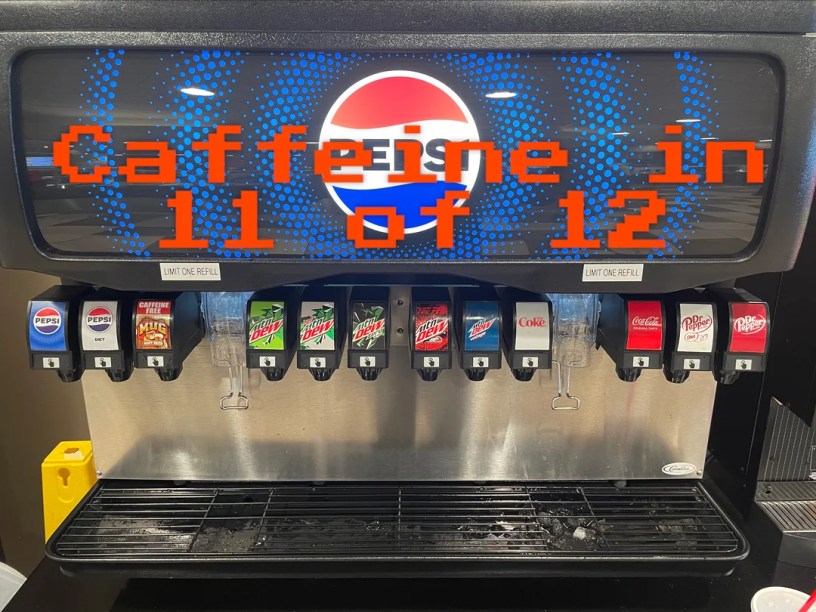
Only thirteen short years ago, a BYU spokesperson, when asked why there was no caffeinated soda at BYU, even though the Church had recently said it was NOT against the Word of Wisdom, famously said “This decision has been based on what our customers want, and there has not been a demand for caffeinated beverages.’ — BYU Spokeswoman Carri Jenkins.
My how things have changed. The above photo (used with permission from a reddit post) shows the soda fountain at BYU-Idaho. While I have no way of verifying this is an actual photo from BYU-I, I have no reason to doubt the veracity of it. If any of you readers are close to BYU-I and can authenticate this, that would be great.
So, assuming it is from BYU-I, what can we learn from this photo? Here is what I learned
- They love their Mountain Dew at BYU! There are five different kinds of Mountain Dew, the nectar of the Gods.
- There is no Seven-up/Sprite type drinks. Must be a victory for Satan.
- There is only one non-caffeinated, drink, the Mug Root Beer, and they proudly have the “caffeine-free” banner on it. Too bad they didn’t get Barq’s, they could have had a full house!
- So as not to promote gluttony (or caffeine overdose) they are limiting you to only one refill. This is so Mormon, and makes me think this is really at BYU.
- They have an unholy alliance between Pepsi and Coke in the same fountain. This is unusual to find out in the regular retail world, as usually a store will partner with one or the other.
What are your thought on the above photo?
Which one would you chose?
 Wheat & Tares
I hate to fact check you to your face, Bishop Bill, but my mom has long assured me that Dr. Pepper is the “nectar of the gods.” The cross-pollination of Coke and Pepsi products is odd, almost certainly a violation of both soda corporation’s licensing agreements. But, in the context of a photo claiming to have been taken inside a private religious institution in Idaho, actually speaks to the photo’s authenticity. Also a tell-tale suggestion of its being real, Pepsi’s logo retains pride of place. With ancestral roots in the northern-Utah/Idaho area, I say this tracks.
Speaking as someone who intentionally keeps his taste buds liberal enough to enjoy both Pepsi and Coke products (so I never wig out in restaurants like other grown adults I’ve seen), it’s all just corn syrup and bubbles [(or whatever carcinogenic artificial sweetener that diet pop drinkers are guzzling piously) just trying to get all the fighting words in I can on this comment]
As a product of the 70/80’s, I got the message to not consume caffeine. I consumed big glups for hydration after exercise or laborious work. Never a Coke/Pepsi, but on a rare moment a Dr. Pepper/Mountain Dew, because they were “not as bad”. Once I learned that Sunkist and Barq’s Root beer contained caffeine, I was in a quandary. The church never mentioned those drinks. Do I obey the prophet and abstain from all these products and only consume Sprite and Fanta? Even more confusing, was my friend’s dad, who was a current LDS bishop with a prominent surname, always was drinking a Coke.
Around 1984 Deseret News ran an article about the mg of caffeine in all products from coffee to sodas to chocolate. The math was easy, 4 cokes equaled a cup of coffee, Mountain Dew equaled 1/2 of a cup of coffee, and a chocolate bar although much less, was 15 bars away from sin.
Concurrently, participating daily in long distance running, I wanted to improve my performance; I learned, for myself, that carbonated drinks were not healthy. At 16-years-old, I cold stopped drinking carbonated drinks, including the “not so bad ones”. Since then, outside of a 3rd world mission, I may drink a soda pop 2-3 times a year. This is by choice.
The Word of Wisdom can be a good thing, along with other rules, when introduced as a learning tool of exposure and self-decision. However, when used as a bully stick and an obedience marker without discussion and explanation is a major problem within Mormonism.
To this day, I choose to not consume coffee, alcohol, and rarely a soda pop. I also choose to avoid corn syrup, GMO, and pesticide covered fruits. I find it interesting how many ex-Mormons health code choices pendulum swings from abstinence to a near devotion to some of these products. That indicates to me the church needs to change its teaching approach from obedience to the consequences of choices and a greater personal understanding. However, that would undermine their authority and empower the individual.
The W&T community will find this interesting. A recent MS podcast provided a list of the first 8 LDS prophets adherence to the W of W:
Joseph Smith – Regularly partook of tea, coffee, and wine, and smoked a pipe.
Brigham Young – “If a person is weary, worn out, cast down, fainting or dying, a brandy sling, a little wine, or a cup of tea is good to revive them. Do not throw these things away.”
John Taylor – Drank tea, coffee, wine, and smoked a pipe and tobacco.
Wilford Woodruff – Drank brandy as well as Portwine and coffee.
Lorenzo Snow – Drank wine
Joseph F Smith – Also drank wine and he had a history of physical abuse that some theorize might have been enhanced by alcohol.
Heber J Grant – Struggled with alcohol drinking, as many as 6 glasses of beer every day. In 1921 he made adherence to the Word of Wisdom a prerequisite for temple admission
George Albert Smith – Took Brandy for medical reasons
David O McKay – once, to everyone’s surprise, he ate rum cake saying “That the Word of Wisdom forbade drinking alcohol, not eating it.”
As someone who is truly caffeine immune (not just a fast metabolism resistant) I miss caffeine free Diet Coke which had superior flavor.
Haven’t seen it at a soda fountain for a long time.
Weirdly I don’t see water as an option. They must really want you to buy a soda (with caffeine)!
As a long distance runner and health nut I rarely drink sodas except ironically when I’m running a long distance race. The high sugar and sodium content at mile 40 is like rocket fuel. I drink caffeine so rarely that when I do, a coffee at 3pm will keep me up until 2am.
A quick AI query says that alcohol is worse than sodas… but by a smaller margin that most would probably assume.
I rarely drink caffeine, rarely drink soda. Occasionally I’ll have a green tea. I hate relying on any substance to keep me awake. If you can’t stay awake, sleep more, organize your life so that you can.
This will come as a surprise to few here, but having worked at BYU for over two decades, I can say with 100% certainty that there was significant demand for caffeine on campus prior to the repeal of the 18th amendment…err, end of caffeine prohibition. In addition to the mini-fridges all over campus full of the black market stuff, there was always an off-campus exodus to Hart’s (before it closed) or Swig by a fairly high percentage of the faculty (not to mention students) pretty much every day. Carrie Jenkins could not have made a more incorrect statement if she tried (and she has on a number of occasions).
Shortly after my family converted to the church, I had a bishop who would not give me a temple recommend to do baptisms for the dead because I admitted to drinking caffeinated soda. Fortunately, we got a new bishop a couple of months later–he also denied my mother a recommend to go with us because she watched R-rated films; she immediate drove 2500 miles to church headquarters to meet with a general authority about the situation…and the situation was rectified.
What are your thought on the above photo?
I’m happy for those students to have more freedom to make their own choices.
I’m dismayed that the church vilifies caffeine and not sugar.
I weep for all the young Mormon parents who would benefit greatly from the health boons of coffee. That stuff is parenting fuel. The prohibition against coffee in the church is arbitrary, unscientific, and nonsensical.
I remember getting my Master’s degree at BYU how long the days were during a hot summer of full-time classes. Early on, I told my friends in class, I was going to Harts during the 15 minute break to get some cold caffeine. I was in the McKay building and they took bets on if I could make it there and back or not. I did. The next day, we had a group that grew day by day until most in the class took that daily walk and refreshment break. It could have been the walk, it could have been the hydration, it could have been the caffeine, whatever it was, the rest of the day was easier to stay away.
When I turned 60, I started drinking coffee. My mother was pretty upset but I said two 8 oz cups of coffee or two 32oz cups of Coke with sugar or Diet Coke with Aspartame to get the same caffeine? Besides, AARP had rated coffee as one of the healthiest foods with its 1500 compounds, not just caffeine. Why just the conversation about caffeine?
I’ve never liked any cola, so I’d be opting for the root beer from that lineup.
When I lived in Provo twenty something years ago there were stories of late night mountain dew deliveries where someone would toss a case over the wall at the MTC.
Personally, caffeine doesn’t have any noticable effect on me. I rarely have any. I probably have one soda a month, on average, partly as an attempt to stay away from all the empty calories, but also just because I’m cheap, and water is usually free.
I don’t like carbonation, so I don’t drink caffeinated sodas. Even when I was in college, I didn’t like soda and would only drink it if I was at a party or otherwise thought it would be rude/weird to not drink soda.
Now I drink coffee. I like coffee. I’ve discovered I’m one of those people on whom caffeine has little or no effect. Like, I can feel the effects of an espresso but it makes me tense, not energetic. But regular coffee? I can have coffee at 5:00 p.m. and get to sleep just fine by 11:00 p.m. And since I get no boost from caffeine, all the coffee I make at home (which is 65% of the coffee I drink) is decaf.
“…there has not been a demand for caffeinated beverages.”
There were plenty of caffeinated soda runs to Carson’s Market (yes, I’m that old), the Husky station by Helaman Halls, and other places around BYU, for years.
Usually, it’s restaurants that have the exclusive licensing for particular soda brands, I’ve noticed that convenience stores tend to have multiple soda brands on tap. There was a gas station near my grandparent’s home in the Avenues of Salt Lake, where that gas station owned a small Coca Cola machine. One time, they put Pepsi in one of the slots, labeled it as Pepsi, but had an off duty Coke employee give them garbage, for putting Pepsi in a Coke machine!
I was pleased when Coke came out with the machines that allowed dozens of flavor choices.
I also remember one sister, who bragged that she never drank a Coke on her mission to So. America, despite the local water there being bad to drink. She learned to drink Fanta Orange warm.
I’m dismayed that the church vilifies caffeine and not sugar.
I had one seminary teacher, who mentioned overweight Church Leaders having the audacity to ask in interviews, if we kept the WofW.
I wonder how many people had moms like mine. She thought caffeinated sodas were limited to cola drinks and that is all she forbad me from drinking. So when the local kids made a trip to a nearby gas station, I refrained from buying Coke or Pepsi (or even Tab) and got Mountain Dew instead. Mom never caught on. (And, like so many other who have already commented, the caffeine does nothing to keep me awake.)
My dad drank coffee (instant) and the powder looked so much like cocoa that I asked to try a spoonful of it. Mom was horrified, but dad said “If you want him to stay away from coffee, let him try the spoonful.” Mom relented and I tried some (far less than a spoonful). Dad’s idea worked. You couldn’t pay me to drink the stuff.
lastlemming’s story about his Dad letting him try coffee so he would never drink it again reminded me of a really funny anecdote that has nothing to do with coffee.
My first two children are close in age. When I was trying to teach baby2 to drink from a sippy cup, I put formula in the sippy cup and left it on his tray. Baby1 (who loved milk) zipped into the room, grabbed the sippy cup of formula and dashed away, gleefully shouting, “I got baby milk!” I did nothing. A couple seconds later, Baby1 returned with the sippy cup and a thoroughly disgusted look on his face, slammed the sippy cup back down in front of Baby2 and stalked away. He never tried to get the sippy cup away from little sibling again.
In an old photo album, I still have a comic cut from The Daily Universe, circa 1970, of two students shackled to a dungeon wall. The new prisoner asks the older, now long bearded one, “I drank a Coke in the “Y” Center. What did you do wrong?” While mildly humorous at the time, it revealed the authoritarian underside of the Wilkinson years at BYU. Carrie Jenkins’ later claim there was no demand for caffeinated sodas on campus rings about as false as can be.
I’m dismayed that the church vilifies caffeine and not sugar.
Agreed, but part of the problem is that the Church never really explicitly forbade caffeine at all; it’s a folk doctrine that arose out of generations of member speculation and using the WoW as righteousness measuring stick. Growing up in suburban CA the 80s, my family certainly observed it this way; my parents regularly consumed Caffeine Free Diet Coke, though my mom did occasionally indulge in a Dr. Pepper very discreetly, sometimes for “medicinal purposes” (treating frequent migranes). Despite this, Mt Dew was absolutely verboten in my house, being associated with “the wrong kinds of people”, whatever that meant. Subsequently, my sister used to sneak Mt Dew as part of her teenage rebellion.
My wife grew up in southern Utah farming country, where according to her, Mt Dew flowed freely, especially as the beverage of choice among hay farmers during certain portions of the seasonal irrigation process that required round-the-clock work. Some of the old-timers openly drank coffee, she said, and the close-knit LDS communities largely turned a blind eye to it, since they all came from farming/ranching families themselves and understood the physical demands of that life. This would have been absolute heresy to the version of LDS life I grew up in.
These days, I enjoy a mid-morning cup of green tea at work. It gives me a small energy lift that can carry me past the midday slump, and I’ve come to find it has some mild antidepressant properties also. Too much caffeine at once makes me jittery, but a single cup of green tea has just the right amount for me. There are other potential health benefits as well. My bishop doesn’t object, because I don’t tell him; its none of his damn business. Without green tea, I would most likely have to go on harsh prescription antidepressants just to get through my workdays. To me, that choice is obvious, but this kind of nuanced thinking would not compute with a devout TBM.
When I was growing up outside the Mormon Corridor, caffeinated sodas were a gray area. A lot of members drank them, and a lot didn’t because of their interpretation of the Word of Wisdom (encouraged by “unofficial” statements by Church leaders). It’s very interesting how BYU completely banned caffeinated sodas even though they sat in this gray area, where there was no official policy/doctrine from Church leaders, and many members openly drank them. Following along from a different recent W&T post, this is just another example of how Church leaders show their authoritarian tendencies: whenever they are in a situation where they can exert more power (the BYUs, young missionaries, Church camps, etc.), they don’t hesitate to exert that power. There was never any official Church justification for banning caffeinated sodas at BYU, yet Church leaders didn’t hesitate to ban then–because they are extremely conservative, and well, they could.
Over the years since my childhood, more and more Mormons gradually started to consume caffeinated sodas, and Church leaders said very little about the topic. Consuming them became much more acceptable, but some very orthodox members still chose to abstain. With Mitt Romney’s 2012 presidential run, the Church finally came out with an official statement stating, “the church revelation spelling out health practices … does not mention the use of caffeine.” (it doesn’t mention coffee or tea, either, but yeah). This statement was presumably done to make Mormons look a little more normal while Romney was running for president. The statement from Carrie Jenkins in the OP was in response to this very statement by the Church regarding caffeine. BYU students were clamoring for caffeinated sodas now that the Church had said they were OK, and Carrie Jenkins was lying through her teeth when she said the reason BYU didn’t offer them was due to a lack of student demand.
Despite the 2012 Church statement on caffeine, it took 5 more years before BYU finally started offering caffeinated sodas on campus in 2017. The fact that it took this long is likely a reflection of very conservative and orthodox leaders forcing their personal views on BYU students…because, well, they could…”free agency” be damned.
It’s only been about 7 years since BYU started offering caffeinated sodas, and in that short amount of time, it now appears (from the photo in the OP) that they are now overwhelmingly embraced by the student body.
I’m no expert, but research on both coffee and tea seems to have demonstrated essentially no serious health problems with consuming coffee and tea, and in fact, there may be health benefits with drinking them. Both beverages are probably better for humans than caffeinated sodas. Church members just look dumber and dumber each year for stubbornly abstaining from these beverages. More importantly to a proselyting church, missionary efforts continue to be thwarted in countries where consuming coffee and tea are culturally important and viewed (likely correctly) as very healthy. Many Mormons openly wonder whether the coffee and tea ban might be lifted.
The acceptance of caffeinated sodas perhaps sheds some light on what might happen if the coffee and tea bad were lifted. We are currently living in a situation where more and more Mormons, especially young Mormons, are consuming coffee and tea. This is very similar to the situation in most of my lifetime where drinking caffeinated sodas became more and more accepted until the Church finally said it was OK. The main difference is that coffee and tea aren’t in a doctrinal gray area like caffeinated sodas were, but I’m really not sure how much this matters since I think the vast majority of Church members are perplexed about the reasons for banning coffee and tea and would embrace the day when they didn’t have to stutter and stammer through explanations for abstaining from these beverages whenever they encountered a curious non-member. I really do suspect that most members would very quickly embrace a change that allowed them to consume coffee and tea. BYU might hold back on offering them on campus for a bit, depending on how strongly the Church worded the change in doctrine, but the drinks would surely show up on campus within a few years.
So, why not make the change? Two words: prophetic infallibility. Abstaining from coffee and tea is in the scriptures (well, “hot drinks” is in the scriptures, but yeah), and a long series of prophets has withheld the ban as doctrine. Removing the ban would provide Church members with yet another very real and obvious example of prophetic fallibility, and the last thing the Q15 wants is for Church members to realize just how fallible their leaders are. I don’t personally consider the coffee and tea ban to be one of the biggest problems facing the Church, but it is just one more example that demonstrates how clinging to prophetic infallibility underlies almost all the biggest problems facing the Church today–in fact, I strongly believe that prophetic fallibility is the biggest problem facing the Church right now (and has been for a long time).
if the Lord commanded not to wear blue shoes, I’d have to comply–even if modern science and general wisdom said blue shoes were beneficial. The WoW is less about what we consume and more about who we trust and seek to follow.
my 2 cents
This has been mentioned before on the Bloggernacle, but is worth repeating. “Hot drinks” is the correct language from a scientific perspective. Among coffer and tea drinkers, there is no correlation between amount consumed and esophageal cancer, but there is a correlation between the temperature at which it is consumed and esophageal cancer. It would be a simple thing for the Church to acknowledge that Joseph Smith got it right the first time and make it about temperature. BYU could announce that it would serve no beverages hotter than 150F and have both scripture and science to back them up. What a concept!
I 2nd mountclimber’s comment. I think that today many younger members treat coffee the way that caffeinated sodas were treated in the 90’s. I’ll go all in on placing predicting that changes to the interpretation of the Word of Wisdom are coming soon.
The introduction of the ideas of “temporary commandments” and “ongoing restoration” solves the problem of prophetic infallibility. I’d place a bet that changes to the Word of Widsom, or at least to the requirement of “no coffee in order to get a temple recommend” happens sometime in the next 1-3 years.
Save this post, and in 5 years just replace caffeinated sodas with coffee, and coffee with alcohol and lets have the discussion again.
The folk-doctrine ban on caffeine was indeed always nonsensical. But the cultivation of coffee itself, aside from whatever medicinal value it may or may not have, is actively destroying the planet. The Amazon rainforest is actively being razed to the ground as we speak to make room for ever more monocropping coffee plantations that actively deplete all the nutrients from the top soil. It has been estimated that a square inch of rainforest is destroyed for every cup of coffee produced—and that’s before we even get to all the carbon emissions from shipping all that coffee to North America and Europe from the global south.
If you find Church HQ’s stated reasons for banning coffee nonsensical, fine, so do I. But the catastrophic environmental impact of mass coffee production is such that we should all be agitating to ween the world off our global coffee addiction anyways, not join it.
Also, Dr Pepper is the sweet nectar of the gods; Moutain Dew tastes like headache and industrial runoff, while Coke and Pepsi are the soda equivalent of eating a skinless, unseasoned chicken breast.
The Word of Wisdom–as interpreted today–is designed to protect a community as well as individuals. And so even though drawing the line at coffee may seem a bit arbitrary to some folks–it’s a lifesaver for others. And that means (IMO) living with the current restrictions is an opportunity for many of us to bear one another’s burdens.
@Jack, if I understand you correctly, you are saying that some of the foods/beverages banned by the word of wisdom can cause harm to the larger community when consumed and/or abused by certain people. That might be true of alchohol, marijuana, cocaine, heroin, etc. For example, people who drive under the influence of these substances can needlessly kill/injure others. Not everyone agrees that a total ban of those substances is the way to go, but at least you have a defensible argument there.
However, you then seem to go on to claim that coffee (and, presumably you’d argue the same thing for tea) can also cause harm to people or a community. That’s a ridiculous claim. Drawing the line at coffee (and tea) actually does seem very arbitrary to pretty much everyone (even most Mormons are confused about the medical or societal benefit of such a ban), and it is a lifesaver to absolutely no one. Abstaining from coffee and tea is absolutely not a way to bear anyone else’s burdens.
Comment by Faith above – Heber J. downing six beers a day – what a guy! (and the dead prophet that I shall henceforth choose to emulate.)
Maybe not 6X daily but I am at the part of my Mormon faith crisis journey where I am evaluating what it means to no longer believe and therefore freely embracing coffee and alcohol (sometimes from 7-11) and I recently got a tattoo.
Still on a quest to visit a good honky-tonk.
As far as I’m concerned, the major Word of Wisdom problem the church members have in the Mormon corridor is the patronizing of the myriad sodia (Swig) and cookie (Crumbl) shops and the various copycat derivatives. I’m an RN and T2 diabetes and insulin resistance is a major problem since LDS who abstain from coffee and tea often fill the void with sugar and artificial sweeteners. Black coffee is healthy, but most of what you can order from Starbucks is just sugar milk drink. The WoW prohibitions against smoking and alcohol has really served our state well from a health perspective. I dismay when I see people leaving the church and straightway embracing alcohol. There is no level of alcohol consumption that is healthy, quite the opposite.
mountainclimber479:
“Jack, if I understand you correctly, you are saying that some of the foods/beverages banned by the word of wisdom can cause harm to the larger community when consumed and/or abused by certain people.”
That could certainly happen–at least in theory. But, I’d think of it more in terms of how the community as a whole draws the line at a safe distance in order to help those individuals within its ranks who are the most susceptible to addiction.
I share many of the thoughts expressed in the post and the comments. I have always viewed the prohibition on “hot drinks” / “caffeine” as the LDS version of Kosher laws. And it seems that is how the world viewed it – thus the observation throughout the years that “Mormons prohibit caffeinated beverages.” Now that it is recognized that caffeine was not the reason for the prohibition on coffee and tea, and now that there are so many caffeinated substitutes for coffee and tea, including artificially flavored coffee and tea, it begs the question of why is there a prohibition on coffee and tea?
The only answer is “Because we say so.”
I think Kosher laws are not necessarily bad. They do serve to instill a sense of commitment to the person and the individual. But Kosher laws can only be constructive if the religion takes them seriously. The LDS church does not take the Word of Wisdom seriously. The history of Word of Wisdom interpretation and application in the LDS church does not yield a greater respect of God but rather a recognition of cultural and bureaucratic evolution.
The collapse of any logical or theological argument against “hot & cold drinks” and the inability of the church leadership to provide clarity emphasizes the weakness of the LDS religion. For despite all its claim of divine knowledge and absolute authority, we see a church completely befuddled the most simple of all questions: Why is it wrong to drink tea & coffee and ok to drink everything similar to them?
By the way, the latest Temple Recommend question on the Word of Wisdom does not instruct on do’s or don’ts but rather asks the person if they understand it. I view this as a cop out! It is a deflection. It’s like me asking my kid if they understand what it means to be honest, rather than asking them if they know who ate all the chocolate chip cookies. My hunch is the LDS leadership would like to formally relax Word of Wisdom policy and being vague about it in the TR questions is a step in that direction.
A Disciple: You bring up an interesting reason for obeying the coffee and tea section of the Word of Wisdom, because I say so. That seems to be the basis of many cults/religions.
Yet there could be so many reasons to avoid coffee or tea, particularly at the time the Word of Wisdom was received but they are never mentioned. For instance in 1835 there could have been a reason about how growing, picking, roasting, and shipping coffee involved so many slaves and was a brutal enterprise. To a lesser extent it could be said about Tea but that’s never been mentioned. Today, people could talk about the inequality between the growers and the owners of the large coffee companies and how their labor is so underpaid. It’s why there is so much discussion about the source of coffee and how it’s grown so people can “support” the good coffee enterprise systems vs the exploitive ones. Fair sourced coffee is coffee that is produced using ethical labor practices, sustainable farming methods, and fair prices for the farmers. There are big price differences between fair sourced coffee and regular coffee you just buy off the shelf.
For instance, I LOVE Hawaiian coffee. I’ve visited the places where it’s grown and seen how it’s harvested and roasted. I love how it tastes. (yes, there’s a difference in how coffee tastes based on where it is grown, harvested, and roasted.) Hawaiian coffee is expensive, $40 a pound compared to other state side fair sourced coffee around $16 a pound or so and your average coffee which is much less.
So if not drinking coffee was for some purpose as not supporting slavery or exploitative labor that would be one thing. Justifying not drinking it because of caffeine is a bit weak. Saying not to drink it because I said so doesn’t really work in the long run because we all grow up.
Related to ideas expressed by A Disciple, a friend of mine has proposed that the modern LDS church should treat some of our historical practices including the Word of Wisdom as something akin to a Nazarite oath. I think some people really do benefit from the discipline of making a commitment to abstain from things, and we as a community would do well to honor such a path and support those who choose it. But let’s stop making all of this stuff a requirement for entry into the temple. For crying out loud, D&C 89 says right there in the text that it’s not meant to be a commandment, but we turned it into one anyway, essentially by making it a temple requirement. I agree with A Disciple that it’s possible the 2018 recommend changes are intended to be a step in that direction.
I personally came from a very conservative home where we rarely had any soda at all, and my parents would have considered caffeinated sodas against the Word of Wisdom. So it was a bit of a shock to arrive on my mission and learn that my mission president would prefer, for our own safety, we drink Coke rather than the tap water. So I did, and I got over any notions of it being forbidden pretty quickly. I’ve discovered over time by comparing notes with family members that I seem to metabolize caffeine very fast and not be very sensitive to it, so I find I can’t particularly relate to others’ descriptions of the effect it has on them.
To the original question about the photo, which would I choose? Probably the Diet Dr. Pepper. I don’t drink soda often, but when I do I tend to go for the artificially sweetened because they are less sweet than the sugary ones.
Instereo, I appreciate your perspective. Section 89 of the Doctrine & Covenants explicitly cites “evil designs” of “conspiring men” as a motivation for the revelation. A god-fearing people should care about the food supply. They should care how animals and the land are treated in the production of food. They should care about how those employed in the making of food are treated. They should care what chemicals are introduced into the foods eaten. That the WoW as taught in the modern LDS church makes no reference to these concerns shows how detached the policy has become from the foundational scripture!
Quentin, I agree with your thoughts. My personal experience with the WoW wasn’t just from my parents but also from an interaction with a neighborhood friend. He had a family member who was a beverage distributor and he always had a supply of cartons of orange drink and tea at his home. I always turned down the tea and I never had a good reason why except the name – being served in a carboard container it certainly wasn’t a “hot drink”. Then many years later I was with a fellow church member and I was thirsty and I grabbed a bottle of juice to drink. The church member smiled at me and said, “That has tea in it.” Sure enough it contained “tea extract.” I smiled back, drank it and greatly enjoyed the beverage.
I see a modern church membership that is increasingly non discriminating about the beverages they consume or foods they eat. The WoW has greatly lost meaning in the church. I think it would be helpful to reemphasize the WoW as a philosophical, spiritual and conceptual guide. I do want tobacco to be prohibited and alcohol consumption to be discouraged. But I see no benefit to the church at keeping “tea” and “coffee” on the prohibited list.
A mid 1970s zone conference Q&A. A sister missionary raises her hand and asks the mission president what she should do if an investigator offers her Coke. The mission president, with a look of confusion on his face, looks at her puzzlingly and says, “Drink it?”
That cemented my love for my MP because I too had been raised in a family where soda was not part of the word of wisdom.
My use of Caffeine is in the form or pre-Workout energy powder that I drink before I surf or swim laps in the pool. I get about 120-150 mgs. This helps me surf longer, and I get my mile swim done quicker!
I had an institute teacher in college who made a connection between the Word of Wisdom and the “evil designs” of “conspiring men” to revelation related to forseeing widespread food adulteration that occurred in the early 20th century (e.g., the adding of plaster and chalk to milk for instance, dead rats making it into processed meats, or coal-tar dye and all sorts of chemical additives being added to various products). I read Upton Sinclair’s The Jungle in high school and it was an eye-opener to how bad the food industry was at the turn of the 20th centure before the passage of the The Pure Food and Drug Act. Our theology would do well I think to ensure our govt. passes measures to ensure food is delivered free from harmful additives and chemicals.
I attended a sealing performed by L. Tom Perry. At the wedding dinner afterwards, which was at a restaurant, the waitress took our drink orders. She came back with the drinks and called out “Who had the Dr. Pepper?” I raised my hand and got my drink.
Elder Perry heard and said, “Who ordered Dr. Pepper?” His tone wasn’t serious and most people laughed, including me. My mother, however, wanted to disappear from embarrassment that her son would order a Dr. Pepper in front of one of the twelve!
I attended a sealing performed by L. Tom Perry. At the wedding dinner afterwards, which was at a restaurant, the waitress took our drink orders. She came back with the drinks and called out “Who had the Dr. Pepper?” I raised my hand and got my drink.
Elder Perry heard and said, “Who ordered Dr. Pepper?” His tone wasn’t serious and most people laughed, including me. My mother, however, wanted to disappear from embarrassment that her son would order a Dr. Pepper in front of one of the twelve!
“Part of the problem is that the Church never really explicitly forbade caffeine at all; it’s a folk doctrine that arose out of generations of member speculation and using the WoW as righteousness measuring stick.
Not quite true. While it is accurate to say that caffeine has never been part of the WoW, it is not true that the prohibition came from overzealous members creating a folk doctrine. I remember in 1972 when the Church published in the New Era its recommendation to refrain from “any drink containing harmful habit-forming drugs”. And I remember that I was very upset that my parents would no longer order a Coke for me at Dee’s Drive-in.
I was unable to find a link to the original New Era article, but from memory it was in the “I have a question” section with the response given by the Presiding Bishop. It was also apparently published in the Priesthood Bulletin. Secondary references to the article can be found here:
Young Womens Manual
D&C Student Manual
Well, when Mitt Romney ran for President in 2012, the Church issued a statement that explained that caffeinated sodas are not against the Word of Wisdom. Though, why anyone would want to drink Mountain Dew is beyond my feeble brain to understand. It tasted like carbonated radiator fluid!