


This post is about current events. You don’t have to read it. Please consider your blood pressure and focus on things you enjoy.
Do you want to know why we have a huge, sprawling, massive federal government? It’s because we have a huge, sprawling, massive society. Society creates government. A small, simple society has a small, simple government. The USA passed that point a long time ago.
Think of corporate and government size as an arms race. We’re all old enough to remember the arms race between the USA and USSR, right? The USA got more missiles, so the USSR got more missiles, so the USA got more missiles, so the USSR got more missiles and so on and so forth.
Corporations got bigger and started doing more things, so the federal government got bigger and started doing more things, so corporations grew, so the federal government grew. Government grows in response to problems. Corporations caused a problem; the government decided to regulate the problem.
Corporate Pollution
Example: Back in the 1960s, people noticed that corporations were ruining the environment. Silent Spring by Rachel Carson educated the population about the effect of pesticides on birds. Cars belched carbon monoxide and got 6 miles to the gallon. Corporations emptied their chemical byproducts into rivers, lakes, and the ocean.
The people asked the government to do something. This required a lot of effort. Protests, education, even some vandalism. The result was laws about Clean Air and Clean Water and the creation of the Environmental Protection Agency. The government told the corporations to clean up their act and hired scientists to enforce that particular law.
The alternative to the government regulating corporate greed and pollution is … I don’t know … letting things get awful? The point of government regulation is to PREVENT pollution. If the government can no longer regulate pesticides and toxic chemicals, then the damage gets done. It doesn’t happen overnight. It takes time to build up toxicity and see the effects on people. Erin Brockovich is famous for fighting corporate pollution, but she didn’t prevent anything. The Pacific Gas and Electric Company dumped chemicals and contaminated the groundwater of Hinkley, California. For decades, loads of people got cancer. Erin Brockovich put together a case and won a big settlement. Yay! But the people who died of cancer are still dead and Hinkley is basically a ghost town. Money can’t undo what already happened.
The Project 2025 Administration [fn 1] seeks to dismantle the Environmental Protection Agency because they think global warming is a hoax [fn 2]. What about everything else the EPA does? If the Project 2025 Administration closes the EPA, who will keep companies from polluting our air and water?
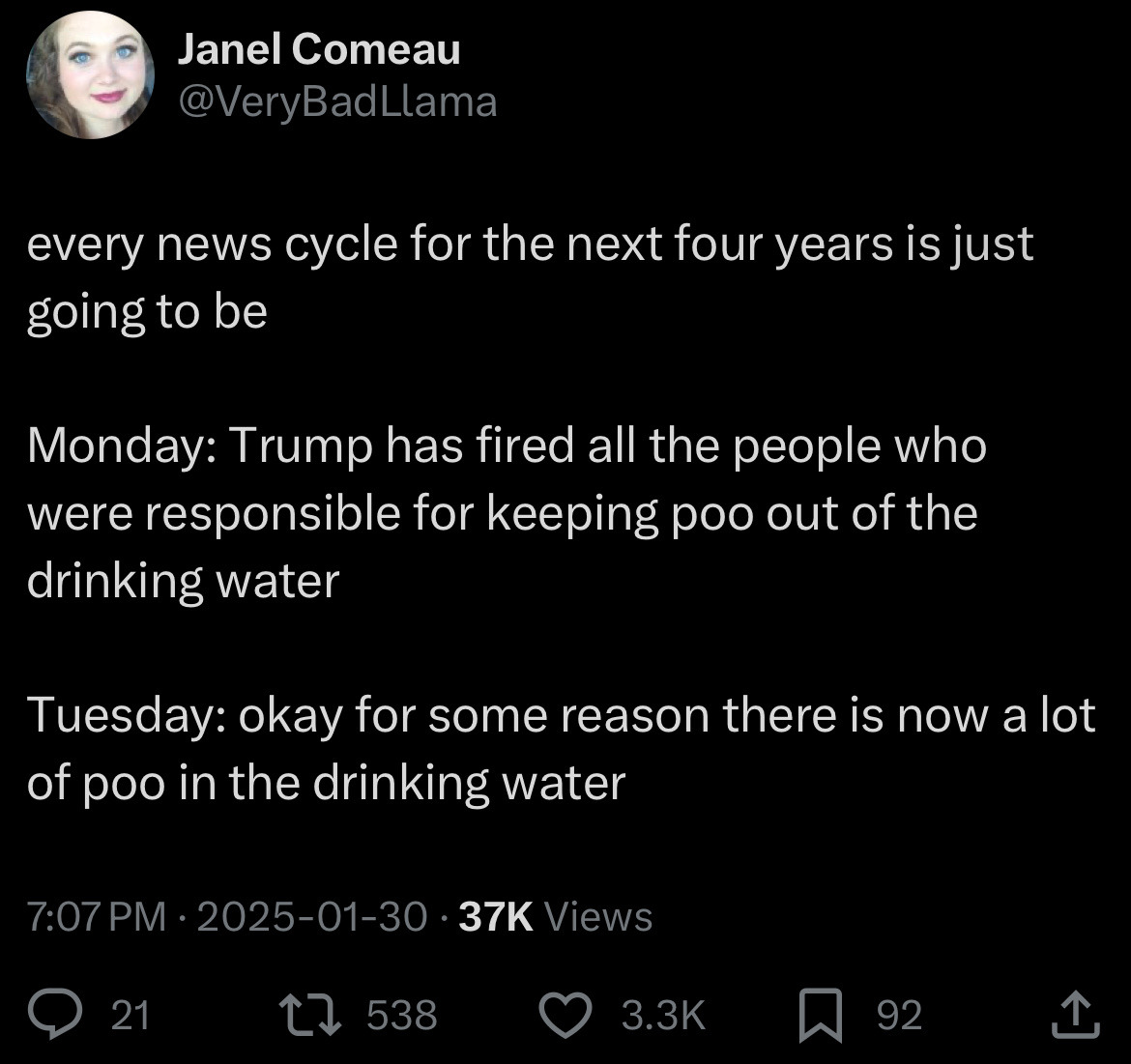
It won’t happen this fast, of course. While destroying Hinkley’s water supply, PG&E lied and manipulated for decades before the damage became undeniable. It will take years or decades to see the full extent of the damage if the Project 2025 Administration stops enforcing regulations that were designed to keep people from being poisoned by big corporations who don’t want to spend the money to clean up their own mess.
The federal government got bigger when the EPA was established because corporations got big enough to do serious damage to water and air. This year is the year that corporations win the arms race and get rid of governmental restrictions on pollution. The only thing individuals will be able to do (maybe) is sue after the damage is already done. If I have to choose between watching my loved ones die of cancer, or get a multimillion dollar settlement, I would choose healthy loved ones. Money can’t make up for the suffering that corporations will cause with their pollution.
If the federal government expects individuals to stand up to big corporations and their pollution, we need more remedies than just getting a pile of money after our loved ones die and our town becomes uninhabitable. Let’s put in place real criminal penalties for the Board of Directors and officers of big companies. If your company dumps chemicals in the water, and someone dies of cancer, all the senior officials at the company get convicted of murder and go to jail for ten or more years. Plus they have to pay out every penny of profit. If a company kills a person, that person’s mom should be able to kill the company.
Consumer Financial Protection Bureau
The CFPB was established by President Obama’s administration in 2010 in order to address the damage done to individuals when big banks and Wall Street crashed the economy in 2008. The CFPB takes on banks, credit unions, securities firms, payday lenders, mortgage-servicing operations, foreclosure relief services, debt collectors, for-profit colleges, and other financial companies operating in the United States to defend consumer rights.
Why does the government do this? Why not tell individuals to look out for their own rights? Because you don’t have any rights anymore. Check your bank’s terms and conditions. I bet you had to waive your right to sue and agree to mandatory arbitration in order to open an account. A big, ugly lawsuit can deter a bank from cheating their customers in a way that arbitration cannot. Check your bank’s terms and conditions again. I bet you waived your right to join a class action lawsuit too. Every financial institution makes you give up these rights if you want to open an account.
I’ll give an example that I know a bit about personally. In the early 2010s, if you got a car loan through Wells Fargo, Wells Fargo would sign you up for car insurance that you didn’t want or need, but you had to pay for it. In 2015, a class action lawsuit took on Wells Fargo in 2015 and won $80 million for members of the class. After that successful class action is when banks started inserting class action waivers in their contracts. In 2019, the CFPB forced Wells Fargo to repay people $385 million. The government can swing a bigger stick than private customers can. I saw those checks. The government forced Wells Fargo to pay back the money they scammed from their customers.
If your bank is scamming you, the CFPB is the only one that can stop them. The Project 2025 Administration wants to get rid of the CFPB. The big corporations just won the arms race against the government.
If the Project 2025 Administration is going to knee-cap the government and hand the win to banks, they need to give individuals their rights back. Pass a law saying that mandatory arbitration and class action waivers are invalid. If the government is going to get forced out of the arms race, individuals need their rights back.
Conclusion
I have no Mormon application. We could talk about how Church bureaucracy got big because the Church got big. But really, right now, I’m just tired. The people who cared enough to vote have spoken and the Project 2025 Administration is going to cripple the federal government. I don’t trust business to look out for individual rights. They never have. That’s why we have unions and a big sprawling federal government.
The Project 2025 Administration is changing the balance of power. Republicans need to acknowledge that and, since the federal government is being scaled back, more power needs to be given to individuals. Make it possible for a mom to get a CEO convicted for murder when his money-making policies kill her child. Ban mandatory arbitration and class action waivers so banks can’t scam their own customers without penalty. We need Congress to make it clear that big corporations can’t ride roughshod over individuals.
Personally, I would rather spend my free time embroidering flowers and let the government regulate pollution. But if I’ve got to start policing factories, power companies, banks, and Big Tech, I’m going to need more rights than I currently have.
Questions:
- Do you trust government more than you trust big business? Or do you trust big corporations more?
- Are there any government regulations that you know of that protect you?
- Since we are now drastically reducing the size of the federal government, how should we reduce the size and power of big corporations?
[fn 1] Trump’s job was to get people to vote. He did his job well. Trump is not actually running the country though, and so I’m not going to refer to Trump as if he’s the power broker with the agenda. On September 5, 2018, a member of the first Trump administration anonymously published an op-ed in the NY Times entitled “I Am Part of the Resistance Inside the Trump Administration“. The author said there were multiple people in the first Trump administration who worked to block some of the President’s worst and most destructive impulses. The Republican Party is well aware that his first administration did their best to ignore him, and they planned out what they’re going to do with Trump basically just being a figurehead leader to stir up chaos and distract people while they implement the 2025 Project. Anyway, this is now the Project 2025 Administration and all Republicans are equally responsible for it.
[fn 2] This post is not about global warming and if you spam comments with global warming hoax stuff, I’ll give you a warning and then start deleting your posts. I’m talking about the EPA’s original job, which was to enforce regulations for clean water and clean air. You can support that part of the EPA’s mission regardless of your thoughts on global warming.
 Wheat & Tares
Do you trust government more than you trust big business? Or do you trust big corporations more?
Are there any government regulations that you know of that protect you?
Since we are now drastically reducing the size of the federal government, how should we reduce the size and power of big corporations?
Cost / benefit is the question that must be asked of any government initiative. Pro-government advocates are excellent at promoting the benefits of laws and regulations. They are not keen on recognizing the costs. Few are interested in questioning efficiency and effectiveness. The trope of a cut in government spending causing people to die is repeated every election cycle, because it works. And the result is that American government is increasingly bloated and dysfunctional.
On the question of government regulation, one of the most important concepts to understand is how corporations use “regulatory capture” to punish competitors and secure for themselves higher profits. This is explained in a famous essay titled “Bootleggers and Baptists–The Education of a Regulatory Economist” by Bruce Yandle (1983). He points out that the call for regulations often is made by special interests who while seemingly in competition, are actually in agreement to help themselves. This creates a challenge for regulators to understand if the law is actually beneficial to society, or if public concern is being manipulated to favor a select group. Yandle writes:
“Bootleggers, you will remember, support Sunday closing laws that shut down all the local bars and liquor stores. Baptists support the same laws and lobby vigorously for them. Both parties gain, while the regulators are content because the law is easy to administer. Of course, this theory is not new. In a democratic society, economic forces will always play through the political mechanism in ways determined by the voting mechanism employed. Politicians need resources in order to get elected. Selected members of the public can gain resources through the political process, and highly organized groups can do that quite handily. The most successful ventures of this sort occur where there is an overarching public concern to be addressed (like the problem of alcohol) whose “solution” allows resources to be distributed from the public purse to particular groups or from one group to another (as from bartenders to bootleggers).”
There is opposition in all things. You can get anything you want in this life with money. Choose ye this day who you will serve, God or man. Let he who is greatest, Serve. Men (and women) are that they are to have joy. These are just a few axioms we live by as LDS members. They apply to the subject of Government vs. Corporations.
So who are the big players? Obviously Government is one because 50 Trillion dollars goes in and out of government every year. Corporations are also are also big players because of their size but they only come together in the market and that’s where their size is magnified. They are individual entities concerned about the bottom line above all else. Government has been used in the past to keep corporations in check but then over the past 50 years corporations have inched their way back by spending huge amounts of money to get it so government doesn’t regulate as much and they can make more money.
A Constitutional responsibility of the government is to protect us. It’s done that with foreign enemies but also in regulating larger powers (corporations or companies and even individuals) who can hurt us either financially, environmentally, or healthwise. Corporations of course don’t like this because it costs them money so there has been pushback. Government has an advantage because it’s centralized under one authority whether is state or federal (both have grown substantially for the same reasons). Corporations are more nimble, can do things in a decentralized arena and not be in public like government. In the past 50-60 years, corporations have been very successful in instilling distrust of government, weakening it, and getting a bigger slice of the pie for themselves because the two parties running government are so divided they can’t lead a divided society as well.
So it kind of boils down to faith. Who do you have faith in that can make it so we all get along and don’t step on each other. Where we can be free to be ourselves and everyone will be valued and receive services that all should have like housing, health, education, and a clean environment. Today it seems Democrats believe in government, Republicans being in Corporations, and religions are pawns to be used to sway the people but since most big religions have also incorporated they fall with the Republicans. If it were about right and wrong that would be one thing but it seems to be about money and power now. Lies, misinformation, hate, fear, and ignorance is the fuel that powers this battle. It seems in our country that the one with the most, wins, so that’s why so many want to strangle government. I think there are examples around the world where government has a purpose the people in that country understand (Denmark, Norway, and some other European Countries) and they do much better than we do in keeping things equal as mentioned above. Of course most in the church would cry “SOCIALISM” without really knowing what it is and that’s the end of that.
I’m a small government guy and so I should be very excited about the DOGE stuff going on right now. I should be looking at Musk as the savior who can do what nobody else was able to do. And as a former federal government employee who lived and worked in Washington, DC, I am very very aware of the kind of waste and redundancy that anti government folks complain about.
Having said all that, I am very concerned about the Musk / DOGE activity going on right now. First, it seems only semi-legal. MAGA folks like to pretend, for example, the USAID can be eliminated by the executive branch since it was set up via executive order (Kennedy). But they fail to recognize that it was codified into law by Congress in 1998. You can’t just cancel USAID. Second, it’s anything but transparent. Nobody seems to know what exactly DOGE is doing and what kind of access they have. Trump says he’ll pull Musk back when and if he needs to. The White House says Musk will voluntarily pull back if he sees a conflict of interest. Does anyone believe this?
I am amazed that people (mostly MAGA but also some mainstream Republicans) put so much trust in people (Trump, Musk, etc.). I don’t trust anyone: not Biden, Harris, Trump, Musk, the Q15, corporate America. I’m not paranoid. There’s just too much evidence out there for me to believe that we can trust non-government hacks to fix the system. Is there anyone reading this who doubts that Trump will offer across the board pardons to any DOGE guy who abuses his access and gets caught?
We need reform, yes. And I’d love to see the federal government get smaller. But we have to be transparent and we have to be legal. Otherwise we are replacing waste and fraud with corruption and greed.
i would rather our society be controlled by a responsive government than corporations. And yes, up to this point, the U.S. government has been largely responsive.
The thought of Trump as a figurehead while others behind the throne are manipulating outcomes is scary. A take-over (coup?) by Musk and the billionaire techbros is scary.
I hope we don’t become like Russia, where criminal oligarchs are in charge
josh h – I would like a government big enough or small enough to get the job done and no more. How big that is depends on what we think is important like the environment, health, equality, etc.
DOGE on the other had is plain wrong. Setting up an agency and giving that much power outside the Constitution is a recipe for corruption. It’s the Congress’s responsibility to monitor government but with the Republicans lockstep with Trump, Congress will abdicate it’s responsibility, another sign of corruption and abuse of power.
I understand the need to curtail waste and that there is waste to be taken care of. I also sort of understand not trusting anyone but there’s a big difference between not trusting them because they are doing things like Trump (lying, bullying, misrepresenting truth, etc) and people who the church has said are untrustworthy like ETB and others have preached about the Democrats. All men (and women) have their problems and any government is a government of men and women but the sides are not equally bad. Today, one is much worse than the other and you can either fight back alone or with a group that is a bit better which is willing to at least try to do what’s right. Your last paragraph is perfect!
Instereo – I don’t care for the DOGE clique hype, but all citizens should favor an independent accounting of the Federal government. And this is all DOGE can legally do. Any firings or cutting off of money will ultimately have to be approved by Congress.
The current Federal Budget expires March 14, 2025. In the next 5 weeks the DOGE team of Elon Musk is going to generate all sorts of noise, but also data points, of where the Federal government spends money. The US Congress will then get to decide if they care and Trump can decide if he cares to veto what the Congress approves. This DOGE exercise could be all smoke and by the end of March, Mr. Musk might be back to making cars and launching rockets and nothing will have changed with Federal government spending or debt.
I am neither a Republican or a Democrat. I side with George Washington who correctly labeled party politics as a threat to the Republic. I want responsible and accountable government. I challenge anyone to defend the current American Federal government operation as responsible and accountable. Would you give your teenager a credit card with a million dollar credit limit and the advice that they could spend whatever they wanted where ever they wanted? For that seems to be what the current American government does, only the annual spending limit is $6 trillion dollars with $2 trillion dollars of that spending put on the nation’s “credit card”.
I realize it’s not super helpful, but I don’t trust any of them either, although it’s on a sliding scale. I do think there is waste in government, things like dumb rules that got set up along the way, but I also believe that up to now, many government employees really have been just trying to do a good job for the public good. There are also some individuals in the private sector who do this. But in both cases, the ones in charge of the purse strings are prone to corruption, especially given that politicians in our system can be bought and sold by large corporations. Privatizing still keeps the control in the hands of those exact same large corporations. We know what they’ve done with healthcare. We are literally watching a new form of paying POTUS bribes by settling frivolous lawsuits in his favor, lawsuits that should never have been brought in the first place. It’s just one of the 999 things we’ve seen in what feels like the longest presidency in history but has really only barely outlasted the cilantro I bought over the holidays.
Musk in particular is a terrible person. He has malign intent. He is not in any way trustworthy to receive a broad security clearance, and he has proven again and again that he does what promotes his own business interests, not the public good. He deliberately spreads Russian propaganda and disinformation, even when he’s called on it. The Nazi salute should have ended this, but of course it didn’t because a whole lot of MAGA people think Nazis are “fine people.”
The loss of regulatory agencies is definitely going to create downstream problems for all of us, and yes, many deaths (as is the failure to really address the problems in the US healthcare system). I do think there is potential for AI to eliminate or streamline some government functions, but AI is also prone to error still (the results in healthcare were horrible).
Sure, there are some aspects of regulatory agencies that could be trimmed (which is very hard to do in half measures, I will concede), but it’s definitely a problem to go in, shut it all down, and say everyone should quit. Look, I’ve done hundreds of layoffs in my career, and if you offer a voluntary severance instead of doing the work to figure out which jobs are redundant, you only lose the top performers who can get a new job easily and those who were already going to leave, but will now take a bunch of money on the way out.
It won’t matter anyway. The people I know who are still pro-Trump are doubling down and believing easily debunked lies that support the actions Musk and Trump are taking.
Love that last comment. Laughing the whole way through that last paragraph. When I’m looking for a charicature of a libertarian, this is what I think. Thanks for the laugh.
Oops, comment for A Disciple, obviosly, not Hawkgrrl.
Brian,
Can you provide substance to your comment? On what basis do you conclude I am “Libertarian”. I do not label myself a Libertarian, have never voted for the Libertarian party and I find much to criticize about Libertarian politics and policy.
And to all who are down voting me. Do you want the governments exercising authority over you to be held accountable? If data shows the public’s money is being misspent, should we not welcome that information? Up through the end of the 20th century, both Republicans and Democrats said they cared about government spending and debt. Were they wrong? What happened that in 2025 we should no longer care about how the government spends money?
Sure can, A Disciple: it’s that lovely, “I’m above it all” when it comes to parties attitude. It’s that oversimplification of how government works (or rather, doesn’t work, according to them); it’s that arrogant, “I’ve got this figured out and the rest of you can’t see what I see” attitude. Every single libertarian that I know, and I know a lot of them, all have three things in common: 1) a much bigger opinion of their own intelligence and understanding than evidence would support; 2) a oversized focus on money; and 3) some sense of feeling personally wronged in their life some regulation or another. Don’t know about you and the third one. Also, though, that whole idea that nobody else cares about spending is so libertarian, and wrong. Cheers!
I am surprised that no one yet has mentioned the thing corporations fought first, before even government regulation. Well, some of you are too young and to remember when unions were strong and gave common workers a voice and the power to fight corporations. So, most Mormon were taught “unions are bad” to realize what unions do. They protect workers. They make sure workers have a living wage.
So, when Janey asks what we need to have to give rights back to the common people, we’ll, we need UNIONS.
If you have questions just study your American history about working conditions before unions. Unions are responsible for minimum wage and child labor laws and other worker’s rights. Just think what a union of all bank customers could do about that business of signing away our rights to sue the bank for losing our money. Just think what a big union of government workers could do to protect workers from Musk’s massive firing. My daughter and son are both IRS workers and are afraid for their jobs. But the unions got gutted years ago by corporations and because unions became a “bad” thing, the government workers are restricted in their powers to form unions. It should never be against the law for common workers to watch out for their rights.
Brian,
In my responses I wrote that I favor regulations that are sensible and serve the common interest of society. I wrote that I want the governments that hold authority over me to be held accountable. I wrote that this March Congress and Trump – the fairly elected representatives of the people – will need to agree on spending levels for the rest of the year. Elon Musk will not decide how money is spent. The US Congress will approve budget legislation that President Trump will sign. I also wrote that I have general distrust of corporations and that I disagree with the privileges and immunities government currently gives to corporations. I recommended reading the article on “Bootleggers and Baptists” to gain insight on how regulatory law can be manipulated to favor special interests.
Brian, you responded to none of these points. Do you agree with them? What about these opinions do you disagree, and why?
And to the forum, I participate as a guest with the intention of contributing to the conversation. When I fail to do that, please call me out! But when I speak of favoring the advice of George Washington, when I speak of wanting a government that is accountable to the people, that is as an accurate statement of my beliefs and I would never expect that opinion to offend anyone.
A Disciple, oh, I assumed, as you wrote: “Can you provide substance to your comment? On what basis do you conclude I am “Libertarian,”” that you wanted me to respond to my comment about Libertarianism.
Agreed. Not sure anyone would disagree with that. Well, except some Trumpers and almost all elected Republicans right now who don’t seem to care that Trump is overriding their Constitutional respsonsibilities.
We all hope. Again, though, clearly not everyone seems to care if Musk is involved and seem happy to let him, indeed want him to. See my comment above.
Agreed again. One side, however, is even more in bed with them and provides more favor to them than the other. Hint, their party starts with an ‘R.’
Agreed again. So, finally, as I wrote initially, it was your last paragraph that I found to align so much with a caricature of libertarians.
Brian, you’re off-topic. Please participate in the discussion that I started in my post, but please stop trying to convince Disciple that you know him better than he knows himself based on a couple sentences.
I read a brief essay a while ago about how to pinpoint differences of opinion to make the discussion more productive. The author pointed out that it helps to find out if people disagree about whether a problem exists and what it is, or if people disagree about the solution.
What I’m drawing from these comments is that we actually have a lot of the same concerns about the same problems. We all agree that government and corporations should be accountable for their actions. Fraud and waste are bad. Some regulations are a great idea (building codes) and some regulations are not a great idea. Government employees are not the huge problem that the Project 2025 Administration is trying to say they are. Oversight is necessary. Bad oversight is bad. No one is entirely trustworthy. Throwing away the entire executive branch and starting over might not be such a great idea.
I have a story about perceived waste. Years ago, there were some news stories freaking out about the military buying $10,000 hammers. I had a chance to talk to someone in the military who knew about procurement contracts. He said the $10,000 hammers are part truth and part incorrect. Like, say the govt wants to buy enough hammers to supply the military for the next 10 years. The govt doesn’t want a shipment of a 10-year supply of hammers all at once. Instead, they want X number of hammers per year for the next 10 years. The contractor, who is going to have to custom make the hammers (hammers are a simplified example), needs the money up front for the specialized equipment. So the govt signs a contract that front loads the cost. The govt pays $10,000 per hammer for the first year, and then the cost gradually drops until by year 10, the govt is getting 50 hammers for a $1. Ergo, the contract actually makes financial sense, but the news story wanted to outrage people.
There are fraud and waste, I’m not disputing that. But I dispute the idea that a news story that’s trying to get you outraged is going to accurately explain what’s going on. The govt has whistleblower laws that encourage employees to come forward if they see fraud and waste. I would rather hear about that. How many people come forward? What are they reporting? What do those investigations look like?
And back on the main topic of the post — the Project 2025 Administration has a lot of plans for knee-capping the government and regulations, but I haven’t seen any plans and promises about how to limit corporations. That’s a big concern for me. Anna is right that unions can fill some of that gap, but not every employee is covered by a union. And consumers don’t have a union. I see a lot of ways that people can be hurt if nothing curbs corporate power.
Federal employee here. I have spent the last 18 years of my life serving in the federal government. I have worked for both Republican and Democratic administrations, faithfully advancing and supporting policies that I personally have not always agreed with. I have lots of other options. I could walk away from my job to a higher paying private sector position today, but I don’t. Why? Good governance matters. Americans take for granted what we have. Security, stability, infrastructure, rule of law, predictability, public-funding of innovation, and many other tangible and intangible benefits that come from well-functioning governments at all levels. I can make a difference that improves the lives of others and benefits society more generally. Frankly, it is inspiring to work alongside so many honest, dedicated, and hard-working Americans who make up the federal government.
I am the first to admit there are inefficiencies and waste. There are also people who could work harder. (I could give you a list of people I personally would fire…it’s pretty short.) These individuals are the exception. I have also worked in the private sector for family-owned businesses and larger corporations, and waste and laziness is just as–if not more–widespread.
Politicians bemoan waste, fraud, and abuse in the federal government. This is rhetoric. If it were as bad as they claim, they’d fix it. It’s easy to vilify “bureaucrats” because most Americans don’t know them personally or take for granted the service we provide. Congress appropriates our spending and has extensive oversight into how we spend the resources. They can and do request information on spending, programs, and outcomes. Departments and agencies willingly–if not eagerly–comply, because the people who work in government are proud of what they do, want to have a positive impact, and know that they are entirely reliant on congress. The White House also has great insight into how money is spent. There are countless internal checks on spending, and money does not get redirected in the ways the media and political pundits claim.
It has been disheartening to watch what has happened since Trump took office. Musk’s actions have been lawless and destructive. I fear they will make government worse by driving out the dedicated workforce and attracting people who are loyal to one party.
There is a debate to have about the size of government. Both parties need to show up and be honest and compromise.
Yes Anna, Mormons tend to be anti-union. And yet, Mormons love newsies. I guess it’s unions for hot boys who can dance, but not for the rest of us.
I agree that we have government because we are a big country. I’ve pondered several times what it would be like to live in Switzerland or Sweden where the land and people you govern is more manageable. These countries also don’t attempt to police the world and are good neighbors to their bordering countries. It would feel for to paying taxes into that system where you can probably see the benefits. These countries also US is big. The US meddles in world affairs (apparently Israel wants us to build them an Atlantic City).
I’ve said this before but it never gets old. My parents are retired public school teachers. My brother had been with the BLM 31 years. My college roommate has worked for veteran affairs for 16 years. My BIL is retired UHP. They loved their jobs and always do their best. They don’t deserve to get a email titled fork in the road from Elon musk. The only government employees that seem to be the problem are the elected types.
gah with the autocorrect in my comment. Stupid Apple platform. See? Even public companies make mistakes.
We have a large federal government because of expediency. The first form of government for the US was The Articles of Confederation, which created a weak executive and judiciary. It was a complete disaster. Everyone knew that. So they created the Constitution still in existence today which changed the US to a federalist form of government from a confederacy. The judiciary expanded in the early 1800s particularly as a result of McCullough vs Maryland which ruled that the states couldn’t interfere in federal government affairs when the federal government was using implied powers. The federal government strengthened as a result of the Civil War to help keep the is together. WWI and WWII put an end to isolationism. Post-WWII reconstruction required a good amount of government intervention to build the middle class and end Jim Crow. Government expansion in the US and many other countries has led to human flourishing on unprecedented levels. This expansion has not inherently crowded out private expansion, but has enhanced it. A dangerous anti-government phobia that has seized do much of the right-wing is a threat to progress. It is ironic that the right-wing is fine with Trumpist and Muskian authoritarianism to destroy this boogeyman of the deep state. It is pure delusion. They’ll destroy the economy. Destroy the structure of everything that we’ve taken to build in just a couple of years.
Musk and DOGE are not elected so what the H are they doing disrupting everything because Trump said they can. Where did he get the access to emails, the Treasury, and be able to hire a bunch of young thugs to intimidate Federal Workers. Congress is elected and is supposed to do the same thing that DOGE is now doing. Why are they not doing it? Doesn’t Trump trust his trifecta majority in the executive, legislative, and judicial branches. This is about authoritarianism, that’s what Trump trusts and the rest of the Republican Party is rolling over and letting him, encouraging him, and blaming the Democrats just to keep everyone blind to what’s really going on. You can say both parties are equally bad but that’s not true now. Trump’s party is clearly a threat and danger to the Constitution and the American people who believe in truth, justice, and liberty for ALL THE PEOPLE.
I’m a senior manager at the bank referenced in the OP. I’ve presented to the CFPB. Let me say – I’m liberal politically – but I’ve seen stuff at the CFPB that would make you scratch your head. Bankers know 10x more than their regulators, to the point of being embarrassing. The CFPB has incentives to find even the smallest infractions – or questionable ones – because its budget comes from the fees it collects from financial institutions who have no recourse but to pay. I would wager that some regulators sit in their bathtubs with a glass of wine wondering how they can get more money from the banks. And btw the consent orders are in the public domain. Wells Fargo had more than 10 for several billion dollars total.
That said, large banks have enormous power. They have the life savings of their customers in their hands and if the bank is poorly managed or fraudulent, the customer wouldn’t have any recourse prior to the CFPB, which is designed to err on the side of the consumer.
The thing that many people don’t understand is that you absolutely *do not* want governments to behave like businesses. That is to say governments shouldn’t maximize profits. They have monopoly power by definition and you don’t want the water company or the fire department or the army extracting every possible dollar from the people they serve. The people desiring Trump running the federal government like a business are asking for, and will get, a big disaster.
S – thank you so much for commenting! The way rightwing propaganda has vilified federal workers is unfair and untrue. There is a lot of idealism in a workforce that chose to make less money because they believe in the rule of law.
I’m going to paste part of your comment in here because I think everyone should read it twice:
I worked for the judicial branch for a few years. Two points I want to make. One is how much I enjoyed choosing to spend time on a problem depending on whether it was right or wrong, not depending on how much money I could make. A woman got through our phone tree and connected with me. She had a $300 problem. I spent almost four hours solving her problem. In private practice, no way could a lawyer spend four hours on a $300 problem. Sure, lawyers are supposed to do pro bono work, but her issue wasn’t a typical pro bono case. That $300 mattered to her because she was poor. That $300 was more important to her than the million dollar case (that I worked on after I finished helping her) was to the CEO of that company. Government employees can do the moral thing without worrying about churning enough fees to pay their salary.
Second point was about the lifestyle. Propaganda is also wrongly accusing govt workers of being lazy because they like teleworking. Total lie. Teleworking is fabulous. But my particular point is about holidays. The court I worked with would not schedule hearings between Christmas and New Years. They also wouldn’t schedule hearings the day before Tgvg. That allowed the private practice lawyers to take holidays. It was a civilizing pressure on the private workforce. People SHOULD get holidays. And by refusing to work through the holidays, the government (the court), helped with the worklife balance of the private sector too.
We owe government workers so much. Thank you for your work, S, and thank you for your comment.
Anonymous:
I like your conclusions. It makes me think of the one “business” mentioned in the Constitution, the Post Office. Nowhere is a profit mentioned. It’s about service. Making sure the mail is available to rich and poor, urban and rural. Republicans with their business approach to everything governmental are perfectly willing to cast away the people on the margins because it’s to expensive. Some may look at providing mail to someone deep in the wilderness of Alaska not worth the cost (you could replace this with areas in any of the states) but that’s the responsibility of government, service to all regardless of station.
The same could be said for Amtrak because the government nationalized passenger rail travel but at the same time tied its hand with restrictions on tracks owned by freight lines and the constant oversight and pressure to turn a profit. Hence what used to be accessible by many is now only available to a few.
Wasteful spending for business is pretty easy to define. Does it contribute to the bottom line, yes/no? But, wasteful spending for government is harder to define because the bottom line should be service and equality. Five hundred dollars for a hammer seems really easy to call wasteful but if you don’t know what it’s for and the requirements it needs to meet, say to put someone in space, then it might be a bargain. It’s a lot easier to jump to a conclusion than it is to find out the reason behind decisions.
Anonymous – thanks for commenting. Like Instereo, I’m glad you brought up the dangers of trying to run the government like a business. Government is not supposed to turn a financial profit. Govt is supposed to use tax dollars to make life better for the citizens, whether that’s a post office that delivers to everyone, regulating businesses to ensure clean water and air, building roads and so on and so forth.
We all saw what Elon Musk did when he took over Twitter. He fired people without considering whether their roles were valuable or if they were doing a good job. He messed up a whole lot of corporate functions. He delivered a worse product and the value of Twitter has cratered. Now, we can all admit that Twitter has long had its problems, and it has, but it was also a community that people came to rely on. Official accounts could release statements and explanations directly to the people. People found friends, artists cultivated patrons, there was public discussion. Musk made all that significantly worse and then sued advertisers for not wanting to advertise on X.
Now Musk is using those same tactics on the federal government. Billionaires are bad businessmen. They exploit their employees and wring every last penny out of their customers while delivering a product that gets worse every year. I’m appalled that the Republicans have let him in to wreak havoc and I hope he gets thrown out soon.
Hey and … about your comments regarding the CFPB. You acknowledged bank customers would otherwise have no recourse and I appreciate that. Perhaps the banks know their regulations better than the CFPB; I have no way to check that. But the CFPB doesn’t need expertise in bank regulations to know that billing customers for unnecessary auto insurance is bad and Wells Fargo should pay that money back. I don’t know how much in fees the CFPB collected from Wells Fargo for that action, but I do know that I saw the checks written to the individuals and they were for thousands of dollars.
The banking comments are extremely salient. It’s true across many industries that companies probably understand the regulations better and that there are dumb incentive structures for government agencies. But at the end of the day, I don’t want my bank to defraud me to increase profits or to sell my personal information to third parties or to increase my fees to exorbitant levels without any oversight or limit.
A new concern that’s coming up is that when a judge was asked to determine if Musk & the DOGE-bags working for him had been given direct access that allowed them to make changes, they lied to the judge, claiming it was “read-only” (as if that would prevent any of these brilliant fascists from doing what they want). They already accessed confidential records, they even rewrote code in the system, but they just lied to the judge who believed them. The current administration is acting in a lawless manner. They will do whatever they want, and if it’s illegal, well, what are you going to do about it? Nothing, that’s what.
@Janey
I probably unintentionally implied that the bank didn’t deserve the penalties it received from the CFPB. I also should have said that while imperfect, the CFPB is a net positive for consumers. An attorney friend of mine left the bank to work for the CFPB and when I asked her about CFPB issues she said “sure… but you have to start somewhere and it will get better.”
I’ve had two positive experiences as a consumer with the CFPB. You can complain on the CFPB website and it’s virtually guaranteed the bank in question will contact you back to try to address the issue.
I’ll tie this back to the LDS by saying virtually all the institutions I grew up trusting have proven themselves untrustworthy. Boy Scouts of America (sexual predator shielding), LDS church (so many issues), USA which is evolving into the Fascist States of America. Between the BSA and LDS I was literally taught that God was steering the country. God is nowhere to be seen.
America does not have a particularly large public service. They make up 15% of the workforce, compared to Australia, 29%, Sweden 30%. Partly this is explained by other governments supplying services like universal healthcare. So in Australia most nurses are government employees.
I am always amused by people saying small government is desirable.
The easiest example is beaches. In Australia all beaches are in government ownership so open to all the public. Local government provide service in the background to beaches such as life savers, toilets, often change rooms, electric and free BBQs, showers, and foot washing sites. My state has 8000k of public beaches.
Last time we were in America we went to Florida where we had to go to a tourist information office to ask where we could find a beach we could go to. There was a public beach 20k down the road. It was 100 yards long, had no facilities, and had a fence at each end where a private house began.
Which is better for the public? Small government?
There have obviously been many experiments in the 1900s that have given very valid reasons for people to fear governments. Nationalist socialist and communist experiments were truly frightening, with governments abusing power to extremes and using all sorts of threats of force to engage in megalomaniacal social engineering projects. The governments of most countries around the world are corrupt, inept, abusive, deprive people of rights, unaccountable, steal money, and are probably a massive impediment to progress. That said, it is a wonder that the governments of OECD countries work to a high degree. When governments are held to standards of accountability that is kept in check by independent agencies, some level of transparency (obviously governments need to keep some information secure and secret), and have a well-functioning system of checks and balances, it doesn’t matter the amount of social spending they engage in. So libertarians are right in calling out the potential of government to become corrupted. However, too many libertarians get carried away with taxation and spending. Accountable checked and balanced taxation and spending is perfectly fine, even at high levels. What libertarians should be focusing on is transparency. And with DOGE being able to make its decisions without transparency and accountability and Trump firing independent investigators whose job is to keep the government in check, we should be extremely worried.
In December when a government shutdown loomed, Musk threatened to fund opponents to any Republican Senator or Representative who voted for continued funding. That has long a tactic the Republicans use (thanks, Grover Nordquist). It wasn’t so blatant before, though.
That mocks democracy.
It’s become normalized.
I thought it might be interesting to compare government debt as a % of gdp for Australia, Sweden and USA. Australia34%, Sweden 32.2, USA 112%. You would think that countries with big government would have big debt too. But just the opposite.
Geoff-Aus:
Thanks for your comments. I’ve often said that if you add up your taxes and healthcare costs you’d get a better representation of what we really spend to live in our country. It seems that all the countries that have better health than the USA does, have a nationalized (universal) health care system and lower taxes compared to the USA’s tax and healthcare costs.
One comment on debt. The rich get tax cuts which contribute to the debt but the debt is financed by loans from the very people that got the tax cuts. So, these rich people and companies get more money from both the tax breaks and from financing the debt. Us normal people end up paying more in taxes and getting less services and are made to feel guilty about any services we receive.
Anonymous – thanks for your follow up comment. I agree with you.
Hawkgrrl’s comment about judges believing lies brings up something that will be more and more of a problem. Rightwing propaganda has done a lot to tear down respect for the judiciary. It’s hard to enforce penalties for perjury.
And how does a court enforce an injunction? I see news stories about courts issuing an injunction to block something that DOGE is doing (for example) and I don’t know how anyone is enforcing that, or even monitoring that. If DOGE ignores an injunction, keeps doing what they’re doing, and then tells everyone they’ve obeyed the injunction … then … i dunno. The executive branch used to obey injunctions but I don’t trust that’s happening anymore.
Janey: We’ve heard in the church about a person becoming a law unto themselves. That seems like the perfect definition of Trump and those that support him. It spell trouble for the rest of us.
As of the moment of this posting, there is a US wide recall of donuts, due to Listeria contamination, 2,000,000 suspected. And, an explosion & fire at a chemical plant in PA has injured 4 firefighters. Just today. But, there’s also Elon Musk calling for “wholesale removal of regulations.”
A number of safety regulations are written in blood, yet there’s whining that it’s too expensive. Some of you have heard of the ill fated drugs Thalidomide & DES. Would eliminating the FDA be worth the human cost of having such disasters be repeated?
Fire, chemical, pipeline, & aviation safety rules are often written in blood. Should we go backwards on those regulations, just to save a big shot a few nickles?
The banking comments are extremely salient.
In my lifetime, there’s been S&L scandals of the 1980’s & 1990’s, then the sub-prime mess of the 2000’s, both causing havoc to a number of people AND the taxpayer. I would have been cheaper in the long run to have regulations to prevent such things beforehand.
It’s also interesting that DOGE so far has not looked into defense contractors.
Janey:
Really…..Really…..are you going to attempt to defend the outrageous, greed driven, corruption tainted, uncontrolled spending that is now being discovered – and dragged into the light of day? Our country was – and perhaps still is – headed for financial collapse and disaster; and we whine about cutting spending? What insanity! We’ve all gone bat sh*t cray, cray.
Judging by the absolute lack of verifiable details on all of these supposed savings, it’s hard not to conclude that the thing that continues to be outrageous, &c., is the rhetoric spewing forth from people who, contrary to law, have taken a cudgel to U.S. institutions.
These words from Moroni 7 strike me as relevant, given the untruths that are being dragged into the light of day:
The Federal Budget for 2024 is 6.75 trillion in spending with a Revenue of 4.9 trillion, leaving a deficit of 1.8 trillion. One percent of that kind of budget is 675 billion. From what I’m seeing on the news with Musk, he’s saving a few hundred thousand here, a million there, but the overall total amounts to tenths of a percent on the dollar. In other words, the big spending is on defense, and it’s not even being looked at. Another large source of expenses is social security but it has payroll taxes that support it and cutting there hurts the very people that have paid into it. The welfare that people get so upset about paying for is now basically a state expense, with the federal government paying very little. So what Musk is doing is not really saving money but unfunding programs that protect US citizens. He’s at the front of an ideological war with Republicans letting him do it because they both agree and are afraid to stand up to Trump. The bottom line is that the American people are not saving very much money but they are losing their freedom and Constitutional protections with no pushback from those who were elected.
The Washington Post is doing a series on the type of people working for the federal government and the service they provide the American people. Here’s a link that should allow you to read the profiles without a subscription. (If it doesn’t work and folks are interested, I can post individual gift links to each profile.)
https://wapo.st/3QnbVrs