
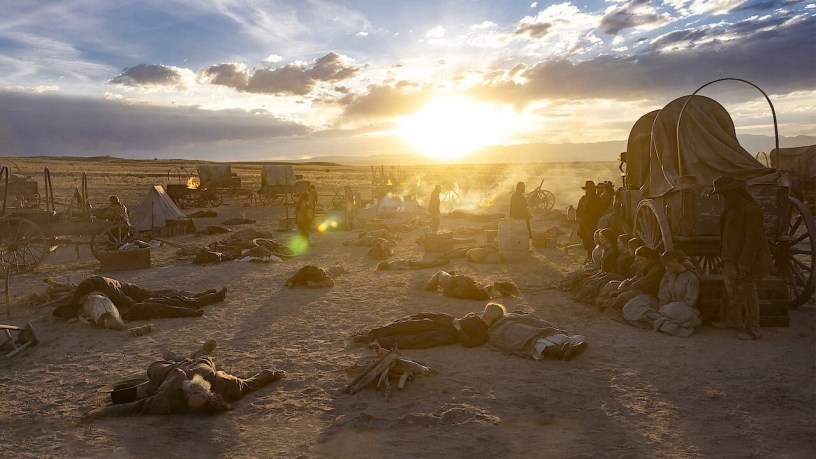
Netflix recently released a series called “American Primeval. First things first: Even though the word primeval is pronounced “prime evil”, and there was plenty of evil in the Netflix show, the word primeval actual means “of or relating to the earliest ages (as of the world or human history)” (You know Bishop Bill is a Mormon when he starts his post/talk referencing the dictionary definition of his topic!)
My wife and I watched the series this last week. It is set in the 1850s Utah and Wyoming. It is a fictionalized version of real life events that happened including the Utah War, the Mountain Meadows Massacre, and the Mormon interaction of the with the Shoshone and Paiute Indians.
There will be spoilers in the below review, but I’m not sure saying the Mormons killed a bunch of innocents immigrants from Arkansas is a spoiler to the astute readers of Wheat & Tares. After we watched the show I listened to a podcast that had Barbra Jones Brown as a guest. Barbara is co-author of Vengeance Is Mine: The Mountain Meadows Massacre and Its Aftermath, and is one of the foremost authorities on what actually happened. Also on the podcast was Darren Parry who is a historian of this time period of Utah at the University of Utah, and he is a Northwestern Shoshone. They both watched the show and gave their review on what show got right, and what they got wrong. If you are at all interested in the history behind the show I highly recommend listening to the podcast which can be found here. Most of my comments below are taken from this podcast.
The Netflix show is very violent, but the biggest takeaway for me from Barbra’s comments was that the actual Mountain Meadows Massacre was much more violent that what was depicted on the TV show. On the show the Mormons wearing masks and a few Paiute storm into the camp, kill the immigrants from Fancher party, and save a few women to give to the Paiute. In reality, they tried to take the cattle, the Fancher party fought back, and the Mormons laid siege to them for five days. The Mormons then realized that the Fancher party could identify them, so devised a plan to kill them all. The Mormons told the immigrants that if they laid down their weapons, they could offer them safe passage past the Paiute. Once they had laid down their weapons, the Mormons then killed every man, woman and child, going through after and putting a bullet in the head of anybody still moving. The only survivors left were babies and toddles who “couldn’t tell the story”.
There is a lot of Jim Bridger in the show, and his Fort Bridger, with Brigham Young trying to buy the fort to keep the US Army from using it. In reality by the time Mountain Meadows happened, Bridger had already sold the fort to Young, and the Mormons had burned it down to keep it away from the Army. Other errors in the show was the travel from Fort Bridger to Mountain Meadows, which is over 400 miles, but appeared to happen in just a few days on the show.
Lastly I’ll say that Darren Perry said the Shoshone and Paiute never had any interaction like was shown in the TV show. They were too far apart. Also the show had the Paiutes offering women they kept alive from the massacre to the Shoshone. Darren said none of these tribes ever took women to rape and kill, and this is just the same old Hollywood trope that Native Americans are savages.
There is so much more, and I again recommend listening to the podcast if you want the whole “real” story.
So, have you watched the show, and what did you think of it?
 Wheat & Tares
“whole” real story vs. “whore” real story? 😉
I watched the Netflix show & the MS review. I do not like violent scenes in movies and this had a lot! It is amazing what CGI can produce, but it is not my style. I defiantly would not want to be present during any war or massacre. I also prefer movies stick to the historical narrative, and according to the historians there was no need to leave the actual history of the MMM for script’s prerogative. It sounds like the director was enamored with Jim Bridger and inaccurately inserted him into the script and other fictional choices.
In 1978, SWK renewed the call for great Mormon films. “Writers, our motion picture specialists, with the inspiration of heaven, should tomorrow be able to produce a masterpiece which would live forever.” TBMs relish in: God’s Army, Cokeville Miracle, Meet the Mormons. Tapir’s look at: Keep Sweet Pray/Obey, Murder Among Mormons, Heretic.
The one movie we have all seen is the temple movie which has not lived on “forever” and now regressed to a slideshow.
Tomorrow is here with more frequent reference to LDS topics in media. Most TBM’s are calling them anti-Mormon when they are Hollywood productions or even based on the actual history. If the church wants the most accurate story of the MMM, they should produce their own movie, but that would not be faith promoting. The LDS culture has now morphed to paying for Jesus family portraits and LDS social media influencers dominating portions of tiktok. The long term damaging effects of on kids and families with Facebook depression should be discussed in church, instead of platforming for missionary purposes and a side-income. Imagine 10 years from now, kids asking why it that long-haired guy in our family picture?
https://www.wsj.com/lifestyle/careers/christmas-jesus-model-utah-lds-mormon-religion-3a1893f6 (you can listen without the paywall, or search NY Post article)
In the end, it is a competition for survival, influence, and power. The 21st-century markers are $$, number of SM followers, most important calling, and “blessings”. The 19th century pioneers and indigenous populations were also in a fight for survival and control, without SM.
Instead of creating Zion and working on self-control, mankind with its’ power structures create systems of authority over other individuals, which is not Christ-like.
As far as I know the producers and creators of American Primeval never claimed that this was an historically accurate depiction of events. So that gives them license to take some pretty broad swipes at these stories that are based on some actual people and places.
But former Mormons like me are irritated at this production. We recognize that the truth about Brigham Young all by itself is horrific and it’s a story that needs to be told. So when someone uses his name to tell an
exaggerated version of things it provides the TBM class with ammo to list this as more “anti Mormon media”. That then perpetuates the LDS persecution complex narrative.
So no, I didn’t bother watching more than one episode once I researched this. I’ve spent enough time in my life getting into made up stories. (Note: I enjoy fiction too but not in this context)
Thank You Susan Brown. It wouldn’t be a Bishop Bill post without a typo! Fixed it!
Here’s what I learned from the first episode:
I will not learn anything from the later episodes because I will not watch them. It’s just violence for the sake of violence. There are no good guys to root for and no actual history to learn.
This post points out an absolutely crucial point. The modern entertainment industry has an open and stated agenda of promoting violence, substance abuse, and wanton sexuality. This so-called series is a prime example.
Modern Hollywood portrays church as a burdensome institution to be scorned and ridiculed. Indeed, Hollywood treats church as something to be avoided at all costs.
This so-called series portrays all religious people as violent psychopaths bent on destroying any who disagree. It presents the idea that democracy unkempt, free love is better than thoughtful introspection.
Unfortunately, an impressionable public has begun to imitate what is shown on television and movies. As a result, the rates of drunkenness and disease are skyrocketing.
The irrefutable fact is that most religious adherents live a life of moderation and want to do what is right. Ande we need more people have live in moderation and fewer who follow the Hollywood example of acting like unsupervised Russian Princesses.
I may watch the show, but I’m not interested in an interpretation of the MMM. Having visited the site 4 or 5 times and read the history both there at the site and in the books that have been written to both expose the atrocities or to cover them up, I have my own observations.
It was a Mormon overreaction of vengeance twenty years after the wrongs imposed on them in Missouri. The connections to the people in the wagon train were vague, weak, and overblown based on the same kind of dialog between divergent groups we currently have on Facebook.
The Native Americans I doubt were really involved but used as an excuse.
Overlooking the area where the blockade and massacre took place shows a degree of cruelty that’s hard to imagine. They looked at each other, either fearing death or getting up the courage to impose death. When the action started, it was through and complete. They may have saved the young children just so they could look in the mirror and not see how completely depraved they were.
Standing at the monument and looking over the field and seeing all the homes in the valley, I think, was the most depressing thing for me. After years of justification and denial, it’s clear that many people still won’t recognize what happened there. That’s why they have homes there, a form of “in your face, we were right for what we did/didn’t do.”
Looking at the area, I’m always overwhelmed by the immense sadness there still in that place. There have been worse acts in our human history. Even though it happened in 1857, I’m sad that things haven’t changed that much. Hate is still justified by mistruths. Terrible acts are still justified and covered up by religion or politics. Finally, people don’t seem to comprehend or care about what happened if they are either not connected to what happened or on the other side of the victors.
It is amazing to me from the comments on Mormon Stories Facebook how many people think they learned a lot about MM and BY from the series. Probably there will be people resign because of it.
I have not seen the series yet (I plan to) but I do know a fair bit about the Mountain Meadow Massacre. What the mormons didn’t realize was that even very young toddlers can answer questions and tell stories, let alone 6 and 7 year olds. The traumatic events of the massacre, and seeing their parents, brothers and sisters shot, clubbed and stabbed to death embedded itself in those young memories. All the relatives had to do was listen to these little children to get the full, truthful account of what happened.
The mormons had a special hatred for the Fauncher wagon train because these innocent people were from Arkansas which is the place that Brigham Young’s best friend (Parley P. Pratt) was shot to death after a man’s wife left her husband and hooked up with Pratt.
Young knew about what was going to happen (by pre-arrangement through John D. Lee (Young’s “adopted” son). In fact Young greeted the wagon train in Pioneer Square in Salt Lake City and deliberately sent the innocent people down to outside Cedar City, Utah where he knew the mormon men were waiting to kill the people of the train.
Fauncher’s wagon train was very wealthy, had many cattle and horses, gold, plenty of guns and ammo, which was further incentive to murder the innocent people. There were very few Indians that participated in the massacre. Two years after the massacre (the massacre occurred in Sept 1957 and Carleton and his soldiers were sent in to find out the truth of the massacre in 1859) and army commanders sent in John H. Carleton, Brevet Major, Captain of the First Dragoons, to assess what had happened to the wagon train. His report of what he found was finally read into the congressional record in 1909. I mention this because there is a thirty-seven page copy of the findings and analysis of Carleton for the massacre called, “Special Report of the Mountain Meadows Massacre” by James Henry Carlleton available for purchase on Amazon. It is an excellent source and very readable.
Here’s a good overview with excellent sources on the massacre:
https://mormonr.org/qnas/B3U7t/the_mountain_meadows_massacre
“Modern Hollywood portrays church as a burdensome institution to be scorned and ridiculed. Indeed, Hollywood treats church as something to be avoided at all costs.” – John Charity Spring
The church wants members to follow the rules, not ask uncomfortable questions, and provide stability and resources (transferring power, authority and respect, and attention) back to the church organization and church community. Hollywood is a competing environment with it’s own rules (including asking some uncomfortable questions), own ways of transferring power, authority and respect, and attention into Hollywood and related identity communities. “It’s just business” after all.
Why the churches think that one of their competitors is going to be properly deferential to churches and provide those resources (especially money and attention) back to the church organization is beyond me. At best, there is some overlap/common ground that BYUTV milks regularly.
Let’s be careful not compare apples and oranges solely by what they have in common.