
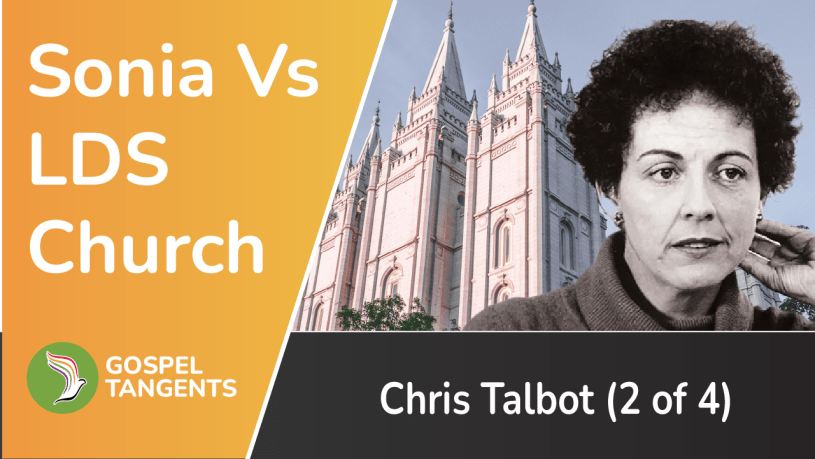
Sonia Johnson turned into a feminist firebrand after the LDS Church publicly announced opposition to the Equal Rights Amendment in the late 1970s. Dr Chris Talbot is a historian at the University of Northern Colorado and has written a biography titled “Sonia Johnson: A Mormon Feminist.” We’ll discuss Sonia’s excommunication, her run for US Presidency in 1980, her fierce advocacy for equal rights, and her changing sexuality. Check out our conversation…
Dr Chris Talbot’s Book on Sonia Johnson
Dr Chris Talbot teaches at the University of Northern Colorado in Greeley. She introduces her new book, “Sonia Johnson, a Mormon Feminist,” part of the Introduction to Mormon Thought series by the University of Illinois. She explains Sonia Johnson’s fame and the controversy surrounding her excommunication from the LDS Church. We dive into the history of the Equal Rights Amendment (ERA) and the LDS Church’s opposition to it in the late 1970s & early 1980s.
History of the Equal Rights Amendment
Chris provides a detailed history of the ERA, starting from its introduction in the 1920s. The ERA was passed by Congress in 1972 and needed to be ratified by three-fourths of the state legislatures in order to become law. (It is the only constitutional amendment that imposed a deadline for states to ratify it.) LDS presidents Joseph Fielding Smith & Harold B. Lee said little about the amendment, believing it was a women’s issue and stayed away from any involvement. It was a surprise to learn that the earliest involvement against ratification of the ERA was from General Relief Society president Barbara Smith, who seems to have persuaded President Kimball to become more involved in defeating the ERA. That’s when the LDS Church’s public opposition to the ERA started. Once the LDS Church made public statements, it made a major impact on public opinion in Utah.
Sonia Johnson’s Activism and Excommunication
Chris describes Sonia Johnson’s activism and her opposition to the LDS Church’s stance on the ERA. Sonia lived in Virginia and became concerned about the role of the LDS Citizens Councils there in opposing the ERA and their activities in various states. Sonia Johnson’s helped form Mormons for ERA to counter the LDS Church’s efforts. The central question for Sonia was: Are LDS men using women for political gain or are women following priesthood instructions?
Sonia Johnson’s Educational Background and Faith
Sonia Johnson was well educated. Her background including her PhD in education and Master’s in English. Her personal faith was strong and developed through her international travels and experiences. Sonia’s mother’s faith on her own spiritual life, also influenced Sonia greatly.
Sonia Johnson’s Excommunication and Public Reactions
Sonia Johnson’s excommunication began with a 5-hour meeting with her bishop. Sonia complained about the lack of formal charges, so the excommunication was delayed 2 weeks so she could prepare her defense once she knew the charges. This led to media attention surrounding her excommunication and the misrepresentation of her statements, which were used by Church leaders as evidence against her.
Sonia’s Appearance on the Phil Donahue Show
A week after her excommunication in December 1979, Sonia was asked to appear on the Phil Donahue Show, an influential show in 1979. The show highlighted Sonia’s public activism against the LDS Church and the broader feminist movement. It helped make Sonia a national figure. Sonia refused to debate with Barbara Smith & Beverly Campbell on the show because she felt like they had no decision-making power and wanted to appear with Church leaders for a debate. Instead, Sonia appeared by herself, and a few weeks later, Phil Donahue met with Barbara Smith & Beverly Campbell to hear their side. Many facts about the show are disputed.
Sonia Johnson’s Marriage and Personal Life
Sonia’s activism led to the deterioration of Sonia Johnson’s marriage. Rick Johnson deceptively asked for a divorce to free Sonia from the patriarchy when in reality he had found someone else.
Sonia Johnson’s Presidential Campaigns
Sonia Johnson’s involvement with the National Organization for Women (NOW) led to her disagreements with its hierarchical structure. She ran for president of the group and lost, which led to a schism within the organization that has lost its power and influence.
Her US Presidential Campaign in 1984
Sonia was persuaded to run with the Citizens Party and her platform focused on feminist issues. Some complained about her running against the first female vice-presidential candidate, Geraldine Ferraro. Sonia dismissed that argument saying nobody says that about men. She received about 0.5% of the national vote.
Sonia Johnson’s Public Speaking Career and Atheism
Chris explains that Sonia became a public speaker in the 1980s, addressing various groups including feminist, college, and some religious groups. Sonia became an atheist, noting her belief that if God exists, He is not doing well. She rejected male-dominated leadership. Chris mentions Sonia’s brief involvement with Heavenly Mother theology in the late 1970s and early 1980s, and her virulent anti-hierarchical stance.
Sonia Johnson’s Anti-Hierarchical Stance and Anarchist Feminism
Chris elaborates on Sonia’s anti-hierarchical views, even criticizing the National Organization for Women for reenacting patriarchy with women. Chris describes Sonia as an anarchist feminist, rejecting all forms of hierarchy, even within romantic relationships. Chris discusses Sonia’s spiritual vision for a world built by and for women, which she attempted to enact in the early 1990s. Chris notes that Sonia’s spiritual vision was opposed to what she saw as men’s commitments to violence and hierarchy.
Sonia Johnson’s Relationships and Sexuality
Rick finds it ironic that Sonia became a lesbian after her excommunication, given conservative fears about the ERA would inevitably lead to gay & lesbian relationships. Chris explains that Sonia’s lesbianism was a commitment to women as a species, not a sexual orientation. Chris discusses the fluidity of sexual orientation and the difficulty of categorizing Sonia’s sexuality. Chris mentions that Sonia did not have a history of sexual attraction to women before her excommunication.
Sonia Johnson’s Relationships with Therapist/Philosophy on Relationships
Chris recounts Sonia’s relationship with a therapist who became her manager, which ended poorly. Chris explains that Sonia’s fourth book critiques relationships as inherently hierarchical. Of course, Sonia detests all hierarchy. Rick asked if Sonia was bisexual, since she seemed quite heterosexual in her marriage. Chris discussed the lack of terms to describe Sonia’s relationships and its hard to describe Sonia’s relationships. Was Sonia a political lesbian rather than biological lesbian? It’s hard to answer.
Sonia Johnson’s Current Relationship & Touching Experiment
Chris describes Sonia’s current relationship with Jade DeForest and their experiment called the touching experiment. The touching experiment involves touching others for self-motivated reasons, not to produce feelings in the other person. Chris notes that this relationship has been successful and is still ongoing. So far, there seems to be success in the touching experiment.
Contested Facts and Church Involvement in Sonia Johnson’s Activism
Chris highlights the contested nature of facts about Sonia Johnson’s activism and the role of the LDS Church. Nearly all facts around her excommunication are contested. Rick asked Chris to discuss the similarities between the Church’s involvement in the ERA and Prop 8 in California. Rick mentions that President Hinckley seems to be a common denominator in these issues. Chris discussed the difficulty of determining the LDS Church’s involvement. There could be plausible deniability.
Chris Talbot’s Future Research and Projects
Chris mentions that her primary project is on Sonia Johnson, but she has other projects on the back burner. She plans to do more research on Sonia Johnson’s later work, including her presidential campaign, the Phil Donahue Show, and other activism. Chris shares that she has a Mormon Studies Review article coming out that situates her essay in the context of media and public attention.
If you remember Sonia Johnson, what are your memories of her? If you don’t remember Sonia (who is still alive), what do you think of her life story? There has been a movement to ignore the Congressional imposed deadline and still pass the Equal Rights Amendment. Do you think this has any chance of success?
 Wheat & Tares
The ERA was passed by Congress in 1972 and needed to be ratified by three-fourths of the state legislatures in order to become law. (It is the only constitutional amendment that imposed a deadline for states to ratify it.)
It would seem that Meta is not alone in its abandonment of fact-checking.
https://constitution.congress.gov/browse/essay/artV-4-2-1/ALDE_00013054/
i stand corrected. Thank you. How many constitutional amendments have passed between 1917 & 1972?
Between the 19th Amendment and the ERA, Congress passed seven constitutional amendments which were ratified by 3/4 of the states within 7 years. That gets you to 26. The 27th Amendment was passed by Congress in 1789, without a limit on when it had to be ratified by 3/4 of states. When it reached the 3/4 threshold in 1992, the National Archivist declared it enacted. Congress (which was displeased because the amendment affected their ability to raise their own salaries) responded by imposing a seven-year limit on all future amendments, which I believe is still in effect (although no amendments have passed Congress since then).
i wonder if era was the first amendment defeated by expiration?
I apologize for such a long comment, but it’s worth my time today, and yours too, I hope.
I have firsthand memories of my lived experience and the impact on us women sequestered to the upholstered folding chairs, of Sonia Johnson and the dealings of the church with her, both as a type, and as a standard of approach by the church toward feminism as a movement and and feminists as members.
When the UN IWY events unfolded during the second wave feminist movement, I was graduating high school, attending college and doing what people do in their 20s. Sonia’s activism and my experiences as a young adult didn’t happen in a vacuum— among all the revolutionary changes for us women in that period, probably the two best were Roe v Wade in 1974, and the ratification process of the ERA beginning in 1972. (And still continuing) There was vigorous pushback to these and other challenges to what was the status quo for women at the time, from both society at large and within the church. Roe was a done deal at the time, but the ERA wasn’t— its potential success was seen as a big threat by church leadership and conservative groups.
The way the church maneuvered female members’ participation in the Utah caucus of the IWY preparations and the pushback at the subsequent international conference in Houston, were later echoed with the actions taken to stop California’s Prop 8. At the time, I barely noticed, but retro-learned about that because of Sonia’s excommunication in 1979, which was well enough publicized that it was something of a shock to young women like me. It seemed like overkill at the time— like, she was a Mormon housewife doing what again, political involvement in support of equal rights? Isn’t that a good thing? And her right as a citizen? But in retrospect, I can see the impact on her of the violence of her excommunication. She spun off into the ozone of feminism, and I remember the impact on us as the next few news reports of her were increasingly unrelateable for us women in those chairs, watching. The Donohue show, the extreme ERA activism — chaining herself to the temple gate, and the hunger strike (over a month!) were beyond our understanding, and I internalized the notion that feminists were strange, 2nd wave was waning, and feminism was becoming increasingly tacky. Which was more effective than saying it was sinful, but why not both?
By then I was married with babies to manage and attending Relief Society in earnest, drinking in the powerful, godly wisdom mingled with patriarchal selfishness I found there. As a child, I always wanted to be a godly person, and to instinctively build my family, not as a dynasty, but as the people I’m proximal to, in a community knit together in love for each other. As a parent I have burned with this fire, and focused it on my immediate loved ones, and my small community, including in volunteer ward building work. What I didn’t do was any appropriate self-building work. I was taught (at RS) that such a thing was selfish, that it was righteousness to “lose yourself” and besides, there wasn’t time as I was so anxiously engaged in action elsewhere in an endless loop of serving others. After a couple of decades of this dysfunction, my life began unraveling, unbearable and lonely, as my ward “family” evaporated when I needed support from them. It was during that time I shifted my perspective of Sonia, portrayed as the devil incarnate from church sources, and shifted my perspective of feminism in general, where I learned the wisdom and practice of taking care of yourself.
Part of this was learning about the ERA and correcting previous misinformation, and that brought greater empathy for Sonia’s excommunication for such a benign thing as exercising her rights as a citizen to use her voice, to promote such a good thing as the ERA. Court of love indeed.
Which brings me to the ERA, which has been called dead in these very comments, and yet we see that it is not at all dead. There are strong legal arguments that favor that it’s met the requirements for ratification set by the founders. The notion that the recent congressional ruling deadlining this effort, is set in stone, is most certainly not a done deal. It’s no surprise to me that this process is a flaming mess surrounded about with bad actions and misinformation disseminated by people with a selfish agenda to perpetuate the norms of patriarchy for their own welfare and comfort. And that on the backs of the unpaid labor of women. Lather, rinse, repeat.
So of course, we witness this back-and-forth battle to establish it as the law of the land, or to make it go away by any means possible. And believe me, there is no dirty trick that hasn’t been deployed against the ERA. Many lawyers’ vacation homes have been funded by taxpayer dollars in this messy battle.
One thing that has never changed over the hundred years of this struggle is the amendment itself. Where once I had been taught to fear it, as I learned more about it, and the incredible struggle that feminism is for humanity, what we’ve suffered through as a nation, what’s at stake for us as a church, and how feminism illuminates the impacts I have personally endured over my lifetime, I have come to really love that thing which Alice Paul wrote* in the middle of the incredible struggle that women’s suffrage was. As a constitutional amendment, it’s so pure and simple, so perfect in its legal wording, so clearly true, that it inspires its haters to deploy a prodigious array of devious acts to keep it out of their lives. But Dr. King taught us about that long arc that eventually bends toward justice. We haven’t yet reached the promised land but Biden’s action today, instructing the clerk that it be published, has ignited the smoldering resolve of supporters of equality, and who will keep getting in good trouble with the opposition we meet in the immediate future and beyond.
Section 1.* Equality of rights under the law shall not be denied or abridged by the United States or by any state on account of sex.
Section 2. The Congress shall have the power to enforce, by appropriate legislation, the provisions of this article.
Section 3. This amendment shall take affect two years after the date of ratification.