
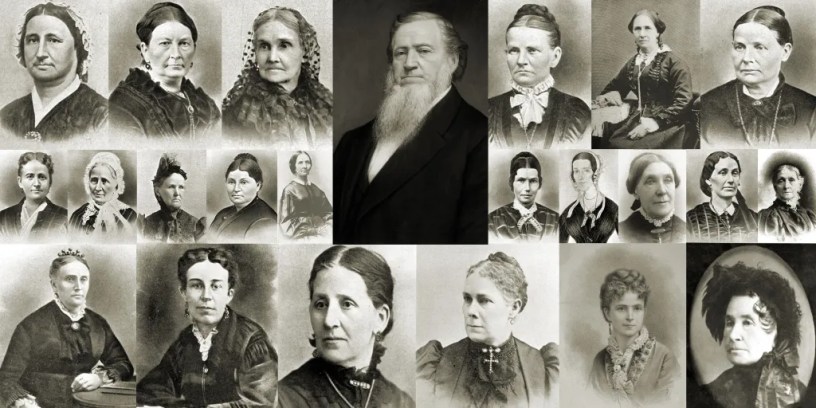
This question of what and how to teach the children about LDS polygamy arises because of a lesson/story posted at LDS.org, “Plural Marriage, 1831-1890.” It is part of a collection of “Doctrine and Covenants Stories” which appear to be teaching materials for Primary teachers and parents to use. With a 2025 copyright for Intellectual Reserve, it appears to be a very recent piece, although there is no authorship or suggestions for use provided with the lessons/stories. So this short piece — eight short paragraphs of text, with illustrations — is the Church’s current answer to the questions of what and how to teach the kids about LDS polygamy. I’ll bet readers have a variety of alternative approaches for what and how to teach it.
Honestly, I have a hard time imagining this coming up in a Primary lesson, even though the presentation appears aimed at that age group. Just try to think of a Primary lesson you have taught where it would be appropriate to say, “Okay, kids, now let’s look at a story that talks about Joseph Smith and other early LDS leaders having two or four or even a couple of dozen extra wives.” So it’s not clear that this short lesson/story has ever been part of the Primary curriculum or will be in the coming year. But it has received some attention on social media recently, as well as a long and detailed blog post elsewhere, so let’s talk about it.
An Ethical Approach to Teaching. First, a more general question. How do you teach anything in Church? My approach, my ethical directive, is this: Do not each anything that is false or misleading. That seems simple enough, but LDS manuals and publications contain a lot of iffy material, particularly on touchy or controversial topics, scriptures, and historical events. It’s easy enough to just skip that stuff if you are a teacher, but you have to know what the iffy stuff is in order to skip it. You can’t just take the material in LDS manuals at face value. [I know that’s what you are supposed to do, but that is problematic sometimes — that’s sort of the point of this whole discussion.] The Church as an institution is more interested in teaching both adults and children to be good, obedient, and unquestioning Mormons than in presenting accurate and reliable historical and scriptural exposition. So maybe “buyer beware” or “trust, but verify” is a good guide for your use of LDS material when teaching, for those who actually use the manual.
The other aspect of ethical teaching is that you have to be fairly well informed about what you are teaching. Put another way, if you don’t know much about the topic you are teaching, you won’t know whether or not the material you are teaching is false and misleading. And most LDS adults know very little about the practice of LDS polygamy — and what they think they know is often wrong. So it’s probably the case that most LDS adults shouldn’t be teaching anything about LDS polygamy to anyone, whether adults or kids.
Inoculation? Not too long ago, there was a lot of talk on blogs and websites about “inoculation” in LDS teaching, the idea that you should go ahead and teach LDS kids and youth about troubling aspects of LDS doctrine and history rather than avoid those topics with the inevitable result that their first exposure to them be from non-LDS friends at school or online sources critical of the Church. Key word: “online.” This only became a problem for LDS leadership with the rise of the Internet. Who knows what was talked about behind closed doors at the COB, but it appears they quietly adopted the inoculation approach. That’s why we’re talking about a story/lesson about LDS polygamy in a group of children’s stories about the D&C. Now of course there is good inoculation and bad inoculation.
The Story. So let’s look at the story, “Plural Marriage, 1831-1890.” There are only eight short paragraphs of text. Paragraph 1 correctly points to 1831 and Joseph’s LDS Translation of the Bible project (under the guidance of Sidney Rigdon) as the start of the story. Abraham and Moses had more than one wife, and “Joseph wondered how the Lord felt about that.” Or maybe Joseph wondered why them and not me? He certainly took a strong interest in the subject. You don’t petition God on a subject you aren’t interested in.
Paragraph 2 then goes on to say: “The Lord said that usually a man should have only one wife. But sometimes the Lord commanded His people to be in marriages of one man and more than one woman.” It’s implied here that God commanded the Israelites, or at least Israelite leaders, to practice polygamy. But no, that didn’t happen, although it is convenient for the LDS narrative to pretend so. Polygamy was a widespread in ancient society, including Israelite society. And every ancient society was happy to claim that God (or its pantheon of gods) approved of their own social practices but disapproved of the practices of neighboring societies. So simply invoking Old Testament examples of polygamy as justification for the LDS practice is not really defensible, particularly in light of Book of Mormon passages that decry the practice. God didn’t command the Israelites to practice polygamy, it was just there like dozens of other social practices.
Paragraph 3: “A few years later, the Lord told Joseph to marry other women. Joseph didn’t want to marry other wives. But he knew it was a commandment from the Lord.” Well, that’s the LDS narrative, isn’t it? This idea that Joseph and other LDS leaders “didn’t want to marry other wives” seems like whitewashing. They were sure energetically engaged in the whole marrying other wives project once it got rolling. And it is certainly true that Emma didn’t want Joseph to marry other wives. I doubt *any* first wives were very enthusiastic about the practice. I think LDS men got over not wanting to marry other wives in about fifteen minutes. LDS women never got over it. For me, “Joseph didn’t want to marry other wives” fails the honesty test, it just sounds better to a modern LDS audience. As if anyone could ever say with a straight face, “Joseph reluctantly married 35 wives.”
Paragraph 4: “This commandment was also hard for Joseph’s first wife, Emma. Sometimes, Emma helped Joseph decide who he should ask to marry him. Other times, Emma did not want Joseph to marry other women.” Okay, that’s a rather straightforward admission. But there’s a sentence missing. It should read, “Sometimes, Emma helped Joseph decide who he should ask to marry him. Other times, he did it without her knowledge or consent.”
You can read the next three paragraphs, but I’ll just skip to the last paragraph. “In 1890, the Lord told Wilford Woodruff, the President of the Church, that men should not marry more than one wife anymore. The leaders of the Church shared this commandment with the Saints. This is still the Lord’s commandment today—a man should be married to only one wife.” Or maybe it should read, “For the moment, this is the Lord’s commandment — a man should be married to only one wife.” And of course it’s not like God writes his updates in the sky for everyone to read. No, such communication is mediated through religious leaders. So it really means, “For the moment, LDS religious leaders teach that a man should be married to only one wife.”
Conclusion. Support for polygamy certainly seems to be on the rise in LDS leadership. Marriage law in the US is in a state of flux. The most unsettling thing for most modern LDS is the idea that LDS polygamy could return. It’s worth remembering (and this is not emphasized in LDS accounts) that the 1890 action did not repudiate LDS polygamy doctrine, just the current practice of it. The doctrine is still there, sort of lying in wait. So the conclusion to the last paragraph should more accurately read, “LDS religious leaders still support the doctrine of LDS polygamy and endorse the practice when they feel so directed by God. For the moment, LDS religious leaders teach that a man should be married to only one wife.”
I suspect even fully committed LDS find the eight paragraphs and accompanying illustrations a little unsettling, even if they don’t read between the lines and recognize that the modern Church has not, in fact, repudiated LDS polygamy. Far from it. Questioning LDS members and anyone who is not LDS likely find the lesson/story deeply troubling, partly for the claims made in the eight paragraphs and partly because this is intended to be taught to children. We haven’t brought sex into the conversation, and plainly sex was an integral part of LDS polygamy. When a precocious ten-year-old girl raises her hand in Primary and asks, “So they had sex with these other wives, right?” — what do you say? An honest answer would be, “You bet. That was a primary purpose, to raise up seed unto the Lord, and that requires sex. Especially with hot wife number 4, young and fertile, but only when the first wife was not around.”
Which brings us back to the original question: Should LDS polygamy be taught to LDS kids? If so, how should it be taught? The linked lesson/story is the LDS leadership answer to that question. What’s your answer?
- Have you ever seen LDS polygamy taught to kids in an LDS Primary class? How did it go?
- Is the linked lesson/story an appropriate presentation for Primary-age LDS kids of the doctrine and practice of 19th-century LDS polygamy?
- Would the whole topic better be reserved for Seminary or Institute?
- If you were rewriting this lesson/story, what material that is now in the lesson would you drop? What statements should be added?
 Wheat & Tares
Best way to teach polygamy is to show this video: https://www.youtube.com/watch?v=bLbLQR95zj8
and this video: https://www.youtube.com/watch?v=r_c6ja7iJlA
and this site: https://josephtoldthetruth.org
Yeah, arelius11, I suppose you can teach the kids that it never happened, that Joseph never taught or practiced polygamy. But, for me, that fails the honesty test as false and misleading. It’s enough of a fringe opinion I didn’t even discuss it in the post. Maybe others can weigh in about whether they consider polygamy denial a live option for this discussion.
I am going to consolidate your links into one comment. Let’s let other commenters visit and/or respond if they feel so inclined. I’m hoping the discussion follows other paths.
This is an interesting observation. I haven’t noticed any of my TBM friends and family being unsettled by this. As a TBM I was certainly unsettled by the history of polygamy, but never really even considered the possibility of it coming back (or at least not in this life). What a fascinating turn of events that would be, to see it come back – could the church survive that? I don’t see how they would.
The Church should stop trying to justify its multi-generational sins by pushing the ridiculous narrative that God commanded plural marriage, so Joseph obeyed. And the only lesson our children and grandchildren should be taught about plural marriage is that it was always wrong, and that it hurt women and children the most.
At a bare minimum an honest retelling of polygamy should include another couple of sentences that say: “But even after 1890 some men, including apostles, continued to marry more than one woman. In 1905 the Lord had to tell another prophet to get serious about actually doing what they said they were going to do back in 1890. Not everyone agreed with this, and two apostles resigned from the Quorum of the 12 over it.”
I have long wondered what would be my bright line–what would push me out of the church for good. There have been many temptations over the last few years. But the cost of leaving is high, and I can justify most things. Most topics are blurry at best.
If concurrent, live polygamy were to make a comeback in the church, I would immediately resign.
Thanks for pointing out that it is not currently tied to a Primary lesson. I was wondering what week it would be in the curriculum but had not investigated yet.
“a man should be married to only one wife”- I think there needs to be the acknowledgement of current widowers being sealed to multiple women and the eternal ramifications. I feel bad for the deceased first wives that would be expected to accommodate another woman in her marriage for all eternity because a man couldn’t be lonely for a few years.
I used to think, back in the early days of the blog, that inoculation was the best approach. The older I get the more I see that inoculation = indoctrination. Pre-pubescent children do not understand marriage, let alone polygamy. They do not have sexual desires. The church’s approach here is to take Joseph Smith’s manipulative excuses to Emma at face value and justify them at all cost (and there is a high cost–to women, to children as the linked article points out, and to Mormon marriages in general). You know who teaches children about why polygamy is justified? The FLDS. We just took several steps toward them in this action. It doesn’t seem like church leaders are sufficiently concerned about the implications of that.
If the teaching materials were truly honest, they would also say something like, “The Book of Mormon prophet, Jacob, told the men of his time polygamy was an abomination to God because it caused horrendous suffering for God’s daughters, making them feel like their hearts were pierced with arrows. But then during Joseph Smith’s time, God changed His mind and decided the anguish of His daughters was less important than letting His sons create earthly and heavenly harems. Sometimes the worth of each soul is great in the sight of God, and sometimes the humanity of God’s daughters is conditional based on the egos of God’s sons. Women and men are separate but equal, meaning women are not entitled to fidelity in their eternal marriages, but men are.”
Thanks for the comments, everyone.
Hawkgrrrl, let me run with your thought and follow an idea I didn’t get into my post. The Church, as you noted, seems to take Joseph’s weak set of justifications/explanations to Emma as points to be defended at all costs. For the present-day Church, that seems like a compromise position of sorts: defending and justifying the historical practice (it wasn’t wrong, God directed it, for lots of possible but weak reasons) while, at the same time, firmly rejecting any current practice of polygamy (it will get you exed). That might seem like a compromise compared to the LDS 19th-century position (defending it doctrinally and stubbornly continuing the practice), but it’s not. This is important.
In the broad middle ground between the extremes (practicing polygamy or strongly denouncing early LDS practice as somehow invalid, either of which likely leads to discipline) there are a variety of LDS member reactions to historical polygamy. The apparent compromise only works AS LONG AS THERE IS NO DETAILED DISCUSSION OF POLYGAMY. The Church makes the apparent compromise work only because it has successfully suppressed almost all discussion in manuals, lessons, talks, and Conference. Wisely, it’s a subject they have worked very hard to avoid.
Start having those polygamy discussions — and that seems to be what’s coming down Retrenchment Blvd — and it will soon become glaringly evident that there is not a compromise middling position that makes most members happy. There is a waffling middle position that, in fact, doesn’t make very many members happy at all, regardless of where they fall on the faith/doubt spectrum. Nobody, absolutely no Latter-day Saint, wants their daughter to be a plural wife! I’m fairly sure LDS leadership does not grasp what this really means (that nobody, absolutely no current Latter-day Saint, likes polygamy). They ought to be looking for ways to back away from the doctrine/practice, not keep moving back toward it.
The approach that I’ve taken with my kids when it comes to inoculation is to teach that, “Just because everything that is taught at church isn’t true, that doesn’t mean that EVERYTHING that is taught at church is false.”
At https://exmostats.org/thedata of the ex-mormons who participated in their survey, 38% of the former members are athiest and 44% are agnostic. Less than 10% reported that they continued being a traditional or engaged believer. If it’s true that only about 27-33% of church members are active, then that means that LDS church produces a lot of athiests.
I think it would be helpful for a lot of people who are leaving the church if there was some sort of cartoon that teaches the lesson of “People have believed in some type of God or Higher Power for thousands of years. Joseph Smith taught people about God. Then Joseph Smith said that God told him to marry multiple women (including underage girls), which you may instinctually know isn’t a good thing to do. Just because Joseph Smith chose to marry multiple wives, this doesn’t mean that God doesn’t exist. Joseph’s Smith’s actions can’t make God exist, and his actions can’t make God not exist – that wouldn’t make any sense. Even if the church that Joseph Smith formed turns out not to be true, that doesn’t prove that God doesn’t exist.”
I’ll be okay with whatever choice my kids make, if my they choose to remain in the church or not. But I think that there are a lot of benefits that can come from being part of a religion and religious community, and I don’t want to poison the well of religion for them.
Polygamy is a historical fact and Mormons are certainly not the only group to practice polygamy. If children are generally interacting with texts like the Bible, they’re going to run into it. There’s no reason to pretend like it didn’t happen, and from a historical perspective it’s an easy question to answer: In the past sometimes people were married to more than one person, usually men with more than one wife. The church did it too for awhile, but it’s not something we do any more. Subsequent questions can be answered in an age-appropriate way.
The larger issue for me in this new lesson is how it’s framed – it blatantly steps beyond facts and into the realm of questionable justification. Saying that Joseph Smith said God told him to do it is still technically accurate – he did actually say that. But it’s completely misleading to say that Joseph REALLY didn’t want to do it, discussed it with Emma first, it was 100% consensual, and everything was above board. Kinda like that time Nephi REALLY didn’t want to murder an unconscious guy, but HAD to cuz obedience über alles (ignoring the wrinkle that if Nephi wanted to take Laban’s clothes, he would have had to do that before the messy part).
I think some restraint is in order when discussing it for sure, and the age of the kids should 100% be considered – It’s obviously not appropriate to teach kids that 30 year-old Joseph Smith had sex with a 16 year-old girl who worked as a servant in their house, then told everyone that God said he had to (Don’t worry, he really REALLY didn’t want to)…then just kept on “not wanting” to marry a whole bunch of other girls as young as age 14.
Say it happened. Say JS said is was a commandment and that it was later rescinded. Believe that if you want. Say all of that in an age-appropriate way. But don’t write lies (officially approved by the correlation dept.) to cover up the crimes and misdeeds of old, dead leaders. Sometimes you have to confront the uncomfortable truths.
Piggybacking off Hawkgrrrl’s comment, my generation left the church because we were never taught about JS’s polygamy and felt betrayed (among other reasons for leaving like being really tired of supporting a church that harms the marginalized). The church’s response? Teach half-truths about JS’s polygamy, how it really ended, and how we practice it today. If I were a gambling man, I would imagine this will lead to just as many people leaving over a trust crisis in a generation as we just witnessed when the church was silent on the matter. Either tell the whole story or don’t bother.
I wouldn’t try to teach it in primary. Seminary and institute, yes. How should it be taught? Please stop teaching that it was instituted to care for widows whose husbands died because of persecution or whole crossing the plains. Not that many women were widowed because of that, and very few women were married into plural marriages because they were widowed.
Also there is really no easy way to teach this. The truth hurts, full stop. The way in which Joseph Smith practiced it was secretive and bizarre. Over 30 women. Many of them already married to other living spouses. Some of them teenagers. I have no doubt that Joseph Smith used the cloak of religion to satisfy sexual fantasies. And subsequent practitioners, Brigham Young included, also used it to satisfy sexual fantasies. In 1832 all angry mob tarred and feathered Joseph Smith attempted to castrate him. The Nauvoo Expositor listed plural marriage as a grievance against Smith. So no it wasn’t just doctrinal disagreements that were leading critics to attack JS. They took issue with the bizarreness of plural marriage. Of course I’d never want to be a seminary or institute teacher and try to tread around these issues. The church wouldn’t want me to be an instructor, either, because I would tell it as it is, and tell them that Smith was partly a pervert with some twisted fantasies.
Although the discussed D&C Stories chapter isn’t covered explicitly in the 2025 Come, Follow Me manual, the manual *does* cover polygamy using similar simplified wording for the week of November 10-16th.
Here is the entire section:
Doctrine and Covenants 132:1–2, 29–40
Plural marriage is acceptable to God only when He commands it. Many people who read the Old Testament wonder about Abraham, Jacob, Moses, and others marrying multiple wives. Were these servants of the Lord committing adultery? Did God approve of their marriages? Joseph Smith had similar questions. Look for the answers God gave in Doctrine and Covenants 132:1–2, 29–40.
Marriage between one man and one woman is God’s standard of marriage (see the section heading to Official Declaration 1; Jacob 2:27, 30). However, there have been times when God has commanded His children to practice plural marriage.
The early years of the restored Church were one of those periods of exception. If you want to learn more about plural marriage among the early Saints, see “Mercy Thompson and the Revelation on Marriage” (in Revelations in Context, 281–93); Saints, 1:290–92, 432–35, 482–92, 502–4; Topics and Questions, “Plural Marriage in The Church of Jesus Christ of Latter-day Saints,” Gospel Library; “Why Was It Necessary for Joseph Smith and Others to Practice Polygamy?” (video), ChurchofJesusChrist.org.
(end of quote)
Notably, the “Ideas for Teaching Children” section of that week’s lesson does NOT mention historical polygamy. It does, however, suggest having children read verses from D&C 132 as they talk about covenants and forever families.
ETA: Here is a link to the lesson for that week: https://www.churchofjesuschrist.org/study/manual/come-follow-me-for-home-and-church-doctrine-and-covenants-2025/46-doctrine-and-covenants-129-132?lang=eng
Huh. So acknowledging that gay people exist and marry each other is tantamount to ruining children, and gays should never be mentioned in grade school, but teaching children about polygamy is somehow less harmful than letting a third grade teacher have a picture of her wife on her desk? Yes, I’m comparing Florida’s ill-fated “Don’t Say Gay” law to a Primary lesson on polygamy.
As Dave B notes, it’s hard to imagine polygamy coming up in a Primary lesson. But it could come up when talking about pioneers and family history, especially for children in Utah. Take your kids to a pioneer-era family reunion and you have to explain that these cousins are from ggg-grandpa’s second wife, and you and your kids are descended from the fifth wife. Here’s a rare and precious photograph of ggg-grandpa with his five wives and it looks like 24 of his 33 children were in the photo too. My first introduction to polygamy was visiting the cemetery where ggg-grandpa and two of his three wives were buried. Polygamy has to be mentioned at some point, unless your family converted after 1900 or so.
I bring a different perspective to polygamy because I’m queer and I was in a mixed-orientation marriage for several years. I would happily have welcomed a sister-wife into the family if it meant that I didn’t have to have sex with my husband anymore. In hindsight, I didn’t love my husband either, though I really tried. I got married because I wanted children and to fit in socially with my Church community. I didn’t know I was asexual when I got married; I assumed I was super righteous and pure and the sexual feelings would ‘wake up’ sometime after the wedding. Nope. I’ve read that some women in polygamous marriages cautioned wives not to love their husbands too much. I could make that work. If marriage is just about making babies and doing the chores, I could handle that. I want at least eight sister wives so I can be besties with at least some of them.
And my attitude ought to scare the Church leaders to death. If marriage is just transactional, if it’s just about making babies, if there isn’t any love or jealousy, is that really something they want? My question for Joseph Smith is if he actually loved Emma. Because if he felt about her the same way I felt about my husband, then that wasn’t love. It was a marriage of convenience, for societal acceptance, to do their duty. But it wasn’t love.
Do men want to be loved? Do they want a woman to love them? Polygamy destroys romantic love. It destroys married love. I dunno if Dallin Oaks and Russell Nelson think they’re going to be in happy marriages in the eternities. What are they going to think when their wives decide they like the other wife more than the husband? Tolerate hubby, but your real love and your real best friend is your sister wife.
Sometimes I see things like this, and I can’t help but think “Throw another woman on the fire.” It really does feel like women are disposable in this church.
I don’t really get this discussion of whether to teach this or not. Some of you talk about betrayal on finding out about polygamy. All I can guess is none of you really liked to read as children. I did. From a young age I read fast, easily and in bulk from morning to night. If I step over a newspaper on the sidewalk, I have read it whether I wanted to or not.
Of course my grandma gave me my own triple combination to go with the Bible when I was 8. They preach at church to read the whole standard works over and over. It was easy enough for me to do it, so I did what I was told, and that included D&C 132. I found 132 particularly interesting and had probably read it multiple times by the time I was 13. I know it very well and have parts of it memorized. I wondered about it all the time as a teenager. No one had to teach anything about it for me to know about it.
My mother knew family history and shared a couple polygamy stories with me for context. One apparently happy story and one very sad and neglectful story. The great grandma I knew in my childhood was a child of polygamy.
I don’t know how you can not teach it and still include it in the standard works. Perhaps it should be removed from the canonized scriptures but taught clearly as history in seminary. It definitely shouldn’t be hidden, but it also shouldn’t be taught as being literally God’s will. 132 teaches that a woman’s agency and consent are ultimately irrelevant to God. This is a toxic message for both girls and boys.
I think the church needs to teach prophetic fallibility clearly, from an early age. Admit that leaders have sometimes made serious mistakes and that is why it is so important that we each study, ponder and pray for ourselves.
They ought to eliminate polygamy from our ordinances and seal anybody that wants to be sealed, and reverse sealing of anyone who wants to be free of it. They should make it clear a sealing is just a ritual & only symbolic of what may sometimes be built in a marriage eventually.Trust God to work it out in heaven for both sexes as Oaks has promised the women.
That polygamy was a part of church history was no secret growing up in the UK. Indeed it was thrown at us regularly by nonmembers, who would ask how many wives, given pretty much the only thing they seemed to know about Mormons was polygamy. And we were having to tell them the church didn’t do that any more.
That environment did cause harm to children. I recall as a child hearing a conversation between my mother and another church member mother. She and her husband had been baffled by the sudden onset of bad behaviour and aggression towards his parents by one of their young sons. It had taken some digging to get to the bottom of it. Turns out the boy had heard some gossip amongst neighbours. The husband had to travel in connection with his employment from time to time, and the neighbours had decided that he must be away visiting another wife. They were able to sit down and talk to the boy, and I have some vague idea the father may have found a way to take the boy with him on a subsequent trip, but that might be wrong.
That it wasn’t a secret did not mean we were taught the truth about it however. I recall the taking care of the widows excuse did pretty much all the heavy lifting.
I think the new chapter in the D&C stories is appalling in its presentation of the material, and intentional twisting of information, presenting it through a lens of obedience. For sure it doesn’t engender trust in God. I have to wonder if it is this kind of teaching that has resulted in my lack of trust not only in the church and its leaders, but also in God.
“Also there is really no easy way to teach this. The truth hurts, full stop. The way in which Joseph Smith practiced it was secretive and bizarre. Over 30 women. Many of them already married to other living spouses. Some of them teenagers. I have no doubt that Joseph Smith used the cloak of religion to satisfy sexual fantasies. And subsequent practitioners, Brigham Young included, also used it to satisfy sexual fantasies. In 1832 all angry mob tarred and feathered Joseph Smith attempted to castrate him. The Nauvoo Expositor listed plural marriage as a grievance against Smith. So no it wasn’t just doctrinal disagreements that were leading critics to attack JS. They took issue with the bizarreness of plural marriage. Of course I’d never want to be a seminary or institute teacher and try to tread around these issues. The church wouldn’t want me to be an instructor, either, because I would tell it as it is, and tell them that Smith was partly a pervert with some twisted fantasies.” – Brad D.
I think that at least Joseph Smith was also using polygamy to fulfil a vision/fantasy of social connection and “being worth attention/attending to”. I think that he may have been also fulfilling emotional-relational fantasies as well. Maybe he just liked the chemical high of “infatuation”.
When we are talking about polygamy, we are talking about it in terms of “fidelity” and “faithfulness”. Polygamy gives men the legal loophole into being held accountable/holding himself less accountable to the emotional & physical fidelity owed to his wife. I am not a Joseph Smith scholar, but I get the sense that Emma was a strong woman who learned to distrust Joseph over time as Joseph put burdens and inconveniences on her time after time. I am glad that Emma got through to Joseph enough to hold the men accountable for their tobacco ruining her floors and that they formed the Relief Society. Polygamy was also used to tie together families because marriage is a form of social glue to meld families together across generations and create social structures that generate moral authority and power.
Brigham used polygamy differently. Brigham was about sex and has 50+ children to prove it. Brigham also felt that the way to pave a homeland for the saints in Utah required a ton of colonization tactics and concentrating power/authority in loyal families.
The prophet with the birthday sealings is using polygamy differently again. He was setting up his court in the afterlife with a premade set of adoring fans in attendance. The fact that he couldn’t guarantee which ones would show up is why he had so many sealings set up. He also felt that he was such a prize that these women would be liberated from their tragic earthly pasts because he showed up, sealing in hand.
Then we have the collision of decisions made in this life coming to fruition in the afterlife where serial earthly monogamy becomes divine polygamy and divine polyandry (which in theory shouldn’t exist) AND that the priesthood power “works as advertised” to actually unite people in the next life who wouldn’t be connected otherwise by bonds of friendship and love the way but aren’t “sealed together”.
These are all “Polygamy”. These are all habits of behavior legalized under the Polygamy “Because I (or Joseph Smith) said that God said so” banner. We don’t have Polygamy defined as “Emotional Polygamy” that was trading marriage for comfort/love, “Physical Polygamy” that was a variable transaction offering some level of financial support for time-share family life and sex, and “Pop Idol Polygamy” setting up a divine court with “trophies” in the afterlife.
People love to say that JS was wrong for marrying a 14 year old. We say it shock others and to effectively claim he was a pervert. That is unfair, putting today’s values on a former time. Both of my father’s grandmothers married at 14, one to a man age 28 and the other to a man age 20. No, they weren’t LDS, and they were American. I am not speaking to defend JS on polygamy, but let’s not throw stones unfairly. My mother was a teenager when she married my father, she 17 and him 27. Early marriage, particularly for women, was quite common in JS’s day. There is plenty to be said against polygamy without hinting at paedophilia. In early American law, the age of consent for women was 12 and 14 for men, although both sexes required parental consent under 21, if my history is right.
…the age of consent for marriage was 12 and 14. The age of consent for sex was sometimes 12, sometimes 10, and Delaware apparently passed a law in 1871 setting the age at 7. Something may have been rotten in some parts of our Denmark!
lws makes another good point. We don’t currently seal living women to multiple men, and we say this is because a man may have multiple wives in the eternities but a woman may have only one husband. Regardless of whether that is true, we knowingly and willingly seal dead women by proxy to every man she ever married, with the expectation that the Lord will figure it all out in the Millenium. Well, some of our living marriages will need some figuring out in the Millennium also, so why not seal the living just as we do for the dead? One gospel, one set of rules.
The justification for polygamy that I grew up with was the comforting myth that widows needed to be cared for. Another justification that I have heard here and there as an adult was that God required the hard commandment of polygamy so that he could put the Saints through a refiner’s fire. Those that obeyed became a righteous, stalwart and special group whose descendents possess the qualities needed to help build up the kingdom in the latter days. Prior to my faith transition, I bought into both narratives. I descend from polygamy and it’s always nice to feel that you are part of an exclusive group that God favors.
In my 40’s, I learned the awful truth about Joseph’s practice of polygamy and the rest of polygamy’s history until the church was forced to end it. I realized that this hard commandment puts most of the suffering, pain and heartache on women. I think it was probably painful for some of the men also. I began to question. Why would a loving God inflict the pain and suffering of polygamy on his children as a means of creating His church on the earth? The gospel that Jesus preaches is all about love. Polygamy produces the bitter fruits of jealousy, resentment and difficult family relationships; not to mention poverty for women whose husbands didn’t have the means to support additional families. Our current sealing practices are STILL inflicting this pain and suffering on women as they worry about what the afterlife will look like for them.
I came to the conclusion that the loving God that I worship would never give his children a commandment like polygamy. Further, the commandment is man made and flat out wrong. I wish that church leaders could come to the same conclusion and have the courage to disavow polygamy. It could help the church shake off a terrible legacy and begin to heal. I think that many church leaders are unable to come to the same conclusions as I, because they are conditioned to defend the indefensible. It’s unthinkable to them that Joseph Smith could have been wrong, and so they have come up with all kinds of mental gymnastics to justify the history of polygamy. It’s deeply disappointing that church leaders are now going to continue inflicting this pain and suffering upon our children with the new polygamy cartoon on the church website. I feel a deep revulsion about the whole thing!!
“Would the whole topic better be reserved for Seminary or Institute?”
Absolutely not, especially if taught by CES employees, who’s ultimate loyalty is to the one who signs their paychecks.
Reading the new kid-oriented polygamy lesson material is super frustrating, to the point of wanting to pound your head on the wall. Why does the Church insist on trying to make historical polygamy OK?
The easiest, most honest way out of the Church’s polygamy morass is to be up-front and truthful about it as a fact of history, and admit that the practice is wrong and always was from the start (similar to how the subject of slavery should be handled in American history textbooks). However, this seems to be a hill the current Church leaders are willing to die on, probably to protect their perceived spiritual credibility, but by continuing to spin historical polygamy as “necessary” and “a commandment” they are doing far more damage to the institutional credibility of the Church than they think they are protecting. As long as they insist on trying to justify it as OK, it will continue to be a completely unnecessary albatross around the Church’s neck.
“Would the whole topic better be reserved for Seminary or Institute?”
Absolutely not, especially if taught by CES employees, who’s ultimate loyalty is to the one who signs their paychecks.
Reading the new kid-oriented polygamy lesson material is super frustrating, to the point of wanting to pound your head on the wall. Why does the Church insist on trying to make historical polygamy OK?
The easiest, most honest way out of the Church’s polygamy morass is to be up-front and truthful about it as a fact of history, and admit that the practice is wrong and always was from the start (similar to how the subject of slavery should be handled in American history textbooks). However, this seems to be a hill the current Church leaders are willing to die on, probably to protect their perceived spiritual credibility, but by continuing to spin historical polygamy as “necessary” and “a commandment” they are doing far more damage to the institutional credibility of the Church than they think they are protecting. As long as they insist on trying to justify it as OK, it will continue to be a completely unnecessary albatross around the Church’s neck.
Any divine defense of polygamy is going to contradict the belief that both men and women are children of God with the same worth and entitled to the same blessings. The minute you teach children/adolescents that sometimes God wants men to have more than one wife, is the minute girls hearts will be broken, and this teaching will create a fracture in their relationship with God. At the same time, it teaches boys that women are divine sex objects and one man can be equal to any number of women. Polygamy will reduce the humanity of women and girls in the eyes of boys.
The church cannot continue to tout the Proclamation on the Family as a source of eternal truth, which includes fidelity in marriage, and simultaneously claim that polygamy was necessary. Either fidelity in marriage is God’s eternal truth or it’s not. If it’s not, then you have to answer the question why God would require fidelity for women and not for men. And the only honest answer to that is because supposedly God thinks women are less human than His sons, less of His children. Women’s anguish is meaningless, and they are expendable eternal commodities. Try to square that with the doctrine of the Atonement and Jesus’ suffering for all people.
To the point of lws329, learning about polygamy in a factual, historical sense really isn’t a big deal. Kids are inevitably going to encounter the dirty laundry of human civilization. When I was a kid, learning about the existence of polygamy was just a fact of growing up in a church with a history of polygamy. The standard line for adults when discussing it with kids was more or less what was laid out in that primary lesson. The distinction here is that it’s weird to give it dedicated space in Primary curriculum, complete with illustrations of a conflicted, unwilling JS and a prayerful, consenting Emma.
My best guess is that it’s becoming a problem for international church members, and this is a poor attempt to give kids some sort of explanation. It wasn’t an issue in the Jello belt for the last 135 years because so many people have a family history of polygamy and you still bump into real live polygamists from time to time. Similarly, the idea of polygamy probably isn’t considered a big deal in cultures with their own history of similar practices.
Given what is known about the history of Mormon polygamy now, the execution of the primary lesson is pretty poor and misleading. This is likely more of an issue of insensitive incompetence than a malicious, willful attempt to revive the dead practice (Hanlon’s Razor, and all that).
The church needs to re-emphasize that God will sort out all the mess surrounding polygamy and canonize the idea that nobody will be forced to stay married against their will. They really need to let go of this notion that polygamy is some eternal commandment. It wouldn’t be a stretch to simply teach that it’s something God says is ok with as long as everyone involved willingly consents, and that it was ultimately abandoned because leaders felt inspired to uphold the church’s other principle of respecting the laws of the land after failing to have the practice accepted legally. Also, that Joseph Smith and other dead leaders will have to sort out any issues regarding their actions on judgement day like the rest of us. This is a much easier position to justify under LDS doctrine than whatever they’re doing now.
@lws329: “Some of you talk about betrayal on finding out about polygamy. All I can guess is none of you really liked to read as children. I did. From a young age I read fast, easily and in bulk from morning to night. If I step over a newspaper on the sidewalk, I have read it whether I wanted to or not.
Of course my grandma gave me my own triple combination to go with the Bible when I was 8. They preach at church to read the whole standard works over and over. It was easy enough for me to do it, so I did what I was told, and that included D&C 132. I found 132 particularly interesting and had probably read it multiple times by the time I was 13. I know it very well and have parts of it memorized. I wondered about it all the time as a teenager. No one had to teach anything about it for me to know about it.”
Wow! Lots to unpack here. Firstly, casting shade on eight year old kids who don’t enjoy reading scripture seems really unkind. So you enjoyed reading; cool. I read books but I don’t look down on those who watch TV. It’s none of my business. Secondly, JS did NOT practice polygamy as described in D&C Section 132 so I would still think there is plenty room for umbridge even if one was aware of the practice. Emma did not consent and many of these women were not virgins.
@ georgis: “Early marriage, particularly for women, was quite common in JS’s day. ” Source? Maybe AI is lying to me but it’s telling me that marriage age of women in the 1800’s was 20-22. Not 14.
“Any divine defense of polygamy is going to contradict the belief that both men and women are children of God with the same worth and entitled to the same blessings. The minute you teach children/adolescents that sometimes God wants (some) men to have more than one wife, is the minute girls hearts will be broken, and this teaching will create a fracture in their relationship with God. At the same time, it teaches boys that women are divine sex objects and one man can be equal to any number of women. Polygamy will reduce the humanity of women and girls in the eyes of boys.” – Mary
I added (some) to “men” because the process of authorizing any man to have more then 1 legal wife, you are creating competition for those objectified women. It’s not just a male-to-male butting heads competition, it’s going to influence all/ a lot of the community interactions the men who don’t get the girl have with others as well. The humanity of these men isn’t greatly improved by this power play and these dynamics.
That’s a great point, Amy. The gender hierarchy created by polygamy harms righteous men who are in their own stratified patriarchal hellscape. The question for non-polygamous men is am I not righteous enough to have more than one wife? Why don’t I “get” more wives? I followed all the commandments. It’s like the whole online toxic subculture where men are described as alpha or beta males.
@Georgis I understand your argument about being cautious to judge historical figures by modern norms and standards, and in general you’re right. However, the proclivities of early church leaders like Joseph Smith to target young girls in their teens would have still been morally frowned upon. Large age gaps weren’t necessarily rare, but they also weren’t common either.
A lot of marriage practices hinged on financial support and the simple fact that life expectancy was 40 years old. Most women tended to marry in their late teens and early twenties, with some definitely marrying in their mid-to-late teens. Men on the other hand typically married later in their early-to-late 20s, because they needed time become financially stable enough to support a family, if they didn’t already come from a wealthy family.
It’s true that the modern concepts of emotional maturity and consent weren’t widely discussed in terms of today’s standards. Regardless, marriages between pre-pubescent girls in their early teens and men entering the final quarter of their life expectancy were still considered highly inappropriate and scandalous. Even in rural contexts where earlier marriages were more common, this would have been frowned upon.
Remember that Joseph Smith’s actions were considered highly controversial and immoral, even within the broader context of an American society that generally accepted younger marriage ages. Even Oliver Cowdery described Smith’s interaction with Fanny Alger (who was 16) as “dirty, nasty, [and] filthy.”
Chadwick,
For girls marriage age at 12 and 14 for boys, see en.m.wikipedia.org/wiki/Marriage_age_in_the_United_States, in the history section. The colonial laws carried over into the state laws in the new republic.
For age of consent to sex, see https://worldhistorycommons.org/age-consent-laws. Some examples from 1880: 10 years old in 37 states, including Utah, 12 years old in 9 states, 7 years old in Delaware. Age of consent to sex and minimum age for marriage can be different, and minors required parental consent, but if a woman was old enough to consent to sex, the state would probably want her to get married if the family agreed, especially if she wound up pregnant. My two paternal great-grandmothers were legally married at 14, as recorded in the state marriage records. The father had died for both of them, one nine months before the marriage and one 16 months before. No doubt the mothers needed their daughters married so as not to eat the widow’s dower portion.
When your AI tells you that women were 20-22 in the 1800s, I saw that, too. That is the average or median age of first marriage, not the minimum legal age, and certainly not the minimum legal age with parental consent.
Pirate, thanks for the response. Joseph Smith’s activities were viewed as lecherous because polygamy was lecherous, And as immoral because polygamy was immoral. Building a harem was also lecherous. Sleeping with a younger wife (or mistress or prostitute or neighbor) and rejecting the wife of your youth was viewed as wrong. Infidelity was condemned.
I remember being in middle and high school some years ago, and I am not sure that 14 is prepubescent, especially for most girks. I think that girls usually start earlier than boys, or at least I remember girls getting taller before I did. I only had sons, so I am not current on a girl’s development, but I question 14 as before puberty.
I am not defending polygamy, but I don’t think marrying a 14 year old was so uncommon as to be outrageous in the first half of the nineteenth century. That is why people bring up his sealing to a 14 year old: to shock the reader to revulsion by suggesting or hinting at paedophilia. That is all that I am saying. Be justifiably outraged for his violating the 1830s-1840s societal norms (polygamy), but not for doing what that society did not condemn (marriage at 14 to an older man).
Out here.Tomorrow I will be watching the funeral of a decent man on TV. This was a man of unquestionably good moral character.
@Georgis
If 14 year old marriages were common, then why did Helen write in her journal how sad it was to miss the dance while her friends went? Shouldn’t they have already been married too then?
Source: Woman’s Exponent 11, no. 12 (November 15, 1882), 90; see Jeni Broberg Holzapfel and Richard Neitzel Holzapfel, eds., A Woman’s View: Helen Mar Whitney’s Reminiscences of Early Church History (Provo, Utah: Religious Studies Center, Brigham Young University, 1997), 224.
I’m threadjacking so I’ll stop now.
I also have forbears who married at younger than today’s customary ages, including more than one who married at 14 — I have not found any hints of scandal in the records or recollections. My mother married at age 18 to a man ten years older, and they were happily married until recently with death in old age.
For the American frontier age, I agree with Georgis that polygamy was the outrage, not age 14. Presentism is real.
For today, I hope girls in the U.S. (and across the world) are protected from both polygamy and too-early marriage, and 14 is certainly too young in today’s America.
Actually I agree somewhat with Georgis. The most outrageous thing about Joseph Smith’s polygamy was not that he was married to a girl who was 14 (or just four months shy of her 15th birthday as the Gospel Topics essays read). Although, this is no doubt outrageous. Indeed it was common in times past for girls to marry younger, including the US. The norms have changed drastically since and science has revealed a lot about women’s health since. The most outrageous thing about Joseph Smith’s polygamy was its secrecy and that he married over 30 women. The angel with the flaming sword commanded this many? His practice of plural marriage didn’t seem to follow any principle per se. It didn’t conform to what was taught in D&C 132. Joseph Smith’s plural wives were not all virgins, he took more than 10, and he didn’t multiply and replenish with them. Brigham Young had 56 wives and 57 children. There would have been more multiplying and replenishing had those women been in monogamous relationships. It would have been more understandable had Joseph Smith taken just one other wife out in the open and made it known as such from the get-go. The way Joseph Smith practiced it made it seem like he was up to something. He was concocting schemes for escapades of a sort. It was truly bizarre.
Georgis, would you please try to put yourself in the position of those 14-17 year old girls whom Joseph married? Here are some things to consider. First of all, women (and men) were very close lipped about “the facts of life” as my own mother euphemistically referred to a basic knowledge and understanding of human sexuality. This was often because sex, even between a husband and wife was considered to be only a duty for most women. Women were not supposed to want or to enjoy marital intimacy with their husbands and were considered to be perverted or no better than a sex worker if they did enjoy it. Men, on the other hand, were encouraged and expected to enjoy themselves in doing their marital duty, so already there’s a big problem between the husband and wife.
Next, you need to know that the average young women back in the 19th century usually didn’t begin menarche until age 15 or later. When it finally happened girls were told the bare minimum, if even that. A bride of any age would be lucky to have been told about what was supposed to happen on her wedding night. You can imagine what a shock most new wives would have experienced the first time she was intimate with her husband, especially if he was the sort that was not sensitive to her needs and her lack of any prior knowledge.
Now imagine that you are a 14-17 year old girl and have grown up with little to any knowledge of such matters. With polygamy you would most often be married to a man who is generally a fair bit older than you, someone who is from your ward, and someone that is your parents’ ages or older. He may be your bishop, home teacher, stake president or even the prophet! You may even go to school or hang out with his children.
This man approaches your parents to ask for permission to marry you even though you are underage. He tells your parents that God and/or the church leaders have commanded him to marry you. You probably don’t know him very well (if at all) and, yet, he is asking you to marry him although he already has another wife and possibly children too. This man says nothing about loving or cherishing you. Rather he talks about how God wants you to have many babies to help the church grow. As the cherry on the top, he tells your parents that THEY will also be automatically blessed with exaltation in the celestial kingdom and be blessed to be in the prophet’s tip top inner circle if they “give” you to him. Who wouldn’t want such amazing blessings and advantages in this life and the next? None of the adults ask for your thoughts about this man and his proposal and they make the decision without your say so.
The other common scenario, if one or both of your parents are dead, is to have the man propose to you in private and tell you that you have 24 hours to make a decision. You cannot tell anyone else about the proposal and talk it through with them. If you balk at all the man may threaten you with damnation, the loss of your reputation, church discipline or even an angel with a flaming sword who will stab you to death on the spot. You may be locked into your room or another room to ensure that you don’t run away and tell others about your “proposal”. Now you have to decide what to do.
To say that you’re under a great deal of stress is a gross understatement. As you think about this proposal you may begin to think about everything that you will miss out on if you become a polygamous wife. No more school. No more hanging out with friends and possibly dating boys closer to your age. If this is Nauvoo or Utah before the reformation in the 1850’s you will have to see or be seen by your husband in secrecy. Is he kind? Will he treat you respectfully? What about his other wife/wives and children? Do they have separate residences, or does everyone live together? What about having a baby at such a young age? Are you physically able to safely have a baby at your age? Did God REALLY tell Joseph to have more than one wife? What if the thought of living this way violates everything that you know to be true and right? What if just thinking about living in such a situation makes you both physically ill and an emotional wreck who can’t even think straight? Will you truly go to hell for turning down Joseph or one of the other church leaders’ proposal?
I won’t go any further than this. What I’ve written should be disturbing enough. When polygamy is discussed in the church I have never heard any leader, teacher or ward member bring up any of the issues that I have written about here. In fact, polygamy is so often talked about quite clinically in the lesson manuals, books and presentations given about it. The emotional, physical, spiritual and religious aspects (how it affects the person in polygamy’s relationship with Deity and Jesus and their spirituality) are rarely if ever discussed. These issues need to be addressed in order to understand what the girls and women who were forced into or “chose” to marry a polygamist had to address. Coercion from leaders and parents also must be considered.
I would hope that we begin to look at polygamy in this new light because it quickly becomes apparent that while this abhorrent practice has been an ancient cultural practice since time out of mind, it has NEVER been a commandment of loving and merciful Heavenly Parents who view their sons and daughters as equal in their worth and in their love.
Poor Wayfaring,
After decades of scientific discovery and moral/legal reasoning, we have gotten a lot better at defining and preventing exploitative relationships, including the marriage of an older man to a 14 year old. Norms have changed indeed. All sorts of exploitation and violence occurred in regular daily life in the 1800s that wasn’t particularly against the law or norms, that wouldn’t happen, or be allowed by the law and cultural norms to happen, today. Georgis’s point was never that such a relationship is not exploitative. It was that such a relationship was not as taboo according to the cultural norms of that time. So yes, presentism (judging the past by today’s standards) is at play somewhat on that specific regard of marriage age. Where the retreat to the presentism argument fails is over plural marriage in general. That was considered immoral, bizarre, and exploitative by standards of the 1800s US and today’s standards.
There are 3 main options being discussed here:
1. Don’t teach children about the Church’s polygamous history at all. This was what was done in the past (for both adults and children).
2. Teach children about the Church’s polygamous history and claim that it was what God wanted the Church to do.
3. Teach children about the Church’s polygamous history and how it was wrong. Prophets claimed polygamy was God’s will for the Church, but it really wasn’t. Prophets can be wrong about big things sometimes.
It seems like a number of commenters, including myself, want #3. However, the Church can’t teach 8-year-olds #3 until it refutes polygamy to its adult members, and that doesn’t seem to be very likely to happen anytime soon. Therefore, the real question, when we consider what is actually realistic, is whether #1 or #2 is better.
Hawkgrrl makes a good point that #2 can potentially be more detrimental that #1 because instead of witholding the information (the kids don’t know whether polygamy existed, much less whether it was “good” or “bad” to practice it), it actually presents the information and indoctrinates the kids to believe that polygamy was a good thing–it’s what God wanted, and members were blessed for practicing it, even though it was so hard to do so. For some kids, it might actually be better for them to learn about polygamy from sources outside the Church that will give them more accurate information (and, arguably, many “anti-Mormon” sources would truly provide them with more accurate information that the new D&C Stories content) instead of being indoctrinated with bad information/teachings at a young age. In other words, the danger is that kids taught at a young age that polygamy was God’s will might stay there for the rest of their lives when they actually might have moved to #3 if they had been presented better information. That is exactly wha the Church hopes will happen, anyway.
There will likely be other kids that more readily move to #3 if taught #2 when they are young. This is what happened to me. I had a (non-CES, early morning) seminary teacher who taught some fairly detailed lessons on polygamy. The conclusion of the seminary lessons was always that polygamy was God’s will for the Church, but these lessons were truly the first crack in my “testimony”. Polygamy just didn’t feel right, and as I studied and thought about it over time, I eventually concluded that it was highly unlikely that polygamy was God’s will. In other words, teaching #2 actually helped me move to #3. I suspect I would have ended up at #3 regardless, but #2 helped me get there faster, and I suspect that I am not alone.
So, the question is if the goal is to get the most members possible to #3 (which I think should be the goal) while retaining as many as possible as active members of the Church (this is still personally my desire, but ymmv), then is #1 or #2 the best approach? I suspect it’s #2, but I’m honestly not sure. I think the Church has conceded that a number of members will arrive at #3 no matter what they do, but if the Church is at least more open about ugly Church history that the members that do end up at #3 will actually stay around in greater numbers than they would if the Church just continued with #1 as it historically has.
I would teach the kids that most men that claim to speak to God eventually are told that they need to sleep with multiple women. God is only ok with it if they are REALLY talking to him. We are lucky to have prophets that REALLY speak to God so it is ok for our prophets, but only them. That should answer all their questions.
The church’s “teaching” of polygamy to young and old reminds me of the “teaching” that went on in Nauvoo and beyond. Older women tasked with convincing other women to submit.
The church’s materials on this leave no breathing room. Every girl and woman has no choice but to accept that her loving Father in Heaven would do this to them.
I read the Come, Follow Me material for this year, watched the clip from the fireside Q & A where the woman on the panel was asked to answer the polygamy question in a “ha, ha, you better take this question” way. It’s all so discouraging. Here we are well into the internet age and still pushing this archaic, demeaning stuff. I’ll sit in Gospel Doctrine and be “taught” – by a woman, so it’s all okay.
The question of ethical teaching in the church is an interesting one, especially for missionaries and for parents. No matter where one falls on the belief spectrum, there is pressure to teach and even testify of certain things. I’m sure that years ago as a missionary, I sometimes said “I know” to things that I absolutely did not know. Perhaps using a foreign language made that feel less dishonest. I have since resolved to be more truthful about my beliefs when I give lessons or talks. But often that just means avoiding certain topics. And one can talk about scriptures in a faithful way without revealing an opinion that the story in question is fiction. And if I am not really showing all my cards, how many other people at church are also not showing theirs?
I just taught my young children about an ancestor who refused to take a plural wife and who (according to family legend and the old ward records) was excommunicated for that refusal. He was a loving companion to one woman. Sometimes the church does dumb things.
When they got older and asked for more detail I centered the discussion on the sealing power. IMO the power to seal was granted to unite the human family, but that sealing power was utilized in less than ideal manners. I think that early practices (plural marriages, sealings as servants, adoptive sealings to general authorities, etc.) were misguided attempts to utilize the sealing power. And we should note those practices reinforced the flawed views of the leaders (I also talked about race and priesthood at this point). To swipe a quote from Jeff Goldblum’s character in Jurassic Park, early church leaders “were so preoccupied with whether or not they could, they didn’t stop to think if they should.” It was Wilford Woodruff who finally took us down the path we are on today (biological, usually two-parent families forged into eternal units). And aren’t we promised that the vicissitudes of life will not stand in the way of eternal joy? So I expect more developments in the future.
Old Man: “To swipe a quote from Jeff Goldblum’s character in Jurassic Park, early church leaders “were so preoccupied with whether or not they could, they didn’t stop to think if they should.”” Man, that quote applies to a whole lot of stuff church leaders do.
This is another example of where having male only leadership is a problem. If half the apostles were women they could point out the consequences for women of not rejecting polygamy.
Is there any evidence that these polygamous marriages produced mainly female offspring, so there are enough women to go round. If not some men are going to miss out. This is very selfish of the men who get the women, and not sustainable.
God does not seem to be anywhere in this.
Thank you Chadwick for clearly pointing out my blind spots. I apologize for coming across as “casting shade” on kids that watched TV. Didn’t intend that. I watched lots of TV too. And clearly my reading abilities are unusual and extreme (some would say indicative of autistic traits which I do have). Not everyone is/was in my position. I know that and I apologize for not making this more clear.
What I was pointing out is that Joseph’s polygamy was no secret in my childhood. You are correct that there are more parts of that betrayal in how he conducted polygamy which were not included in my church education (such as marrying other men’s wives and sleeping with Fanny Alger when he was sealed to her as her father and had her as a daughter in the home). You are right those issues are worthy of betrayal.
However, I did know about the polygamy including bad experiences with it, so it wasn’t a secret.
mountainclimber479,
As I stated in my post, I think the central teaching needs to be that prophets are fallible people that make mistakes. Sure, share d&c 132 that Joseph Smith claimed God told him to do it. But also share that many people today believe Joseph wasn’t following God when he did that.
Then teach agency and consent, which are also scriptural. Talk about the errors with consent in 132. Teach that the scriptures conflict and encourage the understanding of praying and deciding for yourself regardless of fallible leaders.
That is what I was taught. But I can’t anticipate that ethical conduct from the church. They are too focused on maintaining the leadership’s position representing God and the required obedience of the members, to encourage members to grow spiritually, and pray and consider their own ideas about morality. They want to be able to tell members what to think rather than letting them govern themselves.
aporetic1,
I maintained a belief in God for years after losing my standard LDS testimony. While I can’t deny that some exmos adopt a similar thought process (especially since many become atheists concurrently), I’m not sure of the extent to which this is a representative sample. Personally, Joseph Smith’s polygamy has nothing to do with my lack of belief in God, nor do any of his other behaviors. Perhaps such an approach would make a difference, and perhaps not.
(FTR, I thought the same of exmos back in the day.)
@Dylan, Thanks for your comment. I apologize for painting with such broad strokes. I agree with you that the thought process I described isn’t representative for most Exmos. And I also think that there are valid reasons for becoming athiest.
My comment was directed at a very small sample of my exmo friends who have said to me, “If Joseph Smith was lying or made it all up, then there’s no way that God can be real.” They’re smart people, I just think that’s a dumb, invalid argument. Let’s just assume for a minute that it is a valid argument and that Mormonism is true. Then that would leave a bunch of ex-jw’s with the argument of “If Charles Taze Russell made it up, then I there’s no way that God can be real.” And an even bigger group of ex-muslims who could make the valid argument of “If Muhammad made it up, then there’s no way God is real.” It just doesn’t check out as a valid argument in my opinion.
But I agree with you, that my lesson would probably prevent only a very small percentage of people (if any) from becoming athiest. But hopefully it would prevent people like my exmo friends from making such a stupid argument about why they think that God can’t be real.
I did, in fact, teach about JS’ polygamy to Primary kids… 2017-ish? I had made a promise to myself that I would only teach accurate church history, because senior primary kids can handle it. I told them that Joseph Smith was married to many women besides Emma, that some of his wives were teenage girls and some were already married, and that the whole thing was painful to Emma and also eroded community trust. Didn’t say anything untrue, didn’t speculate about sex, nothing like that.
(I was at the time working towards – and I now hold – a license in secondary education, which means I have a good idea of what is and is not age-appropriate for 11-year-olds. Hint: telling them “ignore your own inner voice and do whatever men in positions of authority tell you to do” is NOT. IT.)
My punishment was swift and harsh. I was released from my calling the following Sunday, and after that I couldn’t hold a calling, give a talk, pray, sub in Primary (and they always need subs), feed the missionaries, or even read a quote off of a slip of paper in Primary. Nobody did me the courtesy of asking my side of the story or anything like that, but, since I don’t hold the priesthood, I was already worth almost nothing in the eyes of the Church. As far as I know, my punishment is still in place, but I finally read the writing on the wall and stopped attending a few years back.
(Read a quote off a slip of paper in Relief Society, rather.)
Joni, I am sorry to hear about your ostracization (my word, not yours, but it seems to fit). It sounds like everyone in the ward knew all about it, or everyone knew one side of it. I would be interested to know the feedback loop from your classroom to the bishop, and afterwards, as there is way too much gossip in our wards. Our students, including children, should be able to handle simple factual truth, especially when you made efforts in the class to avoid anything prurient and when you keep it age appropriate. I’d also be interested in knowing the lesson you were covering where polygamy was on the table for discussion. If polygamy was the lesson topic, then we should be able to teach it with sensitivity, which it sounds like you tried to do. I am sorry.
Joni,
Everything you shared is right there in the Gospel Library app, in the Gospel Topics Essay on Plural Marriage in Kirtland. The kids in your class could have read it on their own at any point. It’s not secret information. It’s actually put out by the church, though it isn’t written in the children’s lesson.
Our congregations are so dedicated to “knowing” faith promoting narratives, that members aren’t allowed to actually say the truth out loud. I am sorry this happened to you Joni. I am sorry this is happening to us all.
We are required to pretend we believe and teach incorrect information, or lose any influence and credibility we have in our communities.
Old Man,
“To swipe a quote from Jeff Goldblum’s character in Jurassic Park, early church leaders ‘were so preoccupied with whether or not they could, they didn’t stop to think if they should.'”
But aren’t we glad that Joseph Smith was more concerned with the “could” than the “should” when he went into the grove to pray? Or when he translated the Book of Mormon? Or when he formally established the church? The restoration could not have happened without his gift of forward thinking.
Re: Teaching polygamy to primary children: Milk before meat. Let the parents handle the “meaty” questions.
Joni, come back dear sister.
Jack wrote: “But aren’t we glad that Joseph Smith was more concerned with the “could” than the “should” when he went into the grove to pray? Or when he translated the Book of Mormon? Or when he formally established the church? The restoration could not have happened without his gift of forward thinking.”
I, for one, am glad for forward thinking, which is why I think the perpetuation of the priesthood and temple ban is such a difficult issue. As I’ve come to understand the mid-20th century history, the main reason I am seeing for perpetuating the ban as long as we did was because too many of us (including apostles) had become so entrenched in our traditional beliefs that we were unwilling and/or unable to exercise any forward thinking. I think the main issue between the conservative and progressive factions in the church is that the progressive factions want to see more forward thinking in the modern church. More willingness to challenge our traditional beliefs and practices. How much of the controversies around LGBTQ+ issues or the roles of women in the church etc. come down to questions of forward thinking versus backward thinking? You say that the restoration could not have happened without Joseph Smith’s forward thinking, and I might suggest that the ongoing restoration cannot happen without the forward thinking of today’s prophets and apostles.
Perhaps it is just where I am at in my deconstruction/reconstruction journey but I think the biggest concern I have with this “reluctant polygamist” narrative is related to something Pirate Priest said — “[Nephi, or Joseph maybe] HAD to cuz obedience über alles.” As I have deconstructed and reconstructed my beliefs around obedience to divine decree, it seems really troubling to me when we talk about needing to subvert (there’s a better word here) our own sense of right and wrong because God said so (or someone said that God said so). Obedience is so important to God, according to this line of thinking, that God may command us to do anything, no matter how immoral it seems to us (including murder, as Pirate Priest noted, or child/human sacrifice, or genocide). The troubling message I see in the “reluctant polygamist” narrative is the message that we might be telling our kids to not hold too tightly to what you think is right and wrong because you never know when God might test your obedience by asking you to do something that violates your strongest moral and ethical ideals.
I suppose we could have a long conversation about whether or not that was why Joseph was reluctant to practice polygamy — because he believed like so many others that polygamy was immoral (or maybe “barbaric” would be a better term, since just a couple of decades later, polygamy would be lumped with slavery into the “pillars of barbarism”). In that respect, perhaps the other examples (Abraham or Nephi) would be better examples of this idea. This has become something that has become important to my deconstruction — deconstructing the idea that God wants obedience above everything — even above my own sense of right and wrong.
Georgis no, the lesson manual didn’t say anything about polygamy. It was an objectively terrible manual that hadn’t been updated since the early 90s, and told lots of apocryphal or downright false stories like the Sweetwater rescue. So I pulled whatever I could from the manual and supplemented the rest with my copy of Rough Stone Rolling.
I don’t think that CES would do any better of a job at it, frankly. My husband graduated BYU in 1999 and kept his institute manuals. The church history book mentions polygamy twice – TWICE – in two nonconsecutive paragraphs in a 600+ page manual. And even then it’s only mentioned in relation to men, when polygamy affected WAY more women because that’s literally how it worked mathematically.
The historian Jan Shipps talked about a “donut model” of talking about the American West while leaving a hole where Mormonism would be. The Church does the same thing with polygamy. And they still haven’t figured out that they don’t control the narrative anymore, and haven’t for a LONG time.
@Jack:
Let’s put aside for the moment my opinion that if we’re going to refer to polygamy as “meat”, then it is rancid meat crawling with maggots and with mold growing all over it. I am writing for the moment from the “faithful” perspective that polygamy really was mandated by God (even though I don’t think it was).
Polygamy is a very important piece of Church history. The effects of polygamy still reverberate strongly through the Church today. The practice continues to have a profound impact on how outsiders view the Church.
The “old way” that the Church dealt with polygamy was to attempt to sweep it under the rug. Lesson manuals (even adult manuals) discouraged teachers from even mentioning polygamy. This strategy seemed to “work” for the Church institution until the internet made information on polygamy very easy to find. It turns out that when adults discover that they went to all their church meetings growing up and were never told about polygamy and only find out about it on the internet that they feel betrayed by the Church.
Children growing up in the Church need to learn about the its past (and present) practice of polygamy. It should be part of the curriculum along with the race and priesthood ban, the Mountain Meadows Massacre, the Book of Abraham “translation” issues, and a number of other unsavory aspects of Church history. The entire Church body needs to know about these issues and needs to be comfortable talking about them in a Church setting–not just in quiet whispers with parents at home. The exact age of when to start exposing children and the exact content to expose them to is up for debate, but it needs to happen. Historical facts, ugly as they are, should be presented clearly and accurately (and the new D&C Stories polygamy content is lacking in that regard and should be updated) to children and adolescents–before they become adults. If the Church doesn’t do this, they are going to continue to see members lose trust in the Church and its leaders when they finally do learn about polygamy later on in life. I think the Church is learning this painful lesson, which is why we have this new D&C Stories content.
A lot of members find that they can deal with the Church’s polygamist past and present in their own way. Many of them simply choose to reject it as a part of their personal faith while understanding that the Church’s official position is that it was commanded by God. What they cannot handle is belonging to a church where they attended countless hours of Sunday meetings without a single clear and accurate presentation of the Church’s polygamous history. Institutional honesty and integrity is not something that can or should be wholly delegated to parents and family.
I want to add that it’s important to teach accurate church history to investigators as well. Today they will eventually find out in some setting and they will suffer betrayal.
Unfortunately, our in my experience, our missionaries still avoid these topics. In 2019 I had friend take the discussions in my home. He asked questions about polygamy which I answered honestly from my family history.
The young Elders were upset with me and as a result, my bishop called me into his office. He complained that I had no respect for the priesthood and that I shouldn’t have answered my friends question, but waited for the missionaries to answer.
He clearly didn’t understand what friendship means to me. For me it is an honest relationship where if I am asked a question I answer honestly. And I certainly talked about the church plenty with my friend before he decided to take the discussions.
I find it difficult to understand or justify in any way the LDS cultural idea that we always need to present a faith promoting narrative, even when it is dishonest.
I’m late to the party, but just wanted to point out some similarities between polygamy and the racial priesthood/temple ban:
What else did I miss?
Eep, that was supposed to be easier to read. Try this:
Bro. Jones,
Let’s not forget that the early saints including church leaders were smitten, robbed, brutalized, and martyred. They all were a marginalized people.
@Jack,
I don’t understand the point you’re trying to make here regarding polygamy. Sure, let’s not forget the persecution of early Church members. Can you explain how your reminder of how the early Church was marginalized relates to and/or furthers the discussion regarding the Church’s practice of polygamy? I hope you’re not suggesting that because the early Church as a whole was marginalized that it justifies or explains why the Church would inflict polygamy on its own internally marginalized population, namely women.
@arelius11: I haven’t watched the entirety of all of your videos, but I have viewed enough of them to know that they are presenting the same tired arguments and “evidence” that Joseph didn’t practice polygamy that other Church members who don’t want to accept that Joseph was a polygamist cling to. I don’t agree with the opinions expressed in the videos. I think they are focusing on a small set of evidence that helps their case and ignoring a ton of evidence that indicates Joseph practiced polygamy.
I did happen to watch the conclusion of one of the videos you posted. I would like to use is as an example of some really skewed and inaccurate thinking that is so common to people who deny Joseph’s polygamy. The video is https://www.youtube.com/watch?v=bLbLQR95zj8. If you go to 2:08:20 in that video, and you watch to the end, you will find the narrator featuring a recent interview with historian Ben Spackman where Spackman describes how the Church is going through a period of “unlearning” its false history and traditions. The narrator in the video hopes or claims that this unlearning needs to happen with the idea that Joseph practiced polygamy. When the Church gets around to this, according to the video, the Church will stop teaching that Joseph was a polygamist.
What the video doesn’t make mention of is that Spackman, the expert historian they are citing here, fully believes that Joseph was a polygamist. From Spackman’s own website:
In other words, it appears that Spackman believes that Joseph’s polygamy is something that the Church already has recently gone through an extensive “unlearning” process. Instead of hiding or denying the extent of Joseph’s polygamy, the Church is now choosing to embrace, or at least be more open about Joseph’s polygamy. In the interview, Spackman makes the case that this needs to happen for a number of other Church history topics, but I believe that, if asked, Spackman would readily say that the Church has already tackled Joseph’s polygamy and many of the fruits of that have been publicly published. In fact, one new fruit of the unlearning process would be the new D&C Stories lesson where Joseph’s polygamy is now being presented to kids. I don’t believe for one second that Spackman believes that the Church needs to go and watch your videos or see your “evidence” to go and “unlearn” that Joseph didn’t practice polygamy. Featuring Spackman’s interview in this way is truly astouding to me.
mountainclimber479,
I was responding directly to Bro. Jones’ comment. I resist the idea of placing church leaders in a separate class because they suffered less than other members. When we consider the fact that just about all of the early saints suffered horrible depravations the “institution verses the marginalized” idea doesn’t resonate very well with church history–not to me at any rate.
The original post was about teaching polygamy in church primary classes. If polygamy isn’t a subject covered in a lesson’s material, then it shouldn’t be taught. Teachers should use approved materials and should cover the assigned topics, or they should decline to teach, whether as a regular or a substitute teacher. Teaching polygamy when it isn’t part of that lesson’s material is rebellion and stirring the pot, as is teaching any private lesson. Church should be a place where faith is edified and not destroyed, especially when teaching children. The parents expect their children’s teachers to edify and to teach the assigned lessons, and teachers, regular and substitute, should respectfully decline to teach if they plan to do otherwise.
Moving away from children, I was surprised to hear some years ago that someone visited the Beehive House in SLC and the guides (missionaries) made not one mention of polygamy. When the visitor, who was LDS, asked the tour guides privately at the end why they didn’t acknowledge that several of Brigham Young’s wives lived in this house, they said that they were not to address polygamy unless specifically asked, and that all mention of polygamy had been removed from what they were supposed to say. That seems a bit far-fetched to me: a tour of a historic building, that the church puts out as having historical significance, should be presented in a truthful way. I don’t know what they do now, but we shouldn’t deny our history, especially when doing history tours in historic buildings.
Georgis,
In spite of all your well thought out posts, this last post seems as if you missed the point of the question of OP. The question wasn’t how to best teach about polygamy while defending current church authority and current lessons. The question was, if YOU Georgis, were in charge of what Primary aged children would be taught about polygamy, what would YOU put in the lessons.
The argument is about
1: whether it’s more helpful to teach about it at Primary age to prevent a sense of betrayal when they find out later, or
2: if the teaching that God told Joseph to disregard his wife’s consent is so toxic to both boys and girls development that it should be avoided altogether and taught later or not all.
Or maybe you can think of a better way to teach it that honors the development of children. In glancing over your posts I can’t find where you answered that.
I will reiterate my answer: teach prophetic fallibility and teach seeking personal revelation that may differ from what the prophet teaches. Teach children to follow their own spiritual authority rather than defering to leaders. Then teach an accurate history of polygamy in this context.
I would teach the fallibility and personal spiritual authority all the way through in the curriculum. I would save the history of polygamy in the curriculum until the last year of senior Primary, about ages 10/11.
When do you want people to be taught an accurate history of polygamy in the curriculum?
lws, thanks. Another poster here told how she taught polygamy to 11 year olds although it was not part of the curriculum. She should not have been ostracized in her ward, but she probably did cross a line. I am not sure when children should be taught about polygamy at church. My kids knew about it because we are in a Mormon-minority place, so being Mormon and people thunkung we have multiple wives went hand in hand. There would be no later betrayal. We discussed it in our home, that it was something that happened, but we don’t do it now. Inoculatuon done. I do not think that the church needs to teach much about polygamy in primary. We should teach what we do believe. I also wouldn’t teach the racism ban in Primary. Nor would I teach about the investments at Ensign Peak. I think the home is the best place to address these topics, and when questions come up as teenagers their YM/YW leaders can field questions.
Hmmm… Primary is a place for religious instruction, not history instruction. But, our history formed and still shapes our religion, so it will necessarily come up in our gatherings.
I will frankly admit that I am not a fan of the Come Follow Me curriculum, but I must acknowledge that church’s curriculum developers have a difficult assignment — they cannot please everyone. lws329 suggests teaching prophetic fallibility, and I agree — I think this is an important principle — after all, a prophet is only a prophet when he acts as such — but our current church culture will not allow for any acknowledgement of this truth. The hagiography of current leaders seems to be of the the paramount importance.
Anyway, I’m not sure polygamy needs to be included in the Primary curriculum. All teachers in the Church should be familiar with the Gospel Topics essays, and may use them to answer any questions that do arise, even in Primary. Some other matters of church history also need not be formally taught in Primary, such as the United Order — yes, it happened, and yes, it is mentioned in the Doctrine and Covenants — but church members generally mis-understand it, and err in teaching that Brigham Young’s United Orders were a continuation of Joseph Smith’s United Order. Brigham was never invited to participate in Joseph’s United Order, and Brigham’s later United Orders were wholly and entirely different than Joseph’s. But this truth, even though it is true, is not taught anywhere because of the general Utah lack of knowledge on the matter and, more importantly, their desire for the hagiography of Brigham Young.
We should be truthful about our history, but not all history needs to be incorporated into our Sunday devotional materials. I think we can study history with real historical standards, separately from the work to develop devotional materials, and both can inform each other. I wish the Come Follow Me materials for adults and teens had much more historical (in addition to devotional) context. CES isn’t ready for this yet — but I think there is no choice but to eventually move in this direction.
Regarding the Beehive House, I agree with Georgis that a historical site should share real history. I would not be embarrassed for the Beehive House guides to share that several of Brigham’s plural wives lived in the house; however, I am not sure that I trust CES to draft the script for the guides.
I’m curious, does my teaching polygamy become retroactively non-sinful now that the church has apparently decided to teach polygamy?
And truly, I don’t understand how it could be inappropriate to teach *church history* when you are at, well, church.
(And frankly, the harder we insist that it’s an inappropriate topic for 11-year-olds, the more we make it seem like polygamy was just about sex. I thought it was for taking care of widows???)
Georgis,
I can understand why you give that answer that these controversial topics should be taught at home. On the surface this seems perfectly reasonable. As a homeschooler when my kids were younger, and I was less educated on the effects of this lack of education, I would have agreed with you. I expect many members of the church agree with you. However, there are a variety of problems with this approach.
First of all, most parents do avoid teaching it, either because they don’t know themselves, or because they want to present a faithful narrative and preserve their child’s faith. My children find the Internet to be a treasure trove of information and answers to questions. They love information. They are self propelled learners. So, for at least some of my kids, the effects of only teaching the faithful narrative was that they looked it up on line and learned it from nonmember sources. At that point they did feel betrayal.
This happened with my oldest because I didn’t know the church history that Joseph had written the BoM by looking into a hat with a seer stone. The church came out with this information in the Ensign a couple years later, but it was too late for me to support my kiddo in his sense of betrayal that the primary songs he loved were false.
My 4th kiddo felt betrayal that the church didn’t teach real church history at church. He asked me why this wasn’t taught at church when he was 18 and struggling with whether he should serve a mission or not. At that point I knew more about the history and shared it. He did feel he had been lied to. He was a full seminary graduate. How many missionaries serve without knowing the church’s history? And then of course we do not teach the history to converts. This comes across as a dishonest bait and switch.
There are multiple problems caused by expecting God to take the rap for the acts of fallible humans. We have been discussing the effects of teaching that polygamy was God’s commandment. I will let the various statements stand on these negative effects on both teaching girls God sees them as commodities that don’t need to consent (read 132 again if you don’t see this, she will be destroyed if she doesn’t go along with it) and to teach boys to see girls in this way, as sinful if they do not defer their agency to priesthood holders.
There are similar negative effects that occur when we falsely teach that God approved of withholding the priesthood sealing power from black families. It teaches them negative things about both God and themselves. Black members struggle with the lack of education on church history in adult members of the church.
The church has set up the Genesis group to support black members with the racism they face from white members. They go to church twice, once in their local ward and once in all black church meetings on the Wasatch front, supported by the apostles. In those meetings they do speak openly of Brigham Young’s racism in church history. This helps them deal with the racism of white members.
However, the lack of clear teaching of real church history on this point to white members both as children and adults perpetuates racism in the church. It perpetuates the feeling that God sees black people as less than his chosen white children of Ephraim, the leaders.
Black members accept prophetic fallibility in order to feel comfortable with their membership. In my opinion an acceptance and understanding of prophetic fallibility is necessary to have a mature understanding of the church and the actual effects of it’s teachings. Holding this information back perpetuates racism and negative experiences of black people in the church. To expect all white parents to teach this history when most of them haven’t even read the gospel topics essay is asking too much. We need to start by teaching accurate history to both the adults and children.
Black members, please correct me if I have misunderstood.
Thank you lsw329 for your charitable reply to my comment. It’s kinder than I deserve. You are a gem.
From georgis: “If polygamy isn’t a subject covered in a lesson’s material, then it shouldn’t be taught.” Also from georgis: “We discussed it in our home, that it was something that happened, but we don’t do it now. Inoculatuon done.” Quite confused. Aren’t come follow me manuals meant to be used in both church and home settings? Why is it follow the manual for me and teach what I want for thee?
For the record, I support Joni doing their very best as a teacher. You matter and the way you were treated was truly unkind. I’m sorry.
One time my wife and I were called in to the bishop’s office for teaching false doctrine to our youth SS class. I looked the bishop square in the eye, told him that the term false doctrine is incredibly vague and if he cannot get more specific then the conversation was over. He couldn’t get more specific. We ended the conversation. I cannot answer to such a ridiculous claim.
Chadwick,
I certainly hope parents are never limited to using church curriculum in teaching their own children. YES, absolutely, parents can (and should) teach information not included in Come Follow Me. I see Come Follow Me as a resource for parents, but not a limiter.