
Your currently believe some things that are not true. You also believe some things today that you will not believe in ten years and that you did not believe ten years ago. And if you think back to what you used to believe, you are very likely to remember having believed at that time what you believe today rather than what you actually believed then.
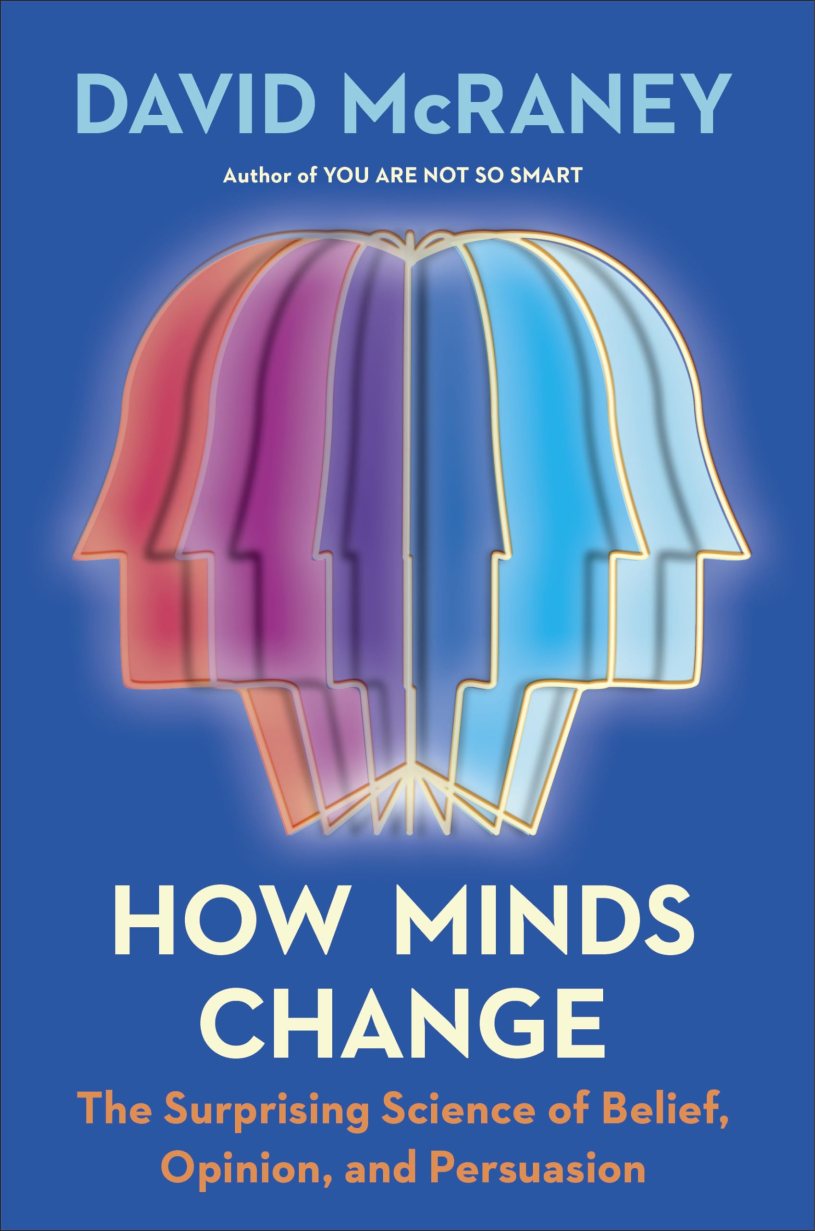
I just finished David McRaney’s book How Minds Change. David McRaney also wrote You are Not So Smart (and does an excellent podcast by the same name) and You Are Now Less Dumb (not quite as good as his first book, but still worth a read). His books explore why we believe what we believe, how we make mistakes in our beliefs, and in this latest book, introduces a method that works to change minds.
The smarter you are, the better you are at convincing yourself you are right. When Harris declined to go on Joe Rogan’s podcast, I felt that this was a big mistake because he has a huge audience and is very open-minded to his guests’ perspectives. This will end up being the James Comey mistake of the 2024 election IMO. But the one thing that gives me pause is that Joe Rogan is a conspiracy theory, and it’s very difficult to convince a conspiracy theorist they are wrong when you are just talking to them off the cuff. We tend to think of the people who believe things like conspiracy theories as gullible or stupid, but in reality, they have far more facts about these things than those of us who don’t believe in conspiracy theories do. A flat earther knows a lot more about flight paths and the horizon that I do, for example. They do not interpret those facts correctly, but I am not in a position to refute their facts one by one because I don’t know as much about it as they do. Much as I loved Harris, Pete Buttigieg would have been better if the goal was to convert Rogan’s beliefs. But if the goal was to show Harris as someone relatable and fun (the traits Rogan really likes), I think she would have done well.
The more intelligent you are, and the more educated, the more data at your disposal, the better you become at rationalizing and justifying your existing beliefs and attitudes, regardless of their accuracy or harmfulness.
People who know a lot of facts often mistakenly think that those facts are why they believe what they do. I’ve often seen people in ex-Mo Reddit query which facts they should use to de-convert their spouse so they are on the same page. Reading through the comments it looks somewhat clear that different people care differently about different things. For one person, it might be a deal-breaker when they discover that Joseph Smith practiced polygamy (if they didn’t know this). Some believe he was essentially a sex pest, a predator who used his position to coerce young women into sexual relationships. Others might shrug that off and say “Well, nobody’s perfect.” Each person cares about this information to a different level.
The average person will never be in a position where beliefs on gun control or climate change or the death penalty will affect their daily lives.
Likewise, whether Joseph Smith was a sexual predator, given that he’s been dead for a long time, is not a direct threat to people today. The issue is what the implications of that belief are, and how we feel about the types of people who believe things we don’t accept.
Which kind of brings us to another important point the book makes…
First, leave your community. This one was kind of interesting. In the book, McRaney shares the experience of two members of the Westboro Baptist Church who left their faith. When they first left, they still believed that gay people were going to hell. They left because the community became intolerable. The restrictions placed on them and the way they were treated when they asked questions caused them to finally decide, during a heated argument, to grab their things and leave. This was extremely difficult because this was a church founded by their grandfather.
Members of the church were highly educated; many of them were lawyers. As previously mentioned, the smarter you are, the easier to justify your beliefs, even if they are wrong or harmful. So, if you believe that gay people are going to hell, using hate speech to picket funerals for gay soldiers feels like you are doing something compassionate to prevent others from going to hell. Being in a group where those beliefs are not questioned, where the justifications are supported, and where the ridicule and opposition from outsiders is strong, all reinforce the “rightness” of these wrong beliefs.
Once they left the group, they could examine those beliefs without the pressure of social standing. They could be more objective. It’s one reason cults and some churches restrict contact with outsiders. This can range from physical isolation on a compound to a policy of shunning to simply smearing the reputation of those that leave. The risk is less about encountering contradictory facts and more about meeting and respecting those whose views differ, and those risks go up if there is an alternative community full of people we previously considered dangerous but now see are reasonable and kind.
But that process doesn’t start with an argument from an outsider.
You can’t change someone else’s mind. People can change their own minds, but when you try to change someone’s mind, you are setting yourself up in an adversarial relationship to them: “I’m right; you’re wrong. Here’s why.” As a missionary, I remember encountering Jehovah’s Witnesses who had a much more adversarial style of proselytizing (at least in that time and place they did). We called it Bible bashing. They were going to prove you didn’t know what you were talking about, but they did. They would start with a setup question that was designed to make you see that you didn’t know something basic like the name of God. I recall thinking that they were asking closed questions, not open ones. There was no discussion, just them showing you that they knew more than you did (based on answers that were entirely subjective–different religions had different answers to these questions, all theoretically relying on the same Biblical text). The problem isn’t really the content of the message (although I would argue it’s also that); it’s the fundamental approach. When you try to argue someone out of their beliefs, they dig in their heels. You are not arguing against their facts so much as their identity and sense of self.
The book encourages the reader to examine your motives; why do you want to change someone else’s mind? Before you assume you are right, maybe you should take yourself through the same “deconstruction” process outlined in the book.
Here’s a breakdown of the core techniques:
- Ask Open-Ended Questions: Instead of challenging beliefs outright, ask how someone arrived at their position. For example, “What led you to that belief?” This invites introspection without defensiveness. Ask about specific experiences they’ve had that related to that belief.
- Use the “Scale of Certainty”: Ask people to rate their certainty about a belief on a scale (e.g., 0-100). When they realize they are not 100% certain, it opens the door for dialogue. Ask them why it’s not higher (or lower).
- Listen Actively: Show genuine curiosity. Deep listening allows individuals to feel heard, which lowers emotional resistance to change. This is one reason that often the highest barrier to persuasion is believing so much that we are right that we aren’t even interested in what they believe.
- Reflect Back Their Reasoning: Summarize what they said, which often makes people more aware of inconsistencies in their logic. Before you continue, make sure they agree with the summary. You can ask them again how they would rate their certainty. Sometimes they still hold the same belief, but have a lower confidence level or are a little more open-minded about it.
- Encourage Self-Discovery: Avoid lecturing or offering your opinion. Instead, help people identify gaps in their reasoning by gently asking questions like, “If this weren’t true, how might you know?”
This process avoids antagonizing the other person, creating a safe space where they feel empowered to reconsider their views without pressure. The techniques are supported by research showing that people are more likely to change beliefs when they come to conclusions themselves, rather than through external argumentation or evidence dumping. In short, people don’t change other people’s beliefs. They allow other people to change their own beliefs. Our experiences and the communities we engage with shape how we interpret the facts we learn.
It seems that the current Church has made some serious missteps when it comes to community, which is one of the most valuable assets it had in terms of retention. The loss of community-building activities and the reduction in how much time Church members spend together and how genuine some of those interactions are contribute to the problem. Parents of teens find particular value in the church community, but even this has been greatly threatened by the church’s stance on queer and trans kids being out of step with society at large. Due to social media, it’s easier than ever for non-believers to connect with other non-believers, whether virtually or in person. Many who leave the church are the ones who are more connected and in step with society at large, meaning that those who remain are becoming more conservative and more insular, potentially more rigid in their views and hostile to other perspectives. This distillation of the membership will only result in more people who leave because they ultimately find the community intolerable, and then the cycle continues. Some leaders have lamented that the Church is losing its best people. When a company starts losing its best people, it usually takes a huge culture shift to recover, if that’s even possible.
Some churches that have a much longer history than Mormonism have found ways to maintain that sense of belonging even when they have had to change some of their core beliefs to do it and increase their acceptance of differences. After all, to paraphrase McRaney, we don’t choose our beliefs so much as we choose our communities (because we admire the people in them), and they in turn influence our beliefs. With the extreme political polarization in our country right now, it’s hard to see how any churches survive in their previous state. Many non-LDS congregations have sorted along political lines. While Mormon congregations are less overtly political than most, I certainly observed an uptick in veiled political rhetoric over the pulpit when compared to the before times. Political polarization is just one of many cultural stresses that are eroding a sense of community in churches.
- Have you used these techniques on someone else or yourself? How did it work?
- How has community shaped your beliefs? Have you seen your beliefs change when you changed communities?
- Have you seen those who’ve left the church successfully replace that community?
- In light of all this, what do you think the church could do, if anything, to improve retention?
Discuss.
 Wheat & Tares
Your first paragraph should persuade all of us to avoid dogmatism. If what I believed ten years ago differs from what I believe today, then which is “right” and which is “wrong”? Truth is indeed relative, and none of us (even in the church) has a perfect grasp of absolute truth. Rather, we perceive and discern differing shades and perspectives of truth as time passes.
If what I believed ten years ago differs from what I believe now, it is entirely possible that I was “right” then and am also “right” now, with “right” meaning an understand adequate to my needs and experiences. Your understanding of a particular matter may differ from mine, and yet we can both be “right” or we can both be “wrong.” Or, we can believe the same thing on another topic, and you can be “right” and I can be “wrong,” with the difference being the reason we believe as we do.
I fear those who speak dogmatically, with absolute certainty, on matters of faith and religion. God is too big for us to put him in a manmade box. We can always learn more, either through our experiences or through revelation, or both. God works in mysterious ways, his wonders to perform.
The title of the OP reminds me of how modern Christianity has done violence to the word “Repent”. It may, among others tangled up with legalism, be the worst translation ever. The Greek word, which we have all heard many times, is “Metanoia”, which was eventually translated to English as “repent”, which was then subsequently hijacked by legalistic understandings that turned repentance into “doing penance” or paying the price for a moral failing. This translation completely sidesteps the meaning of the original Greek word, which would be much more in line with the Socratic method. Metanoia means “to change one’s mind”. There is a beauty to the fact that the most widely repeated command throughout scripture is “to change our minds”. It implies that our small, personal minds can be a massive problem, hunkered down in my own way of seeing the world, my perception becomes my reality, which in reality is claiming I see the “whole” truth while looking at the world through a straw. I subscribe these days to an idea I’ll call “fallibleism”, which is, We hold strong convictions (not certainties) and sufficient reason to hold those convictions, but we hold the strongest conviction that we might be wrong. I see little possibility of creating a better world, one where we actually honor the dignity of every human being, if our core unifying bonds are dogmatic, absolutist truth claims. Dogmatism or focus on “doctrine” is supplanting harmonious relationality for intellectual assent. Our minds must change, but before they can be changed, we must submit to the need to have them changed. Daryl Davis said, “you don’t change someone’s reality by attaching it, you change their reality by giving them a new perception”. We need new perceptions, much bigger and expanding straws to see the world through. The object is not to convince everyone to look through my narrow straw, but to realize my straw is part of the problem and surrender it to a much bigger “mind”.
I love the line “you don’t choose your beliefs you choose your community”.
I’ve often wondered what Church believers would ultimately believe if there was no social aspect to their religion. Would the average TBM maintain this belief system if he or she was totally isolated? Or for that matter, how would the average TBM from Sandy, Utah do if suddenly he or she was transported to the Deep South for the rest of mortality?
At first, we probably didn’t choose our community. Our parents chose it for us. If the community serves us, we stick with it, but over time, we find out the flaws a community may have. If we have children and we expose them to our community, they make the same decisions about whether it serves them or not. If it doesn’t serve them, we are left to wonder if it also serves us by choosing to either stick with our children or with our community. It’s really hard to straddle the line if it’s a big issue like LGBTQ choices.
When my daughter came out, I chose to still love her and accept her. In the process, I learned about another community that was open and accepting. The community I was raised in wasn’t as open. A few still accepted my daughter, but others just couldn’t, even if they were nice to my face about her. Then, another member of the community had a son who came out. I urged her to love her son, not be judgemental, and accept him for who he was. While she said she believed what I said, over time, she couldn’t leave our community and accept him, and as he was pushed out, he seemed to have an increasingly hard time. Eventually, he took his own life. Of course, everyone was upset, but his mother was still in the community, and by then, I wasn’t, but I had replaced it with a new group of more open people.
The church changes over time. Blacks were not allowed to have the priesthood, and then they were. Many in the community accepted that, but others did not and left and either formed or became part of different communities. Either way, there was very little official discussion about any of it. The passive/aggressive nature of many church members means that our communities are centered around what we agree with, and discussions or questions are viewed with suspicion. If the church wants to increase retention, then our communities have to change somewhat as well to places where we can talk even if we disagree instead of the places they are now, where we pat each other on the back about our good decisions. Change happens but it’s scary.
Great observations and excellent book recommendation. I have noticed that when I’m outside the US (I don’t go as much as I used to), the political and cultural landscape is incredibly different, and I don’t even think much about US politics when interacting with others. It is a completely different context.
Conspiracy theorists are indeed smart. They certainly know more than me about a variety of topics that they deeply study. However, they’re problem is that they tend to engage lay people, and not experts on said topic. Their ideas may gain a lot of traction among the unsuspecting, but don’t pass muster among those who have comparable or greater knowledge on the topic.
Lastly, it is certainly hard to change others’ minds. And yet people do change their minds all the time due to others’ influences. Changing minds may not happen in an hour-long conversation. But it is a different ballgame if you are a teacher and give hundreds of pages of reading and dozens of hours of lecture to a student over the course of a semester. I think then you can actually change students’ minds from the time they begin the class to the time they exit. I’ve seen it happen.
Instereo: Your comment about our parents choosing our community at first (for those raised in the church) reminded me of something comedian Todd Glass said: “You wouldn’t let your parents choose your jeans. Why would you let them choose your religion?”
And your salient points about the church changing in terms of accepting people who were previously treated as second class or worse, I was reminded of the thing someone said (I can’t remember who) that if you invite white supremacists and black people to the same bar, you end up with a white supremacist bar. I just watched the film The Order about the rise of Aryan Nations in Coeur d’Alene, ID. When I was at BYU, I participated in the protest when they tried to move their HQ to Ogden because they believed that their ideology would be embraced. I couldn’t believe that was true, that there were still church members in 1986 who were racist. But then, I’ve heard many stories and seen a lot of FB posts and Tweets since then that make it clear that there are still a lot of very racist church members, even in 2024.
Interesting topic, and this looks like another book to add to my growing list.
The willingness to change one’s mind (after thinking critically, weighing evidence, and being presented with factual information that contradicts what you previously believed) is a sign of intellectual maturity, as well as humility (being able to admit you were wrong about something you professed before).
In a weird double standard, the LDS Church (through its missionaries) encourages investigators to be open-minded and willing to question their belief systems of origin, but baptized members are admonished to be “steadfast and immoveable” and never allow one’s spiritual self to evolve intellectually beyond from whatever juvenile testimony one claims to have. Changing your mind is frowned upon, even when your intellectual honesty demands it. Nowadays, the go-to piece of advice bishops give to members experiencing faith crises is to “just focus on what you already know to be true” (i.e. mentally regress back to an earlier time before you knew the inconvenient facts you know now) or something similar. LDS culture is still hobbled by the inability to separate facts/knowledge from belief.
And I don’t consider conspiracy theorists to be smart people, even if they are well-studied in their respective conspiratorial areas of interest. In my experience, such people are driven by emotions and impulses stemming from specific grievances or injustices (real or imagined), to a point that overrides rational thinking, fact-based worldviews and executive functions. For them, fear and anger are driving the bus. More than anything, I pity them.
“Have you used these techniques on someone else or yourself? How did it work?” I’ve tried asking these open ended questions and while I don’t know if “worked” is the proper term, it really did help me be a better listener. I still don’t get some political and religious positions but I do want to try to understand other’s perspectives and am not really interested in convincing anyone of anything. In that regard, these techniques helped me.
“Have you seen those who’ve left the church successfully replace that community?” I would say yes simply because the LDS faith community ain’t what it used to be. My kids have replaced the community with school and sports and drama friends and my wife and I have managed to make a few work and neighbor friends. It is much easier to build community when you are young and social interactions are a feature of your daily life.
“It is much easier to build community when you are young and social interactions are a feature of your daily life.”
And when the church no longer even pretends to offer a meaningful and engaged community, but does less and less as each year passes, for both adults and youth.
From where I’m standing, it seems that the mainstream church values compliance via authority. When someone believes they speak for God, perhaps the only being to change that person’s mind is God. Social pressure and data can only go so far. Respectfully, of course.
“He that complies against his will,
Is of his own opinion still” -Samuel Butler
In many ways, how I was trained as a social worker is about how to change people’s minds. Especially with with cognitive behavior therapy which is specifically designed to make people examine their thinking. But the trick is, they have to be willing to examine their thinking. For people who believe conspiracy theories or political views they generally don’t want to change their thinking so they refuse to examine it for incorrect beliefs. We were taught to stay away from people’s religious beliefs, so I just don’t go there with anyone. But the whole idea is to look at how people interpret “facts” from their experience and thus support and reinforce existing beliefs. So, it would be perfect to challenge conspiracy theories and flat earth beliefs……if the person is willing to examine their thinking, which most of those people are not.
I’ve largely given up trying to convince anyone of anything. It seems science tends points to beliefs and maybe even free will being determined subconsciously. Trying to convince people seems to only harden their stance. I will be interested to see how the scientific community views free will in upcoming years.
I left the church 2 years ago and have a small group of men I hang out with. Some are ex mos and some are active but nuanced. My community and tribe are much smaller than when I was in the church. I’ve looked for replacement communities and haven’t found one yet. I frankly wonder what my # of friends will look like when I’m 70 or a widower. For me the cognitive dissonance was too great to stay but I legit understand people stay for community.
The single biggest blunder in recent years was the church gutting the youth programs. Bishop in charge of YM, losing the Boy Scouts but not replacing it, and 2 hour church sound good on paper but have weakened community for future leaders. I’ve heard rumors of 1 hour church and if that happens I believe the church will be irrevocably changed to become a wealthy but curious and small Christian sect, maybe eventually like the Masons.
Thank you for the recommendation. I am adding this book to my TBR list.
The ideas summarized in your post apply equally to those both inside and outside the church:
If you leave the church, don’t bombard your spouse or relatives with exmo content. It is disrespectful and does nothing to change their mind.
If your spouse or relatives leave the church, don’t bombard them with testimony and conference quotes. It is disrespectful and does nothing to change their mind.