

I posted on the topic of parental estrangement before Thanksgiving, and today’s post is a continuation of that topic.
Deseret News just published an article that will warm the hearts of all narcissistic parents bewildered at the newfound concept of boundaries set by their adult children. The article suggests that “maybe it’s time to heal that relationship this holiday season,” which sounds great, but here’s the obvious problem with the article and the advice. The ones who have cut off the older generations are not represented in the article. Not even one. As someone astutely observed, this is like asking the lions why the gazelles keep running away from them. Hint: the lions did no wrong, according to the lions. And they are just bewildered why those gazelles don’t want to be with them. *shrug* Don’t worry, lions, the article assures them, it’s just “cancel culture.” You’ve done absolutely nothing wrong. Your kids are in the thrall of “woke ideology.” You don’t need to change. Just keep doing what you’re doing, and hopefully they will come around.
Good luck with that. Unfortunately, it’s fairly consistent with a lot of Church advice for parents that is not really designed to bridge the divide. Instead of afflicting the comfortable, it’s telling them to stay the course. It’s telling the comfortable (those who don’t want to change) that they are the real victims.
I recently finished the book Adult Children of Immature Parents by Dr. Lindsay Gibson. The book includes some checklists that help the reader assess their own childhood situation that may have led to the adult relationships they now have. See how your parents rate on this questionnaire:
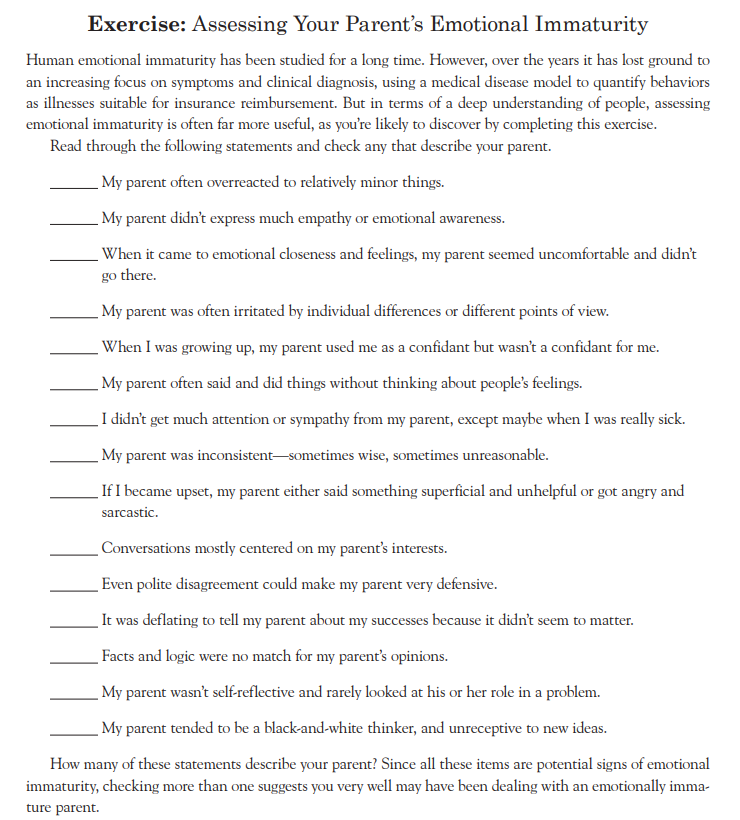
As I went through the list (as a Jane Austen enthusiast) I couldn’t help but observe how many of these traits were exhibited by Mrs. Bennett from Pride & Prejudice. She is constantly complaining about her nerves, must be the center of attention, is defensive over silly things like how important their small town is, and is dismissive of her daughters’ pursuits unless it’s what she’s interested in (mainly, marriage and lusting after the officers). She is constantly saying things that are offensive, and she impulsively and loudly comments on things that are not appropriate at dinner parties where others can hear. She starts arguments that make her look ridiculous and easily offended. She is completely self-centered and lacking in self-awareness and empathy. She ticks a lot of these boxes.
I posted this list in a Jane Austen discussion group I’m in, and I was surprised at how many of the other Austenites said “Wow, this list is my mother.” Maybe that’s the real reason so many are drawn to Austen’s novels; she accurately portrays family relationships and the need to strike out on your own as an independent adult woman. As Darcy says to a baffled Elizabeth: “You cannot have a right to such very strong local attachment. You cannot have been always at Longbourn.” (Longbourn is her father’s estate.)He implies she won’t really want to be around her family one day when she gets married. Darcy, better than most, sees how awful her family is (particularly her mother), how irritating it is to be around them, how inappropriate their behavior is, and how much better her life would be without them.
So what’s the difference between an immature parent and a narcissistic parent? Honestly, they look about the same to me, a distinction without a difference. The only difference I can see is that an immature parent might develop when given feedback whereas a narcissistic parent will refuse to accept the feedback and will double down. As Lucille Bluth would say:

Do these parents really not understand why their kids have cut them off, or do they simply not respect their children’s boundaries? Are they the innocent victims or are they unable to admit mistakes and apologize? As a corollary to the DN article, there is a fantastic article called The Missing Missing Reasons that does represent the viewpoints of those who have decided to reduce or eliminate contact with parents. It refers to an online group of these parents who discuss their bewilderment and hurt feelings and commiserate with each other over the wrongs being done to them. Of course, notably absent from these online forums for the parents are the reasons. They refuse to accept the reasons for the estrangement, instead shifting blame away from themselves, claiming their child was “screaming” at them (see the immature parent checklist item about inability handle even polite disagreement), downplaying any criticism of themselves, and demonstrating their unwillingness to respect any limitations on their own behavior. From the article (which I highly recommend):
I can understand that you may not agree with whatever it was she told you is the problem–but again, that does not mean there is no problem. She told you in a language you understand what the problem is, and you understood her meaning. That you disagree with the problem is immaterial. It’s still a problem whether you agree with it or not. It will be a problem forever until you deal with it. Saying, “I don’t understand the problem” when you really mean, “I don’t agree this is a problem” will not make the problem go away. It will make the person who DOES think it a problem go away.
As the article observes, these estranged parents show a pattern of being vague about the criticisms their children have explained to them. Some of them appear unable to even remember the criticism because they were so adept at deflecting anything negative that they heard. Others yada, yada, yada‘d the details away, instead focusing on their own grief, rage, or rightness. The members in the online support group did nothing to press them for actual details of what caused the estrangement or for the perspective of their children, instead allowing the parents to continue to believe they were the innocent aggrieved party, not that they need to change. Whether or not they were abusive, they certainly seemed exhausting. Their emotions were more important than reality.
I’ve noted elsewhere that parenting advice from Church leaders is at best a mixed bag, and often really really bad. It’s not shocking that a patriarchal church would have some blind spots. How many Church leaders have changed even one diaper? In a church with such strong emphasis on gender roles, and a gerontocracy, it’s very likely that their views on parenting are skewed.
Blind spots aside, does the Church (as a parent to its members) model immaturity and narcissism? I can’t help but notice that at least a few of the items on the immature parents’ checklist seem pretty typical of the Church’s own teachings; statements that the Church never seeks nor gives apologies, and that any criticism of the Church, even if true, is wrong. Additionally, teachings about abuse (siding with the need to forgive abusers while decentering the abused person), advice to treat LGBTQ family members as if they are contagious, and encouragement to be pushy about adult children who leave the faith can all contribute to fraught adult relationships. Church policies that are unfriendly to women, queer people, and historical issues with race are all potential factors that can cause rifts. Political views that are expressed in an antagonistic way, or defense of antagonistic policies can also create divisions and unwillingness to spend time together.
But let’s also be realistic. A lot of parents are going to tick some of the boxes on that immature traits list, and it’s all quite subjective. People can react to their childhood traumas in one of two ways (or along a continuum): externalizing or internalizing. Externalizing continues the negative cycle; those who externalize lash out at others when under stress, shaming or blaming, casting themselves as a victim. Those who internalize will look within to find solutions. They may know that they aren’t the cause of the problem but will see that only they can resolve it because the other party lacks the skill or will to do so. Sometimes internalizing goes too far, with children becoming wracked with guilt or being easily manipulated by a narcissistic parent. But sometimes, an internalizer realizes that the relationship is holding them back; they may choose to move on. There are quite a few healthy tactics to try, before cutting off contact, that can help:
- Understand the behavior. Sometimes as an adult child of an immature parent, you can imagine if your roles were reversed. You would probably be slower to cut off your ill-behaved child than your ill-behaved parent. It’s one way to look at it because your parent is acting more like a child than a parent. Their behavior comes from somewhere, probably their own childhood trauma.
- Set boundaries. Immature parents will push limits every chance they get and can be very manipulative. Setting and sticking to boundaries is the only way to avoid getting entangled in their victim game. (This is usually where the parents who are eventually cut off lose the script; they transgress the boundaries repeatedly and try to gaslight their way out of it).
- Practice emotional detachment. Your parent is bringing enough emotion to the interaction for both of you. Think of their emotional intensity as a fire. You can either smother that fire or add oxygen, increasing it. There’s a reason they caution against fighting fire with fire.
- Focus on self-care. It can be exhausting, emotionally and even physically, to deal with parents who behave this way. Toddlers eventually grow out of it. When it’s an 80 year old, it can feel hopeless.
- Limit expectations. Be aware that everyone is doing their best in life, even if this (waves hands) is their best. They may never be capable of unconditional love or supporting their children.
- Minimize contact if necessary. Start by placing parameters around interactions to keep them on track, but if that doesn’t work, you can reduce contact to maintain your sanity and peace. Boundary violations by an immature parent are grounds for self-protection.
- Shift the dynamic. Don’t allow yourself to be forced into a caregiver role. Don’t argue. Don’t engage in their games. Don’t get defensive when attacked by them. They are lashing out like a child in a grocery store who wants a treat. Ignore, rather than reward, the bad behavior.
- Validate yourself. If you find yourself feeling invalidated or unworthy, remember that you are not responsible for their actions or emotions.
- Seek reconciliation wisely. This only works if they are willing to grow and to adhere to boundaries. You also need to keep your expectations reasonable, which means low. They have held onto these patterns for a lifetime, and it’s hard to let go until they see that these patterns don’t serve their interests. Replacing old patterns with new learned behaviors is very difficult. There’s a reason we say you can’t teach an old dog new tricks.
A lot of this advice is related to reframing the power dynamic in the relationship. Especially in a patriarchal society, and in most churches, the teaching is that parents are in power, and children submit to their power. Parents teach; children learn. Parents set rules; children obey. Parents provide; children receive. Parents lead; children follow. Parents who are stuck in negative patterns from their own difficult childhood because they externalize and lash out at others rather than taking responsibility and creating more positive patterns of interaction may glom onto the “parents are in control” narrative because they felt their lives were out of their control growing up. Unfortunately, as we see, having power isn’t the same as knowing how to use it wisely. Plus, being the parent of an adult is not the same as parenting a child, whatever the parents may think.
- Do you think the Deseret News article is giving parents bad advice?
- Is the Church’s behavior a good model for parenting?
- Do you see parental estrangement as a burgeoning problem among Mormons families you know? Why or why not?
- Is this trend more or less prevalent among Mormons families than in society at large?
Discuss.
 Wheat & Tares
I read the Desert News article and it was simply awful. The mental health issues of children from narcissistic parents can be extremely difficult to overcome. Not all families should be forever families. It’s often best for the targeted children to limit or even eliminate contact. But children who do so should remember that narcissists scapegoat those who do not conform with their desires. There is no going back in these cases. Remember, the narcissists are not above harming the resistor’s children/their own grandchildren to get even.
I had no idea Jacob Hess landed a place a Desert News. Yikes. He’s always seemed to me to be of those “I’m here to build bridges” people who, instead, actively drives wedge between people. He also wrote some very anti-LGBT and other terrible ‘pseudo-intellectual’ stuff over at that M blog years ago and also was part of the incredibly pretensious ‘Public Space’ LDS place. I had hoped he had faded away into obvlion. No so. Instead he has a megaphone.
On to the OP. I read over his ‘piece’-which was little more than organizaing quotes from other places to make the world sound meaner that it is and more divided than it is and to make himself and the Chruch sound both smarter and more charitbale than they are. As always, the issue is more complicated than he presents.
I found that checklist terrifying and helpful for myself as a parent. A lot to ponder there. Thanks for the OP, Hawkgrrrl!
I’m the oldest child in my family. Several of my siblings have cut off or severely limited contact with my parents. I have probably the most contact with my parents among my siblings, but it’s also fairly limited. My parents, mostly my mom, check a lot of the boxes on the immaturity list. I had it less-bad than many of my siblings, it got worse when I was a teenager and after I left the house, when my mom’s behavior degraded from just immature to physically, emotionally, and sexually abusive.
In previous years we have still had family Thanksgiving dinners with my parents and at least some siblings present. This year was, I think, the first time that has just not happened. I know my parents were disappointed, and I think they are confused about why this is happening. My dad, especially, I think is almost as much a victim of my mom’s behavior and gaslighting as we are, although of course he’s his own adult and needs to take his own level of responsibility, as we all do. She is very good at making sure that we all don’t talk directly to each other, and only talk through her instead, so that she can manipulate what we think of and know about each other. He is not very good at building his own direct lines of communication, and I think as a result he just doesn’t have a very good picture of what’s really going on. Every time he gets a piece of the picture from one of us she gaslights him about it. On the plus side, we have managed to cut her out of the middle of our sibling relationships, and I now have a better relationship with my siblings than I have ever had.
On the subject of Deseret News incredibly one-sided treatment of issues: recently in Utah County a convicted murderer was released early from prison. The Deseret News coverage of the story was just a bunch of friends and family of the victim singing her praises and complaining about the unfairness of the early release. ‘The woke libs love crime and are releasing murderers now’ kind of thing. They of course completely neglected to mention that the reason for the early release is that it had been discovered that the cops investigating the case had paid off friends/roommate (I don’t recall exactly) of the suspect to testify against him and told them exactly what to say to achieve a conviction, and this testimony had been directly responsible for the conviction. The guy, very probably, did not commit the murder, and had been in prison for years on a wrongful conviction. This story came up at a family dinner with the (mostly conservative) in-laws and they only knew the Deseret News version of the story. I generally don’t speak up in these situations, not because of my in-laws who are generally very accepting, but because I have deep seated social anxiety and fear of confrontation (see above, being raised by an emotional immature parent) but I did in this case. They mostly switched positions on the issue immediately.
Obviously this topic is not exclusive to the Mormon faith tradition. I think the angle that is somewhat more specific to our faith is that there seems to be this spoken/unspoken concept that parents own their children. When there is a teaching that parent’s righteousness can save a wayward child, and when the entire enterprise views grace as transactional, then Mormon parents feel entitled to have their children as part of their heavenly Mormon flex. Ergo, some Mormon parents don’t believe their children even have autonomy or the right to set boundaries. It’s not a healthy or modern view, but it exists.
The article and comments are quite the dumpster fire. As expected.
I’ll see you that the Church’s behavior is not a good parenting model and raise you that the God of the scriptures behavior is also not a good parenting model. This is separate from Church teachings, many (but not all) do present good parenting models.
On a practical note, yes my parents exhibited some of the traits on that list, and I’m trying to do better by my kids. And, I also exhibit some of the behaviors on that list. I’m always working on it, and hopefully my kids will do even better, should they choose to have kids.
I answered yes to just about every question, either one parent or the other. Yike.
I know my children would probably answer yes to some of them, because I practically had to learn parenting from scratch. So, with the examples I had, raising children was hard and I really tried not to pass on any of the abuse. My husband didn’t have much better parents, with his mother being narcissistic and his dad being physically abusive. His dad learned to do better, and my mother learned to do better.
The church thinks that all families should stay together and at least pretend they are forever families. It really chokes on the idea of advising abused wives to leave the abuser and treats abused children the same way, with the ONLY advice being forgive and pretend everything is fine. Part of why I had to get away from church influence to heal from the abuse I got as a child. And part of the reason I was abused is that my mother was essentially given no support to leave when my father beat her black and blue. This inability to get away to protect herself also made her unable to protect her children. After years of abuse, she was really quite helpless.
The church acts like forgiveness is all the victim has to do, and then everything is peachy in her/his life. Really with any form of child abuse, theLAST thing you need to do is forgive the abuser. Mostly victims blame themselves for the abuse, so forgiving the abuser doesn’t work. The real first thing the victim needs to do is realize the abuser caused it and get angry at the abuser instead of themselves. But all the advice you get at church is just backwards of healing. The church is pretty good at helping the guilty repent, but it is really really bad at helping people get angry at a parent.
Thank you, Hawk, for this interesting treatment of the topic. It hits close to home for me, as someone who for many years has put physical and emotional distance between myself and my aging parents, and have no regrets about it. The DN article is an example of that publication playing to their core audience, namely, TBM boomers who are continually puzzled by their adult kids’ lack of enthusiasm for the Church and its programs; the same folks who would rather spend endless hours doing temple work than visiting their grandkids. If they really cared about solving that problem, they would take a balanced approach, including advising self-centered parents to take responsibility and make better efforts to reconcile with their adult kids. That article was just boomer clickbait.
My parents were pretty dysfunctional when I was a kid; they fought frequently, and in retrospect probably should have gotten divorced, but were committed to playing the role of righteous Church members in public and would never think of splitting up. After growing up, becoming independent, and starting my own family, I made decisions (both conscious and unconscious) to keep some estrangement, as I did not wish to be enveloped in the toxic negativity that always seemed to be swirling around them. I felt compelled to limit my kids’ exposure to their grandparents and their toxic influence. My dad passed away in 2019; in the last years of his life, he and I were almost completely estranged, but for one or two phone calls a year (which I always initiated, not him). Again, I don’t regret it, but there is a lot more to unpack there than I am comfortable going into in this forum. And to be fair, he never made any apparent efforts to bridge the divide from his end. But setting boundaries went a long way toward preserving my mental health and my relationships with my wife and kids. On the other extreme, I personally know mature LDS adults who are apparently successful and independent, yet still defer all their important family decisions to narcissistic, elderly parents who weaponize the Church to assert their power.
Anyway, one area you didn’t mention was the effects of physical and mental aging on narcissistic parents, and in my experience (with my own parents, in-laws and others), it makes things way worse. Physical pain, reduced mobility, cognitive decline and heightened anxiety are natural effects of aging, which also makes already selfish, angry, manipulative people into even worse versions of themselves. The Church often becomes an enabler of this behavior, which they prioritize above all else at the expense of their family relationships. And yes, the Church itself is an abusive (if neglectful) parent, since as an institution it doesn’t care a whit about the concerns of its individual members, and by design absolutely refuses to listen to us, while demanding our loyalty, our deference, and our money.
I’m really into “family values” in my personal life. My personal religion (my purpose) is the happiness of my wife and four kids (although they are now adults so it’s mostly up to them now). So don’t get me wrong: I really value family.
Having said that, I think we sometimes assume that we need to be close to our family members at all costs. That’s the default position of many people including LDS. The ultimate example of this is the abused wife who keeps it together for the sake of the family (eternal family).
But what if there’s another approach to life? What if we view family members the way we view other relationships? What if we gravitate towards those who bring us peace and happiness and move away from those who don’t. Where is it written that we have to occupy ourselves with toxic people?
I’ve never been fortunate enough to experience a friends-giving in late Nov. because we are obligated on Thanksgiving to host 20+ family members including some we’d rather not. We do our duty but sometimes I fantasize about the alternative.
The Deseret News article is clueless. It doesn’t mention examples of why people are cutting off their parents. Is it because they are LGBTQ and the parents won’t validate the mere reality of their sexual and/or gender orientation? Is it because their parents’ conservative politics are overbearing and brash? Is it because the parents push their religious values onto their kids who no longer believe?
The advice that the article gives is terrible. It basically tells parents to reach out to their children who have distanced themselves from them to see them as oversensitive, overreactive, fragile liberals who are practicing “cancel culture.” No. This is ineffective. If anything it is likely to push children away even further. What might be more effective is the parents acknowledging that they maybe some of their views of LGBTQs, liberals, and the non-religious were too harsh and judgmental in the past and that they accept them children whatever their sexual/gender orientations, political views, and religious beliefs are, even if they don’t fully see it their way all the time. It would also be helpful for parents to acknowledge that the inclination to reject (i.e., cancel culture) is very much a phenomenon on the conservative side and that conservatives can be overreactive and oversensitive as well. Let’s not pretend for one minute that there isn’t a lot of conservative oversensitivity at BYU and overreactiveness to views that are more liberal or challenging of Mormon tradition. If you express belief that the BOM is a 19th-century construct or that abortion rights should be protected, you could very well face ostracism, rejection of an ecclesiastical endorsement, or expulsion. That seems to be some pretty harsh cancel culture right there.
I was born into a clan with serious pioneer clout on both sides; here are a few family traditions that may have contributed to my parents’ emotional immaturity:
I no longer blame my parents for the trauma this caused, even tho this list is just the tip of the iceberg. They were trapped in a system that threatened to end their livelihoods and family relationships unless they confirmed. By forcing us to confirm, they naively thought they were keeping us safe. They were just trying to survive
The millennial generation of our clan has found their survival in seeking therapy and leaving the church – and when the older generations try to treat these young uns the way our family has always treated apostates, they go no-contact. Out of the dozens of my fellow grandkids, only a handful show up to family reunions now, and even fewer are still on the covenant path.
I am aware of the issues of intergenerational conflict and estrangement from parents. These have been a human problem for forever. Social media, as it so keenly does, both elevates and personalizes the matter.
This essay surprised me. Not that it discussed the problem. But that the author is so self-justified in being bitter and judgmental. There is no expression of regret over the conflict or hope that it can be resolved. Rather it is a declaration that the parents are awful people and they don’t deserve the company of their children.
Wow! I really don’t know what to say about that.
The “boomers” had a similar episode. Their parents were from a much different culture. Their parents faced war and economic depression and this background greatly shaped their world view. So the boomers rebelled. They saw their parents and the generation of their parents as stilted and old fashioned. They did not have time for their parents because they had an old world to bury and a new world to create.
Then these boomers aged into their 30s and 40s and they had regret. Deep regret. They had rejected their parents and shut them out of their lives. And then their parents were gone and they felt guilt. One reason for the guilt is they may have considered the thought: “Would their children treat them the way they treated their parents?”
There are books and movies and songs written by boomers about their reflection on their parental relationships. I want to highlight a song and a movie. Both were produced in the late 1980s. Both speak of regret and a hope for reconciliation.
The song is “The Living Years”. Here are lyrics from the beginning and end of the song:
Every generation
Blames the one before
And all of their frustrations
Come beating on your door
I know that I’m a prisoner to all my father held so dear
I know that I’m a hostage, to all his hopes and fears
I just wish I could have told him in the living years
….
I wasn’t there that morning
When my Father passed away
I didn’t get to tell him
All the things I had to say
I think I caught his spirit
Later that same year
I’m sure I heard his echo
In my baby’s new born tears
I just wish I could have told him in the living years
The song recognizes the existence of conflict and reasons for it. The song then speaks of hope, but ends with the recognition that what was done cannot be undone, and there is regret.
The movie is “Field of Dreams” and it is a story of redemption and reconciliation. In a fantastical way, a father and son are reconciled. The pain felt by the son and by the father is healed. But why was the pain healed? It was because the son made it his quest to reconcile with his father. He “built the field” where he prepared a place for healing. He then sought out specifically to “ease his pain”. He eased the pain of rejected ballplayers and of an isolated author. But in fact he was really engaged in easing his own pain. The son then “went the distance” and risked his entire farm, and everything he had built, just for the chance to have a reconciliation with his father.
If you are estranged from a family member, and especially a parent. What effort are you willing to make to reconcile? How much of yourself are you willing to risk and sacrifice to ease the pain in your own heart and in the heart of that family member? The movie “Field of Dreams” says you should be willing to risk everything in order to be saved from the regret that will otherwise persist as a shadow of darkness in your heart.
“Limit expectations. Be aware that everyone is doing their best in life, even if this (waves hands) is their best. They may never be capable of unconditional love or supporting their children.”
^^^^^^^So much this.^^^^^^^
My siblings and I have the relationship with our parents that everyone’s abilities and circumstances will bear. This means, in some cases, a lot of emotional detachment, censoring of what we do and don’t say to them, and boundaries that must be carefully (and sometimes invisibly, to my parents, maintained). We love our parents. Our parents love us. We are close in our fashion. There are things I will never, ever tell my parents; there are conversations I just won’t have. I would guess the same is true for each of my siblings–actually, I know it is, because we tell each other this kind of thing.
We have a sister in-law who is newish to the family, she’s quite a bit younger than the rest of us oldsters, and this isn’t the kind of relationship she has with her parents (who are FAR from perfect themselves; aren’t we all?). “I call my parents on their shit, Margie. I just can’t see why you guys can’t do the same. I wish you would.”
It can be so hard to explain to somebody who doesn’t have the history why you still tiptoe around your parents like a teenager when you’re an otherwise successful middle-aged adult who’s happy to call it straight in other contexts. It can feel humiliating. But the truth of the matter is that we really, really need not to judge or make assumptions. My siblings and I have tried to do things differently in the past, and paid heavy prices for it. It’s just not worth it. We’ve figured out how to have the only thing that passes for a good (enough) relationship with my parents. And we’re (mostly) happy with what we’ve got. It may look messed up, it may be messed up, but please just let us do our thing and trust that this (waves hands) actually is the work of many long and thoughtful hours of reflection and therapy (ours, not theirs), and it’s the best we can do and is by no means an easy thing to achieve or perpetuate. I already feel shitty that I couldn’t do better most days (“If only I were braver, if only I had the stomach for more conflict, if only I could find the right words to get through to them”–wrong, wrong, wrong); it’s a good day when I can give myself the grace and validation I deserve. “Yep. This is my best. It’s their best. It’s enough under the circumstances.”
Neither of my parents ticks all the boxes on that helpful list above; but my guess is that list covers most of us at least some of the time. I know it does for me, and I think all the time about how my kids will think about how I did when they’re adults. I kind of suck sometimes, but at least I am aware of the fact. I also agree that the church actively encourages some of the things on that list, treats them as virtues to be cultivated. Black-and-white thinking is righteousness; points of view that conflict with the latest take on “the gospel” at General Conference must be ignored, etc.
One thing I know for sure, parenting is the most humbling thing I’ve ever done. It’s so easy to screw up; it’s so easy to believe you’re doing the right thing only to realize that you were entirely wrong. And what’s right for one kid can be absolutely wrong for another. To those of you on the other side who have raised functioning adults who still want a relationship with you (and my own parents are definitely in that number), my hat is off. Y’all clearly did a lot of something right.
Margie: I am right there with you. Every so often, a voice whispers to me a new piece of wisdom. While that voice is my own, I always call that voice “Menopause,” as if it were a gift and not an affliction, telling me the things I should have figured out by now, a wise goddess overseeing the struggles of women. Several years ago, that voice said “You matter,” which was honestly something I didn’t allow myself to feel, not deeply. About two years ago, in a similar context to what you describe, that voice said “It will never be enough” in regards to my personal sacrifices, subordination, and peace-making. I can only do my own best, and that may never actually result in any change from the other person. If anything, it might make things worse. I have to stop expecting anything. And that’s OK. I’m OK with that. I can even have a sense of humor about it and not get twisted up in knots.
A Disciple: I’m not sure why you conclude that. The OP (which is what I am guessing you mean when you say the article is defending bitterness?) contains three things: 1) a response to the terrible, one-sided DN article that is a total justification of narcissistic parenting, 2) a book summary of Adult Children of Immature Parents, and 3) a list of alternatives that adult children can try before taking a more drastic step like cutting off parents. I think in particular you missed this part: “But let’s also be realistic. A lot of parents are going to tick some of the boxes on that immature traits list, and it’s all quite subjective. People can react to their childhood traumas in one of two ways (or along a continuum): externalizing or internalizing.” When someone (including the adult children) responds to trauma by externalizing, that’s what creates the problems for them and for their relationships. If they overdo it with internalizing, it can also cause problems for them (guilt & shame), although it preserves relationships (at their expense). But yes, it’s true that limiting contact may be necessary when trauma and abuse have occurred, if additional contact just results in more of the same.
Disciple, first of all you blame the boomers for cutting off their WWII and depression era parents, in VERY unjustified ways, then you turn around and wax philosophical about how every generation blames the one before it. Well, let me add that every generation rejects their own children as not good enough.
The arrogant and self declared “Greatest Generation” rejected the boomers as hippies, whether or not they were. They accused them of being druggies, whether or not they were. I could go on, but my point is, every generation seems to think that the generation they raised is wild in behavior and lazy and just not as good as “us”. You see it going on now with gen X saying gen Z is lazy and don’t know how to work, blah blah blah. It goes way back to Ancient Rome.
But I am going to propose that it is parents job to push the younger generation to be better and admit that many parents push and judge too much.
As far as children “rejecting their parents,” it is part of growing up and individuating to select your own set of values, it is necessary. But parents too often take the child’s own values as a rejection of the parent themselves and try to force parental values onto children. This was a big part of the unGreatest generation rejecting the boomers. They KNEW they were right and how dare those hippy younger brats reject those 1950 values. Just like parents often reject children who leave the church or turn out LGTB, the WWII generation rejected the boomer generation for their music, their clothing, and their hair. NOT the boomer’s fault, so quit blaming them. Same with blaming gen Z for not being Gen X.
Now cutting off abusive or too controlling parents is often necessary in order to heal and become a functioning adult oneself. So, don’t blame those who cut parents out of their lives unless you know the reason.
It is seldom one generation’s fault for estrangement between generations, and is very normal for to be some tension. But if there is fault, is more likely to be the parental generation’s failure to accept that their children are not them than the younger generation’s. That is what studying psychology will demonstrate.
The best advice for generational divide came from Kevin in Home Alone.
Anna’s comment reminded me of something I’ve shared before. When I was 13, we had a Sunday School teacher who was a college professor from Guyana. At this age (well, teen years in general), we were all pretty wild in that class and with subsequent teachers, pushing the boundaries, reading dirty passages out of books in the back of the room, giving back sarcastic answers to class questions, etc. He was unflappable with us, and when he was going to be away, he asked me (a 13 year old!) to teach the class for him. It was kind of crazy to be given so much responsibility, and while I was definitely not the worst one or the ringleader, I was not blameless either. I took it totally seriously, and I did the preparation and taught that class. It felt like I was being treated with honor and respect, whether I had earned it or not.
Years later, I saw that Sunday School teacher, and I apologized for how badly behaved we all were. He stopped me, and said with passion, “NEVER apologize for your behavior as an adolescent. It is your job to learn to test the boundaries, to grow, to try new personalities and new ways of interacting. This is how you become an adult!” He was so wise and open-hearted.
Even more years later, I was catching up with friends I grew up with, who were laughing about how every Sunday after teaching our awful class, he would go home, lock the door, turn on dance music, and celebrate with his family that he had made it through another week of hell with us.
Contrast that adult’s wisdom with the problems of parents who think that they must be respected, with or without earning it, and that they don’t have to treat their children with the same respect. The results are not as good. It’s true that each successive generation is kind of bewildering–their attitudes about things we took for granted are simply different than ours. But ultimately, they are going to have to push boundaries and try on new personalities to figure out who they are going to be as adults. That’s just how this works. Some parents refuse to allow their kids to grow up and don’t treat them with respect while demanding respect.
As Margie pointed out, you can be a person who totally relates in healthy ways to everyone…except in your family of origin, where you suddenly revert to the feelings you had in childhood. It’s apparently how humans work. We really cannot understand how anyone feels within their family of origin. We can’t even really understand why we behave the way we do in these situations. It’s not usually intentional. That’s why we often have to pay close attention and make intentional choices about how to deal with family.
I am an immature parent.
I was raised by 2 immature parents. I have learnt over time that my mother was one of 11 and sent away when her mother died of tuberculosis. On reflection my grandmother must have been dying throughout my mother’s childhood.
My mother had no interest or compassion for us. My husband’s mother regularly threatened suicide throughout his childhood. We have learnt that her own mother suffered from post natal depression that could not be named at the time and from which she never recovered.
These are not unusual circumstances for their generation. Complicated by war and PTSD, pretty commonplace stuff for the time.
And my father. Conceived out of wedlock and sent across the planet away from his parents to be educated from the age of 6, consequently completely unable to conceive of a child or baby’s needs. He left my mother when my sister was 5 days old and paid no maintenance.
My mother served a mission in the temple, I chose to limit her influence on my family when I had children but only after repeatedly inviting her into our lives, which was a good decision. I based my whole life on doing better.
But my children find it very difficult to offer us as their parents any compassion. Their lives have been dominated by a sense that they have been robbed of their birthright, a perfect childhood. Life and sickness have intervened in place of perfect availability to their demands, and a belief that the less than perfect is inadequate. They have harmed their lives and ours with their perception that the less than perfect cannot be good enough.
I fear them and I fear for their future, this narrative of relationships has not led them to happiness but broken relationships with partners that they cannot negotiate when they are less than ideal.
Clearly we have not ‘succeeded’ in our life’s mission. I fear that the narrative we are developing is that ordinary humanity is not pardonable, that intention is not good enough and that only perfect parenthood is acceptable.
I lose with both parents and children.
Surely developing a narrative of forgiveness is a better way where all parties are willing and negotiable, except in cases of sexual or physical abuse.
True story. I held a lot of inward resentment towards my mother in my adulthood up until about my mid 30’s. She was ridiculously overbearing at times while I was growing up and it crossed the line of physical abuse on occasion. About when hit 30 and for the next 4 or 5 year afterwards, EVERY Mother’s day in Sacrament Meeting I was asked to say to the opening or closing prayer in Sacrament meeting or give a talk. No one knew I was dealing with these internal issues with my mother. I pinpoint those experiences to having had the effect of completely dissipating my resentment towards her. It really was miraculous. I know this is a somewhat simplified example and other’s peoples experience with their parents really do warrant cutting off contact or possibly confronting, but I think in many cases, the adult child needs to forgive and move on and not cut off contact. Put in some reasonable boundaries, grit your teeth when needed, and enjoy your parents despite their past or present imperfections.
wayfarer, I see this in my own children also. They think they have to have had a perfect childhood and anything less is inconceivable. While we do have relatively good relations with our adultish children/teens, a lot of that stems from us putting in WAY more effort than our own parents did just to get maybe half the honor (or less) from our own children than we give to our parents.
I went ‘no contact’ with my parents years ago and my biggest regret is that I waited so long. If I’d cut them off in my 20s, maybe there would have been enough time for all of us to grow and perhaps reconcile.
On the topic of needing a “perfect” childhood … that got thrown at me a lot. It was a way of accusing me of having unrealistic expectations and blaming me. It was also bull. I didn’t expect perfection. I expected acknowledgment and an apology. That stupid stupid victim-blaming crap of “nobody’s perfect” is just the whine of an immature person who thinks that being imperfect excuses behavior that was atrocious enough to end a relationship over. No one cuts off a relationship because of an imperfection. Relationships have to get bad enough, destructive enough, painful enough, horrible enough, hopeless enough, that the trauma of ending the relationship is less than the trauma of continuing it, and that is so far past ‘imperfection’ that it isn’t even in the same galaxy.
It’s extremely difficult for anyone to be objective in both their own and someone else’s family relationships. I agree with Wayfarer that the current gen of parents do seem to get it from both sides: our parents and our children. But there’s also the risk of saying to your kids “You think YOU had it bad? You should have seen what I had to put up with!” That’s of course an accurate depiction of our experience, caught between two generations, but it’s also not truly relevant to the experience of our adult children. In fact, my parents (Greatest Gen) grew up during the depression. When Covid hit and my high schooler lamented that the old people already had their proms and graduations, I had to point out that my parents’ generation were enlisting and being sent to war immediately after high school, and waiting to hear if their friends and siblings had been killed or not. And let’s not imagine their parents were generally very understanding about mental health or very tolerant of kids pushing back on parental authority. Beating your kids or wives was not only allowed but often sanctioned. That entire generation had a ton of trauma, but coming out of trauma doesn’t always make you empathetic. It can have the opposite effect.
The book talked a lot about the prevalence of parents who try to turn everything back to how it affects them and makes them feel without being able to hear how their adult children feel or are affected, which is what Janey’s describing. That’s what DARVO stands for: Deny, Attack, Reverse Victim & Offender. While I suspect childhood trauma is the rule rather than the exception, what is needed is listening, willingness to change, and decentering oneself when being told someone had a difficult situation or felt traumatized.
But, the other key is that the only way to rise above these problems is to act in a mature manner. When you know better, do better. Admit mistakes. Ask for forgiveness. Take the high road. Ignore bad behavior in others, but pay close attention to it in ourselves.
When I was a kid the old folks would say: these kids and the rock ‘n’ roll music. The old folks nowadays (including myself) say: these kids don’t know good rock ‘n’ roll music.
I am lucky to have humble parents who acknowledged they made mistakes, and apologised for those mistakes. As I said to my mother, they were very young, and were doing their best.
Have I made mistakes, certainly. I too have apologised to my kids.
They acknowledge that they too will likely make mistakes, should they have kids.
We’re all on speaking terms.
I have been deeply blessed all my life by parents that rejected narratives that hurt mental health. Like hedgehogs parents, mine are humble. They apologize, they try to listen and they don’t expect me to give up what is important to me, for what they think is important. I try my best to be like them with my own adult kiddos.
My dad died last year. I talked to him regularly, mostly on the phone. He loved to talk about politics. I don’t have any regrets about our relationship. He loved me best he could and I will always have that. The gift of stability he gave my life can never be taken away.
When he was dying I was doing important things for my kids with disabilities he wanted me to do (I know that with out talking about it. It’s in our family values). I didn’t drive the 9 hours to sit and cry. No. I stayed home and took my adult kiddo who can’t drive or manage his own life to a specialist appointment we had waited 6 months for. I finished writing a research paper and took a final exam. My dad loved education and had been helping me over the phone with that class. I wasn’t worried about my Dad or Mom. Two of my sisters were with them. I talked to each of them each day or more often as they took Dad home to die and changed his diapers and cared for him until he was ready to leave us.
Before he died my sisters started to get exhausted. I had finished the class and my kiddos were fine. I rushed out to relieve them. He died before I arrived. I was able to be with my Mom and plan the funeral and clean their neglected house. A year later we are still trying to pick up the pieces left from my Dad’s decline.
My Mom still feels his presence in her house almost a year later. She hasn’t cried and neither have I. What do we have to cry about? Why insist things should be different than they are? It’s the normal development and decline of human life. He lived his dreams and they ended as they should in their own due time.
It’s normal development to differentiate from your parents. It should be expected and cherished. When I was a young adult my mom would tell me she was coming into town. She would say, don’t change anything for me. We don’t know when we will arrive. We will park in the drive way until you are home.
Neither of my parents would ever try to tell me what to think or do. They would listen and ask questions. They showed basic respect. It’s my pleasure and my sisters’ opportunity to care for my mother as she declines. To see her independence bloom a bit without my dad.
It’s a fine line to tread between parents and children to differentiate from one another, to respect and support one another’s autonomy. It’s essential in any relationship.
The church would do well to teach better ways of thinking that support mental health and differentiated autonomous respectful adult relationships in families. They would do well to honor basic normal human development instead of pushing expectations that can contribute to coercive actions and poor mental health on the part of both parents and children. My biggest disappointment with the church is the failures in teaching the skills of emotional health.
I’m not a parent, so I don’t know anything about anything, but I must say…”My parent was inconsistent” seems somewhat uncharitable. Maybe I’m making mountains out of a molehill—after all, the page states “these items are potential signs of emotional immaturity”—but is there a person who this doesn’t describe?
Dylan,
I agree. We can each improve our maturity. My mother with her degree in Child Development taught parenting classes with my Dad. She tried (tries at age 78) really hard to be a good parent. She succeeds in her relationships to a high level. About the inconsistency issue she used to say “I can’t be consistent so I will be consistently inconsistent.”
Parents are humans with problems, we hold them to impossible standards. Still, it’s an important relationship.