
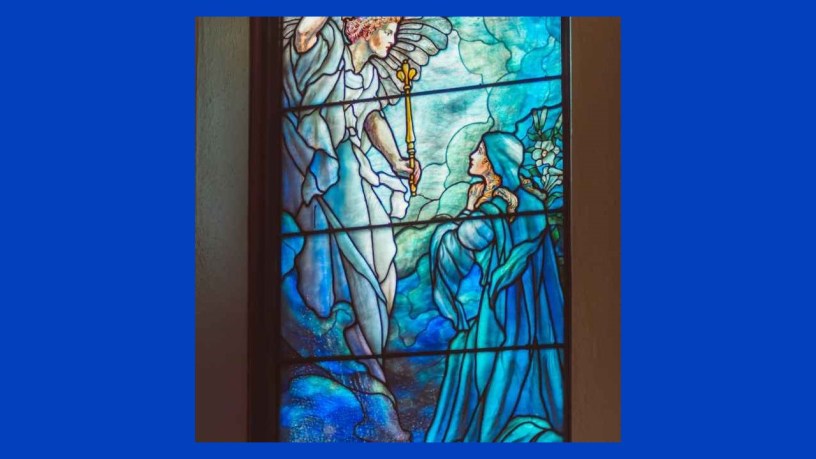
The Traditional Nativity
“And the angel said to her, “Do not fear, Mary; you have found grace with God. You will conceive and bear a son and you will name him Jesus. … And Mary said to the angel, “How will this be when I do not have a husband?” The angel answered, “The Holy Spirit will come on you, and the power of the Most High will overshadow you. Therefore, the child that will be born will be holy…”
—Luke 1:30-35, The New Testament: A Translation for Latter-day Saints, Thomas Wayment (First Edition)
When I was a kid, Christmas reigned supreme as my undisputed favorite holiday, and I relished both its sacred and secular trappings. After over two decades of living agnosticism, my views have changed. I still enjoy the Christmas season, but…
More and more, I find myself uncomfortable with the Nativity story. I’m especially thinking of the Annunciation, where the angel Gabriel informs Mary of her divine matriarchal destiny. Basically, God notifies a teenage girl (read, doesn’t ask for consent) that she is going to have his baby.
As an agnostic, I believe the Nativity is fiction. Yet for me, even regarding it as an inspirational myth fails to remove the ick factor. So, as Wheat & Tares’ resident creative writer, I did the following storytelling exercise:
The following are pop culture adaptations of the Nativity story, specifically adapting the Annunciation quoted above. How do these compare to the account in Luke’s Gospel? More critically, how do they make you feel? Try these out, and let me know what you think in the comments:
A Bedtime Story Nativity (after The Santa Clause)
And the arch-elf Bernard said unto her, “Do not fear, Mary; you have found grace with Santa. You will conceive and bear a son and you will name him Jesus. … And Mary said to the elf, “How will this be when I do not have a husband?” The elf answered, “The Christmas spirit will come upon you, and the power of the North Pole will overshadow you. Therefore, the child born to you will be nice instead of naughty…”
An Allegorical Nativity (after The Lord of the Rings)
And the Half-elf Elrond said unto her, “Do not fear, Arwen; you have found grace with Gandalf. You will conceive and bear a son and you will name him Frodo. … And Arwen said to the angel, “How will this be when I do not have a husband?” The Half-elf answered, “The spirit of Galadriel will come upon you, and the power of the One Ring will overshadow you. Therefore, the hobbit that will be born will be holy.”
A Coming-of-Age Nativity (after Harry Potter)
And Nearly Headless Nick said unto her, “Do not fear, Lily Potter; you have found grace with Dumbledore. You will conceive and bear a son and you will name him Harry. … And Lily said to Nick, “How will this be? James and I only hold hands while sharing a butterbeer, so far.” Nick answered, “The thestrals will come upon you, and the magic of transfiguration will overshadow you. Therefore, the boy that will be born will be holy.”
A High Sci-Fi Nativity (after Star Trek)
And the Sisko said unto her, “Do not fear, Soji; you have found grace with Q. You will conceive and bear a child, and you will name him Son of Picard. … And Soji said to the Sisko, “How will this be when I am only an android?” The Sisko answered, “The Prophets—” And Soji interrupted, saying, “You mean, the wormhole aliens?” The Sisko sighed and continued, “The advanced beings who exist outside of linear time will come upon you, and the power of the Q Continuum will overshadow you. Therefore, the child that will be born will be full of humanity’s virtues and free of its frailties.”
The Marvel Nativity (after the Avengers)
And Tony Stark said to her, “Do not fear, Wanda; you have found grace with the Avengers. You will conceive and bear a child and you will name them Venom the Younger. … And Wanda said to Iron Man, “How will this be when Thanos killed my android boyfriend?” Tony shrugged, answering, “Don’t sweat it. Doctor Strange is going come upon you, and the power of the Infinity Gauntlet is gonna overshadow you. Think of it as a sole-source contract for your womb. I’ll throw in an armored suit for the kid as a sweetener. He will be endowed with superpowers, capable of defeating evil and darkness with a snap of his fingers. Sound good?”
Discussion Points
To be VERY clear, I am NOT INTERESTED in a discussion of the mechanics of the conception, immaculate or otherwise. She was a virgin. Then she was pregnant with God’s Son. Nevermind the how. The issue of power dynamics and consent can be discussed without lurid speculation on the reproductive method.
As a reminder, my primary question for readers of this post: how is the nativity story anything other than creepy?
In particular, I ask that question to progressive Mormons who still observe Christmas. Think in Mormon terms: Here is a clear example of patriarchy controlling a woman’s reproductive life. This is a behavior many of us condemn, or at least find problematic, when perpetrated by Joseph Smith and Brigham Young. Why is it okay when Elohim, the Heavenly Father, does it?
What about my pop culture examples? Which are creepy? Why or why not?
 Wheat & Tares
Jake, without wrestling with Mary’s response in Luke 2:38, I don’t think your initial analysis is quite a slam dunk.
“And Mary said, Behold the handmaid of the Lord; be it unto me according to thy word.”
That sounds suspiciously like consent to me.
Now, if you want to argue that there can never be true consent because of the galactic-sized power disparity between an omnipotent and omniscient God and a teenage girl, okay, I get it, but given that you don’t find the story to be historical, I’m not sure that I can craft an argument that would be satisfactory to you anyway.
I simply choose to believe in a God who truly respected Mary’s autonomy and chose her exactly because He knew she would willingly take on the scorn, pains, and heartache that came with being the mother of the Son of God.
Actually, make that Luke 1:38.
Well, if you put things into historical context, what most women wanted back then was the supreme honor of being the mother of the Messiah. Mothers named their baby girls “Miriam” in the hope that this girl would get that highest honor God could give. It was *the* dream of most girls that they might be choose. Sort of like being chosen by Elvis for the generation just before me.
Then there is the Biblical fact that Mary did giver her consent. She said, “be it unto me.” In other words, “bring it on.”
So, not creepy by the consent standard.
Now, if you look at it from the “child of God” angle, Mary was God’s daughter. Therefore consent or not, it is still father/daughter incest. And if she was under age, then consent means nothing.
But I don’t believe that girls were married at 13 or 14 back then. For one thing, with the poor nutrition back then, menarchy was much later, so 16-18 or so was the common age for first period, then after that marriage was arranged by her father and her consent for marriage meant nothing because that was just how society worked.
Compare another biblical story. Leah was the oldest daughter. Her younger sister was old enough to be attractive because Jacob fell in love with her. But Leah had to be married before her younger sister, so Daddy forced Leah to marry Jacob. After he had worked for Racheal for seven years. So, Rachael hit puberty, but is a gangly unattractive teen with zits, grows a little into an attractive woman, falls in love with Jacob, Jacob works seven years for the right to marry her. So, maybe she got her period at 13, got attractive by 16, fell in love, and add seven years and she is 23, plus one day because Jacob was allowed to marry Leah then Rachael and then work an additional seven years for her because the first seven years bought Leah who was at least 26 by then. So, girls were married in their 20s not 13 or 14.
Poor Leah was married to Jacob against her will because she was oldest and had to be married first. But she knew Jacob did not love her. So, it was common for girls not to have any say at all in who they were married to.
Mary was lucky by that standard if she did consent and normal for that time if she did not.
So, to me, the only creepy factor is if you consider God to be our literal spirit father. And I admit as a father/daughter incest survivor, I am hyper sensitive to that issue.
I’m 52 and this is the year the nativity story hit me as creepy, distressing, manipulative, you name it. I don’t know where that leaves me. I love the symbolism of much of the story, but I can’t ignore the dark aspects of it. Because the despicable parts are there, regardless of whether someone sees them or not. Just like the beauty of it is there, too. So I’m grappling with it all this year. Still celebrating what’s beautiful about Christmas, about Christ. And with a new (to me) awareness of the juxtapositions this season carries. This post was certainly timely for me.
Jake-nice story applications!
Earlier this month I was at the home of a family member that is all in. They are kind and sincere people. They played an lds church video with a child narrating the Christmas story. The missing consent jumped out at me for the first time in my over 10 years of not believing things I was taught as a child. My thinking was firmly progressive long before the god deconstruction. Don’t know how I missed that!
The realization was striking.
Always something new to confirm my disbelief.
I’ve shared this here before, but when I was in high school, my seminary teacher presented an entire lesson about Mary, the culmination of which, in a deeply reverent whisper, was, and I quote: “I submit to you that Mary was the most beautiful woman who ever existed.”
Um, ok. So we read, “…for man looks at the outward appearance, but the Lord looks at the heart.” But when it came right down to it, God chose the hottest woman for himself? In fact, as the creator, he may have actually created her to his own specifications. THAT is creepy. I could not believe this was the entire premise of his lesson. (Also, telling an entire roomful of teenagers that God prefers attractive people? Not cool) It certainly ruined the Annunciation story for me.
I love the pop culture examples. And any way you tell it, and no matter who is doing it, men making reproductive choices for women is wrong.
One correction, whatever it means for the story. According to biblical scholar Dan McClellan the term “virgin” at that time didn’t specifically refer to whether the woman had had sex yet or not the way it does today. Back then it just meant she was a young unmarried woman.
There is no incest in this story. He or she who sees it has a filthy mind. Yes, some church leaders have taught that there was a physical penetration of the Father’s organ into this young woman’s body, but lurid old men saying these things, and getting erections in their pants as they think about it, does not make it true. They were wrong. Both Matthew and Luke agree that the spirit moved upon her and she was with child, and that works for me. To say that God follows natural laws and there is only way to get a woman pregnant is absurd. As has been stated, I think that there was consent. Mary agreed. I see a beautiful story here, both for Mary and for Joseph. I don’t see incest or rape, or any physical copulation. Maybe people see what they look for. I see a beautiful story.
All that aside, I liked the vignettes in the original post. Creative and humorous.
Women’s consent means nothing. If the Bible doesn’t make this clear, have a look at D&C 132.
It’s actually more complicated and troublesome than that.
She’s pressed into single motherhood (by whatever means; was there even an orgasm?), deserted by the father/impregnator for some 30 years during which she raised the child and then the father/impregnator designs that she watch her son be tortured to a slow death.
Is that what we’re to assume a very young inexperienced woman “consented to”?
Thank you, everyone, for your thoughtful comments and the opportunity to benefit from a range of perspectives.
I expected pushback on the topic of consent. Not a Cougar, thanks for giving us a key verse to keep in mind. I think there is room for multiple opinions on this. But I want to point out my OP’s wording though: God “doesn’t ask for consent.”
I did not assert whether or not Mary gave consent. I simply pointed out that God never asks for it. Read the KJV, the NRSV, the NIV, or the Wayment translation above. There are no question marks in Gabriel’s message from God. Mary isn’t asked. She is told.
In any case, consent and incidents where it is called into question in hindsight are always complicated in real life. I learned this working in educational theatre at University of Michigan, where we directly explored the difficulty of obtaining, documenting, and maintaining consent in relationships between educators and students (relationships where one party has power over another person’s future life opportunities). Fraught to say the least.
That said, I appreciate Georgis’s point: “Maybe people see what they look for.” This speaks to both the power and the limitations of storytelling.
Georgis, Mormonism really stresses the *father* relationship of Mormon God too all of us, his children, so I beg to differ about the dirty mind. Yes, I admitted to being *sensitive* to the issue, but….never mind, just imagine yourself roundly called some nasty name. But just don’t go around accusing others of having a dirty mind when you don’t know what the hell you are talking about. Yes, if you as a man were picturing incest, then YOU have a dirty mind, but you were offended by the concept so I won’t accuse you of that.
And since I do not believe in a *male* God at all, I don’t see how Jesus is the “son” of anyone except except Mary. Well maybe the lesbian relationship of Goddess and Mary. But then again, I expect that to offend you.
Thsnks, Anna, and I am not offended. God may be the father of our spirits, but I don’t know that spirits are the fruit of a sexual procreative act between two divine parents. And I reject the idea that God came to Mary in bodily form and did the deed with her to plant his seed in her. Our scriptures do not teach this. This is people making God in the image of men, people purporting to know how God acted. The LDS early leaders who taught this notion spoke in error. They let their arousal at the mental image delude them. Talking about this topic titillated them. They spoke about things where they knew nothing. There is no reason to see a sexual act in the nativity story.
My understanding is that the story in Luke comes from a Greek manuscript written 100ish years or so after the death and resurrection of Jesus. It is unclear if these words came from memory, oral tradition or maybe some Aramaic manuscripts that are lost to history. This doesn’t make them inaccurate or wrong per se, but it might give space to give some grace to the authors here.
The reality is that in all likelihood these are male Greek disciples that are telling Mary’s story. We don’t have a gospel of Mary. For whatever it is worth, I choose to believe in a Heavenly Father and a Heavenly Mother who are perfect in all ways. Therefore, whatever happened with Mary would have to have been in such a way that it would not have compromised the perfect nature of the Gods, Their relationship to Mary, and Their relationship to each other. Should any aspect of that story seem wrong, it is more likely a byproduct of human (male most likely) interpretation of that event.
I’m going to reserve judgement about “creepy” for the reasons I just mentioned. But I find myself longing for a Gospel of Mary written by Mary. I bet it would have been one of the most incredible perspectives on Jesus to have ever existed.
I’m adding this link to a brief Q&A TikTok video by Bible scholar Dan McClellan. He discusses the non-canonical Infancy Gospel of James, which apparently had a profound and lasting influence on historical Christianity, and Roman Catholicism in particular, and therefore on Mormonism. Apparently this is where some of the claims/assumptions about Mary’s status as a virgin come from: https://www.tiktok.com/@maklelan/video/7444977147476774174
I enjoyed reading the bits in the OP, fun stuff, Jake!
I’m well familiar with the Luke narrative (in the KJV voice,) and the words of verse 38 are an important consideration to the idea of Mary’s consent: “And Mary said, Behold the handmaid of the Lord; be it unto me according to thy word. And the angel departed from her.” I expected it to be quoted in the OP, and went looking for it in the comments. It’s referenced in the first one as proof of consent.
Because of my lived experience being a female member, and trying for long decades and to the best of my mortal ability to be a faithful servant, I don’t necessarily see full and freely given consent in those words, as written in the ancient text. What I see resembles covert coercion an awful lot. Or benevolent patriarchy, or whatever you want to call it. It’s hard to pin it down to see it and expose it, that’s by design. It’s supposed to be covert to all observers, but especially to all participants.
When you’re trained to believe that your options are constrained, or they really ARE constrained, (it doesn’t much matter which) and a “best” possible action is unexamined, but pretty much a given (like obey the angel, or follow the prophet, or give your life to serving your family first, foremost, and always), and your life experience is limited at 14, or 18, or 25, and everyone whose life experience might qualify them to advise you is sitting on that information, or they’re erased from public discourse? It can be labeled consent by clueless parties, or manipulative operators with an agenda kept from the consentor. But it’s not fully informed and freely given consent.
Nowhere is it written (anymore) what experiences Mary had when ostracized by family and community for committing sins she did not actually commit. Or when her family culture was poisoned by bitterness between her oldest and his younger siblings, or what she went through as he was railroaded into arrest and was executed. We don’t talk about the negative consequences that happen when women follow the rules given them by culture and doctrine, without first knowing the risks they may face. We don’t even see it. We aren’t allowed to, it’s a taboo subject. And that’s abusive and causes damage, and thus quiet coercion remains covert and goes undetected, uncorrected, and unhealed.
The positive flip side of all this would be for a woman, especially a young woman, to be groomed early to weigh decisions for the impacts on her, to be given specific information with which to weigh her options when offered a proposal, to have advisers who don’t benefit from her decision, and to be explicitly given the option to decline, along with the option to consent.
Did Gabriel treat Mary with this consideration? Did our grandmothers and mothers have this taught them? Will our daughters be shown how to take care of themselves in this way? If not, then it’s not consensual.
Major props for properly labeling Elrond as the Half-elf. Eärendil’s silmaril shined extra bright in the sky when you wrote that. That’s how the three wise Numenoreans found you bearing gifts of a sword, palanitir, and seed of Nimloth.
God has always respected the agency of his sons and daughters, and works with patience, long-suffering, love, and so forth. I believe Mary was informed and consented, and well magnified her calling. The story of our Savior’s birth has been and still is the greatest story ever told. There was no abuse, no rape, no unkindness.
Great post. Yes it is creepy. God supposedly made Adam out of dust, so why not do that for Jesus and spare Mary the labor pains? Come to think of it, why give women labor pains at all? A horribly unfair move for a creator. Come to think of it, almost everything God does in the Bible and Book of Mormon leads the critical reader straight to the problem of evil.
God: Does a thing in the scriptures.
Me: That seems horribly unethical.
Apologists: Well, actually, blah blah blah…
Me: … That still seems horribly unethical.
God could make a universe that operated any infinite number of ways and chose one where we animals experience fear and pain, people get Ebola and Alzheimer’s and leopards can only survive by tearing sentient gazelle to shreds. Not good.
Also, Mary doesn’t give consent in the narrative. That would require an option to decline. What she does is accept her fate. If an angel appeared to you and said, “Rejoice for God is going to give you an extra head and you shall be his two-headed miracle prophet.” Do you have any other option than to say, “Be it unto me?” The Bible has examples of people saying no to God. They don’t go well.
There’s a brilliant poem by Mary Szybist called, “Annuciation Under Erasure.” Well worth the very short google search and read. Jake, I think you’d particularly like it. It’s from her book called Incarnadine which reimagines may annuciations, etc. Fascinating stuff a book I teach often in my poetry classes (both to my literature and creative students).
Moses said no to God because of his speaking issue, and God allowed Aaron to be his voice before Pharaoh. He also refused to circumcise his son, so his wife did it. Jonah said no about going to Ninevah, but he changed his mind. I think that Mary consented, and nothing in the story is supposed to be read to find a lack of consent. People find what they want to find. People looking for hate and oppression will find it in the sweetest places. Did Mary understand the end at the beginning? No. Did Joseph understand why he was sold into slavery, and consent to it? No, he didn’t understand until many years later, and he rejoiced. Mary may have consented, and Joseph did not consent to being sold into Egypt, but both of them had faith in God. I see these stories as edifying, but my personality is such that I usually see the glass as half full. Others see the glass as half empty. From what I see in the gospels, Jesus treated women with dignity and respect.
Brian, thank you for mentioning Mary Szybist’s, “Annuciation Under Erasure.” It was new to me. A powerful, hardhitting poem. I hope others will give it a read too. A simple search of the title will provide multiple places to read it. Here is just one, used in a devotional piece written in 2020 by Jarred Mercer:
https://www.theschooloftheology.org/posts/essay/annunciation-erasure
This is deeply offensive, for the following reasons:
Just a Catholic lurker reminding the author that the immaculate conception does not refer to the conception of Jesus at the annunciation. It refers to the conception of Mary.
Aly, thank you for chiming in! Honestly, I’m a bit surprised I wasn’t taken to task sooner for this admittedly loose use of the “immaculate” reference. I am aware of the distinction you make, and was when writing the OP. My reference was more an act of wordplay than theological analysis, hence the “or otherwise.” Still, your point is well made and well taken. I hope you will continue lurking at Wheat & Tares as Roman Catholicism comes up from time to time in discussions of Mormonism, and we can benefit from that firsthand perspective. I wish you a good Advent
“Just a Catholic lurker reminding the author that the immaculate conception does not refer to the conception of Jesus at the annunciation. It refers to the conception of Mary.”
I don’t get this. Can you give a nutshell explanation how how it is that Mary could have been born without original sin, when everyone else was? Or am I not understanding the doctrine?
It didn’t become official Catholic doctrine until 1854, although it was a long time in development. The question answered by this doctrine is how can Jesus, the son of God, be born to a woman tainted with sin? Sex is dirty (say some), and accordingly they didn’t want Mary to be born by dirty means. Thus the need for the immaculate conception. Back in the 16th century, before the Immaculate Conception was promulgated, the Council of Trent did hold that Mary was free from personal sin, meaning that she committed no sin during her life, or that no sin was allowed to stick to her because she was going to bear the Lord, and thus she had to be clean.
This is a good example of what happens when doctrine goes bad. We create new doctrine to support the bad doctrine. I think this happened when it became doctrine that Blacks couldn’t hold the priesthood or go to the temple, and then we made up doctrines why that was so. I won’t give those doctrines here, but read Joseph Fielding Smith, Bruce R. McConkie, and others if you want to know them. Our church rejects all of these doctrines today, but they were our doctrine (official teaching) before 1976.