

Is the Church as an institution traditional, conservative, or reactionary? Which leaders exemplify which of these approaches, and is that similar to how the membership sees things?
Imagine we are driving during rush hour on the freeway. We are between exits, and the flow of traffic is what determines our speed. As we come up to a congested area, we may slow all the way to a stop, with occasional breaks and an ability to move forward. The direction of all the cars is still forward; we are progressing toward whatever our destination is, but in the same direction. It might be slower than we would like, but it’s in one direction. But if someone decides they don’t want to go in that direction or that the destination is something they dread, fear, or dislike, they don’t have that many options. They can try to inch forward slowly until they finally reach an off-ramp. If they want to be dramatic and dangerous, they could park their car and refuse to move while cars go around them. If they are a lunatic who doesn’t care about damage, they could even put the car in reverse like in an action movie. And if an exit presents itself, they can get off that road and go back where they came from or take an alternate route entirely.
First, let’s go through some quick definitions:
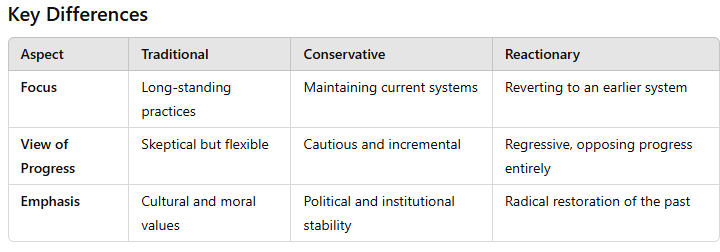
First, let’s dispense with the idea that the current Church is either liberal or progressive, despite what a few whackadoos in Tara Westover’s family might claim (her dad was wary of her going to BYU because it was too woke or whatever). It might have started out that way, but like most institutions over time, it is ultimately concerned with stability and institutional preservation of norms. Jesus might have been a radical who bucked norms, but eventually, you’ve gotta pay the bills, right?
Examples of traditional church practices include things like:
- Ordinances
- Holidays
- Worship format
- Religious clothing
Examples of conservative church practices include things like:
- Opposition to female ordination
- Support for traditional marriage
- Preference for KJV Bible translation
- Barring certain instruments or types of music from worship
- Determining who gets to speak or participate in ordinances and in what ways
Reactionary practices are when progress has been made, and now we are taking it back. It could include things like:
- Women used to have budgetary oversight, separate publications, and then under correlation, the men took it back.
- Women gave blessings of healing in the early Church, then were prohibited from doing so.
- The Word of Wisdom used to be “not by way of commandment,” and now is totally mandatory and checked up on in worthiness interviews.
- The Policy of Exclusion (2015 anti-LGBTQ policy barring the children of same sex couples from baptism)
- The recent transgender policy, barring use of bathroom and prohibiting any pushback against deadnaming could be seen as reactionary as it updated anti-trans policies to be more exclusionary than they were
These specific “reactionary” policies were changes that were hidden under the cover of other changes. Specifically, correlation was a huge organizational change that shifted everything under male, hierarchical priesthood control, eliminating autonomy and localization across the Church as the Church grew in size.
The Word of Wisdom change was grass roots as the temperance movement gained steam in society, so society as a whole was behaving in a reactionary way, not just the Church. Here is a quick integrated timeline:
- 1826. The American Temperance Society was founded, encouraging voluntary abstinence from alcohol.
- 1830s. The temperance movement became popular among the middle class and evangelical reformers.
- 1833. Original Word of Wisdom documentation including the phrase “not by way of commandment.”
- 1851. All members voted to formally covenant to keep the Word of Wisdom, but in reality, adherence was spotty.
- 1920. Prohibition became U.S. law via the 18th amendment which illegalized the manufacture, transportation and sale of alcohol.
- 1919-1921. Heber J. Grant made WoW observance a requirement for a temple recommend.
- 1933. Prohibition was repealed in the U.S. Jokes on us, cuz it never got repealed for us.
As to the anti-LGBTQ policies which I’ve deemed “reactionary” above, they could also be painted as policy clarifications rather than a repeal of rights, addressing gray areas or loopholes rather than taking policies backwards, but that’s a matter of opinion. In reality, when a policy has a gray area or is open to interpretation, local leaders may in fact handle it in a more progressive way or a more regressive way depending on their own views. Cracking down on this variation while erring on the regressive side feels reactionary, but only if your local leaders were interpreting the gray area in a way that leaned progressive or even passive.
I can actually think of quite a few examples of progressive changes, although they are pretty minor compared to the progressive changes I would have liked to see. We’ve talked about many of them here, things like garment design, women’s participation, and downplaying the focus on BOM historicity and young earth creationism.
This question is coming up for me as a result of the reactionary changes that the incoming administration has promised, and that many on the right (especially in the hellscape that is Twitter/X) are clamoring for, including some that are really outlandish like repealing the 19th amendment (that’s the one that gives women the right to vote), the already fait acompli of removing protections for women’s reproductive care nationally (the Dobbs decision), over 500 bills anti-LGBTQ bills that were proposed last year, threats to use the Comstock act to repeal access to abortion medication as well as contraceptives, adding prayer to school, requiring teaching from the Bible in public school classrooms in some states, rolling back (or “ripping out”) non-loyalists from departments that date back to the New Deal and created the current administrative state, banning discussion of LGBTQ identities in schools, banning discussion of race in schools, rolling back EPA protections and climate change commitments, and threats to voting rights protections. There are many more examples, but these are the ones I can think of at the moment.
Does reactionary change work? The answer is complicated. Reactionary changes appeal to groups that feel threatened by rapid change. They succeed when they have control over powerful institutions, as they currently do with all three branches of government in the US. If there is economic or social crisis, or the public can be convinced there is, reactionary measures often gain traction by promising a return to a nostalgic past when things were more stable, whether this is true or not. Additionally, the more polarized our politics are, the more leaders are choosing to make changes via methods that don’t rely on consensus building like executive orders. These types of changes often don’t outlast a regime change, unless public sentiment dictates otherwise.
However, reactionary changes are almost always temporary in the long haul. Individual rights can only be suppressed for so long without backlash; acceptance of LGBTQ people and more visibility and open discussion of women’s issues lead to social progress. Technological or economic advancement also alter the ability to regress to an earlier time. Those who benefited from the progress are likely to resist reactionary efforts. A popular TikTok vignette I watched illustrated a Trump voter calling in to inquire why his prescription medicine was now suddenly so expensive he couldn’t afford it, and the rep explained that he no longer had his ACA coverage and was not their client. The customer was angry about being dropped, but the CSR (customer service rep) explained that there was nothing he could do, and this was what the client had voted for, even if he didn’t know it. He insisted he had only voted to repeal “Obamacare,” NOT the ACA coverage he had been relying on. It was a useful skit to show how reactionary policies may be called for by the public, but may actually be unpopular, creating a second backlash to reinstate the popular progressive policies.
Generational shifts also change the landscape for reactionary changes as younger people don’t share a nostalgic past with those older than them. But young people growing up under reactionary regimes (such as Iran today vs in the 1960s when women did not wear hajib and dressed Western) may take a while to go through the entire progress cycle again when protesting and speech are dangerous activities. Within the Church, speaking against church policies has suddenly been upgraded to “apostasy” that can land a member in a disciplinary court, but it’s still something that leaves plenty of room for local interpretation. (What constitutes: speaking, against, and policy?)
Another issue is that some reactionary changes are not choosing between two policy alternatives. Some people just want to see the world burn. Eliminating a department or a policy is reactionary in a way, but it also only takes 5 minutes to fire 1000 people, but it takes a lot longer than that to rebuild what 1000 people used to do. For a Church example, if you institute a policy that causes 100 families to resign, reversing that policy doesn’t actually bring the 100 families back.
- Do you think the Church is conservative or reactionary? Do you think it varies by leader? Can you provide examples?
- How do you think the Church feels about reactionary politic policies that are emerging from the right? Do they favor these reactionary changes or feel they go too far?
- Do you think the incoming administration will favor reactionary policies or conservative ones? What do you think is the likely outcome?
- How much reactionary change will the public tolerate? Will the administration do it anyway?
Discuss.
 Wheat & Tares
There’s a lot to digest here:
I think most think of the church as conservative, but looking over history, it seems to be much more reactionary than we realized. The Word of Wisdom is a perfect example of a reaction that became doctrine. In the past 10-20 years, there have been many more reactionary proclamations than conservative declarations. The LGBTQ issues but also the smashing of the movement for women and the priesthood and leadership. With women, it’s been very small steps forward and large steps back. I also think the emphasis on the Family Proclamation is a reactionary response to the world. We spend a lot more time in meetings at both the local and churchwide levels talking about preserving the family than we do with how to treat each other or, more specifically, our relationship with our Savior.
I think, looking at the results in Utah of 2016, 2020, and 2024 and how Trump has increased his share of the vote, that we are heading towards a much more reactionary church. We can’t really talk about politics in church, but we can talk about religion in politics. Politics is wagging the moral dog now and we aren’t voting conservative anymore.
I’m not following most of the examples of reactionary changes. If a reactionary change is reverting to a previous system, then within the LDS context, the reactionary change was getting rid of the POX. Similarly, a reactionary change with regards to the WoW would be to once again declare it not a commandment, right? It would be reactionary to go back to a point where half the ward drinks but no one really cares that much. If women gave blessings in 1800s, a reactionary change would be to allow them to do so again.
Alternatively, I suppose the argument could be that the baseline starting point was pre-JS Christianity where women didn’t give blessings, the change was the LDS church allowing them, and then the reactionary change was stopping that practice. But then I don’t know where to stop moving those goal posts to find the starting point that defines if we are going back to something that used to be.
I’m not convinced that the Nelson-era church is traditional, conservative or reactionary. I’m not a historian, and I’ve personally experienced only a small chunk of church history, but I’d argue that Nelson is the most progressive leader the church has had since . . . BY? What other church leader could you see tearing down a temple (Provo, Manti)? Or updating the endowment multiple times. Dropping BSA. Renaming MoTab. Dropping HP groups, YW class names, HT/VT, YM presidency. 2 hour church. Ordaining 11 year-olds. I see Nelson as far more willing to toss aside traditions that he doesn’t see a need for than his predecessors, and to that end, I think he’s progressive. Whether or not the progress is in a direction you like is a different question.
DaveW: I think it can be tricky to determine whether a change is progressive or reactionary, or even just anti-tradition (e.g. seeking to eliminate a tradition that a leader doesn’t value, but it’s not really creating progress or reacting to progress). For example, changing from 3 hour church to 2 hour church seems like it’s an anti-tradition change (eliminating a tradition that Nelson doesn’t value), but it’s not really progressive or reactionary. A progressive change is one that is trying to create a future based on equality, inclusion, and justice. Reactionary changes are trying to undo inclusion or equality to revert to an imagined “better” past in which the older system was seen as more orderly or more stable (even if the outcomes were unjust or unequal).
I think the best way to understand Nelson’s changes is the description his wife Wendy gave, that now he’s “unleashed” and no longer being “held back” from doing all the things he’s wanted to do forever, but the others in charge would not let him do because they disagreed. (That doesn’t really meet any definition of “revelation” I’ve ever heard before, but it fits her view of it).
I do think he’s reactionary when it comes to LGBTQ issues, or at least he doesn’t oppose Oaks’ reactionary policy preferences. Given the reactionary nature of many of the Project 2025 initiatives, I wonder how the church will view those changes. It’s also hard for me to personally grasp because Utah politics are already mostly run by the Church, and the state does some things that I have found shocking and surprising at times, nearly always motivated by religion, but they may not constitute “changes” in Utah. They would in other states, but not there. So, if I had to make a list of possible national political changes, how would the church feel about these reactionary changes (and would leaders differ from the membership):
– prayer in schools (e.g. at a school event vs. private personal prayers which have always been permitted)
– women having the vote repealed
– interracial marriage being outlawed again
– outlawing contraception (under the Comstock act)
– repealing gay marriage (we already know most Utah legislators voted FOR the Respect for Marriage Act)
– prohibiting trans people from using the bathroom of their choice (there is also evidence for how people would act on this one)
– eliminating or restricting anti-discrimination legislation (the Church does one thing in the public arena, and a different thing at BYU)
Was the church unknowingly priming people for trump. Will they like the consequences?
What would the Church look like if it was simply a man-made organization and not one guided by revelation? It would hold on to traditions that make little sense and at the same time it would make incremental changes that reflect changes in society. Additionally, individual Church presidents (not a higher power) would have the ability to drive initiatives that reflect their personal preferences. Does this sound familiar?
You seem to be equivocating a little with your definitions. Per the post, I think that the changes to WoW would be labeled progressive rather than reactionary. What idealic past was strengthening the WoW requirements an a attempt to recover?
I say that your equivocate because the definitions in the post seem to refer mostly to the process, but in a comment you provide definitions that seems to focus on the desired outcome. “A progressive change is one that is trying to create a future based on equality, inclusion, and justice. Reactionary changes are trying to undo inclusion or equality”
Mike Sanders: You could construct a Ven diagram that would probably clear up the progressive vs reactionary change issue. I also find it interesting that when we experience retrenchment that is often a reflection of individual preferences (Oaks) as much as a reaction to anything.
In response to a statement from the first commenter: Trump‘s share of the Mormon vote, while high, actually decreased each election. I think in 2024 Mormons were one of the very few demographics where he did worse vs 2020.
https://www.deseret.com/politics/2024/11/18/latter-day-saints-exit-poll-trump-harris/
Eugene
Thanks for the clarification and the article. It’s nice to see there was a small increase in LDS members voting for someone other than Trump. I just wonder how, between 2016 and 2024, many were LDS in 2016 and no longer identified as such in 2024. My county in Utah went from 90% to 87% in 2020 to 2024, but it also grew in total population, and I’m not sure what happened with church membership except to say it’s smaller in my little community. The bottom line is we have a lot of division in the church manifesting itself in different ways. We also have very little direction from church leadership and plenty of members who are very loud in their support. It’s getting harder and harder to live in our normally passive-aggressive lifestyle when we feel under attack for our political beliefs.
A long time ago I did a study on the personality of the Church. I programmed my computer with the Myers-Briggs personality profile test and had as many people as possible take the test answering as they saw the Church. With that in hand I led an hour session at Washington DC Sunstone Symposium on the subject having the group answer for the Church.
The Church came out STJ, unequivocally. It was split on E/I. In terms that most people understand, STJ is the profile for a manager of a brick yard. The opposite, NFP, is the profile of Jesus: seeing life as a puzzle to be solved, experiencing life with emotional content, and open to change. STJs follow rules, do not perceive emotions very well, and resist change.
This would be at least conservative. But beyond conservative.