
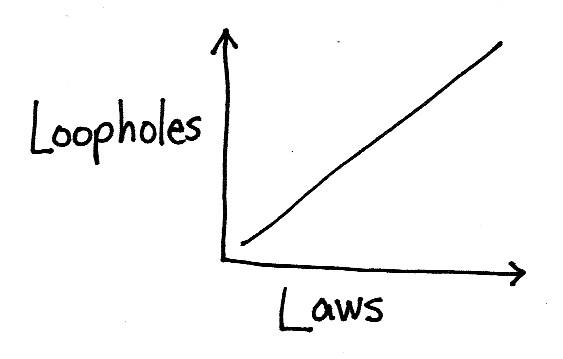
The last 8 years have convinced me that Trump is sui generis. There are many reasons for his uniqueness as a politician, but the one I would like to explore today is that his background and temperament make him an expert at something many of us are not that good at: exploiting loopholes. There’s a reason we’re not that good at it, and it’s because most of us aren’t really trying to game the system, and if everyone games it in the same way, the system responds and shuts down that loophole.
And yet, every system can be gamed. I’ve repeated this Henry Kissinger quote many times: “Every solution is a ticket to a new problem.” You really can’t completely game-proof institutions. It’s like whack-a-mole. You find a loophole, shut it down, and another one opens up. It’s like mercury in the desert. You step on it, and it rolls away and reforms into a puddle elsewhere. The best we can do is keep chasing the loopholes and shutting them down. The worst we can do is allow those who game the system to run the system, but here we are.
Donald Trump has been known to exploit various legal and regulatory loopholes throughout his business and political career. Here are some prominent examples:
- Tax Code Exploitation: Trump reportedly used provisions in the tax code to avoid paying federal income taxes for several years. By declaring substantial losses on his real estate holdings, he was able to offset future income and reduce his tax liability significantly. The IRS allows for real estate developers to claim depreciation on their properties, and Trump leveraged this to avoid paying taxes in profitable years.
- Campaign Finance Loopholes: Trump has utilized campaign finance laws to benefit his businesses. For example, during his 2016 campaign, Trump directed campaign funds to his own companies, including payments to Trump Tower and other properties he owned. This self-dealing allowed campaign funds to be funneled back into his businesses legally, though it has been criticized as ethically questionable.
- Charitable Foundation Misuse: The Trump Foundation faced scrutiny and was ultimately dissolved after being accused of using charitable funds for personal and political purposes. This included purchasing personal items, settling legal disputes, and supporting his campaign, which was outside the intended use for a tax-exempt charity.
- Bankruptcy as a Business Strategy: Trump has used corporate bankruptcy filings as a way to restructure debt for his various business ventures, including casinos and hotels, without personal financial loss. This is a legal strategy, but using it multiple times has raised questions about his business practices and the ethics of leaving creditors unpaid.
- Real Estate Valuation: In various financial and legal contexts, Trump has been accused of inflating or deflating the value of his assets based on what would be advantageous. For instance, he has reportedly valued properties higher to obtain loans and then valued them lower for tax purposes, taking advantage of varying valuation practices across contexts.
These strategies highlight the ways Trump has used available legal mechanisms and regulatory gaps to his advantage in business, taxes, and politics. Loopholes may be technically legal, but they transgress social norms, are often viewed as unethical, and lead to perceptions of unfairness.
The previous norm, even in politics which are notoriously corrupt, was for politicians to mostly try to adhere to the “spirit of the law.” The reason for that is because voters would “vote the bums out” if they were unethical or broke norms. No matter what you did, you had to be able to convince people you did it for the “right” reasons, that your heart, your morality and your ethics were at least in the right place. If you transgressed, it wasn’t for selfish reasons. Or if it was for selfish reasons (sexual peccadilloes, for example), the casualties were all personal (wives, mostly), not national. No constituents were harmed in the process. But now, all bets are off.
In Trump’s first run for president, he ran on the promise to “drain the swamp,” which to him might have meant to skim the profits of the presidential power directly into his own pocket, but to his voters probably meant to curb government regulation and spending, inertia, and the “deep state,” whatever the hell that means. And honestly, why not do both? I’m sure that’s possible. But whatever he does, Trump is definitely going to get his.
Romney once said that not paying more than a cent he had to in taxes made him smart. Sure. But I think the critique was that the rich were able to exploit loopholes that the working class did not have access to, as well as advantages in terms of fancy accountants and lawyers, off-shore accounts, and moving assets into non-taxable structures. In short, the less power you have, the less you are able to get ahead through loopholes. It’s a recipe for a kleptocracy. And of course, as we all know (those who read W&T anyway), the Church did some shady-as-hell financial shenanigans to hide its extensive assets because leaders were afraid that if members knew about their amassed wealth, they would stop paying tithing. Avoiding detection was worth the $5M SEC fine. It reminded me a little bit of a former bishop I had who was often accused of law-breaking because he was a notorious speedster. His answer was “I obey the law. I pay all my traffic tickets.”
Honestly, Trump has brought many loopholes to light (in exploiting them) that I have never even heard of before (how to get unconventional appointments done without congressional approval is a new one this week), and he’s using them to full advantage. It’s not to say no other politician has exploited loopholes–Nancy Pelosi’s stance on insider trading is a damning example on the left–it’s just that he’s like a genius at it and has literally no shame about it.
So what’s wrong with gaming the system? It’s a pretty anti-social approach to life with negative impacts to society:
- Erosion of trust. The general public loses faith in institutions because the powerful are able to control them through gaming the system for their own benefit. It’s unfair.
- Increased inequality. The wealth gap increases (and the power gap) when loopholes are exploited.
- Misallocation of resources. Outcomes may differ from the intended purpose of the organization or funds.
- Undermining of regulatory systems. It leads to more regulatory activity, which then leads to extremely complex legal frameworks to try to close off the gaming, but it really just makes the whole thing a tangled mess.
- Loss of social cohesion. Unfair systems create resentment among the public which leads to polarization and disenfranchisement.
Legalistic thinking often leads to exploitation of loopholes; you have to find the loopholes to game the system, and there are always loopholes. We are operating in the most legalistic era in the Church with Oaks basically running the show. As a retired jurist, he believes in the law, which means a focus on legislating morality (because the Church is…a church) and closing down anything he considers a loophole that members are exploiting or might exploit, at least if it’s something he cares about. And there are plenty of members who approach their membership in a legalistic manner! If they check all the boxes on the list, they win salvation. If there’s a loophole in there, and they exploit it, they can still win.
Tim Ballard exploited the hell out of some loopholes in convincing women that his sexcapades were necessary to “save the children.” The Provo Police Dept was afraid that BYU students who were raped were using a “loophole” of reporting their assaults to the police directly to escape detection by the BYU Standards office, so they funneled police reports directly to Dolores Umbridge (who I assume runs the Standards Dept) so that those rape victims could also be put through the school’s wringer for any of their own minor sins that occurred surrounding their assault–such as becoming pregnant from the rape. Speaking of BYU, “soaking” which made its public debut in the hilarious Jury Duty series because that’s just how crazy that phenomenon was, is a primo example of loophole exploitation (no pun intended).
My own moral compass has always been to try to follow the spirit of the law, which frankly means I’m all too ignorant of what the actual laws are. It’s one reason that I was supremely miserable as a missionary for the twelve hours I actually tried to comply with the “white Bible” rule book with exactness. It was full of really ticky-tack rules that were just kind of silly and not actually necessary to the spirit of the law. Things like how much my luggage weighed (too much, as it turns out). Leaving five minutes late in the morning is apparently a violation. Being a jerk to your companion is not.
But we’re in Trump’s America again, and that means if you aren’t gaming the system, you’re probably one of the suckers and losers who thinks we’re all in this together. And to the extent this is an American Church (a large extent) full of Trump supporters (63%, apparently), the majority are OK with this thinking. Maybe they always were.
- Do you think church members are legalistic or spirit of the law types? Is that shifting? Does it differ by their position in the Church?
- Do you know people in the church who have gamed the system? What examples do you have?
- Do you think this will forever change norms in American politics? In religious institutions?
Discuss.
 Wheat & Tares
I appreciate this analysis. Most people will use loopholes only on an as-needed or exception basis, but Mr. Trump uses them unabashedly and forcefully. The difference is that most people care about the health of the system and others participating in the system, but Mr. Trump cares nothing at all about the system — he will burn everything down to make a dollar for himself — he cares only about himself.
You asked about church members. Regrettably, I feel too many members emphasize the letter of the law, and care little for the spirit of the law. I wish more cared about the spirit of the law, as our Savior did. Seeking the spirit of the law requires reading and understanding of scripture, openness to inspiration, openness to nuance, and genuine love of God and fellowman.
I’m a firm believer . . . that the Church will exploit any loophole it can: financially, legally, morally, spiritually, you name it. For both Trump and the Church, the ends always justify the means; anything other than that they see as damnation (literally standing in the way of their progress). The catch? short term gains for long term long loss: we come to resent the leaders. Not even Machiavelli would approve as the damage these actions are causing are worse than the gains.
I grew up on the milk of “self-reliance” and “saving money” as a consumer. I was starkly impressed by the “A Christmas Carol” . Scrooge went from the self-reliant miser who didn’t take care of himself or anyone else to a carefree, generous man who thought about the poor, and over-paid/well-paid those he hired. The implication was that “being Christian” meant “being generous towards others” because of the “good news”.
I took a lot of business administration classes where it dawned on me that the suppliers were best served by those who paid full price on time and worked within the system to provide feedback/updates on their changing scope of work/preferences. Business administration was looking beyond supply and demand to include “environmental impact” and “sustainability”.
In following Scrooge’s example, I am working really hard to be the type of consumer that is generous towards those who provide for me with goods or services sustainably. I think that is an important question to ask oneself periodically.
Selfishness has become something of an old-fashioned word, but I think it’s still appropriate to describe much of what’s going on today by individuals, institutions, groups of various kinds, governments, and even a nation’s character in general. It helps explain America First, White Male Privilege, and White Christian Nationalism. In crude form it’s “I’ll get mine; screw you.” It is the polar opposite of generosity. And it doesn’t take a biblical scholar to discover which approach is Jesus’ in the Gospels.
Wow! It seems to me there are a lot of no votes in this thread. I wonder what is happening?
The Biden administration pushed through a couple of student loan relief packages knowing full well that it did NOT have the constitutional authority to do so. Obama did something similar with the DREAM act. I won’t even get into Trump yet because we are about to see it live. My point is that both parties look for loopholes. Both parties have presidents who govern via executive order to circumvent Congress.
And yet, all we see here on W&T is Trump, Trump, Trump. It’s not that simple.
Josh H: I specifically pointed out Nancy Pelosi’s BS defense of insider trading (I’d love to just have a portfolio based on hers!), and “RINO” Romney’s line about not over-paying on taxes and the church’s SEC violations. None of those people are Trump, and Pelosi is a prominent Democrat. But yes, Trump’s ascendency and majority support by church members is a salient topic. If you’re tired of talking about Trump, well, join the club, but here we are. The increasing reliance on executive orders is another example of a loophole. If you can’t get the votes (and given our polarization, that’s increasingly impossible), you go around the obstacles. I’m personally in favor of eliminating the filibuster for this reason. I think people might be more careful with their votes if the people they were voting in actually could do the things they promised. We’re so used to gridlock we don’t take anyone’s campaign promises seriously.
I like complaining about Trump as much as the next guy, but surely we could bring up the topic without referencing him or any other politician?
To me, loopholes are about exploiting rules in an unintended way in order to extract something of value (or avoid a loss). Many of the examples in the OP are financial. (Taxes, loans, stocks, bankruptcy, etc.) Other examples involved getting romantic/sexual gains, or avoiding punitive consequences. And while we’re here, I’m not at all convinced that soaking isn’t just a meme.
I don’t see a lot of loopholing (can’t I make that gerund? spell check says I can’t) at church, mostly because I can’t figure out what value I could extract from church. Financially, I could squeeze some reimbursements a little I guess. Getting a significant amount of financial assistance would require some large scale fraud (socially, at least, if not legally) and completely revamping my entire lifestyle. One thing I suppose I could extract is social capital. Virtue signaling can be costly, or not. I can lie about how often I’m going to the temple and may be able to get some value, I guess, but since that wouldn’t impress anyone I care to impress, I have a hard time taking this line of reasoning seriously. Obeying the “white bible” is similar. I don’t believe that it is going to produce any special divine results, so the only impact is going to be the opinion of those that observe the behavior, and perhaps the doers own personal feelings about themselves and their exactness in obedience.
I’m personally in favor of eliminating the filibuster for this reason.
I can’t believe that people opposed to Trump are still saying this.
lastlemming: Maybe they are turning me into an accelerationist. I do feel pretty hopeless, FWIW.
I suppose that lying in LDS “worthiness” interviews could be considered a loophole that many (most?) Church members use, at least some of the time. Following the “spirit of the law” with regards to worthiness interviews would impel members to be completely honest and forthcoming in their responses to their bishops and stake presidents. However, the consequences for not being found worthy can be pretty severe: unworthy people can’t get married, go on missions, serve in callings, etc. Lying works because it is generally impossible for priesthood leaders to discern whether someone is being honest or not, both because the “spirit of discernment” doesn’t generally work as advertised in scripture and Church publications and because priesthood leaders usually don’t have physical evidence of worthiness/unworthiness. As a result, many members game the system and just lie, or at least don’t tell the whole truth. I am most definitely one of these people and have been for pretty much whole life since I became a teenager. Those members that choose to be honest are forced to follow the “repentance process” as dictated by their local leaders, which may involve delaying marriage and/or missions, being removed from callings, and just being generally shamed, etc. while those in the majority who choose to game the system by lying (or withholding some information) get to choose if and how to repent on their own terms.
Many members would consider viewing porn, masturbation, making out, etc. to be violations of the law of chastity, yet only a small minority confess when asked about this in a worthiness interview.
There are many members (and the number is growing) who disagree with the prophet’s stand on LGBTQ and women’s issues, yet not many members confess to this when asked if they sustain the prophet. Now, I’m not sure that “sustaining a leader” means you have to completely agree with them, but if you are following the “spirit of the law” in worthiness interviews, maybe you should be leaving it up to your local leader–the man with the “keys to the kingdom of God”–to make this call, rather than yourself.
I’ve seen a number of posts online about how some members send their tithing donations directly to Church headquarters rather than paying through the new online payment system since the Church does not make donations made directly to HQ visible to local leaders. This allows members to pay what they want in tithing, which may be far less than 10% and still declare themselves to be a full-tithe payer, while local leaders have no idea how much the person has paid.
Apparently, a growing number of (especially younger) Church members are drinking coffee, tea, and alchohol while claiming that they follow the Word of Wisdom in worthiness interviews.
Now that the temple recommend interview has been updated to ask more about garment wearing, I’m sure a ton of members will be lying about wearing their garments 24/7.
When viewed in this light, lying in worthiness interviews is a loophole that I think the majority of active members take advantage of these days in order to be able to live the “full Mormon life” (missions, marriages, callings, social status) without having to actually live the full Mormon life (wearing garments 24/7, no masturbating or making out, no coffee drinking, etc.).
A couple of loopholes include: paying tithing with stock to avoid capital gains and donating overvalued art to the church.
Despite the garment crackdown in public talks, the most recent revision of the temple recommend question actually got more vague, in my opinion. “Do you honor your sacred privilege of wearing the garment as instructed in the endowment?”. (That may not be exact but it’s close.) The only instruction in the temple is “throughout your life”. That and the phrase “honoring your sacred privilege” could both be subject to a great deal of interpretation. You could call them loopholes, but I think a lot of members who are becoming a lot more flexible about garment wearing don’t believe they are lying to say yes to that question even if they know their personal interpretation is a lot looser than what Dallin Oaks has in mind.
@Quentin, you are right about the actual wording of the question, which is this:
However, the interviewer is also supposed to read (and both my bishop and my stake president recently did read to me) the “Wearing the Temple Garment” statement, which states (bold formatting added by me):
It seems like most members would agree that almost any activity except for certain sports can be “reasonably done while wearing the garment”, yet if you believe the stats less than 50% of endowed Generation X, millenials, and Generation Z members aren’t wearing their garments. The temple recommend question itself may be kind of vague, but the explanation of the temple recommend question which has to be read as part of the temple recommend interview doesn’t leave nearly as much wiggle room.
mountainclimber479: I suspect that the people you are referring to would respond “Oh wait, you’re SERIOUS? LOL. OK, Boomer.”
I won’t comment on Trump this time
I’ll say that the general strategy of the church leadership is to emphasize adherence to trifling rules to the general membership. They follow the old-school philosophies of organization management which dictates that organizations are most efficient when adherence to small rules is enforced. That way, according to the thinking, big problems are less likely to happen, and when and if they do, affect the organization. The leaders engage in doublethink too. Telling the members to focus on small trifling matters and then in the same breath criticize them for not seeing the bigger picture. In their business transactions, the leaders are trying to take advantage of loopholes all the time. Why else would they be forced to settle with the SEC? However, when it comes to tithing, the leaders try to push out any and all philosophies which would help members justify paying significantly less.
ji, I too have noticed more downvotes on comments and commenters that usually get upvotes. Perhaps a sign of wider readership on this blog? At any rate, ji, your comment was superb.
Meh……more pablum.
I realized that Wheat and Tares and many other internet forums, especially forums where private or anonymous posts/comments are allowed, are also a loophole for Church members. Prior to the existence of these forums, it was quite difficult for Church members to openly discuss their true thoughts, feelings, and opinions about the Church. You were likely to be shunned or excommunicated for speaking openly in your local congregation, even if you did it in private conversations outside of Church meetings. As a result, it was much, much easier for Church leaders to control the message. The loophole provided by internet forums has made it easy for members to speak openly without fear of discipline and is a huge headache for Church leaders trying to keep the thoughts of members “in line”.
mountainclimber479: Yes, definitely. I remember years ago in a backlist conversation talking about the bloggernacle being the Gospel Doctrine class we all wished we could have rather than the one we can actually have. Anything other than a tightly scripted call & response might land you in social purgatory in most Mormon wards.
The@mountainclimber479 the garment loophole is bigger than you might expect. Doing _____ comfortably is an activity not reasonably done while wearing garments. Hiking in shorts is an activity not reasonably done while wearing garments. The possibilities, if one gets creative, are endless.
Anon, concur. We should give each member the dignity to decide for himself or herself what that individual can and cannot do comfortably in garments. We should not make lists of “approved” activities. Didn’t someone say something about teaching correct principles and letting people govern themselves?
A problem with those who game loopholes or completely ignore rules is that the rule followers are frequently looped into the punishment. Especially in work settings.
One personal example – A team I worked with was always careful to make sure our reports were filed and sent out as required. A new rule came out that the reports now had to be filed more often due to someone in another building never filing reports. So instead of reprimanding the person not following the guidelines more work was added for everyone.
Things like this happen all the time. After many years a local company is instituting uniforms for everyone because people are wearing pajamas to work. Maybe companies are just closing loopholes, but it feels like more rules get added because people are stupid, lazy, and selfish.
(I am sure our countries’ founders are thinking they didn’t plan enough for stupid, selfish, and power hungry leaders.)
@anon, Hmm, I’m not sure I agree with you about the size of the garment loophole in the temple recommend question language. Sure, hiking is something that a lot of members would feel can’t be reasonably done wearing garments. The garment wearing loophole gets a whole lot smaller and tighter when you add in the “wear the garment day and night throughout your life” and “restore the garment as soon as possible” language, which you didn’t mention in your comment. A lot of members are choosing to not wear garments these days for a lot of pretty darn sedentary activities. I highly doubt that most orthodox endowed members believe that the intent of the temple recommend language is to allow people to claim that activities like working 9-5 in an air conditioned office, going out to dinner and a movie, watching your kid’s soccer game, etc. are activities that cannot be reasonably done while wearing the garment.
To be clear, I personally hate wearing garments. I generally only wear them once a week to attend Sunday meetings. The loophole I use to maintain my status in the Church without wearing garments is simply to lie to my bishop and stake president about my garment wearing habits during my temple recommend interviews. If other people can find ambiguity in the garment language of the temple recommend procedure work for them, then that’s great, but I personally don’t see how the current language can be twisted to allow for what I’m doing. I believe that my garment wearing habits are a violation of the language in the temple recommend interview language, and I acknowledge (to myself, but not to my local leaders) that I am lying when I say that I am wearing them in a temple recommend interview. The justification for my lying has a lot to do with what Georgis said, but until the language is loosened up, I have to admit to myself that I’m lying.
mountainclimber479: It’s not a loophole per se, but back in my twenties the thought occurred to me that nobody should answer questions that are none of the asker’s business. We aren’t obligated to tell the truth in such situations; they are obligated to mind their own business.
@Hawkgrrrl, exactly. My primary justification for lying about garments in temple recommend interviews because I don’t think the Church should be asking such questions in the first place.
The culture of the Church most definitely encourages legalistic thinking and loophole seeking behavior. There has always been an emphasis on following rules with exactness, whether priesthood ordinances (sacrament, baptism, temple), administrative rules (temple recommends, BYU honor code, missions) or worst of all, the growing litany of unwritten LDS rules to signal one’s belonging into the group. And whenever there are strict rules, there are always people who try to find clever ways around them. As long as the heavy-handed BYU honor code exists, there will continue to be creative students who come up with ridiculous exceptions (like “soaking”). When I was an undergrad (not BYU), there was a small group of LDS students that gathered every Sunday night at 12:01am to go out for tacos, because, I guess, a minute earlier would have broken the Sabbath (even then as a TBM I thought that was a bit silly). Today, we have senior leaders still emphasizing obedience and conditional love (with obedience to the rules as the primary condition) as being superior to Christlike love/mercy/charity/compassion. A lifetime of Church membership trains people to seek and exploit these loopholes.
Looking at these odd behaviors with nuanced eyes, I see them now as exhausted individual Church members just looking for a little relief from the all-consuming demands of active membership, with a little harmless rebellion. True relief, however, only comes from learning to think critically about the rules (spirit of law > letter of law), and just chilling out about them. I don’t have to waste time and energy looking for loopholes once I realize the rule doesn’t really matter, and never did. This is how I view Church rules now, but unfortunately, this is also analogous to Trump’s attitude toward federal laws, regulations and business/personal ethics.
Rich Brown commented on the role selfishness plays in today’s politics. I’ve observed the same thing. When I’ve talked to people about all the things Rich mentioned, the answer is often phrased by the other about how something affects “me”. I’ve needed to point out how policies affect other, often vulnerable, people. I do not think that happens organically.
Related to church, when a leader talks about their own miraculous recovery, I wonder if they’ve reflected at all on the people in their audience who had less than ideal outcomes to large challenges.
Or when a leader outlines the life coincidences that led to them later being chosen for a high office, does it occur to them that that only really matters to them personally? From a regular church member perspective, if it hadn’t been that person, it would have been someone else.
Maybe Trump can use a loophole or two to bring theses wars to an end.
It seems to me that members would have less need for loopholes if they looked at themselves and each other with more compassion. Without deep compassion, the church and its related hierarchy simply become a mechanism whereby members are ensured of enduring a bit of hell while still in mortality. If the Church (or an individual) is involved in a practice which is truly harmful or doesn’t edify and really help people grow, then it should stop engaging in that practice and try something else.