

I wa reading in the Old Testament. Much to my surprise the Bible addresses abortion by directing priests to perform abortions in certain circumstances.
This is what the Bible says:
21 here the priest is to put the woman under this curse—“may the Lord cause you to become a curse[b] among your people when he makes your womb miscarry and your abdomen swell. 22 May this water that brings a curse enter your body so that your abdomen swells or your womb miscarries.”
“‘Then the woman is to say, “Amen. So be it.”
23 “‘The priest is to write these curses on a scroll and then wash them off into the bitter water. 24 He shall make the woman drink the bitter water that brings a curse, and this water that brings a curse and causes bitter suffering will enter her. 25 The priest is to take from her hands the grain offering for jealousy, wave it before the Lord and bring it to the altar. 26 The priest is then to take a handful of the grain offering as a memorial[c] offering and burn it on the altar; after that, he is to have the woman drink the water. 27 If she has made herself impure and been unfaithful to her husband, this will be the result: When she is made to drink the water that brings a curse and causes bitter suffering, it will enter her, her abdomen will swell and her womb will miscarry, and she will become a curse.28 If, however, the woman has not made herself impure, but is clean, she will be cleared of guilt and will be able to have children.
29 “‘This, then, is the law of jealousy when a woman goes astray and makes herself impure while married to her husband, 30 or when feelings of jealousy come over a man because he suspects his wife. The priest is to have her stand before the Lord and is to apply this entire law to her. 31 The husband will be innocent of any wrongdoing, but the woman will bear the consequences of her sin.’”
https://www.biblegateway.com/passage/?search=Numbers%205%3A11-31&version=NIV
I have to admit that I missed this until very recently.
I’ve read that section a number of times but the King James Version uses euphemisms that I just glossed over as I read.
Many alternative translations to the KJV use the euphemisms and address things in the footnotes.
Eg:
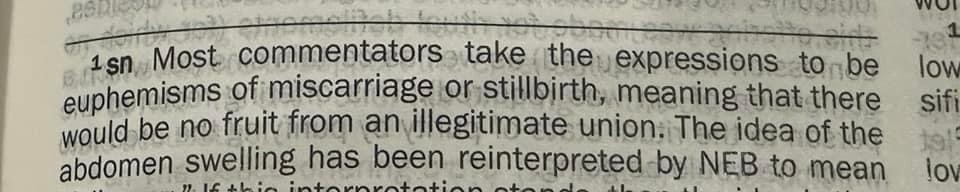
That is, they go to the temple, the priest then causes an abortion if the embryo is the result of an affair.
Note that in the verses mentioned it doesn’t matter if it is at nine days or at nine months and does not matter if the woman wants to keep the child or not.
I am still digesting it all and still thinking about it. I can’t see this standard or approach as one I can embrace but it has caused me to think.
Reflecting on the Bible I have some questions for our readers:
- Would you expect to go to the temple for an abortion or expect a church leader to perform it?
- Should a woman have the right to refuse an abortion regardless of what the Bible says?
- What do you think the Bible should say about abortion?
 Wheat & Tares
What gets lost in translation into our day and age is that the religious leadership wasn’t just “about the church”. The religious leadership was also part of the community leadership, the civil and criminal judicial system, and the armed forces.
So the priest running this ritual for a woman whose child was believed to be conceived in adultery isn’t necessarily a “religious function” as it is potentially a “communal” purity function, potentially a government function, or a judicial ruling.
In this passage, the priest is functioning as an official in a purifying the community of the obligation of feeding/clothing a child of adulterous or “un-pure” origin. It wasn’t best for the family or the community for the mother to give birth to that child, so there was an official offering the ritual to start the abortion process.
Sometimes it still isn’t the best for the family or the community for the mother to give birth to another child. The responsibility for making that decision has shifted to the prospective parents (mainly the mother as primary stakeholder), the healthcare system (for biological information and ethical considerations), and the government. The priest has been replaced as officiator by the medical clinic and the courtroom. The abortion isn’t necessarily being done on the father/potential father surrogate’s behalf in this day and age – the woman has been authorized as an agent to determine whether the abortion is necessary.
I believe in the agency of women to determine what is best for their body, their family situation, and the embryo. I have faith that if there is plan that God has – it includes planning around the intersection of “soul integration” and “abortion”. I do not hold prophets or male religious leaders as experts in presiding over that intersection (the whole “prove that infidelity happened by medical torture is a case in point in the text actually”, even if those prophets and/or male religious leaders feel qualified to do so.
To me this passage isn’t about abortion. Really, so I write something on paper, rinse it on water and have you drink the water, that doesn’t cause anything for any body, and certainly not an abortion in a healthy woman.
The purpose of this ritual is to reassure the father that the baby is in fact his, or if it clearly isn’t his baby when born, reassure him that God wants him to raise the child.
So, translated, they force the woman to drink an herbal potion, known to cause abortions and often the death of the mother too, and if she then aborts the fetus, she is guilty of adultery and probably will be stoned to death. *IF* both she survives and the child survives, she is declared innocent. But they both have to survive being very sick from the poison and any birth defects the failed abortion causes. But no matter what, her husband who by his suspicions forces her to drink poison is innocent. But she is dead from the poison, or stoned for adultery, or just made very sick from the poison. Whether or not she was really guilty of anything except having a husband who was suspicious. Great! Sounds like many of the witch hunts where the only way a woman is innocent is if she doesn’t live through the “test”. In this case, she is innocent if her unborn child survives the poison she is force fed. And why women do not use the old herbal cures for an unwanted pregnancy was they were more dangerous than illegal back alley abortions were.
This was during the time when the drew lots to determine the will of God. And do you know what Bible experts think “Urim and Thummin” actually were? They think they were like dice you threw out and read….sort of like taro cards. That was “prophecy” in those days. God controls such outcomes you know. They literally drew lots to see who was guilty in several old biblical stories. Then executed the “guilty.” In the story of Jonah, the storm comes up and the Sailors draw lots to see who is guilty of sin and caused God’s wrath. Jonah, knowing he is guilty confesses to save the innocent sailors from being thrown overboard. So the sailors throw him overboard. That was just how they determined the “will” of God back then.
Yeah, I think it is time we stopped pretending that God magically makes the outcome what it is supposed to be. And also time we stopped pretending that men know if a woman was “really raped” or that God wouldn’t let her get pregnant if she was raped. Also astopped pretending 11 year old children who are raped are perfectly capable of giving birth, and stopped pretending pregnancy is never dangerous because God protects innocent women from any danger if she just has enough faith, and stop pretending that a fetus’s life is equal to the mother’s life, when if the mother dies so does the fetus. Or when there is zero chance that the child will live, that we shouldn’t do all we can to protect the mother.
I might disagree with those who think the human part of human life begins at conception, but at least I understand those who want to give unborn children every chance at life. What I don’t understand is the magical thinking that any abortion is evil and that God somehow will magically make everything alright, or the thinking that wants to get rid of all forms of female controlled birth control, then make the mothers raise multiple children in terrible poverty, and expect her to do a wonderful job raising them. That kind of thinking makes me angry.
lsw329, they started with “bitter water” which is what herbal potions were called because they poisonous ones were bitter. Then rinsed the ashes in the water.
This passage gets quoted a lot as having something to do with abortion, but that’s now what it’s about. This was a judicial process designed to let God weigh in when a husband accused his wife of infidelity but had no proof. It might have actually helped protect the woman from aggressively jealous husbands.
Here’s a scenario: A woman gets pregnant, the jealous husband accuses her of adultery and demands justice. He has no proof of any wrongdoing, and wants her punished anyway. They go to the priest, who suggests they consult God on the matter. A dramatic ceremony is performed where he mixes up some gross concoction. The woman pays the priest some grain, then swears that the baby wasn’t conceived in adultery, and then she drinks the gross drink…nothing probably happens, which is interpreted as God saying that the pregnancy is legitimate. The woman is judged innocent and hopefully the husband is hopefully appeased instead of doing something to harm her.
Are there issues with this approach? sure. But there is precedent for this sort of thing in the Law of Moses to try to provide women some form of protection from idiot husbands, like the divorce procedures mentioned in Deuteronomy 24.
Ugh typos. Corrections:
This passage gets quoted a lot as having something to do with abortion, but that’s NOT what it’s about…
…The woman is judged innocent and hopefully the husband is appeased instead of doing something to harm her.
@Pirate Priest your interpretation makes sense, but do you have a source? The ‘bitter water’ referring to something that was known, at the time, to sometimes cause miscarriage also seems like a plausible explanation.
I agree with lws329 and the Pirate Priest. I don’t see abortion in Numbers 5. This passage is for a man who thought his wife had been unfaithful. If the baby was born alive, it was vital to the infant’s life that the putative father (the wife’s husband) recognize it. This ritual benefitted the woman, because it ensured that the child, if it was born, would be legitimate, even if the mother had strayed, and her husband would have to provide for it. If the child miscarried from this treatment, then the woman had no protection. Note that the miscarriage needed to be fairly prompt. If a woman was subjected to this ritual at 4 months, and the child miscarried at 6 or 7 months, the woman would not have been judged guilty.
Priests performed all sorts of “administrative” or civic functions in ancient Israel. For example, lepers had to show themselves to the priests if they were cured of their leprosy; this allowed for their reintegration into society. Although performed by priests, and although offerings were made, this was not what we would call today a religious purpose.
While this practice might seem unfair to women, it actually gave them a great deal of protection. It gave women an opportunity to be exonerated from her husband’s accusations of infidelity, whether those accusations were true or false. The NET Bible suggests that the word “bitter” refers not to the taste of the water but “in view of the consequences for her if she was proven to be guilty,” Regardless, it was a much greater protection than pregnant women in almost all other ancient societies had whose husbands believed them guilty of infidelity, where they had no protections. While it isn’t perfect by our standards, it may actually have been a great protection, relatively speaking. The miscarriage had to happen fairly quickly after drinking the water, measured in days and not weeks or months. We don’t have data, but I suspect that most women subjected to this ritual were exonerated, ensuring the child’s legitimacy.
My favorite Bible scholar, Bart Ehrman, did a whole podcast on this. His conclusion? The Bible says nothing about abortion. https://m.youtube.com/watch?v=Agy88gCk1K0
If I had to guess I’d say that people on this board are more interested in what the BOM says than what the Bible says. And since the BOM was written for our time, you’d hope that we’d be able to find material related to abortion (not to mention sexuality, gender, race, family, etc.). Wouldn’t it be nice if the Book of Mormon gave us some guidance in these areas?
The Bible? My expectations are much lower. Heck there’s a talking donkey in that book. There’s approved concubines and slaves in that book. It’s an interesting historical read but if someone thinks they are going to get moral clarity on abortion from the Bible, Good Luck.
@Charles yes there are many biblical scholars who discuss this. For example, Callum Miller at Oxford writing about Christian bioethics
His main argument about Numbers is that the reference is extremely obscure and many translations don’t mention miscarriage at all, (much less anything to do with abortion).
https://academic.oup.com/cb/article/29/1/11/7103199
@Charles There’s lots of biblical scholars who talk about this. For example, Callum Miller at Oxford wrote a whole paper on the topic.
I can’t post the link without my comment getting caught by the filter, but you can easily find the paper on Google
“Why Biblical Arguments for Abortion Fail” published in the journal Christian Bioethics.
Regarding the passage in Numbers, Miller argues that it’s way too obscure of a reference to know what the passage is actually referring to. Especially since most translations don’t mention miscarriage at all, much less any hints at outright intentional abortion.
josh h,
This is a severe stretch, but I guess there is 3 Nephi 1, where Jesus’ spirit communicates with a religious leader just before birth. So if the Book of Mormon teaches that Jesus’ spirit was not in his body at that point, well then life actually begins close to birth as some ancients believed. Which means that while abortion is serious, it shouldn’t be construed as killing or murder.
Yes, I have used this on right-wing LDS. The results have been interesting. A few no longer talk to me, but I can’t claim to have missed them.
I don’t think we’re getting abortions in the temple until we have same-sex sealings.
This how Joseph Smith justifies the abortions at the had of John C. Bennet?
Sent with Proton Mail secure email.
Meanwhile, D&C 59:6 says:
Thou shalt not steal; neither commit adultery, nor kill, nor do anything like unto it.
Notice the injunction is not only not to kill, but to not do anything like it.
Josh h,
The Book of Mormon may not say anything about abortion per se–but it has a lot to say about following the Lord’s anointed.
I am a faithful Latter-day Saint, and I voted YES on Florida’s Amendment 4. A YES vote on this initiative would overturn Florida’s extreme ban on abortions.
I am not an abortion supporter, but my YES vote is driven by religious principles. The Florida ban has no exemptions for rape or incest. And I am mindful that the church’s teaching and counsel apply to church members — as I recall, the church’s official statement says “the church teaches it members…” and “the church counsels its members…“
Other Latter-day Saints in Florida may vote differently.
I appreciate the OP for trying a close read of a passage of scripture. This can be hard, but I think we need to do more of it.
I would support the amendment to overturn Florida’s current abortion ban. The Church does not oppose all abortions: it “opposes elective abortion for personal or social convenience” (from the Church’s Newsroom article on abortion). As I understand it, Florida law currently bans almost everything. Let’s read closely. The Church allows abortions in other circumstances! It is hard to call something a sin if it is only sometimes a sin.
Note also that the Church does not declare to the world that abortion is a sin: the Church “counsels its members not to submit to, perform, encourage, pay for, or arrange for such abortions.” Lawyers on the Church’s payroll wrote this language. They could have written that the Church opposes abortion as a sin, but they did not. The Church only opposes some abortions and it chooses to address its counsel on this topic only to its members. What does that mean?
The Church rightfully opposes adultery as contrary to God’s word, but we don’t seek legislation to put adulterers in jail. The Church opposes gambling, but we don’t pass laws to put gamblers in jail. The Church opposes taking the name of God in vain, but we don’t legislate against blasphemers.
On the Church’s website, under Topics and Questions, we read this in the article on abortion: “Elective abortion for personal or social convenience is contrary to the will and the commandments of God.” Here we point to God and we mention the word commandment–but the commandment only applies to elective abortions for personal or social convenience. I’m not aware of other commandments that ban “elective (insert activity here] for personal or social convenience.” Interestingly, there is no word about God or sin at the Church’s Newsroom site. We read there only that the Church “believes in the sanctity of human life.”
I cast no stones on abortion. I would not limit others’ access to it, as I would not criminalize adultery, gambling, or blasphemy. The Church “counsels its members not to…” That is as far our leaders have gone on this issue. There is no loyalty test or litmus test requiring faithful members to oppose someone else’s choice to get an abortion. I come to this position from carefully reading the Church’s two official statements on abortion.
If abortion was only about the sanctity of life, I doubt we’d have to use Biblical references from thousands of years ago to justify or not justify it. It seems to me that it’s more about imposing a man’s desire to claim or own and to dictate will over a woman. It was forced by men in Biblical times to prove or disprove adultery based on some mysterious outcome of poisoning, and today, it is forbidden by men who make laws against women controlling their own choices and bodies. Very few women have been involved in the law-making process. Also, if it were about the sanctity of life, maybe there would be some laws to help provide for and protect children after birth, but this seems to be grossly underfunded. in terms of education and healthcare. Finally, today, women pay the price, and men, the fathers involved in the pregnancy, don’t pay the price and can even sit in judgment or cast doubt on the woman. Saying it’s God’s commandment not to have abortions is just a way to give an excuse for men to do something against women without understanding and giving it the weight of justification.
I won’t comment on the specifics of what these verses are about, but I will note that the history of abortion is far more complex and interesting than most people realize.
Abortion (called by other names like “restoring the menses”) has been a routine part of care for a woman’s body and health for hundreds if not thousands of years. It was often administered by women. These practices were not objectionable or controversial. In fact, churches were not opposed to them.
I am sharing an excellent podcast on the topic that looks at the practice in the US in the 1800s. I’ve always been pro choice—abortion should be legal, safe, and rare, but this episode helped me to see we should be more humble about things we assume to be fact like when life begins. It also helped me to see that, as a man, I should give women more latitude in knowing what’s right for their bodies.
Link to both the audio file and the transcript below. Note the podcast discusses suicide and other sensitive topics. https://www.npr.org/transcripts/1099795225