
Have you ever wondered what God thinks about politics, especially here in the USA? Here are some historical statements on God and politics that I had in a file. Some are over 100 years old (the quotes, not my file!), but they all still apply today. Most of these are by Prophets or Apostles and could be considered scripture, and thus the “Word of God”
“The more evenly balanced the parties [in Utah] become, the safer it will be for us [the Mormons] in the security of our liberties; and… our influence or good will be far greater than it possibly could be were either party overwhelmingly in the majority.”
1891 First Presidency Letter (Wilfred Woodruf, George Cannon, Joseph Fielding Smith) to John W. Young.
“I regret exceedingly that in political controversies men seem to lack that courtesy and that respect for their opponents that I believe all Latter-day Saints ought to have. I have never yet heard a Democrat make a political speech that I thought fair to the Republicans. Being a Democrat, I shall not say anything about what I think of the speeches of republicans regarding Democrats. … From my own personal contact with dear and near friends, Republicans and Democrats, I have not been able to discover the exercise of what you might call charity, if you like, for the opinions of others who oppose them politically; at least not as much charity as should exist among our people.
“I am a thorough convert myself to the idea that it is not possible for all men to see alike. You know the remark made by a young man once: “It is a splendid thing that we do not all see alike, because if we did, everybody would want to marry my Sally Ann”; and another man remarked, “Yes, thank the Lord. If everybody saw your Sally Ann as I see her, nobody on earth would have her, and she would die an old maid.”
Heber J. Grant, Conference Reports, June 1919, p. 19
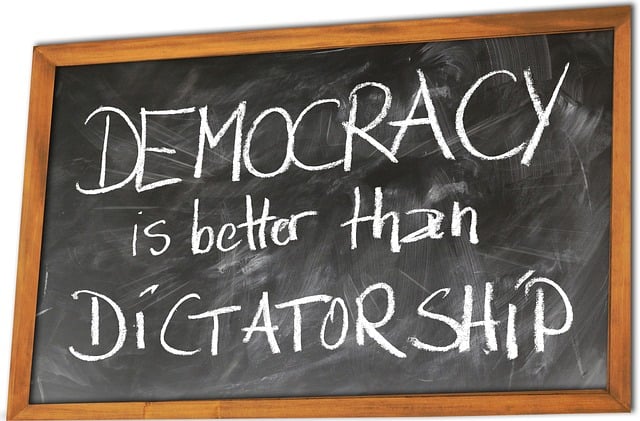
Both of these quotes point to the same principle: that diversity and differences of opinion about political matters are inherently good things for a Democracy and that, without this diversity, the dangers of autocratic rule (dictatorship) would increase dramatically. This is basically the same point made in Madison’s Federalist #10–which, depending on one’s level of orthodoxy and faith in the inspiration of the founding fathers, may also be considered a “scriptural” source. Try not to draw any conclusions from the current presidential race here in the US, and which candidate would stifle diverse opinions.
The third quotation comes from the 1939 Melchizedek Priesthood Study Guide published by the Church and containing, if not scripture, at least the official opinion of the First Presidency at that time. It should be required reading for anyone who claims that “tax-and-spend” Democrats are evil or that the Lord could never approve Universal Health Care.
“Since all capitalistic systems are founded upon the institution of private property, inheritance and the profit motive, great inequalities of ownership and income inevitably result… Among the more plausible suggestions offered to correct existing abuses without adversely affecting the productive system, is to continue the socialization of our service institutions through a system of progressive taxation based upon ability to pay … taking the bulk of their profits to finance free education, free libraries, free public parks and recreation centers, unemployment insurance, old age benefits, sickness and accident insurance, and perhaps eventually free medical aid and hospital service.”
1939 Melchizedek Priesthood Study Guide
While this doesn’t mean that all Mormons should advocate for socialized medicine , It does say prove those who do believe in such things are not heretical, anti-Mormon, or spiritually inferior. There is room for all kinds of political opinions in the Church, and the Brethren, at various times, have held most of them.
The fourth quote (my favorite) comes from a testimony that Dallin Oaks gave before Congress in support of the Freedom of Religion Act, a bill (recently signed into law at the time of this quote) that was introduced to Congress after the Supreme Court voted to allow the State of Oregon to fine Native Americans who chose to use Peyote in their worship services. Elder Oaks was giving the official position of the First Presidency.
“The Bill of Rights protects principles, not constituencies. The worshipers who need its protections are oppressed minorities, not the influential constituent elements of the majority. As Latter-day Saints I have a feeling for that principle. Although my Church is now among the five largest Churches in America, we were once an obscure and unpopular group whose members repeatedly fell victim to officially sanctioned persecution because of their religious beliefs and practices. We have special reason to call for Congress to reaffirm that religious freedom must not be infringed unless this is clearly required by a ‘compelling governmental interest.'”
The BYU Daily Universe, 5/13/92, pp 1-2.
What I believe is important here is that Elder Oaks is stating, quite convincingly, that a practice that Latter-day Saints clearly recognize as “immoral” (the use of hallucinogenic drugs) should be considered part of someone else’s religious freedom and should not be made illegal. In other words: the Church does not believe that everything Mormons condemn as immoral should be necessarily deemed illegal too. This is an extremely important point. Many Mormons assume that the Republican platform is somehow more holy than the Democratic platform because it is generally “against” many of the things (abortion, same sex marriage, pornography) that the Church condemns. This leads Mormons to conclude that they should oppose politically, all of the things that the Church leaders oppose morally. If it does nothing else, Elder Oaks’ testimony before Congress shows that this is not an absolute proposition. I wonder how Elder Oaks applies this to his stance against same sex marriage, which other churches find perfectly acceptable and “part of their religion”. Are transgender people an “oppressed minority”? It seems Oaks has changed a lot in the last 32 years.
What are your thoughts on these quotes?
Which do you find most relevant in today’s political landscape here in the US?
 Wheat & Tares
Compare and contrast: where are you with the First Presidency? They run the gamut of left to right, and we need to always remember that.
In 1889 the First Presidency and the Quorum of the Twelve Apostles prepared a declaration regarding the Church’s position on capital punishment:
“We solemnly make the following declarations, viz.:
“That this Church views the shedding of human blood with the utmost abhorrence. That we regard the killing of human beings, except in conformity with the civil law, as a capital crime which should be punished by shedding the blood of the criminal, after a public trial before a legally constituted court of the land. . . .
“The revelations of God to this Church make death the penalty for capital crime, and require that offenders against life and property shall be delivered up to and tried by the laws of the land” (“Official Declaration,” Millennial Star, 20 Jan. 1890, pp. 33–34.)
100 years later the First Presidency issued on Tuesday, 5 May 1981, the following statement on the proposal to base the MX missile in Utah and Nevada.
“…Our fathers came to this western area to establish a base from which to carry the gospel of peace to the peoples of the earth. It is ironic, and a denial of the very essence of that gospel, that in this same general area there should be constructed a mammoth weapons system potentially capable of destroying much of civilization.
With the most serious concern over the pressing moral question of possible nuclear conflict, we plead with our national leaders to marshal the genius of the nation to find viable alternatives which will secure at an earlier date and with fewer hazards the protection from possible enemy aggression, which is our common concern.”
Over the years of this blog, I have usually not commented on political topics. I think the posts tend to be more common during the weekdays and not on Bishop Bill Sunday.
I went to vote yesterday. I am not going to share who I voted for. However, if we are all objective we have 2 flawed candidates. In generations past neither of them would be chosen for a school board position, let alone President of USA. How did we get here? I think 1 reason was the invention of cable news. When CNN started in 1980, the political opponents would spar and debate and have their differences. However, on the weekends they would go to dinner together and out golfing in DC. CNN, and later Fox/MSNBC/etc. with news coverage 24 hours/day had to fill it up. Best way to fill time and increase ratings viewership is to create controversy. They started shaming the politicians for eating in DC restaurants and golfing on the weekends, instead of flying back to their home state and listening to the local citizens. Superficially that sounds better, but the politicians stopped talking and learning to compromise. Tip O’Neill and Ron Reagan were the last of this culture. Now we as a society have created a literal hatred for other people and their views, not only with the politicians, but within the general public.
A democracy defiantly needs a diversity of ideas and thoughts, and eventually to come to a consensus. However, the center of politics and tolerance has been erased. Every election cycle, I have favored a moderate candidate within both parties during the primaries, but they never advance to the convention.
Figuring who to vote for is not an obvious black/white issue and have a complexity of multiple layers. A few pet topics vary from taxes/guns/abortion/immigration/war/LGBT/role of government/ economy/ and even religious freedom.
No matter what your pet topic is please go out and vote. Apathy is the death of democracy. But let’s participate with less emotion towards the opposition and not insulting the other side for voting different. This is not a black/white issue.
I appreciate the quote “The Bill of Rights protects principles, not constituencies“. Too bad that the LDS church does not put that into practice instead of protecting the “Good name of the church” and actually protect the abused and the truth seekers within the LDS system.
Here’s one that I think may raise a few eyebrows over at Ensign Peak Advisors. It is taken from the “Apostolic Circular of July 10, 1875”:
“One of the great evils with which our own nation is menaced at the present time is the wonderful growth of wealth in the hands of a comparatively few individuals. The very liberties for which our fathers contended so steadfastly and courageously, and which they bequeathed to us as a priceless legacy, are endangered by the monstrous power which this accumulation of wealth gives to a few individuals and a few powerful corporations. By its seductive influence results are accomplished which, were it more equally distributed, would be impossible under our form of government. It threatens to give shape to the legislation, both state and national, of the entire country. If this evil should not be checked, and measures not be taken to prevent the continued enormous growth of riches among the class already rich, and the painful increase of destitution and want among the poor, the nation is liable to be overtaken by disaster; for according to history, such a tendency among nations once powerful was the sure precursor of ruin. The evidence of restiveness of the people under this condition of affairs in our times is witnessed in the formation of societies, of granges, of patrons of husbandry, trades’ unions, etc., etc., combinations of the productive and working classes against capital.”
Tried to leave the link for the above excerpt, but the comment did not show up.
“Every nation has the government it deserves,” the French writer and diplomat Joseph de Maistre declared in 1811. Since the primary function of government is to make laws, it follows that every nation has the laws it deserves.
The words of de Maistre are no less true today than they were in 1811. The reason we have a federal government that is running amok is because the great mass of the public has become lazy and indolent. Indeed, the masses have rejected self-sufficiency and self-reliance and instead, have devoted their lives to seeking immediate gratification.
That is the real problem here. With a general public more concerned with Dua Lipa’s dating life than the quality of our public leaders, there is no question why our politicians are of such poor quality. It takes more than simply voting to fix problems, it takes voting by informed voters.
The public must put down the video controllers long enough to read about important issues. The public must forbear from watching hot dog contests long enough to research the candidates’ positions.
So yes, the politicians absolutely deserve blame for the current situation. So so to do the sweatpants and cros wearing voters who have done nothing to heeds de Maistre’s warning
“The more evenly balanced the parties [in Utah] become, the safer it will be for us [the Mormons] in the security of our liberties; and… our influence or good will be far greater than it possibly could be were either party overwhelmingly in the majority.”
I am not voting for Trump because he is the most UNFIT presidential candidate in US history and I’m not voting for Harris because she is the most UNQUALIFIED presidential candidate in US history. I long for the days when instead of having zero strong candidates we actually had two. Little did I know in 1996 that I was living in the good old days: Bill Clinton, a president who I often disagreed with but one who knew how to triangulate by meeting the Republicans in the middle. And Bob Dole, a war hero who was brilliant at working both sides of the aisle. Both moderates.
The country would be stronger if we had two candidates like this instead of what we actually have. It’s shocking to me that when Biden dropped out the Dems didn’t hold a real convention to identify a strong qualified candidate. And it’s shocking to me that the Republicans would toss aside a strong accomplished governor like DeSantis for a rerun of the reality TV star. The country is weaker because of these two choices.
”However, if we are all objective we have 2 flawed candidates.” Haven’t we always? What am I missing?
”I’m not voting for Harris because she is the most UNQUALIFIED presidential candidate in US history.” A person can dislike Harris and dislike her politics. But in what universe is serving a term as vice president not a pretty good qualifier for the office of President? She’s been in the room where it happens, and avoided scandal in the process. I have no intention to change your vote. But if being VP doesn’t qualify you, what does?
Back to the post at hand, the internet is glorious in that we have access to all the things said by church leaders. We can all find just about anything to support our proclivities. S’marvelous!
I already know that I will not like some of Ms. Harris’ policies, but I voted for her anyway last week. I cannot vote for Mr. Trump or his running mate. I also don’t want to apply the double standard that she must be flawless to get my vote, while he remains lawless. I have always voted R for president since Reagan, except in 2020 when I moved and was unable to get registered in my new state, but I will vote D this time because I want to save our republic. We’ll have another election in four years.
Besides, Ms. Harris is positive and fun, while Mr. Trump is mean and nasty.
I know many people who will vote for Doe 174 (Mr. Trump in the Epstein mess). I hope they will join me in sustaining the winner, whomever it is (but I really hope it isn’t Mr. Trump).
I will be out of the country on election night — it will be interesting to see the results in Addis Ababa.
Josh h, Not sure what qualifications you want Harris to have. Apart from being vice president she was also a senator for a term, and was on a number of committees. I heard an interview with a general who was an advisor to Obama, then trump, and also had dealings with harris’s committee. He said Obama read reports and came back with questions. Trump only read the headlines, and Harris read the reports and came back with action plans to discuss. He said she was very intelligent and he thought she would be very capable as president.
I’ll share the Winston Churchill quote, “Democracy is the worst form of government – except for all the others that have been tried.”
I’ll add my own thought that “Mormonism is the worst form of religion – except for all the others that have been tried.”
aporetic1
It’s off topic of this post but I would be interested in understanding what other religions you tried and what was your experience in their service and why you believe your faith tradition is a better fit.
https://www.abc.net.au/news/2024-10-28/us-election-young-men-back-trump-in-australia/104522558
A survey has just been published in Australia on how people would vote in the US election. Basically 50% for harris, 26% for Trump. In my over 60 age 62% harris 19% trump. The only group where trump is a winner is men under 30 who are 43% Trump and 34% harris. The young women would vote almost totally for harris.
This could mean the polling in America is off, it is also a concern as to what is wrong with so many of our young men.
Is there research on why people are politically conservative or progressive, and why America has more conservatives than most places. Trump would not be running here he is so unpopular here.
That’s a fair point Chadwick. I wouldn’t say that either statement is to be taken literally. Rather, both statements express the sentiment that this government or religion has some real problems, it’s not perfect by any stretch of the imagination, but I still support it and stand by it. (You could say that Winston Churchill and I were using hyperbole).
The other religions that I’ve done a deep dive into are Unitarian Universalism, Baha’i, Catholocism, and Buddhism. And I’ve dabbled in Hinduism, Islam, Zoroastrianism, and Taoism. There are several things that keep me anchored in Mormonism, but the thing that makes me say that Mormonism is the worst religion except for all the others, is that for me, Mormonism accepts and incorporates all the truths found in all of the other religions. My favorite Brigham Young quote is: “Mormonism, so-called, embraces every principle pertaining to life and salvation, for time and eternity. No matter who has it. If the infidel has got truth it belongs to Mormonism. The truth and sound doctrine possessed by the sectarian world, and they have a great deal, all belong to this Church. As for their morality, many of them are, morally, just as good as we are. All that is good, lovely, and praiseworthy belongs to this Church and Kingdom. Mormonism includes all truth. There is no truth but what belongs to the Gospel.” https://www.churchofjesuschrist.org/study/manual/teachings-brigham-young/chapter-2?lang=eng I’m actually a big fan of all of the religions that I’ve studied, and I’ve sought to incorporate the truths I’ve found into my belief system and my religious practice. For me, a religion that embraces ALL truth, no matter where it is found, rises above any religion that is bound by the truths specific to itself.
I’ll throw the question back to you Chadwick, what religions have you tried that are not worse than Mormonism? What was your experience in their service and why do you believe a different faith tradition is a better fit?
(My apologies to Bishop Bill for going off topic from his original post)
Over the last few elections I have heard many church members joke about voting the person in that will usher in the Second Coming the fastest presumably through chaotic and disastrous leadership. I suppose if one believes civil and political turmoil in the US is a prerequisite to the Second Coming of Jesus Christ, that might be a valid voting strategy (though arrogant and to borrow RMN’s second or third favorite word, “myopic” imo). I’m completely fascinated by how church-influenced apocalyptic beliefs can influence people.
As someone who grew up waiting for the “Babylonian world” to end so Zion could begin, I see things a little differently now. I no longer believe that we must wait for society to collapse before we can have a better system. I think we are free to make our Zion here and now particularly in our own lives, homes and communities. I wonder if we have anything to prove to the Gods it is that we are worthy of Zion by being Zion-builders.
I will choose to vote for the candidates that I hope will bring the peace and stability to my community so that I can continue to try to make my own little Zion.
I think the apocalypse is being used as a ridiculous excuse to give up and think you aren’t accountable for your actions. I expect Christ won’t come until we have prepared ourselves for the millennium by building Zion.
Afterall, Christ said he would come like a thief in the night. So we should prepare for His coming everyday by treating others well. Christ has informed us in Matthew 25:40 that how we treat people with little power and respect is how we are actually treating him, and he will judge us on that in judgement day.
He also said to be aware and watch for signs. There have been signs all down through time that could be construed to indicate He is coming. As bad as things are today, they have been worse in the past.
Really we ought just be good kind people and follow Christ. The apocalypse is really irrelevant to this central message.
Just a few days ago a post on this blog put me in a category of a person who does not deserve respect because of opinions I have. I was labeled a liar, and not deserving of civil discourse.
May God in Heaven (Whatever He/She is) help us all…..Regardless of who wins the National Election, we’re headed for a shitstorm. The United States is clearly (sadly) in decline – and all that ANY ******* politician is going to do is make it worse. The entire economy is being propped up….ready for a collapse.
hmmm, I am the person here who usually posts as just “Anna” and there have been other times in the past someone used that. I can’t register as using “Anna” or with my last Initial because someone has registered as both of those and I have nor figured out a way to identify that is unique and recognizable but not completely outing myself because all forms of my name were in use before I got here.
normally just Anna, but there are two of us, so AnnaS
aporetic1
Thank you for asking. When our family decided not to attend LDS services anymore, we considered looking into other faith traditions. The first criteria was they be queer affirming and unfortunately it seems as though the large churches and the small non-denominational Christian denominations in our area weren’t able to check that box for us based on online research and anecdotal evidence hearing the things neighbors would say. We looked into Universal Unitarianism and their theology checked the box but the lack of a meaningful youth program didn’t serve our family at this time. So currently we are in the camp that enjoys second Saturday. So unfortunately I can’t provide any great insight to your question.
The reason I ask is that my wife and I envision a day when we desire to re-join a faith community so in order to keep my options open I thought I would ask, based on your comment.
Thank you to the OP indulging these comments and we can now return to the topic at hand.
One more comment to Chadwick – My heart goes out to you. I will put an asterisk by my original statement. I don’t think that Mormonism is the best religion for individuals in the lgbtq+ community, or for those whose children are lgbtq+ (or otherwise don’t fit the mold, by being neurodivergent, etc…). Yep, I’ve pretty much found the same thing as you, UU is great but lacks a good youth program, Baha’is are great but not queer affirming. If I were in your position, I’d probably have my family focus on a personal connection with the divine, and living true to ourselves. Depending on where you live, I’d look into the (new order) Mennonites. They have a great youth program, and while they’re not exactly queer affirming, my experience with the Mennonites is that they are much more accepting than the Mormons (not anti-lgbtq).
Reading the quotes, I can see that the church has not always been afraid to offend the right-wing fostered by Ezra Taft Benson. In other words, it spoke plainly and truthfully about politics, money, and society. The Church was much more balanced at the turn of the 19th to 20th century. However, the church has changed a lot in the past 60 years, moving towards the right politically on issues even as it stays away from the politics of personality.
Political parties have also followed a similar path. They were much more balanced 120 years ago, but, over time, they started to stake out where they were on the political spectrum with ideas and people. Teddy Roosevelt was a Republican Progressive. Franklin Roosevelt was a progressive from the Democratic party. Democrats typically were from the South, coming from pro-slavery roots in strong support of Jim Crowe. But Truman, Kennedy, and finally, Johnston took that party from those roots and established itself as the more progressive of the two parties, and many former Democrats left the party.
First, they became American Party followers (look at the election of 1968 with George Wallace winning a block of Southern States) and then the Republican Party who accepted them after Nixon’s debacle and Reagan’s huge win in 1980. The progressives were seen as weak after Carter and Clinton, and Obama ran more as middle-of-the-road moderates, but the population was shifting into two camps, conservative and liberal, Republican and Democrat, which Trump further refined into more Jim Crowe conservativism, and the Democrats countered with more progressive social justice and environmental stands. Trump both exploited and expanded the divide, affecting not only the political parties but also religion, schools, neighborhoods, and families.
Now, in 2024, we have to vote and see where we are going to go from here. It’s easy to make excuses for why you’ll vote for one person over another or why one is or is not qualified. We are all sure the information we have is true, yet we live in a time of HUGE misinformation coming from everywhere. We may or may not look to the church for guidance, but we also debate in W&T many of the problems the church has adapting to our modern times. Finally, we have our prejudices from how we were raised and our own experience, which may cast blinders on our choices for who we can support in our vote.
So, as a 70-year-old male boomer, I should be in Trump’s camp. I fit the demographics. But as the father of four daughters who are well-educated independent thinkers who have had to establish themselves in a male-dominated job market, I can say that I admire Harris for her hard work but also her positions on political issues. Trump actively campaigns on taking us back to what we used to be while she campaigns on what we can become. I firmly believe that the Constitution and Bill of Rights apply to ALL people and the fights we’ve had as a nation, like the Civil War, Jim Crow, Civil Rights, ERA, and LGBTQ, and going forward in general, Harris would be better at implementing. She may not be perfect but she’s better than any other choice on the ballot.
It won’t be the end of the world after this election, whoever wins. I just know I’d feel better if Harris won and we faced the future with her vision instead of Trump’s.