

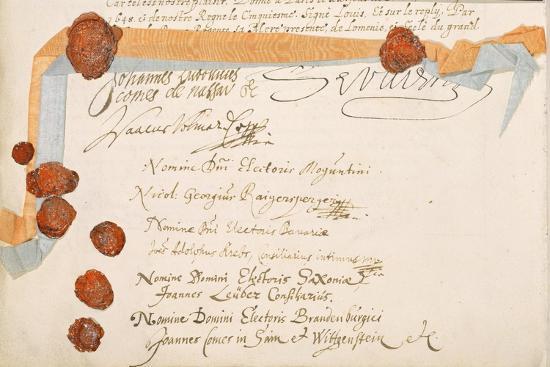
[image: Treaty of Westphalia, signed in 1648, which established the principle of religious tolerance in Europe.]
Tolerance is a peace treaty. We can’t force others to agree with us; we don’t want to be forced to agree with others. We agree to tolerate others’ differences and they agree to tolerate our differences. This is how we live in peace right alongside people with whom we disagree.
Intolerance is when we do not allow others to disagree with us; we do not allow them to live differently than we do. Everything is an argument, and they’ll talk until you stop talking and assume silence is an agreement. The intolerant threaten violence and believe being feared is the same thing as being powerful. The intolerant believe they’re being persecuted when someone tells them they are behaving badly and no one wants them around anymore.
Because this is Wheat & Tares, this post is going to focus on religious liberty, and religious tolerance and intolerance.
“Why won’t you tolerate my intolerance?” This comes in all sorts of forms: accepting a person’s actively antisocial behavior because it’s just part of being an accepting group of friends; being told that prejudice against Nazis is the same as prejudice against Black people; watching people try to give “equal time” to a religious (or irreligious) group whose guiding principle is that everyone must join them or else. [from “Tolerance Is Not A Moral Precept” by Molatan Zunger on Medium.]
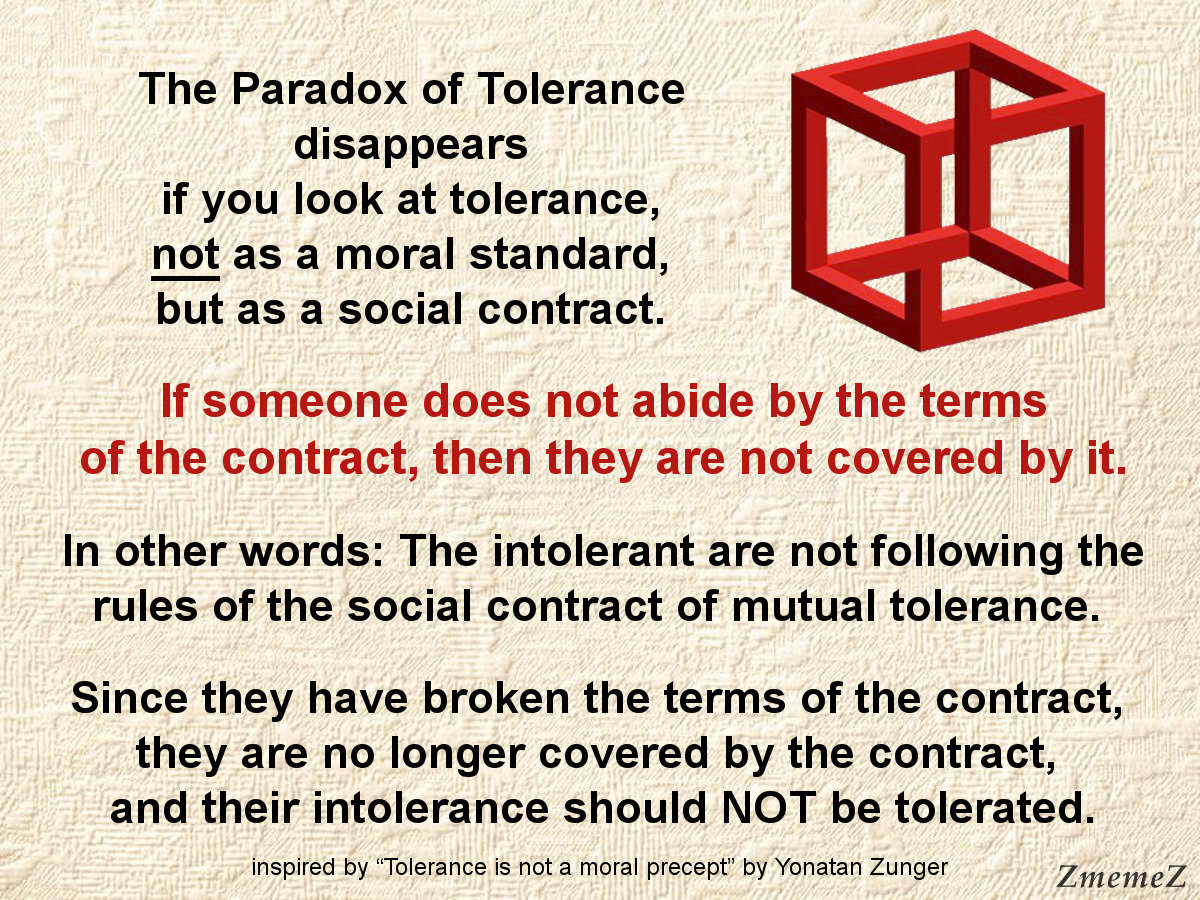
Tolerance is a social norm because it allows different people to live side-by-side without being at each other’s throats. It means that we accept that people may be different from us, in their customs, in their behavior, in their dress, in their sex lives, and that if this doesn’t directly affect our lives, it is none of our business. But the model of a peace treaty differs from the model of a moral precept in one simple way: the protection of a peace treaty only extends to those willing to abide by its terms. It is an agreement to live in peace, not an agreement to be peaceful no matter the conduct of others. A peace treaty is not a suicide pact. [from “Tolerance Is Not A Moral Precept” by Molatan Zunger on Medium.]
The line we draw is living in peace. “Your right to swing your fist ends where my nose begins” is the common saying. Even if your God wants you to swing your fist, you still have to respect my nose. This is tolerance. This is the peace treaty.
Joseph Smith said it this way:
We do not believe it just to mingle religious influence with civil government, whereby one religious society is fostered and another proscribed in its spiritual privileges, and the individual rights of its members, as citizens, denied. D&C 134:9.
D&C 134 is not a revelation given to Joseph Smith. It’s a declaration of belief approved by vote at a general assembly of the Church held at Kirtland, Ohio in 1835. The Church was worried about being unpopular, and the weight of government being used to persecute it. Maybe someone more familiar than I am with the Kirtland period of Church history could comment on which individual rights of Church members were being threatened at this time.
Regardless, the principle set forth in this verse is that religion should not influence civil government to favor one set of beliefs over another. I’m taking out the assumption that everyone is part of a religion because nowadays secularism is as common as religiosity and should be respected as its own belief system.
There’s been a lively discussion going on in Dave B.’s post “An Official Reminder of LDS Neutrality” this week about the Church’s non-neutral stance on abortion. Georgis’s comment succinctly summarized why abortion is NOT a religious liberty issue: “There would be a religious liberty issue if we required abortions, like China’s one child policy, but legalizing abortion threatens no one’s religious liberty, and banning them preserves no one’s. One retains the freedom not to have an abortion. Another woman’s decision to have an abortion in no way erodes an LDS woman’s religious liberty, unless and until she is compelled to have an abortion.”
Religion is influencing civil government to favor one religious belief system, that believes life begins at conception, over the secular belief system, which prioritizes bodily autonomy and rightly points out all the health risks and contradictions involved in banning abortion.
Thus, religious believers have broken the peace treaty about bodily autonomy.
“If one side has breached another’s rights, the injured party is no longer bound to respect the treaty rights of their assailant — and their response is not an identical violation of the rules, even if it looks superficially similar to the original breach. “Mommy, Timmy hit me back!” holds no more ethical weight among adults than it does among children.” [from “Tolerance Is Not A Moral Precept” by Molatan Zunger on Medium.]
What is a proper response to religious believers breaking the peace treaty? Certainly it isn’t to require abortions. The appropriate response is to restore where we were before the peace treaty was broken. Go back to bodily autonomy and restore the right to have an abortion. Religious believers are free to continue to teach that abortion is a sin; they can even excommunicate believers who have or pay for an abortion. But what they can’t do is enforce their religious beliefs about life, conception, and sin on nonbelievers.
Abortion isn’t the only topic, of course. There are other bodily autonomy issues like trans rights, and extending equal protection to same sex relationships. Religious believers try to play the victim card when someone pushes back and tells them they are being intolerant bigots. It’s important that we keep repeating that the religious believers who are passing laws to infringe on other peoples’ bodily autonomy are the ones who are violating the peace treaty of tolerance.
No, I don’t respect intolerant beliefs. And my intolerance is in defense of the peace treaty. Bigots are not being attacked, they’re experiencing what it’s like when someone defends themself and their right to bodily autonomy. Your right to have your own religious beliefs ends where my body begins. As Joseph Smith said, “Don’t mingle religious influence with civil government.”
Questions:
- What’s your response to someone who believes you have to respect their intolerance?
- How do you perceive the attack/defense idea?
- I am so respectful of others’ beliefs that even that time I sat next to a missionary on the train and he wanted to talk religion and spouted a really stupid platitude, I didn’t unleash all my frustrations on him. Should I have?
 Wheat & Tares
Very good post.
I think another way this false religious liberty idea is often expressed is “agree to disagree.” I always balk at this when it is used in a conversation where the person is talking about legislating their religious beliefs or getting rid of laws that preserve the social contract described in the post. It feels like I’m being forced to concede that they have a valid basis for their opinion. No, I’m not going to agree that it is okay for you to have that opinion. Your opinion results in harm to people. This issue is often compounded with church members who have been conditioned to avoid what they perceive to be “contention” at all costs because “agree to disagree” is a tool that they can usually use to skirt talking about hard issues.
Please consider submitting this for publication as a guest opinion article on a widely read site like the New York Times. It provides a clarity that I think many Americans could use. I certainly found it expressing feelings I did not know how to explain.
+1
I, too, refuse to tolerate intolerant beliefs. I believe we have a First Amendment right to express strong disagreement with, condemn, privately block, and show an array of strong reactions to intolerant and hateful speech. In fact, in cases of extremely intolerant, racist, homophobic, and hateful speech, I believe we have a moral duty to combat it through the legal tools that we have available to us. Now, saying racist things is many cases where it doesn’t pose a threat, harass, defame, slander, or disturb the peace, is legal and protected by the First Amendment. But so are strong reactions against that racist speech. Various forms of incivility are also protected by the First Amendment and there may arise cases where engaging in incivility and using harsher language that attacks not just ideas but a person’s character may be warranted and more effective in combating hateful and intolerant speech. Free speech is often confused as civility. It isn’t the same thing. We have the right to be rude, to insult, and to attack other individuals’ characters up to some extent. Free speech is often confused as the refusal to impose social consequences in reaction to speech that someone disagrees with. This is not true. We have the right to call for individuals to be fired, to tattle on them to their superiors, to boycott their services, and to expose them (to some extent as long as it is not defamatory). Think about it. What would your reaction be if you had a friend who all of a sudden openly starting calling for a reinstatement of Jim Crow and saying that Hitler didn’t go far enough with the Jews? They would be free to say that, right? But would you want to be friends anymore? Might you tell other people around you and that person that something is wrong with them? Might you feel a sort of duty to correct that person or impose a variety of legal social punishments on that person for saying what they did?
People talk of cancel culture. This is a phenomenon that has always been, across all cultures and across all time periods. But cancellation has come in various different forms and for different offenses. In recent times in the US, there have been cases where people shouldn’t have been cancelled and those calling for their cancellation were overreacting. And then there have been many cases where an individual’s cancellation was a long time coming and well-deserved. A strong free speech environment is not absent a cancel culture, but contains a robust and well articulated cancel culture. For cancelling is not the antithesis of free speech, but a vital part of it. We are free to cancel in a range of ways. It is an important freedom.
There is no room for “agree to disagree” when it comes to basic human rights. Also, defending one’s abhorrent ideas with “everyone’s entitled to their own opinion” is inherently flawed, because it presumes that all points of view are equally valid and morally sound. They are not.
If, in the interest of “tolerance”, you try to make your LDS ward a welcoming place for people of color AND bigots/white supremacists, sooner or later the ward will be nothing but bigots because everyone else will have left. This is not merely hypothetical; this kind of thing has been playing out in wards all across the Church in recent years.
Fittingly, 11 years ago Boyd K. Packer warned us of the “tolerance trap”, and I don’t think the rhetoric has softened since. A watchman on the tower, indeed…
Mormons need to question their own sense of tolerance, but in the correct direction. For example, you can’t claim to be tolerant of LGBTQ people now when you continually deny that you spent decades actively trying to strip away their rights, even influencing legislatures and courts to assist in those goals.
I think that I would to respectfully take a little issue with namegoeshere’s statement: “No, I’m not going to agree that it is okay for you to have that opinion. Your opinion results in harm to people.” Do opinions harm people? Or do actions (admittedly often or usually based on opinions) harm people? I knew a woman (no dead) who positively hated her son-in-law, and held every negative opinion of him, his family, his everything, yet she also had enough good sense to accept him as her daughter’s husband and to treat him decently.
If I am not going to agree with someone that it is OK for that person to have some opinion, what will I do? Even if that person harms no one, since it isn’t OK for him to hold that opinion, what do I do? Do I get my friends and round him up and put him in a reeducation camp? Or just shoot him? Do I take his children away from him? Do I fire him from his job even if his productivity is great? Do I curse him when I see him in public? or throw stones at him? I don’t want people being cruel to me because they disagree with me, so I should not be cruel to others when I disagree with them. Otherwise, if we can punish people for some thoughts, but other thoughts are OK, who decides? Do we want a ministry of truth in Washington, DC? I don’t want that. Do I want truth police walking around our streets with clubs? Do I want Jews, for example, to wear yellow stars when in public? I don’t want any of that. I therefore choose to be tolerant, even of those with whom I viscerally disagree. I don’t have to be best friends with people whom I see as bigots, ignorant, or stupid, but I must agree that it is OK for them to have that opinion. Translate that opinion into action against another human being, however, and then we have something actionable at law.
Well crafted OP.
Many Mormons (and evangelicals) share the notion that the tenets of religious freedom can act as the basis for exercising intolerance of anything they consider sinful – including SSM, abortion, etc. Boyd Packer famously warned about “an excess of tolerance being a potential trap”. Such misguided thinking is all too often used as the basis for restricting basic human and constitutional rights. Any religious doctrine that interferes with these rights should be summarily rejected.
I find it annoying that so many active LDS members resort to passive-aggressive behaviors in order to mask their intolerance. In June of this year, my Ring camera clearly caught my across the street neighbor stealing a gay pride flag from my yard. Rather than discussing the issue, he resorted to vandalism. In the interest of saving my marriage, I did not confront him. He is always outwardly polite, but I saved the video of the cowardly act. It will be used in an outwardly aggressive manner after suffering through yet another one of his hypocritical HC talks.
Brava! This is exactly right.
Georgis: In the strictest sense, holding an opinion will never hurt anyone (except perhaps the bearer of that opinion) because an opinion in and of itself cannot be seen, heard or do anything. However, simply voicing an opinion can and does hurt people in some instances. Standing on the street corner with a hateful sign hurts people. It hurts when it is a random stranger on the street corner. And if it comes from someone with social capital it hurts more. That includes celebrities, politicians, and religious leaders, particularly ones from your own religious community. And it particularly hurts children when it comes from parents, grandparents, teachers and peers.
It is legal for people to hold stupid, ignorant and bigoted opinions. But their expressed opinions can and do cause harm, and that is not ok and should not be tolerated.
When tRump ran the first time, many of his supporters talked about how they saw him as the savior of the First Amendment. Many gave as their example how stifled they had felt by having to refrain from using the “N” word and how not saying it was an effort to force them to be “politically correct.” They would also often state that they weren’t bigots because they had once had a Black co-worker, or neighbor, or childhood friend. So they liked that tRump “told it like it is” and gave them permission to use that word.
Right, DaveW, expressing opinions can hurt people. We agree, and it should not happen especially in a church or family environment. I wonder, though, where one draws the line. Who decides what opinions are hurtful, or are hurtful enough, that we should not tolerate their expression? and what does it mean that we say here that we don’t tolerate their expression? Are we looking at individual action, or societal, or maybe state? Some people think that burning an American flag is very, very bad, but the US Supreme Court has said that it is OK. That court has also ruled that the KKK or American Neo-Nazi groups can march in Illinois. Some hateful activity is specifically allowed under our laws, and to my knowledge we don’t criminalize thought and words alone, at least not yet.
There are those who think that freedom of speech is a bad thing, but I am not in that group yet. I sometimes want bigoted people to speak their minds, because then I know where they stand and I can choose not to stand with them. Otherwise they hide among us! What does one mean when one says that some expressions of opinion cannot be tolerated? Leninists, Stalinists, Nazis, and Maoists all punished people whose opinions diverged from the party line, and this in our relatively recent history, and they all said that they did it for the greater good. I think that freedom of speech is something worth protecting, and that necessarily includes distasteful speech. I recognize that many people would glady trade in our freedoms in exchange for safe spaces, but I’m not sure that I want others trading in my freedoms.
I fear an all-powerful state that can make windows into men’s souls. Hasn’t Ms Clinton recently, and twice, spoken about criminal penalties for people who spread misinformation? Who gets to decide what is misinformation? Historically, the antidote to the poison of misinformation has been correct information, but in the internet age some things have gotten warped. I don’t know the solution, but I am not convinced that the solution is to curtail free speech. I think that tolerance is a virtue more than it is a vice.
Expressing opinions can hurt people. Perhaps a doctor’s or pharmacists opinion about dosage that ends up being an overdose. Maybe a person suggesting we drink bleach to cure COVID. Expressing opinions about how legal Haitian migrants eat people’s pets, on no evidence, led extremists to bomb threats in Springfield, OH. We don’t live in a magical fairy world of unicorns and rainbows where anything can just be said without consequence and we just have respect people as having different opinions. We live in a world of malicious actors spreading lies and misinformation designed to cause chaos and harm people whose speech we must vigilantly guard against. We also live in a world where there are facts, and we must broadcast them and defend them against malevolent liars. Truth relativity where we can’t define what misinformation is is a world in which humanity gives up and surrenders itself to chaos. I believe in facts and fact-based reasoning. I reject post-truthism and relativism where we just let lies and false accusations just abound without combating them. Throwing our hands in the air and saying, “of, woe is us we can’t define misinformation” is cowardice and a dereliction of moral duty we have as humans.
Well said, Brad D, so please tell me: what concretely would you do to those who say something that you think is false? If it is cowardice to tolerate free speech, what specific act would you propose to counter misinformation? I am asking sincerely. We won’t tolerate intolerance! What does that mean in real terms?
Georgis, there is a difference between “not tolerating” and criminalizing. I do not tolerate the “n” word, but I don’t think the government should criminalize it. What I do in my “not tolerating” is I criticize, ostracize, cancel, and socially punish the person in any way I can, without lowering myself to their level. For example, I don’t tolerate my club using club meeting to have a politician come in and campaign, and I don’t care if he is a founding member of the club. The first time it happened, we raised our strong objection. That is not what our meetings are for. The second time we ended our membership in the club. We kept our personal view on the politician’s party out of our strong objection and would have objected even if we supported that candidate. The thing we don’t tolerate is using a club of people who are into the same sport for any politician to campaign for office. I don’t object to his campaigning, just the club forcing that political view onto me. But I don’t think those running the club should be arrested, just not supported in their behavior.
Great opening post and great discussion.
And to answer the question on what we should do as a society, there can be consequences. Such as the people of Springfield have been harmed by idiots running their mouth. Real concrete harm not just hurt feelings. The proper thing is being done in that a group of Haitians are suing Trump and Vance for the harm done. That doesn’t criminalize speech, but it holds the person accountable for the harm done. It isn’t a perfect system, but much of the time it works.
and we need to go back to the time when newspapers and other media could be held liable for harm done to political and public figures by lies told. There was a time when an out and out lie, such as Hilary runs a child abuse chain that eats babies, and if damage could be proven, then there could be a lawsuit. But now, when the pizza joint that was named in that lie is harmed, there is nothing they can do about the lie, because the lie was spoken against a public figure.
Georgis, you position yourself as believing in free speech. But what I’ve gleaned from your argumentation over several threads is that you subscribe to truth nihilism, which will actually have the effect of reducing free speech and other freedoms. You think misinformation is ok? How about you ask the people involved in the rescue efforts in North Carolina and Florida what they think of hurricane misinformation, which is greatly disrupting their rescue efforts. At some point we need experts and expert opinion to guide us and to stop misinformation that causes chaos. That involves efforts to shut down non-expert purveyors of misinformation. Trump’s world is based on misinformation. It is also based on authoritarianism. You may think that by protecting misinformers and their speech, we’re standing up for free speech, but we’re actually enabling authoritarianism. There is no true freedom without tethers, limits, and regulation. We are wasting our time engaging misinformers. We should shut them down where we can. You ask, “how do we know what is misinformation?” Let me ask you, you think the idea that the government can create hurricanes and control the weather isn’t misinformation? Of course it is. You know that. Don’t pretend like you don’t.
The free speech I believe in has boundaries, expert opinion, and guardrails against dangerous lies. It is a free speech that has always been, and is enduring. The free speech you believe in has ridiculously untenable ideals that ends up enabling liars, authoritarians, and propaganda. It is a fake free speech if I’ve ever seen one.
Great discussion everyone!
I want to address Georgis’s question: “If it is cowardice to tolerate free speech, what specific act would you propose to counter misinformation?”
The specific counter to misinformation should be compelled speech to correct the disinformation. I’m changing “m” to “d” on purpose. Disinformation is deliberate. For example, Fox News beat the drum for Trump’s Big Lie for a long time, spreading the disinformation that widespread election fraud resulted in Trump’s loss, or that he really won, or whatever the specifics were. The company that made the voting machines sued Fox News for defamation, arguing that Fox News knew that Trump lost. Fox News couldn’t even defend that claim. They knew who really won the election; they deliberately lied. Fox News agreed to pay Dominion Voting three quarters of a billion dollars, about $787,000,000 in damages.
The money was a start, but Fox News should have been compelled to advertise what they had done and tell the truth. For the next 90 days (or as long as they talked about The Big Lie), Fox News programs should have started with at least three minutes admitting that they lied about the election, admitting that they knew they were lying, and then debunking something they said. Like there should have been time devoted to admitting that even Trump-appointed judges dismissed cases because there was no evidence of election fraud. There should have been time devoted to admitting they lied about election workers and they didn’t do anything wrong.
That’s how I would propose we counter disinformation. Once you’ve lied, and you know you’ve lied, you are compelled to speak the truth. It isn’t enough to have other sources say Fox News lied; they should have been compelled to say as frequently and loudly as they told the lie.
Anna brought up the Haitian immigrants who are suing Trump and Vance for their lies about the pets. I hope they win. I hope part of the judgment is that Trump and Vance have to go on every news station where they repeated that lie, every social media account where they spread that lie, and admit it was a lie. Note this is a civil penalty. We’re not criminalizing lying like this, we’re forcing them to tell the truth. If they refuse to tell the truth, then they can be held in contempt of court and at that point they go to jail until they’re willing to tell the truth.
That’s not currently a penalty for knowingly sharing disinformation, but it ought to be.
How does religious tolerance become another in the multitude of abortion and gay rights posts here? Mystery stories are created starting with a conclusion, then the author backs through the story to the beginning. After a while reading mystery stories gets boring. Just like these facetious post topics which always lead to the same foregone conclusions.
If the discussion is about religious intolerance stick to that topic. For instance, pro-Palestinian encampments on public university campuses displaying overt anti-Semitism. Is there room to tolerate this religious intolerance? These are PUBLIC places not churches or businesses.
At Utah the police cleared the encampment as soon as it was established. At UW in Seattle it went on for weeks, with graffiti sprayed on buildings and Jewish students barred from passing through the center of campus tent city. Who did the right thing? Utah, in preserving religious tolerance, or UW, in aiding and abetting religious intolerance?
Using the word Trump here brings to mind Godwin’s Law. It’s not so much intolerance as it is ad hominem placarding by narrow minds. As with Godwin’s Law, it is a marker for the replacement of discussion with unspoken group-think.
Anna, thanks for a well reasoned response. On the societal level, I agree with libel and slander laws, and I’m no lawyer, but I understand that one has to prove actual harm or malice, and that is sometimes difficult, and it is true that “public officials” find it more difficult to win suits or libel or slander because of court cases. In New York Times v. Sullivan, in 1964, the Supreme Court ruled 9-0 against Mr Sullivan, the police commissioner in Montgomery, Alabama, who felt that the NYT had defamed him and the Montgomery police force in their reporting on an arrest of the Rev. Dr. Martin Luther King. Per the Wikipedia article, “The Court reasoned that defending the principle of wide-open debate will inevitably include ‘vehement, caustic, and … unpleasantly sharp attacks on government and public officials.'” Especially against blatantly racist police commissioners in Alabama in 1964. I think that most of us today would have supported the NYT, who supported the Rev. Dr. King, and we would have agreed with the unanimous Supreme Court that Mr Sullivan should not win monetary damages. The article continues: “The Supreme Court has since extended Sullivan‘s higher legal standard for defamation to all ‘public figures.'” So what was good (or bad) for Mr Sullivan in 1964 is good (or bad) for Ms. Clinton today. I’ve heard that Justice Thomas wants to overturn Sullivan, which would allow Ms. Clinton to sue for defamation. Should Congress repeal Section 230? Our social media firms will spend a lot of money fighting that. I haven’t fully studied that question and I don’t have an opinion.
Janey, your response shows that there are some teeth in our defamation laws, as the voting machine company got a huge monetary prize from Fox after Fox’s bad behavior. The other remedy is more difficult. How many news agencies reported falsely on the Russian dossier, and how many rejected what was on the Biden son’s laptop? I think that all news agencies, at some point or the other, have peddled false information, and done so with a political purpose, such as CBS and 60 Minutes with one interview with Ms. Harris, one reporter, one room, one place, one time, and CBS has released two vastly different answers from Ms. Harris to the same question–but when I last checked they refused to release the transcript, so the public doesn’t know which answer is true. Both cannot be true. Haven’t we had yellow journalism at least back to William Randolph Hearst, and probably before him, too? Shouldn’t the American public take any news, from any source, with a grain or two of salt? I really like your proposal: “Once you’ve lied, and you know you’ve lied, you are compelled to speak the truth.” While I like it, how would it get enforced? If a court rules for defamation or libel, enforcement might be easier, but can we really compel speech? That’s problematic, isn’t it? Should the Vatican have compelled Galileo to speak what competent authority at the time deemed to be the truth? Was he compelled to recant? I don’t know. He was placed under house arrest and told to quit teaching what was officially false (but really true).
Brad, you make my case about the dangers of free speech. I said nothing about Trump, but some people see Trump everywhere. You write: “There is no true freedom without tethers, limits, and regulation.” My question back: Who sets the tethers, limits, and regulations? What do you propose we do with violators? I see no concrete answer. We already have libel and slander laws, and a voting machine company got nearly $1B in damages from Fox News, so there already is some guardrails. You also write: “We should shut them [misinformers] down where we can.” Again, how do you propose, concretely, that we do this? Should every social media post be submitted for government approval at the Ministry of Truth in Washington DC before it is posted? Who at that agency decides what is misinformation and what is truth? Wasn’t Galileo locked up, tried, and convicted for spreading misinformation? Wasn’t Dietrich Bonhoeffer executed for spreading misinformation? Wasn’t it misinformation, at one point, that illness was spread by invisible viruses, instead of by bad air (miasma theory)? You want to shut misinformers down where we can. Great: how do you propose that we do that? You asked me: “Let me ask you, you think the idea that the government can create hurricanes and control the weather isn’t misinformation?” Sure it is misinformation (or disinformation). I have enough good sense not to believe anyone who tells me that the government is creating hurricanes. I think most people in the NC hill country also are smart enough to recognize this as hokum and balderdash. If we want to shut down websites and newsrooms that post bad information, then shouldn’t we also shut down CBS and its 60 minutes, for their interview of Ms. Harris and the two “official” tapes of her answer? Maybe you propose a Pravda, a government-run news agency under the Ministry of Truth, who will be the only source authorized to issue news. I’m not keen on that idea.
Ms. Clinton has recently called for criminal penalties for people who spread information about elections, and Gov. DeSantis this week said something about criminal penalties for people who spread misinformation about an abortion initiative on Florida’s ballot this November. I disagree with both of them. Caveat lector and caveat audiens. Don’t believe everything you read or hear. Look at multiple outlets. I believe that many who speak are kooks and I choose not to believe them. However, I respect their right to speak, even if I deem them ignorant, because I don’t want someone shutting down your or my free speech if/when they disagree with us.
I’ve enjoyed this discussion. This issue is complicated. Tolerating someone with beliefs contrary to mine does mean that I accept them or respect them. I believe that tolerance for those who hold different opinions is a virtue, even when I do not agree with their opinions, but nothing says that I have to believe them, or do what they say. I choose to practice tolerance. I would hope that this would not be seen as a vice, but clearly it is. Please don’t call the vice squad and have me locked up!
I agree in general that free speech is more important than preventing lies, but also it’s getting kind of ridiculous at this point with candidates refusing to participate in debates if they are going to be fact-checked, and with the bifurcation of the media (thanks to the shift from national media toward individually curated algorithms). People are becoming more and more prone to believing partisan disinformation, which seems to be particularly problematic as one party takes aim at education (both higher education and public education). An uneducated populace will be more prone to believe bad info.
I also think there’s a distinction between misinformation (mistakes) and disinformation (sowing chaos), and some lies are more likely to result in harm to others. For example, the lies regarding FEMA that some have shared. Where is the line in terms of the negative outcomes? In general, I suppose if dupes believe those lies and refuse help and refuse to evacuate, then that’s on them; caveat emptor. Eat a diet of crap, reap the whirlwind. It’s their own lives they are putting at risk, just as someone injecting bleach to cure Covid gets what they deserve, I guess. But what if those dupes then create a blockade to prevent FEMA from helping others, or if police officers do harm to FEMA employees? Now others’ lives are harmed. Obviously, the officers who abuse their office should be fired if so, but should the people spreading lies be held accountable at all or are we just OK with it because people who commit violent acts are the only ones held accountable, if anyone? Even if lives are lost? The latter case sounds more like yelling fire in a crowded theater which is not permitted according to free speech case law. Do we now say “It’s OK to yell fire, but anyone who stampedes to get out and hurts someone else in the process will be held accountable”?
When it comes to complaints of libel, I always remind myself that Thomas Jefferson’s surrogates called John Adams a “hermaphrodite,” so there is a long history of politicians behaving like the scum of the earth to gain or maintain their power.
Georgis, “Ms. Clinton has recently called for criminal penalties for people who spread information about elections”
No. You’re wrong. In the MSNBC interview with Clinton that you are referring to, Clinton says that people should be civilly or criminally charged for some social media posts, but never called for criminally or civilly charging those who post counterfactual content. She did say that it would be a better deterrent to indict Americans who are paid by Russia to spread Kremlin propaganda than to go after Russians who do this, since it is very difficult to indict Russian nationals in the US. In the US, it is already illegal to transmit political propaganda on behalf of foreign actors without registering as an an agent of said actors. Clinton was simply affirming what was already illegal speech and calling for us to crack down on that. So it is really rich of you to criticize me of supporting a Pravda system when you slam Hillary Clinton for speaking out against the spread of that system in the US.
This little error of yours is very revealing. You’re against cracking down on misinformation because misinformation is what informs your narrative. You are clearly easily duped by misinformation and spread it here among us. You claim to be this enlightened centrist but repeatedly spread right-wing falsehoods and talking points. You’re a right-wing hack, Georgis. There is nothing fair-minded about you. You echo Trumpist lies about free speech that are spread for the purpose of getting Trump elected and entrenching the US further in authoritarian leadership. Hope you enjoy your precious dictator on day one who called for the “termination of all rules, regulations, and articles, even those found in the Constitution” over trumped up charges of election fraud. You’re nothing but an authoritarian enabler.
I made my comment Friday morning and happened to check in when I couldn’t sleep (very) early Saturday morning to find this great discussion. I’ve enjoyed reading all the comments.
The conversation has evolved well past my original point, but as a clarification: By stating that I won’t be okay with someone’s opinion when it results in harming others I was not indicating that I think it would be okay to criminalize having said stupid opinion, or even to impose civil penalties on such a person, at least not any more than those legal consequences already exist. The first amendment restricts the government from regulating speech, subject to some limited exceptions. I’m not the government. I get to tell people to eff right off and do any number of things (within the bounds of law) simply because I want to punish the person for, as an example, being a bigot. Boycotts, public shaming, pressuring a person’s employer to reevaluate their relationship with that person – all fair game. As the OP points out, some of these social punishments have in recent years been imposed too hastily and/or in excess of the actual offense, and that is regrettable, but given the restraint the government must employ when it comes to speech, it is what we have. I simply don’t placate bigots by resorting to the ‘ol “agree to disagree” deflection. They want to be a-holes, I’m gonna make em own it.
As to dis/misinformation, I don’t know that there is a solution in the form of laws that does not impinge freedom of speech as it is currently interpreted in case law. But, mark it down, if we don’t figure out how to squash it in a significant way, it will be the end of America and the world as we know it. Our understanding and expectations of the freedom of speech will likely have to adjust to address the problem, and that will lead to lead to a different set of problems. Pick your poison.
Australia has just passed a law that holds tech giants responsible for misinformation carried on their sites with fines being a % of their income.
Where is the outrage against real religious intolerance? I attempted to post a comment about the anti-Jewish camps on public university campuses but it was rejected. Intolerance? Narrow mindedness? Or just electoral partisanship?
When a political party equivocates and turns a blind eye to the real fascist camps in America, it is time to cast them out. Tolerating antisemitism is an ugly form of religious intolerance.
Georgis – you’ve referred repeatedly to opinions and differing opinions as if that’s all that’s at issue here. There is a difference between fact and opinion. Facts can be fact-checked. Here are a few examples.
Illegal immigrants in Springfield are eating pets. False – the Haitian immigrant community is there legally. False – there have been no credible (meaning fact-checked) reports about a Haitian immigrant eating anyone’s pets. So if anyone is repeating these false claims, they are not expressing an opinion; they are spreading harmful disinformation.
If someone says, ‘immigrants are bad’ then that’s an opinion. See the difference?
The court system works great to identify the disinformation that is big enough that it should be public corrected. I’m hoping the Haitian immigrants in Springfield win their case. I already talked about Fox News losing to Dominion Voting Systems. The parents of the victims of the Sandy Hook school shooting won their court case against Alex Jones and Infowars and Jones is on the hook for $965 million in damages. Rudy Guiliani lied about a couple of election workers in Georgia, and the election workers won their lawsuit and Guiliani is supposed to pay them nearly $150 million.
We already have a system in place to identify deliberate lies that have caused harm.
Georgis asked – “While I like it, how would it get enforced? If a court rules for defamation or libel, enforcement might be easier, but can we really compel speech?” Right now, no, the government can’t compel speech (fact based on first amendment case law). This would be a change in the law. I believe (opinion incoming) it’s necessary due to how disinformation and lies are tearing apart our country.
Whether it’s school shootings or climate change or challenging misinformation or any other real problem, I really tire of the conservative voices shrugging their shoulders as if nothing can be done.
Loads can be done. But since as a society we currently value guns and money over children and oil consumption over a warming planet and free speech over those who are harmed by it, nothing gets done. It’s really not at all hard to think of solutions to any of these things.
In a church context, there has been loads of misinformation and disinformation since its inception. When the organization is forced to stop spreading crap, it just stops. It doesn’t apologize or offer reparations or correct the record and thus the disinformation lives on. This is a feature and not a bug and it’s unethical.
So many people here displaying their intolerance. Hypocrisy has a home here. I’ve gotten a real education in Mormon bigotry. You are the skinheads you pretend to abhor.
My denomination was killed for baptising adults, being pacifists and speaking German. Your denomination was killed for practicing polygamy. That’s what religious intolerance is. Don’t pretend it’s some political meme.
thhq, Violence and threats of violence are not poltical memes. Even you don’t believe that. Step up your arguments if you want to be taken seriously.
As Godwin observed, when someone evokes Hitler as a hyperbolic trope they demean the Holocaust.
Consider that. Political name-calling is on a much lower level than actual attacks on Jewish students. A government that aids and abets real antisemitism deserves to be ejected from power.
Mocking me is a child’s argument brian. Grow up.
thhq, That you bascially call me ‘a child’ in the same sentences where you ‘call me out’ for ‘mocking’ you (which is not what even close to what I was doing) and not realize the peek irony of doing so proves my point. Really, step it up. These are serious issues, as you know. The discussion deserves better than such petty back-and-forths.
Every day I receive text solicitations from both parties. All of them are deleted and reported as junk. Every day both parties insult me. I vote based on performace not their hyperbole.
I learned over 50 years that I can say more in 20 words than I can say in 200. Piling up ad hominems doesn’t win the argument. Once again, here’s my argument.
The party that has aided and abetted antisemitism on our campuses over the last year should be removed from power.
Defend your party.
thhq: Judaism is not a monolith. Post-Holocaust in particular, there is a fragmented perspective on Zionism and Israel. There always has been. Additionally, there are plenty who support Israel but feel Netanyahu is a war criminal. My own perspective is that many campus protests and support for Palestine have gone too far without acknowledging that Palestine is funded by Iran, that Hamas is a terrorist organization, that they deliberately hide behind civilians and desire a high death toll to enrage Israel’s supporters, and that October 7th started this bloodbath and was a completely unacceptable action on the part of Hamas, one that many Palestinians supported and celebrated, while others do not possess the knowledge or political power or economic resources to object to Hamas. Additionally, Israel’s actions pre-Oct 7 have not been designed to foster stability in the Gaza strip, but rather to control what they see as a dangerous and uncontrollable impoverished society that harbors terrorists.
I personally object to the use of the term “genocide” for IDF’s actions, since this term was coined to describe the systematic elimination of Jews from Europe (2/3 of them successfully murdered, their possessions stolen, their bodies burned after being mined for even their gold teeth, their clothing and shoes redistributed to German families). The objective was not to create a “safe” Germany. Jews were not committing terrorist acts. Many of the Jews the Germans murdered were not even living in Germany. Germany’s objectives were to steal their wealth and erase their existence. That doesn’t mean we can’t criticize Netanyahu’s actions, but it adds context to that it seems to me is sorely lacking.
I listened to an interview with an Israeli woman who was held hostage by a kind Palestinian family. Aside from keeping her hostage, away from her family, they fed her well, treated her kindly and asked her questions. When she explained to them why her family had moved to Israel in the wake of the Holocaust, the Palestinian family was shocked. They were completely unaware that such atrocities had been committed–ever–let alone to the European Jews. They had asked her why she moved there instead of going to the US, which wasn’t an option for everyone anyway as the US and other Allies limited Visas. Who is responsible for the lack of education of these Palestinian families? Does Israel also bear responsibility for creating two separate education systems? One thing I firmly believe is that if both the Israeli woman and her family and the Palestinian family were living in the US, their children would share a closer perspective than they do today.
While I agree with you that campus rhetoric has veered into shark-infested waters, both anti-semitism and anti-Muslim sentiments should have no place in our discourse. Harris’s views on Israel are closer to my own than they are to these extremist views on campuses. Netanyahu wants a Trump presidency because he wants no controls on his vengeance for political reasons, and Israel’s reliance on US munitions is essential to his cause, and because Israel is truly under threat. Whether his goal of totally eradicating Hamas is achievable is questionable, especially since he refuses to entertain a two state solution. Trump’s signing of the Abraham Accords didn’t exactly solve the conflict, and many foreign policy wonks consider it a factor in emboldening Iran’s actions. Trump seems to be easily manipulated by dictators, including the theocrats who rule Iran, and including “strong men” like Netanyahu who is not a dictator, but is further to the right than most of Israel.
Thanks for writing a cogent defense hawkgrrrl. Our grandson at UW Seattle watched it from his dorm. I think Utah did the right thing and shut it down before it became a mess.
Biden has been condemned for decades by both parties for his incompetence at foreign policy. IMO he learned it from LBJ. I can’t envision Harris being any improvement. She is Biden’s student. IMO Putin was not joking when he endorsed her.
thhq: “She is Biden’s student. IMO Putin was not joking when he endorsed her.” Well, I disagree on both fronts. She may be his employee and unwilling to tear his record down publicly, but she has had her own political career separate from his, in elected positions, for decades. She is of course socially liberal, probably more than he is (as a Catholic, I’m not at all convinced about his pro-choice stance, although he is more pro-LGB and pro-trans than any prior president which is great to see), but she is also first and foremost a former prosecutor. She talks and acts like one, but most of the young left is not excited about that aspect of her record, so it has been downplayed by her campaign. As to Putin’s endorsement, that’s obviously an anti-endorsement to hurt her chances. Putin very clearly prefers Trump, who has consistently shown he is easy to manipulate and admires Putin who is a murderous thug dictator running a country with the GDP of New Jersey. I just got back from the Baltics, Poland & Slovakia, and these countries are universally terrified of another Trump presidency with good reason. Trump is reviled as an unreliable ally and a stooge of Putin. Putin is increasingly aggressive, and is absolutely willing to violate the sovereignty of other countries. I was among those who laughed when Romney said Russia was the biggest foreign threat, but we’ve clearly seen that he was prescient.
How glibly you dismiss Putin’s endorsement Hawkgrrrl. How quickly you forget her statement on The View that she would not change anything she and Biden have done for four years. Given her inability to participate in unfriendly interviews and extemporaneous events like the Al Smith dinner, I have no expectation for anything more than another Biden term. She’s not saying anything different.
Putin will get what he wants from Harris. He likes Orwellian Forever Wars. He’s a veteran of the Cold War just like Biden. They’re reliving Vietnam. Biden and Obama gave Putin Crimea, and Biden has given him a lot of Ukraine. They enabled the murderous thug.
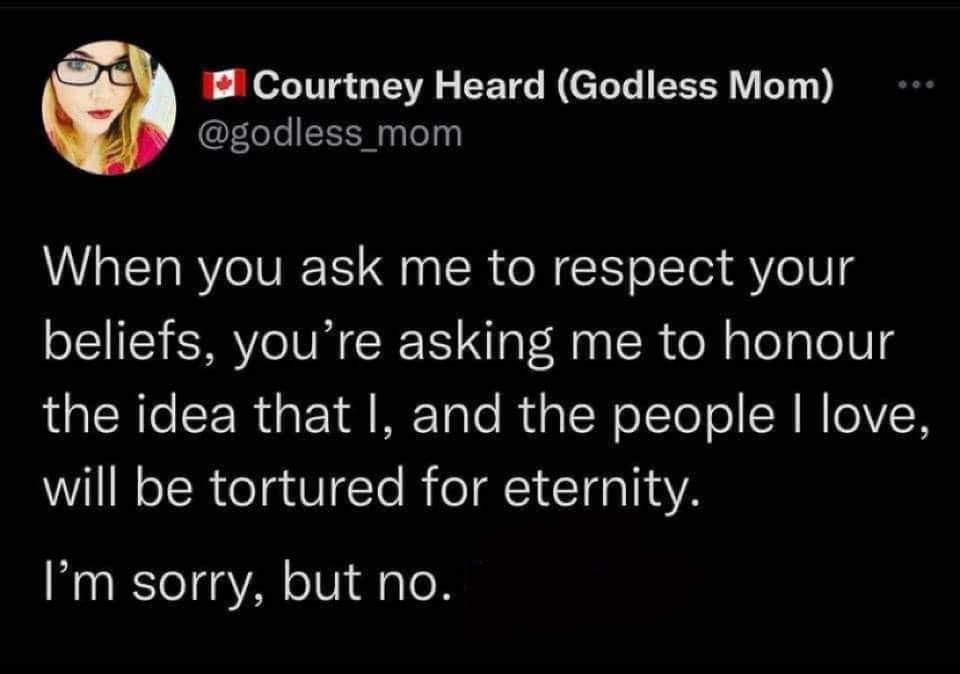
The idea of not tolerating the intolerant doesn’t sit well with me. The OP said, “No, I don’t respect intolerant beliefs.” It made me wonder how one would actually go about respecting intolerant beliefs? Would it imply the already mentioned “agree to disagree” mantra? Would it mean being silent and not engaging at all? How would we like others to respect or honor our own views? There was also the quote from Courtney Heard saying,
“When you ask me to respect your beliefs, you’re asking me to honour the idea that I, and the people I love will be tortured for eternity? I’m sorry, but no.”
Are respecting and honoring someone’s opposing viewpoints the same thing? Can we respect another’s opinion and not honor it? I certainly don’t feel I honor lots of opinions I hear. I even detest some of them. But can I respect them? I think so. They have the right to have an opinion and share it as much as I do, right? I can respect that. If you disagree, I would honestly like to understand why. To clarify, the issue isn’t about what is being said, just the ability for it to be said.
I believe the real issue is choice. Life is choices. Sometimes you have many choices, sometimes not. Sometimes you have lovely choices and sometimes you have very hard choices. We choose who we believe, what we believe and how to live out that belief. In theory, policing hurtful, damaging opinions may seem like the moral thing to do. After all, injustice should be dealt with. But I don’t think that’s the real issue here. If the real issue is about freedom of speech, we should all agree we have a right to say what we want, good, bad or ugly. But what happens when someone’s words or rhetoric becomes a real danger to others? Who defines that line and where will it be drawn? How will we implement consequences for those who are crossing that line? It’s a slippery issue and I wish I had the perfect solution.
Should people be held accountable for thoughts and opinions? Yes. What does that look like? Is it by the individual or a group/agency/government? Do we invite an agency to set those terms and hope they’ll always stay fair? There are consequences from the choices we make. If you choose to spit out lies and hate-filled thoughts, that’s a choice. I also have a choice. I can politely (or not so politely) disagree with you, yell at you, unfriend you, or warn everyone I know to watch out for you. Those would be choices I have. The example of Fox News being held liable for spreading false information is a little tricky. I think it’s abhorrent when a news agency can’t be trusted but alas, here we are. But at the end of the day, I don’t need nor reply on, someone telling me how I should or shouldn’t feel or what I should do about it. I’m capable of researching and making my own informed opinion. The fact that many people don’t have that desire or take the time to know that for themselves, is again, a choice they are allowed to make. At some point, you are responsible for what you believe and how you act upon that. Now, if I’M the one spewing hate, then I may not think I need or want someone else’s opinions but that might be part of the consequences I have to live with for making my choice in the first place.
We are all influenced by different things but at the end of the day, Fox nor CBS nor my neighbor, is going to dictate how I choose to conduct my life. I will choose to offer compassion and grace and mercy and to be a good listener to the best of my ability because that’s what Jesus has called me to do. And yes, sometimes showing mercy and grace means calling people out and having tough conversations. Maybe it means dissolving relationships. Maybe it means starting a blog to allow for healthy discourse so we all can be stretched and grown as humans. Maybe that will go further in bending people’s hearts and minds toward true tolerance and inclusion.
Thanks for sticking through that long post!
I usually agree with your assessments Hawk but only partly on the Israel Palestine situation.
Netanyu has opposed every accord for a 2 state solution over the years.
Netanyu was elected by 23.5% of Israelies, and although he is far right, he is in coalition with a religious right party who would withdraw their support for him as PM If he were to let up pressure on Palestinians.
Netanyus governments have been persecuting the Palestinians for decades. Israel has been building Israeli settlements on Palestinian owned land, without compensating the Palestinian owner, the arming the settlers, and killing or imprisoning the Palestinians who protest.
Netanyu has control of water, food, fuel and medicine, and switches of those supplies. Why? Since October 23 he has cut off all those supplies, he has also controlled the ability of Palestinians to get out. He then bombs them with American supplied bombs in residential areas.
You say hamas is willing to kill palistinians. Not sure where you get that insight. They are the elected government of Palestine.I would say the Israeli government is committing genocide against the Palestinians, but I do not have insight into their motivations but they do not appear to have an exit plan other than to confine the Palestinians, deprive them of the necessities for life, and continue to bomb them.
Netanyu continually says his aim is to destroy hamas, but he has also said all Palestinians are all hamas. If you are a palistinian, are continually being attacked by Israel, the only people fighting back are your elected government, who do you support?
The student protesters are unhappy that Netenyahu has killed 42000 palistinians. They want that stopped. That is not antisemetic, but if you are a jewish person who supports Netenyahu I can see how you might.
Netenyahu is destroying support for Israel in the world community, he is now attacking his neighbours, asinating their leaders, and destroying civilians and infrastructure, and UN peacekeepers. I think, but obviously don’t know, that he is provoking them to attack Israel to keep American support. The Arab neighbours have already said stop killing palistinians and we will not attack Israel. Hamas has agreed to the American peace proposals but Netenyahu will not.
There are a lot of Israelis who do not support Netenyahu. He does not see the other sides point of view. He has been a friend of trump for years and would be hoping for his election to get unquestioning support.
If I were president of US I would be saying Israel has a right to exist and so does Palestine and the other arab states. As long as Netenyahu is PM, there will be no more military aid for Israel.
Opinions lead to real world action, and a type of real world action that I am concerned with is intolerant laws.
For example, there are laws being passed that restrict the rights of transgender people. Politicians are obstructing a transgender person’s right to access the medical care that they want. Politicians are removing the rights of the parents of transgender children to make health care decisions for/with their children. Anti-trans legislation is an intolerance that we cannot tolerate. The method to not tolerate the intolerant is to vote them out of office. No, we don’t compromise. Trans individuals are entitled to every right given to everyone else, including the right to access medical care, wear the clothes they want to wear, go by the name and pronouns they want to use.
Laws banning abortion are another example. You can hold any opinion you want about when life begins. What I don’t tolerate is the intolerant passing laws forcing others to live by someone else’s belief about when life begins.
This poem is about standing up for the rights of others. Not only because others deserve human rights (which they do), but because its the best way to protect ourselves.
The people who are intolerant of trans rights aren’t going to stop there. They’re coming for LGBTQ rights in general. The people who are intolerant of a woman’s right to control her own body aren’t going to stop there. They want to remove other progress towards equality between men and women.
Not tolerating the intolerant means drawing the line in the correct place. We don’t go for appeasement and say, “well, you can take away SOME rights from trans people or women because you have strong opinions about their rights.” We say, “no, you can’t take away any rights from trans people or women. Your opinion doesn’t matter when set against human rights.”
It’s disturbing that this discussion turned into “we should tolerate intolerant opinions because gosh, we just don’t know how to do anything else. Here’s 50 questions to confuse the issue.” Chadwick is right that the solutions exist. We could address disinformation and lies. We can repeal laws that burden women and trans people. We can pass laws that protect the rights of disadvantaged minorities. Hold any opinion you want, but don’t make it a law. Laws should not be based on religious and intolerant opinions.
Get religion out of civil government. Religious intolerance is a lousy way to govern.
Janey,
I agree religion and civil government were originally separated for a reason and I agree religious intolerance is not the best way to govern. What I find disturbing is telling others it’s ok to be intolerant. Would it be more effective to encourage people to fight to change the problematic, anti-human rights laws that are being passed? Or help people become more informed and help spread awareness of these issues? You said “not tolerating the intolerant means drawing the line in the correct place.” What is that line to you? Would you and I have the same line? Is your line more “correct” than mine? What about the line for the unborn? No, I don’t want this to devolve into an abortion debate but I’d like to understand where you’re coming from. You said,
“You can hold any opinion you want about when life begins. What I don’t tolerate is the intolerant passing laws forcing others to live by someone else’s belief about when life begins.”
It has to be someone’s belief about when life begins in order to create a law to pass. So whose belief should it be? Medical professionals? Clergymen? Biologists? The majority of the population? I absolutely believe women should have the right to make choices for their own bodies. They should have access to whatever healthcare they choose (because it’s about choices, right?) I also think people who cause harm to others should face consequences. The issue of when life begins does matter because it’s the line between ending a human life or not. And there are laws in place to punish those who take the lives of others (consequences of choices). That’s the difference of a woman possibly facing jail time for having an abortion or not! Maybe I’m misunderstanding what you were trying to say but I can’t make sense of that statement.
So, advocate for passing fair legislation for all humans? Agreed! Advocating for others to be intolerant of the intolerant? Not so much.
It seems there is so much misunderstanding about the right to freedom of speech. Any one can hold any nutty, racist, communist, fascist opinion their little mind concurs up. But there is no constitutional protection for false statements or hate speech. Why is that so hard for some folks to grasp.
Nic,
When we believe human life starts isn’t necessarily connected to whether we want the government to be involved, at least not for me.
I am a mother of 5, and with my first birth I saw an ultrasound of my baby at 8 weeks. It was amazing to see this little long legged figure jumping off of the sides of my uterus. He appeared to be having so much fun!
As science progresses we can see life younger and younger. Our ability to save babies born too young is getting younger and younger too. A few babies have been saved as young as 19 weeks.
I personally believe that’s a baby. I don’t think babies should be killed late in pregnancy because the child is disabled either. Being disabled should not be a death sentence.
That being said, sometimes it’s a real live baby and a real live mom in jeopardy. This happens regularly. Babies can develop in a a fallopian tube. In this case it’s irrelevant when life begins. There’s no saving that baby. There’s only saving the mom and she will bleed to death if the doctor is afraid to offer care.
I do NOT want the government to intervene in these medical decisions between a woman and her doctor. These decisions need to be managed quickly, with the mother’s decision about her own safety being paramount, without a doctor being afraid to offer care for fear someone will put them in jail or take away their license just for offering the basic standard of medical care they were taught in medical school. These decisions shouldn’t depend on a judge’s schedule.
Now maybe, if I was the one with the pregnancy, I might imagine I would make a different decision than that mom would. Maybe I would imagine the government could or should impose my morality on these people.
However, I don’t have all the information that the mom and her doctor have. They have the best information about the whole situation. They know more than the judge, and more than the state legislature. The mom has to live with this decision. Let’s let her make it and let’s not make doctors afraid to offer necessary care such a doing a D & C for a mother that is bleeding to death, yet the baby has died.
I had this medical procedure once during one of my 3 miscarriages. Without it happening right away, I would have died. Medically this procedure is called and coded an abortion, yet I wanted that baby and was trying to get pregnant.
I don’t want the government making the decisions for a mother and her doctor.
I think some people are misunderstanding what we mean by saying one should not tolerate the intolerant. No, we are not saying gather them all up and shoot them. Although that *would* be one solution. (Kidding) We are saying don’t sit by and shrug about them passing laws that take away the rights of others. One idiot politician thought that post menopausal women didn’t care about abortion, because we are past the age of ever wanting one. As if we don’t care about the rights of women if we are not directly impacted. We mean exactly what the people disagreeing with us said. Vote them out of office. Don’t associate with them, if that’s your choice. But don’t just sit by and allow them to take away the rights of any human being. I mean, come on, there are levels of not tolerating something and we are not recommending their human rights be taken away in any form. That would make us as bad as them. But they ARE recommending someone’s rights be taken away and that is what we liberals should not tolerate from them or us.
Lws329,
I agree completely that the government shouldn’t tell a woman how to handle her health and her pregnancy. Nor should doctors be afraid of legal ramifications for treating them. If I didn’t make that clear, I apologize. You’re also correct that what we believe about when life begins doesn’t mean we want the government involved in the ability to make our own choices. My point was that the government is already involved in that process and what someone believes about when life begins, is affecting those laws. Maybe I misunderstood what Janey was saying, but that’s what I was addressing.
And I just read the headline on CNN this morning that some FEMA operations were paused in North Carolina due to reports that the National Guard saw armed militias threatening them. Some forms of misinformation are clearly harmful and limitations on speech, either from private platforms who have every right (and a duty) to maintain terms of service that limit speech or from the government on grounds that certain speech is threatening, defamatory, and is reasonably believed to incite violence or halt a vital government service from providing urgent aid to natural disaster victims, are warranted for the greater good. Who makes that determination about what is misinformation? Authority figures on private platforms and different agencies within the government. The fact of the matter is that harmful misinformation exists and we desperately need greater efforts to curb it. Might there be instances where private platforms and the governments engage in overreach that violates free speech? Absolutely. But might there be police officers who violate individuals’ rights with unwarranted arrests or brutality? Of course. Does that mean we shouldn’t have police anymore because someone might overstep their bounds? Goodness, no. There is a certain amount of trust we have to place in governments, government agencies, and law enforcement to make to right decisions when it comes to limiting speech that could potentially harm individuals or sow larger chaos. We do not become the Soviet Union in so doing. We follow the course of responsible government in so doing. The idea that we can’t make the determination of what is misinformation, let alone dangerous misinformation, because it is too hard or because we risk violating a little free speech here or there is surrender. If anything, by showing that we can’t crack down on harmful misinformation is nothing more than invitation for geopolitical foes, be it Russia, Iran, China, or others, to flood the US with all sorts of deliberate propaganda, lies, and disinformation for the purpose of creating an environment of chaos within the US. Reagan established the Active Measures Working Group to combat Soviet propaganda from spreading in the US, including the Soviet-originated conspiracy theory that AIDS was created by the US government. It is disappointing that the party of Reagan now seeks to protect a variety of forms of harmful speech.
I think there is a dangerous cluelessness that pervades right-wing and libertarian circles when it comes to free speech. It is unfortunate that it is from within those circles that we find an aggressive push for conspiracy theories and hate rhetoric. Hence many right-wingers figure that free speech guardrails unfairly target them. But the fact of the matter is that free speech was never absolute, nor should it be, and misinformation can and does harm individuals and society. Look, right-wingers and libertarians, you have to stand up against the liars and inciters from among your own ranks. You also have to recognize malicious foreign actors trying to stir up chaos via a number of useful idiots (i.e., Tucker Carlson, Bennie Johnson, Tim Pool, etc.) on your side. We can have disagreements based on reason, but when you protect dangerous misinformers and dangerous pieces of misinformation in the name of free speech, you folks go too far. If FEMA can’t reach hurricane victims because private militias have been misled by liars to regard FEMA as a threat, then we are obligated to consider hurricane misinformation malicious and wage an aggressive campaign to combat it. And that may mean prosecuting the originators (and their accomplices) of malicious conspiracy theories on grounds of threatening rhetoric, false accusations, and defamation.
Tolerance can be problematic when it extends to accepting actions or beliefs that are fundamentally wrong. This kind of tolerance can lead to a new “normal” that undermines established moral principles. For instance, consider the increasing acceptance of LGBTQ+ communities. If society were to fully embrace this shift without critical examination, it could lead to a situation where traditional family structures and the natural progression of human reproduction are jeopardized.
From a pragmatic perspective, if everyone were to adopt an LGBTQ+ identity, the continuity of the human race would be at risk. This view is not just about numbers; it also raises questions about the moral foundations of various belief systems. Most religious texts and moral philosophies emphasize procreation and the preservation of family as essential components of society.
Moreover, the idea of tolerance without limits suggests a lack of principles. If one tolerates everything, it essentially means standing for nothing. This challenges the integrity of moral standards and can create a society where harmful behaviors become accepted simply because they are tolerated. Thus, it is crucial to draw a line and only embrace tolerance for values and actions that align with a moral framework, rather than for those that contradict it.
In summary, while tolerance is important, it must be exercised wisely and should not extend to practices that threaten societal values and moral integrity.
Brad D Yes prosecute the militia, prosecute the internet provider carrying the misinformation, and prosecute the original source. If the fines or prison terms are sufficient to deter the liars, and those who bear false witness, and those who act on the lies they may stop, but it seems like they think its a god given right. I heard trump say that if God counted the votes he would win California. He is just dangerously deluded, and should not be allowed any power.
Rayfi, Yes tolerance is wrong, it should be respect. And you logic is troubling. 5% of the population are gay, and about half of them raise children, either conceived by ivf or adopted so perhaps half don’t have children 2.5%. Now 25% of straight women don’t have children either for one reason or another. So way more than the gay families. You seem to think the gay families will some how infect the straight families with some moral disease? And that the straight families are so weak they will disintegrate and not have children if there is one gay couple to every 20 straight ones.
I was married in 1970, and same people who now see gay people as a threat, were then teaching that birth control was produced by Satan to undermine the commandment to multiply and replenish the earth. Still obsessed with reproduction.
Your next paragraph is a list of assertions leading no where. I would like to know what form your intolerance would take. Would you beat them up? Exclude them from certain jobs? Sounds like you want to turn back the clock 50 years.
You don’t specify what societal values or moral integrity you think are under threat? The far right who advocate intolerance are a threat to so much in the world just now that I am more concerned with their racism, sexism, disrespect for their fellow beings especially women, that homophobia is just one more evil that you seem to be trying to justify. I am more concerned with the threat of intolerance to civilised society and think you are desperately trying to justify evil.
It’s pretty clear that a number of people here only believe in free speech if it doesn’t offend their beliefs, but when it does then they’re happy to stifle it in the name of their own notions of the public good. It also seems that those same people often like to talk about the importance of democracy and rights and anything else they don’t associate with Trump. Ironic.
The bishop in “Benediction” (by Neal Chandler) held out a little longer than this bishop.
Whoops, wrong thread!