
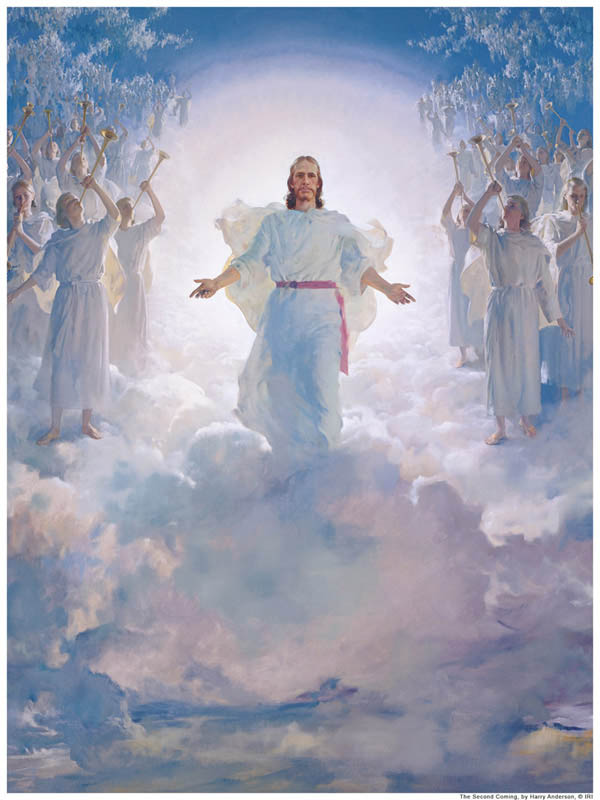
Paul says that “the day of the Lord shall come like a thief in the night” (1 Thess. 5:2). Mark has Jesus telling his disciples that “they will see the Son of Man coming in clouds with great power and glory” (Mark 13:26). Two different depictions, but both Paul and Mark/Jesus think that glorious day was just around the corner. Paul’s advice on marriage and related ethical matters was given in the context of the Parousia happening in his own lifetime. Mark has Jesus tell his disciples, “this generation will not pass away until all these things have taken place” (Mark 13:31).
This is, to put it bluntly, a big problem for Christians of all stripes. First, that return of Jesus or of the Son of Man (scholars are not sure whether the historical Jesus identified himself as the Son of Man expected to appear in glory and power) did not happen on schedule. All of the terrible things recounted/prophesied in Mark 13 were connected with the horrors of the Jewish War (66-70 AD) in which the Jews rebelled against the Romans, initially having some success but ending in the destruction of Jerusalem and its temple after the Romans regrouped and sent additional Roman legions to Judea. There is not a single New Testament scripture that gives a clear hint that it might be two millennia before the Parousia.
The response in Christian doctrine and eschatology was to delay, delay, delay. The Second Coming is always in the future — not so far as to be nothing to worry about, not so soon that followers will lose faith when it doesn’t happen, but in some middle ground close enough to motivate the laity when needed but far enough away to not create expectations that cannot be fulfilled. It’s always over the horizon, just out of sight. It’s not unlike the LDS practice of telling every generation of LDS youth that they are the chosen generation. Rinse and repeat.
The second part of the problem is credibility: If Paul was simply wrong about God’s timeline, that ought to cast some doubt on his whole schema, on his whole understanding of what God was up to with the gospel. Likewise with the expectation of Jesus, expressed in various places in the Gospels, that the coming of the Son of Man (described using various terms and metaphors) was going to happen in one generation. But not many Christians conclude that Paul and Jesus and the authors of the Gospels lose credibility because they were wrong. Instead they start with the obvious fact that no Son of Man has appeared in the clouds for two thousand years, then conclude that Paul and Jesus must have knew that was going to be the case, despite everything they are represented as saying in New Testament writings.
There is a Mormon twist on this problem (of the delayed Second Coming). “Joseph, my son, if thou livest until thou art eighty-five years old, thou shalt see the face of the Son of Man; therefore let this suffice, and trouble me no more on this matter.” (D&C 130:15). Joseph Smith was born in 1805, so as you might expect there was a lot of excitement in the year 1890. And there was a lot going on in LDS history in 1890! But no Second Coming. As noted earlier, that 1890 date was close enough to get the attention of Joseph Smith’s audience, but far enough away that Joseph would not be around to have to explain why it didn’t happen.
Since then, LDS leaders have consistently played the “just over the horizon” game. It’s like one of those movie special effects scenes where a character has a dream or hallucination that they are running down a hall towards a door, but the longer they run, the farther away the door gets. The Second Coming is always just over the horizon. It’s more a state of mind than an event.
So what do you think?
- You might think He’s coming in just a few years, just around the corner.
- You might think He’s coming in a generation or two, well over the horizon but there are some around today who will live to see the day.
- You might think it will be a long, long time. A few more millennia, perhaps.
- You might think (as do the Jehovah’s Witnesses, last time I checked) that Jesus Christ has already returned, He just did so fairly quietly rather than with heavenly trumpets blaring.
- Or you might think the whole idea has lost any credibility and it’s just not gonna happen. Maybe the First Coming was all we get.
 Wheat & Tares
The main point is perseverance. Watch and pray. Keep your lamps trimmed and burning.
The Holy Roman Empire was once Christ’s Millennial Kingdom established on earth. Wrong conclusion. Napoleon ended the Holy Roman Empire in 1806. So I go back to my original point. Persevere.
I love the book series The Expanse. A plot point for book 1, and recurring later, is a generational spaceship built by the Church to seek out a new planet and home.
It struck me that this book series is set in the year 2350 (or so) and Christ still hasn’t shown up.
So I asked my wife if that would bother her and her answer was a quick, “no”. I’m not so settled though.
He can’t just not show up (if this is all real) or at some point we are the Cult of Reasonabilists (from Parks and Rec) scheduling our next doom day around when the park is open. And it’ll be frankly ridiculous.
I tend to think this is another example of our very human tendency to be absolutely sure of things we don’t actually know.
I don’t know what will happen. I don’t know when anything might happen. That doesn’t bother me, and I’m not interested in reading from or discussing with believers who think they have it all figured out. I’m just going to focus on doing the best I can and trying to be a good person each day.
I originally thought both the Bible and modern scriptures diagrammed a fairly extensive (if vague) timeline for the Lord’s return, but those examples you list do raise a lot of questions. If a seal corresponds roughly to a thousand years (I’d say a 100 year tolerance is reasonable), then it should be more or less around the corner.
I’m approaching middle-age. I always thought it would happen a little later than most saints expected, and tend to think it will happen toward the end of my life or during the latter part of my children’s lives. I was surprised in talking to a semi-active coworker who was convinced it was at least 200-300 years away. I thought that was interesting. His justification for it was that things are better now than they’ve ever been in history. Things would have to get a heck of a lot worse. He’s right in many ways, but I can think of plenty of ways things can go south pretty fast.
Most members I’ve talked to think things are just going to get worse and worse until that happens. I sometimes think it induces somewhat of an attitude of apathy or impotence in seeking to improve the world around them. Some early church leaders indicated that things have to get better before He comes, and we have to help usher the way. I lean more that way. Individuals can make a difference.
Knowing what I’ve been taught, if I lived in a later generation and the 2nd coming had not happened yet, I do tend to think that would be a bit of a strain on my faith, barring any further enlightenment the Spirit might be willing to give me. But even without that, what I’ve already experienced would be just enough to keep me hanging on.
This post inspired me to look up the Wikipedia entry “List of people claimed to be Jesus.” It turns out Jesus has returned hundreds of times over the centuries, mostly as people with a mental illness or as cult leaders who often led mass suicides or committed lots of other horrific acts. Ezra Miller, who played The Flash in the recent DC comics movies, has even claimed to be Jesus (while also admitting they suffer from mental illness and committing various crimes).
Which begs the question: was Jesus himself a cult leader on a crime spree or a mentally ill person whose divine identity was a delusion? I don’t think so. From what I’ve read, Jesus likely didn’t do or say many of the things attributed to him in the NT and his identity as the cosmic Christ is largely an innovation of Paul. The historical Jesus was one of many apocalyptic preachers executed by Rome in 1st century Galilee whose message was about subverting the Roman Empire in favor of the Kingdom of Heaven. If we could grab him before his crucifixion and bring him forward in a time machine, he’d be shocked at what is attributed to him and how people have shaped the world in his name.
So while we’re talking about the Second Coming happening or not happening, I’ll submit that the First Coming didn’t really happen either (at least not the way we teach it in church).
Another way to look at it that I have heard, is that Christ said that the Kingdom of God is within. So, when is the second coming? When you accept him into your heart as Savior. And life goes on as before for the rest of the world with no change.
Personally, I am somewhere between that and “We don’t know 1/4 as much as we think we know. Just as the Jews missed Christ’s first coming because they were looking for a political Savior to save them from the Romans rather than a personal Savior to save them from themselves, as in, save them from their own sins, we may miss his second coming because we are looking for totally the wrong thing. And knowing the Jew’s mistake, I tend to think it won’t be some grand and glorious “coming down from the sky with trumpets. That kind of forces everyone to believe and Jesus isn’t into taking away free agency. I know that is exactly what a lot of people hope, that Jesus will come down in full glory and smack “the evil people” the side of the head with a two by four and force them to repent. Or the “rapture” with all the righteous floating up into the sky. Or conversely, the not so rapturous burning of all the bad people. But maybe Jesus will not come in the way *we* want. And maybe he won’t come in the way the evangelicals want. Or the Catholics either. Making up what we want the second coming to be is telling ourselves how important we are. Once again, that is making God over into our own image.
Maybe if we think about who Jesus was when he was here the first time, a poor carpenter leading a motley group of fishermen, former prostitutes, and retired tax collectors, we might come up with a better idea of how he will come back. But one thing I do know, making his second coming into what we want isn’t going to change who Jesus is.
”Most members I’ve talked to think things are just going to get worse and worse until that happens. I sometimes think it induces somewhat of an attitude of apathy or impotence in seeking to improve the world around them. Some early church leaders indicated that things have to get better before He comes, and we have to help usher the way. I lean more that way. Individuals can make a difference.”
I love that, Eli. Regardless of whether Jesus comes again and the world ends, it’s better to behave as if it’s never going to happen and it’s our duty to help the world spin on indefinitely and improve life for everyone for as long as we can.
It could be tomorrow, or it be a thousand years from now, or even longer. No one knows, and anyone who says they “know”… doesn’t know.
So many seminary lessons that it’s Saturday evening, the latter days, that I’m a chosen generation, etc. This was in the late 90’s.
Once I started comparing receipts, it turns out that every modern generation is told the same thing. Parents, grandparents, and my own kids. Go figure.
Since I deconstructed my faith, I’ve slowly over time ended up deconstructing Christianity as well. I’m now in the camp that he’s not coming. Happy to be wrong if the second coming truly is as great as I was told. I will never understand why Jesus needs a billion dollar trust fund.
In stake conference two weekends ago, we learned from our permanent Seventy general authority visitor that the second coming was not generations or even decades away, but maybe only a few years.
hi, come on man, tell us who it is
*ji
I remember having lessons in junior high/high school where the teacher would bring in posterboards filled with news clippings showing recent news articles describing natural disasters, wars, how the world was becoming more wicked for having smaller families, using birth control, “the gays” existing, etc. The point was obviously to show how “the signs” of the Second Coming (sin, wars, and natural disasters) were already happening, so the Second Coming was obviously imminent.
When I was a young teenager, those lessons freaked. me. out!! I mean, I was a pretty straight arrow kid, so I didn’t have that much to repent of, but I did have a “self-abuse problem” (in other words, normal, healthy teenage behavior), so I thought for sure that I was going to fry if Christ were to come soon. As a result, these lessons would scare me into stop masturbating for a few weeks. Did anyone else have these lessons or was that unique to my local ward (I didn’t grow up in the Mormon Corridor)? Well, that was decades ago…and no Second Coming yet.
By the time I was a senior in high school, though, I was starting to wise up and realized that it would have been possible to create posterboards filled with natural disasters, wars, and “sinful behaviors” at any time in at least the last 5000 years, at which point I just started thinking that these sorts of lessons were more amusing than frightening. I still get a good laugh anytime anyone attempts to claim that they are seeing the “signs of the times” because of a few things in the news. I also get a good laugh out of some of Nelson’s statements that seem to indicate that he knows that the Second Coming is imminent and that he is preparing the way as prophet. Right. I’m pretty sure that those statements won’t be quoted 50 years from now when the Second Coming still hasn’t happened.
I really don’t think that there will be a Second Coming, a Millenium, etc. I think humans will continue to exist on the Earth until they make it inhabitable though horrific wars/weapons of mass destruction or through just poor stewardship (too much pollution, deforestation, global warming, etc.). If humans manage to come together and mutually agree to work conserve the earth, then they may manage to inhabit this planet until the sun ages to the point where it expands and burns up the earth 5 billion years or so from now. I doubt that there will still be anything that we would recognize as Christianity 5 billion years from now, but if by some miracle, Christianity still exists, will there actually still be people looking for the Second Coming 5 billion years from now?
Once I stopped believing in a literal Second Coming, I wondered that if Christ actually uttered the things He did about the Second Coming, then perhaps He was speaking metaphorically about what would happen after we die. We all might have a metaphorical “Second Coming” with Christ after we die and meet Him face to face. If you read what Christ said about His Second Coming, most of it seems to make perfect sense if He’s metaphorically speaking about it happening to each of us personally after we die. Yeah, I know that’s not the traditional Christian/Mormon interpretation, but Christians/Mormons also think the Jews misunderstood the prophecies about the First Coming, so why wouldn’t today’s Christians/Mormons misinterpret the prophecies about the Second Coming as well? In any case, a metaphorical Second Coming seems a whole lot more likely than the literal Second Coming that so many Mormons and other Christians seem to believe is going to happen within the next 200, if not the next 20, years.
At this point I think Douglas Adams got it right in Hitchhiker’s Guide to the Galaxy when he wrote about the great prophet Zarquon who arrived at the restaurant at the end of the universe just two minutes before the universe exploded and said “sorry I’m a bit late…”
Bart Ehrmann points out that Jesus personally believed that the end of the world was imminent. He was an apocalyptic preacher. After he was killed, which shocked all his followers, they needed a new narrative to syncretize what he had said, so the idea of a resurrection and a second coming was crafted to explain away the inconvenient truth that he was supposed to be their leader and was nevertheless killed by the Roman state. (Paul’s gospel is not the same as Jesus’ gospel.) Obviously that take undermines Christianity’s foundational premise, but is supported by a considered scholarly reading of the New Testament.
I think those who spend too much time thinking about the end of the world or the second coming may fall into the trap of not focusing on what’s right in front of us (poverty, global warming, human rights, paying the bills, hugging their kids), in favor of an imagined future. No matter how you slice it or what you believe, we are living in the present.
I think it’s a pretty natural phenomenon for people to continue talking and acting like the second coming is just over the horizon. Humans just don’t deal well with uncertainty, and we’ll go through all sorts of mental gymnastics to try to resolve it – remember how stressed out people were with all the uncertainty during the early COVID days? It was awful.
There’s a LOT of uncertainty when it comes to believing in the second coming:
“Jesus is coming back, buuuut it’s going to happen when you absolutely least expect it. Don’t get caught slacking on your tithing though, because it could be in the next ten seconds…or it could also be in ten-thousands years…or it really could be in ten seconds. Also, wear at least two pairs of garments at all times because Jesus might be checking for the right underwear the second he steps off his cloud. Don’t worry though, there will be lots of signs for believers that he’s coming soon…you know, things like wars, famines, earthquakes, wildfires…something about rainbows, I think? Plus other stuff that sort of happens all the time already (it won’t be confusing at all).”
With all that uncertainty, people will do about anything to alleviate their salvation anxiety regarding the second coming…the easiest one is to just imagine vaguely that you know it’ll happen soon, but not too soon. Alternatively, you can rely on things like belief in the prosperity gospel, predestination, etc. to reassure yourself that you’ll be on Jesus’ good side no matter when he decides to show up.
If the second coming is too religious for you, you can always speculate on when the singularity will occur. (Elon says 2026.)
There seem to be two competing perspectives in the scriptures. One is that people will be living somewhat normal lives — marrying and giving in marriage — and the other is that there will be a series of major cataclysms. The interesting thing as that both views are tied analogically to the time of Noah. Those people were “marrying and giving in marriage” when the floods came upon them–but we also learn that the “earth was filled with violence” in those days. And so it is today, I think. If we were to catalogue all of the major difficulties endured by humanity over the last generation it would fill a tome the size of a telephone book. But then we get a completely different picture when we consider what life is like closer to home–for folks like you and I. What do we experience when we walk out our front door on a daily basis?
@Jack, I have a few blank poster boards for you to fill (see my previous comment).
I agree that there are places in the world (and even in the United States) where things are bad and getting worse, and humanity still has a long, long, long way to go, but a number of researchers have found that things are likely better than they’ve ever been throughout human history, and they’re only getting better:
1. More people have access to health care.
2. Fewer people are living in extreme poverty.
3. Fewer people are likely to die a violent death (including war).
4. Fewer mothers die in childbirth.
5. Fewer children die.
6. More people live under freer forms of government.
7. More people have access to education.
8. Fewer people are starving.
9. People are living longer.
10. Global GDP is increasing.
When you are embedded within a religion that continually teaches that we’re living in the “latter days”, confirmation bias tends to make adherents overlook the good and only see the bad things happening in the world since, according to the prophecies, some pretty bad stuff needs to be happening pretty darn soon if we really are in the latter days. However, if humanity somehow manages to continue to improve like this, perhaps it means that the Second Coming is really getting further and further away?
Forgot to add link to support the idea that things are getting better: https://www.vox.com/2015/7/13/8908397/11-charts-best-time-in-history.
mountainclimber479,
Oh, I agree with you. And as a consequence of all the good that’s happening I can’t help but believe that we are slowly making our way across the broad threshold of the Millennium.
That said, I used to hope that the mid-20th century was when we hit rock bottom–and that from there it would be a steady upward climb into paradise. But I have serious doubts nowadays. I think we potentially have a even bigger problems today–though they’ve kind of snuck up on us because they don’t involve bombs flying through air. The demise of the family will, in the long run, cause more grief and destruction than we’ve yet seen in the modern world–IMO–that is, if we don’t get our collective act together.
Jack, I personally don’t think we’re looking at the demise of the family any time soon. I would agree that what in the last 60-70 years has been considered to be a traditional family is diminishing. BUT that has only been a traditional family within my life time, so that’s not a long tradition. In general, the families I know are doing quite well. They just aren’t necessarily what we thought of as a family in my childhood.
Using my extended family as an anecdotal data point, we have to go back to my parents to find a family that is two married parents raising their biological children. The majority of the families in my generation adopted children, so we’re not traditional. We now have long-term only-married-once couples, gay couples, long-term couples living together without marriage, divorced parents, and single parents. We have a few biological children, a lot of adopted children, foster children, step children, not legally part of the family but definitely our children…. You name it, my family has it. We are very definitely a family, loving and supporting each other in ways large and small. Totally committed to each other family.
Yes, families are changing. However, in my experience, the demise of the family is a myth meant to scare people into believing the world is falling apart. It’s cherry picking evidence to support what you already believe about families. It’s giving support to those you believe are a family, but refusing to give it to those living in situations not to your liking.
mountainclimber479,
Your experiences and thoughts on this subject are very similar to mine. As a teenager, I was fascinated enough by The Second Coming that I ventured outside Mormon publications and started reading the Left Behind series. But a few books in, when the authors were introducing The Antichrist character as some 33-year-old Eastern European who was manipulating his way to the head of the United Nations (I hope I’m remembering this right–it’s been a few decades), I reached the point where I said to myself, “This is so stupid.” When I set that book and series down for good, I probably also set the literal Second Coming on my shelf. By the time I left on my mission, I think I had quietly concluded that it was a pointless exercise to fret over the timing and circumstances of a global Second Coming (if it ever came) as the “second coming” that really mattered would be meeting one’s Maker at death.
PWS,
There’s no question that there are loving families of all different make ups. Even so, the effects of divorce, cohabitation, and fatherlessness on children is disastrous by almost every conceivable metric.
But it isn’t just the more direct dismantling of the family that has caused such serious problems. Materialism in the West has caused us (collectively) to reprioritize out lives in such a away that children are often viewed as burdens that we must carry as we pursue the things that bring “real” fulfillment. Careerism and self-fulfillment are the hallmarks of an education in the West these days. All of these things have led to the development of a culture that places the wants of adults above the needs of children–which in many instances involves people baldly choosing the profane over the sacred.
That said, IMO, the number one social problem–in the U. S. at least–is the disenfranchisement of fatherhood–and motherhood is on it’s way out too. There is the lack of individual fathers in the home plus the toppling of the archetypal father in the West. Is it any wonder that we’re in the middle of an identity crisis? That tens of thousands of people are committing suicided every year in this country alone? We don’t know who we are anymore.
And that is just the beginning of sorrows. Those areas where violent crime is highest is where the presence of fathers is weakest. Of course, there are other drivers behind the crime–but I give it to you as my opinion that more stability at home — which means responsible fathers first and foremost — would do more than anything else to quell the gun violence, bodily harm, rape, theft, destruction of property, poverty, drug usage, teen pregnancy, lack of education, and so forth, so prevalent among our youth today.
And the scary thing is–I don’t think we’re seeing measurable improvement in these areas. The black community has a 70% fatherless rate–and is as high as 80% in the inner cities! Hispanics are at about 50% and whites hovering around 30%–though it might be said that there are more white babies brought up in single parent homes because of the overall size of that demographic (Asians do better in just about every metric). Where is this pattern going to lead? What will things look like in a generation or two? All it takes is a critical mass of angry teens–and that’s it–the world as you and I know it will come to a halt.
The said, sadly, this sort of thing continuously slips under the radar because it isn’t flashy–it happens one family at a time. It’s like abortion in that respect. While it may be needful on rare occasion it’s become a holocaust over time–even though it’s one abortion at a time in a private setting. And now after 1.5 billion abortions (globally) I’m afraid to even guess at how bad the holocaust has been–even if we’re talking only in terms of viability. It’s frightening.
I fear that the pearl clutching behavior regarding the Second Coming and Millennium has caused true believer Christians to focus on that future event almost exclusively while completely ignoring Christ’s teachings about loving our families and everyone else, being wise stewards of this beautiful world, avoiding the worship of false gods such as sex, money, fame and power and doing good in whatever sphere of influence we find ourselves in.
Rather than sit around waiting for (or fearing) the Second Coming to arrive why can’t we get on with living our lives to the fullest while being involved in activities that bless and heal people, relationships and the planet we live on? If Jesus shows up while we are thus engaged I’m sure that he would be pleased to see us acting as he has taught us to and not wasting our most precious resource, time, sitting around discussing how horrible the world and its people are while praying for the Second Coming to hurry up and happen. This is NOT my idea of living life “more abundantly” as Jesus puts it.
Maverik – I read a few books of the Left Behind series too, and also abandoned it for being too corny.
My belief in the Second Coming took a hit when I started reading historical scholarship about the Gospels and the Councils of Nicea. I read both “How Jesus Became God” and “When Jesus Became God”. I’m working my way through “The Origin of Satan.” The conclusion I’m coming to is that Jesus never intended to say he was the Messiah of all humanity and would come back in glory to burn anyone who doesn’t believe in him. That was his followers’ narrative.
I agree with the commenters who have pointed out the danger in believing in the Second Coming to the point that it interferes with our efforts to make life better here and now. We shouldn’t be waiting for some unknown future date when Christ will come back and fix everything (by killing all the unbelievers). We should be working towards making this planet and this life as good as it can be.
Life on this planet is doing well by several metrics. Of course there are disasters and suffering, but there is plenty of reason for hope and lots of good causes to work on.
The idea of second comings is found in Zoroastrianism, pre-Christian Judaism, ancient Greek mythology, and Islam. The idea of cyclical rebirth is found in Hinduism, ancient Mayan religion and ancient Egyptian religion. It is simply a common cultural trait to believe in heroes and how they’ll return. Heck, we see this concept in Hollywood movies.
I’m not hinging my future on any sort of second coming of Jesus, although my parents once told of their fervent belief that I would live to see the Second Coming, but that they would not.
Jesus sightings reported during First Nations Ghost Dance phenomenon in 1890.
Joseph Smith would have been… lessee, born in 1805…(counts fingers) two, three, six, umm, 85!
https://www.dialoguejournal.com/wp-content/uploads/sbi/articles/Dialogue_V18N04_91.pdf
Toolworks quotes Doctrine & Covenants 93:1-2
1 Verily, thus saith the Lord: It shall come to pass that every soul who forsaketh his sins and cometh unto me, and calleth on my name, and obeyeth my voice, and keepeth my commandments, shall see my face and know that I am;
2 And that I am the true light that lighteth every man that cometh into the world;
and adds-
Many of us believe in Christ,
but do not believe Christ.
Jack, I have good news! Your figures for fatherlessness are wrong. Children living with their father in the home is at its highest since the 80s and the number of stay at home dads is at an all-time high. And your statistic for fatherlessness in black communities is over double what it is in reality. I don’t know where you’re getting your numbers from, but I think you should pop a bottle of Martinelli’s and celebrate tonight for the progress feminism has made in getting fathers to be more accountable and egalitarian in shouldering the burden of parenting.
Anecdotally, I spend way more time with my kid than my dad spent with me and I consider my own dad to have been above-average for his generation when it comes to being involved with their kids.
I appreciate you mentioning the 20th century because it seems to me that if there ever was a time when Jesus would have been likely to return it would have been at the height of WWII when people were dying by the tens of millions and the US dropped literal doomsday weapons on Japan. The fact that our civilization made it through that and the subsequent Cold War without annihilating ourselves gives me hope that we can make it through the next cataclysms, whatever they may be.
Reading the above… I come to conclude people see what they want to see. Fine by me. I for one believe in Christ, that He was and is what the prophets foretold. I also believe and look forward to His return in glory. People can scoff and think I am naïve. I am fine with that too. In the meantime, I will do my best to learn of Him, live as He would have me live, and serve others. No idea if or when the second coming will be. So I will control what I can control and try to live after the manner of happiness. In the end, faith is a choice. Best wishes to all!
Kirkstall,
I admit that it’s been a while since I looked into those stats. But taking a quick look at them now suggests, to my mind at least, that we’ve found all kinds of ways to recategorize the problem. In other words, it isn’t as bad as we thought it was because we weren’t figuring stepfathers or cohabitating partners or even grandparents or adult siblings or adoption or what-have-you. That said, it’s my understanding that children fare best with both of their biological parents–and it’s in that category that we’d see percentages that look more like the ones I posted. Of course, that ideal set-up is not always possible because of one extenuating circumstance or another. But even so, when the exception–with regard to what’s best for children–out weighs the rule by orders of magnitude then it’s time for us to take a serious look at how to fix it. It is a more serious question by far, IMO, than (say) who ends up in the oval office.
Jack, any thoughts on how to fix it? I don’t have any.
Jack, your comments are both insulting and hurtful to those of us unable to have biological children. Just stop.
For what it’s worth to anyone, in the past Jack has forecfully refuses to either acknowledge or accept any facts or research on issues related to what is best for child-rearing that go against what he perceives as the order of heaven. It’s a lost cause. Asking for clarification or elaboration will only result in many homophobic, ableist, misognistic, naive, and downright uncharitable statements. Be prepared.
@ji, the way I understand orthodox Mormon thinking on this, is it can go one of two ways:
A. Everyone converts to the Church of Jesus Christ of Latter-day Saints and gets sealed in a Mormon temple within 2 years of returning from their mission so that they can produce ideal Mormon two parent families where one parent has a penis at birth and the other has a vagina at birth (sorry for being so crude, but see how evil the world is becoming that I have to be so specific)? Oh, what if they have both female and male genitalia at birth? Errr, uhh…moving along…the parent with a vagina at birth must stay home to cook, clean, and provide sexual gratification to the parent with a penis at birth so that he can go out and earn a living. But…that’s only if the parent with a vagina at birth came of age on or before about the year 1995. After that, it was OK for the parent born with a vagina to work outside the home as long as she didn’t talk about it too much at church until about, oh, say, 2024–isn’t it wonderful that we now have a General Relief Society President who raised children while working as a high powered lawyer? Tender mercies! How many kids are these couples suppose to produce? Well, again, God originally wanted them to have just as many as humanly possible so that we could get all those lucky spirits down here into Mormon families, so birth control was a big no-no, but then God changed his mind at some point in the 1970s or 1980s–He was never really too clear about exactly when He changed His mind–so now family planning is totally up to the couple. What if they can’t have kids? Simple–ostracize them at church and give them some “leftover” spirits in the Millenium, which we’re just as sure must be right around the corner as we were 200 years ago. Yeah, there will be a widow here and there, but that’s not a problem since those with penises can just be sealed to another person with a vagina. What if the husband dies, you ask? Well, you should hear the joke President Oaks told about that in General Conference. So funny! Oh, and don’t worry your pretty little head about those who “suffer from same-sex attraction”. It turns out they don’t exist, as President Packer so wisely taught us, “Not so! Why would our Heavenly Father do that to anyone?” No, no, wait, wait, scratch that thought from Packer. Instead, let’s try going with, yes, “the gays” really do exist, but don’t worry, God has a wonderful plan for them, and to find out what that plan is, all they have to do is suffer through a lifetime of solitude and loneliness to get the greatest reward ever–a quick and easy spiritual gender/orientation reprogramming fix along with an eternal marriage to someone that they simply would not have been attracted to one bit while they were living. Isn’t that great? Divorce, you ask? Not an issue for temple sealed couples. As Spencer Kimball taught, “It is certain that almost any good man and any good woman can have happiness and a successful marriage if both are willing to pay the price.” He also taught us not to marry people outside of our own race, so we’re still figuring out how these two teachings from him are compatible, but we’re really, really sure they are. You see, aren’t the Mormon teachings on families so simple and perfect? Family problem solved.
B. Just as happened before His arrival to the Nephites, Christ annhilates all the evil people on the earth, including their innocent children, which would presumably eliminate every family not sealed in a Mormon temple (well, maybe some non-Mormon traditional familes might grudgingly be allowed to continue if they are willing to reliably cast a straight ticket Republican ballot)? Family problem solved.
Well, I guess it can really only go one way. Oaks is valiantly trying to get plan A to work by leading the charge to save the family, a duty that we know from scripture and modern prophets that he is going to miserably fail at…but he has to try anyway. Far less than 0.2% of the population will listen to him and benefit from his efforts, but is it even worth talking about that when the success rate is so dismal? I guess we’re just going to have to go with plan B. Annhilate families not sealed in a Mormon temple and then have Jesus come and just forget about the mass slaughter of 99.9% of the earth’s population and throw a party even crazier than Nelson’s 100 B-day bash! Family problem solved.
Yeah, Plan A doesn’t sound like a good one because implementable public policy approach, and Plan B is in God’s decision space rather than ours. Are there yet other ways? The reason I ask is because it is fruitless to bemoan things that cannot be changed and it is uncharitable to think ill of others for not complying with one’s own code. I think discussions are better when they are practical and realistic.
Speaking of sister general church officers who worked outside the home, is it fair for them to preach exact obedience to the prophet when they themselves disobeyed President Benson? I know some sisters of that age who made the hard decision to stay home and raise kids on their husbands’ incomes, and some of them are feeling some dissonance. I am fully okay with working women becoming general church officers — absolutely, I am — but it bothers me a little when they use their pulpits to preach exact obedience to the prophet when they themselves apparently didn’t. Do we follow their words or their examples? Yes, the doctrine has changed since President Benson, but I thought we weren’t supposed to be getting in front of the prophet.
I believe in a simple gospel message, and a simple restoration message. I believe you that charity is of very high importance. I believe in the Second Coming — but I don’t believe everything that church members and leaders preach about the Second Coming — when they go beyond the sparse scripture record, they have left me behind.
I’ve already met my quota–so I hope I don’t get in trouble for posting one more comment…
ji,
That’s the question of the hour. And the answer is (of course) to convert everyone. But since that’s not likely to happen anytime soon I think the best thing to do is to follow the church’s lead in their efforts to partner with the NAACP. They’ve put a little money towards a two pronged program: education and a “boots on the ground” welfare of sorts. It’s in its trial stages–so far as I can tell–but if it looks viable my guess is that the church will put more money and resources into the program. It’s not a quick-fix–but with some persistence it could prove to very useful in helping people get their feet on the ground family wise.
PWS,
I’m sorry for the suffering you’ve endured. I’m of the opinion that folks like you and yours–especially (but not solely) where you have the resources to adopt–are saviors on mount Zion, doing the most important work that can be done for people who are unable to do it for themselves. You have a very large cache of treasure in heaven. That said, I’m a child of three divorces and a victim of at least two perpetrators of sexual abuse. Should I refuse to speak of these things because I might offend someone who’s doing the best they can after a divorce that was no fault of the their own? There are many who, like me, believe that the demise of the family is the number one problem in society–and if it is then we should be speaking of it more frequently not less. Sorry–but those are my honest feelings.
Brian,
Dear friend, you and I will have to continue to agree to disagree. My views are informed by the words of prophets as well as the findings of science. And according to both — especially that which has been revealed through the living oracles of the church — this is not the time get lax about these problems. I’ve often heard folks on this blog–perhaps with the best of intentions–criticize the saints for having an “all is well in Zion” attitude about certain social challenges. IMO, this is a challenge that should take the number one position of importance in the West–though I fear that other, lesser, concerns will continue to crowd it out of the center of the arena.
If you are serious about science and families, please read Melinda Gates’s “The Moment of Lift”. From it’s very start, this book is about “improving the lives of families” through improving the lives of women with specific research and scientific research.
ji raises a good point. For years, we heard nothing about food storage in GC, until recently Edler Bednar reminded us that the prophets had spoken and nothing had changed, and what was last said many years ago was still in force because it was spoken from the GC pulpit. Well, Pres. Benson also spoke plainly from the GC pulpit, and apparently that has changed, but who told us so?
My wife was one who heard Benson, and Kimball before him. She made more money than I did when our number one came along, and she quit work and raised all of our children from my one income. We didn’t have many of the nice things that a lot of our peers had. Imagine my wife’s hurt when our baby child, then a late teenager, told my wife that he felt she was wrong to have stayed home, and he was embarrassed to have a stay at home mom when all the other moms in his church age group were professional women.
Then some of these women get in the GC pulpit and talk about exact obedience, when they evidently ignored Benson’s GC talk about women working outside the home. They are my wife’s age, so they heard what she heard. We are at peace with our choice, but was it really the word and will of the Lord that told women/mothers to stay home, or was it a wise man giving general advice based on his life’s experience? It came from GC: was this a matter covered by exact obedience? or is this covered by something else: each member get revelation for himself or herself? How do the people know when something not addressed for years is still valid? Did the women who ignored Pres. Benson’s direction sin? Does follow the prophet apply all the time or some of time? Maybe we should teach what Jesus taught, and let people govern themselves, and give honor and dignity to those choices? These questions are rhetorical, and I have my own answers. Each of us makes choices to make the gospel real in our individual lives, and we don’t all need to make the same choice all the time.
Why the Jews Reject the Christian and Muslim Worship of Avoda Zarah Gods.
Translating abstract Hebrew concepts, such as שם ומלכות, into literal translations is highly problematic. Neither the Koran nor the New Testament ever once brings the שם השם revealed in the First Sinai commandment. This commandment instructs to perform the Torah commandments לשמה (for their own sake).
The New Testament heavily relies upon the metaphor of “father” throughout the Gospel narratives. One reference in Deuteronomy 32:6: “Is this the way you repay the Lord, you foolish and unwise people? Is he not your Father, your Creator, who made you and formed you?”
This strong mussar rebuke merits a common law search for a precedent within the language of the first four Books of the Written Torah. Paul’s critique: “You’re not under the Law” fails to discern between Torah common law/משנה תורה\ from Greek and Roman statute law legal formats.
The Torah never refers to the First commandment revelation of the Spirit Name with any reference to the foreign name Allah. Hence Jews reject this foreign substitution to replace the revelation of the Torah at Sinai with Muhammad’s revelation of Allah in a cave.
The Jewish people utterly amazed that Goyim have no concept of the distinction between tohor vs tumah spirits. This fundamental distinction required for the chosen Cohen people to do “avodat HaShem”; roughly interpreted as the service or worship of HaShem.
The term מלכות refers to the spiritual direction of dedicating defined tohor spirits first revealed to Moshe after the Sin of the Gold Calf at Horev: ה’ ה’ אל רחום וחנון etc. The revelation of this “Oral Torah” the church fathers absolutely deny the existence of the revelation of the Oral Torah.
The only other verse in the whole of the T’NaCH which employs 3 Divine Names in succession, kre’a Shma. Contrast the mitzva of saying kre’a shma with tefillen; with how Goyim scholars interpret Hear Israel the Lord God the Lord is One. The Talmud understands the 3 Divine Names, to the 3 oaths each separately sworn by the Avot.
The term ONE, the last word of the kre’a shma, the person who accepts the yoke of the kingdom of heaven, he accepts the oaths separately sworn by Avraham, Yitzak and Yaacov as ONE upon his heart.
The purpose of tefillen: to swear a Torah oath. Goyim theologies never ask: what oaths did the Avot swear to cut a brit with HaShem concerning the eternal inheritance of the chosen Cohen seed of Avraham Yitzak and Yaacov. Islam in particular give a blow-job to the honor of the circumcised Avot. Christians see the Shema as a declaration of the oneness of God, which aligns with their belief in the Trinity—Father, Son, and Holy Spirit—as one God in three persons. Muslim commentaries on the Shema recognize its importance in affirming the oneness of God, which is a central tenet of Islam.
The Quran makes intertextual connections with the Shema, emphasizing that prayer and devotion to God are not about physical direction but about loving God with all one’s heart. This latter idea fails to address Rabbi Yechuda’s interpretation of לבבך as Yatzir Ha’Tov vs. Yatzir Ha’Rah.
The concept of ‘resurrection from the dead’ shares nothing with life after death as both religions of avoda zarah preach. Rather the Yazir Ha’Tov breaths the spirits which did breath the spirits of the Avot! ONE, this concluding word of the Shma raises the Avot from the dead within the Yatzir Ha’Tov of each and every Jew in all generations, based upon the power to Create from nothing, by swearing a Torah oath!
Hence when a Cohen didicated a korban upon the altar in Jerusalem, the portion of Israel in the korbonot avodat HaShem service, they read the Creation story in the beit knesset.
Rabbi Akiva’s kabbalah known as פרדס defines how to logically understand how to employ the 13 tohor middot, as the critical means to make a precedent search comparison; the substance of Oral Torah common law scholarship upon the Written Torah. A quick examination of Deuteronomy 32:6 learns through the wisdom of Torah common law precedents.
This mussar rebuke begins at 32:1 – 32:43. Mussar defines all prophecies, as codified by Moshe Rabbeinu and all other NaCH prophets. Goyim do not know this basic fundamental of Torah faith/pursuit of courtroom justice.
Their Gospel forgery attempts to pervert tohor prophets to Av tumah witchcraft and sorcerers – who predict the future. This one Torah reference to “Father” merits a look at the previous verse for context. Both Trinity or strict monotheism qualifies as strange worship of foreign Gods.
These alien Gods have no connection with the plagues in Egypt, the splitting of the Sea of Reeds, nor the revelation of the Torah at Sinai. They directly compare to the Av tumah Golden Calf.
This revelation, that all Goyim to this day reject the Torah Sinai revelation. This prophetic mussar directly refers to the tuma worship of foreign alien Gods imported to Judaism by Av tuma Xtianity and Islam.
This tremendous mussar rebuke, Deut. 32:1 – 32:43, compares to the vow which HaShem made to Moshe following the sin of the Golden Calf! Hence the rebuke of Moshe at the end of his life serves to amplify the prophetic mussar taught through the Aggadic story of Noach and the floods. Genesis 6:5 to 8:20: the exile of Noach in his Ark, story of Aggadic mussar – a depth analysis of prophetic mussar of Deut. 32:1 – 32:43.
How could post Shoah Jewry defeat 5 Arab Armies and win our National Independence as a Nation after 2000+ years of oppressive exile? No Goyim courts of law ever once forced any church priest or pastor or any Sheik, to stand before the Bar and receive judgment for their evil war crimes committed repeatedly against the Jewish people and all Humanity in General.
A simple precedent by which to grasp this prophetic mussar of g’lut. A fundamental Torah theme which the Apostle Paul’s “original sin” substitute theology totally uprooted in Goyim minds.
The 1st Sinai commandment functions as the greatest commandment of the entire Torah. And it has no hint or reference to the Xtian Trinity Creed nor the Muslim Monotheism substitute theology Tawhid Creeds.
The abstract term מלכות refers to the korban-like dedication of living blood thrown upon the altar; to the dedication of one or more of the 13 tohor middot Spirits revealed to Moshe at Horev, 40 days after the Sin of the Golden Calf, where a portion of Israel attempted to translate the Spirit Name of the 1st Sinai revelation into the word אלהים.
Tefillah qualifies as the oath dedication of specific defined tohor middot as מלכות. The Order of the Shemone Esrei 3 + 13 + 3 Blessings. Contained within this Order the רמז of 613. Furthermore the order of this standing prayer holds a רמז to the 6 Yom Tov + Shabbat menorah!
Herein understands the Torah concept of מלכות required to swear a Torah oath. The dedication of tohor middot directly compare to the Cohen throwing living blood upon the altar. Hence tefillah stands in the stead of korbanot!
Why? Because both korbanot & tefillah both swear a Torah oath which dedicates tohor middot לשמה.
The Torah openly states that nothing in the Heavens, Seas, or Earth compares to the revelation of the Spirit Name of HaShem. How much more so for imbecile word translations that attempt to convert the Divine Presence Spirit revelation of the Name into words that the lips of man can easily pronounce!
The substitute religions of Av tuma avoda zarah attempt to foist belief in JeZeus or Allah as some “new covenant” Torah faith. These abominations fail to grasp that Torah defines faith as the righteous pursuit of judicial common law justice rather than belief in theological Gods which the mind of Man cannot possibly grasp nor understand.
T’shuva does not correctly translate as repentance. T’shuva learns from HaShem annulling His vow to make the chosen Cohen nation from the seed of Moshe rather than the seed of Avraham, Yitzak, and Yaacov. Chag Yom Kippur commemorates this t’shuva made by HaShem. The Torah specifically employs the term t’shuva wherein HaShem annulled His vow to make the chosen Cohen nation from the seed of Moshe rabbeinu rather than from the oaths sworn to the Avot to this effect.
When the Romans renamed Judea unto the “Palestine”, herein represents a historical example of t’shuva. The Romans sought to physically wipe out the existence and memory of the Jewish people, just as did Hitler’s Nazis!
That the new testament and koran have no awareness of the oath brit faith, how tefillah differs from prayer because tefillah absolutely requires swearing a Torah oath as its time oriented commandment “k’vanna”; whereas prayer has nothing to do with swearing a Torah oath, nor with tohor time oriented commandments! These religious forgeries know nothing about the Torah faith which prioritized the obligation placed upon Torah Sanhedrin courts to pursue righteous compensation of damages inflicted by the guilty upon the innocent.
This concept of annulling a vow derived from Torah common law precedent commandments concerning a father and his daughter or a husband and his wife, where both could annul the vow made by either a girl or a woman. The Roman attempt to expunge the memory of the Jewish state of Judea likewise serves as an example of the intent of annulling a vow. As does UN General Assembly Resolution ES-10/19, adopted on December 21, 2017. This resolution declared the status of Jerusalem as Israel’s capital as “null and void” and called on all states to refrain from establishing diplomatic missions in Jerusalem.
The Xtian and Muslim concepts – concerning worship of their Gods – fundamentally contradict the 2nd Sinai commandment. T’NaCH and Talmudic traditions define the k’vanna of the 2nd Sinai commandment through the Torah precedents which forbid pursuing the ways of the Goyim which reject the revelation of the Torah at Sinai and Horev; and the specific commandment not to intermarry foreign wives. King Shlomo worshipped avoda zarah; when he copied the Goyim practices of building grand Temples and married foreign wives.
The mitzva of building the Beit HaMikdash centers upon establishment of Sanhedrin Common law courts across the land, rather than bankrupting the country build some grand palatial cathedral. Hence the Sages placed the Great Sanhedrin within the Temple itself; they made a tiqqun on king Shlomo’s assimilated avoda zara! Jews do not worship wood and stone idols, how much more so ornate extravagant buildings! The oppressive slavery where Par’o withheld straw, yet beat Israeli slaves, upon this basic Torah precedent – stands Torah faith to pursue judicial justice.
Neither Xtianity nor Islam ever attempted to return the Jewish people to our homeland as, by stark contrast, did the great king of Persia. The Persian king Cyrus, referred to as a “messiah” or “anointed one.” This reference found in Isaiah 45:1, which states: “Thus says the Lord to his anointed, to Cyrus, whose right hand I have grasped, to subdue nations before him and strip kings of their robes, to open doors before him— and the gates shall not be closed.” In this context, the term “anointed” (מָשִׁיחַ, mashiach), used to describe Cyrus, indicating that he was chosen by God to achieve a specific purpose, namely, to facilitate the return of the Jewish people to their homeland and the rebuilding of the Temple in Jerusalem. The Torah mitzva of Moshiach: anoints a Jewish king to police the land, working in close conjunction with judicial common law Sanhedrin lateral courts of justice.
The Persian king learned from the successful conquest of the Assyrian empire by the Babylonians. The Assyrian barbarians uprooted entire populations of conquered nations and replaced those refugee populations with foreign aliens who had no connection to that land. This reality permitted the Babylonian Armies to conquer the Assyrian empire much like water goes through a sieve.
Roman new testament propaganda stands in stark contrast with the great king of Persia. The Romans sought to ignite social anarchy and Civil War among the Jewish people. In this effort they succeeded as well as they did destroying Herod assimilated Temple abomination. The British government duplicated the policies of the hated Romans. During its Palestine mandate period, London foisted a divide and rule policy between Arabs and Jews.
Both the Syrian Greeks and the Romans based their society social order upon the ideas of ancient Greek philosophers Plato and Aristotle and others. Aristotle served as a key advisor to Alexander the Great. Aristotle’s 3 part syllogism does not compare to rabbi Akiva’s 4 part פרדס logic system. All logic requires order: the letter order which distinguishes “God vs Dog”, radically changes how a person perceives the idea communicated! In equal manner Order defines the Jewish Prayer Book known as the Siddur. The Siddur contains the root word סדר – Order.
Why do Jews view Xtianity and Islam as Av Tuma avoda zarah? Goyim never accepted the revelation of the Torah at Sinai. JeZeus did not observe the mitzva of shabbat. This mitzva requires that Jews make the הבדלה/distinction that discerns like from like; מלאכה from עבודה. Failure to understand the subtle distinction which separates these two verbs, both of which translate as “work”; an Am Ha’aretz never keeps the mitzva of shabbat observance – ever in his or her life.
Mesechta Shabbat learns מלאכה whereas mesechta Baba Kama learns עבודה. The question do the toldot follow the Avot asked by both mesechtot; this question based upon the Av time oriented commandments in בראשית, compared to the toldot positive and negative commandments in the Books שמות, ויקרא, ובמדבר. Torah scholarship always strives to make the essential understanding which makes the מאי נפקא מינא הבדלה between like from like “understandings”. The Talmud defines this attribute as the interpretation of the tohor midda of רב חסד. Baba Kama distinguishes between tam and muad damagers. The latter applies to Man because it requires intent, as do all time oriented Av commandments. Four Avot Muad damagers: Oppression, theft, ערוה, and judicial bribery, learned by means of a דיוק logical inference made upon the four tam damagers explicitly stated in the Av Mishna of Baba Kama.
Shabbat observance dedicates not doing forbidden מלאכה on the day of shabbat; דיוק, likewise to not do forbidden עבודה during the 6 days of the ‘week of shabbat’. The Goyim religions of Av tuma avoda zarah never grasped this fundamental distinction of shabbat observance as a mitzva inclusive of every day of the week. Proof that the polecat “daughter religions” never learned the Torah לשמה.
Both Xtianity and Islam superficially claim to respect shabbat, but their religious rhetoric, as empty as Arabs eating camel flesh but abhorring pork! These religions of avoda zarah have no awareness of the chosen Cohen people and the Divine oath inheritance to the oath sworn brit lands, or the spiritual awareness which discerns between tohor vs. tumah spirits which breath within the Yatzir Ha’Tov vs. the Yatzir Ha’Rah within the bnai brit hearts.
Repentance, a totally empty Xtian idea of personal regret; it shares no common ground with t’shuva, that bases itself upon annulling vows. Neither the father nor the husband “regrets” annulling a vow made by his daughter or wife. Therefore, t’shuva shares no common ground with the Xtian void concept of repentance.
Similarly, the translation of “covenant” shares no common ground with the Hebrew concept ברית. The latter – an oath alliance sworn לשמה. To swear an oath alliance requires שם ומלכות. The new testament and koran forgeries never bring the שם השם as revealed in the first Sinai commandment. Therefore, both books of Av tuma foreign religions – worship other gods; both Av tuma religions profane the 2nd Sinai commandment. Both know nothing that a Torah brit requires swearing a Torah oath לשמה, with the intent to cut an eternal alliance touching the chosen Cohen people.
All T’NaCH prophets command mussar strictly to the chosen Cohen people. Herein defines the intent or k’vanna of all T’NaCH prophecy. The new testament Roman forgery does not comprehend these subtle distinctions. It together with Islam believes in some type of Universal God. The Xtian forgery seeks to promote civil war within Jewish society, by perverting prophecy into an Av tuma witchcraft, which makes predictions concerning the future. Throughout the gospel narrative this type of silly narishkeit spews from the new testament like farts.
Chaos and anarchy defined the Jewish revolt attempt(s) against the Romans. Multiple and many Jewish sects dominated the 66 rebellion. Bar Kokhba’s revolt failed to unite Jews of Judea with a well-timed & coordinated Jewish revolt together and united with the Jews of Alexandria Egypt. Furthermore, that general failed to drive the Roman legions out of Damascus, Syria, a critical error.
Bar Kokhba’s critical errors of judgment doomed this second Jewish revolt at Betar. Jewish social anarchy and civil war greatly contributed to the Roman victory over the Jewish revolts in both 66 and 135. The key concept of Torah faith revolves around the righteous pursuit of judicial justice within the borders of the oath-sworn brit lands – the eternal inheritance of the chosen Cohen nation, Bar Kokhba as a military messiah failed to achieve.
The Av tuma avoda zara religions, worship other gods; they pervert the Torah vision of faith – forcibly converted into some theological creed-based personal belief system. These substitute theologies attempts to subvert the Torah faith that spins around the central axis: the righteous pursuit of judicial justice obligations; which makes a fair compensation of damages inflicted by party A upon party B. Av tuma avoda zara religions seek to substitute the pursuit of righteous justice with a personal belief in JeZeus or Allah.
Av tuma Avoda zara substitute theologies attempt to supplant their creed based personal belief in theologically defined belief systems, that define their gods as either a 3-part One God mystery or a simple One God monotheism. Despite the simple fact that monotheism violates the 2nd Sinai commandment. Because if only one God then no need to command not to worship other Gods. Moshe travelled to Egypt, and the 10 plagues judged the gods of Egypt. Just as did HaShem judge the Gods worshipped by the Canaanite kings. Avoda zara plagues all generations of Israel; all generations struggle with assimilation and intermarriage.
The sworn oath brit cut at GilGal, as expressed through the Rashi tefillen recalls the fact that Goyim worship other Gods. No such reality as a Universal God. The lights of Hanukkah, for example, reject Greek philosophy. Rabbi Akiva’s פרדס four basis logic system radically differs from Aristotle’s 3 part syllogisms. Attempts made by assimilated rabbis to interpret the T’NaCH and Talmud based upon Greek logic formats – an utter abomination on the order of Xtianity and Islam.
Greek philosophy qualifies as a foreign substitute theology; an Av tuma on par with the Christian and Muslim avoda zara repeated attempts to convert Jews with their replacement theologies. Hence Jews who study ancient Greek philosophy, they err in Av tuma avoda zara as much as do Jews who convert to Xtianity and Islam; as much as did Moshiach Bar Kachba failure to coordinate the revolt together with the Jews of Alexandria Egypt and to carry the war into Syria with the objective of conquering both Damascus together with all its major naval ports.
The Jewish concept of Moshiach a פרט to the כלל function of the Torah and the Oral Torah in interpreting key aspects of Jewish common law and prophecy; Moshiach: an Oral Torah commandment. Indeed, the Jewish approach to the concept of the Messiah, as found in both the T’NaCH and the Oral Torah Talmud codification, quite different & distinct from how the gospel counterfeit portrays Jesus within Christian theology. The following discussion reflects the different views on this matter, particularly in relation to how Jewish scholars might interpret the failure of the Gospel narrative to align with both the Torah’s precedence based common law legalism, and the traditional understanding of the Moshiach as understood through T’NaCH prophetic mussar.
The Oral Torah mitzva of Moshiach, deeply rooted in how the Oral Torah interprets the k’vanna of the Written Torah; just as the time oriented commandment of tefillah requires שם ומלכות as its oath k’vanna. Particularly through the common law precedents set by Moshe’s anointing of the House of Aaron, as well as the later anointing of King Shaul by the prophet Shmuel.
The notion that the Moshiach must come from the lineage of David, himself a descendant of Judah, a latter tiqqun added to the mitzva of Moshiach. This latter tiqqun sought to ensure that the line of the House of David, completely rejects the Xtian theological “Father God” of JeZeus mythology. This latter revisionist history attempt directly compares to the mythology of how Zeus fathered Hercules! Adultery an Av tumah Capital Crime. JeZeus the offspring of Zeus as the father of the Gods, represents a Torah abomination.
The Talmud’s emphasis on the Torah sage being held in greater regard than a king of Israel, a critical piece Talmudic understanding concerning the priority of spiritual leadership. The Torah Talmid Chacham, perceived by the sages of the Talmud as the one who understands and interprets the Torah common law; possessing the wisdom to guide the nation in matters of our destiny path of truth-faith, which commits the chosen Cohen people to pursue righteous judicial justice. The role of the Moshiach in Oral Torah logic, not just a political or religious leader. Nor some military figure comparable to Bar Kachba; rather, Moshiach represents the Oral Torah interpretation of someone who restores the Torah as the Written Constitution of the Republic; the Oral Torah as the basic model of lateral common law courtrooms. As such, the Moshiach’s anointing, deeply tied to the oath brit relationship established by Avram at the brit cut between the pieces and the tradition Oral Torah learning.
Just as “swearing” an oath blessing requires שם ומלכות, so too the Order established by the Framers of the Talmud affixed a warp/weft loom like relationship between the Aggada narratives opposed by the Halachic portions of the Gemara common law precedent based commentary to the Mishna. Stripping a garment of either its warp or weft threads destroys the fabric of that garment. The statute law halachic codifications of the Middle Ages made this precise abomination. To correct the Rambam halachic perversion requires affixing any and all Rambam posok halacha in his statute law perversion to the identical halacha within the B’HaG, Rif, or Rosh common law halachic codifications. These kosher halachic common law codes always affix their Halachic Gemara rulings to a Primary Source Mishna.
Torah scholarship requires a sharp critical eye which can discern Like from Like. The Talmud refers to this skill as the definition of understanding. Just as swearing a oath blessing requires the warp/weft of שם ומלכות, so too and how much more so ritual halachic observance requires its Aggadic דרוש\פשט learning to T’NaCH Primary sources which makes a common law precedent comparison search that explores the depths or facets of prophetic mussar which defines the פשט of the Talmudic aggada warp. Oral Torah: just as the Gemara makes a multiply faceted משנה תורה\legislative review (re-interpretation) of the diamond like faces of Mishnaic language, so too and how much more so precedent based research gleans prophetic mussar tohor middot comparisons from sugyot of NaCH compared to the identical sets of tohor middot located in other sugyot of NaCH. This depth analysis of prophetic mussar determines the k’vanna of Torah mitzvot and Talmudic halachot observances.
The concept of anointing with oil in the context of sacrifices (korbanot) in the Temple, also fundamental to understanding the Jewish approach to Moshiach. This oil, used in the service of the Temple, symbolized the sanctification of Israel’s offerings and the anointing of its leaders. The Messiah, in Jewish thought, will be anointed in a similar manner to those figures who came before him—especially the kings and priests of Israel, in accordance with the Torah’s stipulations. A concrete act of divine selection and empowerment.
The Xstian claim that JeZeus fulfills the role of Moshiach simply at odds with the traditional Jewish understanding of the term. From the Jewish perspective, Jesus’ life and actions do not align with the Oral Torah’s requirements for Moshiach. The Gospels narrative fail to engage with the Oral Torah’s teachings about the Moshiach, and they do not acknowledge the precedent established in common law, the anointing of the House of Aaron or the priests and kings of Israel. In Jewish tradition, the Moshiach must be a descendant of King David (through his father, not his mother), a precondition which the so called ‘virgin birth’ failed to achieve. Furthermore, the bogus Xtian narrative specifically failed to “fulfill” the specific roles, re-establishment of the Federal Sanhedrin common law system of Torts and Capital Sanhedrin courtrooms which achieved judicial justice in the oath sworn lands of the chosen Cohen nation. None of these pre-conditions did JeZeus accomplish in any the historical context.
The failure of the Gospel narrative to align with the Torah’s precedent for the anointing of the Moshiach another of the many points of contention. In Jewish tradition, anointing with oil – an essential part of the mitzva of Moshiach. As exemplified in the Torah’s precedents of Moshe & Aaron, and of course kings Shaul & David. JeZeus never depicted as being anointed, except by a prostitute. Such a narrative compares to the judicial injustice and brutal torture which the gospel narrative portrays the JeZeus “sacrifice” upon the Roman altar of death. For Jewish scholars, this vile depiction makes only a fictional story. The gospel narrative does satisfy the Torah’s vision of Moshiach, which requires restoration of the Torah Constitutional Republic and the Sanhedrin lateral common law Federal court system. A prostitute anointing the feet of a man hardly qualifies as holy korban.
The Talmudic teachings on the Moshiach, make clear that the Messiah not only restores the Torah as the constitution of the Republic, but just as significant, the Moshiach re-establish Torah Sanhedrin lateral common law courts. The gospel narrative of a spiritual Moshiach, while not entirely foreign to Judaism, based upon the false messiah movements lead by Sabbatai Zevi and Yaacov Frank; based upon these latter false messiah examples the gospel fictional narrative hardly stands as authentic. Talmudic common law rejects such ‘spiritual messiahs as utterly false.
The Oral Torah\Talmud give a specific definition of a prophet as someone who guides the people of Israel toward t’shuva and adherence to the mitzvot (commandments) expressed through Av tohor time oriented commandments. Prophets, employ the 13 tohor middot as the basis of T’NaCH mussar common law sugya comparisons to other T’NaCH sugyot. Prophetic mussar, functions as the warp/weft loom like opposing threads of Talmudic halacha. T’NaCH prophetic mussar, based on a comparison of similar middot configurations within NaCH sugyot, defines the wisdom of learn the NaCH kabbalah לשמה. Time oriented commandments require prophetic mussar as the basis of k’vanna within the heart.
The concept of prophecy in Judaism, not about foretelling the future, a trait known to tuma false prophets, who according to the gospel narrative “fulfil” the words of the prophets. Utterly absurd. Time oriented Av Torah commandments, which require prophetic mussar as their k’vanna of tohor Oral Torah middot, apply equally to all generations of the chosen Cohen people. The gospel narative did not grasp the essence of Torah observance of Av tohor time oriented commandments. Time oriented commandments require prophetic mussar for the generations to observe this unique type of Av commandments לשמה. The idea that JeZeus fulfilled the words of the prophets as absurd as a prostitute pouring oil onto his feet transforms this work of fiction into both Moshiach and the son of God.
The Xtian tradition, judged upon the scales of Oral Torah Av time oriented commandments, clear as the Sun on a cloudless day a false messiah depiction on the order of Harry Potter fiction. Allah Voldemort – dead. JeZeus particularly not only specifically ignorant of the mitzva of Shabbat & the כלל of Av time oriented commandments which require prophetic mussar which define the k’vanna of Oral Torah middot. JeZeus, as a specific example taught “prayer” as “Our father who lives in Heaven” rather that tefillah a matter of the heart. Prophetic mussar k’vanna – a matter of the heart. Tefillah entails swearing a Torah oath לשמה to dedicate a specific defined tohor midda in order to make a tiqqun how a man interacts in the future with his wife, children, family, neighbours and people. The k’vanna of tefillah dedicates tohor defined prophetic mussar middot לשמה.
Xtian theology places JeZeus in a perverse position where the gospel narrative declares that he “fulfilled the Law”, oblivious that the gospels have not the least bit of a clue what Torah common law means nor how it functions. JeZeus’s departure from Torah common law, particularly in matters like Shabbat observance, cited as but one obvious example of how this imaginary man cannot and does not ‘fulfil’ the prophets.
The Jewish rejection of Jesus as Moshiach, or even as the koran narrative as a Torah prophet rests squarely upon the failure of the gospels to address Av tohor time oriented commandments. Besides the failure to align with the Torah’s specific precondition which learns the mitzva of Moshiach from korbanot anointed with oil together with the restoration of the Sanhedrin lateral common law court Federal court system. The Roman fraud gospel framers did not understand Constitutional Torah law.
This fundamental blatant error concerning the nature of prophetic mussar as the definition through precedent comparison which define the k’vanna of tohor middot, as the definition and purpose the Oral Torah Horev revelation. Implications of strange Xtian doctrines, such as salvation through grace, or Jesus’ fulfilment of the Law, judged as Av tuma avoda zarah; the forerunner of Sabbatai Zevi’s antinomian doctrine. The absolute ignorance of the gospel narrative to Av tohor time oriented commandments which require prophetic mussar as their k’vanna within the heart definitively proves that JeZeus failed the “one in 10,000” may attain the level of Torah scholarship and prophetic merit.
The Gospel narratives simply understood as a perversion of T’NaCH and Talmudic Moshiach mussar prophecies. Xtian theology and creeds ignores the foundational principles of achieving Av time oriented commandments, wherein the bnai brit Cohen people breath the tohor spirits of the Creator of the Universe from within the Yatzir Tov of our hearts; the revelation of the Oral Torah at Horev.
Muslim theologians approach the issue of JeZeus and Muhammad being referred to as Old Testament prophets, based upon the false assumption that the gospel narrative merit respect. Latter day Islam which declares the Torah as corrupt compares to the Mormon prophet Joseph Smith. Many Xtian theologians draw a line of comparison between Muhammad and Smith. Both “prophets” introduced their own new order of scriptures.
Both Islam and Mormonism highly revers the treif gospel narratives. Goyim have a deep infatuation with T’NaCH prophets, despite their total ignorance of tohor middot and Av time oriented commandments. Muhammad’s message of monotheism, likewise declares that JeZeus predicted the coming of Muhammad. JeZeus in the Quran has absolutely no concept of the mitzva of Moshiach as interpreted by the Oral Torah פרדס logic system and tohor middot.
The koran regards Muhammad as the Seal of the Prophets (Khatam an-Nabiyyin), despite not having the least bit of a clue how the T’NaCH understands the function and role of prophets. Clearly Islamic thought resembles the prophet Adam Smith far more than any T’NaCH prophet. The koran does not position Muhammad as a continuation of the Jewish prophetic line in a direct, historical sense. Muhammad according to the koran narrative lived as the final prophet who brought the ultimate revelation from God. Both the koran and Mormon holy books supersede all the scriptures which preceded them.
Neither the gospels, koran nor book of Mormon brings the שם השם revealed in the first Sinai commandment. These latter day Goyim “prophets” confuse the Hebrew “oath alliance”/ברית as one in the same with the sophomoric translated term covenant. Lacking the שם השם no man can cut a Torah ברית. Hence, covenant cannot mean brit. A difference of apples and oranges. Which these Goyim prophets remained completely oblivious in their bliss & ignorance. In many ways these spiritual reformers compare to Martin Luther, Huldrych Zwingli, John Calvin, William Tyndale, John Knox, John Wesley, and Mary Baker Eddy. While not all these individuals directly hated or despised one another, certainly significant theological disagreements and conflicts erupted among them.
Luther believed in the doctrine of consubstantiation. Zwingli, on the other hand, viewed the Eucharist as purely symbolic. John Calvin’s theology was influenced by both Luther and Zwingli, but he developed his own distinct doctrines, particularly on predestination and the sovereignty of God.
William Tyndale focused on translating the Bible into English, and his fugitive status continually forced him to hide from English authorities. John Wesley, came much later and had different theological focuses. He disagreed with Calvin’s predestination doctrine, emphasizing free will and personal holiness. Wesley’s Arminian views such as: Free Will, Prevenient Grace that precedes and prepares the soul for salvation; Conditional Election upon faith, Universal Atonement: that salvation is available to everyone, but only those who accept it will be saved. These “prophesies” put him at odds with Calvinist traditions.
Mary Baker Eddy, her teachings were often seen as unorthodox or heretical by mainstream Xtian denominations. The debates and tensions among them highlight the diversity and complexity of the Reformation and subsequent religious movements. Comparatively speaking, Muhammad fits right into the crowd of these religious reformers and prophets.
Share this: