
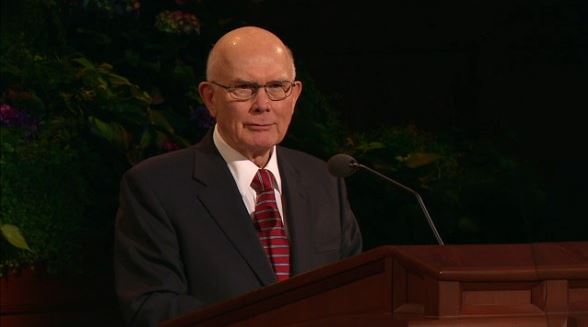
A couple of weeks ago a leadership training presentation just for Bishops and Stake Presidents was leaked. The training was a slide presentation by President Oaks available on the Church website, but only if you logged in with the proper credentials. The presentation is easy to find if you just Google it.
The subject was Membership Councils. When I was Bishop they were called Disciplinary Councils, and before that they were called Bishop’s Courts. Membership Councils sound so much nicer and benevolent!
Pres Oaks starts off by given some statistics that to my knowledge have never been revealed outside the halls of the Church Office Building. He said
In recent years we have had a significant decline in membership councils worldwide. When membership councils are held, the proportion of membership restrictions-especially withdrawal of membership-has also declined significantly.
Some background: the “membership restrictions” can be 1. Remains in good standing, 2. Personal Counseling with Bishop, 3. Formal Restrictions (used to be called disfellowship) and 4. Withdrawal of Membership (excommunication)
President Oaks revealed two things in this quote. One is that there are less membership councils recently than there used to be. The second thing is that when there is a member council, there are less restrictions being placed on the members, especially excommunications, than there used to be. You can tell from the rest of the slides that he does not think this is a good thing.
I’m having a hard time wrapping my head around this. When is it ever a bad thing that less people are being kicked out of your organization? Especially an organization whose stated objective is to get more people to join said organization? So lets all put on our Pres Oaks hat and try to think like him. He comes into his office one day, and there on his desk is a report from the last few years (let’s say 10 years) that shows there are less people being kicked out of the Church. Being Pres Oaks, you figure out there is one of two reasons for this. One is that members of the Church are actually listening to all the talks in General Conference, and they are choosing the “Covenant Path”, and are sinning less. All those Elders quorum and Relief Society lessons where they rehash the talks is paying off! Or the second reason could be that the Bishops and Stake Presidents are going soft, woke if you will, and displaying way too much mercy to the offending members.
Being Pres Oaks, you see the world is more wicked than even, with all the LGBTQ+ nonsense, and people not wearing their garments, so you figure the second reason must be right, and you need to give all the Bishops and Stake Presidents a good talking to. Those ladies of the Real Housewives of Salt Lake City and whatever that new Hulu show is need to be shown the door!
Pres Oaks pretty much says on one slide that he believes the Bishops have gone soft when he says that “many priesthood leaders apparently apply the least membership restriction possible because they fear that a more serious restriction may prevent the member from returning to active Church membership” (I’m looking at you Bishop Bill!!!!) He also said that we should not forgo the council just because there person has already been punished enough through loss of job, wife, or community respect.
Pres Oaks also wants to make sure that a person coming back from years of inactivity gets punished for what he/she might have done during those years: “They [leaders] should not dismiss the potential need for a membership council to help a person experience the spiritual change that can only come through true repentance”
I guess Pres Oaks would have been pretty upset with me when I was Bishop. I only had one Disciplinary Council in the five years I was Bishop, and that was for re-baptism of a person that was excommunicated 30 years earlier for cohabitation. I approved the re-baptism, and it was sent to the First Presidency for approval, and they were baptised! I never had any other court during that time. Now this is not to say that the members of my ward were little angels. There was the normal teenage pregnancies and adults behaving badly. I even had one just like Oaks said, a member that had been inactive for 20 years, and wanted to come back. They confessed, and that was enough. No way I was going to have a court on a 20 year old sin that they had not repeated since. None of these cases ever reached the level where I thought a disciplinary council would help any better that just counseling with the bishop.
My going in rule was that if I ever had to stand before God and justify my actions as Bishop, I’d rather be guilty of being too lenient than of being too harsh. I figured God would go easier on me that way!
Pres Oaks then goes on with the presentation to justify why we need more membership councils. He said that membership councils “with rare exceptions” must be held for endowed persons who committed a serious sin. He said they “cannot repent by himself or herself”.
He then throws out another interesting statistic. He said that in the twelve years since 2010, members who had been held accountable (read formal restriction or excommunicated) had a far lower rate of repetition of the serious sin than those that did not. I’m not sure how they get the numbers for this statistic with the people that were ex’d. How would you know if they repeated the sin if they are no longer members? For those disfellowshipped, how would you know it was a repeated the sin if this is the first time you are talking with them?
What is your take on this? Do you think there is a genuine concern with the Q12 and FP that there is not enough excommunications, or is this just Pres Oaks going rogue since Pres Nelson is in no position to stop him?
What could be his reason for this? Does he see these people not being kicked out a danger to the members, or is he genuinely concerned for their eternal salvation? Does he really believe in a God that is going to punish somebody because their Bishop what not hard enough on them?
 Wheat & Tares
If we truly believe in the atonement of Christ, then the person who has seriously sinned has already been forgiven by God.
The bigger concern from the Church institution should be to help that person forgive themselves and help them heal broken trusts and relationships. The goal should be to heal relationships, strengthen individuals, families and communities.
Church discipline can be used as a tool. Individuals who feel they need punishment, in order to forgive themselves, could choose disfellowship or excommunication as part of their own journey of self-forgiveness.
When church leadership uses the process as external punishment, it seems to lack all the essential elements of the essential teachings of Christ.
There is no way of knowing if a sin has been repeated unless it’s the type of thing s person is arrested and/or prosecuted for, or if the person comes in and confesses. The “true repentance” process being advocated by Oaks is often an embarrassing, traumatic process for the individual and sometimes for other participants in councils.
As someone who participated in several disciplinary councils as either a ward clerk or bishopric counselor, I have promised myself I will never again be any party to those activities. They are truly awful. I later was called to be an Executive Secretary and told the bishop up front that I would be no part of those, including even scheduling them or sitting out in the hall during them.
Using me as a data point, leaders from my bishop all the way up to Oaks have no way of knowing what sins I might commit, because that’s between me and God, and I have no inclination to involve any church leaders in the process.
I have not been a bishop but I was a clerk and participated in 5 church courts and during my mission I was district president for a while and had a couple of cases where members of my district had a church court with the mission president. All of them are moments I regret the most from my time in the church. I think the whole system is bad for the church ultimately and doesn’t accomplish what Oaks and the manuals intend – repentance and protecting the church.
almost everyone being prosecuted by the disciplinary council felt like it was unfair and that their sincere repentance was judged harshly. None returned to the church that I know of. Also my bishop when I was clerk had disciplinary councils for women in the ward that had affairs or sex but not for the men. Those were supposed to be handled by the stake president but he preferred to not have full church court so instead the women were prosecuted but their partners were not. I went home and cried after each one because I felt so awful each time. Autocorrect keeps changing prosecuted to persecuted and for once I agree with it.
nothing shook my faith as much as seeing the reality of the biased and overly legalistic and beaurocratic process of church discipline. It isn’t Christlike. It wasn’t spiritual. It was mean.
One impression of this approach is that Oaks is trying to micromanage the Bishops. Gone are the days of “teach them good principles and let them govern themselves”. This corporate micromanagement is the antithesis of agency. Maybe Oaks will next publish the excommunicated names in the Deseret News or the Liahona so the repentant can really feel true repentance, like times of old.
I would like to know why the church is quick to hold “courts of love” for any one critical of the church and its’ leadership, but then is silent on the countless members who have been associated with child abuse and real sin. The church is more interested in its’ “good name” than any individual. Programs are now more important than people.
Yeah, Oaks and I have zero in common religiously. Here’s one reason why. I served a mission, which gave me some insight into how conversion works and what people need. I learned empathy and humility. Many current church leaders did not serve missions. I believe that includes both Nelson and Oaks.
Maybe, Faith, instead of (or in addition to) publishing names, we could publish stats by stake and ward, showing how many councils were held and the results. This would allow individual bishops and skake presidents know if they need to step up their game. In seriousness, though, I would be happy to learn that discipline is going down. That means that people are making good choices. Except when a sin is widely known, or for apostasy, or for heinous crimes, I think that discipline should be rare. Most people do not need discipline to help them repent, and most sins do not require confession to a bishop.
I don’t think this has as much to do with his perception of the value of discipline so much as his discomfort with local leadership being out of step with the GAs.
I agree that it is better to err on the side of compassion–even so, any virtue can be taken to an extreme. So we have to be careful not to cross the line of negative returns–wherein we err so much on the side of compassion that it becomes damaging rather than edifying.
Hawkgrrrl is on to something, we haven’t had a Church President who served a mission since Gordon B. Hinckley. Not coincidentally, we also haven’t had a media-savvy Church President who at least seemed to m care how we came off to outsiders since Hinckley, either. He still had long-range memories of having to persuade the unconvinced.
But when Nelson and Oaks were mission age, they were serving in Korea. Their formative experiences were not in the context of persuasion by long suffering and gentleness and meekness and love unfeigned, but in a harsh military environment of giving and receiving orders, no matter the local human cost. Small wonder that they run the Church in much the same way.
”My going in rule was that if I ever had to stand before God and justify my actions as Bishop, I’d rather be guilty of being too lenient than of being too harsh. I figured God would go easier on me that way!”
Well, yeah! After all, that’s exactly what the Parable of the Unforgiving Servant is trying to get across. Maybe Elder Oaks should read the gospels again.
In other news, Nemo the Mormon, a faithful member whose social media content is often constructively critical of the church, has been summoned to a Membership Council. Clearly the intention is to shut him up and get him to stop criticizing the church in a public forum. Is there any chance this is going to work? People who have the courage to speak truth to power don’t typically clam up just because power asks them to. And pushing someone out of an organization for being willing to criticize it only incentivizes them to criticize it more, albeit from without rather than within. So the real purpose is to make an example out of him. It’s a head on a pike outside the city gates. Heretics be warned!
The thing is, they could avoid all this drama by setting up a legitimate channel of petition for change within the church. Remember that “Which way do you face” talk? If the leadership would turn around and listen to the members instead of pretending they get ironclad revelation from God and implement it perfectly 24/7, we could clean up a lot of unethical policy and make the church a happier place for everyone.
Jack
too much compassion = bad? Damaging to who? Can you give an example?
I just don’t think the church actually does church discipline to be compassionate. That is a lie to cover for the “justice” and “protection of the good name of the church”. It is to exert authority and to punish sinning members. The trappings of a court are not ecclesiastical counseling or to help the accused but to justify the decision and judgement.
I saw this slide presentation a year ago while serving in a particular stake calling. I issued my strongest possible condemnation to it then, and I do so again today.
I actually had a feeling of darkness after watching this slide show. Its call for more disciplinary councils and harsher punishments was very disheartening. I suppose others felt the same ways, as the bishops at the time ignored it.
One of the silliest aspects of the presentation was the idea that, if your people have fallen into inactivity, the way to bring them back is through a disciplinary council. It is absurd to think that punishment is the way to bring people back to the fold.
Essentially, the slide show might as well have been produced by Kaiser Wilhelm II when it comes to the lack of love that was displayed. A little love would have gone a long way.
As an outsider, can Mormons be punished by the church for drinking sinful beverages? The Bible teaches against drunkenness but not against coffee, tea or wine drinking.
I’m asking this seriously. I was always cautious around my teetotaling parents while they were alive. I don’t drink wine and cider in order to get intoxicated but as a beverage with meals. It’s social custom I learned while living in France.
The kangaroo courts were always a bad idea. Seriously, what exactly do these accomplish? Are the “defendants” even entitled to some sort of defense attorneys? Does the church provide them with one of they can’t afford one?
What the councils have taught many members is the folly of confessing to anyone besides the person you harmed and God. Repentance is supposed to be between you and God, with as much restitution going anyone harmed as the sinner can manage. It should be about restoring relationships between sinner and God and sinner and sinned against. Not about the person’s membership or about the church At. All.
In my experience confessing to a bishop makes it all about the church as if the church were the injured party. Well, unless the church IS the injured party, it should only promote healing between the person who sinned and the person sinned against. The church should keep asking the repentant sinner how they are working to undo the damage. Not how they are making up to the church. The sinner meeting with the bishop does nothing at all to help the victim of that sin heal. Now, that’s fine if it was a victimless sin like masturbation, only in my book that isn’t sin and is none of the bishop’s business.
My biggest beef with the church was that with my father’s sin, he was given tons of love and attention to help him repent and I was given nothing to help me heal. In fact, I was punished for needing to heal. It became all about my father’s relationship with the church as if a harmed child and wife did not exist.
So, my feelings on church courts, they do more harm than good. Because they focus only on the church as victim of sin. Well, I am sure they think in terms of God being offended and the church represents God, so therefore the sinner owes the church some suffering. They restore the sinner’s relationship with the church if all goes well, or it destroys the person’s fragile self worth. Often it destroys the person’s relationship with the church, because the majority of excommunicated people do not come back. They do not restore the sinner’s relationship with the human harmed by the sin. They do not restore the person’s relationship with God, because too often “repentance” is all about jumping through hoops the church sets up as “worthiness” goals, that really do not focus on Jesus, but only focus on worthiness according to the church’s arbitrary definition.
They should follow the example of Jesus, who told the sinner, “Thy sins are forgiven. Go and sin no more. Now, how can I help you fix the relationship with the person you hurt?”
There should never be bishops listening to all the details of a teen girl’s sin. I have known several young women terribly damaged by voyeur bishops who obviously got all turned on by the gory details that the bishop insisted she had to share. The girl felt emotionally raped after such an interview where bishops asked such questions as “What color were your panties?” Her underwear color is NOT part of the sin.
Same goes for grown women. They should never be confessing to any man except Jesus and any human they harmed. And same for men, although it is worse for females. Because unless the bishop is gay, men don’t have the voyeur problem, or the fact that men do not really understand being physically and socially weaker than your attacker. But nobody should be confessing to any supposed “representative of the Lord.” Not when we have access through prayer to our actual Lord. Why do men insist on playing God?
Jesus didn’t tell sinners “Go confess to your rabbi.” He just forgave and if bishops were real representatives of Jesus, that is what they would do.
Brian G,
Perhaps there’s really no such thing as too much compassion because once we cross the line of negative returns it ceases to be compassion–at least the kind of compassion that is informed by the love of God. Even so, I think we can be misguided in our attempts to bring people along with as little conflict as possible. We cannot always be as soft as we would like in our efforts to keep the lord’s house in order. A serial adulterer may need to be excommunicated to 1) mitigate greater condemnation on the sinner 2) induce repentance on the part of the sinner and 3) protect the flock from the poisonous influence of serious sin. But even after all of that, though he may be restricted from praying, teaching, and holding callings in the church, he is still free to join the saints in worship–the intent being that perhaps the spirit of fellowship will work on him in such a way that he will desire get his life in order and return more speedily to full fellowship than he would otherwise. As heartbreaking as these kinds of judgments may be they really are based on compassion so long as they’re done in accordance with the spirit. And I think our local leaders generally try their best to learn the mind and will of the Lord on such occasions–even though they may sometimes err a little too far in the direction of “no action.”
Similar to Angela and JB, I’ve often wondered if Oaks tenure presiding over the Utah court system left him with a wretched view of humanity. Otherwise it’s really hard to understand the source of so much contempt.
I will also add that I hated being part of disciplinary councils but the silver lining was that each time the other counselor and I successfully talked the bishop down on the verdict. So I guess I’m partially responsible for this slide deck.
Pro tip: stop reading jacks comments once he types “even so.” You can thank me with cookies.
Okay, story time.
I know a woman whose husband cheated on her. This was years back. We were face-to-face friends; this wasn’t just something I read on the Internet. She was devastated; beyond devastated. She was so angry and so hurt. And it nearly killed her a second time when her husband was NOT disciplined by the Church. He was briefly restricted from taking the sacrament. It shattered her trust in the Church. She didn’t believe her husband thought what he did was that big of a deal (“It was a mistake; I didn’t love her; other excuses”) and she was hoping the Church could make him see that he needed to work hard to try to heal their relationship since he was just telling her to calm down.
Obviously, I only know her side of the story. But the fact that the Church did NOT excommunicate her husband really hurt her and damaged her hopes that her husband would truly repent. She confronted the bishop and his reasoning was that they hadn’t been married in the temple, and neither of them were endowed, and since husband hadn’t sinned against temple covenants, the situation wasn’t as serious as it would have been if the temple had been involved.
Second story: When I gave up on getting my ex-husband’s attention about the serious problems in our marriage, I went to the bishop. My ex had a porn problem. That wasn’t the only problem in our marriage, but it was the one that I knew the Church would be concerned about. So I spilled all that to the bishop. He called my ex in and took his temple recommend. That actually reassured me, because it meant the bishop was taking this seriously. It didn’t go any further; no membership council or other discipline. But having the bishop say, “this is wrong and I will do something about it” was deeply validating to me.
Third story: When a bishop finally insisted my father surrender his temple recommend, I again felt validated. There was no membership council. But again, having the Church take action against my father healed a teeny tiny corner of my heart. It had nothing to do with me — my father was claiming that Nelson killed Monson because he was tired of waiting to be prophet. But still, having my father formally censured by the Church felt good.
I dunno. I agree with the idea that compassion is good. But I also think that the injured parties need something. If you trust the Church, if the Church is your standard of right and wrong, then seeing the Church take action against someone who has deeply wronged you helps the victim maintain trust in the institution.
Oh, another story. This one is secondhand. I heard it from the sister of the Other Woman.
Other Woman started dating a married man. He was married in the temple. He divorces his wife to marry Other Woman, with whom he is having an affair. They are going to be married in the temple. I vaguely recall that the husband’s bishop made him stop sleeping with Other Woman for several months and go through a repentance process that did NOT involve a membership council. Other Woman is overjoyed that she is now receiving the blessing of a temple marriage and gushes about it to my friend (the sister). Sister causes a huge rift by telling Other Woman that she actually thinks that Other Woman sinned and this whole situation is just wrong.
Now I’m going to speculate. What about the first wife, and the children? Assume they are faithful members of the Church and believe that the Church won’t condone sin and wrongdoing. They’re watching their husband/father marry the Other Woman in the temple. First wife is now in a plural marriage (in the eternities) with the woman who broke up her family. Would she feel better if the Church excommunicated her husband and made it clear that he can’t commit adultery and then marry his mistress in the temple? Are the kids horrified about their new stepmom attending Church with them on their weekends with dad?
—
My take on the “fewer membership councils” issue is that people are just going inactive. If someone quits Church, I doubt a bishop is going to call a membership council about whatever he’s doing. Former bishops and counselors, please correct me if I’m wrong. Were the reduced numbers adjusted to account for inactivity? Going from 100 membership councils to 63 membership councils, during a period when inactivity has gone up by 30% might not be that much of a decrease. Oaks might want to call up inactive people and send them to a membership counsel, but I’m betting no bishop wants to step in that hornets nest.
This is me just being cynical, but I think this push for more membership councils goes hand in hand with the new trans policies, so really it shouldn’t be surprising.
I don’t have an issue with consequences for abusive or other serious actions (some of which have been mentioned in other comments) but I don’t agree that having more “councils” is the solution. Jumping through leadership roulette hoops serves no one. This is Oaks using the methodology that makes sense to him – a law/trial setting. Perhaps he thinks he’s sorting the wheat and tares? He definitely thinks he’s the judge, and a harsh one at that.
I’m with Bishop Bill – by what judgement you judge shall you be judged, and I’m always in the column for mercy (as appropriate). There will be situations where a council may be appropriate, but I think that should be the exception, not the rule.
I think that much of church “discipline” has to do with leadership roulette. Some years ago my sister was disfellowshipped for commenting in RS that while abortion should be rare it should also be between a woman and her God because only she and God knew all of the extenuating circumstances. Someone reported her to the bishop and she had a kangaroo “court of love” and was disfellowshipped. Up to this point she’d been a faithful member. Now she had her eyes opened to the unfairness of the church. She became cynical about the church because she hadn’t been given a chance to properly defend herself or explain her position. The bishop thought that she was guilty and already had his mind made up regarding the outcome. This bishop should’ve kept this church discipline to himself and his counselors but told her VTs and HTs about it. Soon word spread around the ward, and my sister became the ward pariah.
Her husband who was a member of church royalty talked to his uncle who was a GA at the time and his father who’d been an area authority about my sister’s situation. They were appalled that any action had been taken against her at all because she had only been expressing her own opinion and had not been openly advocating for abortion among ward members or the wider public. Her bishop had clearly been out of line to disfellowship her. The GA uncle called the SP and told him what had happened and asked him to clear up the problem. BTW the SP had heard other complaints about this bishop’s draconian way of running his ward and in investigating the situation discovered that my sister was not the only person to be seriously harmed by the bishop’s actions.
While my sister was reinstated to full fellowship the damage to her reputation and her belief in the church had been done. If her bishop had been a more loving person this miscarriage of justice would not have happened. But he was so sure that because he was the bishop he was ALWAYS right. This is the problem with both leadership roulette and with the punitive system that is already in place within the church. A person is always considered guilty until proven innocent and sometimes not even then. Is this really the way that Jesus taught us to treat our brothers and sisters?
Stranger,
I am sorry for your sister’s situation. I might say I am glad your sister’s situation was “corrected,” but that was solely because of her husband’s church royalty relations*. Likely, the stake president would have done nothing despite hearing of harm to other persons by that bishop, absent an instruction from above.
This highlights one of our biggest problems that I am hopeful might be remedied someday — the almost absolute and unfettered dominion the church allows to local leaders along with absolutely no oversight and no upward communications (except where church royalty are involved). We need to allow for honest and candid exchanges between members and leaders, and talking needs to go both ways. I hope for common church members to be treated with respect and dignity by leaders at all levels.
*A rhetorical question: Would your sister’s husband’s church royalty relations have acted the same way in response to a letter from a common church member in similar circumstances? I really, really hope the answer would be YES, but I fear otherwise.
For me, I do not associate the church leadership as representing God, infallibly. That being said, I would be happy to talk with a member of my community (even a leader) at my home or in a church classroom, as a friend and neighbor about any concerns they have (but please don’t come wearing your suit and please speak to me as an equal or I will leave the room and never accept a visit again).
I am no longer interested in placing myself in the vulnerable position as a supplicant to the authority of the church, as if it were God, and accepting their judgement as from God. I have my own connection with God. While I accept their authority as being what is currently their stewardship with the church, I cannot accept them as having irrefutable judgement over me as a person.
I would never attend a membership council, for the reason that as a woman, I would essentially be alone in the room with a gang of men free to beat up on me emotionally and spiritually, if they choose. I do not grant them that choice. Even if they allowed me a token woman as a companion, I could not feel emotionally safe in a room where there are more men than women, gathered to discuss me and my behavior. I will never put myself in that position.
I have felt this way for the last several years since I visited the bishop as an advocate for my disabled child, and he was angered by the fact I was questioning his decisions regarding my child’s fears about attending class where a much bigger child with autism was threatening his tiny disabled self.
Nope. Mama Bear doesn’t care about your idea that God told you the answer, without you ever understanding what was actually going on. I am not going along with things I know are hurting my child just because you feel you have authority. I am not your employee and I am not subject to your decisions and judgement. I will protect myself as well as my loved ones from your shaming. If that makes me an apostate in your eyes, that’s your prerogative in how you manage the church. I hope that works out for you on judgement day, but I won’t be participating in your judgement of me or anyone else.
In his slides Elder Oaks clarifies that the *infinite atonement is actually an *almost inifinite atonement. The atonement is powerful enough to forgive all sins, except for some sins. For some sins, the atonement needs the assistance of the bishopric and a membership council in order for the sin to be forgiven. Thank you Elder Oaks, for clearing that up.
It’s crazy to me that some people think we’re not really Christians, when we’re the only ones who actually know this information about the atonement and what is needed for sins to be forgiven.
After reading Janey’s comments, I remembered some stories I know about. There was the serial adulterer who when I first knew him was on wife number 3. He had one or two children from wives #1 and #2 and two children from wife #3. He started an affair, and confessed, was excommunicated and “made it right” by divorcing wife #3 and marrying his sin. After that I moved away, but still had friends in the area who disapproved of Bro High Council enough to report when he did it again. He again adultered, confessed, “made it right” by divorcing wife #4 with two children and marrying wife #5. My friend in his area felt that he was not “making it right” by breaking up another family, only compounding his sin. She felt that the only way to “make adultery right” was to stay with his wife and children and keep his blasted pants zipped up. Oh, he was excommunicated each time he committed adultery, but he was so “repentant” he was quickly rebaptized and sealed to the new wife in the temple, just about the time his second child with that wife was born, and was into his next affair before he was even dry from rebaptism. There was NEVER any permenant consequences and he left 5 women as single mothers with almost no child support because he had 10 children after all and actually supporting his children would have left him unable to support his current wife and children. So, each time his hands were gently slapped and he was quickly back into some kind of church leadership. Oh, and of course the wives were getting progressively younger and younger and wive #5 was 30 years his junior.
The whole thing left me feeling like “what the blank is wrong with this system that he has hurt 5 women and 10 children, and still is quickly promoted back into good standing in the church. He is a damned sexual predator.
And having worked professionally with battered women, I cannot even count how many women were harmed by having their abuse be no big deal to the church. Most of them were not believed by their bishops who did nothing but befriend and support the abusive man. This hurt the women almost more than the abuse itself because if felt like God didn’t even care that their husband was beating them. It was condoned or ignored by the church. As the counselor, I had to put these women back together after their church kicked them in the face.
Not only was the perpetrator of abuse never disaplined, but the woman was given ZERO help protecting herself and her children.
So, when an abuser or adulterer is ignored and not disciplined, it is mercy for the abuser robbing justice for the abused. Where is any mercy for the victim of (almost always) a man’s sin?
Now, I don’t think the victim of sin would be quite as bothered by no discipline to the abuser if they were given help getting out of the situation and supporting their children. But when they are given no support, it is like God is fine with them being abused and they should just stay and endure it till he kills her.
This type of situation is when there is often “too much” compassion” for the sinner and no compassion for the victims.
Excommunications are all about the idea of protecting the Church as an institution, not helping the “sinner” repent. Taking away a temple recommend is somehow protecting the temple, keeping it pure by not allowing sinners in. But hey, the scriptures teach we are all sinners, we all fall short in the sight of God. The only way to keep temples pure in that sense is to keep all the humans out, kind of like the holy of holies (in a temple, mind you) where no one gets to go in except the high priest once a year.
Likewise with “don’t take the sacrament” or full excommunication. Somehow that’s supposed to protect the sacrament or protect the Church as a body. As if the body of the Church needs protection — it’s the members who need the Church to build them up, and big sinners (the types who might get exed) need it more than anyone.
And of course the whole process is flawed. It doesn’t do a good job targeting wife beaters or child abusers, but it’s really good at targeting those who have honest conversations about the Church in public (which, of course, isn’t a sin at all!). Bishops get zero training in how to conduct a court, and bishop by and large have no clue what counts as competent evidence in such a proceeding. Instead, they are told to trust their hunches, prejudices, and guesses about what is going on. And of course they are often inclined to go easy on a man (a priesthood holder) especially when they are good liars and manipulators. They system is toughest on honest women who are too honest with the bishop, blaming themselves when blame often should be placed elsewhere.
It’s a broken system. It is run by local priesthood leaders who don’t really know what they are doing. Pres. Oaks, as a legal scholar with judicial experience, ought to know better. Likely he does know better.
I know there are some LDS who have been through church courts who regard it as needed, as a positive kick in the pants for them, and they straightened out. But I sure do hear a lot of personal accounts where it was a thoroughly negative experience. And changing all the names to softer, gentler terms (membership withdrawal, etc.) is almost Orwellian. Like the leadership cannot admit to themselves what they are doing with church courts.
So, this is what the church has become? And to think that just last week, I expressed sincere hope that Oaks would coyly confront MAGA in GC.
A curse upon the church’s executive leadership.
They are every bit as monstrous as I feared them to be. The entire institution deserves a good table-flipping and temple cleansing. Whited sepulchres, filled with dead men’s bones. The church will survive me but I doubt it will outlive many generations afterward.
I don’t think the comments here are representative of how things really work in the wards and stakes of the church. As well meaning as some of the comments may be they fail to recognize the context that thirty thousand bishops and three thousand stake presidents provide–plus the fact that millions of members remain loyal to their church leaders both local and general. If the church were a small cult of sorts then I could imagine its membership being taken in by such neglectful leaders.
Also, I think it’s worth mentioning that men are cutoff from the church at a much higher rate than women. And as such, I think it would be wrong headed to assume that that kind of action is taken against men mostly for reasons other than infidelity and spousal abuse and whatnot. I *know* that there are many men in the church–including leaders–who cannot abide the idea of a man of the priesthood being unfaithful to his wife or abusing his family. It is unconscionable to most men in the church.
I know that folks here will disagree with my take on things. But remember friends, you are a tiny minority and the majority of folks in the church have had good experiences with their leadership–at least enough to outweigh whatever negative experiences they may have had. And so I can’t help but see the good fruit of the many faithful members who sustain their local leaders as a sign that something good is happening. The system may not be perfect–but it has done an immeasurable amount of good for me and my house and everyone else I know who is striving to live the gospel.
Jack, I have good experiences with leadership and I sustain local and general leaders. However, I still feel my comment above is valid, and I still fear the answer to my rhetorical question is NO while hoping our culture might change someday to allow for a YES. What do you think the answer is?
Jack.
The comments exactly represent how the church works. I was executive secretary, clerk, or district president for almost 20 years. They exactly match my experience in 4 wards and a branch.
You want to defend the church. I get it. But you haven’t been in a leadership position and haven’t seen the messy and uninspired church discipline system.
I was excommunicated during the POX. It is difficult for me to express my thoughts at the moment.
Jack is contemptible. We already knew this.
Jack, if things in the church are really so rosy, please explain to me why in the 10 or so stakes my agency served in the heart of Mormonville, I can count on one hand the number of battered women who had their abuser disfellowshipped, (the recommended discipline) and yet I can’t count because it was just too frequent, 60-70 cases where the abusive man was given more love and support from priesthood leaders than the battered wife. I became ASHAMED to be Mormon because local leaders were so sexist. They accused my clients of lying. They said it couldn’t be that bad with the woman covered in bruises. They said it was an accident when abuser was trying to hurt his wife and an older child (12) tried to protect mom and got shoved onto cement and broke his arm. They said the abuser was *really sorry* and that she was worse if she didn’t forgive. And forgiveness was proven by staying and being beaten over and over.
I don’t have one little bad story, but a huge glaring pattern of men protecting abusive men, of minimizing the abuse, of allowing children to be harmed. Yeah, it was a few years ago, and I can hope there has been a huge turn around, but I honestly doubt it.
This is my church too, and I honestly wish it treated women as if they were daughters of God, instead of the property of their husbands and the husband has every “right” to discipline his wife as he sees fit. And nothing crosses the line into “abuse” unless the woman ends up dead. I wish you were right and the church isn’t as bad as this conversation suggests, but that is not my experience. My experience is that this conversation is pretty dead on.
ji,
The devil’s in the details. There are a lot of forces at work in situations like the one mention above. I’m of the opinion that certain kinds of influence travel in both directions through the channels of leadership–and that many leaders are humble enough to receive counsel from the “Jethros” in their circle of influence. Even so, the stewardship of presiding high priests is, IMO, super powerful and not to be trifled with. And those who abuse their position as bishop or stake president typically don’t last very long in those callings.
That said, my sense is that a lot of folks are offended by church leaders because they don’t understand the ways in which leadership in the church necessarily differs from leadership in the world. My father-in-law once told me that he never judges a bishop. And why? For the simple reason that he was once a bishop–and he knows what it’s like to be completely misunderstood even when he’s confident that his actions are inline with the spirit of revelation.
Brian G,
I’ve never been in a leadership position–and I hope I never will. But I can tell you this much–I’ve been on the receiving end of the leadership’s chastisement more times than I’d like to admit. I’ve been thrashed up one side and down the other–I’ve even been yelled at by my leaders. And I can say with confidence that in every case where I was “straightened” by the leadership they were right. Not only was it what I deserved–it was what I needed.
That said, I simply can’t take your word for it, Brian–beyond your own experience, that is. I’ve known too many bishops and stake presidents who, while they would certainly recognize where improvements could be made, would never characterize church discipline as uninspired.
Canadian Dude,
Yeah–as I’ve gotten older the hippie in me is finding its way out–and I’m not just talking about the long hair down my back and the long beard down my front. I don’t count the cost of saying my piece as carefully as I used to. And if that makes me contemptible–I can live with it.
Come back, brother.
Well. One problem I constantly see complained of is men behaving badly and not being called to account.
Guess that bothers Elder Oaks too — that good old boys are being excused from any consequences.
Maybe they should just get a free pass?!?
Anna,
No doubt you have special insight into those situations because of your profession–and I wouldn’t want to second guess you. Here comes my famous “even so” — even so, there’s a *lot* going on on the other end. And while my inclination would be to take an abuser to the ground and pound the daylights out of him–the presiding officer is tasked with the responsibility to do all he can to help the couple heal their marriage. And so I can imagine that that can be like throwing the entire toolbox into the works at times. It’s also my sense (for what it’s worth) that ex-ing the abuser won’t necessarily get him to stop being abusive–not in the short term at least. In fact, it could aggravate the problem–so it can be really tricky. And I’m sure that you know better than anyone else that in many cases it’s preferable to go to the police first. I think we sometimes confuse ecclesiastical responsibilities with public responsibilities.
You know what Oaks left out of that presentation? What situations merit a church court. Like, if he’s saying we need to cleanse the membership rolls of people who have been convicted of child abuse or rape, then go for it. Probably some convicted criminals are still on the Church rolls because they’re inactive and don’t have a home ward. Is Oaks talking about convicted criminals?
Or is he going to target trans people? With the recent handbook update to further persecute trans people, is he setting the stage to call membership councils for trans individuals who cross a certain line (like having gender-affirming surgery)? For parents who are supporting a trans child?
Does the Church want more membership councils in situations of adultery leading to divorce?
Is the Church going to crack down more on the ones who are questioning or criticizing, like Nemo the Mormon?
Oaks didn’t address the reasons for membership councils.
Many membership councils are at the bishop’s or SP’s discretion. However, Handbook 32.6.1 lists the situations in which a membership council is required. Here’s the list:
Most felony convictions
Murder
Rape
Sexual assault conviction
Child or youth abuse
Abuse of a spouse or another adult (as outlined in 38.6.2.4)
Predatory behavior (violent, sexual, or financial)
Incest
Child pornography (as outlined in 38.6.6)
Plural marriage
Serious sin while holding a prominent Church position
Jack, Your answer above is a complete non-answer and is a discredit to your honesty (and I want to believe that you are basically honest).
Here is the question: Would [Stranger’s] sister’s husband’s church royalty relations have acted the same way in response to a letter from a common church member in similar circumstances?
My answer was I would hope for YES, but I fear more likely it would be NO.
What is your best guess answer?
Janey wrote “You know what Oaks left out of that presentation? What situations merit a church court.”
I wonder if a pattern of systemically lying to the SEC merits a church court. If so, is Elder Oaks allowed to give the closing prayer in Sunday school? Asking for a friend.
Jack, what church discipline does is give a clear message to abuser and abused as to whose fault it is. Yes, there are cases where the violence goes both ways and I am not talking about them. But abusers usually think that it is all the other person’s fault and they convince the victim that it is really their fault, that they deserve the abuse. A clear message from the church that the abuser is the one in the wrong would help immensely. Yes, the bishop is tasked with doing all he can to save the marriage. But shouldn’t he also try to save the dignity, the self worth, the physical safety, and the spirituality of the victim? Those are slaughtered in an abuse situation. And maybe putting the responsibility to stop the abuse firmly on the abuser is the ONLY way to save the marriage. But bishops do not usually do that. Abusers don’t stop by being asked nicely, but by being firmly held responsible and knowing they will lose the spouse if they don’t figure out how to control their behavior. The threat of losing the spouse is good incentive, but they actually think they keep her by controlling her, so they control her the only way they know how—violence.
ji,
There’s a strange thing that happens here on occasion–and it’s that some folks will ask questions of me (with the best of intentions) without realizing that I’m not obligated to accept the placement of the goalposts by the questioner. And that’s kinda what’s happening here. I think you’re made of pure gold–and so I have no doubts about your sincerity. Nevertheless, the question that you pose is theoretical at best–to me at least–because we really don’t know all of the details. So to answer the question in theoretical terms–I’d probably feel about the same as you do. But even so, my sense is that if we were made aware of the perspectives of everyone involved we’d probably get a different picture–and therefore a different question.
Anna,
I don’t want to challenge your expertise. I’ll just reiterate that I think there are times when it’s better to go to the police–and let the heavy hand of the law do the kind of work that ecclesiastical leaders are not equipped to do.
m
‘Canadian Dude’, your brief comment was so heart-felt, it has prompted me to respond for the very first time on this enlightened forum, where I feel I am among understanding friends. May this quote hearten you, as it does me: “Before you start to judge me, step into my shoes and walk the life I’m living and if you get as far as I am, just maybe you will see how strong I really am.”
Unfortunately, whenever Oaks opens his mouth, it shows that he has no compassion, or desire to understand anything outside his judgmental, bigoted beliefs. In my humble opinion, his leadership is so foreign to that of the ‘servant leader’, that Christ exemplified, that I no longer believe a word he says.
I joined the Church as a convert, in my late 20’s in the late 1970’s. I was, and remain, 47 years later, a celibate gay. At the time in my country, homosexuality was a criminal offence.
I was ‘indoctrinated’ with the then-acclaimed (but now castigated for its victim blaming) book ‘The Miracle of Forgiveness’, by Spencer W. Kimball, where I was told that ‘being gay was a sin’ and I could, and had to, change if I was to remain in the Church. Not only that, but being gay could be ‘prayed out of me’. I tried to believe them. When it wasn’t happening, the praying over me by leaders and counsellors in the church continued and I was told that I wasn’t trying hard enough. I was told to put rubber bands on my wrist and make them sting me whenever I had an improper thought. Hearing President Kimball say so frequently, “homosexuality is deep dark sin” still haunts me. I was told, for my own good, that I had to discard any friends, or family, who had sympathies towards gay people. I did, much to my sadness, and I remain an isolated and alone person today.
I believe I was, and am, a good person. I was very successful in my profession and rose to exercise the gifts of leadership with which I was blessed. I covered up being gay and, must admit that there were many opportunities for service within the Church, because I was seen as being ‘straight’. I have served in many bishoprics, branch presidencies, as a high councillor, stake executive secretary and in a district presidency.
I know there are exceptions to the rule, and I have served with some of the most enlightened and compassionate people, but the ‘exceptions’ have caused the most horrendous harm and damage to people.
I moved to another stake and was called to serve in yet another bishopric. There I came across a gay man who I worked with and gave support to. He found the going too hard and was later excommunicated. One night two members of the high council visited my home with a letter requesting my attendance at a disciplinary council, where I was asked to account for my ‘sins’. I can only assume they read much into my ‘association’ with this gay young man. I made a request to speak with the stake president, who gave the reply, “Tell him he has sinned and he needs to suffer as Christ suffered on the cross.”
I spoke with a previous counsellor to this stake president, and he advised me to “go higher” and put in a complaint about this man. I didn’t, as I knew that complaints come straight back to the stake president. I turned up at the stake centre, to attend my disciplinary council, and the stake president invited me into his office. I held nothing back and let him know that there was nothing that I had to account for, and this could have been cleared up if he had met with me when requested. As he had now been ‘found lacking’ he pleaded forgiveness – “What have I done to you” and “You can walk away as if nothing has happened” – but I was not in a forgiving mood and I found that he ‘protesteth too much’. He had a reputation of being a ‘hard liner’ with little compassion, so I said, “No! I want to go into that disciplinary council and tell everyone what you have done to me and countless other people.” He pleaded with me not to do that, so I just got up and walked out of his office disgusted with the man, never to speak with him again.
I thought that was the end of it but I then started getting nasty letters and phone-calls from people I thought cared about me but who had “heard dreadful things about me”. The only way they could have ‘heard these things was from the stake president and members of the high council. Gossiping and judging at all levels, continues to function very well in the Church.
None of these leaders were ever called to account for their behaviour. It all became just too much, the world closed in, and I ended up as a patient in a psychiatric hospital. No one ever apologised for the treatment I had received.
I later moved to a rural area where I served on a district presidency under a wonderful district president who recognised and used the talents with which I was gifted. Those years were some of the most rewarding of my Church service. Eschewing making close friends, who may discover my ‘secret’, I did make a friend of a local Church leader. Feeling I could trust him I unburdened myself and told him my ‘secret’ that I was gay. Some years later I found out that he had betrayed my trust when a new local leader and another member had spread rumours about my ‘secret’. The feelings and fears of ending up in that psychiatric hospital again, once again raised its ugly head.
It is very rare for Church leaders to be called to account for their behaviour. It is as though they are placed on a pedestal that says, “Untouchable”. Ordinary members however, are being called to account to satisfy the twisted attitude of leaders who, in the similitude of the McCarthy era, of finding “Reds under beds” are being sought; an LDS version of the Inquisition, if you will, to find more people to be tortured on the emotional rack of a disciplinary council.
An apology is not going to change what I, and countless others, have had to endure, however, it would go a long way to hope that change is possible. I would not hold my breath, as President Oaks said in an interview with the Salt Lake Tribune: “I know that the history of the Church is not to seek apologies or to give them. … We sometimes look back on issues and say, ‘Maybe that was counter-productive for what we wish to achieve, but we look forward and not backward … The Church doesn’t seek apologies, and we don’t give them.”
My answer to that can literally be found out of the mouths of babes by referring to the Nursery Manuel, Behold the Little Ones, Lesson 16: I Will Say “I’m Sorry”. Introduction to the Teacher: To prepare yourself spiritually to teach this lesson, please read and ponder: Whenever we do something wrong or make a mistake, we should admit our fault and try to correct it. Our willingness to humble ourselves and apologize can soften hearts and prepare us to meet Christ. … Remind the children that when we say, ‘I’m sorry,’ we can be happy and help others be happy. Invite the children to say, ‘I’m sorry.’”
So, in the absence of any formal apology, or indeed of any acknowledgment of any wrong doing on the part of the Church, I often reflect on this quote: I owe myself the biggest apology for putting up with what I didn’t deserve.
Though I have had so many blessing in serving people and using my creative leadership skills in the Church, if I had the opportunity to start all over again, I don’t think I would join the Church. So much of my life has been a waste. The Church has not lived up to its promise. I see far too much emphasis placed on the arm of flesh – on increasingly bigoted old men, out of touch with those they were called to serve – and increasingly not in the arms of the Saviour. This current entry by Bishop Bill, for which I thank him, is indicative of that decline. And, that saddens me.
May I mention another concern – mentioned in the Salt Lake Tribune, dated 22 Feb 2023 – where the Church was required to pay $5 million for hiding stock holdings. The Church made a statement that, “regret mistakes made and now consider this matter closed.”
A letter from the U.S. Securities and Exchange Commission, dated 21 February 2023, and headed, “SEC Charges The Church of Jesus Christ of Latter-day Saints and Its Investment Management Company for Disclosure Failures and Misstated Filiongs, stated: “We allege that the LDS Church’s investment manager, with the Church’s knowledge, went to great lengths to avoid disclosing the Church’s investments, … etc.”
President Oaks is urging more people to be brought before disciplinary councils. This is a wholly-owned Church company and would have to be signed off by someone with ultimate authority. As this is a matter of dishonesty – a question in the temple recommend interview – whose temple worthiness is being called into question? And, if not, why not?
To merely say that ‘the matter is closed’ is not good enough, and I for one, will continue to question things like this until I can find an answer.
I don’t attend Church like I used to do. I am heartened by this quote: Sometimes we walk away not because we want others to realise our worth and value, but because we have realised our own.
Janey rightly points out that Oaks doesn’t specify what gets you hauled into a disciplinary council, so I’ll spell it out for everyone: disagreeing with Oaks. That’s the one sin Oaks has never been able to stomach. He’s even redefined apostasy to include disagreeing with any policy, a bold move after declaring that the racist ban was only a policy and not doctrine. Now, either way, you’re not allowed to disagree!
If you haven’t spent much time learning about European history or reading George Orwell you might fail to see that for what it is.
“Yes, the bishop is tasked with doing all he can to save the marriage. But shouldn’t he also try to save the dignity, the self worth, the physical safety, and the spirituality of the victim? Those are slaughtered in an abuse situation.” – Anna
What will make or break the marriage is the “dignity, self worth, safety, and spirituality” of the victim. If/When the abuser actually “mourns with those that mourn” aka the victim(s) of the abuser’s choices, and co-set the boundaries to keep both the victim and abuser physically, mentally, emotionally safe – then the spirituality of both of them will have a chance to re-ignite the relationship.
Anything that delays that level of mourning, empathy development, and introspection is also setting up scenarios for future abuse and regression.
I am very closely related to a current bishop and based on what I see, he is much too busy trying to balance his career with managing the YM & ward while trying to squeeze in some time with his wife and children on the side. I very much doubt he has time to add disciplinary duties to his already lengthy to-do list!
I think Elder Oaks may be entirely misreading the data and leaping to conclusions that fit his worldview.
While living in Europe, I saw some WILD excommunications. In one example, an enthusiastic new convert had been in the church for just a few months. He was still getting settled into the church, when he was invited to a family wedding. As is typical of non-Mormon weddings, there was a champagne toast to the bride and groom. Getting swept up in the enthusiasm of the wedding, and social pressure from his family and friends, took a single sip of champagne during the toast. He later felt so guilty that he went to the local bishop to confess. The bishop called a disciplinary council which promptly excommunicated the new member.
This is one example of many that I witnessed firsthand. These sorts of misuses of church discipline tended to happen in the larger areas with actual wards and stakes, while they were almost unheard of in the smaller branches and districts – I suspect this is because branches and districts are overseen by the mission president who typically (1) comes from the US & (2) has usually has many years of experience in higher local offices before, while the wards/stakes function more independently.
The drop in disciplinary action Oaks is seeing could simply be from Pres. Nelson’s efforts to create a more consistent LDS experience internationally. The streamlined, uniform materials could simply be working.
Yes, it could also be related to the younger bishops and stake presidents having a different view of sinful behavior than a hardliner in his 90s. But it could also simply be that church discipline is no longer being misapplied is many parts of the church, and Oaks is simply filtering that data through his single-minded worldview.
The only reason I’d ever want to be a bishop would be to show extreme mercy to those who come to me for repentance. After years of getting your hand whacked by the bishop when trying repent, I’d love to do the opposite.
For the record, I don’t believe for one millisecond that the bishop has any actual authority to forgive sins.
“So to answer the question in theoretical terms–I’d probably feel about the same as you do.”
Jack, I’ll take this as your answer to me rhetorical question. Thank you.
Nemo is being exed. He had the temerity to say that temple spires are not doctrinal. The horror!
Thanks for answering my question Pirate Priest. I drink the whole glass of champagne if it’s offered. But having lived in Bordeaux I prefer a dry red with my confit or entrecote. And this is more important to me than being a Mormon.
@thhq To clarify, the answer is no, members should not be getting excommunicated for having a sip of champagne, drinking a beer or anything else like that. The example I gave was a gross misuse of formal church discipline. Could it preclude someone from getting a temple recommend (i.e. access to the temple), yes.
In fact, there’s not any formal rule about needing to confess things like having a glass of wine to the bishop…you’re just not supposed to do it, and they’ll ask about it during the interview to get a temple recommend. Presumably you won’t lie about it, and they’ll tell you to knock it off if want to go to the temple.
If someone did get exed over something minor like in my story, they could appeal the decision and someone much higher up the chain of command should override and reverse the decision. However, many members aren’t aware that they can appeal those sorts of things, especially outside of the core of the church. It’s especially difficult for a brand-new member who just joined, is trying to get their footing, and is in a ward where they don’t do things properly anyway.
My point was that this sort of mess may be getting prevented by President Nelson’s work to unify the church teachings and procedures worldwide, and the drop in formal discipline could simply be a result of improved church policy & oversight rather than something insidious as Elder Oaks suggests.
What I find most troubling about this presentation on church discipline is the assertion that the church is helping members repent when they shame them, punish them and penalize them. I am not aware of this concept ever being taught by Jesus Christ. I recall the Parable of the Prodigal Son. I recall the father held a feast when his wayward son returned. I do not recall the father punishing his son for returning.
It seems to me that President Oaks and other church leaders misunderstand their role and the role of the church. God wants sinners to repent. God rejoices when sinners repent. Church is a hospital wing for sinners. It makes absolutely no sense to punish sinners as a condition for their repentance. The message of any Christian church should be that repenting sinners are wanted!
At the same time, whenever you have an organization, there is the question of trust and commitment to that organization. Leaders in the church should be held to a high standard. A leader who confesses actions that are wholly contrary and hypocritical to the position they hold should probably step down, even if they are repentant. A leader or member who demonstrates through their repeated actions an opposition to church standards, doctrines and policies should probably be removed from membership.
Where the LDS leadership goes awry is they take a member’s confession as a reason to claim the member is disloyal or a threat to the church. There are times this may be so – especially with abuse and other serious crimes. But in many, if not most cases, the sin that occurred had nothing to do with the church but was simply the member committing a transgression. The leadership, by overreacting to such confessions, actually places obstacles before members who are trying to repent.
My understanding of the scriptures is that the role of a Bishop / Priest is to help the sinner repair their relationship with God and with those they offended. The “church” cannot be offended unless the transgression was public or it caused great harm to a congregation. To say otherwise is to mock the whole idea of church – again, the purpose of a Christian church is to invite sinners to repent!
Lastly, I agree with those who call foul that President Oaks does not enumerate the transgressions that would warrant church discipline. A tiresome problem with the LDS church is how the leadership loves ambiguity. This needs to stop. If there are specific sins that warrant church discipline then teach the members what they are. If there are specific behaviors or advocacy that warrant church discipline than say what they are. Perhaps the main reason church disciplines have declined is that no one has any idea what behavior warrants discipline! Without there being a culture in the church of what is taboo and what is not, it is very difficult for local leadership to act.
Pirate Priest, it took hundreds of years to create the canon we call the New Testament. Yet over the space of ten years Smith created the Mormon canon ex nihilo and unquestioned. This is OK for a gentleman’s club interested in polygamy, but seriously questionable for a group of Christians. IMO Emma Smith got it right and Brigham’s club of horny Elks got it wrong. Much of the criticism above results from how Brigham set up his club in the 1840’s.
Does The Church need less ambiguity or more ambiguity? I think your answer to that probably depends on your last interaction with church leadership, and who you imagine will be writing the detailed guidelines.
Recent handbook changes have impacted my family significantly. We’ve already met with the bishop and told him in no uncertain terms that the changes are wrong, not inspired, and unchristian. I suspect that rises to meet Oaks’ definition of apostacy. I’ve exchanged a few emails with my stake president (who I don’t know well) on the topic. I’ve told him that I have no need to meet with him, but if he would like to meet with me to understand my feelings, I would do so. I’m currently waiting for his secretary to schedule an appointment, where I anticipate that I will tell him all the same things that I told the bishop. Yesterday while discussing this blog post with my wife, she asked, “Are we going to get excommunicated?” I think that is very unlikely, but have to admit that the odds have probably risen to a non-negligible level.
In my opinion, the major impact of enumerating the transgressions that warrant church discipline would be to greatly speed up the sorting system that is currently a gradual process. If my bishop is calling the shots, the recent (bad) handbook changes will be enforced but I’m confident that my disagreement will not impact my membership status. If my stake president makes the call, I suspect it still won’t impact my status, but there is more ambiguity. Given the nature of our callings, my wife is far more likely to be released than I am as a result of our dissent. If Oaks is enumerating the list (and it is my opinion that if such a list were to be made, he would be the most influential person in crafting it) I might give equal odds to no action, formal restrictions (disfellowship), and withdrawal of membership (excommunication).
Perhaps ending the ambiguity in my life would be a better outcome than laboring over the issue for a long time. I don’t know. But it would provide a much higher degree of finality, which is probably what all those lenient bishops are specifically trying to avoid.
I also think that Elder Oaks and the church leadership needs to acknowledge that excommunication isn’t some little thing to help people repent, as they often say it is. It’s brutal and humiliating, and it’s designed to make it as hard as possible for anyone who wants to rejoin.
For a true believer it means being violently cut off from eternal salvation – the saving ordinances that are supposed to allow you into the presence of God are cancelled. You are removed from all your assignments and callings, you are banned from participating in any way at church, but you are still required to show up if you want any hope of being readmitted. Your temple marriage to you spouse remains intact, but it’s little solace knowing that you’ll be locked outside the celestial gates while the people you love are on the other side.
It is a brutal process that is designed to inflict maximum humiliation on the “repentant.” The entire process proves that they don’t really want the excommunicated to come back. They give the volunteer local leadership the power to excommunicate, and high-level leaders even hide behind when it happens to high-profile members (they always seem to point out that discipline happens at the local level, and it didn’t come down from the top). Meanwhile, one of the highest three leaders of the entire church must personally approve each individual who wants to be re-baptized.
I have personal experience of this.
My dad was excommunicated, and it took YEARS for him to be readmitted. He had continually been in high-level stake and ward leadership during my entire upbringing, so his excommunication was extremely public and humiliating. He did everything he could, by the book, to come back to the church – he continued to attend church every week despite the public shame of being unable to speak or participate, he never missed an interview with the bishop or stake president. Then despite multiple recommendations from bishops and stake presidents that he be readmitted, his applications were repeatedly denied for years.
I honestly don’t know why he kept trying, other than because it was truly important to him. I remember talking to him one night after his third or fourth denial, he dejectedly said, “Sometimes I wonder if I would have better off giving up and going inactive instead of trying so hard. The church seems to do anything to get back someone who is inactive, but I’m there every week and do everything they ask, and they don’t seem to care about me at all.”
I will say this about excommunication: It very quickly uncovers who the truly Christlike people are in a community, and it’s often not who you expect. There were people and families who we considered close friends who instantly shunned us when my dad was exed. And there were a few who went out of their way to be kind, nonjudgmental, and loving no matter what was happening with my family.
I think Mosiah chapter 26 reveals how the apostles truly feel about judging the sinner. Alma (the elder) was deeply concerned–even afraid that he might judge wrongfully. But the Lord instructed him with regard to how the church was to receive or not receive the sinner based on their repentance. And his fears were assuaged–and he went to work immediately and established order in the church according to the command that he had received.
Dave W,
Thank you for fighting this fight, publicly, as my family cannot, because our community is not safe and transgender loved ones are not safe to come out. It is not my secret to share with any leader in my advocacy, even for my own emotional well being.
I have sent 20 anonymous letters to leaders of the church explaining my distress, due to this policy. I hope they at least read them.
Additionally, as a woman married to a man who has never been leadership track, whose kids are adults and no longer involved in the church, my opinion is worth next to nothing to my leaders. They would just like me to shut up and not bother them.
Again, thank you for your advocacy. Please know there many others you represent who cannot speak. It may feel alone, but you are not. I hope your family is protected emotionally from the blow back of these difficulties
This looks to me like a personal crusade of Oaks and likely doesn’t represent a consensus view of the apostles. I can’t see some of the younger ones concerning themselves with excommunication rates like that. I think there are big age effects going on here. Nearly all of the current generation of bishops and stake presidents are Gen X and younger. We (speaking as a member of Gen X) grew up after the sexual revolution and don’t remember a world before that, a world in which Oaks was already in church leadership positions. I don’t think younger generations of Mormons, even leaders who fully support the church’s teachings on chastity, regard violations of those principles with the same seriousness as older leaders do. They may even believe in the idea that confession to a bishop is important for those kinds of sins, but I suspect that as a group they are much less likely to view formal church discipline as the solution when people bring those things to them. So they aren’t excommunicating people, nor should they.
Oaks’ assertion that discipline results in lower rates of repeating the sin sounds fishy to me. In my world you don’t get to claim things like that without showing your work. What data is this based on? I suspect there are all kinds of sampling bias problems at work here. I hear there’s a stats guy running BYU. I suggest that the law guy who once ran BYU run this by him before making such bold claims.
I find it strange that the extraordinary power to excommunicate is handed to local leaders with no training, with the result being wildly disparate outcomes for similar sins depending on the local leader, but reversing an excommunication requires direct authorization of the first presidency. I believe excommunications are justified in some circumstances, but we should just take it off the table for quite a lot of situations, including all non-criminal sex. It should be rare enough that if the first presidency insist on managing the process of reversing an excommunication, maybe they should be doing the excommunicating in the first place. That at least would guarantee much more consistent outcomes.
Jack, the bishop excommunicating an abuser does not mean that the police cannot also handle the police side of it. The police’s job is the crime and the church’s end of it is taking care of the sin. Yes, the victim should not go to her bishop and demand the sinner be locked up. But she should be able to rely on her church for support as the person who was hurt and she should be able to expect that her bishop apply what the church handbook says should happen. Domestic violence is grounds for disfellowshiping or excommunication. So why do bishops ignore it as if nothing has happened except a little argument.
Let me give you a specific example of bishop’s siding with and supporting the abuser at the cost to the wife. The woman got a restraining order which said the man could not come within so far of where his victim lived or where he knew she would be. The restriction was placed on the man’s movements not the woman’s. The woman wanted the support of her friends at her ward. She still lived in ward boundaries but because jerk was ordered out of the home, he didn’t live within ward boundaries. But the woman was told by her bishop that she could not attend their ward because of the protective order. She ask why, and was told that the abuser’s repentance took precedent over her church attendance and he was working with the beloved priesthood brother, who stayed in his calling as elder’s Q counselor…even though he was officially living outside the ward. The jerk was not disfellowshipped or really disciplined at all and SHE was exiled from the ward because she was the one with the protective order and filing for divorce. So, I ask you, what is wrong with this situation where she is punished more than the abuser is? This is the kind of thing I am talking about, where the woman IS already working with police and trying to stay safe during the most dangerous time with abuse. But the abuser is not disciplined at all by the church. She is told to stay away so the abuser can still attend church.
If you cannot say outright that this is wrong, then you are not only loyal to the church to a fault, but you are a bloomin’ idiot.
In this case the bishop felt he was being merciful to the sinner, but what he was doing was telling the sinner it was no big deal, while punishing the innocent by banning her from church, and you have a clear case of mercy robbing justice. Mercy for the sinner should not rob justice for the sinned against. And the church handles domestic violence wrong 3/4 of the time. And yes, that damned job was years ago and I am still so angry at the church I could spit nails. They are hurting women who have already been hurt enough. How the hell is that Christlike?
There are cases where excommunicating the sinner is necessary to protect others, and domestic violence is one of those times.
Anna,
I agree that a man who abuses his family should be disciplined by the church. As to whether or not I believe the case that you’ve described to be badly handled by the local leaders–I can only say–yes–it looks bad–that is, according to your description of the events. But “he said-she said” cases are notoriously difficult to untangle–and I wouldn’t be surprised if the story looked completely different from the other side.
And just to add–the church tends to remain silent on what happens during disciplinary councils. And so we have no way of really knowing how many men have been disciplined because of abuse towards their family. My sense is not nearly as many as those who have been disciplined for infidelity. Even so, I wouldn’t be surprised to learn that over time there’s been more than we probably suppose.
et al,
I must say that I’m a little troubled by the double standard that I see here and elsewhere vis-a-vis excommunication. I don’t think anyone here–including me–disagrees with the notion that one who inflicts serious abuse on children, women, and even men should be severely disciplined by the church. And so my question to those who are uncomfortable with the practice of excommunication is: is it really a matter of believing that the church’s values are wanting? That it’s not really about excommunication per se, but, rather, that the church has got it wrong vis-a-vis what should or shouldn’t be a serious offence?
Jack,
The Snyder’s pretzel factory called. They’re interested in using the shape that you have twisted yourself into for their latest design.
There is a world of difference between a man who abuses his partner or children and a gender/sexual minority actualizing an identity that, while contrary to beliefs of mainstream Brighamite Mormonism, hurts no one.
There is a world of difference between a person advocating greater truth, transparency, and tolerance within the church, and an embezzler of tithing funds.
I could go on but ya’ll get the point.
Oaks does not.
When a person is excommunicated, they are doctrinally treated the same, regardless as to the perceived ‘wrong’ in which they supposedly committed.
People exed for advocating for change are literally treated as fallen oath breakers who have fallen in league with great evil- not as mere conscientious objectors who see the church as engaging in evil.
You are either with the church or ’against god’ in their mind- absent of evidence, empathy, or an appreciation for personal revelation and loyal dissent.
Church leaders are considered infallible under this understanding of Mormonism- despite the special pleading used to suggest otherwise when leaders mess (there’s a better word) up big.
Jack – one thing I appreciate about progressive, nuanced, and exmormon spaces is that everyone is welcome, including TBMs. (This is not true of TBM spaces see r/latterdaysaints for example.) Everyone is welcome to contribute but not dominate the conversation. Unlike Oaks, we don’t excommunicate or disfellowship dissenters. If you have an interesting “faithful” perspective or experience that advances the conversation, share it. If you’re going to simply spout traditional TBM views, stick to one comment.
Jack,
While I agree that what people are excommunicated for, is an issue here, I also think it’s the entire procedure, and it’s effects that is a concern for the people writing comments.
As I expressed earlier, the lack of representation of women making any excommunication judgements is a concern for the entire value of a program that administers these councils to people of both sexes. As Anna has deftly described, councils run and comprised of men only, run the risk of making rulings that at the very least appear to belong in a good old boys club. Women and children’s needs and issues in this forum are, at the very least, overlooked and unseen. Whereas according to our church documents women have a special role in nurturing children, and administering to children in the primary, women ought to be part of judgement of people implicated in child abuse of any kind.
Clearly, holding a council with a large group of men, runs big risks for public disclosure of information that is made humiliating by the council and is no one’s business. Additionally, in our culture, which is so centered on following leaders, having additional people present doesn’t offer the person on trial any protection from bias and erroneous prosecution of the person on trial. Most members will feel compelled to sit in silence and say nothing in defense of the person on trial, even when they disagree with what the bishop or SP has to say.
Involving a large group of men in an excommunication holds many risks for those men as well. Many men who leave the church can trace the time they began having doubts, to when they were involved in observing a humiliating church membership council. I have heard this experience over and over from people in nuanced and remember spaces.
The benefits of excommunication, either for the church, or for the judged person, are highly doubtful. This is why so many bishops and SPs have backed off on this practice. They are following the Spirit in my opinion. Most bishops and SPs really try to do what’s right; even my bishop that injured me did so because of lack of skill, not malice. In the long term they are doing God’s will, whereas Elder Oaks is in error on this point.
I do agree with Jack on some points, especially about speculating on one side of a complex situation that’s filtered through the comments section of the Internet.
That said, I think that the primary problems with the LDS model of church discipline are mostly procedural.
(1) It’s completely unfair to declare your local dentist to be a bishop and magically expect them to properly deal with personal, sensitive, and sometimes dangerous domestic situations.
The church pretends that a prayer, a handbook, and a hotline makes them qualified to deal with situations that professionals don’t deal with until they’ve completed years of education and supervised clinical experience.
(2) As mentioned by others, church discipline is a boys club. I don’t need to repeat the problems this presents that others have covered, but it’s a huge issue.
(3) It’s hypocritical to trust local leaders to be skilled enough to wield the billy club of “divine justice,” but not trust them to allow a person to be readmitted. It makes excommunication a one-way door for nearly everyone tossed out through it, and it feels intentional. Jesus said, “go and sin no more,” while leaders like Elder Oaks are effectively saying, “go and don’t come back.”
The procedural issues allow powerful leaders like Elder Oaks to weaponize church discipline against their opposition, and hide behind “local decisions” by nameless bishops instead of taking the heat themselves.
I will add that those are some of the rules of power – if you have power, use it to make rules that uphold your power and then enforce them. (On the other side, if you lack power, you gain it by breaking rules and fighting asymmetrically until you have enough power to start making rules yourself…the trick is to be subtle enough to not get stomped on.)
One more comment on this point. It seems like Elder Oaks sees the the drop is disciplinary actions as an affront to his power. He expects his local lieutenants to toe the line.
Disciplinary councils are declining in relation to what? Total membership? Attendance rates? The number of confessions of sin? Are bishops required to report the yearly number of confessions of sins the the COB?? Is that where DHO is getting this number? If so, what would be his preferred ratio of confessions to disciplinary councils? Maybe there’s a discrepancy between the amount of snitching going on and the total number of disciplinary councils. If so, what would be the ideal unit of snitching to disciplinary council ratio for Oaks? My suspicion is that fewer and fewer members are trusting the intimate details of their lives to their bishops. While they probably think he’s a really nice guy, they understand that he probably wasn’t trained in mental health counseling, cognitive behavioral therapy or trauma-informed care while also attending dental school. “Thus we see,” fewer “confessions” would naturally lead to fewer disciplinary councils.
Mat: Your questions remind me of a boss I had years ago who was really just not good at logic. She said there was a quality problem and that she wanted every manager to submit a stack of write ups for mistakes people had made every week, and then she would compare the thickness of the stacks, and the managers with smaller stacks got in trouble. I pointed out to her that each manager had different team sizes and did different functions and had different tenure, and also that the longer they went, the stacks should get smaller because people improved, right?
No, she disagreed with that and shared a story of making her son pull weeds in their flower bed. After several times, the piles of weeds got smaller and smaller she said. I nodded, “Yes, because the weeds were gone, and there wasn’t time for new ones to grow yet.” She shook her head, “NO! He was just lazy and thought he could get away with it!” Unreal. I hated that place.
Mat and Hawkgrrrl, great point: the Church and leadership collect a lot of data but don’t really have a metric to apply. They don’t have a model that helps them think properly about the data.
So Pres. Oaks plainly thinks the system is not producing enough excommunications. But LDS leadership is never transparent about their thinking. Oaks does not reveal the data he has and is relying on. Who knows, he might just be relying on anecdotal feedback from two or three bishops he knows who reveal they are less inclined to hold church courts than they used to be. And Oaks does not reveal the metric or model he is using to determine that there aren’t enough excommunications being produced. Where, exactly, is the system failing (in his opinion)?
Two things can happen. Some bishops will hear this talk or similar counsel and respond, “Not enough information. Until I have a better explanation of what or who to focus on for producing more excommunications, I’ll just stick with my current approach.” Worse, some bishops will take this encouragement and start doing excommunications where they are not warranted. We might hear some really ugly accounts in coming months and years. Overall, it just seems like a half-baked initiative, and I’ll bet at least half of the GAs think it is NOT a good idea at all.
this comment section is getting long, but it has been an excellent and informative discussion. I hadn’t realized that the slide deck is missing what things need more excommunications. This is so important. If you are a Bishop or a stake president this is more important of a data point than anything else. I would have much less concern about this instruction if this was clarified. As it is there is so much ambiguity – note the point above about more ambiguity vs less which deserves it’s own post entirely.
My experience with Church discipline I will admit is mostly negative and I don’t think that the church should teach its leaders that they are judges or have the trappings of a legal system. I think that the division of responsibilities between stake president and bishop for excommunication of men vs women is inherently biased. It makes it easier to excommunicate a woman than a man. Even with recent changes that don’t require a court with the high council. It still means for men the bishop has to confer with the stake president and for women he does not. Also the system for appeal is so arcane and requires the excommunicated member to appeal to the Bishop or directly to the quorum of the 12 and the members of the church have the disadvantage in this appeal. The leadership will tend to support itself and has no incentive to side with the supplicant.
I have stopped attending but have written and said things that technically could get me excommunicated for apostasy or because I had a glass of Champaign at my friends wedding apparently. I am not worried about that because the stake president is my friend. He let me officiate another friend’s wedding which was held at his house even as a minister technically from an online church. But he will soon be released and leave to be a mission president or temple president. Will the next stake president go through this training and decide that I should be tried and excommunicated?
I am sad to see this from Oaks. It is for me a step backwards and will
not help the church
Yikes, Hawgrrrl, what a horrific work environment with such a lovely boss. Sounds like an episode of The Office. I suppose I naively assumed that DHO would be coming from a more logical/data driven place given his law background, but then again he hasn’t actually practice law in 35 years. The danger is, as Dave B pointed out, is that many bishops will take these vague statements and fuzzy logic as gospel, and apply them in deeply harmful ways.
mat, just a quibble. Per the Wikipedia bio, Pres. Oaks last practiced law in 1961, which would be 63 years ago. He went into the professorship and college administration from 1961 to 1980, and to the Utah supreme court until 1984, when he was called to the apostolate. I had a bishop a while back who was a law professor at a nearby university, and he would be the first to tell anyone that he didn’t practice law–he taught it and he wrote about it, but he did not practice. I’m not sure that judges practice law, either (see, for example, 28 USC § 454, which appears to make it a crime for a US federal judge to practice law). The point is nonetheless valid: law professors and college administrators also often use data and logic to reach conclusions, and sharing the data and logic usually leads to conclusions that are more readily accepted by others.
I’ve lived a long time; and have experienced a number of “Prophets” of the LDS Church. Through my lived experience – I think Oaks represents the very worst of “Mormonism”; as evidenced by his arrogance, his condescension, his ever inflated pride and his presumed superiority over everyone else. If he does become the next “Prophet” – may it be of short duration; and quickly forgotten.
grizzerbear55,
I’ve been on the planet a good while too–and I’ve never seen those negative qualities in Elder Oaks.
***
Speaking to the commenters here collectively: I fear that you have an irrational aversion to authority. The Lord anoints his servants–even in their weakness. The spirit of revelation is at work in the church. The Kingdom will prevail on earth.
Believe.
@Jack,
Irrational is a very curious word choice here. I think that there is a very good case to be made–purely through rational thinking and reasoning when looking at their historical track record–that God rarely, if ever, has a role in the decision making process of the Q15. Indeed, one must, by definition, abandon rational thinking in favor of irrational, supernatural explanations to believe that, “the spirit of revelation is at work in the church.” This abandonment of rational thought would be required even if the historical track record of the Q15 was pristine, but it is even more pronounced given the huge mistakes make by the Q15 over the years (blacks, polygamy, LGBTQ, historicity, etc.).
Jack,
Is is possible for a person to (1) believe and sustain; and (2) be concerned that a counselor in the first presidency is calling for local leaders to conduct more disciplinary councils (membership councils) and impose more excommunications (withdrawals of membership)?
I think it is entirely rational for a person to hold both (1) and (2) to be simultaneously true.
You’re a smart cookie mountainclimber479–but I think the “huge mistakes” you speak of are viewed as such primarily because of assumptions that are sewn together without all of the facts both on the ground and in heaven. But that’s probably a subject for a different post.
ji,
Yes–I think that’s totally possible. So long as we don’t justify leveling outlandish criticisms at Elder Oaks and the church overall because of those concerns.
Ji
You know it’s possible. In President Nelson’s first press conference he said we don’t have an infallibility doctrine. Jack, I am sure you know why those of us who have bad experiences with fallible leaders would be concerned about this. We are all heritage Mormons. We care about the church and the people in it. While we hope for the best, we know people with agency and power don’t always get it right (see D&C 121). Even Nelson would tell you that is the way it is. All we can do is hope pray for the best from the leaders we have. My money is on the bishops and SPs that just don’t have time or desire for these shenanigans.
Iws329,
You’re more charitable than I am. I’m turning into an old curmudgeon–worn down by the weight of so much unbelief in the world.
Here’s a verse from 3 Nephi 28:
34 And wo be unto him that will not hearken unto the words of Jesus, and also to them whom he hath chosen and sent among them; for whoso receiveth not the words of Jesus and the words of those whom he hath sent receiveth not him; and therefore he will not receive them at the last day;
That’s a challenging doctrine. But if we take it at face value what it means (to me) is that the real question is whether or not we believe the apostles to be the Lord’s sent ones. Of course, that’s not to say that we are obligated to believe that they’re infallible. But if we do believe that the Lord has chosen them then we should be willing to give them the benefit of the doubt–for the Lord’s sake–rather than assuming that he’s selected leaders that are so incompetent that we are justified in leveling non stop criticism at them.
Jack, I appreciate your sincerity, and like you, I sustain those who preside over us. Some leaders have spoken against infallibility, but others seem to embrace it and even almost to use it as a weapon. “When the prophet, or stake president, or bishop speaks, the thinking is done.” I’m not so sure. Maybe we should preach fallibility from the rooftops, for it is a great pressure relief valve. A couple of examples.
(1) Black men were not allowed to receive the priesthood before 1978. A man could properly be disciplined if he ordained a Black man. But were people wrong who said in their hearts and to their friends that they felt that this doctrine (and it was doctrine, not just policy) was wrong? The Church now admits that the reasons that apostles gave why Blacks could not hold the priesthood were WRONG. We know from their papers that many among the leadership felt that the doctrine needed to change, and others did not. With fallibility, people who felt that the doctrine was wrong could remain faithful, hoping that error would be corrected in time, as it was. To be a faithful member before 1978, would I have had to publicly declare that I agreed with the teachings of some apostles on the reasons why Blacks could not hold the priesthood?
(2) Some of our former leaders have written and taught some very strong things on the evils of miscegenation, or marriages between the races. Now, a couple of our Black general authorities have White wives. What was formerly condemned no longer carries any taint or opprobrium of sin. I think that the teachings on miscegenation were wrong when they were issued. To be a faithful member, would I have had to publicly condemn miscegenation?
(3) Our leaders used to make no bones about women working outside the home. It almost used to be a sin, did it not? It is not a sin today (or maybe it us, but the apostles don’t want to go there). Where is the truth on this issue? Which leaders are/were right?
I do not write these things to weaken the faith and activity of church members. Quite the opposite. These and other examples, including in local leaders, have given me comfort (released some steam) in times of trial. Releasing steam is good: it protects pipes from bursting. One can sustain someone in office all the while recognizing that that someone is not perfect. I don’t think that it would weaken the faith of most members to acknowledge that the Lord has given the Church to men, and that men act sometimes on their own, and this is OK. How many people left the Church because of John Taylor’s teaching that the true sign of apostasy in the president of the church would be when he would abolish polygamy? We have a few leaders who have affirmed fallibility, but aren’t they effectively drowned out by so many others claiming follow the prophet always? or when the prophet speaks the thinking is over? or everything said in general conference is scripture and the word of the Lord for everyone in all places and in all circumstances? at least for the next six months? I think that we should teach fallibility more openly and publicly. If we didn’t want to get too close to home, we could use the example of the Jerusalem conference and Peter and Paul’s disconnect on Gentile conversions, or Brigham Young’s teachings on Adam-God (which we now reject). We could also use the modern-day parable at D&C 88:51-61, which seems to support the idea that the church is given to men, and men do the best that they can, and the Lord is OK with that.
I believe that leaders can make mistakes, so I sustain them and pray for them, but I do not believe that every word from their lips is only the word of the Lord, and that every decision is the Lord’s. Didn’t Elder Christofferson teach this in general conference in April when the told the story about a family in Hawaii with an ill daughter, whom the branch president chased out of sacrament meeting? The father told his family: “This is not the branch president’s church. It is the Church of Jesus Christ. We will not allow any man or any hurt or embarrassment or pride to keep us from being together forever.” In this story, the man who caused the hurt or embarrassment was the branch president, or some might say the Lord’s anointed servant, or the mouthpiece of the Lord in that branch. I think that this branch president was wrong in what he did, or at least in how he did it (and I think that Elder Christofferson would agree). I don’t have to defend the branch president; the whole church doesn’t go astray on his actions. Nor does it go astray on some words or deeds from leaders higher up. I can sustain them in their positions without agreeing that what they did or said was right because I believe in fallibility. That branch president probably never apologized to this family, but would that be because as the Lord’s servant he can do no wrong, or any wrong he did is imputed the Lord in whose name he acted? or could he have never apologized because of his pride, maybe even arrogance, because of his position? Didn’t President Hinckley warn leaders about pride from their high positions?
I think that sustaining and questioning are not opposites. Job definitely sustained God, but he absolutely questioned, and the Lord commended him for it. I think that we are all glad that Paul questioned Peter on Gentile conversions–I know a lot of Gentile men were. Undoubtedly some here seek to destroy the faith of those whom they consider benighted, but not all. Some are trying to make sense of things in their own lives, and maybe some of them need to release a little steam. I’d rather a little steam be released than have pipes bursting, and I think the Lord would be, too. At least He was with Job. Out here.
Come now, Jack. If history teaches us anything (and, of course it can teach us a great deal) it’s that it certainly isn’t irrational to question, be wary of and sometimes, push back on so-called “Authority”. When someone in power (anyone really) who delares that “it’s wrong to criticize leaders – even when they’re wrong” and “we don’t ask for – nor do we give apologies” it would seem to be entirely appropriate for a person to be concerned – and even have contrary feelings toward said “Authority”.
I stand by my original comment – “I don’t believe that Dallin Oaks is the best we have to offer”.
Whatever. He will have his day, and then he will be gone. I’m hoping a merciful God will not judge him as he encourages us to judge others.