
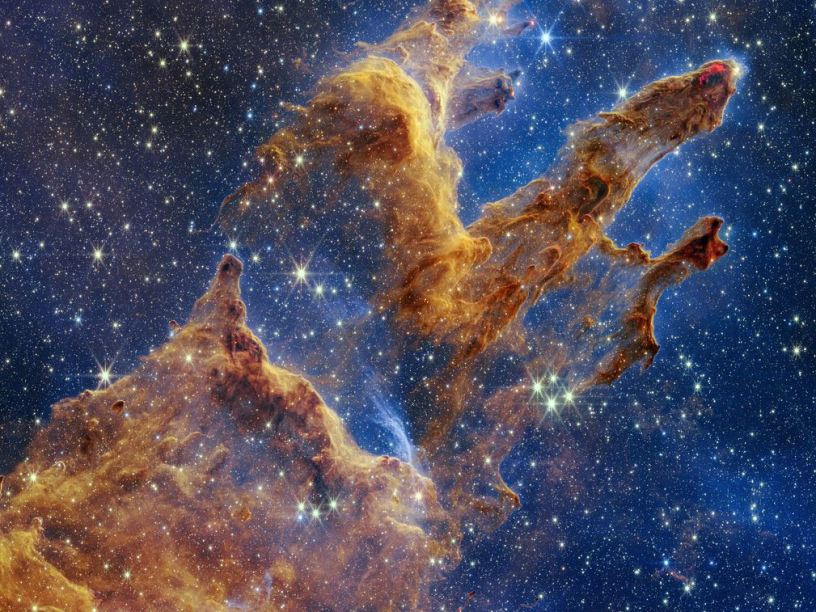
I just finished a book by Neil DeGrasse Tyson called To Infinity And Beyond, A Journey of Cosmic Discovery. It is not a technical book, but more a “general science” treatise of the universe.
Even though I have an engineering degree with several years of college level physics, there was a lot of new things I learned. Part of this is because some of the things in the book are new in the past 20 years (like poor Pluto being demoted)
DeGrasse Tyson on page 210-11 of the book says:
Half a century after Edwin Hubble’s discoveries, the space telescope named in his honor informs our current estimates for the total number of galaxies in the universe. That number has reached several hundred billion and may soar as high as a trillion. Meanwhile, each of these galaxies contains about a hundred billion stars, on average. As our telescopes take us ever deeper into the universe, the sheer scale of objects and phenomena quickly becomes unimaginable to our feeble minds.
Now let’s combine hundreds of billions with trillions. Multiply a hundred billion galaxies by a hundred billion stars per galaxy, and you get a billion trillion stars in the observable universe. That’s a million times more stars than the total number of sounds and words ever uttered by all the humans who have ever lived.
But we’re not done. Astrophysicists now think that at least one planet orbits every star, on average.
I had to read that several times before I could grasp the magnitude of what he was saying. It makes us earthlings pretty insignificant in the grand scheme of the universe. But how do these newly discovered facts mesh with cosmology as taught by Mormon scripture?
Let start with the Book of Moses
And the Lord God spake unto Moses, saying: The heavens, they are many, and they cannot be numbered unto man; but they are numbered unto me, for they are mine.
And as one earth shall pass away, and the heavens thereof even so shall another come; and there is no end to my works, neither to my words.
Moses 1: 37-38
Our current understanding of the universe seems to collaborate the vision of what Moses saw. Worlds without number. I’d say a billion trillion stars, each with at least one planet is pretty close to heavens that cannot be numbered. Or is this just hyperbole in the scriptures, Moses (or Joseph Smith) trying to sound grand with fancy language?
This next one seems more far fetched
But behold, and lo, we saw the glory and the inhabitants of the telestial world, that they were as innumerable as the stars in the firmament of heaven, or as the sand upon the seashore;
D&C 76: 109
So according to this section, there are more than a billion trillion people in the telestial kingdom, since there are more people than there are stars. The scripture also gets it wrong on the “sand upon the seashore” statement. It is estimated that there are seven quintillion, five hundred quadrillion grains. While not as many as a billion trillion, that still is a lot of people in the telestial kingdom, considering that only 110 billion people have ever lived on the earth. At the current rate, Christ won’t be coming for another 700,000 years, just so we’ll have enough people for the telestial kingdom! (I’ll leave the math as a homework problem) .
I think it is easy to see that all these numbers in the scriptures are just flowerily language, meant to signify “a big number”, whatever that means. And don’t get me started on Kolob!
Then to top it all off, the farthest star that we have detected is 28 billion light years away. It was formed soon after the Big Bang. It could long be gone, but we won’t know for another 28 billion years!
So what do you make of all this? How does this mesh with the LDS teaching of the heavens, or teaching from Prophets? Can Mormon theology accept these new findings without changing its teachings?
 Wheat & Tares
There is a parable in Doctrine and Covenants 88:51-61 that might he helpful, but it is generally ignored among us.
5 AM in early December. 8 degrees out, pitch black, walking up the Elkhorn saddle towards Sun Valley. Orion behind, the Dippers in front, and starfield above.
Then day breaks lighting up the ice fog.
Yes, Bishop Bill, the sheer scale of the Universe as we now understand it does stagger the mind.
As recently as the dawn of the 20th century, “the Universe” was just the millions of stars in our own galaxy. Only then did investigation of those fuzzy patches that showed up on photographic plates determine that they were separate galaxies, millions and even hundreds of millions of light-years away. In other words, given there are now a million billion galaxies, our understanding of the size of the Universe has increased by roughly fifteen orders of magnitude since that time, just over a century ago.
The verses you quoted from Moses do lend a cosmic-scale perspective to some Mormon thinking, and they are admirably expansive in that sense.
ji, I need to give some thought to you comment about the parable in Section 88. I don’t know that I’ve ever it of it discussed much. Thanks.
Cool post. Sounds like a good book.
Joseph Smith’s scriptures, while sometimes awe-inspiring, are decidedly anthropocentric. All this vastness in the cosmos is for Us, the Very Important Humans. Joseph sees the bigness of the heavens and, since the Bible says we are important to God, concludes that we are indeed Very, Very Important.
I draw the opposite conclusion. This universe is not made for us. We are a tiny atom in the grand scheme of things.
When we eventually discover extraterrestrial life, it is unlikely it will look anything like us, having evolved in a different environment with different mutations and different adaptations. Every living thing on Earth shares a common ancestor. You share 60% of your DNA with a chicken and 25% with a blade of grass. When we meet aliens they will have 0% of their DNA in common with us. Actually they most likely won’t have DNA at all.
Maybe those beings, whatever they end up looking like, are the real children of God and we’re the aliens! Maybe all this vastness is for them and we’re the background noise. Maybe space is the backdrop for their cosmic drama of sin and salvation and we’re about as important to God as a lobster.
Joseph thought big, but he didn’t think outside the 19th century box.
When you consider that the LDS population is only 2/1000 of the world’s population, you begin to recognize how irrelevant we (LDS) are generally. Then when you consider the data in Bishop Bill’s piece above, it really seems foolish to make everything about us. We aren’t even a blip or a gnat yet we think we have all the answers for the entire world / universe / galaxy / galaxies. It’s ridiculous.
kirkstall I recommend reading Edgar Allan Poe and comparing with what Smith wrote. They are literary contemporaries in many ways, though Poe was far more influential in creating the genres of mystery, detective, science fiction, horror and pirate stories.
New discoveries like this don’t require changes in LDS beliefs. Joseph Smith and Brigham Young had a very expansionist view of the physical world; and were generally welcoming to new scientific discoveries. Joseph Feilding Smith and Bruce R. McConkie had very limited views and were trying to restrict beliefs to certain boundaries.
When it speaks of the number of telestial people it could easily be including people on all of those other planets.
I dunno, that many galaxies and planets and no sign of intelligent life anywhere, except us? Statistically it does seem like it must exist, or have existed, somewhere. But it also seems likely to be at least extremely rare. To my mind that does lend this earth and our species a certain specialness or exceptionalness.
I agree with jader3rd. The idea of the expansiveness of the universe seems compatible with early teachings of the church. Of course, at that early time scientific teachings and discoveries weren’t seen so much as threats to religion. The idea was that science had undermined rigid Catholic views of the 16th century. Protestantism was more openminded and welcoming to science, and America allowed for even more embrace and experimentation. No popes in America to excommunicate the free thinker. No monarchs to crack down on challenges to religious tradition. Then came Darwin and Marx and a whole new surge of scientific and social thinking that began to challenge religious tradition in unprecedented ways. For a while, however, religions in America felt safe, as socialism wasn’t spreading in the US as it was in Europe and Asia. However, the post-WWII Cold War and Red Scare created a strong backlash effect in the US with traditional religions hunkering down hard against science and scientific thinking. John Birch entered Mormondom through Ezra Benson for a while. We still live in this era to some degree.
I think it would be pretty easy even for fairly traditional believing Mormons to accept the idea that the authors of scripture were writing using metaphors taken from the world as they observed it in their time. There was a post here a few days ago about challenges to church doctrine posed by biology. I’d say on balance that biology poses much bigger problems to Mormon theology than astrophysics.
your food allergy, I once read that to say there is no other intelligent life in the Universe because we’ve not found any is like walking down to the ocean’s edge and filling a teaspoon with water, looking in it, and then declaring there is no life on the ocean.
Bishop Bill
I also dunno. What’s in a random teaspoon off seawater? Do Bacteriophages count?
Bill, like I said it seems probable that there is intelligent life somewhere. But since nobody has seen any evidence, we have no way of knowing whether the situation is comparable to the microscopic contents in seawater which we can obviously verify with a microscope. Whoever said that is making stuff up.
I do find it remarkable that, considering the sizes of space and time we are talking about, that there is no good evidence of other intelligent life available.
Speculating about other intelligent life in the universe has the same value as speculating about purgatory. To me anyway. I was never a big fan of science fiction.
I can use the Dippers to get my bearings at night. The stars have tangible value sometimes, beyond the scenic attraction.