
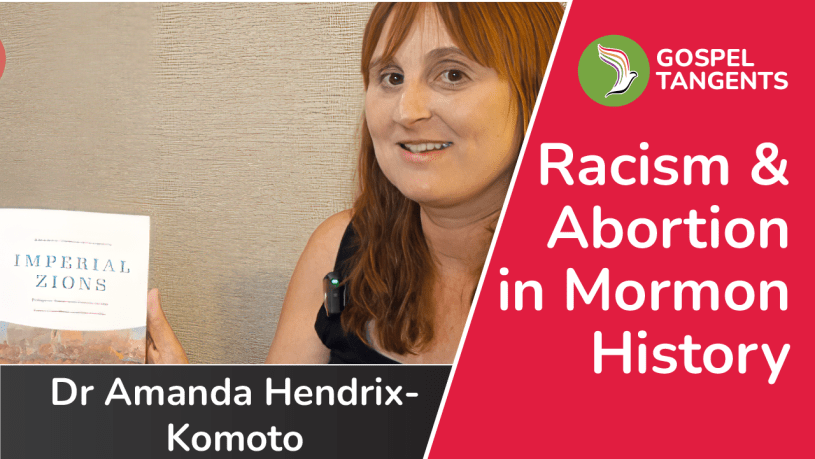
Dr. Amanda Hendrix-KomoTo is a historian specializing in the history of the American West, particularly religion and gender. She lives in Bozeman, Montana, and teaches at Montana State University. Amanda grew up in Blackfoot, Idaho, and shares her background in a heavily Latter-day Saint area. Amanda explains her connection to Mormon studies despite not being Mormon herself. Her father’s grew up on the LDS Church and served as seminary president. He eventually lost his faith. Amanda was invited to attend seminary but did not enroll, citing her busy schedule with band, debate, and AP classes. She has attended many 3-hour block church services, however.
Discussion on Amanda’s Book “Imperial Zions”
Amanda has written a book “Imperial Zions: Religion, Race, and Family in the American West and the Pacific.“
The book’s focus is on Pacific Islanders and Native Americans experiences in the Church. She credits her advisor, Damon Solia, for encouraging her to include Pacific Islanders in the book. Amanda discusses the historical significance of Tahiti and Hawaii in Mormon missionary work and the impact of colonialism on these communities.
Mormon Missionary Work in Tahiti and Hawaii
Amanda recounts her visit to Tahiti. She describes the interactions between Mormon missionaries, the London Missionary Society, and French colonial powers in Tahiti in the 1800s. Tahitians continued to practice Mormonism in the absence of missionaries and the RLDS replaced the LDS Church, growing a large presence in the nation.
The Role of Iosepa and Native Hawaiian Identity
Native Hawaiians had a large cultural practice of remembering their ancestors, which ties in well to LDS beliefs about temple work. Joseph F Smith served a mission in the Hawaiian Islands, and was instrumental in the founding of Iosepa, about an hour west of Salt Lake City. It was a place for Native Hawaiians to gather and easily travel to Salt Lake City to do temple work. Once the construction of a temple in Hawaii began, Hawaiians returned to the islands causing the decline of the community. Iosepa is now a ghost town. Amanda reflects on the importance of Iosepa as a symbol of Native Hawaiian heritage and the ongoing efforts to preserve and celebrate this history. (Iosepa is a Hawaiian word for Joseph to honor the prophet who served in Hawaii as a missionary.)
Amanda’s Research on Native American and Mormon Interactions
Amanda shares her personal connection to the Shoshone/Bannock Nation and her research on their interactions with Mormon settlers. She recounts stories of Native American women and their experiences with Mormon missionaries and settlers. Amanda discusses the establishment of Native America towns like Washakie and the cultural practices that emerged from these communities. She highlights the complex and often violent history of Mormon-Native American relations and the ongoing efforts to address these issues.
The Impact of Mormon Missionary Work on Native American Families
Amanda shares a story of a mixed-race man, Johnny Garr, and his family’s legal battle over his children’s inheritance. There was a question among the family as to whether a Native American grandson of a white man could inherit property. White family members did not want Johnny to inherit the property, but courts ruled in his favor. She discusses the broader implications of Mormon missionary work on Native American families and the legal and social challenges they faced.
Amanda discusses the importance of acknowledging and addressing the complex history of Mormon-Native American and Mormon-Polynesian relations. It is important to encourage tangible actions in these communities, such as supporting Native American businesses and educating children about indigenous history. Amanda shares her personal efforts to support Native American communities and the ongoing challenges of addressing historical and contemporary issues. They conclude with a discussion on the broader implications of these issues for Mormon studies and the importance of ongoing research and education.
We will talk about abortion next week. Amanda is an expert on the topic, and we will discuss the allegations against John C Bennett and also discuss abortion law today.
While racism against Blacks gets much more fanfare, there is a much smaller emphasis on racism against Native Americans and Polynesians. Are you familiar with the probem in these communities?
 Wheat & Tares
Sounds like she’s doing awesome work. I’m curious to learn more about the Tahiti RLDS connection.
“While racism against Blacks gets much more fanfare, there is a much smaller emphasis on racism against Native Americans and Polynesians. Are you familiar with the problem in these communities?”
Of all the painful moments from my faith crisis and deconstruction, learning about the church’s treatment of Native Americans was one of the worst. Most BYU students have no idea that their university sits on land once populated by the Timpanogos and they have no idea that the Timpanogos were wiped out by Mormon militiamen in an extermination order signed by Brigham Young. The details are gruesome and they make the church look truly evil.
We have no right to whinge about Boggs’ extermination order when Brigham Young ordered an extermination of his own. You can’t tell me that mass murderer was a prophet of god. I’m sickened to have his name on my diploma and think it should be scrubbed from the church’s universities completely.
I have often wondered why people don’t talk more about the church’s racism against Native Americans and I can only conclude:
a) Most Mormons don’t personally know any Native Americans very well (I do) and if they did, these stories would get more attention.
b) Most institutions in the US has a history of being horrible to Native Americans so Mormon aggressions get lost in the noise.
c) We, as a nation, are still very racist against our Native American neighbors and we don’t want to look it in the eye. Most white folks hear the words “land back” and recoil in horror without taking the time to research what Land Back initiatives really look like. We’d rather pretend that Native American people are all gone and we’re not complicit in their continued oppression.
Excellent comment Kirkstall.
I am more familiar with the Navajo Tribe than any other Natives American tribes.
I have seen them work very hard to overcome the horrific damage inflicted by outsiders, including the possibly well meaning Mormon missionaries.
It has take them almost two hundred years to overcome the damage and they still have a long way to go.
They are no longer welcoming to any Missionaries who want access to the reservation land.
They have worked hard to preserve their customs and to care for themselves without the “help” from government or outsiders which usually enriched everyone but the members of the tribe.
I was not aware of Brigham Young’s attitude toward them and his ideas to kill.
BY was a real whackjob.
I am a bit surprised that the Mormon Church still has his Discourses up for any and all to read.
They are full of many of his crackpot teachings and ideas.
Even taking into consideration that the ideas of the 1800’s are different than those of today his writings and talks are full of very damaging nonsense.
In 1873 two RLDS missionaries stopped in Tahiti on their way to Australia. While waiting for their boat to be repaired, they located a group of isolated Saints who’d had little contact with any North American church. They baptized 54 people before moving on. Ever since the RLDS/Community of Christ connection has grown and it is now one of the largest non-Catholic denominations in French Polynesia. Thanks to many members involvement in the pearl diving industry, it is also quite fiscally strong.
One indication of the long-standing importance of French Polynesia in Community of Christ: the current president of the Council of 12 Apostles is Mareva Arnaud Tchong from Tahiti. She is, by the way, the second woman to serve in that position.
The Mormon element to racism against Native Americans and Pacific Islanders is particularly insidious, since the LDS Church has explicitly taught for over a century that both of these groups are literal blood descendants of the civilizations described in the Book of Mormon, and even leaned into these teachings when proselytizing to these peoples (not sure if the same is true with the CofC). The Church has eased off such teachings in recent years, but never fully disavowed them. This is worse than typical Christian religious colonialism, because with Mormons, the White Savior narrative is baked into the core product. Not just BY’s extermination order against indigenous peoples of the Utah territory, but also more recently with cultural genocide (the Indian Placement Program) and cultural appropriation (the Polynesian Cultural Center in Hawaii). The white founders and leaders of the Church are invariably cast as the heroes, and “redeeming the Lamanites” is seen as fulfilling prophecy.
Of course, such an approach is built on the assumption that the Book of Mormon is a literal history of the ancient Americas, which is also slowly being walked back by the Church, and is not as prevalent as a core Mormon belief now as it was years ago. It will be interesting to see how the relationship evolves, hopefully for the better of all concerned.
Some interesting stats from French Polynesia (from within the past decade, at least):
83 LDS congregations with approximately 23,000 members
53 CofC congregations with approximately 7,000 members
I follow Dr. Hendrix-Komoto on Twitter and love her insights and posts. I look forward to listening to this interview.
My father is from Idaho and he attended BYU. When he was a young student, he was involved the in the proliferation of Sno Shacks all throughout Utah as an entrepreneur. This is a major way he put himself through school and started a large family when he was young (I was born before he turned 22- right off the mission). Selling shaved ice (e.g., snow cones) was a defining part of my upbringing and the de facto family business. We often went to state fairs, parades, dog shows, and other festivals. But the best places we went to sell concessions at were invariably indian pow-wows. My entire childhood revolves around selling snow cones (and later other food offerings) for many different pow-wows throughout Utah, Idaho, New Mexico, and Montana.
In some of these pow-wow venues, the only way to get access as a vendor was to have tribal affiliation. My father partnered with a native American family as a joint-venture in some of these. As a young boy, I was exposed to so many different cultures and perspectives as I spent vast amounts of time working alongside native American kids about my age. I was culturally ignorant and insensitive in my conversations, but overtime I learned so much and managed to temper my enthocentric view. I am so grateful for the perspectives I gleaned over the years about the long shadow of imperialism, relocation, land theft and genocide.
When I was in AP history in my Utah county high school, I was amazed at how quickly very important historical details were glossed over or not touched on at all. The stereotypes and the ignorance was profound. Since most of my summers were spent working on reservations, I actually had very low connection to US traditions, especially the 4th of July. To this day, I still have fond memories of falling asleep listening to the drum circle and singing/chanting on hot summer nights in a tent next to our concession stand.
Amanda’s book ‘Imperial Zions’ reveals important narratives about Pacific Islanders and Native Americans, shedding light on their experiences within the Church.