

Dave B already posted about the garment retrenchment yesterday, and someone in the comments mentioned the revisions to the church’s policy regarding trans members as potential post fodder, which I will provide here, but there are also some other announcements that have recently happened, so I’ll try to give a quick news roundup recap of all of it. To me, it feels a little like rearranging the deck chairs on the Titanic (so take your vitamin pills!). Some of these ideas are better than others, but overall, I’m not sure there’s a cohesive strategy that actually accomplishes any of the church’s missions in all this flurry of activity.
Before I get to the part where the church punches trans people in the face–again–here’s a quick list of the other changes that have recently been announced:
Young Women as greeters. A few critics are likening this to assigning the most beautiful sisters to serve at Temple Square as a way to “flirt to convert” (literally a tactic of cults, according to Steve Hassan who was drawn into the Moonies by three gorgeous young women who feigned interest in him, a tactic referred to as “love bombing”). Other critics are saying this puts Young Women at risk by the creepy codgers of the ward slipping them more than handshakes at the chapel door. I mean, maybe? The most plausible criticism I can agree with on this one is that it’s more crumbs and continues to preserve the status quo, which is certainly true. Having said that, would I have liked this as a Young Woman? Probably. Would my daughter? Probably. Maybe it’s on par with handing out towels, or maybe it’s more than that. If you are still committed to second class status for women, and obviously Mormon leaders are, this is not a bad assignment for the Young Women.
Sealing Policy. This one’s a bit weird. We’re still committed to upholding access to polygyny while barring women from any whiff of polyandry (both are off-putting to me). Now men can be sealed posthumously to women they only lived with–in sin!–but we are assured that no one will be “forced” to remain in a sealing they don’t want in the next life. M’kay. This one’s just honestly stupid. Like, why. Maybe I’m missing some nuance here because IDGAF.
Holiday Church Services. These are now officially one hour only. Hallelujah. C&E Christians, unite! It’s been a long time since I wasn’t in a ward that did this anyway, but making it a thing is good since you know there’s gotta be some idiot local leader out there assigning lessons on tithing on Christmas Day.
YSA Age Changes. The Church now considers anyone single between 18 and 35 to be a Young Single Adult (YSA). Those who are 36 or older are considered Single Adults (SA–although whenever I see SA I think Sexual Assault). Critics are darkly joking that this will make it easier for the skeevy old dudes to access the nubile young high school grads, but would still prevent 37 year old Joseph Smith from accessing 14 year old Helen Mar Kimball. I suppose this is a nod to two things: 1) people no longer marry as young, and 2) as the church shrinks, keeping YSA wards to smaller age range groups is impractical. I’m not sure I have strong feelings about this one, as I got married at age 23 and was never in a non-student YSA ward. Those who have been should weigh in. One thing for sure, Brigham Young (who said that any unmarried male of 26 years old or more was a menace to society) would not approve.
1-Hour Church Pilot. There’s apparently a stake somewhere (Canada maybe?) piloting the idea of a one-hour church service. First criticism: it sounds like it’s about an hour too long (cue rim shot). Deeper criticism, there goes the last vestiges of community, perhaps. Personally, I think the loss of the linger longer potlucks cannot be overstated, but I’m not sure how much I want to break bread with some of these folks, which brings us to …
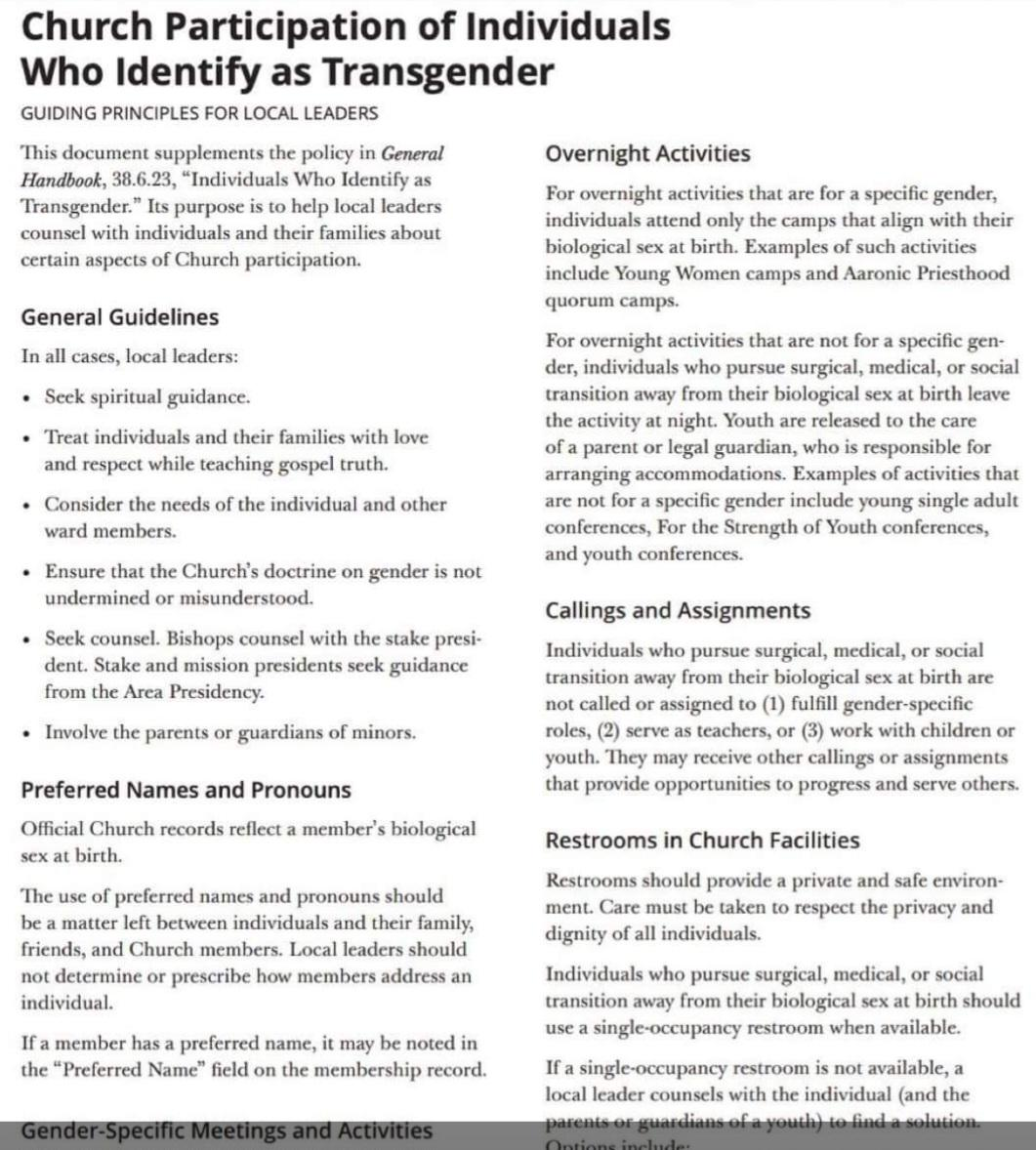
Trans Policy Revision. There are some fairly large changes regarding the Church’s policy for how to treat trans people, mostly reliant on conservative fear-mongering and making sure bigots are not made uncomfortable by the existence of some of the most marginalized people there are. Every potentially positive or kind statement is anchored to something that makes it clear that actually accepting trans people is not OK.
- “Treat individuals and their families with love and respect while teaching gospel truth.” You know what’s not a normal human interaction? One in which one party to the discussion is “teaching gospel truth” to the other one. Also, as we all know church leaders mean “what WE say it is” when they say “gospel truth.”
- “Consider the needs of the individual and other ward members.” This is akin to saying “Consider the needs of the individual and the bigots who are made uncomfortable by their very existence.” Will no one think of the bigots??
- This one doesn’t even throw a bone to the trans person: “Ensure that the Church’s doctrine on gender is not undermined or misunderstood.”
Then, the worst part, IMO, is that anyone who is trans is specifically going to be:
- Monitored while they pee, forcing them to use the wrong restroom. This literally leads to health problems for trans people, and it really should not be taken lightly. It causes serious health problems to hold it as many trans people do rather than (distressingly)using a restroom that is not the gender they identify with. Also, trans people are the most at risk of violence when they enter gendered spaces with which they don’t identify. On the upside, two hour church makes it much easier to just avoid the bathroom. The mythical single seat bathroom is about as common as a unicorn in most LDS ward buildings.
- Ward endorsed deadnaming. This doesn’t clarify what to do if someone has had a legal name change. Everything in the policy refers to “biological sex at birth,” but “Local leaders should not determine or prescribe how members address an individual” only does one thing: give cover to bigots who deliberately deadname trans people to make them feel unwelcome. And believe me, there are people in the church who delight in this. I have witnessed it.
- Restricted from holding any callings because pretty much all callings are either gendered, teaching or in the Primary. What’s left? If they happen to be able to be the organist or pianist, so long as it’s not in Primary, and one-off stuff like librarian (do they even have these anymore?), doing the programs, or family history I guess. So they really can’t be a part of the ward community in any meaningful way. I love how the policy says you can still “progress and serve others” in this extremely limited list of callings. I mean, let’s get real–it’s plenty tough to “progress” in any calling given how restricted teachers and leaders are at this point. I once said “You can correlate the manuals, but you can’t correlate the contents of my mind,” but damned if they didn’t try.
- Smeared as a pedophile, in that they are specifically prevented from working with children in the ward. If you want to be more charitable (I don’t), you could say that it’s not that Oaks thinks they are pedophiles, just that he doesn’t want kids to get the idea that being trans is an option, as if that idea is coming from some random person in the ward and not from going to school and knowing people, as well as their self-perceived gender identity. But realistically, I’m pretty sure that people Oaks’ age do conflate being queer (in all its iterations) with being a pedophile. It’s another canard I’ve also heard from church members who themselves have been put in charge of the kids, which is an irony and a half. Also, one thing the church does a great job at is protecting actual pedophiles who are always most likely to be cis-gendered men. We’ve already discussed these cases in other posts, but let’s be clear: the calls are coming from inside the (patriarchal) house.
- Parents who support their trans kids are definitely going to have a hard time managing this with the new guidelines unless they seriously win at leader roulette, and many if not most will have to step away to remain supportive of their trans kids.
Two other glaring issues I see that the policy completely doesn’t address or even seem to understand:
- Non-binary as an identity is neither addressed nor acknowledged. I guess that makes sense because for sure Oaks does not believe that anything is non-binary.
- Intersex, which is far less uncommon than we used to believe throws a monkey wrench into the works. Up to 1.7% of humans are born with intersex characteristics, so what does “biological sex at birth” even mean for them? If it’s based on the legalistic definition of “assigned at birth,” that’s different than the reality that some assignments are not correct physically, including when one’s chromosomes don’t match ones genitals. These are conditions that exist.
I would never recommend asking an octogenarian or nonagenarian to craft a policy that affects queer people, much less trans people, but that’s what you get when you have a gerontocracy. When faced with new things, we can be curious or we can rage against the dying of the light. While I tend to think that trans adults are mostly going to be safe from this policy because they will have already left this toxic (to their existence) church environment, that’s cold comfort for parents of kids who are identifying as trans or non-binary. Just as you can’t pray the gay away, you also can’t bully kids into a gender they don’t identify with. You can make their lives hell while creating a haven for bigots. I guess that’s the option being chosen, again and again.
But that’s an issue that very few I know will leave the Church over. Most who would have left over this already have. The church continues to show that it’s not interested in retaining anyone with progressive values. I suppose this policy will just continue to be a way to kick the families of trans kids to the curb as they come out to their parents.
None of these changes are the iceberg, IMO, that sinks the Titanic. It seems from reporting that religion in general is in steep decline, particularly increasing post-pandemic, and each of these changes (as with the garment post Dave B did yesterday) could speed up or slow down the decline for some members.
- Do you see any of these changes as slowing down the loss of members? Do some of them speed it up?
- Are there actual members you know whose participation will be impacted by these changes?
- How would you craft a policy regarding trans (including intersex and non-binary) church members?
Discuss.
 Wheat & Tares
First, thank you Hawkgrrrl, for posting this. You did a great job summarizing the unfortunate changes to policy, as well as the likely reasons for the changes.
Are there actual members you know whose participation will be impacted by these changes?
Yes, there are actual members I know. I am one. While I do not present my feminine side often, and never at Church, I am trans and have dealt with that my whole life. Mostly unsuccessfully, I might add. Ironically, it was a therapist I saw through LDS Family Services a few years ago that helped me learn how to acknowledge, accept, and integrate all of myself, which led to a greater and deeper relationship with Christ. That did not translate into a greater and deeper relationship with the Church, although I found a balance that has allowed me to still participate in the Church and tradition I love. My bishop know me, loves me, and has made it clear I am welcome in the ward however I show up. I am sure not everyone shares his opinion, which is one of the reasons I put on my white shirt and tie every Sunday. I feel marginalized enough on a daily basis, and I don’t want my religious worship space to add to that.
These changes, however, make it clear that the Church’s official policy, although not specifically stated, is that my mere existence is (1, the charitable option): a threat to the body of the Church, because seeing me and knowing me would lead people to think that maybe, just maybe, trans folk are regular people; or (2, the transphobic option): a threat to the body of the Church because all trans folk must be/are pedophiles, because why else would they choose to be so abnormal?
So even though I attend Church every Sunday, and pay my tithing, and check all the boxes that I am supposed to check in order to be a performatively acceptable “member of the Church of Jesus Christ of Latter-Day Saints” (not Mormon-no, never that term!), even though all that, I am a threat to the Church simply by my existence. Somehow, by merely being present, I am endangering the ability of the Church to deliver celestial glory for its members. To paraphrase the Reverend Martin Luther King, these policies make it clear that I am not being judged on the content of my character, but on my preference for floral patterns over power neckties. If I come across as hurt and angry, it’s because I am. One of the most trusted and important relationships in my life just sucker-punched me and said, “Stand in holy places, but not this one, and it’s your fault I’m excluding you because I love you.” I’m hurt and angry because I now have to renegotiate what it means to be trans and a Mormon, because I still have my faith, if not in the Church.
The anti-trans changes (clarifications? whatever–) are deeply depressing to me. Some things coming from GAs, like their mostly matter-of-factness about of course members would want to mask and vax during the pandemic, gives me hope that they actually get input from places other than American Republican fearmongering. But then they come out with stuff like this which, as you observe so well, Hawkgrrrl, sounds like that’s the only thing they’re listening to.
I’ll just comment on the YW greeters. I’m in the deep south. It’s too hot to leave the church doors open, and I know in other places the winters are too cold to leave the church doors open. So, one or more of the YM are at the door opening for each person/family/group as they enter. Being the patriarchal south, we’re used to telling boys/men to open the doors for girls/women. I’m not sure how accepted it would be for young women to be opening doors for men.
Once inside, the foyer space between the doors and the chapel entrance is small. The missionaries are stationed there. I don’t see any other space to reasonably place another greeter.
Concrete Cowboy, thank you for sharing.
HokieKate, it’s sad we use youth to welcome people into the church where they have to run the gauntlet through missionaries to find a seat where maybe they just came to worship. Then heaven forbid if you are “different.”
The trans policy, while upsetting, is not surprising. However, the sealing policy change, that men can be post-humously sealed to women they’ve lived with, but not married to? That surprises me. I see it as a reaction to common-law marriages recognized as legal in various countries, so of course they should be able too be sealed (and while alive, in those cases, I think!). But it also seems to suggest that maybe marriage in and of itself has nothing to do with a legal ceremony or contract….and if marriages aren’t about legal acts, are families really about a temple ceremony?
A couple of quibbles:
1. The change calls for YW AND YM to be greeters: “a member of the bishopric invites Young Women class presidencies to organize youth to minister by welcoming visitors and members as they enter the chapel.” In theory, both boys and girls would be welcoming people to church, under the direction of a girl, which seems almost impossibly progressive. Whether the YM actually do it remains to be seen.
2. I don’t believe there is any evidence of the Brigham Young “menace to society” quote. I’m not saying that he wouldn’t have agreed with it, or that the idea hasn’t been pervasive within Mormon (and non-Mormon) through large swaths of time, but I don’t think its an accurate attribution.
As I’m the guy who brought up post fodder yesterday, I’ll put my thoughts on the trans policy in a separate comment, if I can manage to get them into a readable form.
“But it also seems to suggest that maybe marriage in and of itself has nothing to do with a legal ceremony or contract….and if marriages aren’t about legal acts, are families really about a temple ceremony?” – Allie
It is my theory that marriage in and of itself is a big organization construct that pairs people together as a unit to reduce needing to care for an individual because there is a “built in helper and caretaker”. Generally, marriage is used to “take care of men” – and this is visible in statistics comparing the health of married men vs single men and other male populations. Marriage is also used to control (or at least gatekeep) sexuality.
The temple ceremony spousal sealings in early days were about social organization in this life and the next life. To a degree, I think that they are ritual connecting spouses to together in this life – but really, the ritual doesn’t have the same impact that the standard wedding vows or personal wedding vows have. Also, the ritual has been very exclusive for long stretches of time that pitted the couple against the greater family community.
To a degree, spousal sealings today are about social organization still. There is still a double standard that men have access to more social organization options (whom they are sealed to or not sealed to) then women do (and there is additional pushback for women to access those options).
Temple ceremony children sealings seem to be about social organization in the next life and a ritual recognizing parent to child ties in this life. I think sometimes they are used as a “safety net” to still be connected to children even if the parent commits series injury against their child(s) and the children want/need to be disconnected from that parent.
Concrete Cowboy, I got teary eyed as I read your comment. I can’t even begin to imagine how you must feel about the church’s latest policy fiasco.
Why must we defined by the intransigent and close minded beliefs of very old, white, straight, privileged, very conservative men? Like insects that have been trapped in amber, it feels like the Q15, and especially the FP, are permanently suspended in the 1950’s. For a church that prides itself on so-called “continuing revelation” it feels like the church is also trapped in a religious and mental form of amber and will never be set free until (maybe???) younger leaders take over church governance.
I’m sending you many hugs along with a lot of solidarity and support. To quote a friend from HS who underwent a major personal and spiritual transformation for the better: “Change is inevitable. Growth is optional.”
If we learned anything from the horrific November 2015 policy, it’s that the handbook is endlessly malleable, even when it’s presented as direct revelation. These creaky, bigoted policies are a desperate last gasp for the pretense that the Church won’t eventually give way to good science and basic human decency. The deck chairs metaphor is entirely apt.
These will cause a lot of harm before they go away. They will cause a lot of people to go away. And then the policies themselves will go away.
“but we are assured that no one will be “forced” to remain in a sealing they don’t want in the next life.”
This statement only makes sense if we actually believe that a marriage pronounced eternal in that split second in the Temple is what makes it eternal. I believe that, like the creation accounts, all things are first created spiritually or in modern terms, abstractly, in the mind, but the promise of what is first constructed in the spiritual realm is only made true through the word becoming flesh. The words stated in the Temple, by themselves, only hold the promise of that relationship, they do NOT hold the power to make it eternal. Therefore, the statement assuring people they will not be “forced” is complete nonsense. The union is not eternal because it wasn’t even good here and now. A marriage may be pronounced as holding the promise of being Eternal in the Temple, but those words do not make it Eternal.
“Treat individuals and their families with love and respect while teaching gospel truth.”
Somehow the “treat people with love and respect” and “Gospel truth” have been disconnected. What the heck is Gospel truth if it’s not primarily “treat people with love and respect”. 1 John 4 is a profound indictment against this disconnected line of thought. “20 Whoever claims to love God yet hates a brother or sister is a liar. For whoever does not love their brother and sister, whom they have seen, cannot love God, whom they have not seen. 21 And he has given us this command: Anyone who loves God must also love their brother and sister.”
“Gospel truth” has been reduced to propositional claims and conformity to law. Even stodgy Paul succinctly summarizes what “the law” is in Romans 13. “8 Let no debt remain outstanding, except the continuing debt to love one another, for whoever loves others has fulfilled the law. 9 The commandments, “You shall not commit adultery,” “You shall not murder,” “You shall not steal,” “You shall not covet,”[a] and whatever other command there may be, are summed up in this one command: “Love your neighbor as yourself.”[b] 10 Love does no harm to a neighbor. Therefore, love is the fulfillment of the law.”
Therefore, LOVE is the fulfillment of the law. Love is where the law is pointing, Love is the intent of the law. Obedience to the law is NOT a virtue of its own, it only becomes virtuous if used, not to make one loveable, but “To Love”. The law is not about making oneself acceptable to God, it is an expression of seeing the dignity in another human being and refusing to take that dignity away.
STOP teaching that “Gospel truth” is something separate from loving as God loves.
Long ago I served in an Elders’ Quorum presidency with a friend who has since come out as trans, transitioned, and has now been attending Relief Society in her ward for years. I’ve moved away but I have friends who are in the leadership of that ward and stake who I know are allies and wouldn’t want to prevent her from attending Relief Society, but they are now seemingly being told by Salt Lake they must. She is interpreting that vaguely worded “General Guidelines” section as meaning that for her to attend Relief Society she would need her local leaders to ask for authorization from the area presidency. It’s so vague it’s not 100% clear to me whether that’s the intention, but if true, it suggests that Salt Lake thinks they can’t trust local leaders to exclude people they know and care about, so they are shifting decision making authority to mid level bureaucrats. Is this an admission that the church is worried that the current generation of bishops aren’t inclined to go along with arbitrary rules written by nonogenarians?
I expect that quite a lot of trans people in the church who were holding on to finding a way to keep attending will see this as reason to give up and leave, and I don’t blame anyone who does. I expect some of their families will leave with them. I think the number of people potentially affected is possibly smaller than those affected by the 2015 exclusion policy, but I’m just speculating.
What would I do, policy wise? Well, certainly not that. I think true inclusion of trans people poses a greater challenge for the church than inclusion of LGB people, because so many aspects of the church are so gendered. My trans friend has been ordained an Elder. So yes, as far as I’m concerned, I know a woman who has the priesthood, and who has held keys and presided and laid her hands on my head. I don’t think the church can truly be inclusive to her as a woman without acknowledging all of that. Doing that means finding a path to ordination for women and making all of the ordinances gender neutral. With the temple ordinances, that still is going to require a lot of work. So, when it comes to policy I do want to rewrite everything and really include trans people, but the changes I would make would be perceived by much of the membership as truly radical. Many probably aren’t ready for it, not that I think that should be a reason not do it, but I expect there would be big fallout if I had my way, much bigger than what is likely to happen from this latest misguided set of policies.
The topic and changes that bother me is the trans / intersex portion of the announcements. I listened to a fascinating podcast about Testosterone Insensitivity Syndrome. Prevalence is about 5 per 100,000 or one person in every few stakes. Physical characteristics vary by person but the person giving the podcast looks like she could win a female beauty pageant.
When testifying to a state legislature committee considering legislation she legit didn’t know which bathroom she should use but could realistically be expected to use the men’s bathroom. Or be thrown in jail. The LDS policy follows that pattern.
I think people making these hurtful policies believe intersex and trans people are making it up or have malicious motives and if they ignore the problem it will go away. If I were making a policy for trans or intersex I would immediately decline and say they need to ask a trans or intersex person, which they clearly didn’
The handbook section on “Individuals Who Identify as Transgender” (38.6.23) contains within it a link to “guiding principles” which is the document that is included as a screen shot (which doesn’t grab the entire document) in the OP. I don’t know why we have two layers of documentation here; I’m not aware of other instances of this, but I also don’t read the handbook for fun, so I might just be ignorant here. I’m tempted to speculate that the motivation is so that The Church can change the “guiding principles” at any time without it constituting a handbook update. As soon as I saw that the policy had been updated I took screen shots on my phone before it could download the update so I can compare.
The instructions that people can have their preferred name updated in records and used in the ward was moved from the handbook itself to the guiding principles. To me, this feels like burying these instructions. I think the line “Local leaders should not determine or prescribe how members address an individual.” does at least one more thing not mentioned in the OP: it gives bishops space to avoid getting involved in conflicts over names and pronouns. On the one hand, I think we already look to bishops (and church leaders generally) to do too much of our thinking for us. However, the handbook also states: “They …. should be treated with sensitivity, kindness, compassion, and Christlike love.” If you aren’t willing to address someone the way they want to be addressed, you aren’t being sensitive, kind, compassionate or Christlike. This is true for someone named Charles who would prefer that you not call him ‘Chuck’, or someone whose first name is Willard but would rather go by his middle name.
The screen grab above does not capture the section on “Gender Specific Meetings and Activities”. It states: “Individuals attend gender-specific meetings and activities that align with their biological sex at birth. Any exception, which should be rare, must adhere to the “General Guidelines” listed above and be approved by the Area Presidency.” I have a 16-year-old trans son. When he came out to the ward a year and a half ago, he was quickly invited to attend priesthood lessons and activities with the young men. I know my bishop discussed this with the stake president, but as far as I know it was not moved any further up the chain. Now it is clear that the default position here is to disallow this. I have little hope that my Area Presidency would approve the exception. So we’re left wondering if we’re grandfathered in? Will the new bishop notice this change? Will he feel duty-bound to bring it to the attention of the Area Presidency? Or will he prefer to just ignore a potentially uncomfortable situation? While my son rarely comes to church with us anymore, the rest of us still attend every week. We still hold callings. It is increasingly difficult to support an organization that does not have a place for all of my family. Does The Church believe that my family can be together forever?
One more point, and I’ll be done. The most conspicuous part of the handbook update is what was removed. “Some children, youth, and adults are prescribed hormone therapy by a licensed medical professional to ease gender dysphoria or reduce suicidal thoughts. Before a person begins such therapy, it is important that he or she (and the parents of a minor) understands the potential risks and benefits.” Previously the handbook recognized that hormone therapy was warranted in some cases. That is no longer included. Trans youth are at much higher risk of both depression and suicide, but we’ve removed any mention of that from the handbook. What does this say about the Church’s values?
We officially stopped attending one year ago, and had only attended sporadically for several years prior. Our oldest child is non-binary and the reaction of our faith community was a large reason we decided to leave.
The reality is that the church can slowly be dragged kicked and screaming to be more inclusive of the queer community, women, people of color, and other marginalized groups. And progress is always welcome. That being said, literally every other organization we interact with is so far ahead of the Church that it’s just not worth stepping back in time every Sunday cuz tradition. When my child is accepted at school full stop, when most work places are actively challenging their hiring biases in order to do better, when other faiths say love is love and mean it, when businesses all over my community have rainbow flags and mention they are a safe space, when we might actually get a female person of color as our Nation’s leader, when TV and theater are giving everyone role models on their platforms by casting based on talent and not based on eye color, I just couldn’t justify putting up with the crumbs at church any longer.
The sealing policy is being presented as something sexist. But it seems to me that for every man who is sealed to a woman he wasn’t married to, there is a woman being sealed to a man she wasn’t married to. What am I missing?
Also, failure to find a marriage certificate has never stopped people from doing sealings for couples who had a child together. Is this explicitly extending that to couples who didnt have a child together?
@lastlemming
My reading of the sealing policy is that the notable change is a way for people to be posthumously sealed to someone they lived with in life but were not married to. Because our existing sealing policies for people who are still living already treat men and women differently, this new policy had to be worded differently for men and women in order to align with that. In my mind the gendered part isn’t really new, it’s just that the new policy is calling attention to that once again.
Thanks Hawk for distilling this information in digestible amounts, including some items I hadn’t yet heard about.
On the issue of YW as greeters – I have a teenage daughter who is not very enthusiastic about church to begin with, and with good reason; she has a strong sense of fairness and has long recognized the built-in sexism (which she discovered on her own, without any encouragement from her progressive, nuanced parents) and she will see this exactly for what it is. That, and she’s an introvert, very much the opposite of the preferred “bubbly” personality sought for in female ward greeters or temple square missionaries. If she is ever asked to do this, it will push her away even further.
YSA age changes – although I don’t like the possibility of nearly-40-year-old guys hitting on barely-adult women with the blessing of the Church, I also never liked the arbitrary age limit which saw many sincere unmarried people unceremoniously kicked out of their most important social outlet upon turning 31, and severely limiting their prospects even more. I was in YSA wards as a young adult, and though I was lucky enough to marry in my upper 20s (old by LDS standards), I also saw this less fortunate situation play out many, many times, because some bishops just love to enforce the rules for the sake of rules. I’ve also seen on occasion Mormons rushing into marriages at 29 or 30 to try and “beat the deadline” only to have the marriages fall apart later.
Sealing policy – I believe this will change again after RMN and DHO pass, for obvious reasons. As far as I can tell, it’s becoming less and less common for widower apostles to remarry, let alone get quickly remarried to much younger women who have never previously married. Holland (so far), Eyring (so far), Ballard, Hales, Scott, Monson, and Hinkley are all fairly recent examples of senior Church leaders who never remarried after their first wives passed.
1 hour church pilot – I’ve been piloting my own 1-hour church program for years without bothering to wait for SLC to direct it. It does significantly reduce my interactions with fellow ward members, but if you were in my ward, you would understand.
Trans policy revision/clarification – Very sad, though not surprising. It wouldn’t take much effort to simply err on the side of kindness and inclusion, and “let God figure out the rest” as Mormons are so eager to say in response to policies that don’t make sense. Instead, they showed their hand once again, and it is unnecessarily cruel and un-Christlike. I suppose Church leaders see it like the controversies surrounding trans athletes, where there is potential for perceived unfairness based on the advantages of biological sex, and likewise the powers of the holy priesthood must not be allowed to fall into the hands of a person assigned female at birth (gasp!). Even if this policy does change at some point, this codification leaves a stain on the Church’s legacy that will remain, just as with the pre-1978 racial restrictions. “Treat individuals and their families with love and respect while teaching gospel truth.” Why must the two terms be mutually exclusive?
Several years ago, when HPGL, I was getting ready to start the priesthood meeting when a man walked in with what looked like (and was) his wife and two young grown daughters. They came in and sat down. I did not know them. I suppose that I could have asked the women to leave, telling them that there was a meeting exclusively for the women and that is where they should go. I did not do that. We went ahead with the lesson. I welcomed the visitors, and the good man introduced himself, along with this wife and daughters. We then went to the lesson. There was nothing secret in the lesson, nothing that we had to keep away from the women. When it was over, they left. One of the full-time missionaries thanked me for not saying anything, because this was their first time at church and they didn’t want to be separated.
Under the new guidance, would I have been wrong? Should I have asked the women to go to RS? This wasn’t a trans experience, but women who where born women attended a men’s meeting, and I was in charge, and I did nothing. I think I did the right thing, and with the new guidance, if the situation presents itself in the future, I think I’ll still do nothing. I am not in charge anymore, but if a trans man came to EQ, I wouldn’t worry about it. Once that persons realizes how bad our lessons usually are in EQ, he might want to return to womanhood and to RS. My wife tells me that they aren’t any better in her RS, so maybe improving the quality of teaching should be a more important priority than worrying about who is in which class.
Young women as greeters is fine…The sealing policy seems odd, but whatever…Holiday church service changes are good…YSA changes are in line with broader society marrying later, and I seriously doubt there’s going to be a flood of 18-year-olds marrying 35-year-olds as a result.
The trans policy revisions make it clear that the church leadership doesn’t know how to work through (or even work around) some of the complicated things happening in society right now. But they can’t just say that because the membership wants direction on some of these complex social issues and is looking to the church as a valid source of guidance. Church leadership is divided on what to do, Elder Oaks is looming over Nelson’s chair, and so they’ve shuffled the chairs around and delayed any real changes.
You have this wild intersection of biology, psychology, sociology, organizational behavior, politics and several other fields trying to weigh in on trans issues. There’s a lot we don’t know, some that we do know, and a whole lot of noise. Not to mention the current research crisis in academia broadly (not just about trans issues), especially in social and behavioral fields – this includes respected researchers at universities like Harvard being fired after being caught creating & using fake data. (e.g. The publisher Wiley shuttered 19 scientific journals this last May after retracting 11,300 sham papers).
At the center of all the chaos is a group of real living humans who simply want to be treated like people. Their humanity tends to get stripped out of the conversation about policy, but they have feelings, they have families, and they love their pets just as much as you or me.
I don’t think any of these changes are big enough to have any real impact at all in either direction. There’s nothing substantive here.
If someone walks into a church looking for Jesus and community, that’s what they should find. I don’t have the answers on what every little policy should be, but if nothing else they should feel genuinely welcomed and included. Why not just remove gendered activities and classes altogether? Primary, Sunday School, and Sacrament Meeting aren’t divided by gender, and they seem to work fine…so just do everything that way. Setup youth activities so there are two activities each week and each kid can choose which one they prefer. And then focus on making the actual activities and classes better instead of spending the resources and energy on determining who should/shouldn’t be able to participate.
I will give props to some of the youth leaders in my ward. There is a member of the youth who is clearly struggling with their gender identity, and they have genuinely tried to host activities that the individual is interested in and even taken the whole youth group to watch their school concert and be supportive. I know it’s been tricky to navigate, but they’ve genuinely tried to make this person feel welcome.
For temple ordinances and doctrinal things, I understand that it may be more complicated…but just say that publicly. “It’s complex and we understand that people are struggling and looking for guidance. We are prayerfully trying to figure out what we need to do (and maybe waiting until Elder Oaks is gone). We will make the best decisions we can, and then adjust our course as needed and inspired.”
I wonder if the new sealing policy isn’t in reaction to how things are done in areas where the church is growing. In most of the “Western” world, being married is a relatively straightforward process without much hassle to obtain the legal paperwork (at least for heterosexual couples). However in a lot of the developing world, especially Africa, marriage is more complicated. There can be onerous fees, bureaucratic paperwork which may require bribes, and travel from remote villages through areas rife with ethnic conflict. As a result, many couples see themselves as married but are not married in the legal sense.
In my stake, we have several wards which have high baptism numbers driven mostly by immigrants from West Africa and Latin America. The vast majority of the couples being baptized need to be legal married before being baptized. They were either unable to obtain the paperwork in their home country and never officially married, lost the paperwork with no hope of recovering it (due to wars, forced migration, or not having the money to secure it from their local consulate), or did not have the money required to be married in their home country. The ward bishop will often perform a wedding ceremony right before the baptism.
Perhaps this new policy is making an accommodation that the world isn’t run based on western standards (a good thing).
It was in my general-ed Biology 101 class at BYU in about 1995, taught in an auditorium with hundreds of students, that I learned just how common intersex individuals are and some of the different types of intersex that exist. So it’s surprised me in subsequent years just how little the leaders of the church seem to know about this topic given that thousands of newly-minted adults each semester in my generation of devout members were learning about this three decades ago.
It seems to me that the intersex question is the central issue church leaders need to grapple with before they can make useful, logical, and consistent pronouncements about doctrine on other gender-related issues. It feels like this is the sole common ground spot currently—a gender-related inborn point of complication that we can all agree actually exists. So I feel it would be productive and smart to start the discussion there and once church leaders have got the intersex question resolved and policies and doctrines adjusted accordingly, we’d have much more productive conversations about transgender and gay and other such categories.
Right now it feels like the church leadership is in denial that intersex really exists or matters, but if you take seriously the church of statements on sex/gender and gender roles, it has to matter a lot. The last I saw, the church handbook advised parents when there is a question about a child’s biological sex to consult with a doctor who can make the final call on whether to assign the child as male or female. But the option of the intersex child not being artificially assigned as male or female and rather identifying at church as non-binary was not even mentioned. And of course many children and their parents don’t realize until later in life, after they’ve already been assumed to be a certain gender, that they are actually intersex. So can we be confident in legitimately ordaining any supposed male to the priesthood until he’s had a DNA test and thorough, expensive, and invasive examination to ensure that he is not actually intersex? Or is it only feminine behaviors and appearances we anre afraid of in male-only callings and not hidden elements of female biology?
The other Marie: thank you for laying out what I’ve been thinking and finding hard to put into words. I find it sad that if “God don’t make no mistakes” to reconcile how we treat intersex individuals and force a decision by someone other than themselves before they can even make a choice and not allow them to reverse it. To many people speak as if they are God when they have no clue what God did in the creation for his own reasons.
To toddsmithson’s point, the way the church typically rearranges the deck chairs almost always ends with an admonition that is something along the lines of “hey, we tweaked a few things, but remember, the church’s party line is more important that the few tweaks we just made.” toddsmithson brilliantly points out that the church’s approaches to trying to soften its hard-wired bigotry end in a reversal of New Testament theology: The church believes it’s more important to maintain the “truth” of its exclusionary doctrines than it is to practice the kind of love that Paul defines and preaches about. It’s a shame that the church has so indocrinated many of its members that they don’t see this as objectionable or even remotely problematic. Think for a moment about how the church is actually making the case that its “doctrine” (which, despite the church’s claims, is far more slippery and elusive than a few basic, foundational teachings of Christ) is more important than welcoming, than loving, than practicing kindness and ensuring that all truly are “equal unto God”. That’s astonishing. And depressing. And a testament to how the church has fallen victim to its own indoctrination.
@Parsimonious –
I lost count of how many wonderful, committed common-law married couples (cohabitating couples) we were unable to teach on my mission in Argentina because the marriage requirements were so onerous. I was always sad when we had to stop teaching, or couldn’t start teaching, such a couple because there was next to no chance that they could ever be baptized. Only one common-law marriage was ever formalized for the sake of baptism on my mission, and that was a disaster. A very poor couple that presented for years as domestically happy, welcoming to the missionaries, and church-attending finally got married and got baptized while I was in the area. Within weeks, it became apparent that the man severely beat his wife; then he bought an expensive motorcycle and left her, and as far as I know neither ever came to church again. I still feel awful about being part of the missionaries who pressured them into marriage and baptism when they were not ready, such that it quickly led to the dissolution of their home. I hope she’s in a better situation now, and healed. I hope he’s never been able to abuse another woman ever again. But given their age and their poverty and their health, they might both be dead by now.
If I ran the zoo, I don’t know what I’d do to recognize the committed, loving common-law (cohabitating unmarried) couples and let them join the church, in wisdom and order, without opening the doors to casual cohabitation that John Charity Spring might condemn. But it would definitely be something I’d try to figure out.
Just to add some context to how Oaks and other top leaders view trans people (and are now REQUIRING local leaders to treat them), the other people who are barred from participation in similar ways are:
1) murderers
2) those who commit incest
3) pedophiles, including emotional abuse of children
4) those legally convicted for having child pornography
5) apostates (so I guess this one is anyone who disagrees with Oaks which is not a small group, LOL)
6) polygamists (except the ones who are planning on it in eternity, *wink*)
7) prominent Church leaders who have been convicted of “serious sin” (so, PR problems)
8) those transitioning away from their biological sex at birth
9) embezzlers
Regarding the Trans policy, I wouldn’t be surprised to see this retconned in 20 years as supporting Trans folks. See it uses the undefined term “biological sex at birth”. What does that phrase mean? I dunno.
They could of gone with chromosomes at conception but didn’t Cuz during gestation there’s a whole lot of seasoning and stirring. It’s not a frozen dinner you pop into microwave for a predetermined meal.
So 20 years from now they can congratulate themselves, that thanks to the policy, people misassigned at birth can later change it to the correct sex. Progress. Too bad it’s not yesterday, but 20 years from now.
Can anyone link to information on the one-hour church services pilot? A quick search turned up nothing, but I agree it would shred the last vestiges of community were it to be put into effect.
Not a Cougar: Reportedly, the pilot is in Boise, but this is not anything official, just Reddit scuttlebutt. https://www.reddit.com/r/exmormon/comments/1ewju1u/new_pilot_program_for_1hour_church/
There was massive gain in popularity for same-sex marriage rights over the last two decades and inclusion and normalization of lesbians and gays. Over that same period, the church has clearly backed off from its efforts to stop same-sex marriage legalization and to try to change LG sexuality. In in the larger US culture, there has been some gain in acceptance for trans people, but resistance is still very strong and pronounced. The church simply does not face strong cultural pressure to be more accepting of the trans community in the same way that it had pressure to be more accepting of the LG community. Of course, the church still isn’t accepting of the LG community, it is simply less pronounced in its criticisms of them.
Apparently, a new calling has been created: Transgender Bathroom Escort.
Reading about how the octo and nonagenarians run the church I’m left thinking, “We need the equivalent of Nancy Pelosi to go on Fox 13 news and tell Rusty and Dallin to retire.”
I must add on the question of impact that these changes might have on people, that I really see little at all. LGBTQIAs never felt welcomed at church to begin with, especially trans people. The changes seem to be nothing more than a reiteration of what we’ve been hearing for decades. I commend our sibling Concrete Cowboy for their sticking it out at church and holding tough. But it just isn’t a welcoming culture or environment. It is in denial about the reality of trans people and barely masks hostility towards them. It loathes the scientific community for its revelations about the best form of treatment for them, which is being who they are and everyone around them accepting them as normal and, well, real, pronouns and all. This isn’t some new fad. It has always been. For it isn’t the trans people who are the problem, it is the unwelcoming and unaccepting of them who are.
In recent months I know of a gender nonconforming child in Utah who was denied baptism. I think the new handbook changes codify this. It is senseless and cruel.
“Individuals attend gender-specific meetings and activities that align with their biological sex at birth.”
RS and YW leaders: Please instruct the bishopric and male babies that they are no longer allowed in your meetings. Adult women are never invited into male spaces at church, but female infants and toddlers must similarly be prohibited from attending YW or EQ meetings. It is possible to apply for an exception to this rule from the Area Presidency, but those exceptions should be rare, and I suspect it may take some time for the Area Presidency to go through thousands of requests.
[A plausible reading of this instruction is to apply it only to Transgender people, because it is in the “Church Participation for Individuals Who Identify as Transgender” document. If this is the case, a person assigned male at birth who does not identify as male would be barred from RS and YW, but a person assigned male at birth who identifies as male could attend. Because it may be difficult to tell from someone’s outward appearance if they are transgender, leaders should question all who enter the meeting as to their biological sex at birth and their current gender identity, and then throw them out as necessary. As this is a new policy, it will be necessary to at least question everyone in the ward initially to get a statement on their biological sex at birth and gender identity. Going forward it probably isn’t necessary to reaffirm their gender every single week. Any visitors or investigators will need to be questioned when they first attend. As one of our priorities is to “ensure that the Church’s doctrine on gender is not undermined or misunderstood” the only safe policy for babies is to exclude those who are too young to make clear statements on their gender from being brought into meetings that do not align with their biological sex at birth.(i.e. If Sister Smith is attempting to bring her son John to RS, that is only allowable if John identifies as male. If John is too young to state how they identify we run the risk of allowing a trans female to attend RS, which is clearly not allowed.)]
If trump is in the Whitehorse the church can continue with this kind of bigotry. If Kamala is in the bigotry will become more obvious and less acceptable. As most of the free world is to the left of America it is already obvious and unacceptable here. Vote Kampala for progress.
This pronouncement in the handbook doesn’t codify good Christian behavior, it justifies marginalization not just by church leaders but those that follow them. Is that what the Load wants? But then, is the handbook written to promote good Christian behavior?
For those who need to know it, there are LGBTQ affirming churches available: UU, Episcopalian, Disciples of Christ, and Community of Christ. These are the first ones that come to mind, and I know there are more out there. While change is difficult, waiting for the church to come to its senses on how it handles queer church members depends on Oaks and Nelson dying and as Geoff-Aus points out, Trump not being elected would also help. Would Uchtdorf welcome LGBTQ people if he were church president? That’s probably the best case scenario, although I suspect there are several others who would make things better if they could: Christofferson (who was forced to eat s**t in the 2015 policy, doubtless because he didn’t agree with it), Gong (who was too cowardly to post a photo with his gay son & his partner), and some other dark horses. But you’ve also got your Bednar / Anderson types and several who are still unknown, so as a parent, if you have a gay or trans kiddo, I just would not risk bringing them into this church. The church doesn’t deserve them or want them, which is the church’s loss.
Also, you may not know you have a kid in this category until too late. Mine came out at 19, although they have mixed feelings about growing up in the church (not entirely negative) given that in general society is not accepting of non-binary kids.
A few years back a CES leader in Canada explained to me some accommodations made for transgender youths at a youth camp the church held as sponsored at a major public university.
I wonder what with the new church policy if these accommodations would be still possible.
I don’t think Canadian law intervenes with how churches determine their bathroom policies, but the church absol. *wouldn’t* have the same right to overwrite their host’s institutional policies.
This, in addition to the fact that local leaders tend to be more flexible than international leaders, suggests that the accommodation might’ve been a local innovation. (Come to think of it, I don’t know if my source has seen the youth groups at their school this year)
So what happens now?
My mind is too scattered to fully expand of the topic but I think people are right to suspect this as a move towards greater centralization and correlation. The internet is full of anecdotal accounts of members receiving different treatment from their leaders (good or bad) and the leadership see this as a threat to their authority. To be fair, this move would make instances of “leadership roulette” less likely, but probably for the worse, as a means of making more units more, rather than less, conservative.
Hawkgrrrl, now that the more conservative congregations of the global United Method Church have seceded, the American congregations of the UMC are almost universally LGBTQ+ accepting. Certainly our local church has baptized gay couples within the last year and when the general conference voted to allow secession so that the main body could move forward, our pastors made it clear our congregation was fully supporting the majority decision to celebrate gay marriages and such.
Stan Mitchell, a pastor at Grace Pointe Church here in Nashville gives a great sermon called “It’s not enough to offer crumbs from the Lord’s table” talking about how many LGBTQ individual are left just getting the crumbs of Christian fellowship by many evangelical churches. That same idea certainly applies to the LDS church. There are so many Christian congregations that lovingly and openly embrace LGBTQ individuals (and individuals of all stripes), I am saddened how long I made my kids suffer getting just crumbs from the LDS table of Christianity. Honestly, I can’t emphasize enough how much better it is leaving than staying in the vain hope things are going to change. Maybe the LDS church will change in a hundred years, but why make your kids suffer in the meantime when there are so many other great churches out there, even in Utah? I wish I had known better.
When the priesthood ban was lifted I was not long out of high school. I have wondered many times over the years what I would have done had that not happened. I like to think I wouldn’t have stayed engaged with such a racist church, but who knows? I have looked the other way at the sexism all my life, despite being troubled by it.
Now it seems we are at a similar crossroads with gender issues. What can we do besides leave? I wish there were some way for ordinary members to help effect change.