

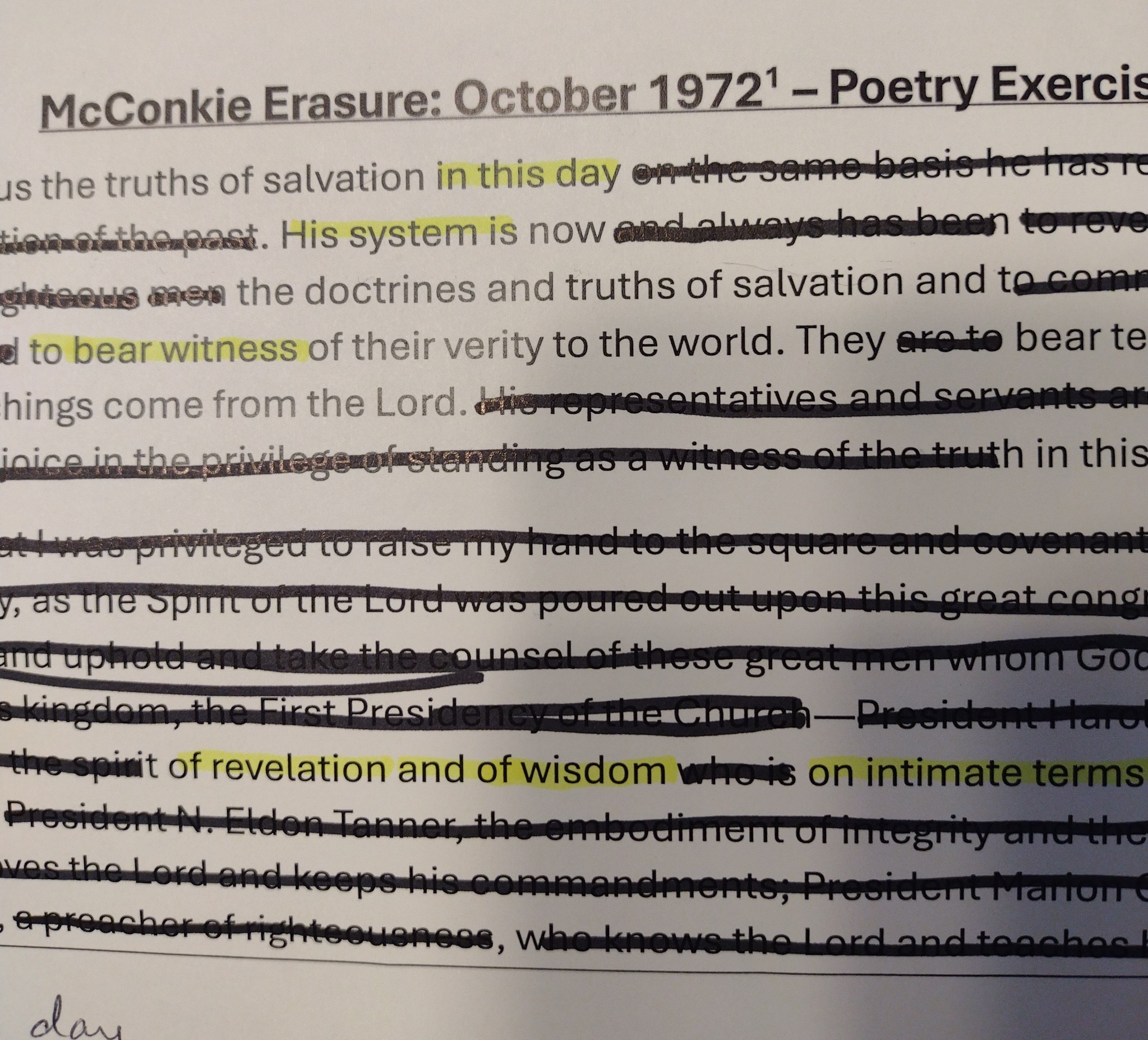
At the Sunstone Symposium last week, I signed up for Jake C.’s workshop on writing erasure poetry from Bruce R. McConkie’s talks. Jake posted several erasure poems prior to the Symposium here and here. I haven’t written poetry since high school (I won second place in a poetry contest for waxing lyrical about how much I hated homework) and had forgotten how introspective the poetry writing process is.
Jake gave us four paragraphs from McConkie’s October 1972 General Conference address: “I Know That My Redeemer Lives,” which was McConkie’s first speech after being called as an apostle. Jake suggested we might want to pick a theme or an idea to test words out as we read the text. I decided to remove anything that made me feel unwelcome or erased my life experience.
Folks, that was almost everything. I erased all the references to priesthood leadership and how it’s a privilege to obey priesthood leaders. Because I dislike the glorification of automatic obedience to priesthood leaders, I erased the references to faithful pioneer heritage. I don’t like the eternal promises and don’t trust the idea of eternal families, so I erased all references to future glory.
I drew out these lines from McConkie’s text:
In this day,
his system is to bear witness
of revelation and of wisdom
on intimate terms.
These words reflect my growing conviction that no one else’s spiritual experiences should to overwhelm our own. The revelation and wisdom are “on intimate terms”, they are personal and private. No one else’s experiences control mine; my experiences control no one else.
These lines are in the present tense. I’ve had to learn how to live in the present tense. Through my adventures in therapy, I’ve realized that a lot of the emotional chaos in my life is because I drag my past into the present, and liberally sprinkle in a fear of the future. One of the skills I learned in Dialectical Behavior Therapy is to be present in the moment. Mindfulness. Whatever you want to call it. The ability to experience life without crushing it between past and present has freed me to enjoy life. I like the present tense of, “in this day.” That’s how it is working now, in the present tense. I don’t have to defend this concept for every person in the past or who will ever live in the future. They can have different experiences and that’s fine.
Erasing both past and future makes Mormonism unrecognizable. Who are we without our pioneer heritage? Our history of faithful obedience? Who are we without our promise of the celestial kingdom? Of eternal families? Ultimately, this exercise helped me define why I don’t fit into the Church anymore, and also why I don’t want to. I don’t want the weight of the past and future crushing my present.
Questions:
- What would you have to erase from Church teachings to feel welcomed?
- Do you agree that Church teachings spend a lot of time focusing on past and future to influence present decisions? Is this a good thing or a bad thing?
 Wheat & Tares
A month ago, I made a trip out to Fort Rock and Crack In The Ground in Central Oregon. The family was amazed by these volcanic wonders. I remembered something else vaguely….the 9000 year old Fort Rock sandals.
https://www.oregonencyclopedia.org/articles/fort_rock_sandals/ https://www.oregonencyclopedia.org/articles/fort_rock_sandals/
These sandals were discovered in the 1930’s, buried under 7000 year old ash from the Mount Mazama eruption that created Crater Lake. People were living here 7000 years before the Book of Mormon boats supposedly sailed from Israel to America.
The sandals are real. Their fabric was made by human hands that arrived from Asia over the Bering land bridge. Unlike Smith’s plates, they did not vanish. Their existence reveals the Book of Mormon to be a 1820’s historical fantasy
>
thhq,
This is about erasing McConkie, not erasing Janey.
Janey is real. She’s OK. I’m more concerned about the Book of Mormon. Can its historical inaccuracy be erasedSent from my iPhone
Having people come to America before the people in the Book of Mormon doesn’t do any damage to the Book of Mormon, but it does destroy people’s incorrect assumptions about the Book of Mormon.
Anne of Green Gables is more historically accurate than The Book of Mormon, and better written. Smith said Noah’s Ark landed
I think I would erase the word “know” from testimony meetings. “Believe” is so much more vulnerable and humble. I think “know” stuffs our souls and minds with so much hubris that there is no room for wonder and growth… No room for possibility. “Know” is misleading. “Know” is so self-serving that it alarms me. I say no to know.
The sandals were made to wear, not to prove the Book of MormonSent from my iPhone
I am with you Old Man,
No more “I knows” would go a long way towards making me more comfortable at church. I am okay with believing and hoping, however, to me the focus ought to be on what we do, rather than anything that is going on in our heads. I think the focus should be on following Christ in terms of how he treated others in the four gospels.
I would also like to eliminate the word sin and replace it with woundedness. Every time I hear the word sin I cringe. In my opinion sin is a focus on the self that can contribute to poor mental health. I also would like to make the focus on following Christ individually, rather than making our own healing (not salvation) dependent on the actions of others.
I don’t like the terms covenant path or think celestial. Again, I think we should have a tight focus on following Christ today, here and now, rather than on the future, or even on past woundedness.
I think the focus should be on loving supportive relationship with God and with other people today, not on personal purity, being loyal to authority, or being afraid of being separated from your family in the future.
And as long as I am dreaming, I would like to see women filling equal decision making roles and equally represented in church leadership with decision making roles (not just pretty faces in pretty dresses, but real decision making).
I am in charge of printing the church program, and Sunday we are having Ward Conference. There’s only one female name on that whole program, and she is the organist. Organists don’t even get to decide what hymns they are playing, the chorister does that, or the bishop or stake president in a ward conference. And having been the stake primary secretary, I know they will require all these women stake leaders to attend, hear the stake president’s talk that he gives in each ward conference for the fifth time, and then meet with ward female leaders. When they meet with ward leaders, the male high council leaders over primary and young women, may choose to dominate the speaking at the meetings. The female leaders will be cheerleaders for the female ward leaders, at the very most. Those female leaders they try to support may be micromanaged by their bishop, to the extent that they have no real decisions to make. These meetings can feel fake, false and purposeless to me. It’s demoralizing. Calling women to supposed leadership positions and giving them few or no decisions to make is just gaslighting.
I would also erase all the past, or better, just erase all the lies they tell about it. Because it isn’t the real history of the church I am bothered with. What bothers me is they lie about what really happened to make it sound miraculous. Then brag about it. Come to think about it, maybe that is why Trump makes me crazy. He makes up lies and brags on those lies.
Recently I have been really bothered about the glorification of …um, stupidity. See, it was really stupid for my ancestors in their handcart company to leave when they did. Then it was even stupider for the ones one and two weeks behind them. See, the Willie company left one week after my ancestors, then the Martin company left a week after that. The had the food, clothing, bedding, and tents for 15 people in one itty bitty hand cart, then they had my great something grandfather who was still a kid with 6 years before he was old enough to vote pulling that itty bitty handcart with his baby sister riding on it because she couldn’t walk yet and mom had other children to look after and carry when they got too tired. It was not enough food to get them to the cavalry fort where they planned to buy more food, with no thought that those cavalry forts might not have enough to sell them. After selling food to five or six handcart companies, the cavalry could/would run out of any extra they had to sell and oh, there are more handcarts on the way that also need food. The whole plan was foolish and didn’t care if people died.
So, I would erase all lies, then see if anything is even left.
Anna, I think that most everyone agrees that the Martin and Willis handcart companies left too late n the year, and left later than instructions from SLC said, and the local church leaders told them not to leave but to wait for spring. At least that is how I understand the story. I don’t see a lie there, except that the company leaders probably told their followers that they’d be fine, but those are individual lies, and not lies from the institution or from its leaders. Once word got to SLC that the companies were stranded, it didn’t matter whether they left due to rebellion, arrogance, eagerness to get to SLC, or stupidity. All that mattered then was getting to their rescue. Has the church propagated lies about the rescue? Maybe yes: I’ve never been to a Pioneer Day parade in SLC, and I haven’t made this a study. I’m not keen into LDS hagiography, and I generally avoid these books. I wouldn’t erase the stupidity of individual ancestors. One of my ancestors was convicted at age 16 in Norfolk of stealing a horse, and he was given the choice of the noose or transportation to the colonies. He chose transportation. I don’t know why he foolishly (stupidly) stole a horse, but I claim him as mine with no embarrassment. However, I have not followed his example and stolen a horse.
Anna,
As a descendent of the Martin company, who is only here because my ancestor married his wife’s sister, I like Georgis’ take batter than yours. Still, I am totally fed up with the church’s deal of covering up unattractive history and sharing only idealized, faith promoting narratives. I want to hear both parts of the story both positive and negative and choose for myself. Seems like that’s what we preach, agency, opposition in all things, honesty, study and pondering, rather than hiding things that are unattractive. I agree with you that if the church wants to build trust they have to be vulnerable, open and transparent, like anybody else that is trying to build trust with someone…. Can someone explain another side to that? I think we hide from our history instead of courageously facing it.
Georgis,
Take a look at Franklin D. Richards’ role in the story.
@Georgis, Apostle Franklin Richards chastised Levi Savage, one of the only members of the company that actually had experience travelling the route, for warning the Willie Company of the dangers they faced in attempting to cross the Rocky Mountains at such a late date. Here is a quote from John Chislett, a member of the Willie Company (https://history.churchofjesuschrist.org/chd/transcript?lang=eng&name=transcript-for-john-chislett-narrative-in-the-rocky-mountain-saints-a-full-and):
I think there is a strong case to be made that high ranking Church officials, including an apostle, bear a lot of responsibility for the fate of the Martin and Willie Handcart Companies.
I believe that the Church definitely propagates lies about the plight of the Martin and Willie Handcart Companies. The story I’ve always heard in Church lessons are how the companies were following the will of God and that they are models of faith that all Church members should follow. I don’t know how many times (dozens and dozens!) I’ve heard this story quoted much as James Faust quoted it (https://www.churchofjesuschrist.org/study/ensign/2006/02/refined-in-our-trials?lang=eng):
In my experience, this little story is the go to way to teach the Martin and Willie Handcart Companies. Never mind that the person telling the story himself confesses that it was a “mistake to send the Handcart Company out so late in the season.” No, that part is glossed over. What is emphasized? Following the instructions of Church leaders, no matter how wrong or misguided they are, will bring you glorious blessings.
What should be taught when the story of the Martin and Willie Handcart Companies comes around in Church curriculum? In my opinion, this is such a missed opportunity to feature an example when an apostle clearly made a wrong decision, and how Church members, leaders, and the apostle himself, should have listened and followed the advice of someone like Levi Savage who, despite not having an elevated Church title or postition, actually had more experience traversing the route. The Church should promote Levi Savage as the true hero here for having the courage to speak the truth to authority. The lesson could emphasize how many lives would have been saved had the Saints followed Levi Savage’s advice instead of following the commands of an overly zealous Church leader like Richards who obviously was lying when he promised, in the name of God, that the company would reach Zion in safety. How about “How Blindly Following a Lying Apostle can Kill You and Your Family” for a catchy lesson title for this new, improved, and honest Come Follow Me lesson on the Martin and Willie Handcart Companies?
Georgia, my ancestor, not the teenager pulling a handcart, but his father pulling a different handcart in that same company, wrote a very detailed journal of the trip. They were *promised* by Franklin D. Richard’s that God would “hold off the winter” until they got safely to the Salt Lake Valley. They got snowed on and they were the FIRST wagon train rescued. Betcha you have only ever heard about the rescue of the two, the last two companies to leave. My great great grandfather’s company left one week before and had more deaths than all the handcart companies that left before them, added together. Then of course the Willie company had even more deaths and then the Martin company had even more. But you never hear about the fact that three handcart companies could not get supplies at Fort Laramie and ended up starving and wading through 18 inches of snow, do you? The company was mostly women, old men, and children. My great great grandfather was one of the few male adults in that company. That was why a teenager was pulling a handcart, because he shared a tent and handcart with 15 women and children and old men. He was the strongest “man” they had to pull that handcart.
and, no, they did not disobey and leave anyway. They were told by church leaders to go and they would be protected. It was nonMormons telling them not to go. That is just another lie and you believe the lies the church tells. Shrug.
In my family the bitterness and feeling of being abandoned by the Lord came down through the generations and my father was even bitter toward church leaders over it.
And the lie about none of the people in the handcart companies left the church, nope. Almost half got out of Utah as fast as they could leave.
So, the church lies to cover up and hide the stupidity of the top church leaders who planned the whole handcart thing. Go ahead and believe the lies, because the church won’t let you read my great great grandfather’s journal.
Thanks for the education. I didn’t know that Franklin D Richards was with the companies before they left and he promised them safety before they left. I thought that he passed them a couple of weeks into the trip and gave them words of encouragement for a journey that they had already begun. I also thought that Levi Savage, one of the leaders, recommended staying the winter in eastern Nebraska, but he was outvoted. When he was outvoted, he supposedly said: “What I have said I know to be true; but seeing you are to go forward, I will go with you, will help all I can, will work with you, will rest with you, and if necessary, will die with you. May God in his mercy bless and preserve us.” (Levi Savage, Wikipedia) I don’t think it is true to suggest that all church leaders said go now.
I have found that absolute statements, those that suggest all or none, are usually not true, hence “never say never.” Do the Saints make and consume hagiography out of the stories of these companies? Yes. I generally give light regard to these stories. I am sorry, Anna, for your hurt0 that more emphasis and recognition aren’t given to your ancestor’s handcart company. You’re right that all of the talk is about Willie and Martin, and your ancestor’s company does get any limelight. Maybe with more education and scholarship word will get out.
Here’s a true story. When I received my acceptance letter from Sunstone back in April, I experienced the usual “Yipee!” reaction one does when an organization they admire says, Jake, you are “accepted.” Almost as quickly, I came down with a monster case of imposter syndrome. I reread the proposal I had submitted–the accepted one–and said to myself, “No one is going to attend this.” Not only is it a poetry workshop, which I know from sad experience guarantees blank stares; it is a poetry workshop about Bruce. R. McConkie?! Could I work harder to rub people the wrong way?!
I spent a lot of time between April and August worried, entertaining my worst fears that no one would show.
But Sunstone took care of me. Being the smartly run organization it is, the Sunstone team knows some sessions need big rooms and others need small rooms. They encouraged me to arrange my session as a workshop instead of the usual lecture format. They gave me a smaller room. And people showed! Seven wonderful good sports, Janey among them. Seven for seven, they each came up with wonderful erasure poetry. We avoided the urge to pass judgment on each other, and tried to maintain a healthy curiosity about our creative impulses.
I can’t go along with the literalism and absolutism of high-demand religions, and political parties for that matter. I’m not sure I want to erase it, because if we erase/burn/ban it, we cannot learn from it. File it in a Special Collections department. Research it. Publish about it. See ourselves as part of an ongoing conversation, not a fundamentalist endgame to build a literal kingdom where every knee bows, every tongue confesses, and people’s hopes and dreams are harvested for the good of the institution.
Georgia, it isn’t AT. ALL. that I feel that my ancestors company was left out of the story telling. I am NOT one of those Mormons who brags about my pioneer ancestors, even though some of them were close friends with Joseph Smith and are named in church history and some had sisters married to Joseph, then Brigham. I can pretty much promise you that you have heard quotes from some of them, but notice I am not naming them—because I am not proud of them.
What makes me angry is that the church lies and it instructs people to lie. Not just in the past, but now the church still encourages people to lie and it even instructs employees to lie. It covers its mistakes and tells lies that make it look wonderful and everything is the member’s fault.
It was Brigham Young and top church leaders who came up with the plan to use handcarts. That had never been done before because it really is a bad idea. And it was just the one year, because it was a disaster.
Of course Fort Laramie ran out of food to sell to the handcart companies. They probably had no earthly idea that people would leave by the hundreds, and carry less than enough food to even make it to the fort. Let alone that more people would keep coming as the summer reached into fall. It was too late in the year for the fort to be resupplied.
And the members were from England and Wales so they had no clue of winter across the high plains of Wyoming, so doesn’t matter if they voted to go or not. They had no clue what the area they had to cross was like. Have you ever lived in the high plains of Wyoming? The town that used to be Fort Laramie gets snow on the 4th of July parade. It hits 32 below zero in November.
So, here they are, just sold everything they own for the ship passage, and they arrive to (1) there are no hand carts. There is no dried wood to make handcarts. It is going to take weeks to make handcarts and they are going to be shoddy because of the green wood that will warp and crack as it dries. (2) they have no money to last the winter. (3) they have no shelter to last the winter. (4) they have no idea about what the high plains of Wyoming are like. So, yeah, maybe the voted to go. They were already up a creek with no paddle and no boat either. But who got them in that situation? Church leaders who told them, “We have this great plan on how you can get to Zion.” But the plan was faulty. And that is the fault of Brigham Young.
They needed more space in the hand cart for food, and smaller groups per handcart. You cannot get enough food and water for 15 people for a month, let alone 3 months in that size handcart.
And Brigham probably figured they could supplement what they carried with hunting. After all, that was what they did. But they did not have time to hunt, and besides, they were on foot and could not move fast enough to kill more than a couple of rabbits, then they had to catch up with the group. And remember, all the men were pulling handcarts, so that left women in dresses or children to go hunt.
The whole plan was stupid, and that lands on Brigham Young’s doorstep.
But to even realize that makes it sound like Brigham was no prophet at all.
And do you realize that Brigham made sure his shipment of whiskey had enough carts, horses, and men to get it to Utah safely. And he sent out a rescue party for that before he ever did for the people.
This may sound really angry, but really if the church wasn’t still encouraging people to lie about things that the church is doing in our modern church, then I would have no problem. But the church instructs people to lie for it. Just look at the SEC mess. The church told its employees to lie. And I know of other cases where the church has told people to lie to protect the church.
I feel the need not to feel pressured to lie, and not be lied to, deeply Anna. Thank you for sharing your family knowledge.
You know what’s fascinating about poetry? How it sparks different reactions from different people. Like Jake said, every poem in the workshop was different.
And this discussion is so different than what I expected. Thank you, Anna, for teaching us that Church history is an erasure poem already. Erase the bad decisions and the people it harmed; write the poetry only about the praiseworthy. The people who were erased will have a voice eventually.
Since my parents are converts, I just honestly could not care less about these weird pioneer fights over the Willie Martin whatever whatever thingamabob. The entire pioneer enterprise seems weird to me. If you want to talk about the Massachusetts Bay Colony, we can talk.
But back to the topic of the post, this exercise reminds me of Thomas Jefferson cutting the objectionable parts out of his Bible–actually cutting the blocks of text out–to get to what he called the “diamonds in the dung heap.” That sure feels like what we have to do at Church, as Janey points out. A big part of that is because one man’s trash is another man’s treasure, one reason it’s always fun to browse second hand stores. One person’s reasons they love going to church are going to be the same as another person’s reasons for quitting the church (examples: polygamy, temple, community, patriarchy, focus on nuclear families, anti-LGBTQ rhetoric). Some people love things that just don’t work for other people.
We’ve discussed many times the theories of Haidt who said that conservative values differ from progressive values, and therefore, when conservatives focus on authority and purity, they are only appealing to other conservatives because these are not values that progressives share (one reason that so many church members feel totally comfortable claiming that it’s not possible to belong to the church and vote Democrat). The more the conservative people at church live within these blind spots, the less diverse the membership will be. After all, who wants to listen to people touting things they deeply oppose such as loyalty to fallible humans rather than personal devotion to the divine, or intrusive worthiness interviews over internal contemplation and growth, or judging what people wear (the outer vessel) rather than focusing on what’s in our hearts? The diamond to dung heap ratio has to be positive enough to make participation worthwhile.
Fascinating stories. I’ve read the Donner and Meek Party accounts, but not these family stories about the handcarts. The common thread was that people didn’t know what they were getting into. The emigrants were ready to hang Stephen Meek, but realized that he was the only one who could possibly get them out of the awful situation he had put them in.
Regarding the Donners,
“Never take no cutoffs and hurry along as fast as you can”
Virginia Reed, Donner survivor, 1847
>
The funny thing is th
La “verdad” contada de manera inflexible siempre tendrá sus lados escabrosos…(Herman Melville)