
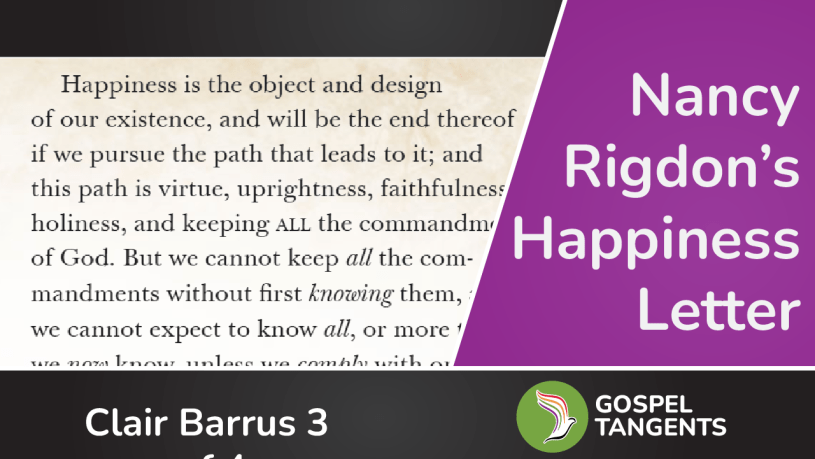
Many people are familiar with Joseph Kingsbury as the scribe who recorded D&C 132. But are you familiar with his role as a “pretend Husband.” We discuss this strange story with Clair Barrus, one of the authors of “Secret Covenants,” edited by W&T’s own Cheryl Bruno. We also discuss the Happiness Letter is a letter Joseph Smith from to Nancy Rigdon, to get her as a plural wife. It was printed by John C Bennett but continues to be cited by LDS Leaders. Check out our conversation…
Early Mormon polygamy and its complexities
Joseph Smith has a revelation to marry Sarah Ann Whitney (just 19). As a cover, she instead has a legal marriage to Joseph Kingsbury with Joseph Smith’s approval. As a cover gthe 3 concoct a “pretend marriage” between Kingsbuy and Whitney (which was legally binding), following the death of Kingsbury’s wife. As part of the revelation, Joseph Smith believes he and Sarah are supposed to have a child named David, who will become a great person like King David of old. This indicates Joseph intended to have a child with Sarah.
A child is never produced, and about 8-9 months later Smith dies in the Carthage Jail. Of course, Emma was pregnant with Joseph’s child who is born after his death, and the child’s name is David, so Joseph believes this child will be the great David. Sarah Whitney later marries Heber C Kimball, and the two try to have a child named David as a sort of levirate marriage where the child is recognized as Joseph Smith’s child. However, the child soon dies. Another child is named David, and that child dies. A third child of Heber and Sarah grows to adulthood, and has an unremarkable life
David Smith becomes a beloved member of the RLDS Church. He is a poet and hymn writer and was well thought of. However, he had serious mental health issues and is committed to an insane asylum, not matching the prophecy of his father Joseph.
The Happiness Letter
In another revelation, Joseph Smith has a revelation to marry Nancy Rigdon, daughter of Sidney Rigdon. Joseph has a letter written and delivered by Willard Richards to Nancy to try to convince her to join plural marriage. Nancy rejects the proposal, and somehow the letter ends up in John C Bennett’s hands. Bennett was excommunicated by the Nauvoo High Council for his role in the “spiritual wifery” system. Bennett publishes Nancy’s letter, which becomes known as “The Happiness Letter,” due to his it’s introduction that “Happiness is the design of our existence.” It further states that which is wrong in one instance can be right if God says so. (Of course, this logic can be easily abused.)
William Clayton Journals
The William Clayton journals have recently come under attack by polygamy skeptics due to the fact they are rich in contemporary evidence of Joseph Smith’s involvement in polygamy. As you can see by the thumbnail above, they contain many other important historical treasures, including an outline of the Kinderhook plates. calling out there legitimacy due to their content of polygamy would cause a chain reaction of other portions of important information on Nauvoo as well. I asked Clair to evaluate the reliability of the journals, and he confirms they are reliable. Clair observes that if Clayton’s journals were rewritten to make Joseph Smith look bad, while Brigham Young is portrayed positively. Clair finds it strange that Clayton would rewrite history to benefit certain individuals, rather than presenting an accurate account. Of course, a few weeks ago, we discussed Clayton’s harsh feelings towards Theodore Turley and Turley’s bad money management. The journals do not appear hagiographic in nature.
Polygamy & the Laws
The journals also detail Joseph Smith’s proposal to Jane Law, wife of (soon to be editor of the Expositor) William Law. There are conflicting allegations about who seduced who, as well as allegations that Emma liked William Law. We also discussed why John C Bennett’s reliability is tough to guage. Clearly Bennett was biased due to his excommunication by Joseph Smith. Some of Bennett’s allegations are true while others are clearly false. Clair notes that when Bennett published affadavits from alleged wives of Joseph Smith, none of the women contradicted the accounts or asked for a retraction.
In these episodes, we really get into the can of worms that is Nauvoo polygamy. What are your thoughts?
 Wheat & Tares
So interesting
The more I read about the early Mormonism, the more it appears to be a development from frontier folk superstitions, poverty, ignorance and low life habits. Racism and polygamy are bred in the bone, and Christianity is tacked on for respectability.
Before there was country western serial monogamy (Tammy Wynette, George Jones, Buck Owens, etc etc etc), before there were rednecks, before there were TV preachers, before there was the Klan, there was Mormonism. Joseph Smith was typical of the 1820’s society he lived in. Scamming the gullible by digging for treasure guided by magic rocks. Living hand to mouth in a sea of infidelities and temporary conjugalities. His life of poverty was what he could scrape together from day to day to keep his family alive. Brigham Young used Smith as a tool, stabilized the organization, and took Mormonism to the level of respectability. But he did not remove the racism and polygamy.
>
The more I learn about polygamy, the more it confirms to me that this practice was an absolute delusion on Joseph’s part. I feel so saddened and sickened for the women involved. The logic in The Happiness letter conveniently removes any guardrails or opposition to whatever Joseph saw fit to do. Commit adultery? Well Jesus said that wasn’t ok, but I guess Joseph knows better than Jesus, and what is evil in one instance is righteous in another. Total insanity. There of course is nuance in different circumstances, but there have to be some absolute truths. I believe one absolute truth is the worth of each soul is great in the sight of God. This means there is never a righteous justification to dehumanize anyone ever. Polygamy was all about the dehumanization of women, cloaked in lies about exaltation and eternal joy.
thhq,
I’m sorry, but your narrative simply does not comport with the historical record. You need to dig deeper–down to the bedrock–and there you’ll see a different picture than the one so many disaffected members try to pass-off as real history.
Faithful members (like Jack?) don’t like us highlighting the Happiness Letter. But it isn’t just Church critics who do this. How many times has this letter been used in General Conference talks or LDS lesson manuals? They (the Church) can’t leave it in the past so why should we? The problem is that we never hear the true context of the letter. It’s quite shocking, so all we hear is select quotes meant to boost our faith without providing the background and source of the letter. So typical.
OK. Let’s dig down to bedrock. I’m a Mennonite. The bedrock is in ca 40 AD. I’m busy rereading the stories of Peter and Paul right now. There were no Mennonites or Mormons back then. Just one church.
The need for revival is always present in every age. In the 1500’s it was Reformation, dispensing with Catholic lies, hierarchy and traditions. In the early 1800’s it was Restoration, dispensing with Congregationalist Universalism.
I have in front of me a Mennonite history timeline, supplied by the Mennonite Heritage Center in Abbotsford BC. 250 years before Joseph Smith, Mennonites relocated from Netherlands to Danzig because they baptized adults. 200 years later they left Danzig for Ukraine because they were pacifist. 100 years later they left Ukraine for the USA, Canada and Germany because they didn’t speak Russian. Many stayed behind and were persecuted by both czars and Stalin. Khruschev allowed most of the remaining Mennonites (Umseidlers) to leave in the 1960’s.
See any similarity to Mormonism here? Forced migrations build perseverence and sustain the church against decadence and assimilation. But they are not unique to Brigham Young.
With that background why would I need the Book of Mormon? 1820’s Campbellite Restoration was doing just fine without Joseph Smith. Many of the people in our church have Church of Christ and Disciples of Christ (the descendents of the Campbellites) upbringing and education. The form is similar to early Mormonism, with baptism central and little organized theology beyond “no creed but Christ, no book but the Bible”. I had to listen to an awful sermon yesterday, which randomly skipped through Judges, telling Bible stories. I prefer the structure of the Calvinists, even though I’m not a Calvinist. I get more out of sermons that get to the point, whatever it happens to be. If you want an inoffensive taste of this, read Barth’s lectures on John Calvin.
>
thhq,
I agree that there was a spirit of restorationism long before Joseph Smith emerged from the woods. But what I’m talking about specifically is your misapprehension of Joseph Smith’s character and personality–as well as that of the church.
I recommend the works of Richard Bushman: Joseph Smith and the Beginnings of Mormonism and Joseph Smith: Rough Stone Rolling. He offers both a compelling and empathetic view of the struggles of Joseph and the church in its infancy within the frame work of the concurrent culture.
I find it incredulous that, despite a plethora of credible historical evidence, many TBMs stand by their man Joseph.
Where else does there exist a relatively small group of loyal followers to a ‘religion’ founded by an acknowledged treasure digging misogynist? Who was then succeeded by another womanizing tyrant?
Mormon apologists fail miserably in their vain attempts to put lipstick on this pig. Contrary to the familiar hymn, Mormonism is not built on a firm foundation.
I have made conjectures based
Testing. My posts are truncating.
Sent from my iPhone
<
div dir=”ltr”>
<
blockquote type=”cite”>
Another conjecture. Emma Hale saved Joseph Smith from his wandering ways. She adopted him and turned him into a family man. She was with him on Cumorah. She put up with his old habits, and she was the main civilizing force in Mormonism until he died. She rain relief and she composed hymnals. Without her there is no Mormon family and charity, just some golden plates.
My interest in Mormonism is historic. It’s part of the West I grew up in. I’ve been to Cumorah, Nauvoo and Liberty over the last 50 years, and I’ve read a lot from many sources.
>