
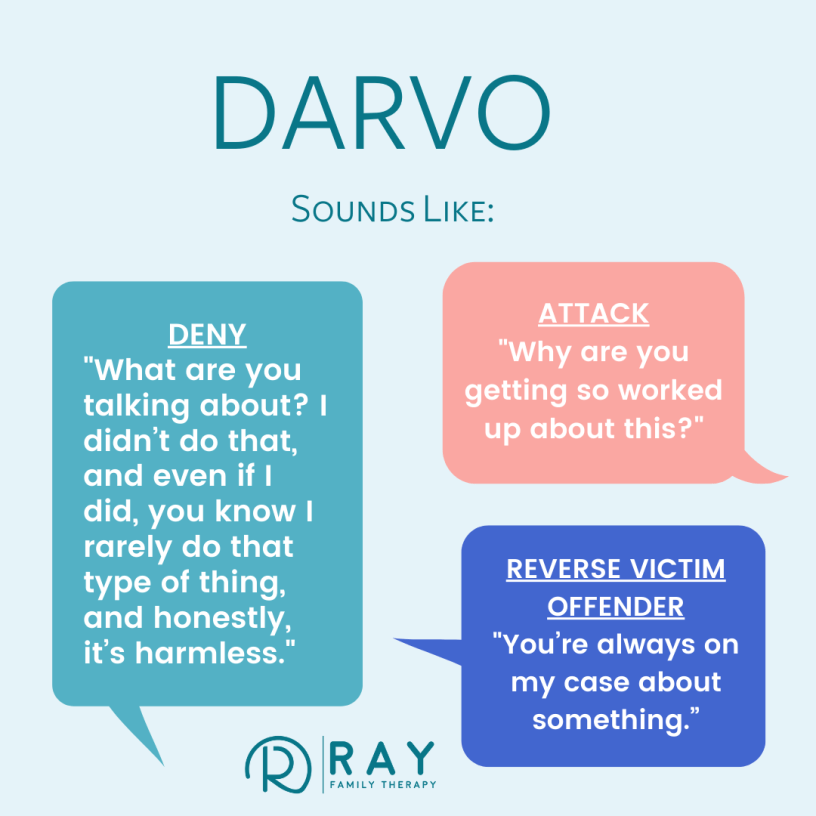
DARVO is a psychological term to explain the behaviors of abusers and narcissists toward their targets. It stands for Deny, Attack, and Reverse Victim & Offender. Awareness of the acronym and the behaviors it describes can help those who are in abusive relationships to identify that the relationship is hurtful to their mental health or even their physical safety.
Deny
Denying is a tactic where the gaslighter flat-out denies the occurrence of certain events or dismisses the validity of the victim’s emotions. Abusers employing DARVO deny their actions, the impact of their behavior, or even the existence of abuse altogether. They may dismiss or minimize your experiences and emotions. By denying their actions, abusers attempt to create doubt and confusion, making it harder for you to hold them accountable.
Abusers may deny facts, claim you are misremembering events, or deny that their behavior had a negative impact. Denials can be carefully worded things like “I did not have sex with that woman” (OK, Bill, sometimes a cigar is just a cigar, but not in this case), and sometimes they can be straight up lies like “That woman (I sexually assaulted and can’t tell apart from my first wife in photos) is just not my type. I don’t even find her attractive.” In both cases, the denials create confusion and help the culprit avoid accountability.
Here’s a church example. When Kirton-McConkie incorrectly stated that bishops are not permitted to report abuse to the police in the state of AZ, that is untrue. Reporting in AZ is not mandatory, but it is permitted. The church just doesn’t want bishops to report abuse if they can avoid it, due to a fear of bad press and big payouts to victims.
Or here’s another one that’s no longer true. When asked about mothers not being allowed to hold a job as a paid seminary instructor (church policy until 2016ish was that women in teaching positions would be fired when they became mothers) the response from the rep at the Church Educational System was that these women no longer wanted to work as soon as their children were born, implying that they just quit on their own. It’s an obvious lie because now that the policy has changed, surprisingly some women do in fact continue their employment after having children. Fun fact: being a stay at home mom doesn’t include a wage, and raising kids costs money.
Or another one that’s now defunct, BYU did not used to sell caffeinated sodas. When asked why, their PR team said there was no demand for caffeinated sodas, an obvious lie based on the brisk business done by all the surrounding convenience stores that were steps away from campus.
There are many many examples of church denials related to thorny problems in church history, including Joseph F Smith literally tearing pages out of unsavory historical records so that church historians wouldn’t see them and publish them.
Attack
In the attack stage of DARVO, abusers target your credibility, character, or motives. They may resort to insults, threats, gaslighting, or manipulation to discredit your account of the situation. By attacking you, the gaslighter seeks to undermine your credibility and intimidate you into silence.
Attacking the one who has criticized you appears to be a time honored tradition. “You made me do this” is one abuser’s refrain. The entire “AITA” subreddit (and the lesser known “AIO” / Am I overreacting?”) is full of stories in which an abusive partner has convinced someone that they are in fact the reason for their bad behavior. If only you had done or not done X, Y, or Z, I wouldn’t have done [abusive behavior]. Eventually, the person starts to question whether they are in fact the one creating the problem.
A quick example that comes to mind is calling those who have left the church “lazy learners” or claiming that someone didn’t get a testimony when they prayed because they didn’t “pray with real intent.” Or that if someone got a different answer (personal revelation) than what the church said, they must be getting their answers from (checks notes) Satan.
Another example of this behavior is when protestors or marginalized groups are branded as “seeking attention” as a way to distract from the substance of their request or complaint. This approach re-focuses on the character of the person who wants change rather than on the change itself. Likewise, when a person who was sexually assaulted is attacked in a criminal trial based on their behavior (drinking or dugs), dress (too sexy?), or where they were at the time of the attack (choosing to be in a vulnerable place), as well as statements they did or did not make that can be twisted to imply consent.
Reverse Victim and Offender
Abusers using DARVO reverse the roles, portraying themselves as the victim and the actual victim as the offender. They may claim that they are being unfairly accused or that the victim provoked the abuse. This involves shifting the blame onto external factors or the victims themselves.
A pretty obvious example is to claim that you are being persecuted when you are being prosecuted for a crime, that you are the victim of “lawfare,” avoiding responsibility for your violations of the law or of others whom you’ve victimized. Replying to one politician’s misdeeds by pointing to his opponent’s misdeeds, even if the two are not equivalent, can also be part of this strategy. As children, we used to say “You’re rubber, I’m glue, whatever you say bounces off me and stick to you.” That’s how the RVO in DARVO works.
For a church example, when we are told that someone “Can leave the church, but can’t leave it alone,” we may lose sight of the fact that they gave substantial time and money to the organization that they feel wronged them or was dishonest with them about its aims, or they could literally be victims of abuse, scandal or mistreatment. Within the Catholic Church, there are some who will defend the Church’s coverup or back the priests who are accused of molesting children. They paint the Catholic Church as the victim of unfair press, glossing over the very real lives ruined by molestation, denials, and cover-ups.
There’s been a recent scandal involving an Evangelical pastor who molested a 12-year old girl. His sermons referred to his weakness with a “woman who had a Jezebel spirit” (in reference to the 12-year old child he molested). This is a classic example of someone claiming they were victimized by the person they abused.
This is a quick post today, and it’s a simple topic. The Church is a large organization with many people in it, and not every behavior of an individual is a reflection of the organization, but some are more organizationally sanctioned (e.g. an official representative of the Church such as CES, PR or Kirton-McConkie).
- Have you seen examples of DARVO at Church? Is it from the top down, local, or on missions? How did you deal with it when you saw it?
- How do you deal with DARVO behaviors when you see them?
- Do you think identifying these behaviors helps people preserve their mental health?
- Is there a risk of over-diagnosing DARVO behaviors?
Discuss.
 Wheat & Tares
when I make my children do something they don’t wanna do they always claim abuse. I give them extra time and space to come around, but in the end, they just have to go along or they start fighting the decision I’ve made.
Afterwards, whatever force I used against them, they come back at me with, and then we both feel bad. It would just be easier if they do as they’re told, instead of all the drama.
when I make my children do something they don’t wanna do they always claim abuse. I give them extra time and space to come around, but in the end, they just have to go along or they start fighting the decision I’ve made.
Afterwards, whatever force I used against them, they come back at me with, and then we both feel bad. It would just be easier if they do as they’re told, instead of all the drama.
Handy acronym, helpful discussion. I was sure you were going to suggest the acronym applied to the consistent tactics of a certain politician to any criticism or prosecution, however factually supported and well deserved, at the end of the post. Maybe that’s an exercise left for the reader.
Someone criticizes the church. The church excommunicates that person for apostasy. Then the church quietly corrects the problem the person pointed out. Sam Young and a few others.
Or the church spends years excommunicating people who criticize it for denying black men the priesthood, crying “religious persecution” when other college basketball teams wear arm bands quietly protesting racial discrimination at BYU, defends it discrimination as “doctrine” and insisting it cannot change until the millennium some time, then makes a huge show of “revelation” and “miracle” and “God has spoken” when it finally catches up to society and corrects its official racial discrimination.
The church excommunicates, ridicules, criticizes a group of women for *asking* that the prophet pray about giving women the priesthood, claiming it is improper to “demand change” and being totally unwilling to even say that they could consider even praying about it. Demanding the prophet pray, such a serious crime. Then they start claiming women already have priesthood power—-just like all nonmembers do because if they do something the church asks, they are using “priesthood” to do as they are asked. But still refusing to give women any real voice in the actual running of the church.
Or, how about telling me that I was “unforgiving” and worse than my sexually abusive father because I would not let my children stay over night with “grandpa” and other crimes of trying to hold my father even a little accountable or protect my children or myself.
This type of behavior seems to be a reflexive behavior with the church, because after all, *it* is perfect and cannot make mistakes, and it is inspired of God so everything they do or think is the will of God. While members are all fallen sinners, so anny problem is anutomatically the member. Abuse of unhappy members is built in to their theology. The Church of DARVO of Latter Day Saints.
Another tactic both the orange dictator and the church use is to YELL LOUDER THAN YOUR VICTIM so everyone thinks you are really the one being hurt. Why poor sweet polite compromising Biden doesn’t stand a chance against the biggest mouth around, and why most members still believe that Ordain Women was using such unfair tactics as to actually attract attention to the fact that they were not happy. So unfair to the church to say, “look, they won’t let us attend a meeting.” It is “persecution” of poor them to point out the obvious. And they use their pulpit to criticize, and use their “religious authority” to proclaim the women apostates.
“Another example of this behavior is when protestors or marginalized groups are branded as “seeking attention” as a way to distract from the substance of their request or complaint.” This is a difficult example for me, in part because of my experience with protests.
Growing up in the DC area, it was common to see protests almost every time I went to the National Mall to see monuments or museums. One thing I came to notice was that, no matter what the intended topic of the protest was, there were always (for lack of a better term) “me too” protesters who were there with signs for their own causes unrelated to the main topic. Pro-abortion protests? You would see signs about the Gulf War (I or II), Israel/Palestine, the environment or some other “left-wing” cause. Pro-life protest? You would get signs calling for lower taxes, promoting gun rights, or other “right-wing” causes. And the counter protests were the same, with a hodgepodge of issues from the opposing side. In some cases, those protestors are outright attempting to hijack someone else’s protest.
Today, I live in the Seattle area, where protesting sometimes seems like the preferred hobby (you should see May Day near my office). Again, a protest focused on immigration might have a wide variety of signs on unrelated topics as well (though not as many counter protesters, as it’s less ideologically diverse).
There is a point where protestors are “seeking attention” in ways that are counterproductive to “the substance of their request or complaint”. We’ve seen this recently in some of the environmental protestors and pro-Gaza protestors who have blocked traffic in various cities (sometimes endangering lives by blocking emergency services). It’s perfectly valid to call them out for this behavior, but from their perspective that would be indistinguishable from DARVO.
A TBM leaves the Church because he no longer believes the Church’s truth claims. He is seen leaving a Home Depot parking lot on a subsequent Sunday. Therefore, he left the Church because he has trouble keeping the Sabbath Day holy.
All people and organizations (not just some discretely labeled set called “abusers”) can engage in these behaviors, as well as change from these behaviors. These coping skills are taught and they can be untaught if people are willing to change.
Early in my marriage a weird pattern developed that had some similarities to DARVO. I was raised by counselors, so I was used to working out conflict by certain rules taught by my parents. But of course my husband’s script was different.
My script is to expect to be listened to genuinely when I share a concern (early on before the concern is very big). To me this is an essential part of intimacy and honesty. My husband’s script was to never complain about anything ever (push it down until you blow up about it by mistake, and then feel justified for blowing up, and then walk off without hearing the other person’s response, and then go back to ignoring the problem). So his expectation for me was that if I did complain about something, he felt attacked to the point he would have a fight or flight reaction, which would make it so he could no longer understand or hear anything I was saying. This would have many of the characteristics of DARVO in how he responded.
I was also taught to be accountable for my own actions and to consider if there was something I could change to help the other person. From my husband’s point of view, I was causing our problems, so I would genuinely consider if I felt any guilt, if had had any intention to hurt him, or if I could change something to make things better. But the effect of this deflection is that my concerns were never heard. I knew the only result of my not being heard would be divorce, so I refused to comply with his request that I never share a concern (complain, or criticize) Eventually we corrected this pattern.
Change did not come until I stopped listening to what he would say during his fight or flight reaction, and completely disregard it. I became very sure of myself. I would say repeatedly “You misunderstood me. When you are ready to talk about this let me know.” Then I would walk away and not talk to him until he calmed down. When he would demand I listen to his concerns, I would explain I couldn’t listen to his concerns until he was ready to hear mine. He would complain his concerns were never heard. I would explain that if he wanted me to consider his concerns he would have to bring them up at a separate time from when I brought up my concerns (impossible for him because he was taught to never complain). The fact he had concerns didn’t negate my concerns. He was going to have to listen to me at some point if he also wanted to be heard. He would eventually get to where he could do that. However, I don’t think we would ever have got to that place if I hadn’t refused to even consider his complaints against me.
I do think there may be some similar dynamics with the church. They haven’t got a sufficient mechanism for listening to members who have concerns, or to work out conflict. They have at times lashed out at members who were simply trying to work out conflicts and resolve genuine concerns. They have set up their communication to be top down, with only the members listening (going through bishops and SPs who are only trying to follow the handbook and can only try to convince you to agree isn’t enough). Members have to go to extraordinary efforts to be heard in this relationship, and they have to be willing to stop listening to the church’s reverse complaints about them having concerns at all. This can be enormously difficult for members with little or no personal authority who are listening closely to the church, and believing the church even when it lashes out falsely against them in a defensive posture instead of listening.
It takes personal confidence, strength and humility, to listen to concerns and consider how to change. The church is accountable to God for how they respond to members with concerns. I know they want to focus only on how members are accountable to the church. However, each of us is ultimately only accountable to God, and no, the church is not the same as God. In the end, no relationship can be maintained without a genuine effort to hear and understand the experiences of others in the relationship. Telling members how the church thinks they ought to be doesn’t change the way things actually are for members. This breach in communication and relationship will continue to degrade, until and if the church takes effort to genuinely hear and consider. I hang on to a tiny glimmer of hope for the church. Mostly I do my part to repair the relationship by maintaining my own confidence in my own concerns. When they are ready to listen instead of tell me, only then can things change. So far I see no mechanism for that being made available to members.
Observer, I have an honest question for you to think about. You mentioned about calling out protestors that you think have “gone too far” as not just being more DARVO. But, honestly by accusing them of “going too far” you are saying at this point we are justified in ignoring the point the protestors are trying to make. Just more DARVO, from my perspective too and I don’t agree with climate protestors damaging works of art or heritage sites. So, my question is, when protestors are being ignored, badmouthed, and nothing is actually changing, what should the protestors do.
Back to a church example. Ordain Women wanted the church leaders to *honestly* pray about women’s issues in the church. For generations, women have been asking politely and been ignored. So, they get a bit more insistent in their asking, still asking, not going out and ordaining women themselves or leaving the church. But asking the prophet to pray. Such an apostate idea—that the prophet should see a problem and ask God about it. Or Heaven forbid, pay attention to unhappy women. The women asked for an audience with the general authorities, but instead the GAs make a big show out of meeting with the group of women saying women should be nothing but good little obedient children. So, when your polite requests to be heard are ignored over and over, how do you make yourself heard?
I know, I ended up more like lsw329 and had to throw a public fit once to get my husband to listen to the fact that living in Germany and not being able to drive was making it so I could not even feed my children and HE was the one who had to be with me to get my military driver’s permit. He needed to STOP working like there was a war on and take minimal care of his family or I would take his family back stateside where I could take care of my children….after a month of nothing but bread and butter from the German bakery that was walking distance to live off of.
When you are not heard, sometimes you have to up the protest and it IS DARVO to insist that the protestors still be ignored because now they are resorting to “unfair” tactics.
My suggestion in the case of protestors “going too far” is to pay attention to the problem. Not disempower the protestors.
Anna, please reread what I wrote. I never said anything about protestors “going too far”. I said that there is a point where their actions are counterproductive to the point that they are trying to make. That is not the same thing. Look at the specific example I gave, that of environmental and Gaza protestors blocking traffic, including emergency vehicles (such as ambulances).
At the point where their protests are demonstrably harming others (such as preventing someone having a heart attack from getting to the hospital) in a way unrelated to the substance of their protest, most people are going to tune out their message. At that point, their message is lost because the mechanism of their protest is louder than their message. The story becomes more about “Man dies in ambulance because protestors blocked traffic” rather than “Protestors have legitimate grievance”.
That’s not “throw[ing] a public fit” at someone directly involved in the discussion. It’s something that causes direct harm to other, unrelated people.
And this isn’t just some theoretical harm. Two years ago, an ambulance transporting a patient in critical condition was blocked by a protest on I-5 in Seattle (see https://komonews.com/news/local/downtown-protest-on-i-5-blocks-ambulance-carrying-patient-in-critical-condition-seattle-downtown-washington-state-patrol-harborview). That patient was lucky and survived the additional 19 minute delay, but others may not be. Road closures due to marathons have been shown to increase deaths from heart attacks by up to 32% (source: https://www.nejm.org/doi/full/10.1056/nejmsa1614073) because of an average 4.4 minute delay in getting patients to the hospital.
Such tactics are ineffective. Look at the results of the traffic protests, or the art/heritage site protests you mentioned. Did they actually lead to an increased focus on the issues the protestors wanted to talk about? No, they didn’t, because the focus was on the methods*, not the message. The protestors did that to themselves by using ineffective methods. Pointing out to them that the methods are ineffective, or counterproductive isn’t the same thing as DARVO.
*Blocking traffic to make people late to work, or miss their flight isn’t likely to make them sympathetic to your cause, even if it makes them more aware of it. It’s only more likely to piss them off, and then associate your cause with their irritation.
Let me add that I have a bit of a personal perspective on the traffic protests. Earlier this year, my then-5-year-old was severely injured and had an extended stay at Harborview Medical Center, the same Seattle hospital in the article from 2022 above. One one of the days that I was travelling to the hospital to stay with our son and give my wife some much needed relief, Gaza protestors held a protest on I-5 and created significant delays.
I understand the reasons for their protests. I even agree with some (not all) and respect them.
But boy, their protest made me want to tell them that they and their entire issue could **** off. In the moment, I didn’t care what their reasons were. I had bigger priorities. I had a little boy who was recovering from a severe burn, and a wife who was at the end of her emotional rope. And they were blocking me from taking care of them.
Take that and multiply it by thousands of people caught in that traffic jam they caused, and you will see what I mean when I say that their protest was counterproductive.
I believe that there are likely a number of reasons for DARVO in person to person relationships. I’m no psychologist, but it would seem to me that if someone has “always right syndrome” (they think they are always right about everything) that that person is pretty much guaranteed to engage in DARVO. If you’re think you’re always right, of course you would deny the complaints anyone raised against you, attack back at them since they are wrong, and always try to make the case that you are the real victim.
“Always right syndrome” is baked into Mormon theology. Church leaders are supposedly constantly receiving revelation from God, so whatever they say and do is “always right”. As a result, it should be no surprise that Church constantly engages in DARVO. If Church leaders really believe that they are always right (and I’m convinced that many of them really do believe this), what else do you expect them to do?
Of course, a study of Church history leads pretty quickly to the discovery that Church leaders are far from “always right”. As a result, the Church really needs to back off of this top-down, authoritarian style of management to one that matches the the reality Church leaders aren’t always right. In other words, a style of management that allows for the concerns of regular members to be heard, acknowledged, and acted upon.
I’ve said this before, but I’m convinced that the largest problem facing Mormonism today is its insistence of the infallibilty of its leaders. Until the Church accepts the fact that its leaders are highly fallible, we won’t see any change.
Observer, first of all, I am not picking on you. Your reaction is common. Your reaction is MY reaction. That was why I used the term “going too far” because I think some tactics do go too far. But then there is still the problem. I am trying to get anyone to see the problem of what do you do when you are ignored by the only people with power to fix the problem. I am sort of playing devil’s advocate because I see both sides.
So, anybody, help us out here.
Back to the argument of lcounter productive” tactics.
“Counter Productive” is EXACTLY the argument used against those tactics that people in power use to convince people like me to be mad at the protestors instead of mad about the problem. “Ordain women’s tactics of public protest was “counter productive.” Go read the feminist blogs and see how that is used to silence protestors.
Yes, I SEE that making powers that be angry are counter productive. THAT is why I am asking you, anybody for something that protestors can do instead that will actually work. I have lived this problem now for years as a Mormon Feminist. We try “wear pants to church” and get death threats. We ask nicely and get laughed at. We get angry and organize, and we are apostate.
What can protestors do when just protesting with a proper permit and carrying signs and not hurting anybody, just doesn’t work?
So, I didn’t use the same wording you did? That does not invalidate my question. So, YOU (or anybody else) don’t like people blocking traffic! Fine. I don’t like oil companies that insist on keeping on drilling for more oil and the world gets hotter and the polar ice caps melt, and flood coastal cities, cause hurricanes, wild fires, and the heat kills people. And I don’t like asking nicely to be treated like a full human instead of an extension of my husband and the church just keeps on ignoring and bad mouthing the protestors instead of seeing the problem.
So, since you want to stick to the problem of protestors blocking traffic, and emergency vehicles can’t get through…..yeah that is a small problem compared to what I see as a much bigger evil with hundreds of people dying of the heat. What should environmental protestors do in order to make the world wake up and see we can’t just keep burning fossil fuel? We just had a woman right here in my home town who died out hiking because of the heat due to global warming. People are dying of heat and hurricanes are getting more powerful and earlier and you are worried about traffic? So, what should environmental protestors do in order to be heard? Again, I am not saying that blocking traffic is not a problem. I am asking what works instead?
What should women in the church do in order to be heard? Unfortunately most people want nice sweet protestors who do not threaten their daily life so the protestors can be ignored. Asking nicely does not work. Actually making people worry and get scared is distracting from their point according to people who want to ignore them.
Do you see the problem that if protestors get nasty, they are bad people and if they stay polite and ask nicely, they are ignored? Damned if they do, damned if they don’t. So, what is a workable solution? Pick one: 1. women in the church. 2. Environmental protestors. 3. Black Lives Matter. Give me something that might work and doesn’t inconvenience any one by blocking traffic, damaging artwork, burning white people’s stores, or embarrassing the church leaders. Because people mostly only resort to destruction and violence when reasonable tactics fail, or they think reasonable tactics fail. Yeah, there are people, mostly insecure men, who just want an excuse to riot at the Capital building. But most protestors want a solution to the problem.
I think this question is part of “how to stand up to DARVO.” Only instead of personal, it is institutional.
Anna, call me crazy, but I believe in honest and open reason and discussion. I believe in (and am a strong advocate for) free speech, but I also believe that free speech ends at the point where you infringe on other people’s rights. For example, I support your right to protest for whatever you want, right up until you infringe someone else’s rights, such as by trespassing on (or blocking their access to) their property. I also believe that the proper answer to speech is more speech. Sometimes, though, you simply aren’t going to convince other people to take your side, no matter how right you think you are. You have the right to express your opinion, not the right to have (or make) everyone agree with you.
I also believe in the right of free association. The Church is a private, not a public, organization. If a private organization does not listen to your concerns from within, you really only have two options: either accept that they will not change, or speak up publicly and accept whatever consequences come from that. A private organization has the right to decide who can be a member, and how it operates. At the same time, the organization cannot punish a member more severely than by expelling them from the organization. A private organization does not have to listen to its members and those members do not have to be members of an organization they don’t agree with. It doesn’t matter if you’ve been a dues-paying member of an organization for 10, 20, or 50 years, your options are still the same. If you remain a member, you accept the terms of membership.
So, if you want to know how to stand up to institutional DARVO, the answer is simple. If it is a private organization, then you are free to leave whenever you want. No one forces you to remain a member of an organization you disagree with and that refuses to listen to you. You may not like the options available, but those are the choices you have.
It’s the same choice that I ultimately had to use with my abusive ex-wife. She wasn’t willing to change, and the only solution was to end the relationship.
I like your answer. And I think I agree with you on harming others. Myself, I always avoided conflict and was a bit of a pacifist. Everyone else I knew was ready to jump into the gulf war and I was feeling like “pre-emptive war” was still a war of aggression. You talk it out, or you wait and watch, then if you are attacked, you defend yourself. You do not strike first. Ever.
That “if you don’t like it, leave,” for private institutions is why I gave up on being heard at church and left, and encourage other feminists to leave. But, then I always had problems with the church over doctrine also and leaving was good.
So, even asking this question is new to me. Where do protestors cross the line from peaceful protest into “counter productive” or even into “riot” is new to me. I think it was environmental protestors throwing soup at paintings that triggered the question. That crossed a line for me. But then I wondered. If global warming continues, we will kill ourselves as a species. I don’t think God is going to declare it “second coming time” and then clean up our earth for us. I think God is going to be just pissed enough at our selfishness about using up the earth instead of tending to it like a precious garden, to let us fry in our own mess. We only get one earth. If we kill ourselves, ain’t nobody gonna stop us. At what point does our own survival become worth blocking traffic. And if a few people die….and I just still don’t *like* it.
And with the mess in the US is in now, at what point do we fight for the rights being taken away from women, the rights of my LGBT loved ones being threatened? I have a trans woman family member who no longer dares visit Utah because she would be afraid to even use a restroom—she does not “pass as cis”. At what point do we throw the tea that doesn’t belong to us, or to the British whose treatment of us is the problem, into Boston Harbor? That is destroying someone’s property. Like rioters burning down the local grocery store to protest the killing of another black man. I don’t like it. Blocking traffic is out, as is throwing soup at a Monet waterlilies painting. I am just not sure myself at what point we behead Marie Antonette. The thing is, people do not always have representation, or the freedom to leave a bad marriage. Especially with Republicans wanting to get rid of no fault divorce. People cannot always vote when asking for our rights is refused. At what point do we fight for our rights? At what point do we block traffic to make a necessary point? At what point should the Germans have overthrown Hitler? (Sorry for that, but I lived in Germany and listened to the WWII survivors beg us to never let a dictator get started, and then I watch Trump.)
Anyway, thanks for listening.
I think it is naive to think that many members are fully free to just up and leave the church. Many people would face divorce, ostracism, shaming, being ignored, withdrawn financial support, withdrawn parental support (for the younger members), etc. for so doing. There are cases of a father allegedly battering his son for refusing to serve a mission and of a family abandoning their son in the middle of the desert for refusing to serve a mission. So maybe the church and its members and leaders don’t have power over individuals to fine them or imprison them, it doesn’t mean that they don’t have power over that person through manipulation and shaming to get them to pay, pray, and obey.
Brad D is right on this. And even leaving the church doesn’t mean the effects are left behind. My sister left the church 30 years ago. She is only now getting counseling to help her deal with the feelings she had about it that she repressed all those years. Being raised a member isn’t something you can walk away from. It lives inside you for both good and ill. It’s permanent and pervasive. Pretending it’s otherwise is just pretending.
And yeah , you don’t get to decide how people close to you respond to your efforts to build distance. It can be a genuine risk.
My daughter in law called me last night. She has deteriorating health until she get bad enough for a liver transplant. She was devestated because she had called her own mother for support, and gotten clubbed with Jesus. Her mother thinks her health would be better if she would just repent, divorce my daughter, and go back to church…or something. It isn’t even always the church DARVOing people. Members do it to other members.
See, *the mother* is the REAL victim here because she has lost her firstborn child to the devil. It isn’t that mon’s self righteous judgemental attitudes have driven her daughter away. It is because horrid lesbianism has turned the daughter evil and now made her sick ….
So, yeah, leaving the church didn’t protect my DIL from the church’s homophobia. Just about every time she interacts with her mother there is something and all during her growing up, Jesus was used as a club. Not a source of love, but a judgemental monster, who persecutes you and makes you have anxiety attacks or destroys your liver (actually it is a congenital condition) if you don’t “love” him enough. But my DIL cries, how could anyone love such a monster. Jesus is the monster under the bed, waiting, watching for a mistake so he can clobber you. And her poor poor mother having such a wicked daughter. Excuse me while I go throw up.
djjd
Anna,
In general the church leadership would not approve of what this mother has done with your daughter in law. However, they fail to understand that the policies and theology they teach contribute to relationship breaches that undermine family and friendship connections in just the way you describe. When they teach that everything will be good for you if you keep the commandments, then they inadvertently teach that if you are having problems it’s because you didn’t keep the commandments. Many people try to counter this transactional gospel at church and in conference messages. However it remains a seductive dynamic in our culture to blame the victim. I think it helps people who haven’t yet experienced significant problems feel safe, superior, and in control of their lives. After all they haven’t had any serious problems and they keep the commandments so they feel protected. It saves them from having to plan for challenges in their own lives and also from feeling compassion for those that do have problems. It’s an anti Christ position, but people often can’t see it.
My hopes that your daughter in law can feel supported in other ways. I feel encouraged that she has you.
I echo everything in the comments that has been said about the church’s institutional gaslighting. I also agree that the fundamental problem from which most, if not all, the problems in the church stem is leader worship and the idea of leader infallibility. The church has become an idol to itself.
As for protests, there is a material difference between protesters putting at risk other’s property/money vs. other’s bodily safety and health. A common response to any protest that results (intentional or not) in property damage is that the protest “crossed the line.” Our concept of private ownership of personal and real property has been elevated by our capitalist economic system (and its resulting culture and our values as a people) to be considered valued the same, or more than, human life and health. Climate change literally threatens the perpetuation of human life. Human existence itself hangs in the balance, but those uppity protesters glued a picture of Wallace on the colonizer king charles’ face! The audacity! Policies and laws that would end the corporate activities that are creating climate change “are just not financially feasible without completely upending our economy,” but the alternative will very likely be mass human extinction. Thousands of black people are either murdered by a militarized police or made indentured servants by the prison industrial complex based on criminal laws and sentencing guidelines that target (some deliberately) black people, but look at the property damage caused by all those BLM protests! “That’s just too far.”
Our notions and value of property and money are the fundamental problem here, not the protesters.
When protesters’ actions veer into violence against actual people (no your property is not part of you), that is another analysis entirely.
if the protests that arise out of that tragedy result in *gasp* property damage, then the protesters are in the wrong.
is the north west of USA on fire, along with neighbouring Canada.Have we just had heatwaves in north Americ, southern Europe, Middle East, India,China, south east Asia, resulting in another hottest month on record. Might climate change be a real problem the world is trying to address. Only one side of American politics will help save the world.
My youngest daughter has been asked to spend the next 6 weeks fighting fires in Canada, from Australia, for a second year running.
On the subject of the post I think the level of this behaviour in the country will be completely different with Trump running the country, v with Kamala Harris in the witehouse. Organizations like the church will also be affected by this too. They will feel safe in continuing in a Trump environment, but perhaps embarrassed into doing better in a Harris environment.
If Harris wins, I hope someone in security is planning for a better organised republican assault, by those who no longer believe in democracy, because they follow trump.
I wish I could vote for Kamala, but am terrified for America and the world if she doesn’t win. So many consequences. How are members justifying voting for trump?
Geoff, in order to understand why people vote for Trump, you have to understand the mental illness that is far right Christianity. I won’t take the time to explain, but look up “manifest destiny” and compare the beliefs in the BoM about Columbus being inspired by God, and the US being God’s favorite nation in the whole world. Then look up “Christian National” and American Evangelicals. Your country does not have insanity like “manifest destiny” and Christian nationalism because it wasn’t founded by religious nut jobs like my ancestors that came on the May Flower (a ship that landed in Massachusetts and brought the first successful colonizers.) See, you guys had those sane colonists who were the criminals and the criminally poor. Mostly the criminally poor. We had wealthy religious kooks. And unfortunatly, we have never cured the religious kooks and they are now trying to take over the country, and tRump will lead them, because they think he has been hand picked by God to fix how secular this country has become. They honestly think he is some kind of Savior instead of a common crook.
Back on the topic of DARVO, I used to work at a YWCA that had expanded it programs from just things women needed to other programs too. Officially, I was the rape counselor, but if a woman came into the battered woman’s shelter and had a background that included rape or child sexual abuse, then I got her because the other counselors were ?scared? of dealing with it. So, I ended overwhelmed because I not only got all the rape victims, but 1/2 to 3/4 of the battered women too, so I ended up doing lots of counseling with battered women. I taught them how to combat DARVO tactics, although we didn’t use the acronym back then. One thing I had to teach them not to do was hit first or even hit back, because if they return violence for violence, it escalates and as women, they are usually not as strong and are most likely to end up dead. And in the case of the police being called, it is NOT seen as self defense, but as equally participating or even causing the violence. But it was so hard for many of them to not fight back….and it is the opposite of what women are expected to do with rape, so, conundrum how to teach my rape victim/battered wives to cope in this insane society where women are damned if they do and damned if they don’t.
When you are dealing with one individual, using all of the tactics to deal with any form of dirty fighting, and there are a few more besides DARVO, and that other individual doesn’t want to lose the relationship, you *can* sometimes save the relationship. Not most of the time but sometimes. So, I taught the women to call out any form of DARVO, and some of the things that lws329 mentioned in her post about staying on one subject, giving time outs when either person gets upset, setting an appointment to talk about the problem, and sticking to just that one problem. It was a l-o-n-g process and took a lot of skill learning for the victim, and hopefully getting the offender into anger management and teaching him some conflict management skills.
But applying this conundrum to institutional DARVO, it is a whole different ballgame because you are never dealing with one person. It is impossible to stand up to an institution the way one stands up to an individual. You can’t reason with an institution that gives you no voice and no vote. And leaving can sometimes be a worse choice than living with the abuse. There are institutional expectations and norms to deal with, for example, in the church they expect women to keep sweet. So, the prophet can say publicly that no women are pushing for ordination to the priesthood, because the women know that pushing for priesthood can get them excommunicated. And with the government, if there isn’t a violent riot with property damage and a few deaths, then the protestors are ignored. And if there is property damage and a few deaths the protestors are the “bad people.”
And we admire Martin Luther King Jr because he said nonviolent protest is the best way. But many of the protests ended in violence anyway because people get upset when the protestors block traffic, or parade past their house, so they start throwing rocks or pull out guns.
It is like when I was teaching my DV victims not to hit first or hit back at all. It really means to just stand there and get beaten black and blue, only with an institution when you can’t ever force a situation where you can reason with them, you are just going to keep being beaten black and blue till they kill you.
Just a note of praise. This discussion is great. I have learned so much. Peace. Out.
Geoff, you asked how members of the Church can vote for Trump. Anna is right for some, but there are many more members of this Church and other faith groups who look at policies offered by the Republicans and those offered by the Democrats, and these rational, sensible, caring, and intelligent people prefer the policies offered by the former over those offered by the latter. Trump’s tax cuts, for example, help poor people. I haven’t itemized deductions (for me, for mortgage interest and charitable contributions) since the cuts, because Trump’s significant increase in the standard deduction is a tax cut for a lot of people in the lower and middle classes. Some people are legitimately concerned about our wide open borders. Others look at inflation caused by massive run away spending (the Republicans might be a little better here, but not much). For most people, the vote for Trump will either be a well considered vote for Republic policies or against Democratic policies. Similarly, most people who vote for Ms Harris will vote for Democratic policies or against Republican policies, although some (a few) will vote against her only because of her race or gender–and let’s be honest, some people will vote her only because of her race or gender. Good people look at a lot of issues from their own perspective and make a well considered choice. Some on both side vote for other, less legitimate reasons. But I don’t think that it is fair to say that most Trump voters are religious bigots, nor that most Harris voters are socialists. Most Americans are not one issue voters, and that is good. Most people weigh several issues and make a choice, and this is good. Others may look at another’s choice and criticize it, but that really isn’t decent behavior, in my opinion. I respect people who look at the issues and make their own choices, instead of voting for whom they’re told to vote for.
Well said, Georgis
@Georgis I can see this with past Republicans. In any normal election I’d agree. I have voted for Republicans in the past. Trump is a different beast. He publicly proposed suspending the constitution so he could be president again after he lost (see truth social). We could have had a good border deal months ago but he killed it. He didn’t fix immigration or reduce spending in his first term (remember “I don’t really care, do you?” Makes my blood boil.) I think if anyone is voting for him for those reasons they’re unfortunately very misinformed. I wish we were having an election that was just about the Republican vs Democrat issues from decades past. I’m afraid those days are gone. Trump isn’t even the only problem anymore, it’s that he encouraged the worst parts of society back in to the mainstream. Even if Trump loses and disappears we have a lot of work to do as a society to fix what he broke.
To be fair, be didn’t create the problem – politicians, for-profit News, and social media have been working to divide Americans for a very long time. Trump saw an opportunity and took it.
Sadly, Republicans could have stopped this early on, but didn’t have the courage or integrity to do so. In the early days Trump was not well supported in his party. His own running mate compared him to Hitler. Even Mike Lee was a never trumper. As he gained popularity they realized that if they didn’t support him he’d break from the party and take half of the reliable Republican voters with him. He would never have won an election, but it could have been the end of the Republican party. Mitt Romney and the Jan 6 committee are about the only Republicans left with a shred of integrity, and they’ve been all but blacklisted.
I’m glad to hear the tax cuts helped someone who (apologies for the assumption) isn’t a billionaire. I would argue that the best course of action for someone who hopes to get back to something resembling the Republican platform of decades past is to vote for Harris to get us through the next 4 years and then participate vigorously in the Republican primaries next time around to get someone viable on the Republican ticket. That’s what I’ll be doing.
Geoff, I don’t know any Democratic voters and few Independents who would argue that policy differences are the only thing at stake in the election. I also know many Republicans who are wary of Trump for both policy and all the other reasons that everyone else is worried apart from policy. Establishment Republicans who aren’t in line with Trump are leaving and/or quiet. Many have left. But the truth is, Trump controls the party now, depsite many Republicans wishing it weren’t so. But many will still vote for him even with their hesitations because they have belived for too long in the boogey man fears they have heard about the left. The Republican party here is wandering, but they are hiding it very well. Very loud Trump supporters are winning over the party. People have short memories and are distracted. Also, in general, Americans are not well educated. Trump supporters especially tend to be under-educated, poor, and feel victimized. Establishment Republicans and Trump are captializing on it. Anna is correct, Evangelicals are his strongest base. Mormons aren’t far away. If this were only about policy, it would be bad enough. But it’s also about so much more. January 6th wasn’t that long ago. Trump calling Georgia to rig the election for him wasn’t that long ago. But some people are blind, don’t care about democracy as much as they say, or erronesly claim that a President Harris is somehow a greater threat to the world. We can only shake our heads. And, of course, do our best to assume that while the party is lost, individual Trump supporters aren’t all aggressive, fear-driven, dishonest, narcissistic, racist, misognositic, pig-heads. It’s difficult, but we try.
I do not see nearly all Republican voters as “aggressive, fear-driven, dishonest, narcissistic, racist, misognositic, pig-heads.” Nor would I put those or similar labels on Democratic voters. I think most Americans are decent people and patriotic citizens who weigh issues and candidates, and who vote accordingly. What should we do with those whom we determine to “aggressive, fear-driven, dishonest, narcissistic, racist, misognositic, pig-heads”? Send them to reeducation camps? I won’t put ugly labels on people who vote differently than I do. I do not know yet how I will vote in November, but I won’t call most Americans stupid if the other person wins. The enlightened should be the most tolerant, should they not? Maybe there is some DARVO action happening here, where some want to denigrate and even attack those who think differently, belittling them as uneducated, poor, and benighted because of their politics.
Georgis, you’re projecting onto my comment: I clearly say we should do our best not to group all people who vote for Trump into the that grouping of adjectives (which so clearly belongs to him).
And when I write those other (statistically true) descriptors of being under-educated, poor, and feeling victimized of many of die-hard Trump-supporters, that’s a call for action and compassion, not belittlement. We need to do better to address those things.
Georgis,
Thankyou for responding, I really could not understand why people would vote for trump.
Can I gently point out that there are people like republicans in most countries but that they make up a small proportion of the population, and are extreme. The rational, sensible, intelligent, and caring people want to build a better society, and take a big picture view.
They are concerned that financial inequality not only damages the poor but society. That in that context trumps tax cuts where the wealthy get an extra $60,000 while most people will get less than $500. The tax system should redistribute wealth toward helping those who need help not away from them and toward the wealthy. Have you heard of “patriotic millionaires” who believe the wealthy should contribute more to make America more equitable. And therefore less divided.
“Mr. Biden departs the race just as monthly Border Patrol encounters with migrants along the southern border dropped in June to their lowest level since his first month in office.” Not quite the open border trump describes. The democrats did try to address it, and trump had his followers defeat it so he had something to use in the campaign.
The rest of the world sees a problem with man made climate change, and is working together to keep our world habitable. Trump has said he will destroy this. At present we are living in the hottest time in history, which scientists believe could be a tipping point. It may be impossible to recover after 4 years of trump. Also Much of the world will not accept exports from countries that are not trying to save the world. So america under trump, no more trade with the first world.
He has also said he does not believe in democracy, unless he wins. Which is a problem for the rest of free world as well as america. Who will lead the free world?
He also does not believe in the rule of law, either American laws or internationsl law. The consequences of that for the present world order are difficult to predict, but disturbing to contemplate.
And then there is the concern that good people want a person of trumps character as their leader. To represent them to the world.
You did not mention Abortion. The number of abortions in America has been reducing for 30 years but trumps policies turned that around to an increase of 60,000 more abortions. Overseas trump increased the global gag rule resulting in 2 million more abortions, mostly unsafe so also 1300 maternal deaths. And in America reproductive rights restricted for what?
So you may think trumps supporters are rational,sensible, and caring, but I would hope they would please think a bit more carefully about the consequences of trump please. He will do so much damage that is worth than a hundred dollar tax cut can compensate for.
A normal republican candidate you can compare with the democrats policies, trump is not comparable.
I wrote a long comment but it has disappeared.
I would add to the last few comments some international points.
The rest of the world is combining to defeat man made climate change. We have heatwaves in much of the northern hemisphere, resulting in forest fires. The average tempersture of the world is hitting new records regularly. We are reducing the use of fossil fuels to this end. Trump says America will not be part of this. It will not work without America. Many scientists believe we are at a tipping point that will tipped beyond recovery in 4 years.
Financially many first world countries will not trade with countries not meeting climate targets. Who will trumps america sell their products to?
Trump does not believe in the rule of law, or democracy. These are the attributes that distinguish the free world from the others. America will not be the leader of the free world for long if trump is president. The free world will be in minority without America.
As others have said above, comparing tax cuts between republicans and democrats is ignoring the incredible damage trump can do.
Geoff, your question was why do some Americans vote for Trump, and I answered: they came, they saw, they voted. I am not defending Trump. I do not like him, and I agree with your concerns. My point is that demonizing Trump voters, most of whom are actually decent people, probably sweeps too broadly and puts labels falsely on too many people. Out here: going to help a lady move today.
My guess is that fully half of those who will vote for Trump will be holding their noses.
Why do people support Trump? Delusion, groupthink, mass ignorance, confirmation bias, denialism, political blindness, belief in propaganda, and because they feel they’re at war with a liberal boogeyman. It is same recipe as to why people support the Ayatollah theocracy in Iran or why many Russians support Putin applied to a different culture. Are there good people who support the Taliban? Of course, in particular contexts, I’m sure they can be good people. Are there good people who support Putin? Of course. My sister-in-law is one of them. She is Russian, lived in California for 30 years but moved back to Russia with my brother in 2017. She supports Putin’s efforts in Ukraine. But I simply cannot bring myself to speak to her on that topic. A part of her simply has been blinded to support and justify pure evil. Half of the US has been put under a delusion and is blind on matters political. Are they good people? In a great number of contexts they are and can be good people. But the fact of the matter is that in a political context, they support and stand for evil.
Geoff Aus,
I have never voted for Trump and never will. The things you have stated are correct.He is terrifying.
However, this doesn’t make all my neighbors who have chosen to vote for Trump bad people. Mostly they are misinformed, and voting best they can from the information silos they live in. All their friends and family vote for Trump. You have to be a genuine rebel in my neighborhood to vote Democrat. My friends have been saying from 2019 forward that Biden has dementia.
I voted libertarian in 2016 because Trump is such a bad example for my children. But I probably would never have studied enough to be willing to vote Democrat and actually oppose him except for the pandemic. There are 3 asthmatics in my household and my medically fragile youngest child was hospitalized with pneumonia multiple times in his childhood. His pulmonologist was terrified of COVID. As a consequence of this situation I started researching and studying to determine how horrible it would be if I voted Democrat.
All my friends withdrew their support and would no longer talk to me when I told them what I was thinking about. My conservative husband and I started arguing on and on about politics. This caused a great deal of stress in our household. I have lost multiple friendships over this issue. Over time I found other friends, mostly on social media.
Most people don’t have the emotional flexibility to even consider that maybe the narrative they are hearing from their chosen media sources could be wrong. They genuinely don’t believe anything they read in what they call the mainstream media (anything centrist or to the left). They genuinely see my willingness to read and consider these sources as immoral and naive. They believe I have been deceived by a false liberal narrative. They very carefully avoid media that doesn’t confirm the Trumpist narrative.
So no, they aren’t terrible people. They just don’t know any better.
I’ve asked Georgis this question before but they didn’t respond: name 5 democrats that want wide open borders. I’m a democrat and I want border control that is consistent, fair, equitable, and reliable.
As to tax cuts of 2017, I live that world every day. Yes itemized deductions were increased. And personal exemptions were eliminated. For single folks, they win. But take away my six personal exemptions and the increase to the standard deduction was a net tax increase. The 2017 tax act is many things, unfortunately it is not a tax cut for the working poor, one data point notwithstanding.
While I do agree republicans can and will find reasons to vote for Trump, these reasons aren’t the droids we are looking for.