
Over a decade ago, I was at dinner with my then Mormon boss. We were talking about the issues raised by the second anointing. My question to him was “Do you think it’s possible for someone who is still alive to have already passed the test of life, having their calling & election made sure?” He said that he did not believe that, adding that even the prophet, so long as he was still alive, had to work out his own salvation “with fear and trembling” before God. Nobody gets a hall pass for life. Nobody is above the law.
And yet, that’s what the Second Anointing ritual claims, that the recipients (who are a very select group) have had their calling and election made sure, meaning that regardless of their actions during the remainder of their lives, they will be exalted. The men are conferred godhood and celestial kingship in the here and now. The ritual does not hinge on future faithfulness; it assumes that the participant has already proven an unwillingness to commit sins. There are of course examples of church leaders who received the second anointing and subsequently committed sins like extramarital affairs, but as a result of the rite, they were not held accountable or excommunicated. Consequences are off the table in these situations, although the rite also states that if one denies the holy ghost after receiving it, they are not eligible for the atonement.
In an interesting twist, this co-worker of mine was later called as a Mission President, which means that he and his wife (probably) received this higher level endowment, if they had not already received it previously. Although historians noted that the second anointing was greatly decreased after around 1941 (perhaps due to the war, or due to the preferences of leaders at that time), it later appears to have enjoyed a resurgence in popularity among church leaders. (Official numbers are not known as the Church does not discuss or publish them; historians noted roughly 15K members received it before 1941). Tom Phillips, who ineffectively sued Pres. Monson for fraud after receiving his second anointing, stated that after he received the ordinance, he was instructed to identify two other couples who were mature and committed to the church and had similar characteristics to them, and that they would be recommended as well to receive the ordinance. If everyone given the ordinance is recommending two couples, basic math says that’s going to increase exponentially, until someone changes that instruction.
Some have suggested that a good analogy for the second anointing might be a professor who achieves tenure status. A professor with tenure has extra job security that doesn’t apply to adjunct professors. This is granted to them only after they have proven their worth to the university, and is supposed to grant them the freedom to focus on things like research and publications with less university oversight. They aren’t trying to prove themselves anymore. It’s an interesting analogy, although one can be fired with tenure for truly egregious issues.
When I was a student at BYU, I took a religion class from George Pace. He often talked about having one’s calling and election made sure, which he said was something that everyone was eligible to receive if they were worthy, and that it would occur, not through a secret church-driven ritual, but through a direct visitation from the Savior. I liked that it felt egalitarian; I only learned later that he had been smacked down by Bruce McConkie for his ideas (although it’s confusing because he had a published book on the topic). As required, he groveled and begged for forgiveness when chided by his superiors. His ideas are similar to things that Denver Snuffer has claimed, and are supported by the same scriptural citations.
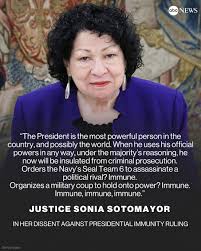
The recent immunity ruling for POTUS, handed down by an already immune SCOTUS has put this issue front of mind for me. The conservative majority pointed out that they were worried that if a President can be held accountable for official acts (or even adjacent acts), they will hesitate in critical moments. Personally, I think there’s a bigger risk from them not hesitating; many former leaders have committed acts they should not have, and have not been held accountable much. As Pres. Bush said “History will be my judge.”
It is often said that sunlight is the greatest disinfectant, meaning that exposing wrong-doing is vitally important to eliminating corruption. In Plato’s Republic, he talks about the Ring of Gyges, a special ring that renders its wearer invisible. As a result, the wearer of the ring can’t be held accountable for actions committed while wearing the ring. The scenario challenges the notion of intrinsic morality, questioning whether someone who has the opportunity to act without accountability will behave selfishly, unjustly, and in a corrupt manner. Guess what? They often do.
Immunity is a powerful drug that can lead to real problems, regardless who is immune from accountability, and it can lead to many bad outcomes, whether in government, corporations, or the church.
- Abuse of Power: Individuals may feel emboldened to misuse their power for personal gain, engage in corruption, and act above the law without fear of consequences.
- Erosion of Rule of Law: Legal immunity undermines the principle that everyone is equal under the law, leading to a breakdown of legal integrity and public trust in the justice system.
- Corruption and Impunity: Immunity can create a culture of impunity, where illegal activities go unchecked, leading to increased corruption and unethical behavior.
- Authoritarianism: Leaders who cannot be held accountable do not have to worry about what their constituents think or how they are affected. Their word is law, unchecked; questioning those in authority can be punished by expulsion from the group, either officially or culturally through social pressure.
- Public Distrust and Disillusionment: Immunity can lead to widespread disillusionment with leaders, decreasing engagement and fostering cynicism. Communities eventually erode as individuals choose not to participate.
- Stifling Opposition: Leaders with immunity may target and suppress their critics unfairly, creating unjust outcomes and stifling input on decision making.
- Weak Leaders: Immune leaders are weak leaders because eventually their decisions are prone to be driven by self-interest rather than the public good. Accountability is there to give them pause so that they do not destroy the community they seek to lead.
While a lack of accountability can occur in any organization, individuals who are granted powerful positions for life, as Church leaders are, are going to be particularly vulnerable to the effects of immunity.
- Do you see some of the bad outcomes of immunity in the Church? Do you see benefits to having immunity for leaders?
- Were you alarmed by the SCOTUS ruling? Why or why not?
- Do you believe that the second anointing guarantees exaltation? More importantly, do you think Church leaders, especially those who’ve received it, believe it? Or do you think they don’t really take it literally?
- What would you do if you wore the Ring of Gyges?
Discuss.
 Wheat & Tares
The idea and procedure of a second anointing is the epitome of arrogance
In the normal course of administering the law, prosecutors are sometimes vested with the power to grant immunity to a witness. The purpose is to procure testimony that will hopefully lead to the conviction of a person higher up the criminal chain, so to speak. Someone whose criminal action has and may again produce more harm than the person granted immunity. Most people understand this: it’s better to convict and punish a ringleader than one of the pawns.
Now I’ll grant that the context of presidential immunity is different than the immunity a prosecutor might grant. But notice how the common sense order is reversed under the majority’s opinion: for presidential wrongdoing executed, no doubt, by aides and officers subject to the president’s direction, we can still go after the pawns but not the ringleader. Rather than helping the president move forward with needed right actions, it certainly seems like this incentivizes presidents inclined to take iffy or simply wrongful actions to go ahead and do it. The whole thrust of the majority’s opinion seems misguided.
The biggest losers here are the president’s aides and those who serve in the Cabinet and the administration. They’ll be the ones left holding the bag. Maybe we need a Constitutional amendment to remove the presidential pardon power, so Trump can’t order underlings to commit crimes (for which he himself would now be immune from prosecution) then pardon his cronies if convicted.
As for any Mormon comparisons: accountability is a concept that is almost nowhere apparent in the LDS hierarchy.
The idea and procedure of a second anointing is the epitome of arrogance in my opinion. It is the opposite of what Jesus taught and showed by example, that being humility. I don’t know how anyone would even consider doing such a thing without feeling total embarrassment and mortification. On another note, I was in the Marriott Center when McConkie publicly chastised George Pace by reading a paragraph from Pace’s book and then pronouncing, “This is a bunch of Sectarian hogwash”. Years later, I was talking to a friend, and that memory came up and she asked me if I wanted to hear the rest of that story. Her parents were best friends with the Paces so George told them a few years after that mortifying experience had happened to him, he was asked by McConkie to come to his home as Bruce lay dying. McConkie then asked for George’s forgiveness for him, meaning Bruce, being so unkind and thoughtless. My thought was that was nice but would have been even nicer if Bruce had given the apology publicly. Anyway, fwiw.
A female friend of mine who works in the COB (in a fairly high position of daily connection with apostles) feels like the second anointing has led to a lot of complacency about church policy and procedure from admin folks. Like they think their salvation is assured, so whatever they decide is good, or more does not need to be done.
Since this isn’t a necessary ordinance for salvation that we do for the dead, and it feels very inequitable to the living (what if you don’t know someone to recommend you? what if your spouse isn’t active/a member?), the idea is off-putting/sad to me.
I can say with a high level of confidence that not all mission presidents get it. This is a Q-top-2-70s thing, and it’s also a friends-and-families-of thing (which at the highest quorums is the same thing). Unless your boss had family connections (entirely possible), I’d be surprised, actually. There are simply too many of them (mission presidents) and too little time at their training at the start of their missions. And after that, it can get haphazard and sometimes things have to coincide: visit of apostle to the mission coinciding with available temple coinciding with the time in the apostle’s schedule coinciding with a good word from the supervising 70. I’ve also heard that there are some Q-15 who perform the ritual more than others. Even that some of them don’t particularly like performing it, or perhaps they don’t like it, period.
Also, there was that one time, I heard somebody (somebody quite ballsy) ask Elder Hales point blank if his calling an election was made sure. “No,” he said simply. And then followed up with, “I can still sin badly. I could still lose it all.” And then he followed that with, “I don’t plan to.”
When I told this story in a BYU religion class—the professor was rhapsodizing about callings and elections and the supreme righteousness of our leaders and I thought it was gross— the professor (CES company man) was horrified, 1, that Elder Hales had been asked the question and then tried to tell me I hadn’t heard what I’d thought I’d heard, or that I just didn’t understand what it meant to have a calling and election made sure (wink wink second anointing).
If Elder Hales didn’t believe his second annointing gave him immunity, I certainly don’t. I’ll never, ever be offered it—but I would decline it if offered. It’s elitist nonsense designed to reinforce the idea of an old school aristocratic caste.
I think they mostly believe it. It is especially disgusting that they are giving it to celebrities and big contributors. It’s like the Pope in the middle ages, giving out indulgences.
I have heard of “making your calling and election sure” but never anything about this Second Anointing ritual.
The more I learn about the Mormon church the weirder it seems to be.
No wonder so much of the world things that the Mormon Church is not Christian.
Freaky stuff this ritual.
Too many conservatives support the idea of presidential immunity and too many liberals are against it because everyone seems to be looking at it in the context of Trump (for obvious reasons). But consider this: if Trump gets re-elected he’d have a harder time going after Biden post-election for acts that Biden engaged in during his presidency.
I guess my point is that we can all form an opinion on presidential immunity but we should look at it in terms of presidential power, not just “how does this help or hurt Trump”.
My own view is that this all comes down to how we define “official act”. If a president calls a governor of a “friendly” state and tries to get that governor to manipulate his state’s vote count, is that an official act? If a president asks his VP to engage in an unconstitutional act, is that an official act? If a president asks his own Justice Department to reject the results of an election from some states, is that an official act? Here’s one: if a president asks a White House to engage in certain activities that could be considered illegal (at least by most HR departments), is that an official act?
Regarding the potential exponential growth of second anointing recipients, I agree with Margie’s position that there are inherent limits on the rate at which they can be given. They may ask everyone for referrals, but may be quite limited in how soon they are able to follow up on them. I’ve wondered about mission and temple presidents particularly because I live near a small temple that’s been open for many years now, so I know multiple former presidents of our temple. It seems like if all of them had received it, the numbers might be quite large already and are of course set to grow a lot.
One of my (many) objections to the second anointing is that I believe it can reinforce in the mind of some church leaders a notion of their own infallibility, probably depending somewhat on personality type. I think Nelson in particular believes that whatever ideas pop into his head in the middle of the night are by definition the will of God for the church, by virtue of his position, and confirmed by having been told he has earned his exaltation. It’s the Wilford Woodruff Official Declaration 1 logic: I must be doing God’s will for the church because God hasn’t killed me yet.
I think the first emergence of “calling and election sure” thinking actually comes early in the restoration from the Book of Mormon, when Nephi is told by God that he’s so good that God can trust him with Godlike power. I imagine that’s how some apostles think about it. I also imagine they find questions about committing sin after having received the anointing troubling, and they avoid thinking about or discussing it. It’s part of the benefit of the public silence about it: not having to discuss all the implications.
To go with your government analogy, my assumptions about Nelson’s thinking are roughly equivalent to the remark once made by Nixon that “if the president does it, it’s legal”, which has now been largely confirmed by the court ruling. I don’t think all presidents of the US or of the church have thought this way, but some do. I think that kind of thinking in the mind of any head of any organization is toxic to good decision making. The second anointing should become a thing of the past if only for that reason.
correction: …a White House intern…
The idea of immunity for high office holders, be it POTUS or prophets, is disgusting. Accountability (to the law or to God) is a crucial check on power. People who have been granted some form of immunity from being held accountable for their actions, and truly believe in it, are usually people who have don’t have enough integrity to hold themselves accountable.
And I agree that the ordinance of the 2nd Anointing is also disgusting and elitist, and contradicts the gospel of Christ, which seeks to equalize God’s children. Just like early polygamy, it exists solely as a secret country club for the inner circle of high-status Mormons. Its power comes from its secrecy; most Mormons have never heard of it. To bring the practice to an end, we need to keep talking about it openly, drag it out into the daylight and force the leaders of the Church to explain themselves.
It is especially disgusting that they are giving it to celebrities and big contributors.
Is there a list out there that I am not aware of? Which celebrities? Which big contributors?
Dave B: Your point is very important as pertains to Presidential immunity, and I would just add that it’s effectively the same way it worked during the SEC scandals within the church. The leaders who made the decisions were immune (paid barely a hand-slap fine and then claimed “the matter is closed”) but in the meantime, the underlings who worked for the COB and refused to attest to documents dishonestly were simply fired and replaced with more compliant lackeys. I’m not saying the government went after the lackeys (although the decision makers were quick to claim they were acting on advice of lawyers). I’m saying that the honest lackeys were unjustly fired for having a conscience. That’s a consequence. Of course, similar things happened in Trump’s administration, too. When you refuse to execute an unethical command, you are fired for being disloyal, not praised for being honest. Honesty is not valued.
I am too egalitarian to really get what this second anointing stuff is all about. I hope I would have the good sense to go now a widow’s lawn if the offer ever came my way… Which it won’t.
*mow
Where is the 2nd anointing in the scriptures? In 132:18 it refers to being sealed up by the Holy Spirit of Promise and in 131 it refers to the more sure word of prophecy as a man knowing he is sealed up unto eternal life. In 130 it refers to the 2nd comforter as Christ personally comforting someone.
Ordinances have been clearly established as symbolic rituals. Baptism symbolizes our commitment to continually repent and follow Christ. It doesn’t actually equal becoming clean of sin but is only symbolic of such (according to Renlund). Confirmation symbolizes joining the followers of Christ and having the Spirit. Being confirmed doesn’t mean that magically happens, just our own commitment to make it happen in our lives. The sacrament is about being willing to always remember our commitment to Christ. The endowment is more commitment, but it seems to be mostly focused on committing to the church organization, but some would say it is further commitment to Christ. Sealing is about connecting that commitment to your spouse (and parents and children). Obviously, none of these amount to anything real unless you live the commitment, which is what I always have believed is necessary to be sealed up by the Holy Spirit of Promise.
So where does a 2nd anointing come in and what does it signify? I can see a value of symbolic rituals that are an opportunity to express our commitment to become better people doing better things. I can’t see the value of a ritual that symbolizes God’s commitment to you to save you regardless of your future actions based upon your past actions. That’s extremely transactional, and could be mistaken for a free ticket to do whatever you feel like (which it isn’t since it is still only a symbolic ritual and is not what it symbolizes). I do think such a ritual could confuse a leader and persuade them that they aren’t accountable for how they hurt others.
It seems problematic and very self serving in any case. Hmm… maybe it’s a way to retire a person from trying so hard to please God? If so, perhaps Elder Holland hasn’t yet received it…
My own deep dive into what the Second Anointing is began decades ago, in fact before I received my own endowment. Initially, there was little material available other than partial historical sources, but over the last couple of decades the subject has begun to emerge into the open much more, as any simple online search will show. To date, I feel that the church has not handled the subject very well at all.
To begin with, the Second Anointing is clearly mentioned in the very beginning of the Endowment that most of us are familiar with. We are told that if we are true and faithful that the blessings promised in the initiatory washing and anointing will eventually be realized. Most of us have heard this promise many times but it slides over most of us. Usually, we assume it refers to the future, to the next life etc. which, in fact, is true – most members will not receive it during their lifetime. But, as first given by Joseph Smith, and then under the direction of every president of the church since, it can be, and is, given to people in this life.
In our day, the Second Anointing is given with First Presidency approval to at least hundreds of members every year. General Authorities and Temple presidencies certainly, and others such as some mission presidents and patriarchs. RMN received his SA before being called as an apostle as recorded in his original autobiography. Today, the Q15 bestow the ordinance in any Temple, and it is also given on behalf of the dead, although apparently this is done only in the SL Temple. Up until the 1940s the SL Temple used to publish the numbers of SA’s for both living and dead performed in all the Temples.
Part of the reason the SA is kept so confidential is its unavoidable implications for the role – present and future – of women and their Priesthood role, something current church leadership is still grappling with. In the SA the husband is anointed a King and Priest, the wife anointed a Queen and Priestess, an actual realization and not a future promise.
Do we ordain women to Priesthood office? Absolutely. We have done so since 1843. This fact is best realized when we understand that it is the wife, not the husband, who performs the final part of the SA, the highest ordinance yet revealed to mortals. Husband and wife, King and Queen, Priest and Priestess – they are co-equal in authority. One is not above the other, just as our role models, our Heavenly Parents, are a perfectly balanced and aligned partnership. In this ordination, if nowhere else, we see that women DO hold the Melchizedek Priesthood.
Another aspect of the confidentiality is the simple logistics involved in administering the ordinance in a church of 17 million members.
Any person receiving their SA is ensured exaltation provided they do not commit the “unpardonable sin.” For transgressions such as adultery etc. normal church action is taken, as we have seen with the last two GA’s excommunicated, for example. The whistleblowers who received their SA and then left the church – Tom Phillips being the best known – are in that same category. The Phillips account of receiving, with his wife, their SA is accurate and conforms with everything else I can learn in historical accounts.
For the great majority of us, if we keep our covenants, at some point in the future we will also be judged worthy of exaltation and receive the same blessing, effectively receiving what some of our fellow members have already been given. Taking the long view, we can see Divine Justice still prevails, as it must.
neodan469, I disagree with you that after the 2nd Anointing a husband and wife are totally equal, because that contradicts what women are still told during the washing and anointing. So, it contradicts the first anointing. There women are told they will become a queen unto their husband and a priestess unto their husband. Not the “most high God” as men are priests to, but their husband. So, my husband becomes a god and I am a priestess unto him, while he is a priest unto the most high God. Big difference! Not equal!
Which is exactly why we cannot talk about it, is because it is far from equal and it means that women cannot be ordained to the same priesthood as men. Women cannot be ordained to any priesthood until their husband is declared a god. Women cannot be ordained to the priesthood of our Heavenly Father as men are because they get the priesthood of a lesser god when and only when their husband becomes a god, their lord. Look at who takes whom through the veil and you see who is the lord over women and who lord over men. It is SO nauseatingly unequal.
This was more clear in the past, when the relationship of God, men, women was a more clear hierarchy. But the church keeps working to obscure the fact so that women don’t leave the church is bigger numbers. Women used to make their covenants, not with God, but with their husbands. And now that many women are endowed long before they are married, it is obscured that the person at the veil addressed as “the lord” is the woman’s husband. The person standing proxy at the veil for men is standing proxy for God, but the person standing proxy for a woman is standing proxy for her husband. But we only hear the wording for the men, as the person standing proxy is standing in for The Lord. When I was first married, it was clear that my husband was to be my lord and I was to have his priesthood. Not God’s, but my husband’s. NOT EQUAL!
neodan469 has got right.
I like to think of King David’s two anointings as analogues to what initiates experience today. He was first anointed to become king–and later he was anointed as king. And it is in that space between the two where we are in a state of justification as we work out our salvation. And as long as we keep at it the day will come when we will receive the promise of eternal life–which is the more sure word of prophecy by the Holy Spirit of Promise.
Believe.
“neodan469 has got [it] right.”
@Jack, it seems like you’ve completely dodged the troubling issue from the OP. I think most readers of this blog are familiar enough with the endowment and second anointing ordinances to know that the former is anointing a person to become a king/queen while the latter actually does make one a king/queen (guarantees exaltation to people while they are still mortals unless the person commits the “unpardonable sin”). Furthermore, most Church members are comfortable with a perfect, omniscient God judging them after they die. However, what many members are uncomfortable with is having infallible human beings taking on the role of God and making these types of monumental judgements in this life. It is even more troubling to learn that these decisions are often made through a recommendation system whereby people who have received the second anointing are asked to recommend personal acquaintances that, in their opinion, are also “worthy” of receiving the ordinance. It sounds a lot like the way that exclusive invitation only country clubs operate. Some questions:
1. What is the purpose of guaranteeing exaltation to a person in this life?
2. Even if God might wish to do so, are fallible Church leaders capable of choosing the people who should receive this ordinance on a global scale?
3. If yes to #2, what about Tom Phillips, Hans Mattson, James Hamula, George Lee, etc. (including all the leaders who have committed serious sins after receiving the second anointing that we don’t know about)?
4. Does it make sense that only people that are married and whose spouse is still living may receive the ordinance (I guess that’s the case, anyway–I’m not sure how the ordinance could be done unless both were alive)?
5. Why not just leave judgment in God’s hand for everyone once we have died?
6. If someone truly is so special that they are incapable of sinning, why can’t God approach them directly as the Book of Mormon says He did with Nephi to let them know that they will be exalted instead of using what appears to be a quite dysfunctional elite country club nominating system?
7. Why is the ordinance not to be spoken of even amongst Church members? The Church could publicly acknowledge it–and they probably should since so many people do know about it these days, and staying silent just creates a lit of misinformation and distrust–while still limiting access to the “elite”.
Mountainclimber479, I have given your post a thumbs up for so clearly articulating the issues involved. My own post earlier grew so lengthy that I didn’t have room to explore many of these issues. Just a couple of comments:
#3 God knows the future of all of us, but that does not prevent people like Judas Iscariot, or Hitler, Putin or Latter-day leaders who apostatize from being called. We must have our agency.
#5 There IS a Final Judgement by God ahead for everyone, whether they receive their SA in this life, or by proxy, or not at all. No exceptions.
#6 God obviously could do what you suggest and has done. My thought is that regulating the ordinance via the church organization introduces a level of control so that we don’t have chaos with folk everywhere claiming that they received a personal visitation confirming their Calling and Election has been assured and claiming all kinds of things. That already happens to some extent as you know.
#7 I alluded already to the reality of administering such an ordinance in a worldwide church of 17 million members. The church structure is simply not adequate to handle more than they do. Years ago, I saw what happened when all the workers at a particular Temple learned that there was a “Second Endowment” (the terminology used in this case), a further blessing available that they had never been told about. A LOT of anger and frustration.
Our challenge is to work for change and growth – in very recent years, bringing Mother in Heaven somewhat out of her obscurity has been an encouraging example of how grassroots bottom-up “activism” has brought positive change, although much more is needed. After two centuries we have still yet to fully define who the “Godhead” [the object of our worship!] is and their roles, for example, much less many less consequential issues!
Eventually the church will catch up with the Gospel. The changes coming down the track are enormous.
100% agree with the OP that insulating leaders from accountability invites those leaders to act badly. The issue of leaders protecting themselves from accountability is pervasive and is not just a thing in religion and politics. Consider that Boeing recently accepted fault in actions that resulted in two of its planes crashing – resulting in several hundred dead passengers. There were deliberate, intentional decisions by Boeing management that lead to this outcome. But no executive is going to jail. No executive is facing a financial penalty. Rather, the “company” is paying a fine. If we wonder why corporations seem to act above the law it is because the executives are immune from the law. If they get away with illegality the executives personally profit. If the company gets caught the fine is a small pittance of corporate revenue and the executives pay no personal price.
As for the ordinance of the “Second Anointing” I believe it is a man made ritual. There is a divine acknowledgment of “immunity” spoken of in scripture. An example of this is in the Book of Helaman, chapter 10. Here the Lord communicates to the prophet Nephi that he can be trusted to have power over the earth because the Lord knows Nephi will not ask or do contrary to the will of the Lord. So Nephi is not actually immune from doing wrong, it is that the Lord knows that Nephi will not use God’s power improperly.
A key observation to make about this “anointing” is that this acknowledgement is directly from the Lord to Nephi. Why would it not be the same for each of us? Why would we need a church leader to make this acknowledgment? The insertion of church leaders into the process does invite corruption. Are decisions then being made according to the will of God or according to the fear of men? If a person is given the “Second Anointing” then the giver must become a defender of what the receiver does with this blessing. This leads to social pressure among leadership to justify sin and rationalize bad behavior.
In answer to neodan’s #7, why isn’t the 2nd A talked about? Well, because our current leaders want to be chummy with other Christian denominations and avoid the charge that Mormons are not Christian. And the practice is *not* Christian because it is human’s declaring another human to be a god. That is highly unchristian, blasphemy, and a bunch of other words that would HIGHLY offend other Christian religions. Is it any wonder at all that other Christians have movies blasting Mormons as “God Makers”. We are literally declaring each other gods! That is blasphemy in any other Christian religion.
Also, another subject the leaders don’t want members talking about: Mother in Heaven. If she is God and equal to Heavenly Father, well, that right there makes us polytheistic, pagans that we are. We have multiple Gods, in that we believe in God the Father, Jesus, and H.G. As three beings, separate beings. Then if we try and add in that all three, in order to be Gods have to be married, then we have at least six Gods. So, if Heavenly Mother is equal to Heavenly Father, then Mormons are polytheistic, multiple gods. We are, not just a peculiar people, but down right polytheistic. We are not Christian by their definition because the believe in so crazy idea that Jesus, Heavenly Father, and HG are all some mysterious way, one being with three people in it and if you say that the Trinity doesn’t make sense, they say that is the beauty and mystery of God. We think they are illogical and they think we are not Christian but don’t talk about any of that because we somehow want to convince them that we really are Christian without meeting their definition of Christian.
So, if there are multiple separate people in the God Head, and God’s wife is equal to him, and we can declare humans to be gods, then we are decidedly not Christian, but pagan heretics. Arrogant pagan heretics, who think some humans can judge in the place only Jesus can judge.
This whole conversation would horrify my sweet little old lady neighbor friends who go to Bible study, and introduce me to friends from Bible study group. If they knew I even participated in such a blasphemous discussion, they would never speak to me again. The whole idea of anointing a living human as a God is blasphemy.
P.S. and the SCOTUS declaring the president immune from prosecution for crimes is political blasphemy, it is decidedly undemocratic to have any one person above the law. That makes him (always a him) into some kind of king, elected once and then he can declare elections illegal and he is king for life, and all he has to do is sent a seal team after any political opposition, just like Putin has his enemies poisoned.
I would like to hear some examples of when a president hesitated or didn’t pursue a good action because he was afraid of prosecution. I would also like to hear some examples of frivolous and politically motivated prosecutions of past-presidents. If your answer is Donald Trump’s prosecutions but no others in more than 2 centuries, well, I think there might be a better explanation for these rare prosecutions of Trump. This immunity nonsense is a solution looking for a problem. Furthermore, it is a solution that, because the Constitution is completely silent about it, the Supreme Court has no business making up. You think it’s good policy? Great, run for congress and get a bill passed.
The second anointing also sounds like a solution looking for a problem. I see zero benefits to the existence of this ordinance and lots of problems with it.
I think this second anointing stuff is complete nonsense, at least in how we speak about the purpose of ritual (ordinances). I mean, what are the metrics used to receive the SA? It seems that it’s a personal merit-based reward, primarily indicated by rising to certain positions within the Church. What happened to “The Lord looketh upon the heart”? I’m not convinced in any sense that Russell M Nelson is more righteous or pure than my next-door neighbor or the Dalai Lam, Mother Teresa or my client that gives 10 hours a week serving the poor and needy. If the SA is a capstone validating purity, whether that be internally or externally, then why not administer the ordinance to newborn babies, they are as pure as they get.
When my oldest son got married (in the Payson temple), the sealer said something that shocked my ever-loving religious cynic. Although shocking, it actually was not surprising, nevertheless, it proved to me once again how backwards religion can get without people ever noticing a thing. He said to my son and his “to be” wife, “You guys have reached to end, the pinnacle”. As if the ordinance itself makes an “Eternal marriage”. All I could think is, good God, they aren’t even married yet, they have spent exactly zero minutes living in the same space, wrestling with the difficulty of life, actually trying to love each other when the going gets tough, and they were just told that because they are getting married in this special place, with this special authority, with these special words, that they have completed the final task needed for their exaltation. For me, it was a profound realization that our LDS church really does confuse ends with means. Ritual can be useful and powerful, but it is ONLY a means to an end, NOT an end unto itself. The legal act of the marriage ceremony is NOT a marriage, it guarantees absolutely nothing. The ceremony and ordinance is nothing more than a shared public moment, where we celebrate the possibility of this new union. The ordinance, like the beginning of any other journey into the unknown, is an expression of confidence and pronouncement of the promise and possibility this relationship holds, but the realization of a marriage, we call eternal, is created in the trenches and the bumpy ass roads of daily life, where we forge a bond that has the power to persist beyond death.
Salvation, exaltation, heaven, hell, etc. are not things granted in an instant, they are the results of participating in the really difficult work of creation and development. So, the SA, if it has any use at all, which is highly suspect to me, it would not be to pronounce a future reward that has not yet been created, but only an expression, first made in the abstract, of the possibility of creating something grand and heavenly. Furthermore, I recently heard someone say, “If you get to Heaven and you are alone, you aren’t in Heaven”. There is no sense where salvation or exaltation as an individual accomplishment makes any sense. Salvation or Exaltation, to me, is the construction of the type of relationality which constitutes heaven.
Religious ritual is NOT and end, only a means, therefore thinking of it as immunity is a logical fallacy. Clearly, being sealed in a Temple, does not make anyone immune to divorce so why would the SA be different? The problem is, the LDS church administers the ordinances as ends and not means. The fact is, a heavenly marriage may begin with a meaningful legal ceremony, where powerful words of possibility are spoken, but that is neither a guarantee or a requirement.
It’s probably no surprise that I’m not a fan of this whole second anointing thing, both as a supposed ordinance but also for the secrecy surrounding it. It feels like the stuff that Dan Brown writes novels about.
Has the church ever even defined what the unpardonable sin is? Is it just being disloyal to the institution like some of the folks mentioned in mountainclimber’s comment (whom I would never call serious sinners but YMMV)? Is it something like murder that would require blood atonement? Asking for a friend.
Back to the OP, I’m pretty exhausted by the lack of accountability in late stage capitalism. A Disciple calling out Boeing is a great example. While it can be exhilarating to watch congress eviscerate bad actors, there is no actual consequence. Disgraceful.
Interesting article on a certain type of immunity/impunity:
“As with the Goon attacks, few of the altercations resulted in prosecutions. Police said that witnesses wouldn’t coöperate, or that victims declined to press charges. Sometimes, when things got out of hand at the Taco Bell, employees called leaders from the Mormon Church instead of the police. According to Mike Sanchez, a former Gilbert police detective who investigated the Devil Dogs, the Church’s involvement gave the young men an “aura of invincibility.”
https://www.newyorker.com/magazine/2024/07/01/how-a-homegrown-teen-gang-punctured-the-image-of-an-upscale-community
neodan469, I’m very fascinated by this anecdote you mention about temple workers learning about a second endowment and getting upset about it. I’m kind of curious how they learned about it. The reaction you describe sounds about like what I’d expect, and it’s likely the primary reason it’s not discussed publicly by church leadership. It’s also a good reason to discontinue the practice. The church has enough public elitism already without the extra layers of secret elitism.
I personally learned about the existence of a “second endowment” (in those exact words) in the MTC from a fellow missionary who had heard of it and had asked his general authority father about it. Apparently his father acknowledged its existence but didn’t give him much more than that. Too sacred or somesuch, as one would expect. Anyway, it’s still amazing to me that the second anointing isn’t more widely known among members given how much public discussion about it there has been in the last decade since Tom Philips went public. I suppose that goes to show how good most members are at staying away from “unapproved” sources.
mountainclimber479,
I think the workings of the spirit render the decision making process far less arbitrary than it may look from the outside. Also, we should remember that participants always have the freedom to opt out.
As to the efficacy of the ordinance itself–my question is: if the apostles are not inspired then why should we believe that any of the ordinances are efficacious?
As to your point about sinlessness: I don’t think the second anointing necessarily aligns with sanctification. I do believe, however, that the ordinance aligns with the more sure word of prophecy even though we may still lack a degree or two of purification. It’s more a matter of momentum and trajectory–and receiving the second anointing serves as a way of strengthening us as we continue forward.
That said, the scriptures are clear that there is always a possibility that we may fall regardless of our station. And with respect to committing all kinds of sins without losing the promise–we have to remember that we’d still have to repent even if it means spending some time in hell (which is perfectly logical to me as one who is a near-universalist).
Finally, rather than viewing the second anointing as something that creates an elite class I see it as a manifestation of God’s generosity–in that he will not hold back his blessings from us when we are ready to receive them. I agree with Hugh Nibley–that there are more endowments to be received in the next life. And so all that we receive here, including the second anointing, is only a beginning to the process of growth that awaits us in the eternal world.
@Jack, I feel like you’ve kind of messed up your analogy with the anointings of David in your latest comment. You previously said David was anointed twice: he was first anointed to become king at some future date and then later he was actually anointed a king. The parallel with the first and second anointings is clear: the first anointing happens during the endowment ceremony that all temple endowed Church members are familiar with. Those who receive this endowment are anointed to become kings/queens (exaltation) if they fulfill the requirements presented in the endowment. In the second anointment, people are literally anointed kings/queens (i.e., they are guaranteed exaltation). It’s David’s second anointing that literally made him King of Israel, but it seems that you (and neodan) are saying that the second anointing ceremony in the temple is merely symbolic–unlike how David’s second anoiting literally made him a king, the second anointing in the temple doesn’t literally grant one exaltation (even though that’s literally the wording contained in the second anointing).
If that’s the case, my question is, what’s the point of the ceremony? I mean, everyone that receives the first anointing is promised that they can become kings/queens (exaltation) if they meet the requirements, so it seems like you’re saying the situation doesn’t actually change with the second anointing. Why symbolically anoint a person a second time and literally tell them they are a king/queen (exaltation) if they still have to meet the same requirements as people only singly anointed in order to actually become a king/queen (be exalted)? To be clear, the second anointing ceremony literally anoints a person as a king/queen, so I guess you are saying that what this really means is that these people merely have the potential to become a king/queen, but again, isn’t that the same situation as singly anointed people? Are you implying that the second anointing really just a special blessing, kind of like a patriarchal blessing, or a blessing of healing, but a blessing that, however special, cannot guarantee exaltation?
This explanation–that the second anointing is not the same as having one’s “calling and election made sure”–is also certainly not how many members understand the second anointing, so it’s not really clear to me whether you’re correct or not. In some ways, it feels like this explanation has been manufactured in order to allow a reasonable explanation for the well-known cases of apostasy and other serious sins that have occurred with those who have received the ordinance. The Church could remedy this by not being so secretive about the topic. Second anointings were common in the 1800s and were well-understood by the general membership of the Church at that time. Why the need for such secrecy in 2024 when the topic was much more openly discussed (and the ordinance was much more widely available to members) in the 1800s?
My understanding is that the second anointing became very uncommon and was nearly stopped for a certain number of years in the mid-1900s. I recall reading somewhere (and I’m not sure if I can find the source or how good of a source it is, so take this with a grain of salt) that many top Church leaders at the time had become uncomfortable with the second anointing (for reasons expressed here) and wished for it to be discontinued, and indeed the ordinance slowed down to the point where a number of the general authorities had not received it. However, later on there were some other Church leaders who felt that it was a good thing, so they jumpstarted the practice again. If this is how things happened, it feels to me like the leaders who wished to deprecate the second anointing had the right idea. After all, it’s not as if many weird temple things haven’t been abandoned already (sealings of adoption between two adult men, live polygamous sealings, endowment penalties, etc.), and as I’ve mentioned above, I’m having a hard time wrapping my head around the purpose of second anointings if they don’t actually accomplish anything that wasn’t accomplished in the first endowment (other than just a blessing???),
You seem to be implying from your comments that apostles use the Spirit and thus simply don’t err in selecting people to receive the second anointment. This is difficult to disprove, yet I do believe you are quite wrong. My main evidence is the string of mistakes that I lay at the feet of the apostles over the last two centuries (and I’ve provided you with many examples of these in past comments). If apostles made those mistakes, they could certainly err in who they selected to receive the second anointing.
The current process does indeed create an elite class of members rather than just showing God’s great generosity. There are thousands of rank and file members around the world who will never, ever, ever be considered for the second anointing using the current selection system who are probably more deserving that high ranking Church leaders, who are essentially the only people who can ever receive it. The current system appears to be that certain high callings (70?) are guaranteed a second anointing and then a recommendation system at the local level is employed because apparently the apostles who are the only ones who can perform the ceremony are, according to you, so in tune with the Spirit that they will never choose someone who shouldn’t receive it don’t have enough spiritual power to locate the deserving people at the local level on their own. I’ve met so many people in small branches and wards in corners of the world who will never be noticed by Church leadership, even local Church leadership who seem to me to be more deserving of exaltation than many Church leaders are. In particular, this system completely blocks single men or women from receiving the second anointing. Again, this process is messed up, and it does create an elite class within the Church that needs to be eliminated.
My opinion is that the second anointing either ought to be universally offered to everyone using a process similar to the way access to the first endowment is granted, or (preferably, in my opinion) the practice of the second anointing ought to simply be abandoned as it sounds like nearly happened in the mid-1900s.
mountainclimber479,
Actually, I do believe that the second anointing corresponds with having our calling and election made sure. Sorry if I wasn’t clear on that point. What I meant to convey was the idea that we need not be wholly sanctified to receive it–though my guess is that we’d be judged as clean through the merits of Christ.
As to the analogy of King David–I admit that analogies only go so far. But even so, I think one can be anointed king and still have a lot to learn about how to carry it off properly–much like a child who is installed as king who must rely on the wisdom of his courtiers until he is of age. My guess is that we’ll have a lot to learn in the next life–more than we can imagine in the here and now with our limited mortal understanding of things. And that our kingdom will grow in proportion to our personal growth in the things of eternity. And so being anointed as a ruler in the Lord’s kingdom doesn’t necessarily mean that we’re immediately prepared take on all of the weight and responsibility associated with ruling an entire cosmos. IMO, it means that we’re ready to begin–even if that means our beginning is no greater than our own house.
As to the rest of your comment–I think we’ll have to agree to disagree. I believe the apostles have the wherewithal to judge who should or should not receive such a blessing. And as one who is not likely to receive that blessing during mortality I have no problem with others receiving it. In fact, it gives me hope to know that such a blessing may be received in this life. To me, that reality means that God is near.
I think the second anointing was developed for an inner circle to make them feel extra special, but also extra guilty if they change perspective on the church. It might also make someone feel that they no longer need evidence to back their opinions or that they no longer have to treat people kindly if they don’t want to.
SCOTUS is corrupt and illegitimate. It has been taken over by bad faith justices who use the court as a vehicle to foist their ideological agendas onto the American public and to protect Trump from the justice system. Alito and Thomas are corrupt to the core. Gorsuch shouldn’t be there. It should have been Obama’s pick. Kavanaugh is a sexual abuser who has no business whose entire career as a lawyer and judge is illegitimate. Coney Barrett lacks qualifications and was illegitimately pushed through last minute. There are 13 circuit courts. Biden should pick 4 more justices to be on the court to have more justices to more fairly adjudicate the growing number of cases. Alito and Thomas should be removed for their lacks of ethics and their wives’ involvement in insurrection.
Brad D
I am curious why you believe the allegations against Kavanaugh. The claimant is unable to provide any substantive evidence – not the place, and not the time. The claimant names three people involved and all three deny a party involving the four teenagers ever occurred. That is three witnesses against one!
One of the persons named was Mark Judge. He has written extensively about the dishonestly of the allegation and the reporting on it. Why would you not believe his words? What inclines you to reject his witness but to believe the claimant?
By the way, I agree with you that the Supreme Court is inconsistent in following the Constitution. But the court is most definitely not “corrupt” and “illegitimate”. The justices on the court are each biased to view the balance of government authority and individual rights in their own way, with the majority of justices often deferring to the government, even if they disagree on which branch of government has authority.
The Murphy decision, written by Barrett, argued that the Executive Branch can coerce speech, or at least it can do this and not suffer any consequences and not be preempted from doing it. One would think the First Amendment was rather clear on the question – “Shall not abridge” is a simple, clear, declaration. What do you think of Barrett’s reasoning? Do you agree with it? Is she only wrong and unqualified when you disagree with her?
Or how about Jackson who agreed with the court majority that the government overcharged the J6 defendants. Is she a corrupt, unqualified judge?
”Public Distrust and Disillusionment: Immunity can lead to widespread disillusionment with leaders, decreasing engagement and fostering cynicism. Communities eventually erode as individuals choose not to participate.”
Granted, I read at sites like this one, but I’ve seen no one learning about the second anointing and expressing eagerness to be chosen. Most everyone, as is evidenced in this thread, is appalled and wants nothing to do with it. And, by extension, wants less to do with church leadership. And that “less to do with leadership” goes all the way back to the founder of this procedure. At least for me.
A Disciple: While I agree that the claim against Kavanaugh was not proven in a court of law (15 year old victim did not file a police report), the government didn’t really look into the claim as if it was taking it seriously because this is the guy FedSoc wanted who would overturn Roe, and that’s all that mattered. Do you also disbelieve Anita Hill’s claims against Thomas? Personally, I find both Blasey-Ford and Hill more credible than Kavanaugh and Thomas. I’m not sure either men committed an actual crime, punishable by law, but the incidents certainly reveal their male privilege and disregard for the impacts to women, which is exactly what their judgments from the bench reveal. Asking Kavanaugh’s drinking buddies for a character witness is like asking his co-conspirators. I don’t know if you’ve ever been to a high school drinking party in the 80s where Catholic school girls and frat boy antics were the norm, but if not, I respectfully submit that you don’t know what you are talking about. The claim she made was more plausible than the denials from where I’m sitting, and all he had to do was say “I am devastated if my adolescent actions made her feel unsafe. I can only say that I regret things I did as a teen, like many teens, and I was unaware of the negative impacts to other people. I don’t remember the incident, but I hope that she will accept my humble apology for how it affected her.” Instead we got that laughable whiny-crying “I love beer so sue me” defiant posturing as if not getting appointed to the SCOTUS was worse than barely escaping sexual assault at age 15. DARVO at its finest.
A Disciple, consider how the Supreme Court rushed with utmost speed to weigh in on a ruling by the Colorado Supreme Court that Trump was disqualified from the ballot because he was an insurrectionist. And then when they choose to weigh in on immunity, something completely unnecessary given how thoroughly the immunity argument was rejected by a DC circuit court, they sit on the issue until their term is up. And their ruling, presidents are immune from some actions if they are conducting official business. They delayed justice for Trump in the DC indictment. And justice delayed is justice denied. The Supreme Court has enabled Trump’s criminality. In so doing they are complicit in crimes.
Thomas has accepted millions of dollars worth of gifts from billionaire Harlan Crow. Much of this he failed to disclose. He is corrupt and should be impeached, and possibly charged with crimes.
Apparently many commenters did not read the opinion. Chief Justice Robert’s and Justice Barrett explained in detail how a president could be prosecuted for “unofficial acts”. Stop listening to liberal commentators who are acting like the world is coming to an end.
Limited immunity is baked into our system. Policemen have immunity, but there are limits. Federal employees, prosecutors, legislators all have immunity, though there are limits. Military physicians have it, too. Immunity is also important for checks and balances. gesmith60 makes a valid point. The Supreme Court decision did not say that Trump was immune, period.
Both state and federal trials can proceed after each trial court hears evidence and determines whether the conduct charged was official or unofficial. In our system, we would rather ten guilty men go free than one innocent man go to jail. Trump did not get due process because the trial courts, all of them, refused to hear his immunity defense to determine whether his actions were official and whether immunity applied. Why? The prosecutors were not seeking justice. They were seeking convictions before election day in November. I would rather see justice done right, even if it takes longer, than to see justice done on a political schedule for political reasons. All of the trials against Trump are alive, and the Supreme Court killed none of them. Each prosecutor must simply give the accused an opportunity to be heard, and each court must then rule on the immunity issue in that particular case. Trials can then continue. This is due process. Trump can still be convicted. The world is not ending.
Georgis, you must be following the Fascistic entertainment and
misinformation system to make such a factual mistake. Of course MAGAturds and facts diverged long ago. But who ya gonna believe, the good Fascists or your own lying eyes? Oh well, that cliche won’t work with RWAs since they can hold several contradictory views at the same time. (Biden has weaponized the Justice Dept! But when we gain power we are going to use the Justice Department go after our political enemies especially Hillary Clinton, who has personally murdered 50 people! The entire Justice system is rigged but
Hunter Biden was properly charged and convicted.The possession of firearms should not be controlled unless it’s someone that disagrees with the anti-democratic pro-cleptocratic Right, then convicting Hunter Biden is okay because rights are pie and we don’t want any one who disagrees with our Putin-loving White, albeit heavily made up to hide his pudgy pasty puss [ha! ha!], to have them, see The Heritage Foundation Project 2025.
Schitzinhizpantz lawyers raised immunity in his cases, hence the appeal. Duh.
Hence, the “we are not political hacks” originalist Supremes read the plain words of the Constitution as it was understood at the time to give the executive eg the king broad immunity for all official acts because heretofore US presidents have cowered in fear to use executive power. Now, the president does not have immunity to forgive student indebtedness or prevent the oligarchs from poisoning our air and water but he can prevent the peaceful transfer of power. and share our military secrets with random people. And here’s the best part, we the Supremes, when we’re not busy taking away rights of which we. disapprove, like women’s bodily autonomy, we are busy NOT DEFINING what constitutes an official act! heh heh heh
“Will no one rid me of this troublesome priest?”
varaj2, you prove my point, and thanks. Of course the Supreme Court did not decide what constitutes an official act in particular for the Trump cases. The Supreme Court does not like to decide questions of fact in the first instance, for they are a court of appeal. This is a job for the trial courts. The trial courts can look at exactly what each indictment charges, and while they all have some commonality they also have differences. Each trial can then determine, as it pertains to this defendant, was what he did an official or unofficial act. If unofficial, the trial can continue. If official, then the trial court determines whether he went too far. If yes, the trial can continue. This is due process, and it is a good thing, because due process protects all citizens, even bad ones. That is true for all constitutional protections. Illegal search and seizure protects the innocent as well as the guilty. Right to counsel protects both. Free speech protects both. Due process is no different, and when the Government cannot give due process, then the trial must end. We saw this just this week when the actor who killed that person on a movie set killed someone. The government acted improperly, and the defendant was set free–whether he was guilty or innocent! I think that you want Trump jailed, you don’t care what for, so long as it happens before election day, because this will encourage people to vote against him and will help Biden win. I am not for Trump’s reelection, and I want the criminal trials to proceed, but with due process. If they result in his conviction, so be it. If not, so be it. That is how our justice system works. Back on the actor case, I hope that the poor lady armorer, who has already been convicted, gets her conviction thrown out, because it seems like the same set of facts should have applied to her as they applied to the rich actor.
I know that people will hate me because I write here that Trump should get due process, and because I don’t call for his judicial lynching. I care less about Trump than I do about due process. We let murderers go free on due process grounds, and bank robbers, and even child molesters. I think that our system is strong enough to allow justice to run its course here, even if the trials are delayed with no convictions before election day. If we’re honest, a conviction before election day really is the goal, isn’t it?
Georgis, you missed the point. The immunity case was brought within the context of Trump’s attempts to rig the 2020 election by bring in a game slate of electors to basically overturn the will of the people in a number of swing states. The DC trial for Trump has been scheduled for March, but the Supreme Court has effectively used the calendar to ensure that Trump does not stand trial before the election. They had no business in hearing arguments on this frivolous issue. They should have acted with more immediacy and declared very clearly that presidents are not above the law. They’ve delayed justice for Trump and justice delayed is justice denied.
By holding the centrist tack, one easily gets duped by right wing lies. This seems to be a pattern. No one is above the law. Trump should have been tried long ago for these indictments and the Supreme Court has been complicit in allowing Trump crimes to go unpunished. We all know that creating a fake slate of electorsWe all know that if Trump gets elected, those trials won’t happen and justice.
This is reminiscent of a recent comment by news commentator Candace Owens who said to her audience that she told her husband that she was researching Flat Earth Theory and that her husband was becoming concerned. To reassure him that she was open-minded she told him (and her audience) that she was “not a flat earther and was not a round earther.” There are instances where one jumps the shark in the quest to appear open-minded. If you can’t acknowledge the basic fact that the Supreme Court made an underhanded attempt to deny justice for Trump, then you have a problem. If you can’t acknowledge the basic fact that Trump is a criminal and that the Republicans should, like the Democrats, be desperately pleading for the party to find someone else, then you have a problem.
Auto spell checked.
“by bringing in a fake slate of electors”
“had been scheduled for March”
“We all know that creating a fake slate of electors is not official business and is criminal”
“… and that justice will be denied for Trump.”
Georgis, Schitzinhizpantz did receive due process. I doubt you can provide a single instance where he did not receive due process. That statement does not mean that no errors were made. And though Schitz has a propensity for hiring incompetent lawyers so long as he likes their looks and kiss his favorite orifice, they pursued every possible appealable issue. Of course one could argue that because the guy with an ass bigger than an Atlantic City stripper was treated far more leniently that almost any other defendant he didn’t receive due process, as his treatment was “special”. I had a client who, outside the presence of the jury, yelled “this isn’t fair.” He was taken down by two bailiffs, put in court holding, and when the jury returned they were told that due to unforeseen circumstances, he wouldn’t be present for the rest of the afternoon. True, he was Black and poor so he was clearly in the wrong having been cursed with a skin of darkness…
P.S. The Nuremberg justices of this Supreme Court have found that actual innocence does not prohibit the execution of a defendant so long as s/he received due process. And apparently they almost always have…
“I am not for Trump’s reelection, and I want the criminal trials to proceed, but with due process.”
How has the process not already been due process? I’d really like to know.
BradD, you make my point. People want a trial and conviction before November’s elections. You wrote: “the Supreme Court has effectively used the calendar to ensure that Trump does not stand trial before the election.” That’s your chief concern: the political calendar. You want justice (and we agree there), but you want it on a political schedule for political motives. I think that the trials should take however long it takes to get it right. Expedited justice for political reasons is not justice. You write that the Supreme Court “had no business in hearing arguments on this frivolous issue. They should have acted with more immediacy and declared very clearly that presidents are not above the law.” Immunity is never a frivolous issue. It deserves to be heard seriously. If you were a policeman charged with a criminal act for something you did during performance of your duties, you would consider your immunity claim to be very serious. The Court did not rule that the President is above the law. Quite the contrary: this defendant can be tried, after the immunity issues are squarely dealt with.
Varaj2, you also make my point when you write: “I doubt you can provide a single instance where he did not receive due process. That statement does not mean that no errors were made.” In their haste, the lower courts gave an absolute no on the immunity question, instead of doing what they would have done for a policeman, which is examining the claim to see if the policeman’s acts were official or unofficial, and if official, was immunity rebutted by gross misconduct. The trial courts refused to give this defendant this procedural check on immunity, ruling that there is no immunity for a president, ever. The Supreme Court said this was error. Due process also requires, I think, that when errors are made (and you admit that some were made), the courts must pause to address the errors.
That is what the Supreme Court ruled in Trump: the president has (i) some absolute immunity on a very narrow set of allegations, (ii) a presumption of immunity on a wide range of official acts (but that presumption can be rebutted), and (iii) no immunity at all on unofficial acts. The Court returned the cases to the lower courts to determine which alleged acts are covered by (i) immunity, (ii) presumption of immunity (rebuttable), or (iii) no immunity at all. Criminal trials may then proceed on indicted offenses where immunity was rebutted and for unofficial acts (no immunity). This might not happen before the elections in November, but politics should not drive a court’s schedule. This is part of what we call the rule of law. When an election is certified and electors vote, we accept the results. When the Supreme Court rules, we accept the ruling. I support the rule of law, and supporting it in general means that I must also support it for Trump. And for Biden.
Back to the OP. Immunity for policemen does sometimes mean that policemen abuse their powers. Their immunity can be rebutted, but immunity plays an important role. Sometimes we need policemen and firemen to do very brave things quickly, almost reflexively, and immunity is intended to give them the space to make difficult calls. Fortunately, the presumption of immunity can be rebutted in egregious cases. Prosecutors can’t be charged for their charging decisions. Physicians in military hospitals can’t be sued for malpractice by their patients (at least that used to be true, though I know that some were trying to change that). Judges have immunity, unless that immunity is rebutted (by showing a bribe, for example, or clear favoritism). Diplomats get immunity under international law, even when they commit serious crimes, unless their home government removes the immunity. Some states give immunity to people who help injured people at accident sites, the good Samaritan immunity. Legislators get immunity from slander and libel for what they might say on the legislative floor. Prosecutors can give known criminals (including murderers and child molesters) immunity if they testify against others. Immunity is baked into our governmental system. Immunity is based on good intention, and it is a necessary grease in our government’s mechanisms. It can be abused. I’m not ready to throw out all immunity because of a few examples of abuse.
Do I see some of the bad outcomes of immunity in the Church? After defying President McKay and publishing Mormon Doctrine, Bruce McConkie might have been in trouble with the Brethren, but his father-in-law no doubt protected him, and Harold B Lee called him to the apostleship three months after his (McConkie’s) father-in-law died. He was effectively immune, and he proceeded with an authoritarian tone. For example, his immunity allowed him to teach a lot of reasons why Blacks should not receive the priesthood, reasons which some Q15 did not hold before 1978 and which the Church now rejects outright and altogether. His comments on the Catholic Church, and on Jews justly being persecuted throughout history, were also not challenged by his peers or superiors. While he is not representative, I think that some leaders might be tempted by their immunity to be authoritarian and callous, such as when BRM wrote to an LDS scholar in 1980: “It is my province to teach to the Church what the doctrine is. It is your province to echo what I say or to remain silent.” That generally isn’t how most people in the Q15 carry themselves, when they try to lead by gentleness, persuasion, kindness, and patience.
G, I didn’t make your point; you simply have poor reading comprehension. Please cite the cases in which any lower court held that Schmitz had no immunity ever and was also forbidden to appeal that ruling.
Georgis, you’re absolutely clueless and you’ve revealed yourself to be a bit very fairly-minded person. To suggest that Trump has not been treated with due process is delusional in the extreme. If Trump wins, there will be no justice for him. There will be no trial. He will not serve any sentence. The Supreme Court delayed the DC trial to the benefit of Trump. They know they did. Clarence Thomas’ wife has connections with the Jan. 6 insurrectionists. Alito’s wife is an insurrectionist sympathizer. If those two justices so much as want to share the same bed with them, they are to act on Trump’s behalf. Again, justice delayed is justice denied. Active efforts to unnecessarily delay the Trump trials are political acts.
How many of you are unhappy the shooter failed?
I may not like Trump but I don’t want him shot, poisoned, or hurt in anyway that would make him a martyr. I want to see people be able to see right from wrong, vote, and seeing Democracy work. Then I’d like to see justice, the law, and even mercy be applied to heal our nation. I’m happy the shooter failed and pray that both candidates are protected this election cycle.
An assassinated Trump is a martyr. A slightly wounded Trump from an assassination attempt is still a martyr although less of one. I don’t want Trump hurt or killed. I want him to face justice through the constitutional system we have. I want him to face defeat in a free and fair election. My guess based on very scant reporting and information is that the shooter was a psychologically troubled lone-wolf as most political assassins tend to be. He simply slipped through the cracks of the secret service and local police security barrier. Security is mostly a boring job and it is easy to get lazy. I’ll change my view in light of new evidence, though. I don’t believe any of the rhetoric that Democrats have used has called for violence against Trump. Democrats have bent over backwards to express their condemnation of the attempt and their well-wishes to Trump’s health. I echo the same. What I have been seeing, though, is a growing call for violence and retribution from Trump supporters. I strongly worry more violence and calls for violence will follow.
A group of boys in a treehouse scheming how to keep the girls and their cooties out.
A group of grown-ass men sitting in a basement debating which of them is the “one mighty and strong” as foretold by revelation.
A group of elderly suits initiating one another into a VIP godhood club because of their superior Righteousness.
Another group of elderly suits scheming how to overturn the will of the people and keep themselves in power.
They all need to get out of the treehouse and come back to reality. There’s chores to do. Where’s a stern parent when you need one?
Should the students who are prepared to study higher math be held back because others are still learning their arithmetic?
I don’t believe in Minority Report style executions. It’s a tragedy all around, and I’m glad he wasn’t more seriously hurt. He needs to lose at the ballot box, not be put in a box. And I’m extremely sad about the bystanders who were shot (one of whom was killed), and that a 20-year old whose brain is still not fully developed is now dead, having attempted this. What a country we live in. It’s appalling. All these political attacks are disgusting to me. So are the power grabs, corruption, and partisanship in places where it doesn’t belong like the judiciary.
The GOP claiming victimhood is absolutely ridiculous, IMO. I hope everyone takes the heat down, and that Trump and Project 2025 fail hard at the election.
On taking the heat down, I simply don’t find any evidence that polarization was what led to this assassination attempt. The assassin was a registered Republican, loved guns and gun culture, whom classmates described as conservative-ish, and hung out with schoolmates with MAGA hats, although he did donate $15 to Act Blue in 2021. There is no evidence that he was motivated by left-wing ideology or anything that Biden or any other Democrat said or did. At any given moment there are lone-wolf lunatics trying to assassinate presidents, presidential candidates, and other political figures regardless of how polarized or unpolarized the political climate is. This guy simply slipped through the cracks. And the Democrats will probably suffer for it, despite them having nothing at all to do with this. It is quite clear that Trump and other Republican leaders have no intention whatsoever in ratcheting down the rhetoric. They will continue promoting conspiracy theories and lies. Many of them, particularly the Trumpists, will continue to promote violence. I have no intention of softening my stance against Trump or discontinuing saying that he is a threat to democracy, a pathological liar, and a criminal who belongs behind bars. Because those are basic facts.
Can we remove the shackles just for a bit so I can sit here and downvote Jack over and over and over? It’s petty, but sometimes pettiness satisfies. You sometimes try to coax people back into the church, Jack, but I am reminded every time you post why I left, which makes me feel strangely indebted to you. I’ll have to try and work through that feeling.
I am travelling for work, BradD, so I have not seen all of the news coverage, but I did hear that the would-be-assassin contributed money to Biden or to a pro-Biden group. Maybe I misheard, but I am not sure that he was as Republican as you paint him. When I was in my 20s, everyone where I lived registered as a Democrat because all local elections were decided at the Democratic primary. People who voted for Reagan in November 1980 voted for sheriff in the Democratic primary a few months befire. Also, maybe we should quit throwing around the phrase threat to our democracy. Even Biden apologized today or yesterday for recently telling his supporters to put the target on Trump. I decry some of the language coming from camp Trump, but I am not so naïve as to think that everything from camp Biden is golden. I think extremists on both sides can decrease the rhetoric, and I encourage civility in our political discourse.
Correction: Pres. Biden said bullseye, not target.
jaredsbrother,
I’m far from perfect but I have a hope in Christ. And a wish that everyone might have that hope “that there might not be more sorrow upon all the face of the earth.”
Georgis, you and others are overreacting to Biden’s “bullseye” remark. Biden used a common metaphor that is mostly not understood to be a call for violence. That Biden said he shouldn’t have said that is further indication of the commitment of the Democrats to peace and order. Now contrast this with Trump in the following instances:
Between 2015 and 2020, ABC reporters found 54 cases of violence, threats, and assaults that invoked Trump as a reason. None were found that invoked Obama.
In 2017, Trump told police not to be too nice to suspects.
In 2018, Trump praised Greg Gianforte, then candidate for Montana governor, for bodyslamming a reporter.
In 2020, Trump boasts of having federal marshals hunt down and kill Michael Reinoehl, a left-wing protester who killed a right-wing counterprotestor who had bear spray in an act of possible self-defense. He said, “That’s the way it has to be. There has to be retribution.” Compare this with the treatment of Kyle Rittenhouse.
In 2020, Trump encouraged violent far right group the Proud Boys to “stand back and stand by.”
On Jan. 6, 2021, Trump encouraged a mob of protestors to storm the Capitol because he was unwilling to acknowledge clear defeat and have a peaceful transfer of power. Since then, he has riled to his supporters to feverish conspiracy theories and hatred on the basis of the Big Lie that he won the 2020 election.
According to Mark Esper in 2022, Trump asked about shooting protestors in the legs.
In 2023, Trump suggested that Mark Milley deserved execution.
Earlier this year, Trump promised a bloodbath if he was not elected in 2024.
Trump has harassed witnesses and jury members.
He tweeted an image of himself taking a baseball bat to Alvin Bragg’s head.
When Paul Pelosi was attacked by an assassin, Trump made inappropriate jokes about it at his rally.
Trump is a massive threat to democracy. He has shown that he does not believe in the peaceful transfer of power.
The idea that calls for violence are happening on both sides is a really bad comparison. If you want civility in discourse, demand that first and foremost of Trump and his followers.
Last night president Biden admitted that his comment about putting Trump in a “bulls-eye” was a mistake. In context, what Biden was saying at that private donor meeting was that Biden needed to go after Trump’s flaws and shortcomings. It was an attempt to shift the focus on from Biden’s incredibly poor showing in the debate to Trump’s lack of morals/character and his policy prescriptions for a 2nd term.
I see a lot of iconography in Republican’s use of guns, AR-15s, and really menacing rhetoric down here in southern Utah (Google the “Coexist” gun sticker- that’s a fun one I see a lot down here). In my view, I see a lot more subtle (and not so subtle) violent rhetoric being invoked by the Republicans vs the Democrats. But there is probably room for improvement across the board, so the suggestion to turn the temperature down is a good one and I’ll always look for ways to do that in my personal sphere of influence.
Corey Compertore as the firefighter killed at the rally. Here is a snipet of what his widow said when Biden reached out to her:
It’s of course the widow’s right not to speak to Biden. But I’m glad that he attempted to reach out (apparently Trump has not yet, but I’m sure he will). I’m also glad that Biden said it was a mistake to use the bulls-eye metaphor. I wish Trump would have apologized for his many, many violent rhetorical flourishes which lead to many deaths and injuries on J6. It is notable that he said he would “tone down” his convention speech, though this remains to be seen. I also wish that Elder Holland would have apologized for using “musket fire” in his 2021 BYU speech. The problem is that a lot of our language and metaphors (including in the scriptures) involves combat, war, battle, etc. Perhaps we need to shift away from violent verbiage and metaphorically bury our violent rhetoric like Anti-Nephi-Lehies did of their physical weapons of war.
Jacob L,
Unfortunately, all our language is riddled with military metaphor. It’s in our hymns and many talks. We refer to the “world” as an enemy we must “fight” against. To me this language is contrary to Jesus message. In New Testament times, they wanted a military leader to come save them. Jesus made it clear that wasn’t his purpose. Yet we still talk like it was and is, and we still look for an enemy to fight against.
After my friend spoke about fighting against the evil influences of the world one Mother’s Day, I asked her whose face she saw in her mind that she was fighting against? I asked her, “Are you picturing your transgender nephew when you say that?” I flustered her. She finally said she meant people that taught others not to believe in Christ.
To me that isn’t reasonable either. I don’t think Christ taught us to fight atheists or agnostics, or socialists or communists or capitalists or LGBTQ or liberals or feminists or MAGA or anyone at all. I believe we should indeed bury our violent rhetoric.
Should the students who are prepared to study higher math be held back because others are still learning their arithmetic?
This question isnt meant for us and should be posed to the church correlation committee.