
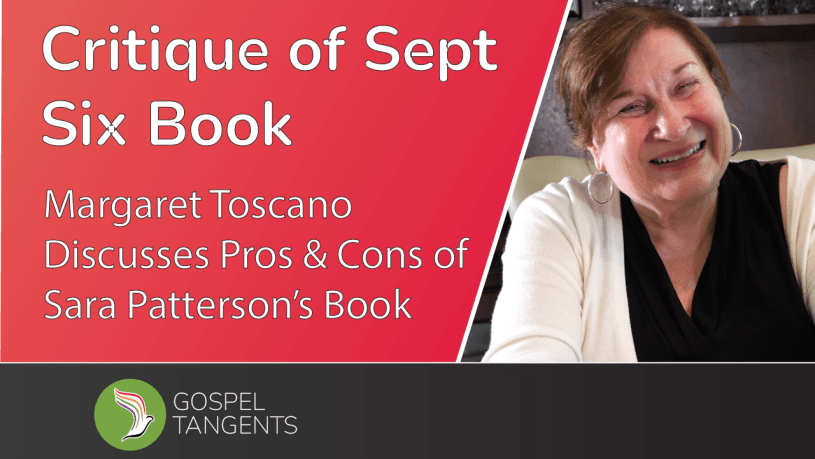
Dr Margaret Toscano gives a review of “The Sept 6 & the Struggle for the Soul of Mormonism by Dr Sara Patterson. We’ll learn what Margaret likes and doesn’t like about the book. Check out our conversation…
Margaret argues that Patterson underplays the significance of the 1993 Purge and its impact on members. Toscano discusses her experiences as a Mormon intellectual and feminist. Margaret’s first trouble was due to an article in the Daily Universe after speaking at BYU about feminist issues. She noted that apparently Boyd K Packer was a reader of the Daily Universe. Leaders cited problems because Margaret and her husband Paul challenged church leader’s authority on controversial topics. Elder Boyd K. Packer was identified as the person behind the investigation, and apostasy was defined as disobeying a church leader or speaking critically of the church in a public meeting.
Margaret noted in a previous Gospel Tangents interview that Sarah Patterson’s book’s purpose was to disrupt and upset the story of September 6. Margaret criticizes the book for not providing any other narrative or official story about September 6 and for lacking a clear chronology of events in 1993. Margaret believes Sarah intentionally organized the book in a way that makes it difficult to follow a narrative pattern.
Margaret liked the book for its focus on others like David Wright & Sonia Johnson, but she felt the book neglected important 1993 events. Margaret noted that Patterson could have started with Fawn Brodie or Juanita Brooks instead of David Wright, as they were also struggling for the soul of Mormonism. The September 6 events were significant in Mormon history, despite the book’s lack of focus on it. Patterson’s book made it sound like the individuals involved in Sept Six were not working together, but were part of a larger group of intellectuals connected to the Sunstone Mormon Women’s Forum.
Margaret knew Avraham Gileadi and disagreed with him on some topics but respected him as a scholar. Avraham challenged the authority structure of the church as a scholar, and his work has been used by various groups, including fundamentalists. Margaret and I discussed Boyd Packer’s targeting of Avraham. Margaret’s friendship with Lynne Whitesides and involvement in Mormon Women’s Forum are not mentioned in the book. Margaret Toscano critiques authoritarianism in the church, arguing for open communication instead of obedience.
Mormon Feminism History
Margaret and others discuss the limitations of a history of Mormon feminism. She discusses the exclusion of Laurel Thatcher Ulrich from BYU women’s conference, and looks back at Claudia Bushman and other women in Boston and Washington DC advocated for Mormon feminism in the 1970s and 80s. Lavinia Fielding Anderson and Linda King Newell tried to Nauvoo to reclaim women’s rights. Margaret and others organized Mormon Women’s Forum and sponsored priesthood debate at East High School in 1989. Margaret met Lynne Whitesides at Sunstone symposium and they started a book group. Margaret and others felt restricted by church’s stance on symposia, leading to counterpoint conference in 1993. She discussed the Mormon Alliance, a group formed to speak up for people’s rights and challenge authoritarianism in the church. Margaret and others rallied in support of BYU professors denied tenure, including Marti Bradley and Mike Quinn.
Margaret discussed church disciplinary councils & how they affecting the community. They held vigil and delivered white roses to Church Office Building in attempt to reconcile with church leaders.
Mormon feminism and the September 6 movement. The protest against church leadership’s handling of women’s issues gains international attention. Toscano discusses the debate within Mormon feminism over whether to work for small changes within the church or push for bigger changes, such as ordination for women.
Excommunication’s Impact on Progressive Movements
Margaret Toscano discusses the impact of excommunication on progressive movements within Mormonism, including feminism. The internet played a significant role in the resurgence of Mormon feminism, connecting individuals like Lisa Butterworth and Margaret Toscano. We discussed the history of Mormon feminism, including high-profile excommunications of feminist leaders. Examples include Sonia Johnson, Janice Allred, Gail Houston, Kate Kelly, and John Dehlin, among others. Margaret shares her insights on the church’s response to dissidents, including the Denver Snuffer movement and John Dehlin’s excommunication. Margaret believes the church’s actions are counterproductive and lead to polarization, rather than addressing issues in a more constructive way.
Challenges of Creating Change within the Church
We discussed the challenges faced by intellectual groups within the Mormon community, such as the lack of cohesion and the fear of association with controversial individuals. Margaret suggests that these groups could improve their impact by staying more united and not abandoning their causes. I asked if there’s anything intellectuals could do better to support these movements.
Margaret discusses recent uproar over Relief Society president’s statement on women’s empowerment. She mentioned Neylan McBaine and Jana Riese’s discuss challenges of making change within the church. We discussed ways to bring about change within the church, including the importance of both radical and quiet workers. I asked about Armand Mauss’s interview that the Church needed a quiet period to lift the priesthood ban on blacks. Does the feminist movement also need a quiet period for women’s priesthood? Margaret disagrees with Armand’s view on the ordination of African American men, believing that change will happen through openness and willingness to listen.
Margaret thinks the church will change on LGBTQ issues, starting with allowing same-sex marriage, as younger members are more open to it. She expressed concerns about the accuracy of Sara’s book in remembering and valuing the experiences of hundreds of people who went through the Mormon dissident movement. She also criticized Sara’s use of a “purity system” to frame Mormon dissidents, arguing that it devalues the experiences of those involved. Margaret argues that the church’s focus on purity obscures its authoritarianism and silencing of marginalized groups.
Margaret criticizes the book’s focus on “racial purity” and its downplaying of responsibility for authoritarianism and silencing. Margaret discusses the concept of “doctrinal purity” in the LDS Church, citing examples of members who were excommunicated for their beliefs. Margaret also questions the Church’s stance on the term “Mormon,” noting conflicting views from Hinckley and Nelson. Margaret argues that sexual purity is the one place where Patterson’s model works, and discusses LGBTQ issues.
Margaret shares her personal journey of leaving Mormonism while still identifying as Mormon. Margaret expresses pride in her work on Mormonism, including her work with Joseph Smith, women, priesthood, and temple. She feels her Mormon heritage is important, and she wants to help the Mormon community through scholarship and activism. Margaret discusses Paul’s personality and diverse writings, including books on theology, memoir, novels, and essays. Margaret and Paul want to be remembered for their contributions beyond the September 6 event, rather than simply as dissidents or a definition of who they are. She wants her husband Paul to be remembered as a significant Mormon intellectual writer, rather than just as a member of the September 6 group. Margaret respects and values Sarah’s work, despite their differences.
Relationships with Sept 6
Margaret discusses her relationships with members of the September 6 group, including Mike and Paul, and her involvement in Sunstone symposia. Margaret knew Lavainia Anderson for over a decade before they became close friends through Sunstone. Margaret has respected Maxine Hanks’s work on women in authority but they have not been close friends.
Evolution of Sunstone
We discussed the evolution of Sunstone over the decades, It used to focus more on scholarship, and now seems to focus on personal experiences with the church. There has been a loss of scholarship and diversity. Margaret expresses disappointment in the lack of scholarship and diverse perspectives at Sunstone. There has been a shift towards more fundamentalists and angry ex-Mormons. Margaret recalls meeting Eugene England at Sunstone in 1984 and the broader range of discourse that was possible at the conference in the past.
What are your perspectives on the September Six and Sunstone?
 Wheat & Tares
I think September 6 shows a lot more about the LDS Church and its use of the disciplinary system (church courts) to maintain orthodox boundaries than about any of the individuals who were targeted and exed. Specifically, after a brief period of softening under Pres. Hinckley, the Church is now back to hardening its boundaries and drawing the circle of orthodox belief and practice ever smaller. Ideologically and doctrinally, the Church is shrinking.
A separate but related question is whether this hardening of boundaries and shrinking of thinking is good or bad for the Church. Which requires defining what is good or bad for the Church, as opposed to good or bad for the members, individually or collectively. It might be good for the Church as an organization in narrow terms (one can’t argue with a $100 billion bank account) but bad for individual members who live inside the bubble of an increasingly insular church. The LDS Church is becoming richer financially while becoming impoverished intellectually and even morally. Individual members do not benefit at all from the enriched Church (it came from member’s pockets, so they are worse off) but, largely without realizing it, individual members suffer from the intellectual and moral decline of the Church.
It’s exactly opposite for me Dave B. There has been a wealth of knowledge added to our understanding of the restored gospel over the last 30 years or so. Latter-day Saint scholars have provided a veritable river of information and insights from pretty-much every discipline that overlaps with the study of the temple, the scriptures, and our history. Truly, knowledge is “pouring down” like never before.
Re: Moral Decline: I think that’s in the eye of the beholder. As I see it–the saints have never been more charitable (collectively speaking) than they are today. They’ve never given more to humanitarian efforts than they do today. The amount of service they provide in callings, missionary work, temple work, and welfare assignments is truly remarkable, IMO. And so, while our collective moral compass may need some adjustment betimes, there are a lot of good people in the church doing a lot of good with their time, talents, and resources.
Re: the September Six: It was inevitable, IMO. Just as Latter-day Saint scholarship was beginning to skyrocket the church had to make doubly sure to protect its boundaries against a veritable deluge of academic influence–especially when the world was on the brink of unleashing the internet.
I think Sept. 6 was the beginning of a new phase of retrenchment for the church when it showed that it was going to double down on its traditional teachings and punish those in the academy who promoted different ideas.
Jack, if the church has the truth, why should the leaders feel the need to “protect” it? Why not just defend its ideas on the marketplace of ideas? Why fire and excommunicate?
Brad D:
“Jack, if the church has the truth, why should the leaders feel the need to “protect” it? Why not just defend its ideas on the marketplace of ideas? Why fire and excommunicate?”
Those who were excommunicated still have the freedom to publish their ideas to the world. What they don’t have the right to do–as members–is publish destructive content about the church and its leaders without consequence to their standing in the church. The church has every right to establish and protect its ideological boundaries. And those who disagree with the placement of those boundaries are free to establish their own organization–one that better reflects their own religious values.
“The church has every right to establish and protect its ideological boundaries.”
Sure it does Jack, but sometimes they die on the wrong hill: priesthood ban, Michael Quinn’s work on polygamy that is now “the company line.” Clearly the brethren aren’t leading on history, they’re following, and they should leave people like Lester Bush and Michael Quinn alone instead of ostracizing and exing them. (I know Lester wasn’t exed, but he was pushed into inactivity.) History proves the scholars were right and the brethren were acting like the Catholic Church vs Galileo. Quit the knee-jerk reactions and forcing people out of the Church. It’s wrong and they’ll find that out at the judgment day. God bless Quinn and Bush.
And there was never a need for Bush and Quinn to start their own church, now that the church has adopted most of their conclusions. Quinn and Bush weren’t destructive critics. They were actually trailblazers that the brethren are now following.
My personal reaction to the Sept 6 was to go out and buy their books. I was still active and only had a bunch of doubts back then. But the church’s defensive attitude of angrily attacking rather than just letting truth speak for itself had been bothering me and I wanted to know what the leaders were so scared of. Any book that Boyd k Packer gets bent out of shape over is something I want to read, because I am a firm believer in the idea discussed in the previous W&T post about the need for opposition in all things and the value of constructive criticism. I think it is dangerous to silence those who offer constructive criticism. And it is pretty easy to tell wild conspiracy type criticism and hateful criticism from constructive criticism. So, I wanted to know the history the top leaders were hiding from members. And I wanted more information on what feminists thought about things like Heavenly Mother and why women are banned from priesthood. What I learned is that I am wise not to trust the church because they are hiding some real history because they are afraid it makes Joseph Smith look more like a conman than a prophet.
Rick B,
The brethren care first and foremost about getting people to live the gospel. And anything that gets in the way of that is suspect (to them) as it should be.
Michael Quinn’s work on polygamy may have opened doors to the study of the origins of polygamy in the church–but it came with a couple of pineapples lodged in his basket of eggs. Though he was good at digging up stuff he jumped to faulty conclusions that were, frankly, devastating to many members. Thankfully Brian Hales, Don Bradley, and others have been able to correct those misguided assumptions. But even so, Quinn’s interpretation of the data is continuously paraded about online as *the* historical narrative.
Lester Bush similarly pushed too hard. Like Quinn he opened doors to the study of the origin of the ban. Even so, pushing the new narrative opened the way for people to start throwing ten consecutive prophets under the bus. And even though there is now better scholarship on the ban than the was fifty years ago it is paraded about online as nothing more than a product of the ugliest kind of racism.
These two examples (and many others like them) have destroyed the faith of many members–many of whom had only budding testimonies. The brethren have their finger on the pulse of the church–they know better than anyone else how the saints are faring with regard to the maturity of their faith. And if they advise us to pull back a bit on the reins then that’s what we should do rather than cracking a whip.
Anna:
“I think it is dangerous to silence those who offer constructive criticism.”
None of them have ever been silenced. They’ve been free to continue to publish their work–as per John Dehlin. But what they can’t do is publish under the guise of faithful membership. That sort of supposed credibility can wreak havoc in the church–and prey upon the tender hearts and minds of the Lord’s little ones in the faith.
Jack, excommunicating those who offer constructive criticism may not silence those who first offered that criticism if their main concern is criticizing the church, but what about if their main concern is their standing before God. Excommunication certainly tells them “shut up or you are never getting your temple blessings restored. All of the September six wanted to stay in the church, and some of them have been rebaptized with blessings restored, and some have repeatedly asked for and been denied rebaptism, while others just decided that God knew their hearts even if the church doesn’t. So, it did silence most of them.
It also silenced those who might agree with them. Me for example. I totally agree with some of what got some of them excommunicated. But I can’t say it in any way that I could be recognized because my sealing to my husband is still very important to him and as long as he believes, I will not do or say anything that could get me excommunicated.
The nature of constructive criticism is that it wants to improve the church that those saying it care about. It is different than plain old criticism in that criticism is not given by people who like the church, but by enemies. So, the church kills friends by excommunicating constructive critics. They do not silence enemies, but they silence people who do not want to see the church shoot itself in the foot. But once the church silences them, they probably say, well church go right ahead and shoot yourself in the foot.
So, yes excommunication people does silence constructive criticism. Both from the person who voiced the criticism and all those who might dare to agree.
Jack, did Galileo destroy faith too?
I mean come on. You have a terrible take. Those were hills they chose to die on and have been definitely proven wrong in the Gospel Topics essays.
Anna,
I think we’ll have to agree to disagree on the nature of their criticism. To me it was more destructive than constructive–and just wrong in many instances.
Rick B,
I think Galileo serves as a better analogue to Joseph Smith–who revealed a new religious cosmology for which (revelation) he was ostracized. Quinn and the like are (to me) more similar to scholars who, while no doubt very talented, interpret their findings in a way that plants seeds of doubt with respect to the resurrection of Jesus.
Jack,
“Plant seeds of doubt”? Perhaps the evidence Quinn and others have used simply made you uncomfortable. Even the church’s own Gospel topics essays state that discomfort is not evidence that the scholars’ claims are untrue. They are likely true or at least truer than your current perspective. Those swelling motions in your mind are a sign your mind is growing, and that is a good thing.
Jack, when you’re in a hole, quit digging. Or are you trying to bury yourself?
I’m going beyond 3-ish comment limit–hope I don’t get in trouble.
Old Man,
It’s not merely the idea of planting seeds of doubt–it’s planting seeds of doubt about something as essential as the resurrection (as I state in my previous comment). Creating doubts about Joseph Smith’s role as the Lord’s prophet is similarly destructive.
The thing that troubles me about Quinn’s work is the harm that it’s caused others–it doesn’t trouble me personally. I know that there are better explanations than his vis-a-vis Joseph Smith’s polygamy.
Rick B,
It can get lonely down in the trenches.
I listened to Gospel Tangent’s podcasts interviewing Margaret Toscano’s reaction to Sara Patterson’s book. While I have always applauded Ms Toscano for her Mormon feminism, I thought she pulled a dirty trick in Sara Patterson. She critiqued the book heavily for not interviewing her as a primary source, but evidently couldn’t be bothered during an entire semester of teaching to respond to Patterson’s calls. And Patterson had a publisher’s deadline to churn out the book by the September anniversary. Margaret cited being “so busy” teaching 300 something students. Good grief, she’s been teaching for decades. You can’t tell me she doesn’t have a system, efficiencies, tenure, and hasn’t seen a cohort of students before. No, she submarines Patterson intentionally.
Toscano’s other frequent critique was that the book didn’t delve into the detail SHE would have preferred. Patterson didn’t interview the lists of dozens of Toscano’s personal friends and compatriots. It wasn’t a chronological multi-decade anthology, Patterson failed to read Toscano’s mind and write her perspectives on this subject or that. Patterson used former published quotes by Toscano that Toscano did not disavow, but Toscano nonetheless said she would have elaborated upon.
Rebuttal points to Toscano would include:
-Margaret frequently cited that Patterson was an outsider telling the story and needed more inside perspective. Well, guess what? You’ve all had 30 years to tell your stories, to give interviews (which you snubbed) and other people are telling your stories now. You had your chance to do so and other perspectives are valid, even if not your own.
sorry for the typos- my eyesight is poor.