
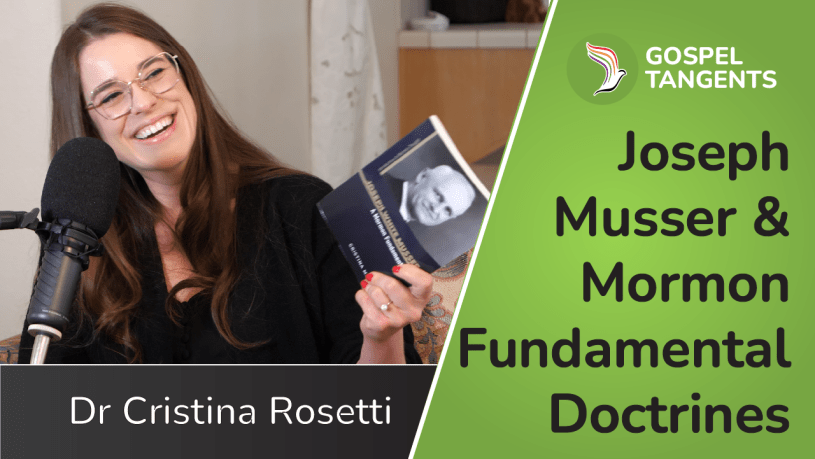
Dr. Cristina Rosettis is retirng from Mormon Studies at the young age of 34. Why? After studying Mormon fundamentalism, she’s ready to move on to other topics. But more importantly, she recently announced her engagement (and betrothal) to an Anglican priest in Quebec, Canada. So, she is retiring from her position at Utah Tech and moving to the great white North. We’ll definitely miss her.
But before she leaves, we’re discussing her new biography “Joseph Musser: A Mormon Fundamentalist.” We start out by discussing the origins of the movement and the role of John Taylor in fundamentalist circles. He died in hiding due to federal pressure on polygamy.
Mormon History and Kirtland Temple
In part 1, we discussed the history of fundamentalist Mormonism, and the recent Kirtland Temple sale. Rick mentioned attending a Q&A with the First Presidency and Presiding Bishopric of the Community of Christ and being surprised that they answered questions from the audience, including 2 from Rick. Cristina asked if the LDS Church would redevelop the Kirtland Temple in Ohio, and close it to the public like all other LDS Temples. While there are no guarantees, the LDS Church currently plans to keep it open to the public for at least 15 years and has no plans to change the purpose of the temple for community purposes. Cristina notes Kirtland Mormons had speaking in tongues, but it’s not a substantive part of the tradition now. Rick mentioned that speaking in tongues still happens among some groups such as the Bickertonite Church & Temple Lot Church.
Mormon Fundamentalism.
Cristina recounts that John Taylor’s 1886 revelation on polygamy is generally accepted as a legitimate revelation, especially in fundamentalist circles. Lorin Woolley seems to be the first to tell stories about John Taylor organizing a priesthood quorum outside the LDS Church to preserve polygamy. While fundamentalists generally accept this alleged story, historical records do not show that this quorum was organize until the 1920s. Because Lorin Woolley did not keep a journal, Joseph Musser became instrumental in documenting fundamentalists doctrines, especiall the idea of priesthood independence from the main Church.
Early Mormon fundamentalist movement and its leader Joseph Musser.
Following Lorin Woolley’s claims, he ordained his father, John Wickersham Wolley to the Council of Friends. This is the preisthood quorum that regulates polygamy outside the LDS Church following the 1890 Manifesto. These ordinations happened between 1921 and 1929. Joseph Musser was ordained an “apostle to the world” in 1929 and begain, publishing periodicals and pamphlets to spread the movement.
Joseph Musser is first confronted by the apostles about unauthorized polygamy in 1909. Musser complains that the apostles aren’t folloing the scriptures and said his stake president is supposed to hold a disciplinary hearing. The apostles agree, but Musser’s stake president is a good friend and polygamist and refuses to sanction Musser. Musser adds polygamist wives in 1902 and 1907, before he is finally excommunicated in 1909.
Mormon fundamentalism and polygamy in the early 20th century.
Following the 1890 and 1904 Manifestos, polygamist marriages were still taking place. In 1904, President Joseph F. Smith is hauled into Congress to discuss whether the LDS Church was still practicing polygamy. Smith had a pregnant plural wife at the time despite being president of the Church. This was the cause for him to issue the 2nd Manifesto, calling for an end to polygamist marriages. To prove he was serious, in 1906, apostles Matthias Cowley and John W. Taylor were dropped from the quorum of Twelve due to their roles in performing plural sealings. One was excommunicated and the other was disfelloshiped.
Mormon polygamy and excommunication in early 1900s.
Because Musser had received his 2nd anointing ordinance at the young age of 27, he wasn’t concerned about his 1921 excommunication. His diary entries reveal the mundane nature of the second manifesto and its impact on everyday life for early Mormon fundamentalists. He was rather indifferent in his diary, posting a news clipping from the Deseret News of his excommunication, and writing “normal day at the office.”
Mormon Fundamentalism and Heber J. Grant’s views.
Even thoughHeber J. Grant was a polygamist, he hated polygamy, and came down hard on polygamist marriages by issuing the 1933 3rd Manifesto. Fundamentalists see Grant as an apostate, and he is reviled more than Wilford Woodruff. Grant talks about polygamy in 1931 General Conference, saying it’s embarrassing and some people are maligning the church’s name. Grant is annoyed by rumors started by Loren Woolley that apostles were still practicing polygamy secretly, and came down hard on anyone continuing to sanction new plural marriages. Because he came down so hard, polygamist groups began to form in the 1930s. Cristina noted that fundamentalists oppos modernism, and modern LDS Church leaders opposed fundamentalism, thus creating a real division for the first time. Many more excommunications start under Grant, loyalty oaths are issued, and law enforcement crackdown begins. Cristina notes that women go to prison for polygamy (not just men), and many take it as a badge of honor to be persecuted for their religion.
What do you make of Grant’s crackdown? It is said his harsh crackdown created the fundamentalist movement as we know it today. Is it too little, too late, or should it have been done sooner?
 Wheat & Tares
I compiled and edited a collection of Joseph Musser’s sermons back in 2004 when I was a Mormon Fundamentalist, and although I don’t share those beliefs any more I still have some admiration and sympathy for Joseph Musser.
He was someone caught in between changes within the church and stayed faithful to the principles his church leaders told him to stay devoted to, even when they later did not. I’m convinced he was completely sincere, and believed the Woolley’ stories wholeheartedly.
I wonder if the church had taken a more honest approach to it’s past history and teachings when it made it’s changes then perhaps Mormon Fundamentalism would have had less followers, but maybe more members being aware of those teachings and that history would have had the opposite effect.
Cristina has added so much to the field and I know I will miss her contributions. Thank you!
I should say Dr. Rosetti. I have the deepest respect for her. Again thank you!
Great interview and important subject matter, but my word, please get a copy editor. At least run it through spell check.
Nathan Taylor, where did your beliefs wind up now?
Neo fundamentalism (Snuffer+co)?
“jpv – Nathan, where did your beliefs wind up now? Neo fundamentalism (Snuffer+co)?”
I’m a non-believer in anything supernatural now, but have still retained my wonder for the world and my love of people, and am living very happily in a much more secular setting these days. I’m glad Cristina has been able to use my research, but I have been glad to put this part of my life behind me.